Friday, January 07, 2005


Another non-denial denial

Alberto Gonzales, Bush's nominee for Attorney-General, on whether he supports torture:

"I am deeply committed to ensuring that the US government complies with all its legal obligations... [including] of course the Geneva Conventions whenever they apply."

Note the hedges - "legal obligations", "whenever they apply". Coming from a man who has argued that anything which does not cause "death, organ failure, or serious impairment of body functions" is not torture and is therefore not illegal [PDF - large], and who is on record as saying that the Geneva Conventions don't apply to suspected terrorists [PDF - large], this isn't actually a denial at all. Instead, he's saying that he is "deeply committed to ensuring that the US government continues to do exactly what it is doing for as long as it wants to". Given that what it is doing has been described by the Red Cross as "tantamount to torture", and in some cases is taken straight from the Spanish Inquisition, I think it can be said that Gonzales continues to support torture. But for some reason, the media dares not say so.

Thursday, January 06, 2005


For who?

Helen Clark is apparantly considering a national day of mourning to commemorate the New Zealnd victims of last week's tsunami. All three (so far) of them.

OK, so that's a little cruel. There are almost 800 kiwis unaccounted for, and if even fifty of them are dead, it will be a tremendous disaster in such a small country as ours. But at the same time I can't help but feel that Clark is missing the larger picture. Over 150,000 people have died in this disaster. Shouldn't we spare a thought for them too?

Sadly familiar

The Independent has a report today on the "evidence" used by British intelligence services to justify the (unlawful, according the Britain's highest court) imprisonment without trial of twelve suspected terrorists. The men have spent up to three years in jail (mostly in solitary confinement) in the basis of information which has later been admitted to be "flawed and innaccurate". For example,

  • A security service assessment was embarrassingly withdrawn after it emerged that the purpose behind a visit to Dorset by a group of Muslim men had not been to elect a terrorist leader but to get away from their wives for the weekend.
  • Confirmation that the Government is using evidence of association with the Guantanamo detainee Moazzam Begg to hold at least two of the foreign terror suspects under its emergency powers.
  • False allegations made against one of the Algerian detainees in relation to his association with Mr Begg arose from an MI5 surveillance operation of Mr Begg's Islamic bookshop in Birmingham in 2000. MI5 wrongly claimed that weapons had been found there.
  • The Home Secretary has been forced to concede that some of the funds raised by the detainee Abu Rideh for alleged terrorist activity were sent to orphanages in Afghanistan run by a Canadian priest.
  • Testimony against two of the detainees came from an affidavit sworn by a man who was offered a lenient sentence in return for evidence.

And the list goes on...

If this seems sadly familiar, it's because our own Security Intelligence Service has applied the same low standard in the Ahmed Zaoui case. "Evidence" against Zaoui has included "unsourced extracts from various news reports with no attempt to excise opinion from fact", material sourced from the website of American conspiracy theorist Lyndon LaRouche, a poorly shot home video taken by him in Malaysia and Vietnam, and a videotaped interview which was mysteriously "lost", then found again... except for the part they claim is actually incriminating, where we'll just have to take their word about what was said.

The lesson from this is that spies the world over seem to either be remarkably paranoid, willing to believe anything "just in case" - or remarkably gulliable. They also seem to have a nasty habit of interpreting all information so as to support their desired conclusion, no matter how innocuous - and if they don't have any such information, they seem more than willing to simply make it up. This is simply unacceptable when people's rights are on the line. Western democracies did not fight long and hard to eliminate the arbitrary power of kings, only to replace it with the arbitrary power of spies.

Depriving someone of their freedom is the sort of thing which requires actual evidence. if our intelligence services are unwilling - or unable - to provide this, then they should be told to go away and come back when they have something which passes the laugh test. It's that simple.

Outnumbered and in denial

An Iraqi general estimates that there are now 200,000 insurgents in Iraq. Meanwhile the US - which along with its allies has only 150,000 troops - seems to be in denial, continuing to talk of a small number (originally 5000, now 20000) of "foreign fighters" rather than admit that they're facing a grassroots, popular rebellion with widespread public support.

But I guess Bush just doesn't want to hear the true scale of the problem...

A billion dollars for Indonesia

Looks like I was wrong about the size of Australia's increase - rather than a mere half billion Australian dollars, they've upped it to a cool billion (US$764 million), targetted specifically at rebuilding shattered parts of Indonesia. Germany meanwhile has increased theirs to US$674 million. Kindof puts the US to shame, doesn't it?

(Yes, Americans, I am trying to make you feel competitive. That's what pissing contests are all about)

Wednesday, January 05, 2005


Putting Rush's outrage in perspective

A GDP-based analysis of tsunami contributions also shows the lie behind a particularly odious meme doing the rounds among the right-wing blogs - that of the "stinginess" of the Muslim world:

Top radio talker Rush Limbaugh stepped into the breach on Tuesday, detailing for his audience the relatively stingy response from brother nations.
  • Saudi Arabia - $10 million. "That's like an afternoon shopping spree in Paris for a member of the Saudi royal family," noted Limbaugh.
  • Iran pledged a puny $627,000 - a small fraction of what they're spending on their nuclear weapons program.
  • Wildly wealthy Qatar - just $10 million of their petrodollars.
  • The United Arab Emirates - $2.6 million.
  • Kuwait - $2 million.
  • Libya - $2 million.
  • Turkey - $1.25 million.

Compare that to the $350 million in government aid pledged by the Great Satan (America), not to mention hundreds of millions more from private U.S. donors.

What's wrong with this? Firstly, it groups two very different classes of nations together - the rich Arab world (Qatar, Kuwait and the UAE, with per-capita GDPs comparable to those of poorer European nations, though with vastly more unequal distributions of wealth), and a group of poorer states - Iran, Turkey, Libya - with per-capita GDPs in the region of US$6000 - US$7000 (with Saudi Arabia falling somewhere between the two). Attacking the latter for making only token contributions is akin to demanding that the homeless throw their pocket-change into the collection-jar - praiseworthy (though possibly foolish) when it happens, but nowhere near a moral requirement. But how do the former's contributions compare with that of the US? The table below is illuminating, to say the least:

CountryAid
(US$ millions)
GDP
(US$ billions)
% of GDP
Kuwait10041.460.2412
Qatar2517.540.1425
UAE2057.70.0347
Saudi Arabia302880.01042
USA350108800.00322

Every single "rich" Arab nation is giving more as a proportion of GDP than the US - and Qatar is the world's top giver by this measure. Rather puts Rush's outrage in perspective, doesn't it?

(Thanks to The Swanker for the preliminary analysis, though I've used my own figures in the above, as drawn from BBC and Wikipedia)

Update (07/01/05): Updated with these figures from the BBC. Rush's case looks even worse, doesn't it?

Update 2 (14/01/05): Updated Kuwait from a Reuters article in the Domion-Post.

Other measures

What's the best way of measuring contributions to the asian tsunami? The easiest one is in absolute terms, comparing dollar figures. On this measure, Japan is the most generous, followed by the US and then Norway - though this is expected to change tomorrow, with Germany taking the top spot and Australia - a country with less than a tenth of America's population - pushing the US into fourth place. An alternative method which gives a better idea of generosity is to correct for population, giving dollars per capita. A table of how the various donors stack up on this measure can be found here, and it is less than flattering to some nations that like to think of themselves as generous (including New Zealand). A third method is to compare donations by donor government's ability to pay, as measured by GDP. In response to a request from NZ Political Comments I was planning to do a quick table of this using the figures from Wikipedia, but their GDP figures look a little dubious (especially for NZ). Fortunately, an anonymous commenter has saved me the effort of researching better ones and effectively done it for me. So here's the comparison, using their figures for GDP, and updated with the latest figures for donations:

CountryAid
(US$ millions)
GDP
(US$ billions)
% of GDP
Kuwait10041.460.2412
Qatar2517.540.1425
Australia7645710.1338
Norway1821720.1058
NZ47.6850.0560
Denmark751670.0449
Sweden802380.0336
Germany67422710.0297
Austria66.162450.0270
Finland301420.0211
UK24216660.0145
Japan50035820.0140
Ireland13.51160.0116
Saudi Arabia302880.0104
Switzerland23.82390.00996
Canada959590.00991
Taiwan50.25528.60.00951
Netherlands364610.00781
Spain688860.00767
Italy9515500.00613
Portugal111820.00604
South Korea508580.00583
Belgium16.32299.10.00546
France6616610.00397
USA350108800.00322

(South Korea's GDP figure from the CIA World Factbook)

As for usefulness, there's obviously a strong correlation between this and the per-capita rankings, which you'd expect, as richer countries can obviously give more per head. The real difference is in the bottom of the table, where the US drops about four places because, frankly, it can afford to give more.

Update (06/01/05): Updated Germany and Australia.

Update 2 (07/01/05): Updated Saudi Arabia.

Update 3 (15/01/05): Added Kuwait, Taiwan and Belgium, and updated Austria. Unfortunately the "one China" policy corrupts even the CIA factbook, so Taiwan's GDP figure (source here) may not be entirely comparable.

Update 4 (18/01/05): Updated New Zealand's contribution.

Forcing Labour's hand

United Future's draconian and barbaric "justice" policy and their expectation that it will be a starting point for future coalition negotiations should drive home the dangers of allowing them to influence policy after the next election. But what can left-wing voters who care about human rights (and want policy grounded in reality rather than fantasy) do about it?

One tactic is simply to tell them: make it clear to Labour that we want them to go left rather than right. But if that fails, we must be prepared to force Labour's hand. And the best way of doing this is to vote for one of the smaller left wing parties.

Current polling suggests a repeat of the 2002 scenario, with Labour having two or three partners with which it can form a government. Voting for the Greens or the Progressive Coalition instead of Labour will not alter the left's overall share of the vote or its chances of forming a government - but it will alter how power is distributed within that government, and may (depending on the relative strengths of the various parties) make a left coalition the only real option. In the 2002 election, a swing of just 1% away from Labour and towards the Greens would have cut United Future out of the running and prevented them from having any influence on policy, without adversely affecting the total voting strength of the eventual coalition. With United Future flexing its fundamentalist muscles, that seems worth aiming for, neh?

Taking Bush and Blair seriously

Writing in the Guardian, George Monbiot performs the usual exercise of comparing America and Britain's contributions to helping victims of the tsunami with the costs of murdering people in Iraq. But he does it with an unusual twist: he takes them seriously for an instant and accepts (for the sake of argument)

...that the invasion and occupation of Iraq had nothing to do with power, domestic politics or oil, but were, in fact, components of a monumental aid programme. And let us, with reckless generosity, assume that more people in Iraq have gained as a result of this aid programme than lost.

To justify the war, even under these wildly unsafe assumptions, George Bush and Tony Blair would have to show that the money they spent was a cost-efficient means of relieving human suffering. As it was sufficient to have made a measurable improvement in the lives of all the 2.8 billion people living in absolute poverty, and as there are only 25 million people in Iraq, this is simply not possible. Even if you ignore every other issue - such as the trifling matter of mass killing - the opportunity costs of the Iraq war categorise it as a humanitarian disaster.

In other words, such vast sums of money - US$225 million a day for the US, and slightly under a tenth of that for the UK - could have been far better spent elsewhere. Assuming, that is, that Bush and Blair were actually sincere in their claims to have been motivated by humanitarianism - which they were not.

Tuesday, January 04, 2005


That's more like it

It's good to see that our government has doubled its tsunami aid contribution to NZ$10 million (US$7 million). I've adjusted the table accordingly.

Draconian and barbaric

That is the only way to describe United Future's proposed "law and order" policy. Though alternatively, it could be called a wishlist for the "hang 'em high" brigade. The policy includes

  • abolishing distinctions between different classes of drugs;
  • making drug dealers accomplices to the crimes of their customers;
  • specialist drug courts (the implication being different rules of procedure and lower standards of evidence);
  • scrapping concurrent sentencing;
  • mandatory life imprisonment for "heinous" crimes;
  • mandatory prison terms for repeat drug offenders;
  • allowing victims to appeal parole board decisions;
  • lowering the age of criminal responsibility to 12;
  • "voluntary chemical castration for sex offenders as a pre-condition of parole".

According to Marc Alexander, these moves are justified because otherwise "we'll keep building prisons." Which is a rather curious justification, given that the effect of the dramatically increased sentences and mandatory life imprisonment proposed will be more people in jail. Our prison system is already struggling due to the imposition of longer sentences - yet Alexander thinks that making them even longer will result in us building fewer jails? Crazy.

"Dealer liability" - or rather its target - is also curious. Sure, methamphetamine has been implicated in a couple of high-profile murders in the past few years - but alcohol contributed to 141 deaths and 555 serious injuries in 2003 through drink-driving alone. Overall, it is implicated in 60% of all incidents reported to police, 77% of street disorder and fighting offences, and 40% of serious assaults. By any sensible measure, Alexander is after the wrong dealers.

Further lowering the age of criminal responsibility means putting more children in prison. It's not just barbaric, it effectively writes people off for the rest of their lives. But the worst idea is chemical castration. Quite apart from the Orwellian phrasing of "voluntary... as a pre-condition of parole" (which implies that people who "choose" to hand over their wallets to muggers do so "voluntarily... as a condition of not being beaten"), this is simply a monstrous violation of human rights that treats people like animals, based on the crude belief that the root cause of sexual offending is nothing more than an over-active sex-drive. It's a simple solution for simple minds, whose aim is more to humiliate than cure - which in fact describes United Future's crime policies to a T. They are not interested in actually solving the problem, only in showing how vicious they can be. Unfortunately, that's par for the course from our politicians, and no doubt National, NZFirst, ACT and Phil Goff will all try to outbid United Future by being even more savage.

The problem with this bidding war is that it is predicated on a lie. The "need" for tougher sentences and harsher penalties is driven by the belief that crime is "out of control" and that nothing is being done about it. This is nothing more than dishonest fearmongering. Our crime statistics show that even in the middle of a P-epidemic crime rates have dropped, while clearance rates - the number of crimes solved by police - have increased. But what has increased is the reporting of crime in the media - which has led to (to quote a Ministry of Justice report) "an inaccurate and negative view of crime statistics". It has also led to policies which target this created media fantasy, rather than reality - which cannot be good in the long-term.

But perhaps what's most offensive is that all this viciousness won't work. A 1997 report into predicting trends in crime rates found that severity of punishment had "no significant deterrent effect", and that

No relationship was found between the changes in the number of prison inmates and recorded crime rates. The size of the prison population was not significant in any model... the size of the prison population does not significantly reduce the number of potential offenders

In other words, having harsher sentences in order to "keep criminals off the streets" doesn't reduce crime one iota. But it does allow politicians to gain votes by playing to the public's thirst for vengeance. I guess that's what's really important in criminal justice policy.

"Kind of a shame"

Why have things gone wrong in Iraq? Why hasn't it turned into the democratic paradise promised by the NeoCons before their illegal invasion? The Americans like to blame the resistance, but perhaps some of the answers can be found in an article in this week's Economist, excerpted and commented on by James Wolcott:

"There is only one traffic law in Ramadi these days: when Americans approach, Iraqis scatter. Horns blaring, brakes screaming, the midday traffic skids to the side of the road as a line of Humvee jeeps ferrying American marines rolls the wrong way up the main street. Every vehicle, that is, except one beat-up old taxi. Its elderly driver, flapping his outstretched hands, seems, amazingly, to be trying to turn the convoy back. Gun turrets swivel and lock on to him, as a hefty marine sargeant leaps into the road, levels an assault rifle at his turbanned head, and screams: 'Back this bitch up, motherfucker!'

"The old man should have read the bilingual notices that American soldiers tack to their rear bumpers in Iraq: 'Keep 50m or deadly force will be applied.' In Ramadi, the capital of central Anbar province, where 17 suicide-bombs struck American forces during the month-long Muslim fast of Ramadan in the autumn, the marines are jumpy. Sometimes, they say, they fire on vehicles encroaching with 30 metres, sometimes they fire at 20 metres: 'If anyone gets too close to us we fucking waste them,' says a bullish lieutenant. 'It's kind of a shame, because it means we've killed a lot of innocent people.'"

Kind of a shame, killing the people you're trying to democratize, but after awhile, says the same lieutenant, "It gets to the point where you can't wait to see guys with guns, so you start shooting everybody..."

With characteristic dry English understatement, The Economist's embedded reporter (Economist pieces are unbylined) notes, "[W]hen America's well-drilled and well-fed fighters attempt subtler tasks than killing people, problems arise." Their contempt for Iraqis is undisguised and dramatically expressed: a soldier, confronted by "jeering schoolchildren," fires canisters of buckshot from his grenade-launcher at them, and marines busting down doors in Ramadi scream at trembling middle-aged women: "Bitch, where's the guns?" Small wonder, ventures the correspondent, that "many Iraqis are probably more scared of American troops than of insurgents."

And they wonder why Iraqis hate them...

New Fisk

The Ghosts of Vietnam

Asset forfeiture: the dangers of settlements

In my previous post in this series I raised questions about the government's motives for introducing civil asset-forfeiture. An unhealthy emphasis on revenue led to settlements playing a key role in the system - despite the fact that this would likely reduce its impact on crime. But that isn't the only reason we should be wary of allowing settlements. In particular, there are two key problems which should cause deep unease.

The first is obvious: the same logic which leads suspected criminals to settle with the government also applies to those innocent of any crime whatsoever. Whether a case should be settled is essentially a matter of weighing up the cost of settlement against the expected losses (including the costs of defence) - guilt or innocence has very little to do with it. The same logic applies in criminal cases, but there at least the government must meet the high standard of proof beyond a reasonable doubt, and this discourages it from taking cases where the evidence is questionable. The proposed asset forfeiture regime does not have this safeguard. Instead, the crown must meet a much lower standard of proof - the civil standard of a "balance of probabilities" - and all they have to prove is that the defendant has engaged in criminal activity in the last seven years. Once that is done, the defendant is subject to a reverse onus; they must prove themselves innocent (or rather, prove that the value of their assets can be explained by legitimate income). The evidential burden for restraining property is even lower - all the government needs is "reasonable grounds for belief".

These low standards of proof will produce injustice. Proceedings will be brought against innocent people, and some of them will settle to avoid the costs of defence. The former already happens in the criminal justice system; the latter almost certainly does as well (the problem is we just don't know). With lower standards of evidence, the risks will be that much greater. If we apply the principle that it is better to let the guilty go free than punish the innocent, it is not a risk we should take.

The second problem is more insidious. While asset forfeitures will be handled by an independent "recovery agency", separate from (but co-operating with) police and prosecutors, there is still some danger of leakage between forfeiture settlements and criminal plea-bargaining, essentially allowing wealthy criminals to buy their way out of jail. This already happens in America. In Reefer Madness, Eric Schlosser reports that in some cases, a defendant's willingness to hand over assets is more important in determining their sentence than their degree of actual guilt; in one case, "a major cocaine dealer with a fleet of Learjets" served less than four years in jail - despite being caught with twenty tons of cocaine. If cases are brought concurrently, then this sort of thing will almost certainly begin to happen here; a guilty plea if you only take the car, not contesting seizure of the house if the charges are reduced. The victim will be justice - and in particular the idea that everyone deserves equal justice regardless of wealth.

See also:

Asset forfeiture: "a valuable means of revenue collection"
Asset forfeiture: disappearing concerns
Ahmed Zaoui Standards of Evidence

Monday, January 03, 2005


All of the above

The Society for the Promotion of Community Standards is attacking the families commissioner and Peter Dunne for expressing an inclusive view of what a family is. They do this by posing a question: are any of the below a "family"?

  1. Two lesbians who have chosen not to enter a so-called "civil union", cohabiting in a sexual/domestic relationship, together with children born to one or both partners via IVF.
  2. A transexual, who has undergone a sex operation to become a 'women', and a homosexual man, cohabiting in a sexual/domestic relationship, together with a child for whom the homosexual has guardianship responsibility (the child was born to a lesbian, now deceased, who used the man's donated sperm for IVF treatment). The two adults have chosen not to enter a civil union.
  3. A bisexual person living in a sexual/domestic relationship with a lesbian and and a homosexual man, an adult three-some, together with children born to the lesbian via IVF and children for whom the homosexual has guardianship rights due to the passing away of a lesbian through whom he obtained children prior to living with the bisexual.
  4. Two homosexual men who have chosen not to enter a civil union, cohabiting in a sexual/domestic relationship, who live with their children they have both fathered through one lesbian woman via IVF, as well as the same lesbian mother.
  5. Two bisexual couples who are in a loving open group relationship together with kids they have had from previous short-term relationships before opting for a bisexual lifestyle.
  6. A de-facto heterosexual couple living with a bisexual and her kids.
  7. A middle-aged homosexual man living in a civil-union relationship with a 16-year old homosexual boy, together with three young boys born to a lesbian (now deceased) with whom the older man assisted in creating a 'family' via IVF.

Speaking for myself, I think the answer to this is "all of the above". Family is not defined by heterosexuality, by legal status, or by having children. It is not a matter of genetics or who is fucking who. Instead, it is defined by love and by an unbreakable connection (meaning that even though people may get divorced or seperated or grow up and move on, even though they may hate one another, there is a sense in which they still belong; no-one can throw you out, and you can never really leave). To the extent to which the above groupings share this trait - something SPCS is conspicuously silent on, preferring to concentrate instead on gender and sexuality - they are families.

(Though actually I prefer Wittgenstein's theory of family resemblance to any sort of essentialism, but the above still applies to the extent that we can find traits that roughly capture most of the resemblence...)

I'm also amused by SPCS' complete misunderstanding about bisexuality - and their total lack of imagination of other possible groupings. Traditional polygymy or polyandry doesn't get a look in, and neither do groups of ordinary heterosexual couples who have decided to live communally and like partner-swapping. But all of these are likewise families to the extent that they share the characteristics above (and all are also likely to outrage the fundamentalists).

Protected species at war

I sometimes think of Kea as our other national animal - their cheekiness, their cunning, their ingenuity, perseverance and tenacity (though it must be said that all of these admirable traits really only apply to destroying things - like cars). It's unfortunate then that in the South Island they seem to be making a play to exterminate our official national animal, the Kiwi.

It's all DoC's fault, of course. They monitor Kiwi breeding by sticking hatches in the top of kiwi burrows, so they can open them up and have a quick look. Unfortunately they're not the only things that can open hatches - even when they're weighted down with bloody great rocks. Not that they have any evidence that its Kea, of course, just suspicion, which has led to some paranoia on the part of DoC workers:

"Staff are taking quite extreme measures to make sure there are no kea about when they do monitoring, including bypassing a burrow and going on to the next one if kea are about."

There's also this comment:

"You can bet if [Kea are] in lowland forest, they're up to no good."

Of course they're up to no good! They're Kea!

I'm sorry, but it's difficult not to see the funny side here...

No evidence = indefinite detention

The Bush administration is now planning lifetime detention without trial for suspected terrorists:

Administration officials are preparing long-range plans for indefinitely imprisoning suspected terrorists whom they do not want to set free or turn over to courts in the United States or other countries, according to intelligence, defense and diplomatic officials.

The Pentagon and the CIA have asked the White House to decide on a more permanent approach for potentially lifetime detentions, including for hundreds of people now in military and CIA custody whom the government does not have enough evidence to charge in courts. The outcome of the review, which also involves the State Department, would also affect those expected to be captured in the course of future counterterrorism operations.

[...]

As part of a solution, the Defense Department, which holds 500 prisoners at Guantanamo Bay, plans to ask Congress for $25 million to build a 200-bed prison to hold detainees who are unlikely to ever go through a military tribunal for lack of evidence, according to defense officials.

Note the recurrence of that key phrase: "lack of evidence". Even with the lax standards of a military tribunal - allowing hearsay and "evidence" extracted under torture - there is not enough to charge these people. All the US has is suspicion, and by any standards its not even a reasonable one. And yet they're proposing indefinite detention because they can't prove anything? Talk about "guilty until proven innocent"!

It's also important to remember how people end up in Guantanamo. A look at US detention practices in Iraq is sufficient to raise serious doubts - there, people have been detained and even tortured by the US as "suspected terrorists" because they have refused to pay informants who were trying to extort them, because their neighbours have wanted to settle scores, because US forces had the wrong house and refused to admit their mistake, because they have expressed "displeasure or ill will" towards their occupiers, or simply because they were in the wrong place at the wrong time. People have ended up in Guantanamo for similar reasons - Abassin Sayed, an innocent taxi driver who spent thirteen months in Guantanamo on the word of vindictive Afghan militiamen, is a case in point. The US cannot prove anything against these people because there is nothing to prove. And yet it regards that inability to prove anything as an irrelevant detail. Instead, prisoners are victims of circular, kafkaesque logic: they would not be imprisoned unless there was good reason; they are imprisoned, therefore good reason exists. Imprisonment justifies imprisonment. Facts, evidence, guilt or innocence are all irrelevant.

There are many hallmarks of a civilised state, but an absolute bedrock principle is that punishment requires evidence. The US's plan for indefinite detention violates this principle, and replaces the rule of law with an essentially arbitrary system of punishment. Didn't they fight a revolution about that once?

If the US believes that these prisoners are dangerous terrorists that must be imprisoned to prevent future attacks, it should present evidence of such to a competent, neutral tribunal. If it cannot do that, then it should release them. It really is that simple.

Sunday, January 02, 2005


What else is going on in Guantanamo?

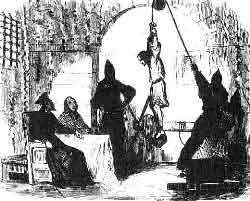
The strappado, according to one prisoner. Traditionally, this was done using a rope passed over a beam to suspend people by their arms, as pictured below:

strappado

Nowdays, though, people just use handcuffs and a well-placed iron bar or pipe. Either way, the effect is the same: intense pain and possible dislocation of the shoulders.

The allegation was made through the man's lawyer, Clive Stafford Smith, and much of the article focuses on the Kafkaesque conditions he must operate under:

Under the rules the United States military has imposed for defence lawyers who visit Guantanamo, Stafford Smith has not been allowed to keep his notes of meetings with prisoners, and will not be able to read them again until they have been examined and de-classified by a government censor.

He cannot disclose in public anything the men have told him until it too has been been de-classified, on pain of likely imprisonment in the US.

This is obviously crippling for his ability to mount an effective defence. But worse, much of the evidence is also classified - including statements by the prisoners themselves! One prisoner, Moazzam Begg, is apparently being held primarily on the basis of a statement he gave while being tortured in February 2003 - but as the statement is classified, he cannot see a copy, and therefore cannot dispute its contents. Stafford Smith rightly asks "What kind of civilised legal system does not allow the suspect to see his own statements?"

But the worst bit is the way these war criminals are using "national security" to cover up their own misdeeds:

Stafford Smith has drawn up a 30-page report on the tortures which Begg and Belmar say they have endured, and sent it as an annexe with a letter to the Prime Minister which Downing Street received shortly before Christmas. For the time being - possibly forever - the report cannot be published, because the Americans claim that the torture allegations amount to descriptions of classified interrogation methods.

How convenient.

Inside Guantanamo

The New York Times has a story today detailing abusive techniques at Guantanamo, which pretty much confirms what we knew all along: that prisoners there are being systematically tortured by US military and intelligence personnel. And it's not just a few sporadic cases; one interrogator estimated that one in six inmates were subjected to abusive treatment which the Red Cross has called "tantamount to torture".

There is no question that this is official US government policy. New interrogators are told that they have greater "flexibility" in extracting information because the Geneva Conventions do not apply. Internal FBI documents recently released to the ACLU talk of the base's intelligence staff having their "marching orders from SecDef" and of specific abuses being "approved by the Dep Sec Def". And we already know, from a Senate Investigation way back in May, that Donald Rumsfeld drew up the list of "allowed" techniques and specifically authorises some abuses:

After officials at Guantánamo asked for more leeway in dealing with Mr. Kahtani, Defense Secretary Donald H. Rumsfeld in December 2002 approved a list of 16 techniques for use there in addition to the 17 methods in the Army Field Manual. He suspended those approvals the next month after some Navy lawyers complained that they were excessive and possibly illegal. But after a review, Mr. Rumsfeld issued a final policy in April 2003, approving 24 techniques, some of which needed his permission to be used.

(My emphasis).

These techniques include prolonged sleep deprivation, "dietry manipulation" (starvation), "environmental manipulation" (baking or freezing), stress positions (backed by rifle butts and beatings if the victim moves), and use of dogs for intimidation. Both the vice chairman of the Joint Chiefs of Staff and Deputy Secretary of Defence Paul Wolfowitz have described these methods as "a violation of the Geneva Convention", yet the US continues to claim that prisoners at Guantanamo are treated according to international law. General Miller, former commandant of Guantanamo and Abu Ghraib, has gone so far as to say that

"Should our men or women be held in similar circumstances, I would hope they would be treated in this manner."

We can only hope that America's enemies do not take him at his word.

Saturday, January 01, 2005


Double it

With the international community stepping up to the plate over the asian tsunamis, the New Zealand government's contribution of NZ$5 million is looking increasingly miserly. A quick per-capita comparison tells the story: where Australia is giving US$2.63 per person, and Ireland US$3.46, New Zealand is only giving US$0.88 for each of us. Even the US is giving more per head than that!

Countries should give overseas aid in proportion to their ability to pay. And globally, we're a relatively rich nation; we're not as wealthy as the Scandanavians or the Americans, but well ahead of the global average. Last year's UN Human Development Report ranked us 24th in the world on GDP per capita, just slightly ahead of Spain. Yet Spain's contribution per capita is almost double ours.

In this case, New Zealand is clearly not pulling its weight in the international aid effort. It's time to start. Our government should double its base contribution to NZ$10 million, and stand ready to increase it further as the need arises.