Wednesday, February 09, 2005


Thirteen days

Further to my post on prisoners and benefits, according to the Dominion-Post this morning, the average time taken to stop a benefit payment after someone is jailed is thirteen days. Given that ten of those is the challenge period, it's hard to see the entire issue as anything but a storm in a teacup. The data matching system is working, and benefits to which people are not entitled are being cut expeditiously. So what's the problem?

Unfortunately, the government is responding to this beat-up by promising legislation to remove the ten-day challenge period and to allow "the prison telling us to be taken as evidence that the person is the [right] person". But the problem isn't on the prison's end - it's on WINZ's end, with making sure the person on Corrections' list maps to the right person in their database.

Removing the challenge period will result in misidentifications and innocent beneficiaries being punished for the crimes of others. Unfortunately, the vindictiveness towards prisoners seems to outweigh any such considerations.

Prisoners and benefits

The news that around half of all prisoners are paid benefits (which they are not entitled to) while in prison has (predictably) caused some to froth at the mouth. But while the number is shocking, there's an important piece of data missing that is required for us to judge whether this is in fact incompetance on WINZ's part: the average length of time such benefits were paid for. Without this, we cannot judge whether prisoner's benefits are being swiftly cut off shortly after their incarceration (in which case the data matching system in working), or whether they are being paid for months and months before anybody notices (in which case there is gross incompetence and heads should roll).

As for concerns about the Privacy Act, MSD is simply using the Act as an excuse. The ten day waiting period is not required by the Privacy Act, but by the risk and consequences of a misidentification. And the Act fairly clearly does not prevent data matching between WINZ and Corrections, otherwise we would have no data here at all! Which makes Marc Alexander's complaint a bit of a beat-up; privacy concerns are not the issue, it's the speed of data matching which may be a problem. As for his call for

prisoners who had invalidly received benefits to be made to repay the amounts of money immediately or forfeit assets to that value, where possible

this is (like so many of Alexander's ideas on law and order) simply mindlessly punitive. While criminal conviction justifies a loss of liberty, it's hard to see why it should justify different treatment with regards to debt collection.

Tuesday, February 08, 2005


Gone

The Whig has decided to call it a day...

The cost of manned spaceflight

In Voyage, Stephen Baxter presents an alternate history in which America doesn't stop at the Moon, but presses onwards to Mars. It's a good story, but near the end he lays out the cost of this goal: virtually the entire unmanned space program. Pioneer, Voyager, Galileo, all sacrificed to send four people on a one-off trip to plant a flag. And at that stage of the book, knowing what wonders these missions had discovered, I concluded that it wouldn't have been worth it.

Baxter's book was fiction, but we're seeing the same tradeoff now in NASA's decision to cancel further unmanned missions and bring down the Hubble space telescope in order to spend more money on manned spaceflight development. While I think that manned spaceflight is a great idea, and I'd dearly love to see people on Mars in my lifetime, they're sacrificing one of the most scientifically successful and useful missions ever, and one that has years of life left in it if properly maintained. And like Baxter's alternate history, I just don't think it's worth it. Returning to the moon is a worthy goal, and one I'd like to see reached - but not at this price.

Fortunately, as the story notes, the US Congress has been known to provide money for programs that NASA has decided to cut, and "there is a significant chance that funding for Hubble will be returned to the budget". We can but hope...

More things I would go to if I was in Wellington

His Excellency Göran Persson, Prime Minister of Sweden, "Economic and Social Policy: the Swedish Way". Monday, Feb 14th, 17:30 - 18:30, Government Buildings (Lambton Quay, near the railway station), VUW.

Details here.

Robin Hood in reverse

I haven't paid much attention to the current debate on Social Security in the US because I thought I'd seen it all before. Social Security, and the (then) Bush campaigns' mendacity over explaining its plans was a major theme in Paul Krugman's The Great Unravelling, which I read recently. But for all his criticisms of the Bushies' dishonest accounting and dishonest salesmanship, Krugman never in his worst nightmares imagined that they'd do what they're planning to do now.

American Social Security is what we in New Zealand call "superannuation" or "the pension"; it's what (hopefully) keeps poor Americans from starving in their old age. It's funded on a "pay as you go" basis through a dedicated payroll tax, a flat-tax which cuts out at a medium-high level of income (by US standards), so that basically the poor and middle classes bear most of the burden of paying for the scheme.

This obviously suffers from the same problem as New Zealand's superannuation scheme - the demographic bulge caused by the baby boomer's retiring - and the Americans used the same solution: saving to cover the gap. Twenty years ago they hiked the rate of the payroll tax - which falls mostly on the poor and middle classes, remember - in order to build up a "trust fund" to pay the bills in the future. This trust fund invested its cash in the safest investment money could buy: US government bonds.

Enter Bush. Bush wants to get the government out of the social security game by privatising it - otherwise known as the "let the elderly starve" solution. His problem - aside from covering existing obligations to current retirees, which he tries to hide with fuzzy maths - is selling it. Social Security is a genuinely popular program which makes people feel relatively secure about their retirement; radical reform carries a significant political cost. So, he relies on the oldest trick in the book: invent a crisis. This started out as making a lot of noise about how Social Security would no longer be able to meet its present obligations when the trust fund ran out... in about 2050 or so. Unfortunately, this depends on some rather pessimistic economic assumptions which make things seem a lot worse than they actually are. As Kevin Drum has pointed out, Social Security's "bankruptcy date" has moved into the future by more than a year for every year that has passed. So, enter phase II: suddenly, the "crisis point: is 2018 or so, when payroll taxes will no longer be able to cover outgoings, and the system will have to start drawing on its savings. But the only way this can be a "crisis" is if the trust fund can't be tapped - in other words, if the US government decides to stiff one of its largest investors and refuse to pay out on those bonds.

What would the Bush Administration gain from this (apart from a global economic meltdown)? It would be able to make its tax cuts permanant. Those tax cuts of course flow almost entirely to the top one or two percent of Americans - and will now be funded by stealing money saved for retirement by the bottom eighty percent. In other words, it's Robin Hood in reverse: robbing from the poor to give to the rich.

There's a warning here for New Zealand. Like the US, we are prepaying the expected costs of a demographic bulge in retirement. But while the Cullen Fund isn't putting all its eggs in NZ government bonds, it is still going to be a large pot of money which will be a perpetual temptation to politicians. And it's not inconceivable that at some stage in the future, some crusading market fundamentalist will decide to fund another round of tax cuts for the rich by looting the retirement savings of ordinary, working New Zealanders.

We must make sure that that never happens.
Not entirely fair

ObservatioNZ describes the present National party as "Muldoon with monetarism". WHile I think this is a perfect description of Brash - his autocratic leadership style, populist Maori- and beneficiary-bashing, and adherence to market fundamentalism - I'm not sure that it's entirely fair to the party as a whole. After all, National isn't just Brash - it also includes talentless born-to-rule tories, inbred rural consevatives, panty-sniffing monarchists, capitalists without a conscience, and "mother knows best" paternalists. Shouldn't they get a look-in too?

Monday, February 07, 2005


Justice for Genoa

More than 70 Italian Police Officers go on trial today for their role in the brutal nighttime raid on the Armando Diaz school and adjacent alternative media centre during the G8 summit in Genoa four years ago. During the raid, peaceful protestors were savageley beaten; one man

was beaten unconscious and received several broken ribs, a fractured hand and the loss of all his front teeth.

Other injuries included an American who was kicked so hard in the groin that he will never be able to father children.

Forty of those arrested at the Diaz were taken to a holding centre at Bolzaneto, outside Genoa.

There they were submitted to physical and verbal abuse, including being threatened with rape by officers who were singing fascist-era songs.

The international media was then duped into believing the Diaz was a hotbed of violent resistance.

Two Molotov cocktails were planted and police also showed off an array of knives, sledgehammers and pickaxes which they claimed to have found on the premises.

One enterprising officer, Massimo Nucera, also claimed to have been stabbed and produced a damaged jacket to prove it.

Tests on the jacket later showed the stabbing was faked, and it later emerged the penknives had been used to prepare food in the school kitchen and the tools were from a nearby building site.

The police officers - including the second-in-command of Italy's counterterrorism unit - face charges including assault, false arrest, and abuse of office. And the reputation of italy's police - and of Italy itself - hinges on the result. If this turns into a whitewash, then Italy will be tarred as a country which puts force above the rule of law, and which allows its officials to act with impunity towards its citizens - just as it did in the 20's and 30's.

Accountability

Who's responsible for the BMR? Who's responsible for the illegal and inhumane imprisonment scheme which has so far cost us over a million dollars (some of which may be overturned on appeal), and may cost us millions more? Before Christmas, I asked the Department of Corrections for some answers in this area. This is what I got back.

In January 1998 a project team was convened to develop a programme within D Block at Auckland Prison designed to reduce disruptive behaviour. Following the riot at Auckland Prison in march 1998, the conceptual work undertaken by this project team was 'operationalised' as the BMR in its original form. (The regime was subject to later changes and modification).

This work was undertaken at the direction of the then Regional Manager *Auckland Prison) Kevin White (who is no longer employed by the Department).

The table below sets out the names of the project team members, their positions within the Department at that time and (where applicable) their current positions.

NamePosition as at January 1998Current Position (if applicable)
Bryan ChristyUnit ManagerSite Manager
Trevor TohillUnit ManagerUnit Manager
John DallowSenior Prison OfficerDeceased
Owen StewartSenior Prison OfficerSenior Corrections Officer
Chris BurnsSenior Prison OfficerGeneral Manager, Auckland Central Remand Prison
Thom BotterillSenior Prison OfficerNo longer employed with the Department
William ThurstonSenior Prison OfficerRetired
Tania ScrivanPsychologistNo longer employed with the Department
Gerald HomfeldSenior Prison OfficerSenior Corrections Officer
Wendy Miller-BurgeringUnit ManagerReintegration Co-ordinator
Jim van RensburgManager, Special UnitsManager, Te Piriti Special Treatment Unit (Psychological Service)

Lest anyone draw the wrong conclusion from those people who are "no longer employed with the Department", according to the response to a previous request, no Department of Corrections staff have been disciplined in any way over the BMR fiasco. And it's not as if they don't deserve it; according to another response, those named above do not seem to have even considered whether what they were doing complied with either the Penal Institutions Act 1954, the Bill of Rights Act 1990, or our obligations under various international agreements governing human rights and the conditions in prisons.

What about the people who decided which inmates were to be subjected to these cruel and inhumane conditions? Again, according to Corrections:

Since 1998, a number of managers at Auckland Prison have held an appointment as Superintendent or a Deputy Superintendent for various periods of time (which entitled them to approve the placement of an individual inmate on the BMR).

These managers are Kevin White, Bryan Christy, Kelly Puohotaua, Murray Frew and Graham Cahill... These managers have held various different positions within the Auckland Prison management structure for periods of time from 1998 to date, including the positions of Unit manager, Assistant Site Manager and Site Manager.

With the exception of Kevin White, who left the Department in April 1998, they are all still employed by the Department...

In addition to this, from 2001, Phil McCarthy, the General Manager of the Public Prisons Service, personally approved placements to the BMR.

Followup requests have been sent, and at some stage (possibly around the beginning of next month) I plan to produce a scorecard of exactly how much money each of these people has cost us. And then, maybe, we can have some accountability...

Baby steps in Darfur

The Sudanese government has announced that it will no longer fly aircraft over Darfur. It's a small step, but a positive one. The Sudanese airforce has been providing air support and intelligence to the Janjaweed; now they'll have to do without it.

In the long term, the only solution to Darfur is going to come from negotiation backed by sanctions. The sheer size of Darfur as well as poor transport links make putting peacekeepers on the ground practically impossible without the consent of the Sudanese regime. Even with the cooperation of Sudan's neighbours, it would be extremely difficult to keep anything more than a token military force supplied. And while bombing may make people feel better, it won't significantly impede Janjaweed operations, because of the simple fact that they have nothing to bomb. In other words, while military force may be justified, it isn't really a workable option.

What can work is convincing Sudan to either rein in the militas itself, and to allow AU peacekeepers to monitor the situation and protect those in need. Absent military force, this has to be done essentially through economic and political force, dangling carrots such as trade deals and being able to sell oil while threatening sticks such as sanctions and embargos. ICC indictements against members of the Sudanese regime are an important example of the latter. While the Sudanese regime refuses to extradite anyone to face justice, for the 51 accused of participating or condoning crimes against humanity, leaving the country now incurs the risk of prosecution - just like Henry Kissinger or Donald Rumsfeld.

Unfortunately, this method takes time, during which many more people will die. But it's the only one we've got.

Sunday, February 06, 2005


A detainee's story

Martin Mubanga is a British Muslim who spent 33 months in Guantanamo bay essentially for being in the wrong place at the wrong time. He was released last week after American authorities finally admitted to serious doubts about the "evidence" against him. In an interview in today's Observer, he describes his time in Guantanamo, and details racism, abuse and mistreatment by US interrogators. On one occassion, an interrogator made him piss in a corner, then daubed him with his own urine while calling him a "poor little nigger". On another, they tried more traditional (or as US Atorney-General Alberto Gonzales would call them, "quaint") methods:

After several hours of questioning, Mubanga felt severely dehydrated and begged for a bottle of water. Once again he was lying on the floor: the interrogation booth chair had been removed. As he tried to drink and cool himself by spraying a little water around his face and hair, Mubanga said, the interrogator turned violent: 'The guy started kneeling on me, and I was wriggling backwards to get away from him, trying to get in the line of sight of the CCTV camera so someone might see what was going on. Of course, he didn't want to let me do that, so he stood on my hair. It was painful, but I tried to keep moving. Then he stood on the leg chain, so my shackles dug in really deeply, cutting into my legs. But I just took the pain. I'm looking at him, the pain's getting worse but I wouldn't scream out. I just kept looking at him. From that day on, I refused to talk to any interrogator. I said nothing at all for the next seven months.'

The US response to this is as predictable as it is laughable:

"Al-Qaeda training manuals emphasise the tactic of making false abuse allegations.

"That this detainee is now making allegations of abuse at Guantanamo seems to fit the standard operating procedure in al-Qaeda training manuals."

I guess those FBI agents whose documented concerns about abuse were uncovered by the ACLU are all really working for Al Qaeda, and those CCTV videos of the Guantanamo IRF team beating the shit out of inamtes are Al Qaeda videos then...

Mubanga is now planning to sue the British government for their involvement in his original detention. I wish him luck. Mistakes have clearly been made in some of these detentions, and it is only by holding power to account, either through the courts or at the ballot box, that they will be reduced in the future.

Kafkaesque

But K. should not forget that the trial would not be public, if the court deems it necessary it can be made public but there is no law that says it has to be. As a result, the accused and his defence don't have access even to the court records, and especially not to the indictment, and that means we generally don't know - or at least not precisely - what the first documents need to be about, which means that if they do contain anything of relevance to the case it's only by a lucky coincidence. If anything about the individual charges and the reasons for them comes out clearly or can be guessed at while the accused is being questioned, then it's possible to work out and submit documents that really direct the issue and present proof, but not before. Conditions like this, of course, place the defence in a very unfavourable and difficult position. But that is what they intend. In fact, defence is not really allowed under the law, it's only tolerated, and there is even some dispute about whether the relevant parts of the law imply even that.

The Trial, by Franz Kafka, ch 7.

The inherent lack of fairness of the CSRT's consideration of classified information not disclosed to the detainees is perhaps most vividly illustrated in the following unclassified colloquy, which, though taken from a case not presently before this Judge, exemplifies the practical and severe disadvantages faced by all Guantanamo prisoners. In reading a list of allegations forming the basis for the detention of Mustafa Ait Idr... the Recorder of the CSRT asserted, "While living in Bosnia, the Detainee associated with a known Al Qaida operative. In response, the following exchange occured:
Detainee: Give me his name.

Tribunal President: I do not know.

Detainee: How can I respond to this?

Tribunal President: Did you know of anybody that was a member of Al Qaida?

Detainee: No, no.

Tribunal President: I'm sorry, what was your response?

Detainee: No.

Tribunal President: No?

Detainee:No. This is something the interrogators told me a long while ago. I asked the interrogators to tell me who this person was. Then I could tell you if I might have known this person, but not if this person is a terrorist. Maybe I knew this person as a friend. Maybe it was a person that worked with me. Maybe it was a person that was on my team. But I do not know if this person is Bosnian, Indian or whatever. If you tell me the name, then I can respond and defend myself against this accusation.

Tribunal President: We are asking you the question and we need you to respond to what is on the unclassified summary.

In Re Guantanamo Detainee Cases: 02-CV-0299, U.S. District Court for the District of Columbia, pp 46 - 47.

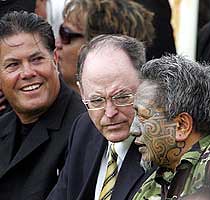
Seated with the other freaks

Don Brash at Te Tii Waitangi Marae yesterday, seated between Destiny Church's Brian Tamaki and shotgun-wielding Tame Iti:

brash-iti

Somehow, this seems appropriate, putting all the freaks and radicals together...

(Image stolen from Stuff)

New Fisk

The sins of our fathers, the folly of man and the art of documenting history

In defence of Waitangi Day

The approach of Waitangi Day has brought the usual chorus of calls to rename or even replace our national day, on the grounds that the present one is "divisive", "marred by protest", or "all about guilt". I think these calls are mistaken. Waitangi Day emphasises the fact that the Treaty is the moral foundation of our constitution. It may not have legal force, and we may disagree about exactly what it means, but it is unquestionably where the whole project of "New Zealand" began. And that is something we ought to celebrate.

At the same time, along with celebrating, we should also reflect. The Treaty sets out a vision - a vision of cooperation and partnership, of Maori and Pakeha working together to build something new. At times, we have failed to live up to this ideal. We should remember those times, so that we don't make the same mistakes in the future.

Or alternatively, we could all just enjoy the summer while it lasts, while cursing the fact that we don't get a day off this year...

Saturday, February 05, 2005


Results and concerns

Preliminary election results from Iraq show Grand Ayatollah Ali Sistani United Alliance list ahead with two-thirds of the vote - though this is from partial results from mostly Shi'ite areas; the picture will change as results from other areas come in (though with far lower turnout in the Sunni areas, maybe not by that much).

Two-thirds is a significant number, being the amount required under the Transitional Administrative Law to elect the President. In other words, the Shi'ia are in a good position to appoint the transitional government, and certainly in a position to veto it. No President (and by extension, Prime Minister, Council of Ministers, Supreme Court or military or intelligence officials) will be appointed without their consent. Whether you think this is a good or bad thing depends on how much you like quasi-theocrats.

As for what I think: democracy is a messy business, and it has to evolve at its own pace. If Iraqis voted collectively for people who think that all laws should be in accordance with Islam, then we have to respect that decision. Provided the door is left open for change (meaning regular free and fair elections) then Iraqis will reach their own consensus on how their country should be run. I am concerned about the rights of minorities and women in Iraq, but I'm also aware that it took several hundred years for our model of democracy to acknowledge those rights. I would expect progress to be much faster in Iraq, given universal suffrage and a relatively good position for women under the Ba'ath. People generally don't vote for their own oppresion, and trying to deprive 50% of the electorate of fundamental rights is (or should be) electoral suicide.

And OTOH, that's not a blank cheque. Elected governments can violate human rights just as unelected ones can, and in some ways its even worse. If the Iraqi National Assembly or the government it appoints fails to live up to international standards in this area - and in particular, fails to immediately put an end to the Iraqi security services' use of torture - they deserve to be treated as pariahs.

Rumsfeld and "command responsibility"

US Secretary of Defence Donald Rumsfeld is reconsidering whether to attend a conference in Germany. Why? Because he may face arrest on war-crimes charges over the actions of American soldiers at Abu Ghraib. Iraqis abused in prison and the US Center for Constitutional Rights have filed suit there, as German law claims universal jurisdiction over war crimes and crimes against humanity. It also imposes criminal responsibility not just on those who abuse and torture, but also on their superiors who induce, condone, order, or simply fail to stop such treatment.

Is there a case against Rumsfeld? There certainly is with respect to Guantanamo. Documents released under the US Freedom of Information Act show that he specified the interrogation techniques that may be used there - some of which (such as "environmental manipulation" - leaving a detainee chained to the floor in a pile of their own shit in a tin shack in the tropical sun for a day without any water, causing unconsciousness from heat exhaustion) are specifically noted as being construed as torture by other nations, and some of which (particularly isolation, which is likewise noted to breach the Geneva Convention) require his specific permission. There's also this chilling note:

If, in your view, you require additional interrogation techniques for a particular detainee, you should provide me, via the Chairman of the Joint Chiefs of Staff, a written request describing the proposed technique, recommended safeguards, and the rationale for applying it with an identified detainee

Depending on what was requested, any such authorisation may be an open and shut case for torture under US (let alone international) law.

Unfortunately, they're not trying to prosecute Rumsfeld for Guantanamo - but a similar document reportedly exists for Abu Ghraib, authored by Lt General Ricardo Sanchez (who is also subject to this case). And as Sanchez's political superior, Rumsfeld has "command responsibility" for his actions. The irony here - that this principle of "command responsibility" was the justification for prosecuting high ranking Nazis at the end of WWII - is inescapable. With their "universal jurisdiction" law, the Germans seem to have taken the lesson of Nuremberg to heart.

Friday, February 04, 2005


Sedition by Example II

Despite the title, this is actually the first in a series of historical examples of speech which has led to prosecution under our sedition law (the other sedition by example post beng an attempt to give some examples of modern speech that might fall foul of this law). I will post further examples as they come to hand, and as my currently limited research time permits.

Peter Fraser, demanding an immediate repeal to conscription, Alexandra hall, Wellington, December 10th, 1916:

For the past two years and a half we have been looking at the ruling classes of Europe spreading woe, want and murder over the Continent, and it is time that the working classes of the different nations were rising up in protest against them. [Lloyd George] wants to continue Hell, and to compel the young life of the Dominions into a sweltering Hell. And so far only one country has said - only one part of the world has said, "We think this has gone far enough; we will submit to it no more."

We find that there is a general settling down, and a crystallising of public opinion in favour of peace, or at least peace negotiations, for no country knows what they are fighting for. There is nobody in this country who knows, or in Britain, Germany, Russia or France, But they have come forward and said, "We will send you, whether you want to or not, to fight," and you know not what, no more than the sheep which are branded in the Ngahauranga slaughterhouse.

It rests with the people to say how long they will stand for it. We are told that we were fighting to secure a lasting peace; first it was to relieve Belgium, and the majority of men who went honestly believed that they were going to fight for the rights of the smaller nations and liberty; afterwards, before the incident of Greece came along, before they realised that militarism respected no nationality - if it was necessary to trample underfoot any nation, then any brand of militarism would do. They realise that today. Socialists realise it. Afterwards, we were told that we must fight for a lasting peace. The only peace that is going to last, for millions of men, is the peace they will get in the sleep of death.

In spite of his awful description of war, Lloyd George said that "this war must go on. We do not know how long. The war against Napoleon went on for twenty years. We do not believe this war will go on for long, but we must face it, however long." Are the people going to stand for that sort of thing? I do not believe they will. I believe they are gradually waking up and they will till they sy: "No longer will we be the dupes of crowned heads of Europe or their diplomats."

For saying this, Fraser was arrested and charged with having published seditious words likely to "incite disaffection against the Government of New Zealand and to interfere with the recruiting of His Majesty's forces... discourage the prosecution of the present war to a victorious conclusion; and to encourage opposition to the enforcement and admininistration of the laws... relating to compulsory military service... and to excite disloyalty in respect of the war". He was convicted and jailed for twelve months.

(Source: Tomorrow Comes the Song: A Life of Peter Fraser, Michael Bassett & Michael King, Penguin, 2000.)

New Fisk

Baghdad, the city that dreams of death

Democracy under MMP

One of the reasons people supported MMP was to build a more consensual style of government, with parties working together to pass legislation that is broadly acceptable to most New Zealanders, rather than using their artificial majority to ram through laws opposed by the majority of the population.

While some have argued that Labour is conducting "business as usual" (at least in the area of social policy), on this front MMP actually seems to be delivering. According to the Progressives, 80% of all bills have attracted broad support, being assisted by more than one "opposition" party. The result is better legislation that is more in tune with the wishes of the electorate - something that should be the aim of any democracy.

Given this, why would anyone want to get rid of MMP and return to the days when a tiny, ideologically driven clique within the Cabinet could impose massive changes on the country, regardless of what anyone else thinks?