Tuesday, July 19, 2005


Borrowing for tax-cuts

Today's piece in the Herald on National's tax plans finally made it clear how they are planning to pay for their tax cuts: they're going to borrow:

[John Key] was confident a review of spending across departments would throw up enough waste and duplication to help fund cuts. The other ways the cuts would be funded are:* A lower oberac surplus (operating balance before revaluations and accounting changes) than Labour's.* Borrowing more to finance some capital items like roads and possibly student loans.

Just to make this clear, the OBERAC (operating balance excluding revaluation and accounting changes) effectively tracks the level of investment in our society. Currently most of that "surplus" is being spent on things like schools and hospitals and roads, or stashed away in the Cullen fund so we can pay for people's pensions in the future. "A lower OBERAC surplus" means not doing some or all of this. It means running down our infrastructure. Given National's stated commitment to roads, this means that it will most likely be our schools and hospitals which will bear the cost - schools and hospitals which still have not recovered from a similar run-down under National in the 90's.

As for outright borrowing, the fiscal irresponsibility of this is simply breathtaking. We've spent the last twenty years clawing our way up from the effects of Muldoon's borrowing binge. We've spent the last six recovering from the effects of the policies intended to end it. As Brian Easton pointed out last week, it is extremely difficult to get off this wagon once you have got on it (see that twenty-year process above). The compounding cost of debt servicing can very quickly cause a blowout, especially if the economy goes sour - as it is expected to next year.

Then there are the equity issues of who pays. Borrowing creates a burden on future generations (as does running down infrastructure). This is one thing when they receive a valuable asset in return. But what National is proposing is borrowing to fund consumption, the equivalent of maxing out the credit card to pay for a self-indulgent shopping spree. There will be nothing to show for it, and the next generation of New Zealanders will be left to pick up the tab and clean up the mess. Meanwhile, the people who will benefit - the rich - will be laughing all the way to the bank...

This is not the plan of responsible economic managers. Instead, its the "spend today, pay later" promise of a party desperate to get elected no matter what the cost. It is irresponsible and unsustainable, and we should reject it.

Means subverting ends

The American invasion of Iraq is going to go down in history as a perfect example of the road to hell being paved with good intentions, of the way means subvert ends and the logic and necessities of military action destroy and undermine everything that that action is supposed to achieve. A war to save Iraqis resulted in US soldiers gunning them down at random because they saw every "Hajji" as a threat. A war to end Saddam's reign of terror resulted in the occupying power publicly considering the use of death squads to keep the civilian population in line. And a war to end torture has simply changed its victims; now it is Sunnis, rather than Shi'ites and Kurds, who are being hung from hooks in the ceiling in dark rooms, screaming in agony as the very same Mukhbarat thugs, thoughtfully rehired by the CPA to help keep order, beat them, electrocute them, and drill holes in their limbs with power-tools.

And now, there's something new to add to the list: having ostensibly waged a war for democracy, the US tried to fix the Iraqi elections. When democracy-promoting NGOs refused to cooperate,

the White House promulgated a highly classified Presidential "finding" authorizing the C.I.A. to provide money and other support covertly to political candidates in certain countries who, in the Administration’s view, were seeking to spread democracy. "The finding was general," a recently retired high-level C.I.A. official told me. "But there’s no doubt that Baghdad was a stop on the way. The process is under the control of the C.I.A. and the Defense Department."

What this translated to was financial support for former Prime Minister Allawi's party, plus a bit of ballot-box stuffing, to make sure the "wrong people" didn't win - all kept "off the books", using money that wasn't appropriated by Congress, in an effort to avoid oversight. It didn't work - mainly because the Iraqis weren't above such tactics themselves - but the fact remains that the Americans tried. And in the attempt, they corrupted the one genuinely good thing which could have been salvaged from the whole bloody mess. No matter what you thought of the war, I think everyone would have to acknowledge that Iraq's steps towards an Iraqi democracy were something positive. Maybe not worth the deaths required to achieve it, but something positive all the same. But now, the US has corrupted even that. Rather than dying for democracy, it turns out that 25,000 Iraqi civilians, an unknown number of Iraqi soldiers, and almost 2000 coalition troops died so that Bush could fix an election...

Monday, July 18, 2005


ACC reaches a new nadir

The Accident Compensation Corporation is supposed to provide New Zealanders with public-funded insurance against accidents in the workplace and at home. unfortunately, over the years, they seem to have been infected with a desire to maximise their profits by screwing their customers, using every trick in the book to avoid or reduce payouts to claiments, no matter how well justified the claim. but today, they really have hit a new nadir: forging a claiment's signature to avoid paying out.

The person responsible came forward and admitted it six months ago, and ACC has done nothing. She has not been disciplined, and ACC has not apologised. This simply is not good enough. They owe their client an apology, but more than that, they need to change the toxic internal culture which leads case managers to go to such lengths. And if they are unwilling to do so, the Minister should sack the CEO and install someone who will.

Consistency on smacking

Writing in the Herald this morning, Stevan Eldred-Grigg argues for consistency on smacking. If we are allowed to smack children - out of love, of course - because they often do stupid things and cannot understand rational argument, shouldn't that also apply to others who behave childishly? Drunk partners and senile grandparents, for example?

It's a vicious parody which makes clear the moral values of those who advocate for smacking. They only hit those who can't hit back. Those in exactly the same intellectual situation with any smidgen of physical or legal power to resist are immune. This is not about love, it is about power and whether they can get away with it.

Protecting the weak from physical domination and abuse by the strong is precisely what the law exists for. We should not be leaving the weakest and most vulnerable members of our society outside the protection of the law. Instead, we should ensure that anyone who assaults another can be prosecuted - regardless of the age of the victim.

Johannson on the election

Keith Ng has a very interesting interview with political scientist Jon Johannson on Public Address at the moment. Johannson nails down what this election is all about right at the start: the Revolution:

I think '05 is the final argument about the efficacy of the whole reform period and the politics that succeeded it, because Brash is so identifiable as the heir of Ruth Richardson, the neo-liberal purist. Despite the current packaging, that really is the real Don Brash.

It's a link that the government should be making more often. "Remember Ruth Richardson? Remember the Black Budget, the Employment Contracts Act, mass unemployment, food banks, run-down schools and hospitals? That is Don Brash's vision of New Zealand, and if he becomes Prime Minister, that is where he will try and take us again"

Or, they could just use this photograph, which really says it all...

But Johannson thinks that this is the last gasp for the market purists, their last desperate chance to impose their vision. And if National is forced into coalition with Winston, it will fail, and possibly screw the National party for quite some time.

There's also some musings on the "mainstream" and the constant cries that Labour is "too PC". Here, Johannson laments Labour's unwillingness to stand up for its beliefs, and suggests that Helen Clark respond as follows:

if it's too PC to care about the social cohesion of this country, then guilty. If it's too PC to actually want to reduce the inequality that was cause and accentuated last time National was in office, I'm guilty.

Like Johannson, I would very much like to see this. It makes the connection between Labour's policies of opening opportunity and reducing inequality with the basic kiwi idea of the "fair go" - and does it far better than ladders and silly cartoon chainsaws. But like Johannson, I don't really think she'll do it. This government has been characterised by a reluctance to stand up for its policies; instead it backs away at the slighest challenge, surrendering the ideological ground in the process. Up till now, this has been praised as "competant political management", but ironically this refusal to defend their position may very well be what costs Labour the election.

United Future's list

United Future has released its party list. The big news is the demotion of sitting MPs Bernie Ogilvy and Paul Adams in favour of newcomers Paul Check and Janet Tuck. The former represents Outdoor Recreation, a small party that has linked up with United Future. Given that they captured just over 1% last election, they should theoretically bring United two new MPs - meaning a number 6 ranking is rather low. The other obvious points are the high degree of candidate turnover (resulting in some stupendous rises), and the overwhelming white-maleness of the upper echelons of the list. Oh, they have women candidates (though not enough) - but in terms of ethnic makeup their list looks like the New Zealand of fifty years ago, rather than the New Zealand of today. This list simply doesn't reflect the reality of modern New Zealand - but then again, neither does United Future in general.

As with Labour, I've done a comparison showing candidate's relative placements with last time.

2005 RankName2002 RankDifference
1Peter Dunne10
2Judy Turner7+6
3Gordon Copeland2-1
4Marc Alexander40
5Larry Baldock6+1
6Murray Smith5-1
7Paul Check----
8Janet Tuck----
9Bernie Ogilvy3-6
10Paul Adams8-2
11Graeme Reeves----
12Russell Judd16+4
13Hannah Baral----
14Joy Lietze53+29
15Neville Wilson----
16Richard Barter----
17Sharee Adams36+19
18Steve Taylor29+11
19Ian McInnes18-1
20Ross Tizard27+7
21Fiona McKenzie----
22Graeme Barr46+24
23John Walker----
24Duane Wichman - Evans----
25Ram Parkash----
26Ralph Kennard----
27Jayati Prasad----
28Vanessa Roberts----
29Gerald Telford----
30Robin Loomes----
31Robyn Jackson----
32Tony Gordon----
33Greg Graydon----
34Martyn Seddon25-9
35Bernard McClelland----
36Beth Stone----
37Robin Westley----
38Anne Drake17-21
39Noel Hinton----
40Michael Satur----
41Diane Brown----
42Steve Dromgool----
43Andrea Deeth----
44Mark Peters----
45Pauline Moffat----
46Dennis Wells60+14
47Milton Osbourne----
48Garry Pedersen----
49John Pickering----
50Adam Archer----
51Neil Linscott----
52Barry Hayes----
53Janita Stuart----

Further candidate details can be found here.

New Fisk

Farewell, Ane-Karine, adventurous envoy and friend to all the Middle East

G8: The rich renege

Less than two weeks ago, the G8 agreed to forgive the debts of 18 poor nations. And now, before the ink is even dry on the agreement, they are trying to renege on the deal. The "problem" is that debt provides leverage over countries which can be used to force them to open their markets, privatise their public services, or otherwise pursue policies which profit the west rather than their own citizens. Some countries are reluctant to surrender this leverage, and are proposing to replace debt-forgiveness with more conditionality-laden "grants" - which could then be withdrawn if the recipient countries failed to toe the desired political line.

This is not what the millions of people around the world who campaigned to Make Poverty History fought for. But then again, should we really have expected any different? The rich nations have promised again and again and again to reduce trade barriers and open their markets to the poor through the WTO - and again and again and again they have failed to do so (and then, to add insult to injury, turned around and demanded more concessions from the poor in exchange for the same promises that they had failed to keep in the first place). This is not an abberation; it is just business as usual - the business of screwing the poor for fun and profit.

How should the poor world respond to this display of bad faith? They should repay it in kind. In The Age of Consent, George Monbiot pointed out that effectively, the poor world owned the rich world's banks. The scale of the debt is so huge that a collective default would be absolutely ruinous to the debt-holders. The poor should start using this as what it is: a weapon. They should make a collective and credible threat to default unless the rich world moves to equalise trade rules and free the poor from their burdens:

the poor world should do as the IMF and the World Bank have done, and attach 'conditionalities' to the handling of its debt. Just as the IMF has threatened to ruin the economies of the poor nations if they do not implement the reforms it demands, the poor world should threaten to ruin the economies of the rich nations if they do not agree to its terms. The point of possessing a terrifying weapon is that you do not have to use it; the fear of the weapon is sufficient to ensure that other people do as you demand. Nowhere does fear do its work with more celerity and less constraint than in the financial markets, which often flee even from their own shadows.

The financial system is built on a fantasy: that the debts on which it has constructed its wealth will one day be redeemed. The possibility that it could be awoken from its dream, that the nations which owen the banks might dump the debt on which the system is built, would induce a panic that no financial market could resist. The enemies of the poor will be forced to turn upon each other. The banks and financial speculators of the rich world, who have, through the liberalization of financial markets, been granted power over their own governments, will, when they realize that the developing nations are serious, demand that the rich world's governments must do as the poor world requests, to prevent the entire structure's collapse. Thus all the means which have been deployed by the rich against the poor are neatly turned around and deployed by the poor against the rich.

Putting together a coalition of debtor nations to do this would require a colossal collective effort - but we're already seeing the first steps towards it. The west's continued bad faith in trade talks resulted in the birth of the G22, a collection of poor nations who successfully stuck together to stymie WTO negotiations until they saw more progress on agriculture. Bad faith on debt reduction will further push the poor towards taking concerted action.

No doubt the right will decry the idea of threatening to ignore contracts and such, but bluntly, the poor world is being kept in debt-slavery. And they deserve their freedom every bit as much as the debt slaves of ancient Athens who were freed by the seisachtheia.

Sunday, July 17, 2005


The Iraqi regime is now arresting bloggers

Via European Tribune: Iraqi blogger Khalid Jarrar has been arrested and imprisoned without charge, reportedly for opposing the occupation on his blog. His brother Raed (formerly of Where Is Raed) has the details:

My brother called my dad from the Iraqi mokhabarat's jail to inform us he was alive; he said he was abducted by the mukhabarat men from his university.

[...]

My dad said that Khalid mentioned something about his writings or his blog. We’re not sure whether our blogs are the reason behind the abduction of my brother, but it’s one of the possible scenarios. In case if they were, we’ll stand for our political values of anti-violence, anti-occupation, pro-dialogue, pro-free speech, and all of the other honourable stands that my family has taken in our lifetime.

Our goal now is to ask the mokhabarat to take my brother to court and reveal what exactly he is being charged with (if anything).

Like Baghdad Burning, Khalid has been a critic of the occupation and of the behaviour of American soldiers in Iraq. His blog states

I am pro God, I am pro life, I am pro humanity, I am pro truth, and when the American goverment choses to be against all that then damn it: i AM anti American-goverment.

Now it seems that such opinions are enough to justify detention without trial. Still, it could have been worse - he could have been tortured. Or, as Raed notes, he could have been executed and thrown in the garbage.

So what's the difference between the new Iraq and the old one again? Increasingly, its looking like only the names have changed...

Meanwhile, if you'd like to make a token gesture of support for Khalid, you can sign a petition here.

A gentlemen's game

many have suggested the Black Caps show their disapproval of the Mugabe regime while on tour - for example, by wearing black armbands exactly as Henry Olonga did. But as Rod Donald points out, this could cost the players their cricketing careers: the ICC's clothing and equipment regulations bar any political messages, on pain of suspension from international play and a US$25,000 fine.

Why do they do this? Because cricket is "a gentleman's game". And calling a murderous thug a murderous thug would be ungentlemanly...

Kiwi Carnival #3

Welcome to the third fortnightly Kiwi Carnival. The idea behind the carnival is to highlight the best posts from the New Zealand part of the blogosphere over the last two weeks. Every carnival will be hosted at a different blog, and any kiwi blogger or ex-pat can join in simply by submitting an article.

Following the precedent set from the last few carnivals, I've thrown in a few forcible submisions of things I think are worth reading, but whose authors (for reasons of their own) did not submit. But now, on with the show...

The London bombings are a big theme in this carnival. Christiaan Briggs - who is over there at the moment - points out the obvious: this is the chickens coming home to roost. No-one in London is surprised that this has happened; "today’s just extra special because the bombs were pointed the other way".

Peter Cresswell preaches the war against terror, which he characterises as a war for freedom, and against those who hate the good simply for being good.

Just Left reacts to the news that the bombers were British, and argues that this forces us all to consider the issue of tolerance and "how we might attain fairness and justice for all in a meaningful way, without undermining our own freedoms."

To this, I'll add two forcible submissions: Che Tibby posted an impressive call for people to avoid the mindless hatemongering the bombers hoped to inspire. Al Qaeda is in part trying to provoke a war of civilisations between Islam and the west, and to force those of us in the middle to pick sides in that war. instead, we should stand up for our vision of a world where we can all just get along, by opposing hate, violence and killing no matter its source or direction. Meanwhile, Reading the Maps reminds us of Karl Marx's reaction to the Indian Mutiny. Which is a longer way of saying "plus ca change, plus c'est ca meme chose".

Freedom also seems to be a strong theme this fortnight. Philosophy, et cetera argues that we should focus on delivering substantive freedom to all - "that is, enabling people to achieve their goals and live the sorts of lives they want to live". This requires both negative freedom - freedom from outside interference - but also helping people become "better educated, well-informed, and generally able to achieve their goals", so they can handle things for themselves.

Nigel Kearney responds by arguing that the idea of substantive freedom is fallacious, being "a long way from our ordinary understanding of the word 'freedom'" - and that even if correct, it fails to support the "socialist" policies advocated by its users.

Hamish McKenzie of Fighting Talk ruminates on the possibility of New Zealand having a national day of celebration similar to Canada's, chiefly by asking "why not"?

Mellie of Random ContributioNZ blogs about running up a mountain.

BerlinBear talks about visiting the recently opened Holocaust Memorial in Berlin.

Hans responds to Ashraf Choudhary's comments on stoning and the Koran, suggesting that rather than trying to have it both ways, stone-age religions should either come out of the closet and stand up for their repressive beliefs, or join the modern world.

I present some concrete policies to reduce greenouse emissions

Dave Crampton talks about the G8 summit and argues that trade, not aid, is the road to making poverty history. The statistics on this are simply staggering: it has been estimated that poor countries lost over $28 billion due to one-sided trade policies in 2000 alone - "enough to halve the number of people living on $1 day". Over the past 20 years, it has added up to US$272 billion - enough to wipe out Africa's debt and vaccinate every school-aged child.

DPF considers the prospects of New Zealand First holding the balance of power after the election.

Finally, two more forcible submissions: Maramatanga's analysis of ACT's woes, and Frogblog's defence of taxation as upholding our social contract.

The next Kiwi Carnival will be held at Not For Sale in two weeks' time.

Saturday, July 16, 2005


Trinity

trinity

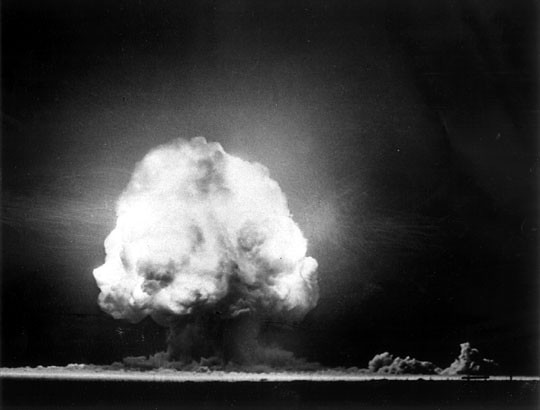
Sixty years ago today, on July 16th, 1945, at 5:29 am, the world's first nuclear test was conducted: Trinity. It was the birth of nuclear terror. With it, we went from an age where wars merely killed a lot of people, to an age where they could threaten civilisation or the future of humanity.

Nothing of Trinity's like had ever been seen before. The watching scientists were shocked, awed, and appalled at what they witnessed. Some were justly proud of their technological achievement, and saw beauty in the flash and the fireball. Others were aware of what they had unleashed and what it threatened. Kenneth Bainbridge, the test director, summed it up simply: "Now we are all sons of bitches". Oppenheimer, the Manhattan Project's director, was more grandiose, uttering the memorable quote from the Bhagavad Gita:

I am become Death, The Destroyer of Worlds.

Fortunately, he was wrong about the latter part. The weapons he helped design have been used exactly twice, killing hundreds of thousands of people - and they have never been used since.

Friday, July 15, 2005


New Fisk

Lebanon’s deputy PM survives assassination attempt

Henry Olonga in Auckland

Former Zimbabwean cricketer Henry Olonga will be in Auckland tonight to speak about Zimbabwe and the Black Caps' tour.

Where: Aotea Chapel, Queen St, Opposite Town Hall
When: 8:00pm.

If you can't make it, you can always turn up to tomorrow's protest march, leaving from the bottom of Queen St at noon.

Turning nasty

In the wake of the London bombings, a nasty strain of thinking has emerged in the US which threatens to turn the "war on terror" into a global "war on Islam". This began as worries over whether Europe's Muslims posed a threat to the US, with an implicit call for visitors to the US to be screened on the basis of their religion (something the US, to its discredit, now seems to be implementing). It has since morphed into a wider attack on "permissive" European immigration policies. For example, James Pinkerton of Newsweek asks "Can we learn from Britain's mistake?" - the mistake being, in their words,

a disastrous social experiment in Great Britain: the bringing in of large numbers of barely assimilated, barely patriotic and sometimes openly hostile foreigners into that country.

This is coupled with a call for action:

If a group can't be made, one way or another, to abide by the rules of its adopted home country, the group ought not to be living freely in that country.

But as has become tragically clear over the past few days, the UK wasn't the bombers' "adopted" country - it was their country. The London bombers were as British as the Queen. What would the US have the UK do? Start rounding up its Muslim citizens and putting them in camps? Likewise, how can the US do as Pinkerton asks and stop New York from becoming "New Yorkistan"? Evict residents and strip US citizens of their citizenship on the basis of their religion, regardless of their actual actions or beliefs? Herd them onto jumbo jets headed east? Are pogroms and ethnic clensing now really required in the name of American security?

The British response, while not nearly as hysterical, is still worrying. Blair has promised to tackle extremism, by jailing people for "inciting terrorism" and abrogating the ECHR, Refugee Convention and Convention Against Torture in order to deport or exclude refugees with extremist views. It's easy to see the potential for abuse - any criticism of US or British policy in the Middle East could be classified as "incitement". The result, perversely, may be a growth rather than reduction of extremism. The Guardian's Dilpazier Aslam points out that the reluctance of British Muslim leaders to rock the boat by criticising such obvious injustices as Fallujah drives younger Muslims towards extremism. By threatening to criminalise such criticism, the British government will simply strengthen this pull, and allow extremism to fester in secret. Worse, they will also discourage debate on whether the tactics of terrorism can be justified - and it is by winning this debate, rather than by throwing people in jail, that extremist terrorism will be defeated in the long term.

Thursday, July 14, 2005


Kiwi carnival reminder

Just a reminder that submissions for the third Kiwi Carnival are due by Friday-ish. So if you've posted anything you're particularly proud of and want others to see, email the URL, post title, and summary to kc.submission@gmail.com. I'll do the actual carnival post on Sunday, so there's time for "last-minute" additions by slackers. And if you don't submit anything, I may be forced to go looking...

Previous Kiwi Carnivals can be found here and here.

Wednesday, July 13, 2005


We can stop the tour

The ICC has rejected the government's pleas over Zimbabwe - but in the same breath, made it clear that it recognises the right of governments to impose sporting sanctions:

"It is also recognised that governments will, from time to time, elect to use sporting sanctions as a tool in their foreign policy programmes.

"Our members accept and respect that where this clear directive is given by a national government, the obligations of the future tours programme will not apply"

The ball is now clearly in the government's court. The ICC has given them an out - imposing sanctions - and it is up to them to use it. And to their credit, the government is least looking at it, with Goff querying the ICC on exactly how clear a directive must be to satisfy them. If a simple resolution from Parliament saying "don't go" is enough, then the Black Caps are off the hook.

I have some concerns that Sneddon might not want to be off the hook - or rather, that financial concerns would press him to continue the tour even if given an out - but the government can easily step in here. The government may not want to pay Mugabe, but I don't think there'd be any bariers to compensating NZC for lost income if the tour doesn't go ahead.

Fortuin on Mugabe

Former race relations conciliator (and former South African) Gregory Fortuin has a good piece on Scoop on "constructive engagement" with a despot. The despot is of course Robert Mugabe. Fortuin admired him for his role in overthrowing white minority rule in Zimbabwe, but now condemns him as "a tragic despot and an embarrassment to the African continent":

When Verwoerd, Vorster en Botha showed scant regard for the Judiciary and rode rough shot over the Constitution (albeit an Apartheid one). We asked the world to condemn them. Most of the world did, but we also remember with contempt the Reagans and the Thatchers who propped up the regime and called it "constructive engagement". And so when comrade Robert shows scant regard for the Zimbabwean Constitution and Judiciary he deserves even greater condemnation.

When the Apartheid Leaders set out to ruthlessly eliminate legitimate opposition, the ANC called on the people of the world for assistance. When the evil Apartheid regime showed inhumane regard for people already stripped of their dignity by bulldozing their "homes" consisting of mere corrugated iron and a plastic sheet in squalor conditions, Arch-Bishop Desmond Tutu travelled the planet calling for sanctions. I applauded him. And again I say to comrade Robert, having suffered oppression yourself and now perpetrating the same thing makes you doubly guilty. Black oppression is as bad as white oppression. You cannot fix one evil by perpetrating another evil. You are an embarrassment as an African Leader.

Fortuin calls upon the world to apply the same measures to the Mugabe regime as they did to apartheid South Africa - including a sporting ban. While the latter is mostly symbolic, the symbolism was very powerful for the victims of apartheid, and is likely to be just as powerful for those opposing Mugabe.

So, how many more voices must be raised in protest before the government will do the right thing?

Ominous rumblings in Fiji

The Fijian miliary is threatening to remove the Fijian government if it goes ahead with legislation to grant amnesty to participants in the 2000 coup. The Reconciliation, Tolerance and Unity Bill is a political stitch-up, aimed at ending investigations into the coup which have begun to get to get too close to the truth. So far, the country's Vice-president, Deputy Speaker, Minister of Information, Minister of Lands, and two Senators have all been prosecuted for organising the coup or serving in Speight's "government". Most were members of the CAMV party, an ethnic Fijian party and primary supporter of the government. If too many more members of CAMV go to jail for treason, the government won't have the numbers to stay in power and will have to call elections early. Hence the reconciliation bill, which will allow the government to "wipe the slate clean" - in the process ignoring crimes such as kidnapping, arson, assault, and outright murder.

The bill is clearly a Bad Thing. It would undermine the democratic principle of the rule of law, and it should thus be opposed. But there's also a principle in democracies of the military being subserviant to civil government, rather than seeking to second-guess it at gunpoint. Commander Bainimarama's proclaimation violates this principle. The military's purpose is to protect the state from outside threats and widespread civil disorder - not from bad legislation. Once they start seeing their own government as a threat, they have clearly crossed a line.

Henry Olonga in Wellington

Former Zimbabwean cricketer Henry Olonga will be in Wellington on Thursday evening to speak about Zimbabwe and the Black Caps' tour.

Where: St Andrews on the Terrace, 30 The Terrace
When: 7:30pm.

There's no charge, but according to Frogblog donations will be accepted from those wanting to contribute to the cost of Olonga's plane tickets.