Monday, October 15, 2012


Oh FFS

It seems WINZ was alerted to its IT muppetry last year:

Beneficiary Advocacy Federation spokeswoman Kay Brereton said she alerted officials to the fact members of the public could access sensitive information in July last year.

Ms Brereton said staff at the Wellington People's Centre (WPC) were trained to use the self-service kiosks when they were introduced at Work and Income (WINZ) offices.

[...]

She said an IT person from WPC found you could track backwards into WINZ's system.

"We got to the place where we could find all the IP addresses for all the computers in the local network and we thought that was probably far enough.


Brereton alerted both the immediate WINZ staffer who was training them, and national office. And it appears they did exactly nothing in response. This isn't just rank incompetence - its actively not giving a shit. WINZ's shitty attitude towards their "clients" poisons everything they do.

Sunday, October 14, 2012


Muppets

So, it turns out that WINZ are a bunch of fucking muppets at computer security, allowing sensitive, private information to be accessed by anyone at any of their kiosks (or indeed, anyone on their network). Including invoices from contractors, address information for beneficiaries, and medical information on abused kids.

Great job, guys. Good to know you're taking care of the extremely sensitive information people entrust to your care.

But it doesn't stop there. You can also access configuration information, including passwords (stored in plain-text, naturally) for WINZ's internal servers.

This is a fundamental failure of basic network security, the level of carelessness you'd expect from ACC or SIS. Heads need to roll for it. Meanwhile, it certainly makes you think twice about their plan for a massive database of at-risk kids. Given their security practices, they might as well be drawing up a shopping-list for pedophiles.

If you'd like to thank Keith financially for his journalism, you can do so here.

Friday, October 12, 2012


No freedom of speech in the UK

Over the past few years Britain has developed an increasingly intolerant attitude towards public expressions of dissent, arresting and even jailing people for criticising its involvement in Afghanistan, for failing to visibly enjoy the olympics, and for expressing republican views. And now we have another case, with a man sentenced to four months imprisonment for wearing a T-shirt with anti-police slogans:

A man who wore a homemade T-shirt containing an offensive anti-police sentiment in the immediate aftermath of the deaths of PCs Fiona Bone and Nicola Hughes has been jailed for a total of eight months.

Barry Thew, 39, of Radcliffe, Manchester, was sentenced at Minshull Street crown court in Manchester to four months in prison, after admitting a section 4a public order offence – displaying writing or other visible representation with intention of causing harassment, alarm or distress. Thew also admitted breaching a suspended sentence imposed for a previous offence of cannabis production for which he was ordered to serve another four months concurrently.

The court heard that at 2.15pm on 18 September, less than three-and-a-half hours after the officers were killed, he was seen in Radcliffe town centre wearing a white T-shirt with the handwritten message on the front and back. He was arrested and taken into custody after complaints from outraged members of the public.

The T-shirt said on its front: "One Less PiG Perfect Justice." On the back: "KiLL A COP 4 Fun.co.uk HA, haaa?"


In bad taste? Sure (but then, so were the police's actions in killing Thew's son three years ago). But something he should go to jail for? Hardly. While its a crime to incite murder, its not a crime to express satisfaction at someone's death (example: David Cameron was notably not arrested for this). Free and democratic societies recognise this, and robust societies can deal with it. But the UK is no longer free and democratic, let alone robust; the increasing intolerance of those in power towards any view which is not suitably fawning towards them demonstrates that.

An alternative

Faced with National's utter disinterest in jobs and its refusal to allow Parliament to investigate the matter, Labour, the Greens and NZ First have done the only thing they could: launched their own inquiry:

Labour, the Greens and New Zealand First plan to run their own inquiry into the manufacturing sector in New Zealand.

The leaders of the three parties, David Shearer, Russel Norman and Winston Peters made the announcement today at the end of a "Jobs Crisis Summit" in Auckland run by the Engineering Printing and Manufacturing Union.

The Government blocked an inquiry on manufacturing by the finance and expenditure committee and so the Opposition decided to run an inquiry independently.


An independent inquiry like this won't have access to a select committee's resources or powers - but it won't need them. Those in denial - including the government and its finance-sector backers - would never have cooperated with a formal inquiry anyway. All the independent inquiry has to do is bring together people who recognise that there is a problem and/or have an idea towards a solution, and provide them with a platform from which to advocate an alternative economic approach - a task which will be much easier without the "do nothing" status quo's involvement. And if in the process they manage to work out some way of working together and present themselves as a broad coalition government in waiting, so much the better.

Telling us what we already know

A whistleblower has come forward to tell us what we already knew: that the UK's "investigation" into torture and war crimes by its soldiers is a whitewash:

Louise Thomas, an official working with the inquiry team who says she has resigned in protest at the lack of progress, spent six months working with the Iraq Historic Allegations Team (IHAT), which was set up in response to a growing number of complaints from former prisoners. Many were detained at a secretive interrogation centre that the British military operated in the south-east of the country.

Thomas, 45, a former Wren who also served as a police officer for five years, told the Guardian she had seen around 1,600 videos of interrogation sessions, a number of which showed prisoners being abused, humiliated and threatened.

They suggested that some of the detainees were being subject to extreme sleep deprivation and beaten between interrogation sessions.

Thomas alleges that the abuses recorded in the videos are being investigated in an ineffective manner, by investigators who sometimes show little concern for what they are seeing, and that not all relevant material has been handed over to the inquiry by the MoD.

"I saw a really dark side of the British army," Thomas said. "The videos showed really quite terrible abuses. But some of the IHAT investigators just weren't interested."

The army's response? That these claims will be investigated by IHAT's management. Who will no doubt whitewash the whitewash by finding that nothing is wrong and that the whitewash team is conducting a "thorough investigation". That's how the establishment operates. The problem is that this shameless abuse is utterly corrosive of public trust. If British politicians and officials want to know why people think they are liars, they have only to look at their own habitual responses to official wrongdoing.

(And meanwhile, another seven British soldiers are being investigated for murder in Afghanistan. But no doubt they'll whitewash that too).

Hone stands with the people

Mana Party MP Hone Harawira was arrested last night at a protest against state house privatisation. His crime? Blocking a driveway. The sewer will no doubt be going apeshit about this, but I think its admirable. It shows that Hone stands with the people, that he's willing to get directly involved in grassroots protest and share the same risks as everybody else in doing so. You won't see Labour (let alone National) MPs doing that; they're too "respectable" to get down and dirty with the peasants.

Leaked

The usual tactic when a Minister gets into trouble is to deny everything and blame the department. we saw it with Murray McCully over the gutting of MFAT, and we've seen it from the Prime Minister over the GCSB's illegal spying on Kim Dotcom. But the loyalty of public servants only goes so far, and when they are asked to carry the can for a Minister's fuckups, they tend to get leaky. We saw it over MFAT, and now we're seeing it from the GCSB in a devastating fashion:

Prime Minister John Key is facing fresh claims tonight about what he knew about Kim Dotcom, and just what he may have said about the internet tycoon.

Labour claims it has sources inside the Government Communications Security Bureau (GCSB) spy agency who are adamant Mr Key gave an address to staff in which he spoke of Dotcom.

If it's true, then the timing is highly significant – contradicting Mr Key's previous statements, and Labour says there may even be an audio-visual recording of the address.


A video would be the final straw, but Labour didn't deliver the goods. But what they did deliver was damaging enough: Key was forced to go from denial to "I don't recall" to "I may have" (which is Key for "of course I did") in the space of just a few hours. He's now forked between looking deceitful and looking incompetent, neither of which is acceptable in a Prime Minister.

Meanwhile, GCSB is denying that there is a video (based apparently on an "exhaustive search", which apparently began before the leak and may in fact have triggered it) and has begun an investigation into the leak. Which raises the spectre of a GCSB officer being prosecuted for revealing the non-national-security-sensitive and definitely unclassified information that John Key spoke to them in a cafetaria. Its difficult to see that passing the political smell test, let alone a BORA-challenge (section 6 surely means that it must be interpreted to apply only to sensitive and classified information which is potentially damaging to national security). The GCSB would be fools to go down that path.

Thursday, October 11, 2012


Equality of sacrifice? Yeah, right

The government says that times are tough. As a result, public servants have been facing cuts, layoffs, and a pay freeze for the past three years. but not everyone is suffering. Their CEOs, for example, got tens of thousands of dollars extra last year in pay rises:

Across the Government's 15 ministries and six departments, 16 chief executives received increases in their income.

The average movement in base salary for chief executives in the state services who have held the same position for 12 months or more was 2.7 per cent.

The average base salary increase across the public service was three per cent, although 21 per cent of the chief executives across the wider public sector received no pay increase over the last year.


What's good for the goose is good for the gander. If CEO's think that public service pay must be frozen, then perhaps they should lead from the front and accept a freeze or cuts in their own outrageous pay and conditions. And if they're not willing to accept that, then we can hardly take them seriously when they demand it of others.

Imperial over-reach

Since the Peace of Westphalia in 1648, we have lived in a world of nation-states. One result of this is that we have a multitude of different legal jurisdictions, with different laws. Generally, nation-states respect this; laws stop at the territorial limit, unless the regulated conduct directly involves their own citizens or is one of a limited number of areas where we accept (and expect) all nations to assert universal jurisdiction (e.g. torture and war crimes).

Not any more. The US has just asserted universal jurisdiction over every corporation in the world, on the grounds that those not doing business in the US are "purposefully" evading US jurisdiction. Yes, really:

In May, Megaupload's lawyers asked that the charges be thrown out because the company had no US address and could not be served with court papers. However, in his ruling, Judge O'Grady said: 'It is doubtful that Congress would stamp with approval a procedural rule permitting a foreign corporate defendant to intentionally violate the laws of this country, yet evade the jurisdiction of the United States' courts by purposefully failing to establish an address here."

Yesterday, Dotcom, who is facing extradition from New Zealand to the US over the case, questioned the judge's ruling that the company was intentionally avoiding the jurisdiction of the US and should be liable for trial in a country where it was not based.

'US judgement scary for non-US companies: By not establishing a US office you "purposefully" chose to evade US jurisdiction?' he said on Twitter.


Its a pretty weird ruling, but one entirely in keeping with the US's imperial sense of itself. Hopefully it will be overturned on appeal. If not, well, I look forward to our Department of Labour prosecuting US companies for their violations of NZ labour standards and union rights.

Facebook: Tax cheats

Who'd have thunk it? Facebook are tax cheats:

Facebook was accused last night of "disingenuous and immoral" tax avoidance after a new analysis of its UK business suggested the social networking giant paid just £238,000 in corporation tax in Britain last year.

Although industry experts estimate the company made £175m in revenue from its UK businesses last year, Facebook is able to avoid paying millions in corporation tax by diverting most of its sales via Ireland.

Annual accounts published yesterday at Companies House showed Facebook UK Limited declared turnover of £20.4m using the entirely legal scheme. Yet Enders Analysis, an independent research firm, has estimated Facebook's likely UK sales at £175m last year as the world's biggest social networking website has continued to attract advertisers.


The Independent is dubbing them "the antisocial network". It seems entirely appropriate. People and companies who avoid their taxes are social cheats. They take the benefits of society - not least a business environment which allows them to operate without having their offices pillaged by angry mobs - without paying for them. And that is decidedly antisocial.

Meanwhile, now I'm wondering whether Facebook does this here. Perhaps some enterprising business journalist would care to look into it?

Must watch

Last night, Campbell Live had a blistering piece on "the New Zealand institutions that broke our trust", exploring the background to the Kim Dotcom fiasco and looking at why the police and GCSB got it so wrong. In the process, they explore relations between the National government, the US, and Hollywood, which suggest a disturbing political quid pro quo: Dotcom's head was the price of John Key's White House photo-op. And the police went along with it because, in the words of a US source, "they're easy".

You can watch it here.

A serious question

What's the point of Section 7 of the Bill of Rights Act if politicians simply subvert it for their own political ends?

Section 7 BORA requires the Attorney-General to

bring to the attention of the House of Representatives any provision in [a] Bill that appears to be inconsistent with any of the rights and freedoms contained in this Bill of Rights.

The assumption here is that a) the Attorney-General will report honestly; and b) Parliament will pay attention. We've already seen substantial doubts raised about (b) (notably in the case of the Electoral (Disqualification of Sentenced Prisoners) Amendment Act 2010). And now we have (further) good reason to doubt (a) as well.

On September 19, the government introduced the Public Safety (Public Protection Orders) Bill to Parliament. The bill would allow unpopular (technically serious and violent, but in practice it translates into "anyone the Sensible Sentencing Trust can whip up hysteria about") prisoners to be further detained at the end of their sentence, potentially indefinitely. The bill is a fairly explicit breach of the BORA provisions against retroactive penalties, double jeopardy, and arbitrary detention. Despite this, yesterday the Attorney-General finally released his advice declaring it consistent with the BORA.

As Andrew Geddis notes, there are a number of odd things about the advice. It is dated October 4 - two weeks after the bill was introduced into the House. And for only the second time - the other being the notorious Foreshore and Seabed Act - it is the personal view of the Attorney-General himself, rather than that of a named official from Crown Law or Ministry of Justice. But the oddest thing about it is the conclusion. Back in 2009, when considering the Parole (Extended Supervision Orders) Amendment Act 2009, which allowed similarly unpopular prisoners to be subjected to home detention at the end of their sentence, the Attorney-General declared the bill to be inconsistent. In doing so, he essentially used a duck test for determining whether something constituted "detention": if it looked like penal detention, it was. In that case, the law allowed the Parole Board to "impose what is in effect electronically monitored home detention for anything less than 24 hours a day". He was also very clear on detaining people based solely on the risk of future offending: that it was detention without charge or trial.

Fast-forward three years, and the Attorney-General has apparently reversed his position. The far harsher conditions imposed by the Public Protection Orders Bill (24 hour home detention within prison grounds, with censored mail, bugged phone calls, and guards) apparently is not penal, but a civil regime. And detention based on the risk of future offending is now OK.

This inconsistency raises grave doubts about whether the Attorney-General is consistently and conscientiously performing his statutory duties under the Bill of Rights Act. Those doubts could be mollified if he released all the legal advice he had received from his department on the bill, so we could see whether he really has changed his mind, or whether he had ignored the considered advice of Crown law to rubberstamp a bill to further Judith Collins' reputation as "the crusher". Sadly, I don't expect that: such release would be contrary to longstanding precedent, the Minister will not release anything that makes him look bad, and he is basically immune to the OIA on this.

But that secrecy has a cost, in that it raises doubts about the sustainability of the BORA regime itself. If Attorney-Generals can't be trusted to properly warn Parliament about bills that may contravene the BORA, there is only one alternative: to strengthen post-facto review by the judiciary by allowing laws to be struck down. Finlayson has a choice: he can either do his job properly (and be open about it), or see more power flow from an institution the public don't trust - Parliament - to one they do: the Supreme Court.
Wednesday, October 10, 2012


Text messages and freedom of information

Text messages are hot news in the freedom of information community right now. Locally, Whanganui District Councillor Michael Laws' comment about them has sparked a LGOIMA request, which looks set to go to the Ombudsman, as well as a series of related requests to government ministries about how they handle their Public Records Act obligations around them. In the UK, Ministers have just been instructed that they are not exempt and must be disclosed on request like any other official information. And in Canada, the Information Commissioner has just launched an investigation into them:

At this time, there is no Government-wide policy on the use of text-based peer-to-peer forms of communication. Consequently, the Information Commissioner has initiated a systemic investigation into whether text-based messages containing government information sent from, or received on, government issued wireless devices are properly managed and preserved to ensure the right of access to information.

Eleven institutions have been selected for review based on a number of factors, such as the size of the institution, the volume of requests it receives in a year, or its responsibilities for providing direction and assistance on recordkeeping for the Government of Canada.


it will be interesting to see what recommendations they make.

Greece's downward spiral

Half of Greek police force voted for Golden Dawn, Digital Journal, June 21 2012:

Greece's far-right Golden Dawn party maintained seven percent of the vote in the June 17 elections, winning 18 seats in the Greek parliament. Support held strong in one sector as figures show that half of Greece's police force voted for Golden Dawn.

To Vima published figures showing half of Greece's police force voted for Golden Dawn (Chrysi Avgi), a figure unchanged since the failed May 6 elections. The paper says this phenomenon raises "numerous questions about the political perceptions and choices of uniformed official."


Greek police send crime victims to neo-Nazi 'protectors', Guardian, 28 September 2012:
Greece's far-right Golden Dawn party is increasingly assuming the role of law enforcement officers on the streets of the bankrupt country, with mounting evidence that Athenians are being openly directed by police to seek help from the neo-Nazi group, analysts, activists and lawyers say.

In return, a growing number of Greek crime victims have come to see the party, whose symbol bears an uncanny resemblance to the swastika, as a "protector".

One victim of crime, an eloquent US-trained civil servant, told the Guardian of her family's shock at being referred to the party when her mother recently called the police following an incident involving Albanian immigrants in their downtown apartment block.


Greek anti-fascist protesters 'tortured by police' after Golden Dawn clash, Guardian, 9 October 2012:
Fifteen anti-fascist protesters arrested in Athens during a clash with supporters of the neo-Nazi party Golden Dawn have said they were tortured in the Attica General Police Directorate (GADA) – the Athens equivalent of Scotland Yard – and subjected to what their lawyer describes as an Abu Ghraib-style humiliation.

Members of a second group of 25 who were arrested after demonstrating in support of their fellow anti-fascists the next day said they were beaten and made to strip naked and bend over in front of officers and other protesters inside the same police station.

Several of the protesters arrested after the first demonstration on Sunday 30 September told the Guardian they were slapped and hit by a police officer while five or six others watched, were spat on and "used as ashtrays" because they "stank", and were kept awake all night with torches and lasers being shone in their eyes.

Some said they were burned on the arms with a cigarette lighter, and they said police officers videoed them on their mobile phones and threatened to post the pictures on the internet and give their home addresses to Golden Dawn, which has a track record of political violence.


Thanks to Germany, Greece is heading towards actual fascism, with an actual Nazi party organising attacks on immigrants and using its police proxies to torture and intimidate its political opponents. The spiral needs to be stopped - but instead Germany is tightening it with more grinding austerity.

What the European union means now

When the European Union was founded, it was supposed to bring peace and democracy to Europe. Fifty years on, and it means teargas, stun grenades, and the transformation of a city into a police state as the EU's de facto leader visits one of her de facto vassal states:

Greek police have used teargas and stun grenades to halt angry protesters in central Athens who tried to break through a barrier and reach the visiting German Chancellor Angela Merkel.

Tens of thousands of demonstrators defied a ban on protests to voice their displeasure with the German leader, who many blame for forcing painful cuts on Greece in exchange for two bailout packages worth more than €200 billion.

[...]

Some 6,000 police officers were deployed, including anti-terrorist units and rooftop snipers, to provide security during the six-hour visit. German sites in the Greek capital, including the embassy and Goethe Institute, were under special protection.


All of which costs money. If the Germans want to lecture Greece about borrowing, then perhaps they should stop imposing costs on Greeks by visiting.

The Guardian reports quarter of a million protesters. That's the depth of the hatred Germany has generated through its financial demands. And if Greece remains even remotely democratic - something the Greek government realises is now in doubt - this German-imposed austerity is going to poison EU relations for decades to come.

Not a conflict

Labour is accusing Education Minister Hekia Parata of a conflict of interest over a new Christchurch character school. why? Because it will be run by her second cousin:

The school, Te Pa O Rakaihautu, was endorsed by the ministry just weeks before work began on the overhaul of the city's education in October last year.

It is understood the final application is lodged and awaiting approval. Te Pa is chaired by Parata's second cousin, Rangimarie Parata Takurua, sparking accusations from Labour of a conflict of interest.


I oppose nepotism and corruption, but this is ridiculous. Most people don't even know who their second cousins are. Its a relationship so tenuous that it matters only to genealogists; the idea that it could constitute a conflict of interest in and of itself is simply absurd.

There may be good reasons to oppose this school's application, but this is simply not one of them. Labour needs to find better ammunition than this.

10/10: World Day Against the Death Penalty

76f78395c20087f7ef3aea62b0ef6f5a_3

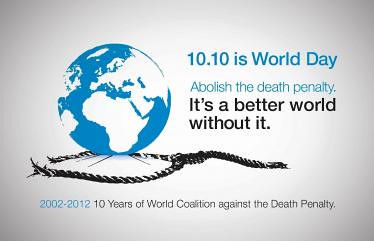
Today, October 10, is the world day against the death penalty. Out of 194 UN member states and observers, 96 still have the death penalty on their books - though fewer than half of them apply it in practice. Today is the day we work to change that.

This year's focus is on the progress made in the last decade - and its pretty dramatic. Ten years ago, 31 countries sentenced people to death. Today, its 21. Ten years ago there were only 80 countries which had banned the death penalty entirely. Today its 98. Even in the pro-death penalty US, four more states have abolished it. The progress is slow, but it is steady, and in the right direction.

Tuesday, October 09, 2012


The return of youth rates

Here we go - as threatened during the election, National are planning a pay cut for young workers:

The Government is introducing a new pay rate for 16-19-year-olds of a minimum $10.80 an hour.

The new pay rate, to be called the 'starting-out wage', will not be compulsory but 40,000 teens will be eligible.

It kicks in on April 1 next year and the Government estimates it will create up to 2000 youth jobs in the first two years.

The starting-out wage will be set at 80 per cent of the adult minimum wage, which is currently $13.50 an hour.

It will apply for six months after starting with a new employer. The move was National Party policy ahead of the election last November.


Its standard National Party theology: if the economy is bad, pay and conditions must be cut, to "boost employment". Which has worked so well with the 90-day law. What it actually does is redistribute wealth, from the young and poor to the old and rich.

...unless of course young people organise against it. They were pretty successful at this in the leadup to abolition, forcing several employers (such as McDonalds and Burger King) to scrap discriminatory youth rates from their contracts. National's plan will simply see a return of such industrial action.

National doesn't care about jobs

The last few weeks have seen hundreds of job lost around the country, with layoffs announced at Solid Energy, KiwiRail, Nuplex, New Zealand Aluminium Smelters, and Norske Skog's Tasman pulp and paper mill. In response, the EPMU has called an urgent summit of unions, economists, business and political leaders. Most politicla parties, including Labour, the Greens, and NZ First, will be there. But one won't be: National:

Friday's jobs summit is being written off as pointless by the Prime Minister.

Unions, business and opposition parties will host the summit, aimed at tackling what it calls a jobs and manufacturing crisis.

But John Key says there is no crisis with all statistics he has showing moderate growth.

Even if he was invited, he says he wouldn't go to the summit.


The message couldn't be clearer; National doesn't care about jobs, they don't care about the economy, and they don't care about the lives of ordinary New Zealanders. And while ordinary kiwis are struggling, they're sitting there in their Beehive offices, sipping champagne and denying that there is even a problem. And next, no doubt, they'll be telling us to eat cake...

Justice for Kenya

Between 1952 and 1956, the British waged a dirty colonial war in Kenya against the Mau-Mau. Opponents of the colonial regime were detained in camps, deported to reserves, and of course murdered, tortured, and raped. The extent of the atrocities was exposed by the release of the British Colonial Office's secret archive last year: beatings, castration, water torture, and the roasting alive of a prisoner

But now, three Kenyan victims of these atrocities have won the right to sue the British government for their mistreatment:

Three Kenyans who were tortured by British colonial authorities can proceed with their legal claims against the UK government, a court has ruled.

London's High Court ruled the case, relating to the 1950s Mau Mau uprising, could proceed despite the time elapsed.

The ruling means the case will now go to a full trial. Lawyers for the three hailed it as a "historic" judgement.


Appallingly, the British government has admitted the facts of the cases (which include beating, castration, and rape), but says that (thanks to independence) Kenya is now responsible for British crimes (an extremely perverse form of legal victim-blaming). Fortunately, the courts have rejected that position. An appeal is still possible, but it looks like there might finally be justice for Kenya.