Friday, March 13, 2015


Earning that reputation XV

The Statutes Amendment Bill is an annual piece of legislation to provide for "technical, short, and non-controversial amendments" - basically, minor legislative tidy-ups rather than policy changes.

The National party is using it to extend former MPs' undeserved travel rort by up to $4,000 a year.

How? A Supplementary Order Paper proposed yesterday by Simon Bridges would amend Schedule 2 of the Members of Parliament (Remuneration and Services) Act 2013 - the bit that deals with Travel entitlements of former members of Parliament. The relevant section currently reads:

The total amount paid to a former member by way of rebates for international air travel in each year must not exceed the amount of rebate to which the former member would have been entitled if he or she had flown between Auckland and London using the lowest-cost online business-class return air fare as at 1 July in the relevant year.

The SOP would change that "lowest cost" to "an Air New Zealand". A quick google shows the difference to be worth about $4,000 each way. Because obviously, we can't expect our "elder statesmen" to fly China Southern or Malaysian Airlines. No, English and Brownlee and Peters and Mallard will get nothing but the best when they retire.

Fortunately its a Statutes Amendment Bill, so all it takes is one MP to object and it doesn't happen. David Seymour? The Greens? I'm looking at you here.

Meanwhile, MPs wonder why the public view them as thieving parasites? This is why. The travel rort for retired members was never justified. It serves no public purpose whatsoever. It should have been abolished. Instead, it has been enshrined in legislation and now the government wants to increase it by stealth. Unless Parliament stops this, MPs will earn every bit of their reputation. And they'll only have themselves to blame for it.
New Fisk

Syria revolution four years on: Don't bet against President Assad - a ruler willing to see his country destroyed so long as he can cling to power

Urgent?

Last year, National rammed through a new anti-terror law giving the SIS new warrantless surveillance powers. We were told this was urgent - so urgent that a select committee could only be given a week to look at it, which wasn't enough time to read the submissions. But was it really?

If the law was that urgent, you'd expect those powers to be used immediately. But it turns out they weren't. Yesterday the SIS released their first statutory report on the use of warrantless surveillance, and it speaks for itself:

The ability to issue a section 4ID authorisation came into effect on 12 December 2014.

During the period 12 – 31 December 2014, no authorisations were issued under section 4ID of the NZSIS Act.


So much for the case for urgency.

(See also: Peter Dunne's refusal to say how many times the new passport revocation powers, granted under urgency, have been used. That also speaks for itself. The urgency over the spy bill wasn't because the changes were urgently needed, but because the government wanted to limit debate).

Bullying Northland

First, National tried to win the Northland by-election with pork. Now, they've turned to threats:

John Key is warning voters there is no "free lunch" in the Northland by-election, as National claims major roads and free-trade deals will be in doubt if Winston Peters wins.

[...]

Speaking to Turners & Growers in Kerikeri yesterday, Key said "all the other parties [were] ganging up on National" making the contest difficult.

If National lost the seat it had held for more than half a century, there could be consequences, such as throwing into doubt the South Korean free trade agreement (FTA) he is due to sign in Seoul this month, because it would require a vote in Parliament.

"If we lose Northland, it's not costless," Key said.

[...]

Osborne, who has risen from electorate treasurer to potential MP in just weeks, even warned a flagship National roading project to extend State Highway 1 as a motorway further into Northland, could be derailed if Peters beat him.

"If the people of Northland want the Puhoi to Wellsford motorway extension, which is vital to open up Northland to our biggest market . . . if we want that, there's only one choice, and that's to vote for me," Osborne said.


The message is clear: if Northland doesn't vote for National, they won't get their roads (or probably their bridges). Its outright bullying of the sort you expect in a banana republic. But isn't it so very, very National?

Police aggression kills

When tasers were introduced, we all knew that it was only a matter of time before they killed someone. And now, they have:

Police tasered, pepper-sprayed and set dogs on a 53-year-old man who died in Napier in the early hours of this morning while being arrested.

The man, from out of town, visited his parents at their Hastings home last night where he attacked his father, police say.

Acting Eastern District Commander Superintendent Mike Johnson said his father is in Hawke's Bay Hospital recovering.

The man had left the property in a car and he was located by police in the car in a carpark at Westshore Beach in Napier.

The man did not respond to several voice appeals, and police gained entry to the vehicle after smashing two windows. The man resisted attempts to get him out of the car and police deployed a number of tactical options.

Once the man was removed from the vehicle he struggled with police who were attempting to place him under arrest.

At this point the man became ill and Police staff administered first aid and tried to resuscitate him. Ambulance staff arrived and continued resuscitation attempts, but he died a short while later.


But its not just tasers. This sorry incident is also a perfect example of what is wrong with our police, and how their aggression escalates problems. Faced with a criminal suspect sitting in a car who wasn't going anywhere, they didn't disable the car or park it in and just wait it out. Instead, they smashed the windows and tried to remove him by force. From the news report - which echoes the police statement, so if its wrong the police have no-one but themselves to blame - there was absolutely no need for this. But I guess de-escalating the situation and waiting it out so they could make a safe arrest would have made them look "weak", so instead they upped the ante. And now a man is dead as a result. Heckuva job, guys! Now that's a better work story!

This man is dead because of the police's ego. They need to be held accountable for that. But more importantly, they need to change the way they're doing things, and turf the sorts of aggressive fuckwits who think escalating a situation is a good idea out of the police force, so this never happens again.

Thursday, March 12, 2015


A further explosion of spying

Back in 2013, John Key passed a spy law granting the GCSB new powers to spy on the internet in New Zealand for "information assurance and cybersecurity". The result has been predictable: an explosion of spying. Back in 2012, the GCSB had only 11 interception warrants in force, five of which were issue in the 2012/13 year. This year its 19, with eleven new ones issued. More significantly, in 2012 they had 26 access authorisations, eleven of which were new. Now its 59, with 48 issued in the past year alone.

[Stats from GCSB 2013 annual report erratum and 2014 annual report, p. 19].

So, we've had an explosion of spying, particularly on domestic computer networks. And that's the warranted stuff that we know about; we have no idea about the GCSB's use of their warrantless interception powers. And yet, despite doing twice as much spying as before, the GCSB claims to be collecting less intelligence. Another example of how they're doing less with more...

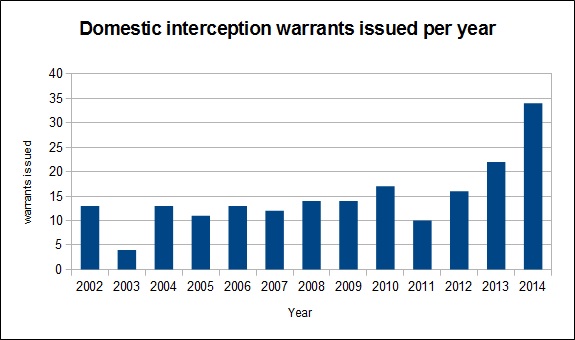
As for the SIS, a picture is worth a thousand words:
SISwarrants2014

[Latest data from p. 20 of their annual report]

Last year's trend of increased spying has continued, and it now seems to be going exponential. And it was doing so before the post election "foreign fighters" scare, or any 1080 threat (they will be in next year's annual report). The SIS is now spying at over twice the level it did when John Key came to power (by total warrants), and is getting almost three times as many warrants issued a year. And for what? Is the world today really twice as dangerous as it was in 2002, immediately post 9-11? Is it really twice as dangerous as it was between 2009 and 2012, when there were NZ combat troops in Afghanistan? Really?

As I noted last year, it is hard to see the justification for this increase, and the natural conclusion is that the effective threshold for granting an intelligence warrant - which lets the SIS tap your phone, hack your computer, break into your house and steal your stuff - has decreased significantly. And when the only real check on the spies is what the Prime Minister is willing to sign, that's really worrying.

A good idea

One of the problems with our spy agencies is that not only are we kept in the dark about what they do, we're also kept in the dark about what they think they're allowed to do. For example, while the GCSB Act apparently forbids spying on New Zealand citizens, the GCSB clearly spies on them through its full-take collection of the Pacific and claims that this is legal and authorised. Clearly, their interpretation of the law differs from the obvious one. In response, the New Zealand Council for Civil Liberties' Thomas Beagle has suggested that they publicise their interpretation of the law:

One of the issues with public oversight of an agency such as the GCSB is that we can all read the governing law but only those within the agency know how the words of the law are interpreted and put into action. Other laws get publicly tested in the courts or as they are applied, but the secrecy that the GCSB requires means that this does not happen for the GCSB Act. This leads to a gap in knowledge of the law between those within the agency and those without, and the uncertainty in this gap leads to mistrust.

However, it is my understanding that the GCSB does prepare legal analyses of the various parts of the GCSB Act so as to ensure that GCSB staff act within the letter of the law.

My suggestion is that the GCSB should make these legal analyses (edited for security reasons as required) publicly available. As these legal analyses would only discuss the publicly available law, I believe that making them public would not risk New Zealand's security.


As he notes, this would lead to a better understanding of what the spies do, and - to the extent that it seems that they are taking our privacy seriously and not weaselling around the law NSA-style - greater trust in the spy agencies. Unstated, but obvious, is the converse: refusal to publish these interpretations will lead to more mistrust and a belief that they have something to hide.

Saved!

Public protest has saved the Titirangi kauri:

The giant kauri at the centre of a protest in West Auckland will be allowed to stay.

Owners of the Paturoa Rd sites where the 500-year-old kauri and a 300-year-old rimu were scheduled for removal, John Lenihan and Jane Greensmith, have released an open letter saying the kauri tree can stay.

In a statement released to media, Mr Lenihan and Ms Greensmith, said they wanted to turn the two sites from a place of "conflict and division", to a place of "hope".

"...we don't want to play the games of others, games of blame, conflict and abuse, instead we have been trying to come up with solutions where no one loses everything but we all compromise," the letter says.

"Let the trees stay including the kauri which we have been calling 500, and the rimu called 300. It doesn't matter how old they are as they now need to stay."


The message? Protest works. Get enough friends, make enough noise, create enough bad PR, and your opponents have to back down (the difficult bit is of course that "enough" is a very moveable target). Its something we should do more often. But while protest has saved these two trees, there's clearly a wider problem of insufficient protection for them in general. Hopefully the Auckland Council will be fixing this quickly, otherwise its likely to face more such protests.

Legislate in haste, repent before you've even started

When John Key promised to remove MPs' outrageous, undeserved pay rise - without showing us the bill to do so - I predicted that it would be a knee-jerk rush job, which we'll probably need to fix later. It turns out that "later" is sooner than I thought: National is now having to pull the bill and redraft it before it has even been voted on out of fears it could give MPs even more money:

Prime Minister John Key's plans to quickly ram through changes to the way MPs' pay is set have hit a speed bump amid concerns they could deliver higher, not lower, increases in future.

[...]

But plans to debate it this week have been repeatedly revised, and it now seems unlikely to reach the floor of the House until next week.

"On Monday it was going to be Wednesday, on Tuesday it was Wednesday or Thursday, on Wednesday morning it was Wednesday, on Wednesday afternoon it was Thursday and today it's next week," an Opposition source said.


All of which is a potent reminder of why we have select committees and public submissions: to catch problems like this before they become law, and allow the public to suggest alternatives. And it suggests that what National should have done if it wanted to fix the problem this year is a two-stage process: an urgent bill to claw back the undeserved pay rise and substitute a politically set one in its place, followed by a proper bill through the normal Parliamentary process to fix the system in the long term. Instead, their poor political management and desire to be seen to be acting immediately has resulted in such a mess that the window for retrospectivity has basically passed. Thanks to National, MPs will probably get to keep this year's pay rise. And the public should hold them accountable for that.

(I have no problem with retrospectivity to correct a mistake, if it is done in a timely manner. But as more time passes, the case for a retrospective clawback becomes untenable. You could just do it immediately afterwards, before the money had been spent or plans made on that basis. But now that its no longer going to be immediate in any sense of the word, I think we just have to live with the mistake and instead commit to fixing it properly in future).

Wednesday, March 11, 2015


Upwards redistribution in the UK

Who did well out of the UK's recession? It sounds like a stupid question - surely the answer is "no-one"? - but it turns out that a sinking tide didn't lower all boats. Instead, it just redistributed the wealth upwards:

The gap between richest and poorest has dramatically widened in the past decade as wealthy households paid off their debts and piled up savings following the financial crisis, a report warns today.

[...]

Evidence of Britain’s rapidly growing wealth gap was revealed by the Social Market Foundation (SMF), which analysed the changing incomes and savings of thousands of people. Its findings will be seized on by Labour as evidence that any recovery from the downturn is uneven and not shared across all income groups. However, the trends uncovered by the SMF began before the Coalition came to power, underlining the huge impact of the credit crunch on levels of affluence.


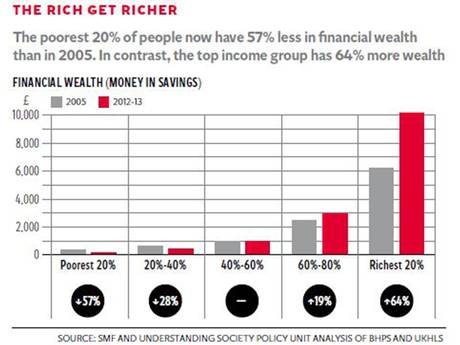
The graph shows the full story: the rich increased their wealth by 64% between 2004 and 2013, while that of the poor dropped by 57%:
6-Poverty-Graphic

[Image stolen from The Independent]

While its not mentioned in the article, the Conservative / LibDem policies of tax cuts for the rich and cuts for the poor undoubtedly contributed to this upwards redistribution. Yes, in a time of hardship, rather than helping those in need, the government pillaged them and gave their money to the rich. And that is simply vile.

Doing less with more

Since coming to power, the National government's command to the public service has been to "do more with less". So we have a biosecurity crisis and longer hospital waiting lists (sorry, non-waiting lists, because now you don't even get on the list) and a failing justice system. But there's one sector which has avoided cuts: the spies. The GCSB's budget has increased from $48.9 million in 2008 to 74.7 million today. But despite this, they are apparently collecting less intelligence now than they did then:

New Zealand's foreign spies are gathering less intelligence than they did seven years ago, the country's top spook says.

Acting director of the Government Communications Security Bureau Una Jagose has been in the job just ten days, following the resignation of Ian Fletcher.

Jagose was answering a question from Prime Minister John Key, who was chairing Parliament's Intelligence and Security Committee. It is just the second time the committee has been open to the public.

"As I understand it, today we collect less intelligence than we did seven years ago...there hasn't been any radical shift upwards as has been suggested in the media."


Note that this is intelligence, not raw data, so its a subtle dodge around the real question of the level of interception and collection. But it also shows the ineffectiveness of their new methods, and their inefficiency as an organisation. We're paying the the GCSB 50% more money to do less than they did seven years ago. Any other department with that sort of performance record would be being restructured into oblivion right now. But I guess the rules are different when you operate in secrecy and your "oversight" committee is legally forbidden from inquiring into your operations.

Holograms, reptilians, and the OIA

This week's amusing OIA request: is David Seymour a hologram? He's denied it, even offered to let people feel him (at "$5 a feel", of course - ACT members don't give it away for free), but this proves nothing: while he doesn't have an "H" on his forehead, he still has that uncanny resemblance to Arnold Rimmer, and he could be hard-light.

And seriously, how do you respond to this sort of OIA? While it could be dismissed as frivolous (because no reasonable person could actually believe that David Seymour was an Arnold Rimmer clone, could they?), that's hassle. The Prime Minister's office has been here before, when they were asked whether John Key was a shapeshifting reptilian alien ushering humanity towards enslavement. And they took the easy way out: a refusal under s18(e) as "the document alleged to contain the information requested does not exist or cannot be found".

"Silly" OIA requests are a fact of life. There will always be some, the difference is that now with the internet we get to hear about them. And we get to see how the government (and David Seymour) responds.

"More than minor"

So, it turns out that the Auckland Council ignored the law in granting consent to fell the Titirangi Kauri:

Despite being advised that cutting down a 500-year-old kauri tree on a Titirangi property would have a "more than minor adverse effect", Auckland Council granted the consent anyway.

Neighbours and protesters opposed to the removal of a stand of old native trees to make way for houses say the council ignored the views of its own landscape planner Gordon Griffin.

[...]

In a May 2014 report, Griffin told the council that the development would involve "considerable visual impacts and modification of the highest quality vegetation..."

"I agree that there would be adverse effects that are more than minor..." he wrote.

If the effects on the environment are considered to be more than minor the law says a consent application must be publicly notified, those opposing it say.

However, Griffin said that on balance he supported granting consent for the development at 42 Paturoa Road. It was subsequently granted without being notified.


I'm not an expert on the RMA, so I'm not sure whether this is grounds for the Council to revoke the consent, but it certainly seems to be grounds for a judicial review. Unfortunately, that's a hugely expensive process. we need a much cheaper way of holding public authorities to account where they have apparently behaved unlawfully.

Meanwhile, the Save Our Kauri petition is now over 23,000 signatures. Go ahead and add to the pressure.

Spying on friendly nations

Today's GCSB leak: the GCSB spies on friendly trading partners for America:

New Zealand spies on Vietnam, China, India, Pakistan, South American nations and a range of other countries to help fill gaps in worldwide surveillance operations by the United States National Security Agency (NSA), documents show.

[...]

The NSA profile of the GCSB reveals the New Zealand organisation is running spying operations against 20 or more countries, including friendly nations and trading partners.

The eavesdropping stretches from India and Iran in Asia to isolated scientific bases in Antarctica. These countries are listed in the NSA report in a section headed "What Partner Provides to NSA".

The NSA officer's review said the GCSB "continues to be especially helpful in its ability to provide NSA ready access to areas and countries ... difficult for the US to access".

It said the "GCSB provides collection on China, Japanese/North Korean/Vietnamese/South American diplomatic communications, South Pacific island nations, Pakistan, India, Iran and Antarctica".


With the exception of North Korea, with whom we're technically still at war, none of these nations are our enemies, and most are close trading partners. And as with the GCSB's spying on the Pacific, it doesn't advance our national security, let alone our international relations, at all. Instead, we spy on our friends simply so we can give sensitive information about them to our other "friend", the USA.

This isn't in our interests. Its not consistent with our position as a friendly nation which respects international law - let alone with how we see ourselves (it also seems inconsistent with the GCSB's legal objectives). And if this is what our spy agency does - spies on friends rather than enemies, partners rather than threats - then we are better off without it.

Tuesday, March 10, 2015


1080, blackmail and terrorism

By now we've all heard about today's announcement of a threat by anti-1080 loonies to contaminate infant formula unless the government stopped using 1080. The story is still developing, but there's some interesting points already:

  • The threat was made in November, but only announced today. Fonterra has prior on covering up health scares to protect their brand, and this smells like more of the same. And it seems that it was only announced today because the media were finally getting wind of it. So, we learn about a significant threat for media management reasons, not because the police think we need to know about it.
  • While the police are calling this blackmail, there's a word for threatening to kill (which poisoning infant formula is likely to do) or cause serious risk to the health or safety of the public for the purpose of unduly compelling the government to do or not do something: its called terrorism. As for why they're not going down that route, maybe they think it will be too hard to prosecute, or maybe its just because their expected perpetrators aren't Maori or Muslim. Note that even if the threat is a hoax, it is still threats of harm to people or property and punishable by seven years imprisonment.
  • John Key and Nathan Guy have called this "ecoterrorism", but there's no "eco" about it. The environmental movement in NZ supports the use of 1080, because it kills threats to the environment (see also: the Parliamentary Commissioner for the Environment). It is hunters - people like Guy - who don't.
The last bit is particularly disturbing. We have a Prime Minister who has significantly increased surveillance powers, and who will be staging a review in just a few months to grab more, hyping up a domestic threat by pointing the finger at an innocent party. Its pretty easy to see where this is going to go, and its not going to be pretty.

Pork and poor governance

Yesterday, faced with losing the Northland byelection and their easy majority with it, National resorted to outright pork-barrelling and promised to upgrade ten bridges in Northland. Andrew Geddis has a great analysis of the actual need for this (very little), and basically calls it corruption. I wouldn't go that far - corruption benefits donors and cronies, not voters - but its certainly the sort of pork-barrel politics you see in the US. And its nakedly so. This morning, when asked about the timing of the decision, John Key said it was planned before the election but delayed by Kim Dotcom and Nicky Hager (yes, really). But this afternoon, Transport Minister Simon Bridges gave a more honest answer: on Friday:


So, the day after that shock poll then.

No matter who you support, this is appalling governance. Who gets roads and other public services should be decided on need, not on whether the government is in danger of being embarrassed in a by-election. And such decisions should be made after appropriate cost-benefit analysis, not on a whim by the PM's electoral strategy team. But clearly, National doesn't care about any of that, and can't even be bothered pretending any more.

The flag referendum bill

The government has finally released its New Zealand Flag Referendums Bill. As expected, the bill provides for two referenda, the first selecting between four alternative flags by preferential voting, the second a runoff between the most popular alternative flag and the current one. The actual referendum mirrors the process of the Referenda (Postal Voting) Act 2000 (with appropriate changes for two referenda, one of which uses a different voting system). If we updated our referendum legislation to cope with such possibilities, we wouldn't need to include it every time the government wanted to ask us a question.

There's one interesting feature, though. The Citizens Initiated Referenda Act 1993 imposes a $50,000 spending limit on advertisers. There's no such limit in the new bill. From the timeline's mention of a "regulated advertising period", one was clearly contemplated, but it has now clearly been removed. Which is something the government owes us an explanation for. Spending limits are a normal part of referenda in New Zealand, designed to ensure a fair process and level playing field. The only reason to remove them is because you want the process to be dominated by money. And that just isn't good for our democracy.

Collection, surveillance, and interception

Back in 2013, John Key promised he would resign if there was mass-surveillance of New Zealanders. Now that the former head of the GCSB has admitted that there is mass-surveillance, which includes New Zelaanders, he's changed his mind. His reason? Because he's "sure the lawyers would tell you there is a difference" between mass-surveillance and mass-collection. At this stage, we should all remember John Key's view of lawyers: "I can provide you with another one that will give you a counterview", and this morning he's reportedly not even sure what the word he was hiding behind yesterday means anyway, but it doesn't matter. Because firstly, from a targets point of view, there's no difference whatsoever. Just as with public security cameras, it doesn't matter whether someone is watching them right now; what's important is that a) you know you're being watched; and b) they can look at the data whenever they want. And that's the case with the GCSB's spying on kiwis in the Pacific, regardless of what word games the Prime Minister plays.

But more importantly, none of it legally matters. Because the GCSB Act doesn't talk about "surveillance" or "collection" - it talks about "interception". What's "interception"?

intercept includes hear, listen to, record, monitor, acquire, or receive a communication, or acquire its substance, meaning, or sense

Its a pretty expansive definition, which covers not just the traditional ideas of someone sitting there with a pair of headphones while you're on the phone, but also recording it for later use, acquiring it from a foreign "partner", or even just being given a summary. They don't have to look at it - simply recording or acquiring it is enough. And it applies to any communication whatsoever, whether phone calls or internet or Morse code.

It is clear from what we've seen so far and what has been admitted that there is mass-interception across the Pacific. Because of the method - "full-take" - that mass-interception necessarily includes the private communications of New Zealand persons. The scale of that interception seems to be well beyond a level where it could be considered "incidental", and to piss on the legal requirement to minimise impacts on third parties. John Key was the Minister in charge of the GCSB at the time, and he still holds overall responsibility through his national security portfolio. The buck for this stops with him, and its time we held him accountable for what the spies have done under his watch.

Monday, March 09, 2015


Australia are torturers

Its official: Australia's refugee gulags violate the Convention Against Torture:

An independent expert has found aspects of Australia's asylum-seeker policies have breached the United Nations Convention Against Torture.

A report addressing concerns about Manus Island, as well as recent amendments to maritime laws, is due to be submitted to the UN Human Rights Council today.

It was prepared by Juan Mendez, the UN special rapporteur on torture.

Human Rights Law Centre director of legal advocacy Daniel Webb says the report finds detention of asylum seekers on Manus Island, and conditions at the centre, violate the convention.

Mr Webb says the torture convention prohibits subjecting people to cruel, inhuman or degrading treatment, and the report confirms Australia is failing to meet this basic standard.


Bring on the prosecutions. And if Australia won't prosecute itself, then we should do it for them.

A nation of loraxes

Yesterday news broke that an Auckland developer was planning on razing a 500 year-old Kauri tree - one of only 200 remaining - to make way for a deck. It was appalling news which showed a complete disregard for the environment. But this morning, protesters turned out to save it:

About 50 people have gathered to save a 500-year-old kauri from the chop this morning, and have scored a significant victory.

Residents of the Auckland suburb Titirangi have vowed to stop the felling of the tree, arguing that is unfair to lose such a treasure from their neighbourhood.

Contractors had been due to chop down the tree this morning but left saying they did not have the power to remove protesters.


Its great to see people getting out to save their local environment, and it shows that kiwis care about the trees and will speak for them. But they shouldn't have to. we used to have a law enabling local authorities to protect significant trees under the RMA. National effectively repealed that law. And the result is what we're seeing in Titirangi today: greedy developers destroying the environment for private profit. If we want to really stop it, we need to enable councils to protect trees properly again, rather than having the law effectively be a licence for the chainsaws.

Meanwhile, if you'd like to show your opposition to the murder of this tree, there's a petition here.