Wednesday, July 08, 2015


No democracy for Canterbury

Back in March, National announced a public consultation on whether democracy would be restored to Canterbury. Today, they released their foregone conclusion: nope:

Environment Canterbury (ECan) will move to a mixed governance council of seven elected councillors and up to six appointed in 2016 as a transition to a fully elected council in 2019, Environment Minister Dr Nick Smith and Associate Local Government Minister Louise Upston announced today.

[...]

The mixed governance plan means a majority of ECan councillors would be elected at the local body elections in October 2016, with four elected at large in Christchurch, one elected from North Canterbury for the districts of Kaikōura, Hurunui and Waimakariri, one elected from mid-Canterbury for the Selwyn and Ashburton districts, and one from South Canterbury representing the Timaru, Mackenzie, Waimate districts and the parts of Waikati north of the Waitaki River.


National are so proud of this decision that they released it under cover of a sportsball game in an effort to bury it. And no wonder: it continues the unjustified removal of Cantabrians' democratic rights to ensure that farmers can continue to steal their water and destroy their rivers.

As for the consultation, National has this to say:
534 submissions were received, of which 475 were form submissions generated through an online tool organised by the Labour Party and opposed to the model.

The implication: the views of these people who had taken the time to submit were ignored because of the method they had chosen. Its typical National party arrogance, and it makes it clear that the consultation exercise was simply a sham. National doesn't want Cantabrians (and specifically Christchurch residents) to vote, and they don't give a shit what people have to say about it.

But the question is whether it will pass. National no longer has an easy Parliamentary majority, and are dependent on the votes of either Peter Dunne or the Maori Party to pass this. If neither votes for it, Canterbury's democracy is restored by default. So I think we need to start piling the pressure on those MPs to ensure that this bill doesn't pass.

£93 billion

That's the scale of corporate welfare in the UK, according to an analysis by the Guardian:

Taxpayers are handing businesses £93bn a year – a transfer of more than £3,500 from each household in the UK.

The total emerges from the first comprehensive account of what Britons give away to companies in grants, subsidies and tax breaks, published exclusively in the Guardian.

Many of the companies receiving the largest public grants over the past few years previously paid little or zero corporation tax, the analysis shows. They include some of the best-known names in Britain, such as Amazon, Ford and Nissan. The figures intensify the pressure on George Osborne, the chancellor, just as he puts the finishing touches to his budget. At the heart of Wednesday’s announcement will be his plans to cut £12bn more from the social welfare bill.

Yet that sum is less than the £14.5bn given to companies in direct subsidies and grants alone.


And to put this total in context, its an eighth of the total UK government budget, and more than the UK spends on education. Removing it and making these tax-cheating corporations pay their own way would instantly balance the government's books - or erase the Tories' cuts to health and welfare. And yet, we're told that it is poor people in need, rather than rich tax-cheats sticking their hand out, who are the problem.

Perhaps the data-journalists at the Herald could do a similar analysis for New Zealand?

Cancelled

Some good news on the climate front: Genesis Energy has cancelled its planned (and consented) Rodney gas-fired power station:

Genesis Energy has confirmed the gas-fired power station planned in Rodney, north of Auckland, has been scuttled.

The company's general manager of strategy and corporate affairs, Dean Schmidt, blamed flat demand for electricity, which has seen big power projects put on hold by several companies.


Its unclear whether they've returned the consent, but the land they were planning to use is now for sale, making it a moot point. And so one of the biggest potential future sources of greenhouse gas emissions, which would have increased emissions by 2% and continued to spew carbon into the atmosphere for 30 years, isn't happening anymore. I'd call that a win.

But its not enough. If we are to decarbonise our electricity sector and achieve our 90% by 2025 renewables target, we need not just to ensure that all new plants are renewable, but also to actively shut down around half our current thermal generating capacity. The gradual closure of Huntly's remaining two steam turbines will get us partway there, and Taranaki Combined Cycle (the original monster emitter) will reach the end of its design life in 2023. Provided we ensure that these plants are replaced with geothermal and wind rather than more gas, we might just make it.

"Something special"

In last year's election, John Key campaigned on the promise that New Zealand was "on the cusp of something special". But less than a year later the economy is cooling and we're heading for recession again. It turns out that Key's "something special" came and went without us even noticing. But instead of economic nirvana and prosperity for all, it just meant unaffordable houses, people dying of cold-related illnesses, and longer queues at foodbanks. That "something special" was only special for rich MPs with multiple properties in Auckland. For the rest of us, it was indistinguishable from recession.

The kicker: while the Household Labour Force Survey won't be out until next month, its unlikely to have droped much since March, if at all, so National's "something special" means unemployment of ~5.5%, a full 2% higher than under Labour. And that's as good as it gets under National: an extra 50,000 people out of work, just to keep wages low. And meanwhile, the rich laugh all the way to the foreign tax-haven. If that's Key's idea of "special", he can keep it.

Tuesday, July 07, 2015


Climate change: Committing to failure

The government announced its climate change target today: 30% by 2030! Except that its not quite the same as our previous targets:

New Zealand will commit to a new, more ambitious climate change target,Climate Change Issues Minister Tim Groser announced today.

“This target is to reduce our greenhouse gas emissions to 30 per cent below 2005 levels by 2030,” Mr Groser said. “This is a significant increase on our current target of five per cent below 1990 emission levels by 2020.”


[Emphasis added]

Yes, they shifted the baseline just so they could get a target which rhymed. But what does that mean in real numbers? An 11% cut from 1990. Hardly "significant", and definitely not "ambitious". While other developed nations are promising cuts of 40% from 1990 over the equivalent timeframe, we're sitting here with our thumb in our arse.

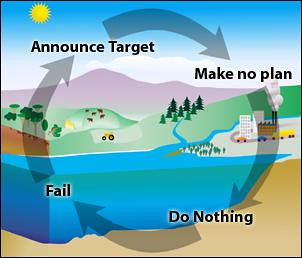
But its not just unambitious - it also commits us to failure. National has committed us to a 50% reduction in 1990 emissions by 2050. Earlier I pointed out that any target below 27% was dumping the effort of emissions reductions unfairly on future generations. And National isn't even doing half that. It's the classic New Zealand climate change policy:


As a country, we can and should do better than this.

Tonga: Defying the monarchy

Last week, Tonga's unelected inbred monarch over-ruled the elected government, decreeing that the country should not ratify the UN Convention on the Elimination of All forms of Discrimination against Women. The government's solution? A referendum:

The Prime Minister of Tonga says the issue of signing a United Nations Convention which recently led to protests in the country, will be put to the public to be voted on, after the coronation celebrations end.

[...]

'Akilisi Pohiva, who supports CEDAW, says the decision is up to the people.

"It is a matter for the people to decide and since the public is split, there's a split amongst the people of the country, I think the best thing to do is to give it to the public to make the decision."


Tonga is priest-ridden, and its priests are willing to lie about the effects of CEDAW to boot, so I suspect they'll lose. But it does send a clear signal to Tonga's king who is in charge: the people.

What are they hiding?

Surprise, surprise! National doesn't want the public to see the documents about Murray McCully's sordid Saudi sheep bribe!

The Foreign Affairs Minister is delaying releasing information about his dealings with the Saudi businessman he has given millions of dollars of taxpayers' money to.

[...]

Mr McCully said he needed a further 30 working days before he could respond to an Official Information Act request asking for information about his dealings with Mr Al-Khalaf.

He said he needed the extra time for consolation and to source the relevant documents, but added he may not release any information at all.

Primary Industries Minister Nathan Guy also delayed releasing information about the Government's extension of the ban on live sheep exports.


And according to Twitter, Tim Groser is doing the same. Its a transparently political delay, in an attempt to bury the news and wait for public outrage to blow over, and a perfect example of how the government manipulates the system to serve its own ends. But it invites the obvious question: what are they hiding? Because if those documents showed that everything was above board, they'd release them in a flash.

New Fisk

Greece debt crisis: EU 'family' needs to forgive rather than punish an impoverished state

Europe rejects democracy

Yesterday, Greeks overwhelmingly voted to reject the German austerity which has destroyed their country and killed over 11,000 Greeks. You'd have expected the EU, supposedly built to ensure democracy in Europe, to respect this decision, or at least recognise the democratic limits it set on Greece's negotiating position, and try and negotiate a new deal within those boundaries. But you'd be wrong. Instead, Europe has doubled down on destroying Greece, with the European Central Bank (which deliberately caused a bank run last week to threaten the Greek people) refusing to back Greece's banks, and Angela Merkel saying that there was no possibility of negotiations. In other words, the only acceptable Greek position is total surrender, and the only acceptable Greek government is a quisling one which actively works against the expressed democratic desires of its people. As for democracy, it apparently has no role in European politics.

And now that that's been made clear, so has the solution. An undemocratic Europe is not worth belonging to, and no democratic country should participate in such an institution. Democracies should leave the EU.

Monday, July 06, 2015


Bad faith from police

Nicky Hager's case against the police over the search of his home was in court today, and its already produced one surprising revelation: the police broke their promise not to use seized material until its status had been decided by the courts:

Police broke their undertaking not to use information seized from the home of Dirty Politics author Nicky Hager, the investigative journalist's lawyer claims.

Officers acting on a complaint from blogger Cameron Slater, whose hacked emails were the source of much of Dirty Politics, seized electronic and other material in the early October search of Hager's Wellington home.

[...]

Some of the documents have been shown to Hager in an edited form. One that was first released in edited form was later shown in its entirety.

Hager's lawyer, Felix Geiringer, says the unedited version indicates police have broken the undertaking to seal Hager's information and not use any of it pending a decision in the case.

It is alleged an officer involved in the search read a document and instructed another officer to make inquiries about a person whose name appeared in the document.


This is significant. The court case is over whether the information could have been seized at all, or whether it was covered by journalistic privilege. By breaking their undertaking, the police deliberately sought to make the court's decision moot and to benefit regardless of whether their search was ruled lawful or not. It is a deliberate attempt to subvert the ruling of the court and a clear sign of bad faith and a lawless attitude among the police - the same sort of approach which saw charges thrown out in Nelson recently. And those responsible for it need to be held to account.

Freedom of speech wins in Iceland

Iceland has repealed its blasphemy law:

Iceland has legalised blasphemy following a campaign started by the Pirate party after the Charlie Hebdo terrorist attacks in France. The move to repeal the 75-year-old law, under which blasphemers could be imprisoned for up to three months or fined, faced opposition from some church groups.

In a statement on its website, the party wrote that it was a victory for freedom of speech and showed the principle could not be defeated by terrorist attacks. The law, which was passed in 1940, had been an attack on “humorists and all the friends of freedom of expression”, the party added.


Good. Blasphemy is an archaic offence whose sole purpose is to protect religion from criticism and punsih those who do not subscribe to the popular orthodoxy. It has no place in a free and democratic society. But while Iceland has joined the free world, blasphemous libel is still on the books in New Zealand. Isn't it time we repealed it?

New Fisk

Greeks don't want to leave Europe, but Europe wants revenge on the Greeks
In the tiny village of Hercules frightened workers plan to vote No to the EU

OXI!

The votes are in in Greece's referendum, showing a decisive rejection of surrender. The question now is what happens next. Will Germany force Greece from the Euro and the EU as revenge for daring to take this decision to the people, or will they accept that the Greek government simply has no mandate for further destructive austerity and negotiate a deal which might actually help Greece rather than destroying it? And the fact that people can credibly ask that question, that economic warfare against the democratic decision of an EU member state is a live and "serious" option, tells us how sick the European project is, and how divorced it has become from its ideals.

If Europe crushes Greece, then the European dream is dead. The only Europe worth belonging to is a democratic one which works for its people rather than its bankers.

Friday, July 03, 2015


An English veto

The UK has developed a distressing habit of making significant constitutional changes for partisan political reasons. Last term it was the Tories' attempt to equalise the size of electorates - a move which would have improved their electoral system but was driven purely by an effort to shaft the Labour party. That was defeated - the LibDems decided it wasn't in their partisan political interest for UKanians to have an equal voice in Parliament - but this term we have "English Votes for English Laws" aka "preventing Scottish MPs from voting on things".

As with equal sized electorates, there's a reasonable argument underlying it: the UK has devolved a lot of policy to the Scottish Parliament, so why should Scottish MPs be allowed to vote on matters which only affect England? But the real driver is the desire of the Conservative party - which dominates in England - to lock Labour out of power forever, combined with some pretty toxic English supremacism. Because what EVEL actually means is that in order to govern in practice - that is, enact its policies - a party would not to win not only the confidence of parliament as a whole, but also of English members - basically, an "English veto" on government, forever. England uber alles!

The core problem here is that, for historical reasons, Westminster effectively does double duty as both the UK and English Parliament. But the solution to this isn't self-serving changes to standing orders to diminish the role of Scottish MPs and make it clear that they are a subject people, but a fully devolved English Parliament with powers equal to the Scottish one. But the UK will never do this - firstly, because it is democratic; and secondly, because then it would invite quite reasonable questions about what Westminster is actually for. After all, if Scotland and England and Wales and Northern Ireland each govern themselves, do they really need 650-odd elected parasites (and fuck knows how many unelected ones in the Lords) to handle the few issues they decide need to be handled jointly? I think not.

As for the solution, the SNP is threatening a legal challenge, which will of course fail due to Parliamentary Privilege. Which leaves them with the other option: walk. If the Tories want England, let them have it. At least Scotland can be free.

The law, in its majestic equality, allows both poor and rich alike to access the courts

(With apologies to Anatole France)

Yesterday in Question Time the Greens' David Clendon took the government to task over legal aid cuts. National has cut legal aid funding by 15% in the last five years and reduced access, leading to a rise in clients who cannot afford lawyers representing themselves (which is both bad for them - the lawyer who represents themself has a fool for a client - and for the court system, as their inexperience leads to delay and disruption). But National doesn't think this is a problem, and certainly not one attributable to its cuts. And it insists that

the courts are open to those who wish to avail themselves of them

In other words, "let them eat cake". Which is I guess the answer we can expect from Ministers on quarter of a million dollar salaries about anything affecting real people.

Meanwhile, in the UK, we can get a glimpse of our future. Over there, the government has also cut legal aid, driven by the same relentless push for austerity and uncaring attitude to access to justice. The result? Yesterday, the lawyers went on strike:
Today is the first day of a wildcat legal strike across the country. Those who find themselves arrested will struggle to get legal aid representation. Within days, the courts system could grind to a halt.

It is happening across England and Wales. The strike will be followed in Merseyside, Greater Manchester, London, Devon, Leeds, Cardiff, Halifax, Derby, Birmingham, Sunderland, north and south Tyneside, Newcastle, Huddersfield, Dewsbury, Bradford, Hull, Kent and Reading. It's impact will be felt everywhere.

It is not technically a strike. Lawyers can't strike. Instead, meetings across the country saw solicitors and barristers gather together and come to individual decisions about whether they would back the action. It is a convoluted process with a complex way of refusing labour.


Basicly, they're refusing to accept legal aid cases anymore. Which means that people arrested will all have to queue for the services of already overworked duty solicitors, and will (if sensible) exercise their right to refuse to be interviewed without a lawyer present, meaning that they can't be interviewed at all. The courts will face similar blockages. If the strike holds, the entire system will fall over, because it essentially operates by goodwill.

That's only one part of the problem, but if New Zealand lawyers want to be properly paid for legal aid services, maybe they should try the same thing here?

New Fisk

Greece debt crisis: What happened to democracy when it’s a case of 'Vote Yes or else'?

Another crony appointment

This morning Nick Smith appointed former National Party President and MP Geoffrey Thompson to the board of the Environmental Protection Authority. Naturally, of course, they don't mention those rather pertinent facts in his bio, referring only to his "central government" experience.

As with other appointments, he may or may not be qualified, but his political background makes it look like pure cronyism and casts doubt upon the integrity of the appointment process and the Minister.

Thursday, July 02, 2015


Getting the message on Nauru

I've been watching with concern as the pressure created by acting as Australia's gulag guards has undermined Nauru's democracy. The destruction of judicial independence, the erosion of free speech and the right to protest, the suspension of opposition MPs and now their effective detention through the cancellation of their passports all show a clear trend away from democratic norms, driven by a desire by the Nauruan regime to avoid criticism and challenge over detention and corruption. And New Zealand is helping to pay for all of this - New Zealand aid money helps fund Nauru's yes-courts and the police who beat protesters and the prisons their opponents are stuck in. But that might be about to stop:

Foreign Minister Murray McCully has sought a meeting with the Nauru Government and indicated New Zealand's $2.3 million annual aid funding is under review because of growing concern about civil rights abuses.

A group of prominent legal university academics released an open letter to Mr McCully, in which they urge him to take a "more forceful approach" to Nauru and withdraw New Zealand aid funding for Nauru's justice department if the Nauru Government did not respond.

In a statement in response to the letter, Mr McCully said he had asked representatives of the Nauru Government for a meeting in Sydney next week.

"We take our responsibilities as a donor to the justice sector seriously, and we will be discussing our contribution with the Nauru government in light of recent events." New Zealand gives $2.3 million a year in aid to the justice and education sectors in Nauru. Of that $1.2 million goes toward funding its justice department.

Good. Because if Nauru is going to behave like a dictatorship, they can fucking well pay for it themselves. The only money we should be giving them now is money for new elections.

The UK gives up on child poverty

One of the few good things that Tony Blair did as Prime Minister of the UK was to legislate for a statutory target for the reduction of child poverty. This not only represented a commitment to eliminate this scourge, but it also ensured constant monitoring. But the current UK government wants to cut welfare spending, which will almost certainly make things worse. Their solution? Repeal the target and the reporting:

The government is to scrap its child poverty target and replace it with a new duty to report levels of educational attainment, worklessness and addiction, rather than relative material disadvantage, work and pensions secretary Iain Duncan Smith has said.

[...]

The downgrading of the existing target comes before a big cut in tax credits, expected in the 8 July budget as part of a drive to cut the welfare budget.

The cuts to tax credits would have made it even harder to reach the old child poverty target by 2020, the target date set by Labour and the end point of this parliament. Although some MPs welcomed the attempt to focus on the root causes of poverty, the removal of the material income target was denounced by Labour as the obituary notice for compassionate Conservatism.


So, replace reporting about poverty with reporting clearly aimed at demonising the poor. Because that's what tories do. But its also clear that the government has simply given up, and that they have no intention of doing anything to help. The UK will be paying the cost of that for decades to come.

OIA review update

The Government Administration Committee issued its report on the 2015/16 estimates for Vote Ombudsmen, which included the usual horror story about how the Ombudsman's Office is bleeding staff (and institutional knowledge) due to poor pay. But it also had an update about the state of the Ombudsman's investigation into government OIA practices:

The impetus for this review has been allegations that the OIA process is being circumvented for a variety of reasons. We were interested to hear from Dame Beverley that she thinks the problem is due more to ignorance of the Act and inexperience in implementing its provisions, than maleficence. She
said that Ministers’ staff are in particular need of training as ignorance and inexperience of the Act leaves Ministers exposed. Dame Beverley also observed that those who know best how the Act should work are no longer with the public service. Looking ahead to the release of the ombudsmen’s report, Dame Beverley thinks that it is likely to recommend establishing a regular audit process. A review of guidance might also help with systemic issues or gaps in governmental agencies. She also expects considerable improvement in response times.


A regular audit process is a good idea. While OIA complaints have been rising, the vast majority of OIA refusals go unchallenged, meaning there is no effective review of them. Auditing responses would allow this review, and allow misunderstandings of the Act by public servants to be corrected.

Agency and Minister's responses to the OIA survey will be released later this year, followed by the Ombudsman's report and recommendations. I'm looking forward to both.