Thursday, November 26, 2015


Fiddling the OIA

Even the Police Association's Greg O'Connor recognises that the police and wider public sector are fiddling the OIA:

Police and other government departments are reluctant to hand over public information because of potential embarrassment to politicians, says Police Association president Greg O'Connor.

"Anyone who is dealing with the public sector at the moment - there tends to be an attitude of making people work very hard for their Official Information Act information," he said.

[...]

Mr O'Connor said the public service - including police - had adopted a defensive posture when it came to releasing information.

"Commissioners are answerable to ministers as any other CEO in the public sector. The stuff that is going to embarrass government is going to be hidden in official documents or statistics."


This is a problem that everybody seems to recognise, yet nothing is ever done about it. The Ombudsman, who should be hacking into the perpetrators with a flaming sword, seems helpless. And the consequences for confidence in our political system and the rule of law are significant. If the government and public servants can flout the law like this, why shouldn't we?

Ngai Tahu supports dictatorship in Canterbury

The Local Government and Environment Committee is currently hearing submissions in Christchurch on National's latest bill to extend the Canterbury dictatorship. And surprisingly, local iwi Ngai Tahi wants to deny Cantabrians their democratic rights:

Restoring full democratic elections would be a "step backwards" for Canterbury, Ngai Tahu says.

[...]

Ngai Tahu emerged as one of the few groups at the hearing supporting the bill.

It was one of several groups, including Canterbury councils, that asked for government intervention in 2010. The changes resulted in the elected councillors losing their seats.

"The proposal to return to a fully democratically elected model does not provide sufficient recognition towards the Treaty partnership," its submission says.

"It is considered that the proposal would be a step backwards for Canterbury as a number of other regions have moved towards equitable representation for iwi at a governance level."

The iwi supported continuing the mixed model after the 2019 elections, proposing to incorporate three Ngai Tahu appointed commissioners alongside three appointed by the Government.


This is nonsense. If Ngai Tahu is concerned about ensuring iwi representation, it should argue for it. There's more than one way to address that problem, and councils are experimenting with various methods (some have Maori seats, Auckland has a statutory Maori Advisory Board, while Rotorua has an explicit partnership with Te Arawa giving them representation on council committees). There's scope for Ngai Tahu to find a model which works for them. But instead, they're arguing that the democratic rights of other Cantabrians continue to be suppressed and that they continue to be forbidden from controlling their own region. And that is fundamentally anti-democratic and a failure to uphold the Treaty Partnership.

National's RMA "reforms"

This morning the government announced that it had cut a deal with the Maori Party to introduce (and presumably pass) a bill for RMA "reform". The complete bill is here, and I've been going over it. The good news is that National's plans to gut environmental protection by removing environmental values (and adding a development clause) to the Act's "matters of national importance" is dead. They're adding risks from natural hazards, which is uncontentious, but nothing else. The bad news? They're trying to get it in via the back door by requiring local authorities to ensure they have sufficient "development capacity" through land zoning and infrastructure. Meanwhile, much of their explicitly anti-democratic agenda to reduce public participation and allow the Minister to overrule local communities and dictate plans from Wellington remains unchanged.

They're also using the bill to completely rewrite the EEZ Act to allow the Minister to "call in" applications and appoint stacked boards to produce the desired outcome - exactly as warned by Greenpeace a fortnight ago. So, I guess we'll see those seabed miners back for another go at strip-mining the seafloor, this time with Paula Rebstock collecting a huge government salary to rubberstamp the applications. I'm extremely surprised the Maori Party accepted this, given their professed environmental values, and some pointy questions need to be asked there. Because given their recent complaints about being short of money, the natural suspicion is that another deal has been done...

Compare and contrast

School gets aid despite assets worth millions, Dominion-Post, 13 January 2014:

A high school under investigation by the Ministry of Education for illegal fee-charging has been criticised for being allowed to operate under its own set of rules.

Early last year former private school Wanganui Collegiate was integrated, after a falling roll and increasing debt meant it would fold without a government bail-out.

In 2012 the prestigious decile 10 school was running an expected loss of $800,000 and subject to government providing funding, a Crown Monitor was appointed to oversee its finances until integration went ahead in January last year.

When Wanganui Collegiate applied for integration it said it would likely close without financial support from the Crown, Ministry of Education acting head of sector enablement Marilyn Scott said. "The proprietor acknowledged capital assets were held but not liquid assets that could be used to pay the operational expenses of the school."

According to Wanganui Collegiate's annual report for the year ending March 31, 2013, the college had more than $3 million in freehold land and, in addition, the college grounds were valued at $1.7m.

The school's foundation owns three commercial properties in Wanganui, two of which have rateable values of just under $1m, while the third property, a car park on the corner of Victoria Ave and Glasgow St had a rateable value of $4.75m.


Maori girls school to close after 110 years, New Zealand Herald, 26 November 2015:
A secondary school for Maori girls will be closed after 110 years because of concerns about its debt and governance.

Education Minister Hekia Parata confirmed this morning that Turakina Maori Girls College in Marton, 40km north-west of Palmerston North, would close in January.

Ms Parata said there was "a great deal of goodwill" towards the Decile 3, state-integrated Presbyterian boarding school and she was saddened to have to close it down.

"However, the financial information provided ... doesn't give me confidence that the proprietor is able to clear its debt and become financially viable," she said.


The lesson is clear: if you are rich, white, and worth millions, the government ignores advice to shovel money at you. If you're poor and brown (and for girls), they let you fail. National's racism and pandering to the rich pervades every aspect of policy.

Wednesday, November 25, 2015


Climate Change: A look at our future

Climate change seems like a very abstract problem. Sure, emissions are out of control, our governments seem intent on doing nothing about it for fear of offending the fossil fuel industry, and the effects are all vague and general and very far away anyway. So the met service has decided to make the problem a little more concrete with a weather report from 2050:

A mock weather report looking 35 years into the future has painted a stark picture of a wintry New Zealand, ravaged by extreme conditions including both drought and flooding.

Just days before world leaders meet in Paris to discuss a global climate change deal, a futuristic fake MetService forecast for August 14, 2050 has appeared on social media.

TV meteorologist Chester Lampkin shows that winter temperatures that day ranging from 12C to 20C -- up to 3C warmer than normal for a winter's day.

It shows showers and thunderstorms across Northland, Auckland, and Hamilton, with 70-90mm daily rainfall causing flooding and closures to an "underwater" Northern Motorway, North-Western Motorway, and Tamaki Drive.

Coastal flood warnings are in effect for Auckland's coastline.

Most of Canterbury, meanwhile, is parched and under a fire risk.


If you're planning to be alive in 35 years, this is what you're looking at. John Key and Bill English don't care - they'll be dead, so why act? But the rest of us should care - and should force the government to do something about it.

Satire: $1 million to buy science headlines

Science and Innovation Minister Steven Joyce today announced nearly $1 million of new funding to produce news headlines suggesting that the government is positive about science.

"This government wants to appear positive about science and technology, and I am pleased to be able to announce this additional funding for a second tranche of projects designed to produce headlines saying that," Mr Joyce says.

"We’ve provided funding to the next highest ranked applications that were not able to be funded with the initial $1 million available in 2014/15. We want to support as many of these innovative headline-generating projects as possible.

"This means 25 new projects will be carried out in communities around New Zealand, gencouraging young people to care about science. Some of them will be inspired to go on and study science at university and become the scientists of tomorrow. Of course, they'll be laid off within three years and forced to go overseas or change careers, but the government's target of generating positive headlines about itself will have been achieved".

The Unlocking Curious Minds programme is part of the Government’s strategic plan to encourage all New Zealanders to get engaged with science and technology. It ties in with the innovation and skills stream of the Business Growth Agenda, and the National Statement of Science Investment, which commits to underfunding scientific research.

"The National Government believes that science funding should not be spent funding public good research by scientists," said Mr Joyce. "Instead it is focused on what matters: generating positive spin for itself while leaving the fundamental problem of an under-resourced science sector unaddressed".

Inspired by the Government spending yet more money encouraging young people to pursue careers in science while cutting jobs at the other end of the pipeline.

Vanuatu: Ending the farce

Last month 14 Vanuatu MPs were convicted of bribery and corruption and sentenced to imprisonment, robbing the government of its majority. But rather than accept this and resign, Prime Minister Sato Kilman initially tried to cling to power, refusing to call Parliament to allow a confidence vote. Now, vanuatu's President has ended the farce by dissolving Parliament and calling a snap election:

Vanuatu's president has dissolved the country's parliament in an attempt to resolve an impasse after the conviction of 14 government MPs for bribery.

The 14 MPs lost their appeals against both their convictions and jail sentences last week, forcing them to vacate their parliamentary seats.

The convictions meant the opposition, led by Ham Lini, controlled two-thirds of the remaining seats.

President Baldwin Lonsdale today called a snap election and dissolved the parliament, citing the inability of the prime minister and opposition to form a government of national unity.


And hopefully that's the end of it. A new Parliament can be elected, hopefully of people untainted by corruption, and Vanuatu can finally move on.

Police, censorship, and policy

This morning we learned that the New Zealand Police had "blacklisted" a leading crime researcher from accessing police data, supposedly because he talks to criminals in order to study crime. At face value, its merely Orwellian, or maybe Hellerian, but of course the "associating with criminals" is merely the excuse. The real problem is that the Police don't like what Jarrod Gilbert has been saying about them or crime policy - so they're trying to destroy his career as revenge.

So far, so normal: our police are chronic abusers of power and obsessed with maintaining their own public image. They've shown a willingness to manipulate and fabricate evidence in criminal cases (and continue to endorse those who do so); of course they'll do so to protect themselves from critics. But Dr Gilbert going public has exposed a very real problem with how the police view research and how they can shape our policy debate.

First, the context:

The data sought by Dr Gilbert was for a government research project into "alcohol-related crime and proximity to premises with liquor licences in Christchurch". He was working with a team of five researchers - four with doctorates and two who are full professors.

We would like such questions - and similar ones, such as "is the war on drugs working", or "what sort of policing works best" - to be determined by the evidence. But the police don't permit that. Their research contract is based on a commercial model, rather than a public service one, and so gives them not just a right of review, but also a right to "correct" findings if they are "negative", or to veto publication altogether. And to make it clear that the police only want results they approve of, they explicitly threaten to blacklist the researchers and "any organisations connected to the project ... from access to any further police resources" if they don't like the results.

All this is fine if you're talking about research into what colour of toilet paper people prefer, or which sort of widget sells better - but not so good when you're talking about public interest research like that performed by Dr Gilbert. And when you're talking about public interest research which will be used by or to convince other government agencies about the merits or otherwise of policy proposals, it becomes absolutely toxic. If a line of research does not accord with police preconceptions and whims, then they can censor your results, rewrite them, or even prevent you from doing the research altogether. Which allows them to shape the policy debate to ensure that the outcome matches those pre-conceptions rather than the data. Its policy-based evidence-making!

How much of the law enforcement policy landscape is shaped by this police censorship? We just don't know. But it suggests a rich line of questioning (both of police, and of other government departments) for any journalist who wants to ask.

Tuesday, November 24, 2015


An offer we should refuse

Andrew Little is off to Australia tomorrow, to stick up for kiwis where John Key won't. In response, the Australians are suggesting that we join them and become part of Australia:

Most Australians would support hardworking Kiwis becoming citizens - and if New Zealand wants closer ties it should become his country's seventh and eighth state, an Australian senator who helped review tough new deportation rules says.

Ian Macdonald, who chaired the parliamentary committee that recommended a new law that has led to the detention and deportation of New Zealanders, said Labour leader Andrew Little's calls for, among other improved rights, access to citizenship for Kiwi expats would be uncontroversial with most Australians.

"The issue of closer ties with New Zealand is one beyond any limited expertise I might have, but as an observer...I would love to have New Zealand join us perhaps as the seventh and eighth state - you can have two. And what a wonderful country it would then be, and I wouldn't need a passport to get across to Queenstown with the wineries, it would be great."


No thanks. Because the three words that spring to mind when I think of Australia are racism, militarism and corruption. Australia has an explicitly racist refugee and immigration policy, which uses arbitrary detention, torture and rendition to keep Australia white. Its always first to sign up to America's imperialist wars, which New Zealand wants no part of. And its political culture is utterly toxic and corrupt, with MPs routinely having to be jailed because they seem incapable of obeying laws against taking bribes or corruptly using their influence to pay off their donors. And that is something that we should want no part of. Joining Australia would be turning to the dark side - and its an offer we should refuse.

Fiji: More torture

Another story of torture in Fiji - and once again its the police who are responsible:

Rajneel Singh writhed in pain on his Lautoka Hospital bed last night

The wounds on his body told a gruesome story.

They were slowly healing but Mr Singh, 32, still felt unbearable pain.

It comes admist claims Mr Singh found details of plans to destabilise the Government on a computer in his internet cafe.

The Lautoka internet cafĂ© owner claimed some Police officers then “tortured” him using “hot rods” and dumped him in a pine forest between Nadi and Sigatoka.

The criss-cross scars on his back (see photo), and burn marks on his hands and legs appear consistent with Mr Singh’s story.

Later, he alleged, officers wanted him to change his statement to say the scars were self-inflicted. He declined and called acting Police Commissioner Brigadier-General Sitiveni Qiliho. He is now being guarded by military officers and Police officers from Suva have been sent to investigate his claims.


Fiji really needs to clean up its police force and start jailing torturers. But with the military back in charge, that's looking unlikely.

This does not inspire confidence

John Key was on the radio this morning, trying to scare us all about terrorists again so we'll fall into line and let the spies do whatever they want. Today's scare: there are "one or two" New Zealanders so dangerous that they're being kept under 24/7 surveillance. Others are being watched specificly because they are raising money for ISIS (which is a serious crime). Which invites the obvious question: why haven't they been arrested?

Asked by Radio New Zealand why authorities did not take action against people who were sending money offshore, Mr Key said: "That's exactly the question I asked my officials: 'If you see someone that looks like they're planning some sort of activity, why can't you deal with it?'

"And the answer I always get from my agencies is that it's not as clear-cut when you get to court. They claim different things, and ... they just wanted absolutely firmer evidence to take them to court."


Right. They spend millions of dollars a year watching these people, who they "know" are involved in terrorism, a criminal activity - and yet they are unable to gather sufficient evidence to secure a conviction in court. Which suggests two options: either they're doing an appallingly bad job of it, or they're watching the wrong people. Either way, it does not inspire confidence that our spies are doing their job properly.

Monday, November 23, 2015


One country at a time

Indonesia has announced a moratorium on executions:

Indonesian presidential chief of staff Luhut Panjaitan made the announcement, saying the country needs to focus on fixing its economy.

The decision comes seven months after the execution of convicted Australian drug traffickers Andrew Chan and Myuran Sukumaran.

"We haven't thought about executing a death penalty with the economic conditions like this," coordinating security minister Luhut Pandjaitan told reporters. He didn't elaborate.


Possibly that's a sign that the Australian boycott of Indonesia over their executions is working.

A moratorium is not repeal, and Indonesia has had moratoriums before them resumed executions. Still, anything that stops them killing people is a Good Thing - and hopefully, this time, it will become permanent.

Vote on the TPPA!

handsup-400px

Last month I highlighted an interest effort to run a DIY referendum on the TPPA. Voting has opened, and you can vote on it here.

The obvious criticism is that a DIY effort has no legal effect. But neither does a referendum under the Citizens Initiated Referenda Act 1993. What it can do is send a message, and help focus public anger if the government ignores that message. So, go ahead and vote - the worst that can happen is that the government ignores it.

New Fisk

Whoa there, David Cameron! Haste and rhetoric is no recipe for peace

Let the rich pay for their own golf courses

Over the weekend, Bernard Hickey pointed out an unpalatable truth: the Auckland Council is giving massive subsidies to the rich. How? By subsidising golf courses:

Did you know that 1400 members of the Remuera Golf Club receive the exclusive benefit of a piece of Auckland Council-owned land valued at up to $517 million?

The club pays rates of $130,000 a year. If up to 70 per cent of that land was broken up and sold for housing and the rest left in parks, it would produce revenues of $16.5 million a year.

That's an annual subsidy of $16.37 million, or $11,700 a member. That includes Prime Minister John Key, who is an honorary member.

Even if each member played 50 rounds a year, that would be a subsidy of $233 per round or $13 a hole.


This is obscene. It is also, in a city facing a serious housing crisis, absolutely unjustifiable. And unfortunately, its a common problem across the country. Here in Palmerston North, for example, the rich are subsidised through rates rebates - which until recently were denied to charities serving the poor.

Cities need public spaces. But golf courses aren't public spaces. Instead, they're exclusive preserves of the well-to-do, the New Zealand equivalent of a medieval English forest. That would be fine of their rich members were paying for them, but they're not. We're paying for it. And we shouldn't be. Auckland should either redevelop its golf courses, or sell them. Either way, the rich can pay for their land-hungry snob-clubs themselves.

Friday, November 20, 2015


Fiji: The military obstructed justice

Ten days ago the Fijian government forced out its police chief over his efforts to prosecute torturing, rapist soldiers. Naturally, the Fijian government lied and said he was departing for "personal reasons". But today, former police commissioner Ben Groenewald has made it clear why he left; because the military obstructed justice:

Fiji's former Police Commissioner has urged his replacement to open an independent criminal investigation against the military officers he says obstructed the course of justice.

In a statement published by Islands Business, Ben Groenewald says the way the military thwarted police efforts to arrest Pita Matairavula, a suspect in the brutal assault of Iowane Benedito, played a big role in his decision to resign last week.

Mr Groenewald, who's back in his homeland of South Africa, says during a meeting where the Prime Minister and the acting commander of the military were present, he informed them that the police were going to arrest the five suspects in the Benedito case.

Four were apprehended the next day but it took several days before Pita Matairavula, a former body guard of the Prime Minister, could be arrested.


The problem? Groenwald's replacement, Colonel Sitiveni Qiliho, is the very person who obstructed the arrests. And its hard to escape the conclusion that he has been put in place to stop the prosecutions and restore military impunity.

This is Fiji's new "democracy": a military regime under a democratic mask, run by the same criminals by all the same methods. Our government should not allow itself to be fooled. Unless the Fijian government demonstrates a clear commitment to human rights and the rule of law, we should restore sanctions on it.

New Fisk

In a borderless world, the days when we could fight foreign wars and be safe at home may be long gone

Climate change: Ignoring a problem doesn't make it go away

Yesterday the Parliamentary Commissioner for the Environment released a major report on the impacts of sea-level rise on New Zealand. Its a major problem, which threatens to 30,000 homes and businesses and will inflict tens of billions of dollars of economic damage in the fairly near future. The government's response? Do nothing:

Finance Minister Bill English says the Government will not budget for the costs of rising sea levels, despite a call from Parliamentary Commissioner for the Environment Jan Wright to plan for the cost.

[...]

English said he would not be including sea level rise as a fiscal risk in the Budget "in a hurry".

He said Wright's report was "pretty speculative" both on the level of sea level rise and the likely cost that would incur - and whether that would change any decisions.


So, do nothing to reduce emissions, then do nothing to deal with the effects of that inaction. Instead, dump the costs and the politically unpleasant decisions on someone else (and meanwhile, sell up your coastal property portfolio and dump it on some other sucker). That's pretty much the government's plan. But this is a real problem, and it is already having real effects. Our government has a major role in both minimising the damage caused by and compensating the victims of natural disasters. Well, this is a natural disaster, albeit a slow-motion one. And it is the government's job to do something about it. Which means providing policy tools to allow councils to restrict coastal development and manage retreat, and (in the longer term) compensation for those whose homes will be rendered uninhabitable by the government's continued refusal to act. We do this for earthquakes and for landslides, with building standards and EQC. And we need to adopt the same approach for climate change too.

OTOH, if they don't, these decisions will be made for us by insurance companies, and by nature. If you live in a low-lying area, your home and business will become uninsurable, which will effectively destroy its value overnight (banks won't give you a mortgage unless a property can be insured, so no-one can buy an uninsurable home - which means you can't sell one). And when the rising seas wash away the only road to Eastbourne, its residents will simply have no choice but to move. Ignoring the problem won't make it go away - it will simply make dealing with it harder and more expensive. But I guess if National cared about long-term costs, they would have dealt with this problem (and rotten state houses, and child poverty) long ago.

Thursday, November 19, 2015


Drones feed terrorism

And that's according to the people who murder people with them:

Four former US air force service members, with more than 20 years of experience between them operating military drones, have written an open letter to Barack Obama warning that the program of targeted killings by unmanned aircraft has become a major driving force for Isis and other terrorist groups.

The group of servicemen have issued an impassioned plea to the Obama administration, calling for a rethink of a military tactic that they say has “fueled the feelings of hatred that ignited terrorism and groups like Isis, while also serving as a fundamental recruitment tool similar to Guantánamo Bay”.

In particular, they argue, the killing of innocent civilians in drone airstrikes has acted as one of the most “devastating driving forces for terrorism and destabilization around the world”.


There's more, but its basicly what we've known all along: that you don't defeat terrorism with terror. You don't defeat murder with murder. Instead, that just gives you an ongoing problem where your efforts to solve it continue to feed the cycle and make it worse. And the only people who do well out of that are terrorists, militaries, and the parasitic industries who feed them.

Urgent?

Last year, National rammed through a new anti-terror law, giving the Minister of Internal Affairs new temporary powers to cancel passports without notification and for an extended period. We were told this was urgent - so urgent that a select committee couldn't be permitted time to read the submissions on the bill - but was it really?

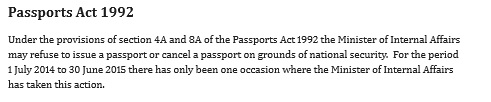
If the law was urgent, you would have expected those powers to have been used immediately after its passage. So were they? Of course not. Here's the Department of Internal Affairs' statutory declaration on its annual use of passport cancellation powers from its Annual Report:
passports2014
Note that that's under sections 4A and 8A, not the schedule. The conclusion: these "urgent" powers have not been used. That's good - people's rights have not been abused. And yet it suggests strongly that there was simply no case for urgency, and casts doubt on whether they were ever necessary in the first place. National abused our Parliament and our democracy to pass this law. They told us it was urgent and necessary to prevent imminent terrorist threats. And yet whenever we've checked that claim - on emergency warrantless surveillance, on whether DIA had ever had trouble extending a passport revocation in the courts, and now on urgent passport cancellation, we find that it was not necessary and that new powers have not been used. The obvious conclusion: the whole law was not justified, but was simply a power grab by the SIS to increase their budget and shift the status quo ahead of a statutory review which might have been unwilling to grant new powers (but would be less willing to remove existing ones). And National let themselves be played like a fiddle. The other obvious conclusion: it should be repealed.



