That's the only way to describe Auckland property developers John Lenihan and Jane Greensmith, who this morning had their henchmen attack and ringbark the 500 year old Titirangi kauri. But this wasn't just an act of spiteful environmental vandalism - it was also done deliberately to subvert a High Court judicial review scheduled to be heard this afternoon, to make it pointless by establishing facts on the ground. And that's something the court should take very seriously.
Something else they might want to consider: criminal nuisance charges against those responsible. Because taking a chainsaw to a tree when there's someone in it clearly endangers their life and safety regardless of whether the ultimate intention is to cut the tree down or not. And people need to be held criminally accountable for that.
Finally, I hope anybody thinking of doing business with these scumbags keeps in mind their established pattern of malice, deceit, and lawlessness. These are simply not people you can trust. They should be treated accordingly.
Wednesday, December 23, 2015
Malicious orcs
Monday, December 21, 2015
Denmark plans to rob refugees
The Syrian refugee crisis has brought out the best in some countries. Germany has opened its borders, Canada its hearts. Denmark, OTOH, is different: they plan to rob refugees at the border:
An MEP from Denmark’s centre-right ruling party has defected in protest at government plans to seize valuables from refugees to help fund their stay in the country.
Denmark has mainly been a transit country for refugees, and the minority Liberal government hopes to deter more from seeking asylum by taking valuables or cash worth more than 3,000 Danish crowns (£290) during border searches.
[...]
The immigration reform bill, which has yet to be approved by parliament, would give authorities “the power to search the clothing and luggage of asylum-seekers and other migrants without a permit to stay in Denmark with a view to finding assets which may cover expenses,” the immigration ministry said.
Denmark expects 20,000 asylum seekers this year, compared with almost 200,000 expected by Sweden. Many of the refugees passing through Denmark this year have been bound for its neighbour.
There's an obvious and unpleasant historical comparison here - but apparently that's the sort of country Denmark is now: one which robs the helpless for its own profit.
Friday, December 18, 2015
Plain packs win in Australia
Four years ago, the Australian government passed a plain tobacco packaging law, requiring cigarettes to be sold in plain, vomit-coloured cartons with no distinctive branding. The tobacco industry was outraged, and tried to challenge the law, first in the Australian courts, and then - after a sham restructuring in an effort to establish jurisdiction - under a free trade deal Australia had signed with Hong Kong. And now, they've lost, with the FTA arbitration tribunal rejecting the case on jurisdictional grounds:
The federal government has won its case against tobacco giant Philip Morris Asia challenging Australia's tobacco plain-packaging laws.
It means the former Gillard government's plain-packaging laws, introduced in 2011, will remain in place.
The tribunal in the arbitration, based in Singapore, has issued a unanimous decision agreeing with Australia's position that it has no jurisdiction to hear Philip Morris's claim.
So much for that. And hopefully the Australians will demand costs from the cancer-sellers for their efforts.
Meanwhile, plain packaging has been on hold in New Zealand pending the outcome of this case. Now it's been resolved, hopefully we'll see some rapid progress.
Thursday, December 17, 2015
Illegal
That's apparently the High Court's ruling on the police raid on Nicky Hager:
The judge found that the search was illegal. He said that the Police had failed to disclose relevant information to the Judge who issued the warrant. As a result, he formally declared that the warrant was “fundamentally unlawful”. He also found that the search was therefore unlawful. Justice Clifford also expressed concerns about other aspects of the Police’s actions.
I'm waiting to read the full judgement, but this is good news. Meanwhile, I'm wondering if the police officers who lied to the judge to get that warrant will keep their jobs, or whether they will face prosecution under s175 of the Search and Surveillance Act. Sadly, I think we all know the answers to these questions. The police think the law only applies to other people, not themselves.
Climate change: How bad is NZ's climate fraud?
Earlier today I highlighted the New Zealand government's climate change policy of paying its Kyoto bill with dodgy (and now banned) "emissions reduction" units while banking AAU (which will then be used to pay for future targets). So how dodgy are the units we're using? We're literally claiming emissions reductions for burning coal.
As noted earlier, the credits we're turning over include 86.3 million tons of "reductions" from Ukraine - which is noted for being particularly dodgy. The raw data is here [XLS], and project details are in the Ukranian JI Registry. I've extracted this data for the top 20 projects NZ has purchased emissions "reductions" from here. Those projects account for 61.4 million tons of emissions - or roughly a year's worth. And eleven of them claim reductions for "spontaneous ignition of coal waste piles".
What does that mean? The Stockholm Environment Institute working paper referred to in that Guardian article has the details. It means:
extract[ing] coal from coal waste piles, leaving bare rock which does not ignite, and combust[ing] the extracted coal, mostly in power plants. Emission reductions are claimed for the avoidance of waste pile fires, while emissions from combustion of the extracted coal are not counted because it is assumed to substitute coal which would be otherwise obtained from coal mines. For the amount of coal that would otherwise be obtained from coal mines, projects also claim emissions reductions for avoiding upstream emissions from coal mining, including methane emissions associated with deep coal mining and CO2 emissions from electricity consumption by coal minesThe Institute's conclusion: "we rate additionality of this project type as not plausible and overcrediting likely to be significant".
New Zealand is claiming at least 31.2 million tons of "reductions" form this bullshit - half a year's emissions.
But it gets worse. The Stockholm Institute identifies
Note that the government probably didn't buy these credits itself - they were likely turned over by participants in the ETS to pay for their emissions. But the government has chosen to use them to cover our Kyoto emissions, in order to be able to bank its AAU and claim it as a reduction later. And given that it has now banned these types of credit, it did so in full knowledge of how dubious they are. The effect this will have on our international reputation is left as an exercise for the reader.
Correction: Corrected references to "the" Ukraine in this and the following article, as its apparently insulting (like calling us "the colonies").
Climate change: A policy based on fraud
The government released a pile of climate change reports today on its Kyoto Protocol CP1 and CP2 (to which we are not a party) obligations. And they expose the naked fraud which lies at the heart of our climate change policy.
First up, Kyoto. Under the Kyoto Protocol, New Zealand had accepted a target of limiting its net average emissions over the to 2008 - 2012 period to gross 1990 levels. Which in practice meant a target of 309.5 million tons over five years. So how did we do? Our emissions kept increasing, and in fact increased by around 20%, but thanks to the net-gross scam, we were able to use forest reductions to cover that. So, we met our CP1 target, fairly, within the (broadly accepted) Kyoto rules. And according to those rules, the surplus can be "banked" against targets for later commitment periods.
But then the real scam begins. Because according to our CP1 "true-up" report, we paid for a huge chunk of our emissions with international units. Most of this is ERU's under Kyoto's Joint Implementation mechanism, and a staggering 86.3 million tons of that came from Ukraine - where huge amounts of credits were issued fraudulently and as part of an international criminal scam. But we're also using 16 million tons of Kyoto Certified Emissions Reductions issued under the Clean Development Mechanism. These are also hugely problematic - around 50% of CERs were issued for destruction of refrigerant gases - gases which had been produced solely so they could be destroyed for credit. Which is why such "credits" are no longer accepted, and cannot be used in Kyoto's second commitment period.
But Kyoto CP1 Assigned Amount Units can. And by paying for our CP1 obligation with these dubious and possibly fraudulent credits, New Zealand has assured that it has a huge surplus of AAU. 123.75 million tons worth, or about two years worth of emissions. And predictably, we're using this banked credit to "pay" to "meet" our self-imposed CP2 target:
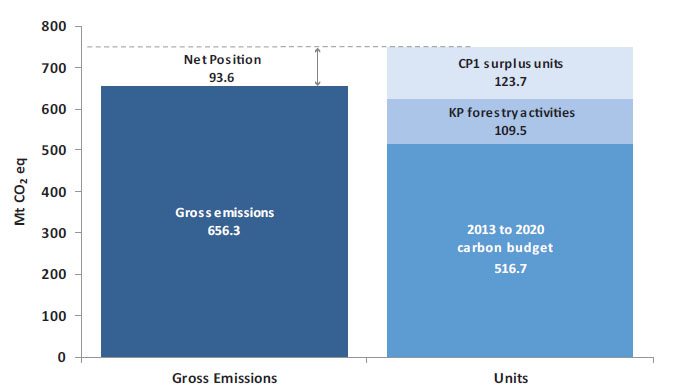
New Zealand’s projected gross emissions and units acquired over 2013 to 2020 period* (as of 14 December 2015)
Or, to put it simply: we bought fraudulent credit in CP1, we laundered it into AAU, and we're effectively using it to pay to meet our CP2 reductions. And then we'll no doubt try and carry over that surplus (plus any other fraud we can launder) to pretend to meet the (self-imposed, not legally binding) 11% by 2030 target we offered at Paris. And meanwhile, our emissions will just keep on rising.
And this is why other countries no longer support international carbon trading: because its an outright scam. And the fact that New Zealand's climate change policy is based on it speaks volumes about both our honesty and our commitment to real change.
Wednesday, December 16, 2015
John Key is still losing his "war on P"
Back in 2009, John Key launched a "war on P", in the form of his Methamphetamine Action Plan. An important part of the plan was regular progress reports, tracking the price, purity and availability of methamphetamine, so we could see if the police were in fact winning.
So how are they doing? Badly, just as they always have. Six years after launching it, the price, purity, and availability of methamphetamine are unchanged. In other words, Key's much-vaunted "war" has achieved absolutely nothing.
This is supposed to be an empirically-based policy. The empirical results show that it is a failure. Will Key accept this? Or will he just keep throwing good money after bad, wasting more police time and effort in the hope that the results will be different this time? Sadly, I expect it will be the latter - which is the very definition of insanity.
Bullshit victim-blaming
Yesterday, the Children's Commissioner revealed that more children than ever before were living in poverty. John Key's response to this massive failure of government policy? Victim-blaming:
Prime Minister John Key says drug dependency is a major contributor to poverty in New Zealand, as a damning new report claims that one in three Kiwi children are living in hardship.
[...]
In an interview with Newstalk ZB's Leighton Smith this morning, Mr Key said a range of factors contributed to poverty but he singled out drug abuse as a concern.
He said drug dependency locked people out of the labour market and kept them in poverty.
Subtext: child poverty isn't the government's fault, but the fault of drug-addicted parents. Exactly the sort of thing Key's right-wing, victim-blaming base want to hear. Except its utter bullshit, and obviously so.
First, the hard stats: back in 2013, Key's government started drug-testing beneficiaries (and making them pay for it). So, how many drug addicts did this programme uncover? Sweet fuck-all. In the first year of the programme, they tested almost 30,000 people - with just 47 positive results (another 74 people refused testing, which National regards as an admission of guilt rather than a proactive attitude towards personal privacy). So, that's a positive rate of 0.16% (or, at most, 0.4%). And this is supposed to explain a third of all kiwi kids living in poverty.
Or, we can look at the trend over time. In 1984, child poverty was 15%. Today, its 29%. John Key's explanation for this is "drug addiction". So where are the addicts? After all, an extra 14% kiwi kids living in poverty due to drug addiction should mean roughly an extra 14% kiwi parents (give or take) as addicts. That's roughly one in seven - a huge number/ So, where are they? They should be clogging our courts, our streets, and (according to John Key, who thinks "drug addiction = joblessness"), our dole queues. But they're not. And in fact, illicit drug offences have dropped over the past 20 years, from 24,417 in 1994 to 16,543 today (1984 figures are not available).
In short, Key's position is just bullshit victim-blaming. But if he didn't blame his victims, he'd have to accept responsibility for this crisis, and then do something about it. And that's the absolute last thing National and John Key want to do.
Tuesday, December 15, 2015
Absurdity in Thailand
How absurd is Thailand's lese majeste law? A man could be jailed under it for insulting the king's dog:
A Thai factory worker could go to prison for a "sarcastic" post on social media in which he disparaged the king's dog, Tongdaeng.
The worker, Thanakorn Siripaiboon, faces years in prison for his crimes, which include sedition and insulting the king.
As the New York Times reports, Siripaiboon's lawyer, Anon Numpa, said the precise insult towards the dog was not specified in the military court where he was charged.
The idea of punishing people for criticising those in power is deeply undemocratic. Punishing people for snarking about their pets is simply absurd. Rather like monarchy itself, really.
National fails on child poverty
For the past year, National has been talking about a recovery, even a "rock star economy". Things are doing so well John Key gave himself a $13,500 pay-rise as a christmas present. Meanwhile, more children than ever before are living in poverty:
Nearly one-third of all New Zealand children are living in poverty and more than half of those kids will never escape it.
The latest Child Poverty Monitor report, released by Children's Commissioner Russell Wills, laid out a grim reality for more than 300,000 children.
It draws on a number of different measures by the Ministry of Social Development (MSD) to paint a single picture of child poverty in New Zealand.
While the number of children living in the most severe hardship has decreased slightly, a total of 29 per cent of children lived with income poverty, compared to 24 per cent at the last measure.
Children were also far more likely to be living in poverty than pensioners, of which 13 per cent lived on incomes that were less than 60 per cent of the current median income. That worked out to be around $30,600 or less.
Particularly worrying, about 14 per cent of children were living without basic essentials like fresh fruit and vegetables, a warm house and decent clothing. But it was difficult to interpret trends, because some of the measures had changed in the past year.
The government's response? Try and obfuscate the issue by talking about their "range of measures" and pretending that its all about "benefit-dependent households". But its not. These kids aren't just the children of beneficiaries, but the children of ordinary working New Zealanders, who have seen their wages and conditions stagnate or even go backwards under National's repressive employment laws. They live in poverty not because of some failure on the part of their parents, but because National's economy delivers for the few, not the many. And ultimately, they suffer because National chooses to do nothing about this. As Tolley's response shows, reducing child poverty simply is not a priority for this government.
It should be - because child poverty costs us a huge amount of money. It leads to unemployment, crime, health, and lower economic potential, imposing long-term costs on the welfare, education, health, and justice system budgets. Reducing it is an investment, not a cost. But like their friends in the business community, National is not interested in investing in New Zealand. They'd rather run it into the ground instead.
Monday, December 14, 2015
Climate change: Still doing nothing
Over the weekend, 200 countries agreed a new climate deal in Paris. Despite the rhetoric of "the end of the fossil fuel era" and "the worlds greatest diplomatic success", its just the usual bullshit of promises no-one intends to keep sweetened with money no-one intends to give. Tellingly, it doesn't include any binding emissions reduction targets, making the entire thing purest hot air. Its aspiration, not action - and its a bit fucking late for that.
As for our government, its clearly got the message. In the face of an empty agreement, it has no plans to change its policies:
Mr Key told Morning Report New Zealand's significant steps on emission reduction would not involve cutting back on the mining of oil, gas and coal.
"Not in terms of the production side of the house, if you like ... I can't exactly tell you off the top of my head how many barrels of oil we produce a day but it would be what Saudi Arabia, Iraq and those other countries, Iran, produce in a nano-second. It's just not large."
[...]
[Climate Change Minister Tim] Groser said no change in goverment policy was needed in the short term, but in the long run, New Zealand would have to do more to meet the agreement. Part of that would be finding technical solutions to agricultural emissions.
...which they intend to do by doing... nothing! In other words, we're going to respond to this "historic" agreement by just keeping on shitting in out atmosphere. Which is what happens when there are no binding targets.
But there's another, positive, consequence: no binding targets means no credible possibility of carbon trading. Which means that if the government wants to meet their 11% by 2030 target, they're actually going to have to reduce domestic emissions. Sadly, I expect that what will happen is that they'll simply refuse to meet it - or rather, refuse to enact policy and leave it as a problem for their successors, then denounce them when they try and do anything. Which of course is why we're in this mess in the first place.
Monarchical fiction again
Sigh. People hate the TPPA, and as with other controversial political topics - banning child beating, the 90 day law, and retrospectively approving Parliamentary spending - they're demanding the Governor-General do something about it, via a petition asking him to "command" the government hold a referendum.
These people are fools. In our constitutional system, the Governor-General "commands" nothing. They act only and always on the advice of elected Ministers, even to the extent of signing their own execution warrant if told to do so. They're a rubberstamp, nothing more, and the idea that they are (or should be) anything more than that is pure monarchical fiction.
But they're fools in another way too. Because if your whole argument is that the TPP lacks any democratic mandate (one I agree with), then surely the answer to that cannot be to appeal to an official who lacks one himself. Because fundamentally, the Governor-General is illegitimate. They are appointed, not elected. And that means they have no more right to make decisions in our name than Canterbury's unelected dictators.
If you want to defeat the TPPA democratically, then the answer is to vote out the government which signed it, and vote in a government which will withdraw from it. If no political party will offer that choice, then you need to argue and lobby and vote the fuckers out until one will. But appealing to the representative of a vestigial hereditary dictatorship is neither constitutional nor democratic.
Meh
So, John Key's vanity flag referendum has had the expected result, with National Fern pipping Labour Fern for first place in the preliminary count. Meh. It was always an uninspiring choice, and the addition of Red Peak - a flag which emerged from the grassroots and showed us what the process could have been like - at the last minute didn't change that. So now we have an uninspiring design stolen from a weetbix packet versus a colonial relic. And to be honest, I hate either option. So I gues snow its a question of what I hate more: Britain, or John Key?
I want the flag to change, but not like this, and not to John Key's stupid fern. So I'm with Simon Pound: vote for the current flag, then have another go at it in five years - and next time, do it properly.
Friday, December 11, 2015
This isn't helping
Speaking of ham-fisted anti-terror measures increasing radicalisation, Radio New Zealand has the appalling story of a kiwi Muslim questioned at the airport after visiting her family in Iraq. There seems to have been no justification for this questioning, and its primary effect is to reinforce the perception that Muslims aren't real kiwis and are enemies of the state who will not be left to live their lives in peace. Which is not exactly going to encourage a positive perception of the state which bullies them in this way, or encourage them to volunteer information which may result in others being similarly bullied.
Countering terrorism ultimately depends on community cooperation. And you don't get that by victimising and bullying an entire community. Instead, that just makes things worse. We have only to look at the UK or Australia for the consequences.
Making the problem worse
From the UK, a warning that ham-fisted anti-terror policing is radicalising Muslims:
UK authorities are radicalising young Muslims by tackling the terror threat in the wrong way, a former Home Office counter terrorism advisor has claimed.
Jahan Mahmood, who resigned from his government job over disagreements on counter-terrorism strategy, claims authorities are misrepresenting the severity of the threat facing the UK.
Mr Mahmood said far too many people were being arrested, with the majority never charged or convicted.
[...]
He claimed this led only to further radicalisation of already ostracised individuals, arrested on “very flimsy” evidence only to be released.
Apparently only 39 percent of those arrested in the UK under anti-terrorism legislation are ever charged. Which suggests a huge level of over-policing. And the experience of these unjustified arrests for the victims and their families and their communities is not exactly going to be a glowing recommendation of the British state. Instead, it makes it clear to them that the state regards them as an enemy and that they will not be permitted to peacefully get on with their lives like any other citizen. And that last bit - the basic denial of human dignity - is a chief driver of radicalisation and terrorism. Its hard to escape the conclusion that if the UK didn't look so hard for "terrorists", and didn't go around kicking in people's doors in the middle of the night because someone was seen wearing a hijab, they'd have a lot less of them.
The cost of austerity: Northland's forests
Back in October, Forest & Bird released drone footage of Northland's forests, showing them dead and dying due to rampant pests. The Department of Conservation should obviously be doing something about this, to prevent total ecological collapse. But they won't, because of budget cuts:
Six weeks after a Forest & Bird video revealed Northland native forests dying of neglect, the Department of Conservation (DoC) has admitted it has no plan or budget to save them and no intention of asking the government for more funding.
DoC manager for Northland Sue Reid made that clear this week to a meeting of the Northland Regional Council's environment committee.
[...]
"We have to show what we will achieve within our current budget, and it is not sustainable to just go cap-in-hand to the government for more money."
So, DoC is going to stand by in the face of a pressing ecological crisis because their Minister has cut their natural heritage management budget by $6 million and they're too chickenshit to ask for it back so they can do their job properly. It really makes you wonder what the point of them is. Meanwhile, National's austerity looks like it is going to cause permanent damage to Northland's forests.
...but I guess that just means more Swamp Kauri for Judith Collins' partner to export to China, right?
Thursday, December 10, 2015
The vandals are back
Back in March, a pair of environmental vandals in Auckland tried to have a stand of 500 year old kauri cut down. People rallied to protect the trees, and after days of protest and a treetop occupation, they were saved, with the landowners agreeing not to cut them.
But they lied. Today, the chainsaws were back again - as are the protesters. The good news is that the contractors hired to do the deed have walked off the job after being made aware of the issue; they care about their reputation. And it would be a brave tree-cutting firm who took it on now. But now that the vandals have gone back on their word once, any future promise they make simply cannot be trusted. The natural suspicion will be that they are simply saying whatever it takes to get the protesters to go away, so they can murder these trees when no-one is watching.
Ultimately, the only thing that will protect these trees from the chainsaw is robust planning protection from the Auckland Council. While the National Party, which supports environmental vandalism, has tried to make this difficult, it is still possible. And the Auckland Council should get a bloody move on in doing it.