Friday, June 07, 2019


Climate Change: National still peddling denial

One of the core ideas underlying the Zero Carbon Act is the idea of policy durability: that in order to be effective, climate change policy has to survive multiple changes of government. As a result, the Bill has been watered down and weakened in an effort to gain the support of the National Party. National is still peddling denial. In a speech to the Federated Farmers Taranaki agm in Stratford on May 24, National's climate change spokesperson Todd Muller made all the expected complaints about methane targets being "ridiculous". But he goes further than that. A lot further:

“The view, expressed particularly from Left of Centre, that somehow climate science is a locked box, and we know what the impacts are, is a complete nonsense.

“I’ve been overseas twice now and sat in audiences where hundreds of scientists have debated the interaction between gases, the other particles in the atmosphere, the ocean and their view of those interactions. If you’re not a scientist, this stuff gets eye-watering very quickly.

“The point is, this stuff is not conclusive.”


In public, National has been pretending that they're on board about climate change, that they recognise that it is an existential threat and that they need to be part of a solution. But in private, to their supporters, they're peddling the same old bullshit they were twenty years ago when they shitcanned the first attempt at an ETS, fifteen years ago when they opposed the carbon tax, a decade ago when they first opposed then gutted the current ETS: that the science isn't settled, that the climate isn't changing, that it's all just a big left lie.

What does this mean for policy durability? Pretty obviously, there can be no meaningful consensus with a party which doesn't even accept the reality of the problem, and which continues to put the interests of its polluting supporters above the survival of humanity. There's no point even talking to such people. Everyone interested in climate change policy learned long ago that engaging with deniers is a waste of time. You just block them and move on.

But its also a mistaken view of "durability" to base it on National's attitudes now. What realisticly matters is the attitude of the National Party in 2023, or 2026. And there's likely to be a lot of change between now and then, both from them and the public. When you look at durable policy in New Zealand, it isn't durable because the major parties sat down and negotiated it from the outset. Instead, the party in government made it durable: they legislated, and carried the public with them to such a degree that the other major party was forced to sign up to it to have any hope of getting elected. The classic example of this is the anti-nuclear policy: hugely controversial, National hated it, but it was so popular with the public that they were forced to promise to retain it, and they didn't dare go back on that even when they had a huge artificial FPP majority by which they could impose their will (and then, 20 years later, even hinting that they wanted to repeal it was pure political poison for them).

On climate change, there's the advantage that reality will win the public for you. The climate crisis is very obviously here, and getting worse by the day. Does anyone really think that the news over even the next three or six years is going to support weaker action? Does anyone really think that with fire and flood and homes washing into the sea, people are going to support a softer line on the fuckers causing it all? Does anyone really think this is all just going to go away?

Which is why worrying about "consensus" with Denier National is unnecessary. Instead, the government should legislate the strongest bill NZ First will allow them to - and dare National to oppose it. If they do, paint them truthfully as the party of denial, delay, and do nothing, and voters will do the rest.

Thursday, June 06, 2019


Not a good international citizen

I've spent the afternoon crafting a brief submission to Parliament on the International Treaty Examination of The War Crimes Amendments to the Rome Statute of the International Criminal Court. The government wants to ratify a treaty amendment which would make the use of chemical or biological weapons, expanding bullets or blinding lasers in "non-international armed conflict" (you know, the sort NZDF is in in Afghanistan) a war crime. That's good! Except there's a twist. Here's what the national interest assessment says about expanding bullets:

New Zealand could make an interpretative declaration upon ratification to clarify that the prohibition on expanding bullets in non-international armed conflict does not extend to situations where they are used by police or armed forces in law enforcement and counter-terrorism operations where the intent of the use is to avoid incidental civilian injury or damage.

Expanding bullets were one of the first things banned in international armed conflict, and they were banned for a reason: because they cause horrific and inhumane injuries. Banning them in non-international armed conflict - which is most wars nowdays - is a no-brainer extension of that principle. But instead of accepting that, New Zealand seems to be trying to weasel out of it with American-style interpretation games. And this is simply dishonest and wrong. Its like signing a treaty guaranteeing people unqualified ownership of their lands, forests, fisheries, and other treasures, but "interpreted" "unqualified" to mean "we can take it whenever we want": deceitful and two-faced. But its also stupid, in that other parties may not accept New Zealand's perverse "interpretation" allowing banned weapons to be used, which means that New Zealand police and soldiers who actually use them in any circumstances which could be considered a non-international armed conflict (like, say, Afghanistan) would still be exposed to prosecution. And insofar as New Zealand politicians and officials tried to shield them, they would be in the dock too as accessories.

This is not being a "good international citizen", Its being a cheat trying to excuse war crimes. And that is simply not acceptable.

Climate Change: Chile going carbon neutral

New Zealand is currently in the process of enacting legislation to set us on a pathway to carbon neutrality (except for cows) by 2050. Meanwhile, Chile - not a country we think of as being especially rich - is going the whole way:

Chile vowed to go carbon neutral by 2050 on Tuesday, in a plan hailed by experts as one of the most ambitious yet for a coal-dependent economy.

The host of the next UN climate talks in December president Sebastian Piñera pledged to close eight of the country’s 28 coal-fired plants by 2024.

The move would slash the share of coal within the electricity grid from 40% to 20% in five years, with a view to phasing out the fuel completely by 2040.


Chilean farmers are going to be carbon neutral. So why shouldn't New Zealand ones be the same? What makes them deserving of special treatment, either with respect to other New Zealanders, or the rest of the world? The answer is "nothing": their special target is just a subsidy to a privileged parasitical minority who have lived off us for far too long already.

New Fisk

The final punishment of Julian Assange reminds journalists their job is to uncover what the state keeps hidden
We fought for liberty, freedom and independence on D-Day. But what happened to these promises in the Middle East?

Climate Change: An existential threat

How bad is the threat of climate change? Existential risk to civilisation bad:

A new climate report co-authored by a former fossil fuel executive has painted a bleak outlook for the future of human civilisation - including nuclear war.

Existential climate-related security risk: A scenario approach, published by Australian thinktank Breakthrough National Centre for Climate Restoration, suggests climate warnings from the likes of the UN are downplaying the sheer chaos that could erupt by 2050 as the world warms.

If emissions don't start to fall until 2030 - behind the goal set by the 2015 Paris Agreement - the authors say the world could warm 3C by 2050 "due to the activation of a number of carbon-cycle feedbacks". This could result in sea levels rising 0.5m by 2050, 3m by 2100 as ice sheets and permafrost melt, and up to 25m in the longer-term.

"Thirty-five percent of the global land area, and 55 percent of the global population, are subject to more than 20 days a year of lethal heat conditions, beyond the threshold of human survivability," by 2050, the report says."


And what this means is famine, war, and death on a massive scale. Some countries will simply cease to exist. Others, facing starvation or water shortages or just not enough space, will go to war to secure those resources. And the pressure from that could push us into nuclear war. But even if we manage to keep the lid on that particular horror, the loss of farmland and the uninhabitability of major population areas is likely to mean a major population crash, and that's really not going to be pleasant.

As for 25m of sea-level rise, Floodmap shows us what that means for New Zealand: practically every major city will be underwater. Palmerston North will be a beach town. Hamilton, Rotorua, Taupo and Queenstown will be OK, and that's where we'll all have to live. I guess it'll be getting crowded then.

If we don't want this to happen, we need to act like this is an actual crisis, and reduce our emissions as quickly as possible. As for the foot-draggers who want to delay action so they can make a bit more money by destroying the world, we should treat them like they're trying to kill us. Because that is, in fact, what they're doing.

Wednesday, June 05, 2019


No press freedom in Australia II

Yesterday the Australian government raided a journalist for revealing its plans to spy on Australian citizens. Today, they're raiding the ABC for revealing that war crimes were committed by Australian soldiers:

Australian Federal Police officers are raiding the ABC's Sydney headquarters over a series of 2017 stories known as The Afghan Files.

The stories, by ABC investigative journalists Dan Oakes and Sam Clark, revealed allegations of unlawful killings and misconduct by Australian special forces in Afghanistan.

The search warrant names Oakes, Clark and ABC's director of News Gaven Morris.


The message is clear: the Australian government regards revealing its crimes and planned crimes as a crime. And again, that's not the sort of behaviour usually seen in a democracy. Tyrannies raid journalists, not democracies.

Climate Change: Try not to fly

How are people reducing their ecological impact to deal with climate change? In Sweden, they're giving up flying:

The number of Swedes taking the train for domestic journeys has risen as plane journeys inside the country have fallen, reflecting rapidly growing public concern about the climate crisis.

“Flygskam”, or flight shame, the feeling of being embarrassed or ashamed to take the plane because of the environmental impact, has become a social media buzzword along with the hashtag #jagstannarpÃ¥marken, which translates as #stayontheground.

Echoing the schoolgirl climate activist Greta Thunberg’s refusal to fly because of the harm to the environment, a survey published last week by Swedish Railways (SJ) found 37% of respondents chose to travel by rail instead of air, compared with 26% last autumn and 20% in early 2018.


Its relatively easy in Sweden, because they have a decent rail network, with 200km/h links between most major cities, and scheduled services which actually use them. But its still a substantial shift towards flying only when necessary, or not flying at all.

Obviously its harder in New Zealand, due to our shit-to-nonexistent rail service and Cook Strait in the middle. But we already have a no-fly movement in New Zealand. And following The Spinoff's advice to talk about what you're doing to normalise it, I'll break the "don't talk about my life" rule for once. Yes, I still fly. But not much. A couple of years ago, I decided I'd cap my discretionary air travel at two return domestic trips a year. I offset, of course (and Air New Zealand's scheme is pretty good), but the most effective offset is not to emit in the first place. If there's something unavoidable, like a wedding or a funeral, then I fly to that if I have to, and double the offset for every extra flight I make (fortunately those are few and far between). So, no flying to Auckland every couple of months for larps, no ducking over the Tasman for a weekend to raid restraunts, no international holidays and no larp-tour of Europe for me. It's not as environmentally friendly as it could be, but its a start, and I'm hoping to wind it down as my obligations elsewhere decrease.

Odious secrecy II

Last month, when the government released its Zero Carbon Bill, I highlighted how it contained an odious expansion of secrecy which throw a veil over practically all decisions made by the Independent Climate Change Commission. I wanted to see how this particular atrocity came about, so I sent an OIA to the Minister seeking all advice and communications on the drafting of this particular clause. I got the response back yesterday, and I was appalled. The short version is that there's not really any advice, and the Minister apparently has no fucking idea how this part of his bill works, or even what it actually says.

In his response, the Minister says:

Clause 10 of the Climate Change Response (Zero Carbon) Amendment Bill requires the Commission to keep information confidential and allows otherwise confidential information to be disclosed to the Commission. The intent of the Government was that, for the purpose of accessing relevant information under the CCRA, the Commission should be treated as though it were an administrating agency and be subject to equivalent obligations of confidentiality.

This provision may be relevant for the Commission in providing advice about the settings of the New Zealand Emissions Trading Scheme (NZ ETS). Cabinet has agreed that this will be a regular function of the Commission. It will be brought into operation by proposed legislative changes to improve the scheme.

The only substantive piece of "advice" on this is two paragraphs of a Cabinet paper:
The Commission will require access to government-held information in order to fulfil its functions. The provisions of the Bill will need to balance access to this information with the need to safeguard legally privileged or personal information. Where appropriate, it will also have statutory provisions to allow it to access information that it might not otherwise be able to gain, for instance under the CCRA.

I propose that, for the purpose of accessing relevant information under the CCRA, the Commission should be treated as though it were an administrating agency. It will also be subject to equivalent obligations of confidentiality.

[Emphasis added]

Where to begin on this? Firstly, the Bill at present only has powers (in s5ZV) to obtain information from government entities, about how they will be affected by climate change, how they plan to deal with it, and what progress they are making on those plans. Every single one of those agencies is already covered by the OIA, so as a matter of principle, their information should be open. It shouldn't become secret simply because another government agency has asked for it. But that is the effect of this bill (more on this below). Secondly, the Bill at present has no powers for the Climate Change Commission to gain information from non-government agencies. Those powers might be coming in the ETS legislation, but even if they are, as I noted earlier the Official Information Act already contains protections for legally privileged and personal information, as well as information that is "commercially sensitive" or which has been compelled by an enactment. These protections are more than sufficient to safeguard the interests the Minister claims to be concerned about. If he believes they are not, then he needs to make a much better case than this for bypassing them.

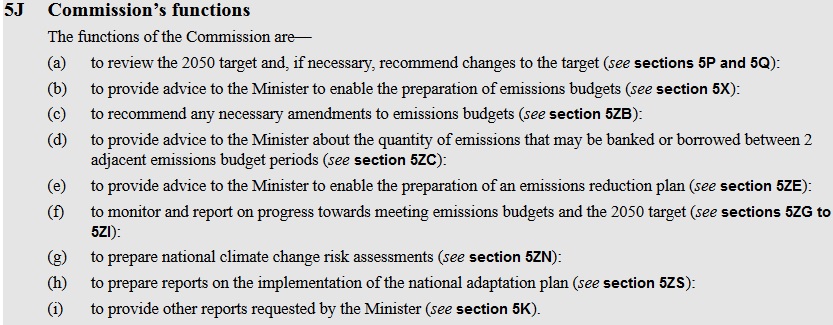
But even if you agree with the Minister that the OIA is not sufficient for protecting these interests, the Bill goes a lot further than that. Once amended, the secrecy clause will apply to "the Climate Change Commission, in respect of the performance of its functions or exercise of its powers under Parts 1A to 1C... at the time during which, and any time after which, those functions are performed or those powers are exercised" and require it (with certain specified exceptions) to "keep confidential all information that comes into the person’s knowledge when performing any function or exercising any power under the relevant Part of this Act". So what functions are exercised under parts 1A to 1C? Its all neatly summarised in s5J on the Commission's functions:
ICCCFunctions

And under the bill as drafted, all of this will be required to be kept confidential. The setting of targets, the advice to Ministers about budgets, their assessment of whether the Minister is actually meeting those budgets, all secret. And while some of it may be required by law to be published or tabled in the House, the internal advice and correspondence (which is where all the dirt is) will all be secret.

With its target and budget setting powers and apparent control over the ETS, the Climate Change Commission is intended to be the driver of climate change policy. I've said before that climate change is our most important policy challenge, and that everything else is basicly just rearranging deckchairs on the Titanic. The effect of this Bill would be to make be to make everything said and done by the most important agency dealing with that challenge a secret. All of it. Its as if they decided to exempt everything done by Treasury from the OIA - that's the policy effect here. And its not just an attack on transparency, its also woefully shortsighted. To point out the obvious, the Greens expect this law to last, and for other parties to oversee it when they are in government. But it will be pretty hard to hold those future governments to account if everything the primary advice agency does is legally secret.

From the Minister's response, this is not what he intended. In which case, he needs to amend the Bill to fix it. Otherwise that secrecy is going to come back to bite him.

Tuesday, June 04, 2019


No press freedom in Australia

Last year, Australian journalist Annika Smethurst broke the news that the government was plotting to allow the Australian Signals Directorate - their equivalent of the GCSB - to spy on Australian citizens and hack their computers. The plans were shelved as a result, but last month the Australian government was re-elected and took a sharp turn to the right. So today, they're raiding her house for exposing what they were doing:

Federal police officers are raiding the home of News Corp Australia journalist Annika Smethurst over a story about a secret government plan to spy on Australians.

Ms Smethurst, the political editor for News Corp Sunday titles including The Sunday Telegraph, was at home preparing to leave for work this morning when several Australian Federal Police officers arrived with a warrant from an ACT magistrate giving them authority to search her home, computer and mobile phone.

Ms Smethurst complied with the warrant and is presently waiting for the raid to be completed. She has declined to answer questions apart from confirming her identity.


This is highly disturbing. Smethurst's story was in the public interest, a basic part of the democratic business of holding the government to account. That's not something which should attract a police response in a democracy. In fact, the sorts of countries where it does attract a police response are tyrannies. Is Australia saying it is one of those now?

A victory for press freedom in the UK

In 2017, journalists Trevor Birney and Barry McCaffrey released the documentary No Stone Unturned. The documentary investigated the 1994 Loughinisland massacre in which six people were murdered by the Ulster Volunteer Force, a crime for which no-one has ever been brought to justice. It named the main suspects (including a British soldier), and explored the possibility of police collusion in the murders. But rather than acting on the new information to bring the murderers to justice, the Northern Ireland Police raided the journalists' homes and arrested them on suspicion of stealing confidential documents.

Last week, in a decision reminiscent of our own one on the Hager case, a judge threw out the police's search warrant and ordered that the journalists' documents be returned. And today, the police finally dropped all charges:

Police in England and Northern Ireland have dropped a controversial investigation into journalists who made a documentary about a Troubles atrocity, following a public outcry and a stinging rebuke from judges.

The Durham constabulary and the Police Service of Northern Ireland (PSNI) announced on Monday night that they were no longer investigating Trevor Birney and Barry McCaffrey over their work on No Stone Unturned, a film about the murder of six Catholics in Loughinisland, County Down, in 1994.

The journalists were immediately released from police bail and, on Tuesday can retrieve computers, files, phones and other material that had been seized.


Its a victory for press freedom in the UK. But now the police have been told they can not persecute people for trying to hold them to account, maybe they'll do their actual job and find the murderers? Or should we just take this entire debacle as their collective admission of guilt?

Austerity is mass-murder

NeoLiberal austerity is a cruel policy which robs the state of its ability to help people. In the UK, it is also mass-murder:

More than 130,000 deaths in the UK since 2012 could have been prevented if improvements in public health policy had not stalled as a direct result of austerity cuts, according to a hard-hitting analysis to be published this week.

The study by the Institute for Public Policy Research (IPPR) thinktank finds that, after two decades in which preventable diseases were reduced as a result of spending on better education and prevention, there has been a seven-year “perfect storm” in which state provision has been pared back because of budget cuts, while harmful behaviours among people of all ages have increased.

Had progress been maintained at pre-2013 rates, around 131,000 lives could have been saved, the IPPR concludes. Despite promises made during the NHS’s 70th birthday celebrations last year to prioritise prevention, the UK is now only halfway up a table of OECD countries on its record for tackling preventable diseases.


That's 130,000 totally preventable deaths because Tories wanted to slash state spending to keep taxes on the rich low. Its simply murder on a colossal scale. And the Ministers responsible for it should be prosecuted for it.

Meanwhile, every time I see numbers like this, I'm left wondering: how many New Zealanders has austerity killed? How many people did Roger Douglas and Ruth Richardson murder with their cuts? How many are still dying today because those cuts have never been reversed? Are there any studies? Or are we all looking the other way because Boomers got tax cuts and a housing bubble?

Climate Change: Left in the dust

The government's Zero Carbon Bill, which would establish a framework to drive New Zealand towards net-zero emissions of everything but methane by 2050, is currently in select committee. The government is spinning this as an ambitious plan to fight climate change. Meanwhile, Finland has just left us in the dust:

Finland will go carbon neutral by 2035, under a coalition deal published on Monday, setting one of the world’s earliest timelines for reaching that mark.

After more than a month of negotiations, five parties agreed on the goal championed by incoming Social Democrat prime minister Antti Rinne.

Rinne told reporters it was time to “invest in the future”, presenting the climate strategy as part of a package with increased welfare spending.

The new government said it would legislate the target and then review it in 2025.


That's an all-gases target, by 2035. And Finland has further to go than us: 40% of their electricity still comes from fossil fuels (including peat), and they have a huge paper industry which they're going to have to bring down to sustainable levels. They're going to have to spend billions to phase out dirty systems and replace them with clean ones - but the government has committed to that (or to just regulating them out of existence and finding other jobs for unemployed peat cutters and forestry workers).

This is the sort of crash decarbonisation which is needed, and it is happening because the government - a broad coalition of five parties - has recognised that this is a crisis and is acting like it. Meanwhile, we're diddling around with a 2050 target with an enormous loophole for farmers. If you're looking for a demand to put in your submission to the select committee, then this is it: all gases carbon neutrality by 2035. Follow Finland, not farmers.

Friday, May 31, 2019


Climate Change: We need to tax jet fuel

Aviation is one of the fastest-growing sources of greenhouse gas emissions. But as Stuff points out, jet fuel is exempt from taxes:

[A]lthough fuel prices have climbed steadily for the last quarter century, the jet fumes we spew into the skies are heavily subsidised.

That's because, unlike other types of fuel, airlines don't pay tax, apart from GST, on the aviation fuel they use on international routes.

It is legally exempt because of a 1944 global agreement.


The agreement is the Chicago Convention on International Civil Aviation, but it doesn't require countries to exempt fuel they sell from tax. Instead, it requires that fuel on board planes and not unloaded not be subject to tax or duty (which is both convenient and sensible). But according to a 2012 UK parliament report, it became common practice to exempt aviation fuel to encourage the growth of air travel.

This isn't just unfair - airlines should pay their way, just like everybody else - its also stupid. Exempting jet fuel from carbon taxes or the ETS means airlines have no financial incentive to find lower-emissions fuels or alternative technologies. Which means the only way we can reduce emissions from them is reducing flights. There's already a "no fly" movement from those concerned about climate change, and reducing your air travel is being pitched as one of the most effective things you can personally do to save the climate. That's only likely to grow stronger as the climate crisis bites. And the tax exemption pushes us down that path rather than alternatives.

Like the internet, and not dying of plague, cheap and easy air travel is one of the great miracles of our age. It brings the world closer together, and that's a Good Thing. But this shortsighted policy means we are being forced to choose between that, and destroying the planet. And that's no choice at all.

How Australian

Something nasty was hidden in the details of yesterday's budget: the government will spend millions on stopping non-existent refugee boats:

Efforts to prevent boats of asylum seekers heading to New Zealand will receive $25 million in funding.

The initiative will have New Zealand work in other countries to prevent people smuggling ventures, and is part of a wider boost to immigration enforcement announced for Budget 2019 .

The Government says the focus on "Maritime Mass Arrival Prevention" is consistent with long-held policy. But talk of mass arrivals was a "dog whistle" to appear tough on migration, a refugee campaigner says.


Just to put this in context, on March 15 a racist arsehole murdered over 50 people because he thought they didn't belong here. And the government responds by spending millions to prevent refugees claiming asylum here - effectively pandering to that racist and his supporters. How Australian.

One state at a time

New Hampshire has abolished the death penalty:

New Hampshire, which hasn’t executed anyone in 80 years and has only one inmate on death row, has became the latest US state to abolish the death penalty when the state senate voted to override the governor’s veto.

“Now it’s up to us to stop this practice that is archaic, costly, discriminatory and final,” said New Hampshire state senator Melanie Levesque.

The senate vote came a week after the 400-member house voted by the narrowest possible margin to override Republican governor Chris Sununu’s veto of a bill to repeal capital punishment.


Good. Twenty US states have abolished the death penalty so far, and there are formal moratoriums (imposed by Governors, the courts, or state medical boards) in another eight. But the map of the death penalty looks like the map of everything else in the USA: its murderous red states vs anti-death penalty blue states. And it'll probably take a while to overcome that.

Thursday, May 30, 2019


A deckchairs budget

The government has formally released its budget today, highlighted as being all about wellbeing. There's some valuable initiatives in there, including almost $2 billion for mental health, a move to index benefits to wages rather than inflation, and a $1 billion investment in rail infrastructure. All of this is great. At the same time, there's something huge missing from the budget: climate change.

Oh, it got a mention in the speech as part of environmental measures, and there's some token funding: a few million to manage the ETS and keep the independent climate change commission running, $50 million for trees, and a token boost of ~$11 million to research spending on agricultural greenhouse gases. But there's no major policy announcements on how the government is going to deal with it, and no major new initiatives to reduce emissions.

Climate change is the most important problem facing New Zealand. The Prime Minister called fighting it "my generation's nuclear free moment". Its the only policy that matters, and next to it everything else is deckchairs on the Titanic. But that's what we got: deckchairs. No money for a major decarbonisation of our electricity system. No money for a major decarbonisation of our transport system. No money, in short, to stop us poisoning the planet.

Governments show what they value with money. Jacinda Ardern's government has shown what it values today, and it is not the future. It is not what the Prime Minister says she values. And when we have so little time left, that is a huge wasted opportunity to move us towards a more sustainable path.

Arbitrary detention in Spain

Twelve Catalan politicians are currently on trial in Madrid on charges of "sedition" and "rebellion" over Catalonia's 2017 independence referendum. Many of them have been held without bail since their arrest almost two years ago. But now, a UN working group has concluded that their detention is arbitrary:

The Working Group on Arbitrary Detention, overseen by the United Nations Human Rights Council, has released an opinion on the pretrial detention of Catalan leaders Oriol Junqueras, Jordi Sànchez and Jordi Cuixart concluding it to have been arbitrary and calling on the Spanish government to "adopt the necessary measures to remedy the situation [...] without delay". They go on to suggest that "the appropriate remedy would be to immediately release" the three.

The report finds that their imprisonment without bail violates international rules, including parts of the Universal Declaration on Human Rights. Besides being released, the group says the three should be "conceded the right [to] compensation" and that the government should "carry out an exhaustive and independent investigation [...] and adopt the appropriate measures against those responsible for the violation of their rights".


Its unprecedented in modern Europe for a democratic state to be the subject of such a finding. But then, so is beating people and shooting rubber bullets at trying to vote. Naturally, Spain is outraged that the UN is calling it out for its undemocratic, authoritarian practices. And in doing so, the Spanish government sounds just like its fascist forebears.

The trial itself is expected to wrap up in a few weeks time, and we all know what to expect: convictions and long sentences for those who dared to stand up for democracy. Spain clearly thinks that that will make Catalans become good little subjects again. I doubt it. Instead, it will become another justification for independence: to escape Spanish injustice.

Climate Change: "Freedom gas"

When the US invades and destroys a country, they call it "bringing freedom". So its probably natural that they'd start referring to methane, a dirty fuel which destroys the global climate and threatens to make the Earth uninhabitable, as "freedom gas":

America is the land of freedom, as any politician will be happy to tell you. What you don’t hear quite so often is that the stuff under the land is also apparently made of freedom as well. That is, at least according to a news release this week from the Department of Energy (DoE).

Mark W Menezes, the US undersecretary of energy, bestowed a peculiar honorific on our continent’s natural resources, dubbing it “freedom gas” in a release touting the DoE’s approval of increased exports of natural gas produced by a Freeport LNG terminal off the coast of Texas.

“Increasing export capacity from the Freeport LNG project is critical to spreading freedom gas throughout the world by giving America’s allies a diverse and affordable source of clean energy,” he said.

[...]

“With the US in another year of record-setting natural gas production, I am pleased that the Department of Energy is doing what it can to promote an efficient regulatory system that allows for molecules of US freedom to be exported to the world,” said Steven Winberg.


America has increasingly become a bad pardoy of itself, and this is more of the same. But where "freedom fries" were harmless, their "freedom gas" poses a direct threat to the lives and security of the entire world (including a hell of a lot of Americans). The best way of defending ourselves against that is to make it an economic dead-end as quickly as possible.

What a muppet show

So, it turns out that the Budget "hack" was performed using that nefarious, illegal hacking technique called "using the search engine". Police have concluded that it wasn't illegal and they will be taking no further action (because its using the fucking search engine). I'm surprised they didn't charge Treasury with wasting police time.

Meanwhile, Treasury secretary Gabriel Makhlouf has presided over incompetence and smeared the opposition. We pay public sector CEOs the big bucks supposedly to take responsibility. We pay Makhlouf over $600,000 a year on that basis. So how about we get what we paid for? By running a muppet show, Makhlouf has fucked up his agency's biggest event of the year, and the centrepiece of the government's policies. It would be hard to imagine a more public screwup. But I forget: he's fucking off to Ireland. So I guess he's in DNGAF mode now. While SSC is looking into it, there's nothing they can really do to him now, so we'll get no accountability at all. I guess NeoLiberal public sector management theory didn't really think about that...

And then there's the next obvious question: how long has this flaw been lurking in Treasury's web servers? How many budgets have been googled in advance that way? Was market-sensitive information revealed, and did someone make money from it? Because that actually would be important.

Wednesday, May 29, 2019


Treasury owes us answers

Writing in The Spinoff, Danyl Mclauchlan argues that Treasury should tell us what actually happened. He's right. Budget data is supposed to be some of the most secure information held by the government. One way or another, it has been released to the public early. And there needs to be some accountability for that. It doesn't matter whether Treasury staff were total muppets, or if it was a real hack - either way there has been a failure on their part to safeguard crucial information. The only question is the degree of incompetence.

But conveniently, by referring the matter to the police Treasury has ensured that they can never do that. It might prejudice the police investigation, you see. OIA requests can be refused to avoid prejudice to the maintenance of the law, and anyone who actually tells anyone anything can be prosecuted. Accountability of course goes out the window - but neither Treasury nor their Minister has any interest in that (Ministers are rarely interested in incompetence in their own agencies, because it makes them look bad for allowing it). As for us, the public, we're the loser, stuck with an incompetent, arse-covering public agency which has just failed on one of its most important tasks.

Still, it could be worse: at least they haven't killed anyone. Unlike some other government failures.


