Wednesday, July 07, 2004


Perceptions

How can we reconcile the fact that crime rates have been falling for the past seven years with the current perception (targetted by Brash) that it is increasing? The answer is right there in Brash's speech:

Every day, the media carry stories of horrendous crimes...

Our perception of crime is shaped primarily by the media. The problem is that the media's presentation does not nexcessarily reflect the facts. Michael Moore touched on this in Bowling for Columbine, where he noted that, in a period when crime had fallen by 20%, media stories about crime increased by 600%. Sociologist Barry Glassner pins this on the television editor's maxim of "if it bleeds, it leads". Crime coverage is both exciting and cheap - all you need is a scanner and a camera to get hours of flashing lights, sobbing relatives, perp-walks and grim-faced police officers. No investigation required.

This isn't just happening in America. A recent study compared newspaper crime reporting in 2001 with coverage from 1992, and found that:

[i]n 2001 crime news (as a proportion of ‘hard news’) had risen to 21.6% in The Dominion (compared with 15.79% in 1992), to 18.83% in the (then) Evening Post (compared with 13.90%), to 24.24 in the New Zealand Herald (21.05%), to 15.17% in The Otago Daily Times (13.79%) and to 21.37% in The Press.

Professor McGregor notes that the general increase in media coverage of crime occurs at a time when recorded crime is at its lowest rate for over a decade, dropping by 12.7% since 1996-7 (Department of Police Annual Report 2000/2001).

I haven't seen any similar studies for TV - any of our media geeks know of any? - but the same trend seems to be operating there.

As for the effects, a 1999 survey by the Ministry of Justice (Attitudes to Crime and Punishment: A New Zealand Study) found that the public

tended to have an inaccurate and negative view of crime statistics and to underestimate the lengths of sentences imposed on offenders. Survey respondents perceived there to be higher levels of crime than national figures suggest. The overwhelming majority (83%) of the sample wrongly believed that the crime rate had been increasing over the two years prior to the survey.

Survey respondents substantially overestimated both violent crime and property crime statistics. Two-thirds believed that at least half of all the crime reported to the police involved violence or the threat of violence, yet police statistics show that the figure is nearer to 9%. Two-thirds of those surveyed overestimated the likelihood of a New Zealand household being burgled. Only 15% came close to the actual figure of approximately one in every 14 households burgled annually.

Generally speaking, it is a bad idea to base your policy prescriptions on misinformation. Unfortunately, Don Brash and his friends in the Sensible Sentencing Trust are advocating exactly that.

Robert Lord Winston, presenter of The Human Mind and various other educational pop-science ("pop-medicine"?) programmes will be talking in Palmerston North tomorrow...

Tuesday, July 06, 2004


Dishonest fearmongering

Plenty of people are attacking Don Brash's recent law and order speech in which he demanded that our criminal justice system treat its subjects with even more savagery. The attacks have focused on the policy prescriptions - the cost of building more prisons, the stupidity of eliminating parole - but since that ground seems well-covered for the moment, I thought I'd start from the other end. Brash's argument for those policy prescriptions is built on the idea that crime is out of control, that the government is failing in its basic duty to protect its citizen's lives and property, and that nothing is being done about it. He goes out of his way at the beginning to establish a picture of a society wracked by violent crime, in which "women and older New Zealanders are forced to significantly modify their behaviour because of the threat of violence", "our children are much less safe than they should be", and

appalling family violence, resulting in death and disfigurement for women and children; random killings by drug-crazed criminals out on parole; brutal muggings of young tourists visiting our country; dangerous and often drunk drivers, many with numerous previous driving convictions, killing people on the roads
are all everyday (and highly frequent) occurrences.

The problem is that none of this is really borne out by the facts. There's a reason Brash says that he doesn't "intend to recite a lot of statistics" to make his case: it's because the statistics don't support his case at all. Rather than relying on the facts, he is engaging in dishonest fearmongering.

Are we a more violent society than, say, the United States? Don Brash is certainly trying to create that impression - but a like-for-like comparison of our rates of violent crime, using the same definitions of each offence, shows that our per-capita rate of murder, robbery, rape and aggravated assault is around a quarter of that in the Land of the Free:

In 2000, America had more than double the rate of forcible rape per capita than New Zealand, more than three times the rate of murder and non-negligent manslaughter and robbery than New Zealand per capita, and over four times the rate of aggravated assault per capita than New Zealand. The rate of total violent crime for America in 2000 was 506.1 per 100,000 population; almost four times the rate of 132.6 for New Zealand.
The report notes that we should be cautious when comparing different jurisdictions due to the different ways in which statistics are recorded, but by international standards new Zealand errs on the high side - we count every crime, rather the most serious, and count reports rather than suspects. Unless you believe that the reporting rate for violent crime is between two and four times higher in the US than it is here (and approaches 100% in every category), then the trend is clear: we are far less violent than the US, and not a violent country by international standards.

(Hat-tip to Russell for this link)

So much for international comparisons. But what about our own standards? Firstly, as shown in the graph below, the overall crime rate is at its second-lowest level in fifteen years:
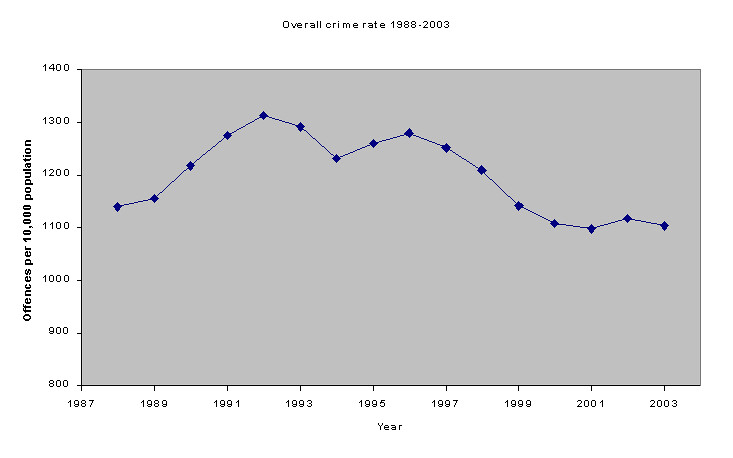
overallcrime

What about the specific examples used by Brash? Family violence? Offences under the Domestic Violence Act have remained constant over the last four years. Random killings? The murder rate fluctuates significantly from year to year - 2003 was a low, with only 46 murders; 2002 was a high, with 66 - but the overall trend has remained constant, as has that for homicide (murder plus manslaughter) in general. Brutal muggings? Robberies have been up the last two years, but are still about the same as they were in 2000, and lower than in 1998. Homicidal drunk drivers? As can be seen from the LTSA's statistics, deaths and injuries in alcohol-related crashes have decreased significantly.

As a caveat to the above, violent crime - assaults and intimidation - is up - but not substantially so, and certainly not sufficiently to justify the level of public panic. It hasn't doubled; it hasn't even increased by 10%. Instead, the last three years have been up by around 6% over the post-1994 average. If we take a longer view, then rates of violent crime have increased since the 80's - and the culprit is fairly clear. It's no accident that the baseline jumped 50% in the early 90's, when "screw the poor" policies had produced massive social dislocation and poverty and created an underclass. Like so many of the problems in modern New Zealand society, the current high trend rate of violent crime (compared with the 80's) can be laid squarely at the feet of Ruth Richardson and Roger Douglas.

And as a caveat to the caveat, our violent crime statistics do not include sexual offences such as rape and sexual assault. They're down - at their third lowest level in fifteen years. New Zealand is certainly a safer place for women and children than it was last year, or five years ago (when sexual offending was 25% higher than it is now). The crimes ordinary people are most likely to be victims of - burglary and car theft - are both down significantly, as are dishonesty offences in general. Contrary to Brash's assertions, you are not more likely to be a victim of crime now that you were last year, or five years ago.

What about the claim that nothing is being done about crime? Hardly. Over the past five years, the government has responded to falling crime rates with harsher sentences and increased use of preventative detention. And on a more everyday level, clearance rates - the percentage of crimes resolved by police - are up across the board. In the case of burglaries and car thefts, they're up significantly (the clearance rate for burglary jumped by 50% in 2000 and has stayed up since). The police are "doing something".

So, where does this leave Brash? I would say that it rather reduces the "urgent" need for his policy prescriptions. But it also once again exposes his tendency to disregard the facts when they are inconvenient. Like the infamous Orewa speech, his law and order address is aimed at creating and manipulating public perceptions and public fear. The Orewa speech made sweeping claims about "Maori privilege" and "race-based policies", based of course on "what we all know" and "what we see on TV" - and when the underlying facts were examined, those claims turned out to be (to use the technical term) bullshit. This is more of the same. Don Brash isn't interested in discussing crime with an eye to extracting sensible policy options which will address the problem; he is interested in stirring up public fear to get votes. It was despicable when he did that with race relations; here it is merely dishonest.

(Appendix: If you want to look at the underlying facts, check out the police crime statistics. The reports include historical data, and I've used the 2000 and 2003 reports to compile 15 year trend info here (Excel 97 format). Longer-term data is available from Statistics New Zealand).

Monday, July 05, 2004


Spot the difference

After reading this story in the Herald, I was struck by the similarity in the policies of the National party and the Destiny New Zealand.

Here's a quick table to summarise:

DestinyNZNational
Opposes the Civil Union Bill because it "undermines marriage" and is destructive of "family values". Allowed a free vote, but most MPs oppose the bill because it "undermines marriage" and is destructive of "family values".
Would require beneficiaries to work 30 hours a week in return for the benefit, and review invalid and sickness beneficiary cases to determine their justification. Would reintroduce "work-for-the-dole". Think all beneficiaries are dope-smoking layabouts.
Would lower taxes and gut the RMA. Would lower taxes and gut the RMA.
Would strengthen ties with traditional allies such as the United States and Australia. Would strengthen ties with traditional allies such as the United States and Australia, and support them "without reservation".
Would hold referendums on letting nuclear-propelled ships back into New Zealand ports, and on nuclear power plants. Would let nuclear-propelled ships back into New Zealand ports, if they thought they could get away with it. Are talking about a referendum as cover.

Don Brash isn't Brian Tamaki (or his political stand-in, Richard Lewis) by any stretch of the imagination - he's a social liberal, not a fundamentalist conservative. But many of the core policies pursued by his supposedly mainstream party are indistinguishable from those advocated by a bunch of religious wingnuts. And that is deeply, deeply worrying.

Karpinski knows too much

The finger-pointing over Abu Ghraib continues. Last month, Brig. Gen Janis Karpinski (former commander of the prison), pointed the finger at her superiors, claiming that abuses had been directly authorised by generals Sanchez and Miller. Now she's also fingering Rumsfeld:

Brig-Gen Janis Karpinski, who commanded the 800th Military Police Brigade, which is at the centre of the Abu Ghraib prisoner-abuse scandal, said that documents yet to be released by the Pentagon would show that Mr Rumsfeld personally approved the introduction of harsher conditions of detention in Iraq.

[...]

During inquiries into the scandal, she has repeatedly maintained that the treatment of Iraqi detainees was taken out of her hands by higher-ranking officials, acting on orders from Washington.

"Since all this came out," she replied, "I've not only seen, but I've been asked about some of those documents, that he [Mr Rumsfeld] signed and agreed to."

Asked whether the documents have been made public, Gen Karpinski replied "No" and went on to describe the methods approved in them as involving "dogs, food deprivation and sleep deprivation".

Rumsfeld's response has been to deny everything and blame people lower down the food-chain - particularly General John Abizaid. I wonder what he thinks of that?

As I've said before, none of this gets Karpinski off the hook - she was at the very least grossly negligent for allowing torture to occur "on her watch" - but it does tell us who else should be in the dock with her. Except that she's not in the dock - she has been suspended, but not charged with anything. Why not? Because if she was charged, she would be entitled to a defence, to demand documentary evidence and call witnesses under oath. And from what she's already said, that would be deeply damaging not only to her superiors, but to the Bush administration. She simply knows too much...

The market in action

What does the Reserve Bank mean when it talks about "counteracting wage inflation"? It means adjusting the economy to stamp out things like this. If the rich use good economic times to reap larger profits and scam even higher executive salaries, it's fine, but heaven forbid that ordinary workers should use them to gain any real improvement in pay and conditions.

What is the point of having a market if its a one-way street?

A little rich

National is complaining about AgResearch's plan to close its Wallaceville facility and transfer people to Palmerston North and Dunedin. As with previous CRI reorganisations (such as LandCare), it looks likely to result in significant staff losses. Apparently, no-one wants to live in Palmerston North (no, really...?)

What makes this all a little rich is that the re-organisation is a direct consequence of AgResearch's legal requirement to "operate in a financially responsible manner", i.e. to generate "an adequate rate of return on shareholders' funds". This requirement is laid out in the Crown Research Institutes Act 1992. Three guesses as to who passed it...

I also find it interesting that National is once again advocating direct ministerial interference in the day-to-day management decisions of (legally independent) crown entities. The reason we stopped doing this was because ministers had a nasty habit of using those entities as job-creation schemes and putting large projects in marginal electorates. I guess the spirit of Muldoon lives on in the National party after all...

Restaurant Review: Zibibbo

"Mediterranean-style", which is great if you like that sort of thing. But I think a better idea is to skip the tapas, skip the mains, and have two desserts and a chocolate martini.

Sunday, July 04, 2004


Lange on nukes and self-perceptions

The Herald has a long and detailed interview with David Lange, where he talks about his election and time as PM, Helen Clark, the Treaty "partnership" and various other things. One of the more interesting bits is on our anti-nuclear policy. Lange thinks that the idea that our nuclear ban is an impediment to better trade relations with the US is a gross misconception. The real problem is that we've already given the Americans everything they wanted on that front:

they can sell anything like here, they can invest anything here, they can have airlines here til it comes out our ears. They can own land. Why would the Americans give us anything?

[...]

Look, we could get a nuclear weapon and put it on hire trailer and take it around A and P shows all around New Zealand, and it wouldn't give us a free trade agreement. It is absolutely irrelevant.

And he's hit it right on the head. Because of our strong free-trade position, we have nothing to give them, and therefore they have no reason to give anything to us - especially when doing so would have significant domestic political costs.

There's also a few interesting comments on our attitude towards the larger powers. We no longer seek validation from a pat on the head from the hegemon. The uphevals of the 70's and 80's - the perceived betrayal by Britain when it abandoned us for the EEC, and outright bullying by the US in response to our desire to run our own country - coincided with what Michael King called "the indigenisation of Pakeha culture", and led to a new perception about our place in the world. Rather than being subserviant, we would be independent, and pursue our own values rather than those of whoever was biggest on the block. And we're comfortable with being small; we have no need to swing our dick on the world stage. To the extent we pursue national greatness, it is in sport, in our diaspora, and in being a country that people want to live in.

Some people are not happy with that - witness NZPundit's passing comment that we are "a silly little self-absorbed country of no importance and no influence" - but for most of us, it's enough.

New Fisk

So this is what they call the new, 'free' Iraq
US military tried to censor coverage of Saddam hearing

Saturday, July 03, 2004


Express is right

Big News objects to Express's labelling of opponents of the Civil Unions Bill as homophobes.

Well, what else are we supposed to call them?

Opposition to the bill is rooted in the belief that gay relationships are inferior, and therefore undeserving of formal legal recognition. This is homophobia. It's an ugly word, but those who object to being tarred with it have a simple solution: don't be homophobes. It's that simple.

New Fisk

Confused? Shadow of his old self? Hardly

Friday, July 02, 2004


It may be "divisive", but its democracy

The National party's "born to rule" attitude seems to extend even to matters within their own party, with Clem Simich objecting to fighting a selection battle for his safe Tamaki seat as being "divisive for the party".

Simich is one of National's better MPs - he's experienced, doesn't make a fool of himself by braying about "communism" every time he opens his mouth, and voted for the Civil Unions Bill. But none of that should provide him any immunity against a selection battle. The core idea behind democracy is that our rulers should have to justify themselves to us. If National has any commitment to internal democracy, then it should apply that principle. I have no doubt that Simich can justify himself - like I said, he's one of National's better MPs - but he should still have to do it.

Is this "divisive"? Only if they let it be. But the principle of democracy is more important. If Simich is unwilling to face even the scrutiny of his own party, then it says a great deal about the attitudes of that party to the rest of us.

Ahmed Zaoui update

Ahmed Zaoui is back in court, this time asking for bail. Eighteen months in prison without charge is affecting his psychological state, and his lawyers argue that he should be released to the Mangere Refugee Centre. The core of the case is about the interpretation of the law - whether section 114(O) of the Immigration Act 1987 requires that a person covered by a Security Risk Certificate be detained in a prison - but the lawyers are also going for Habeas Corpus, and asking the government to justify Zaoui's continued detention without trial.

(Scoop has a pair of excellent background pieces here and here.)

Meanwhile, true to form the National party is saying that the case is vexatious and "an absurd waste of time and taxpayer money". The idea that the government must justify detaining someone without trial or charge for eighteen months seems absolutely foreign to these born-to-rule pricks.

About bloody time

The Immigration Service has officially ended its policy of demanding pregnancy tests from Tongan women coming to New Zealand.

About bloody time. The policy was an affront to our values and a needless insult to our friends. The people who established and implemented it ought to be ashamed that they ever considered such a thing.

Getting it right the second time

You may remember that last year the government amended the Electoral Act to avoid a byelection after Harry Duynhoven technically vacated his seat by having his Dutch citizenship restored. The kludge - the Electoral (Vacancies) Amendment Bill - was to legislate so that the change of citizenship clauses did not apply in the current parliamentary term. This was "intended as a temporary measure pending a full review" of those sections of the Act.

The review has now been completed, and the result - the Electoral Matters Bill - was introduced to Parliament last week. The primary purpose is to fix the citizenship clause so as to explicitly allow MPs to maintain dual citizenship acquired before they entered the house, or acquire it if the reason is solely due to descent or country of birth (citizenship acquired by marriage was exempted in 1981). It also makes it clear that an MP vacates their seat if at any time they cease to be a New Zealand citizen.

This is a good change, and one that deserves support. The old rules are archaic and fail to recognise our generous views on dual citizenship; it's well past time they were updated. It's just a shame that we needed a mess like the Duynhoven affair to point out that they needed changing.

(The rest of the bill amends the rules governing free election advertising, but it's rather technical and I don't think I can be bothered wading through it all at the moment).

New Fisk

No mention of power cuts and violence at trial of the century

Thursday, July 01, 2004


Why not Kant?

Some of you are probably wondering why, in my post on rights and autonomy, I didn't just fall back on Kant and his second formulation of the Categorical Imperative as acting so as to treat people "always as an end and never as a means only" as a grounding for valuing autonomy and hence rights. There are two reasons for this.

Firstly, because the Categorical Imperative is based on just such an assertion of value: the intrinsic worth of human freedom. So it doesn't really get us anywhere, except maybe providing moral support from one of philosophy's biggest names.

But more importantly, it's because Kant is only interested in rational autonomy. Autonomy is about self-determination, being free from external influences and governed by one's own mind. But according to Kant, this means being governed solely by rational thought. Our wants, goals and desires are all "external influences" which enslave us. This is really a peculiar form of incompatibalism about free will, one which identifies the self solely with the rational faculties.

I disagree vehmently with this conception. Quite apart from the fact that it leads to the nightmare of second-guessing and "false consciousness" and opens the door to totalitarianism (as laid out by Berlin in "Two Concepts of Liberty"), it is simply mistaken. Our wants, goals, and desires are not an external influence; they're part of us, a vital part of who we are. Just as decisions made in accord with and in pursuit of them are free despite the universe (and more importantly, our brains) being generally deterministic, decisions made in pursuit of our goals are free despite their not being the sole product of reason. Our ability to reason is simply another part of us, a tool that evolved to help us better navigate our world and achieve our goals.

Because of his conception of autonomy, I'm wary of using Kant. If I'm trying to provide a grounding for liberalism, then the last thing I want to do is open a backdoor to second-guessing. Far better to use a conception of autonomy where people's choices are not valuable by virtue of being rational, but by virtue of being their choices, and freedom includes not just the freedom to be right, but also the freedom to be wrong.

A satisfying conclusion

Saddam Hussein went before a judge today. He'll be back tomorrow for a formal filing of charges, and will apparently be charged with "ordering the 1988 massacres of Kurds, the 1990 invasion of Kuwait and the 1980-88 Iran-Iraq war" (shouldn't the Iranians get a crack at him for that?)

While its traditional for unsuccessful ex-dictators to be torn apart by a mob or strung up with piano wire, putting them on trial is a lot more satisfying.

A landmark day for New Zealand

The Supreme Court opens today, marking our full judicial independence from Britain. The first case to be heard is over whether ineffective assistance of counsel constitutes a miscarriage of justice, which seems to fit the bill for a substantial constitutional significance; details of other cases under consideration can be found here.

There's also a lovely piece of understatement relating to the failure of the opposition's attempts to gain a referendum on the matter:

Today's ceremony will also mark the failure of a citizens initiated referendum launched last year by National, New Zealand First and Act to gather enough signatures for a referendum on the court.

To succeed, it needed about 310,000 signatures by tomorrow; it appears to have fallen short by about 300,000

Or, to put it in English: despite National, ACT and NZFirst's best efforts to raise a stink about "fundamental constitutional change without a mandate", nobody else cared.


