Wednesday, August 12, 2009


Flag-burning before the courts again

On Anzac Day in 2007, Valerie Morse burned a New Zealand flag at a dawn service in Wellington. She was arrested, convicted of offensive behaviour, and fined $500. Yesterday, her case went before the Court of Appeal as she sought to have the conviction overturned on BORA grounds.

This is a vital case for freedom of expression in New Zealand. It pits the Bill of Rights and its affirmation of freedom of expression directly against the desire of the right to maintain an official version of history and protect it from challenge and dissent. And it highlights the fact that freedom of expression exists precisely to protect the rights of a minority against the desire of the majority to silence them. If it does not do that, then it is worthless.

In the wake of Brooker v Police [PDF; summary here], the odds ought to be good. That case dramatically raised the bar around public order policing, applying the BORA fully and requiring that there be some actual risk of public disorder, rather than mere annoyance to the powerful. Unfortunately, the Court of Appeal don't seem to have got the memo, talking about how the right to shock was dependent on the occasion, and that it was offensive to "besmirch" a symbol under which soldiers fought. I am hoping that they were merely playing devil's advocate to draw out the point, but if not, then we may find once again that our freedom is held hostage to the traditionalist whims of dead old men.

(More at Media Law Journal)
More OIA control-freakery

First we had Immigration Minister Jonathan Coleman demanding all "sensitive" OIA requests to his department are run by his office (and starting a witch-hunt when they are not). Now, the government's OIA control-freakery has been taken a step further, with Health Minister Tony Ryall making the same demand of DHBs:

District health board bosses have been told to run official information requests past the health minister, raising fears their independence will be undermined.

In a letter sent to all DHB chief executives at the end of June and obtained by The Dominion Post, Health Ministry staffer Oliver Poppelwell asked boards to supply Tony Ryall's office with copies of all requests under the Official Information Act, which allows the public and media to ask for information from any government body.

The minister's staff would also liaise with boards about the response "on occasion".

This is a gross abuse of power. DHBs are statutorily independent, and run by their own boards. They are responsible to the Minister for performing their functions, but the relationship is deliberately an arm's-length one. As such, the Minister's legal powers are quite limited: he can direct them to give effect to a particular policy, but not any specific act (so the Minister can't say "bump my mother to the top of the waiting list), and only by publishing a notice in the Gazette.

The reason for this demand is pretty transparent: governments and health ministers get hammered by any hint of poor performance in the health sector, a tactic used successfully by Ryall last term. Now he doesn't want anyone using it against him, and wants to cut off the flow of information which makes it possible. It is a purely political move, and directly contrary to the OIA's spirit of openness.

It wil be very interesting to see what the DHB's responses were, and whether their OIA policies have changed as a result. In the meantime, people have suddenly got a new list of things to OIA: they can ask Ryall every week/month for whatever he has been forwarded by DHBs, and any communications he made in response.

[Hat-tip: Tumeke, who has a way with words: "Tony Ryall wants to run the Eye of Mordor over any official information request in the health sector..."]

Tuesday, August 11, 2009


Beating the disabled

At the moment, New Zealand is voting on whether it should be legal for parents to punch children in the face or hit them in the head with a piece of concrete - the last remnants of legal physical violence against children. Meanwhile, other places are still in the dark ages. A piece in the New York Times has highlighted that much of the US still permits corporal punishment in schools (and its the states you'd expect), and that disabled students are beaten more (because obviously, that'll "fix" them. Yeah, right...).

Clicking through to the actual report, I'm confronted with a picture of the preferred tool of American child abuse: a "paddle" - basically, a cricket bat. The impression is only reinforced by the NYT's description of one of these implements as being an inch thick. If you attacked an adult with such a weapon, you'd be going to jail. But beating children with these weapons is institutionalised across much of America.

Just another example of what a cruel and barbaric place the US is.

Bennett in trouble

Social Development Minister Paula Bennett is now officially being investigated by the Privacy Commissioner for her release of private information on two beneficiaries who had criticised the government. And she's likely to be in trouble. Last month, the Privacy Commissioner outlined the key issues to the Herald:

Considering a complaint she would look at "whether the person involved had authorised a minister to talk about their case publicly, or whether their authorisation can be inferred from their statements in going public with their case".

Another consideration was whether disclosing the information directly related to the purposes for which the information was obtained.

Harm is also a factor - but given the level of public vilification of the two women, that should be easy to show.

In short, Bennett is in trouble, and is likely to be held to account for her abuse of her Ministerial position. Which raises the question: shouldn't the Prime Ministerbe doing that...?

Climate change: Fossilised

So, how is our utterly pathetic 2020 climate change target going down internationally? Badly. We've just been awarded the first "fossil of the day" award at the Bonn talks for:

announcing the adoption of a completely inadequate and highly conditional 2020 target range of 10% to 20% below 1990 levels at the Plenary session of the Kyoto Protocol negotiations today. This follows comments in the New Zealand Parliament where the Government criticised small Pacific Island States for advocating for the targets needed to ensure their survival.
Yeah, way to go - that'll help our "clean and green" image.

National's target is more than just bad policy - it is an attack on our national identity, a repudiation of who we are as kiwis. If you think of our country as "clean and green", a leader on the environment, a country which "does our bit", then please let the Prime Minister know.

[Hat-tip: Sign On]

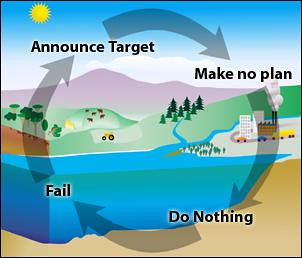
Climate change: Our policy in a nutshell

Courtesy of Scoop:

nzclimatechangepolicy

So why have successive governments failed to actually do anything? Because they have been slaves to a failed neo-liberal ideology which ruled out any "interference" in the market from the beginning. The result is self-induced helplessness and policy restricted to the most timid and ineffective measures - see for example National's list of how it plans to achieve this target: research, some timid incentives, a home insulation scheme, and a gutted ETS which gives polluters a free ride and will almost certainly now exclude our largest polluters: dairy farmers. This is why we fail: because the sorts of measures which will be effective - government tree-planting, regulation for energy efficiency and vehicle fuel efficiency, a biofuels obligation, banning growth in thermal electricity generation and steering electricity-sector investment completely towards renewables - are completely outside the policy-space imaginable by our blinkered neo-liberal relics.

Monday, August 10, 2009


The double-whammy

The government seems to be trying to get all its bad news out of the way in one day. First, there's their utterly pathetic, unambitious climate change target. And now, they've also announced they will be sending the SAS to Afghanistan to die for America.

Last time the SAS were sent overseas, Parliament got to debate and vote on it before a single soldier was sent. The government has not committed to repeating this. So, people will be sent overseas to fight and die in a war of dubious legality and even more dubious chances for success, and the decision will be made not by any elected body, but by unaccountable prerogative power (and made even more unaccountable by a policy of refusing to comment on "operational matters").

So, blood for butter all over again, except with new imperial masters. Screw that. If John key thinks Afghanistan is so important, he can go over there and fight for it.

Climate change: Utterly pathetic

I've just been watching Scoop's live webcam of the PM's press conference, and John Key has announced a climate change target of 10% to 20%, the latter figure conditional upon an international agreement with "favourable" treatment for forestry.

Pathetic. Utterly pathetic. We had a chance to show leadership, and we wasted it. But National's farmer-cronies will be happy, right up until their farms dry up and blow away (at which stage they will no doubt expect us to bail them out of their stupidity and greed).

An OIA has already been filed for the government's advice on setting the target.

Update: And here's the press release and Q&A. So, we're demanding the world make an agreement that limits temperature change to less than 2 degrees, while refusing to do anything to actualy make that happen, and we're demanding that developing countries, who are not responsible for the problem, bear the burden of fixing it. We're doing less than Europe, and (more importantly) less than Australia. In short, our government has given up. Pricks.

What do you call someone who laughs at the disabled?

A National Party MP:

The MP for Waimakariri Clayton Cosgrove has called on Prime Minister John Key to discipline National MP Paul Quinn for laughing at the plight of 12-year-old Kaiapoi school student Brittany Graham who has cerebral palsy.

“I was absolutely horrified in Parliament last week during the general debate when Paul Quinn shouted out ‘ha, ha’ while my colleague Ruth Dyson was saying that Brittany might not be well enough to continue going to school when the Government cuts out special needs funding for kids.”

I think this speaks for itself about the sorts of people we now have in government: people utterly lacking in either empathy or simple decency.

A cleanout in the UK

According to the Guardian 120 UK Labour MPs - a third of their caucus - are expected to quit at the next election. 63 have already said they're going. And that's in addition to the unknown number who will be forcibly de-elected by their angry constituents.

The primary reason is apparently a crack-down on secondary employment, which will "prevent them realising their earning potential". And naturally, they're timing their departures to take advantage of the UK Parliament's generous severance package.

Good riddance is all I can say. UK Labour has been sick for a very long time, and the attitudes on display here are simply further evidence of it. And with these self-serving parasites gone, perhaps Labour can regain its position as a party of the left, rather than a continuation of Thatcher.

Climate change: the big day

Today is a Big Day in climate change policy. After a public consultation exercise which called overwhelmingly for a strong target, and a government-commissioned strapped-chicken report which, by ignoring our best means of emissions reduction, came to the conclusion that its all just too expensive, the government will be naming its 2020 target for the upcoming Copenhagen climate change talks. Note that this isn't strictly a target for domestic emissions reduction; rather it is a "responsibility target": what level of emissions we will be responsible to the international community for, and to the extent that it is not matched domestically, how much we are willing to pay.

There are strong reasons for choosing a tough target, and then setting strong policy to meet it. And there is reason to think we can meet a tough target. But anti-environmentalism is now a bedrock belief on the right, while "strong policy" is an anathema to those who think everything should be left to the market. And so the government is making timid noises about a target in the 5 - 15% range. 5 - 15%, when the science is telling us we need to be pushing for 40%. Like Australia, this simply seems to be a recipe for failure.

And failure seems to be the goal. National has figured out that ACT-style overt climate change denial is toxic with the electorate, so they have hit on a more subtle strategy: sabotage the talks with non-commitment, thus allowing their polluter mates to continue to pollute with abandon, while being able to point the finger at someone else. But New Zealanders expect better from our government. We expect to be a good international citizen, "do our bit", and show leadership on environmental issues to get the world to act. And if National isn't willing to do this, it should get out of the way for someone who can.

Sunday, August 09, 2009


New Fisk

Little has changed since the secretive days of the Suez crisis

Saturday, August 08, 2009


Fearmongering

The Press this morning reports that the Department of Internal Affairs is concerned about unregistered celebrants taking the lead in marriage ceremonies, and that the National Guild of New Zealand Celebrants thinks that this could call the legality of the resulting marriages into question:

Christchurch marriage celebrant and former president of the National Guild of New Zealand Celebrants June Russell said only registered celebrants could solemnise a wedding and that a marriage may not be legal unless officiated by a registered celebrant.

"Some [unregistered] celebrants have just been doing the whole ceremony and getting a [registered] marriage celebrant to just sign the legal papers," Russell said. "They [the couple getting married] are leaving themselves open to that marriage not being legal."

I call bullshit:
22. Marriages not to be void because of defects in procedure

(1) Except as provided in section 15 or in section 21 of this Act, no marriage shall be deemed to be void by reason of any error or defect in the notice, declaration, or licence required before solemnisation, or in the registration of the marriage when solemnised where the identity of the parties is not questioned, or on account of any other infringement of the provisions of this Act...

(The sections in question make clear that prohibited marriages - marrying your children etc and those conducted entirely without a licence and celebrant are void; the Civil Union Act 2004 has a similar provision)

It's an offence for the celebrant to solemnise a marriage contrary to the provisions of the Act, and an offence for someone to solemnise a marriage while falsely pretending to be a celebrant - but that's their problem, not that of the parties. Provided the parties and witnesses thought it was a marriage, and an actual celebrant signed the papers, its difficult to see on what basis a court could declare the resulting marriage void.

Friday, August 07, 2009


Climate change: Even the Herald thinks we should act

As the voice of Auckland's business community, the New Zealand Herald is not exactly noted for caring about the environment. But today, it devotes its editorial to a call for New Zealand to lead on climate change:

New Zealand's biggest earners - tourism, agriculture, seafood, sustainable forestry, food and beverage - all benefited from the credentials provided by our environment, he wrote. This gave us a point of difference, a reason for consumers to pay more for our products and, most importantly, a way to grow in a competitive world. Copenhagen, said Mr Ross, was a great opportunity for New Zealand to make a big global statement and to sell more for more money because of it.

[...]

The public has not been well served by the renewed debate on what approach New Zealand should adopt. Major emitters have spread unnecessary alarm over the cost to the average wage-earner of an ambitious target. The Greens, for their part, make light of the obstacles to the likes of aggressive tree planting, pest eradication and lower stocking rates. On balance, however, an enterprising approach appeals more than caution. It would not be inimical to a push for rule changes.

The world has become far more environmentally conscious. We cannot afford to be seen as a laggard. There is a chance to seize the initiative. It should not be missed.

Economic advantage is not the best reason for acting, but its one that the greedy will understand. And its not just a matter of selling ourselves better - its also about not being whacked with border taxes by the US and EU. Even those who couldn't care less about our "clean and green" image and whose core business depends on pollution - farmers, for example - should understand that threat.

Unfortunately it has become clear from the "consultation" round and John Key's STFU to Keisha Castle-Hughes that the government isn't actually interested in what we think. It is too deeply in hock to large polluters and dirty farmers. And we'll all pay the price for that in the future.

Climate change: India goes solar

While the developed world wrings its hands over climate change and comes up with new excuses for inaction, the developing world is acting. First we have had a string of Pacific island nations - Tuvalu, Tokelau, Niue - setting 100% reduction targets. And now we have India, one of the world's largest emitters but still a developing nation and not responsible for the problem, setting itself an extremely ambitious solar energy target:

Although India has virtually no solar power now, the plan envisages the country generating 20GW from sunlight by 2020. Global solar capacity is predicted to be 27GW by then, according to the International Energy Agency, meaning India expects to be producing 75% of this within just 10 years.

[...]

The plan provoked prolonged discussion at a meeting of the national climate change council in New Dehli yesterday, which resulted in major changes from early drafts. The draft document had envisaged a government subsidy of around $20bn (£11bn), and falling production costs, in order to achieve a long-term 2040 target of 200GW of solar power.

20GW by 2020 is 5% of their expected electricity generation. 200GW by 2040 is about 20%. That's an awful lot of carbon dioxide they won't be emitting. I'm not sure if it will be enough, but as with their massive shift to wind, its certainly an enormous step in the right direction.

There is a catch, of course: India expects the developed world to keep its word and help fund this massive downward shift in their emissions pathway. But if that's the price of reaching a global deal which eventually brings India in, then it seems worth it to me.

Garrett the thug

Not content with drunken bigotry, sexually harassing his staff and threatening people submitting to select committees, ACT MP David Garrett is now trying to intimidate other MPs, challenging a Labour MP to "take this outside" during select committee hearings.

This sort of thuggery is not acceptable in the modern world. It is particularly not acceptable in Parliament. Threatening or intimidating an MP in the course of their duties - effectively trying to bully them into not performing those duties - is a very serious breach of Privilege, regardless of whether it is done by a member of the public or another MP. Parliament can not function when MPs are physically threatened for their political views and for representing their constituents.

A complaint has been lodged, and hopefully the Speaker will pass it on to the Privileges Committee. In the meantime, one thing has become abundantly clear: David Garrett is a bullying thug who has no place in our Parliament.

Climate change: Our policy of hypocrisy

The Pacific Islands Forum has wrapped up in Cairns with a call for serious action on climate change, with the final communique [scroll to Annex A] demanding:

We call for a post-2012 outcome that sets the world on a path to limit the increase in global average temperatures to 2 degrees Celsius or less.

We call on states to reduce global emissions by at least 50 per cent below 1990 levels by 2050.

We call on states to ensure that global emissions peak no later than 2020.

We call on developed economies to take the lead by setting ambitious and robust mid-term emissions reduction targets – consistent with the agreed science and the directions embraced by the Major Economies Forum Meeting in July 2009.

A 50% reduction in global emissions by 2050 means an 80 - 95% reduction by developed nations. Which makes our "50% by 2050" long-term target, and our expected 15% by 2020 short-term target look rather pathetic.

The Forum makes its decisions by consensus, so the New Zealand government agreed to this. But our policies are in stark contrast to what we have agreed to, what we are demanding from the rest of the world, and what is necessary to prevent dangerous levels of climate change. In short, National is making hypocrites of us, and pissing away both our mana and our "clean and green" image, so that their farmer-polluter mates can continue to profit from their unsustainable practices for a few more years.

From Peterloo to the G20

The_Massacre_of_Peterloo_sml

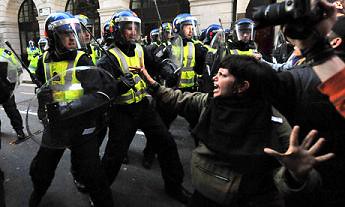
On PASystem, SamF reminds us that the Sunday after next is the 190th anniversary of the Peterloo Massacre, when a crowd of peaceful demonstrators demanding democracy was charged by cavalry. Back then, any demand for reform of the UK's undemocratic system of government was regarded as by definition seditious and treasonous, and any public gathering in favour of such "radical" ideas a revolution in the making, which had to be nipped in the bud by armed force. Reading the continuing fallout from the London G20 protests, where peaceful protestors were "kettled", then beaten for failing to disperse (at the cost of one life), I'm left with the overwhelming impression that that attitude has never really gone away. Sure, the weapons have changed - but the basic response is still the same:

G20_thugs_sml

(Image stolen from the Guardian)

This time, even the authorities seem to realise they've gone too far. The chief inspector of constabulary has recommended a complete overhaul of the policing of protests, starting from the position that police are there to facilitate peaceful protest rather than suppress it (he also recommended that police actually obey the law and wear their badge numbers at all times so they could be held accountable for any abuse of their power - something honoured mostly in the breach, it seems). This has now been backed up by the first report from the UK's Independent Police Complaints Commission (into a woman who had been severely beaten and crushed by a police shield-wall), which has likewise recommended a complete review, better communication with protest groups, and proper plans to let distressed or vulnerable people out of "kettles". And they haven't even got to the serious cases yet. The question though is whether the police will listen to these recommendations or simply ignore them. Unfortunately with a culture and leadership which regards the public as the enemy and protest as fundamentally illegitimate, I expect the latter.

Thursday, August 06, 2009


Cutting off the perks

The conviction of Taito Philip Field for corruption has raised more questions about former MP's perks, with the revelation that he and his partner will still be entitled to enormous travel discounts despite his criminal conviction. Several MPs have suggested tweaking the rules to ensure that MPs convicted of a serious offence relating to their time in office should be cut off, but I think it is time to go further and expunge these ongoing perks permanently. They're a relic of a former age, no longer enjoyed by present MPs, and entirely unconnected with the performance of their duties. It is long past time they went.

Doing it would be easy. As with the rules on MPs expenses and allowances, former MP's perks are set not by legislation, but by a determination of the Speaker (the Directions and Specifications for Services and Funding Entitlements for the House of Representatives, its Members, Former Members, and Certain Electoral Candidates 2008 [PDF]). According to s8 of the Parliamentary Services Act 2000, these must be issued annually, after consultation with the Parliamentary Service Commission (who are, naturally, all MPs). So, all it needs is for the Commission to advise, and the speaker to decide, that it is no longer appropriate to subsidise Roger Douglas's overseas holidays, and its done. No more perks. The problem is that threefour of the Commissions' nine members - Gerry Brownlee, Phil Goff, Jim Anderton, and the Speaker himself - are all pre-1999 MPs and have an enormous vested interest in continuing the system so they can claim those perks themselves when they eventually depart the political scene.

In the longer term, the provision of perks to former MPs is permitted by s4(1)(f) of the Parliamentary Service (Continuation of Interim Meaning of Funding for Parliamentary Purposes) Act 2009. But this Act expires at the end of 2010, meaning that it will either need to be renewed, or a final definition will have to be agreed and inserted into the Parliamentary Service Act. Either way, the time will be ripe to clarify that funding for former members is only for transitional purposes (closing your electorate office etc; see s6.3 - 6.12 of the Directions above), and not for delivering ongoing benefits. That's what superannuation schemes are for.

Correction: Somehow, I'd forgotten Gerry Brownlee's membership in the PSC - though unlike the others he's not entitled to the full perks.

Fiji: time to rise up?

Pacific Forum Chair and Niuean premier Toke Talagi has been making waves at the Pacific Forum by suggesting that Fijians "rise up" and take to the streets to force out their military regime. John Key and Kevin Rudd are aghast, but its a good idea. From the Philipines to Czechoslovakia to Serbia to the Ukraine, mass non-violent public protest has been a very successful tactic in evicting undemocratic, dictatorial regimes. If Fijians want their democracy back, taking to the streets and refusing to move is probably the best way to do it - and it is a prospect the other democracies in the Pacific should welcome, not condemn.