Friday, June 11, 2021


The economics of killing Huntly

RNZ reports that Genesis Energy's use of coal has spiked over the past few years, as they use to burn it rather than pay for gas:

New Zealand has significantly increased its use of coal in recent years, despite its status as the worst, most polluting fossil fuel on the planet.

In the first three months of this year, the same amount of coal was used to generate electricity as in all of 2016 and 2017 combined. Coal generated 10.35 petajoules from January to March, slightly under the 10.52 petajoules in all of 2016 and 2017, according to MBIE's Quarterly Energy Statistics, released yesterday.

10.35 PJ is just under a million tons of CO2, in three months. And that was in summer, when load should be low. For winter, they've cut a deal with Methanex so they can burn gas, but that's not exactly a clean fuel either.

How much is this costing is? The government is meant to internally value carbon at $150 a ton. So Huntly burning coal for a single quarter costs us ~$140 million. A quarter. Gas isn't as harmful as coal, so its carbon value is only ~$100 million a quarter. And when you start adding that up, its doesn't take long before you're talking Real Money.

(Genesis will be paying some of this cost - ~$40 a ton - through the ETS. But that's a tiny fraction of the social cost of the damage it is causing, and it shows the scale of the effective subsidy we are giving it to pollute)

What could we do with this money? Well, a standard-sized windfarm costs ~$300 million. If Huntly burns coal half the time and gas the other half, you can basicly buy one and half windfarms every year to reduce its emissions. You need about seven to replace it completely, so its economic for the government to completely replace Huntly with wind over five years. And that is exactly what they should do: establish a special purpose SOE solely to build renewables, with the explicit purpose of driving fossil fuels out of the market permanently (and as a bonus, they get a revenue-generating asset). Alternatively, they could just pay existing power companies to bring forward construction of already-consented projects, or to plan and build new ones (which is a good idea, given that a whole bunch of consents will expire in the next few years). And from next year, they'll have a dedicated pot of money from ETS revenues to fund it.

But its also worth remembering that Huntly isn't the only villain here - there are a pile of gas power stations too. And exactly the same logic applies to them: it is economicly worthwhile for the government to replace them in a fairly short timeframe; the only question is exactly how short.

Thursday, June 10, 2021


Another sign of MBIE's captivity

When the government asks the public to conserve electricity, its usually because we're on the edge of a supply crisis, and its necessary to ensure our own lights will stay on. And when it does that, people generally buy into it, because they can see the reason. But last month, MBIE pushed for a conservation campaign not to keep the lights on, but to protect large energy users' profits:

Officials last month advised the Government to consider asking consumers to conserve electricity as one of two options to keep a lid on soaring wholesale electricity prices, documents released under the Official Information Act show.

[...]

MBIE advised Woods consider two options to bring wholesale prices down.

One was to encourage the country’s largest gas user, Methanex, to cut back production to free-up more gas for electricity generation.

Methanex has subsequently done that by agreeing to suspend production at its Motunui facility for almost three months, but Woods’ spokeswoman said there had been no intervention by the minister.

The other option MBIE advised Woods consider was “facilitating electricity demand reductions from mass market consumers” who are on fixed-price contracts and not exposed to spot market prices.

In other words, we should suffer to keep electricity prices low for big users, like good little peasants. Fortunately, Woods said "no", and I'm glad of it, because this would have been an abuse of the public trust which endangered cooperation in times of actual need. But the fact the suggestion was even made tells us whose interests MBIE serves, and who it really works for - and it isn't us. Instead, they've been captured by the group they're meant to regulate, and are basicly just lobbyists for them. In which case, why are we paying for them again?

A republic is demographicly irresistable

Via New Zealand Republic: younger kiwis support a republic (where "younger" is basicly "people under 50"):

NZRepublicPoll

There's a bit more on NewsHub here.

This is basicly like the support graph for Scottish independence, which seems to have become demographicly irresistable. Sadly, Jacinda Ardern - who implicitly claims to be the voice of generational change in New Zealand politics - is pushing the Olds' position of "no change", which is going to become increasingly unsustainable. But if she's not going to push for this, then maybe younger New Zealand should get a Prime Minister who will?

Good riddance to the Tasman Mill

Last night Norske Skog announced it will close the Tasman Mill at the end of the month, with the loss of 160 jobs. Good. This mill is a major source of emissions, and in 2019 we subsidised it to the tune of 238342 tons - meaning it was about 0.3% of 2019 national emissions. Which were being produced by 0.006% of our workforce. In other words, a disproportionately dirty facility whose emissions outweigh its benefits, and which we are well rid of.

But what about those workers? Well, at today's prices that emissions subsidy is worth $9.6 million a year. The government could spend say, five years worth of it on creating new, low-emissions employment in Kawerau to give them something better to do, or just devolve it to them (at ~$60,000 a year or as a lump sum) to help them retrain and move. That's what a just transition for these high-polluting industries would look like, and it would leave everyone better off. Not least because the government has put itself on the hook to subsidise these polluters for the next 40 years, so paying to shut them down is a massive fiscal saving.

(Other policy implications: the government should immediately rip 1 million tons from the Climate Commission's 2022-25 emissions budget, and 1.25 million tons from future budgets, to lock in this saving and ensure no-one else emits in their place. Because they were being subsidised for 90% of their emissions, there's less of a need to cut the ETS auction amount - just shutting off the flow of free credits has the same effect on the system. Though if Norske Skog has a significant amount of credits banked, there should be an adjustment to make sure they sell them).

So what major emitters does that leave? Marsden Point is shutting down and turning into a tank farm. Motunui is going to run out of gas pretty quickly. Tiwai Point says it will leave in 2024 (but who knows), and the Huntly power station will go if Tiwai goes (or if we build a bunch of wind and solar farms, so get on it). Which leaves the Glenbrook steel mill, which we subsidise by 2.1 million tons of carbon (~$85 million) a year. The quicker we kill it, the better.

Wednesday, June 09, 2021


Climate Change: Scammed

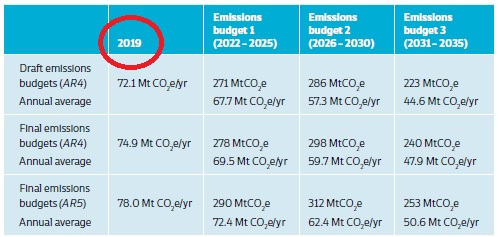
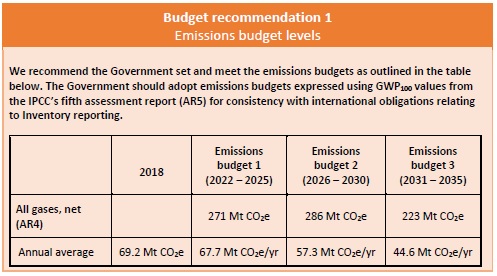
Reading the Climate Change Commission's final advice, the obvious question is why their budgets are so much higher than those proposed in their draft (by about half a year's emissions over 14 years)? Simple: we're being baseline-scammed. The draft report set its budget based on 2018 emissions:

2018baseline

But the final report calculates them from the new, higher 2019 base:

2019baseline

The difference is 5.7 million tons a year - an 8% increase. And they've basicly just carried this through to the 2035 budget (though the pathway we use to get there is slightly different). Not that they're honest enough to admit it, instead saying that the difference is "primarily due to increases in historic emissions estimated in New Zealand's Greenhouse Gas Inventory and increases in projected emissions under the Current Policy Reference case". None of which would matter if they'd used honest, 1990 Kyoto numbers in the first place.

Baseline scamming is the oldest trick in the climate-delay book. Want to pollute more, while hiding the fact you are doing so? Use a later, higher baseline! (See also: New Zealand's Paris target, which uses a 2005 baseline to hide how weak it is against internationally-reportable 1990 numbers). This rewards failure, delays action, and is fundamentally dishonest. Its use by the Climate Change Commission undermines trust in the entire Zero Carbon Act regime, which was meant to bring honesty to climate change policy. But if they're willing to nakedly scam us like this, why should we trust their reporting, their monitoring, or their future recommendations?

A mini-Official Secrets Act for the Reserve Bank

The Finance and Expenditure Committee has reported back on the Reserve Bank of New Zealand Bill. Part of the bill is a new confidentiality clause, restricting publication or disclosure of information obtained using the bank's information-gathering powers. The first-reading version was actually good, with explicit recognition of the OIA. So naturally, the Labour-dominated committee reversed that, to specifically limit the application of the OIA:

The Bank may make information or data to which this section applies available under the Official Information Act 1982 only if 1 or more grounds under subsection (2) apply.
The scary thing is that this is actually an improvement on the current law, which excludes the OIA entirely.

How did this happen? The committee is "concerned that confidential information could be released under [the OIA]". But delving into the advice, it appears that the Reserve Bank in their initial briefing (p 21) thought the initial clause thought that it already did, saying "The confidentiality provision has the effect of limiting the availability of information under the OIA" (despite the clause saying the opposite). But their later departmental report recommends a "clarification" as:

The policy intent behind this provision is that information would only be available under the Official Information Act 1982 (OIA) if it could otherwise be released under this confidentiality provision. This ensures that information that is compulsorily acquired from financial institutions is appropriately protected. The provisions in the Bill are based on section 135 of the Insurance (Prudential Supervision) Act 2010, which had the same policy intent. Engagement with the Office of the Ombudsman suggests that amendments to this drafting would be desirable to more clearly give effect to this policy intent.
Both the bank and the committee believe that ousting the OIA is necessary to protect this information. But why does it need to be protected? The initial briefing says the RBNZ asks banks about their credit card rates or the amount they have loaned out to do things like help set monetary policy. Obviously, there are interests around bank regulation, commercial prejudice, confidentiality, and potential economic damage if this information is released. But the OIA already has provisions protecting those interests, in sections 6(e), 9(2)(b), 9(2)(ba), and 9(2)(d). The problem here is that neither the RBNZ or the government (or apparently the Ombudsman) trust the OIA to do its job. So instead, they want to give the bank its own mini-Official Secrets Act instead.

This control-freakery is unnecessary and undemocratic. But isn't it so very, very Labour?

Climate Change: Committing to failure again

The Climate Change Commission released its final advice to the government today, and the media is full of reports about how "ambitious" it is. Bullshit. Because when you look at the budgets - the only thing in the entire document that actually matters and has legal weight - they tell a different story: Weaker1

Row 1 is what they recommended in the draft. Row 2 is what they're currently recommending (row 3 is for compatibility with future numbers). That's right, they've increased the amounts we are allowed to emit in every period, by almost half a year's net emissions. This isn't "ambition" - its backsliding.

The report is full of stuff about how we need to move to walking cities, and to EVs, and do away with coal (though not completely - BlueScope, one of our worst polluters, will not be expected to change its current dirty methods of steel production one iota). None of that matters. All it does is determine the distribution of who is expected to change and who is not. And because they've increased the amount we are allowed to emit, a crash switch by us to walking and cycling to reduce emissions simply makes space for polluters like BlueScope to pollute more.

To give a more concrete example: the Marsden Point refinery is one of our biggest polluters, emitting close to a million tons of CO2 a year. Its big enough that the possibility of it shutting down is included in the Commission's sensitivity analysis. Its owners announced shutdown plans last week. This ought to be good news, but the Commission will allow 2022-25 emissions to increase by twice the amount that that shutdown will save.

(The sensitivity analysis really shows us who the climate villains are: Tiwai Point, Glenbrook, and Motunui. Tiwai also has a nasty effect of discouraging investment in renewable generation, which again suggests the need for the government to step in and build what the market is afraid to).

Finally, last week Climate Change Commission chair Rod Carr warned that we had no wiggle room on climate policy, and that if we did not cut emissions, other countries would impose trade barriers and sanctions to force us to do so. His lax budgets have firmly set us on the second pathway. And honestly, that might be the best path: successive governments have shown no inclination to do what is necessary, and despite all its proud rhetoric about "my generation's nuclear-free moment", Ardern's government is no different. We need emissions to drop, and drop quickly. If our own government won't cut our dirty coal, dirty steel, and dirty milk, then maybe other governments will have to do it for them.

Member's Day

Today is a Member's Day, the first since the Budget. Unfortunately it looks like most of the time will be taken up with boring committee stages. First up is Anahila Kanongata’a-Suisuiki's District Court (Protection of Judgment Debtors with Disabilities) Amendment Bill, followed by Louise Upston's Rights for Victims of Insane Offenders Bill. The latter is complicated enough that under the usual "one hour per part" rule, it should burn the entire day. In the unlikely event that it doesn't, then the House will vote down Nick Smith's Electoral (Integrity Repeal) Amendment Bill (because Labour is afraid of its backbench, and like Samoa's HRPP, wishes to prevent political competition), before moving on to Andrew Bayly's racist New Zealand Superannuation and Retirement Income (Fair Residency) Amendment Bill (which Labour has decided to vote for because they want to be NZ First). There will be no ballot tomorrow.

Tuesday, June 08, 2021


Self-inflicted "poverty"

Nurses are going on strike tomorrow in pursuit of better pay and higher staffing levels. So why isn't the "Labour" government paying them properly? Apparently, they're pleading poverty:

Prime Minister Jacinda Ardern says the nurses’ union wanted a 17 per cent pay increase for all nurses, but the Government is strapped for cash.

[...]

Ardern, speaking to reporters on Tuesday morning, said the Government was financially constrained due to the Covid-19 pandemic.

Firstly, any "financial constraint" the government is suffering is entirely self-inflicted by their refusal to tax the rich fairly. But secondly, its a bit hard to believe Ardern, when her own Finance Minister is gloating about how much money they have. But then, its been clear for a long time that when the government says it has "no money", it has no money for you. Meanwhile, it has plenty of money to subsidise the rich with artificially low tax rates, and plenty of money for subsidising polluting farmers with free water and emissions, and plenty of money for US warmongering. The government has chosen what it wants, and we should hold it accountable for that choice.

Surrendered II

Good news on the climate front: OMV's surrender of its exploration permits in the Great South Basin, announced last December, has finally gone through. But there's other good news as well: from the sudden hole in NZPAM's permit map, they've also surrendered a pair of permits - 51906 (Matuku) and 60091 (Te Whatu) - off Taranaki.

This shows the value of the government's offshore exploration ban in strangling the fossil fuel industry. There are now only five active offshore exploration permits: five off Taranaki, and two off Raglan. And every permit surrendered makes it that much harder for this criminal industry to spread costs to drill the rest, meaning an increasing chance that they too will be abandoned and surrendered. But that's not enough: we need to stop extracting from existing wells as well. Its time to give the market certainty to invest in a fossil-free future and build the renewable generation necessary to electrify industry. And the way to do that is to set a firm sunset date on fossil fuel extraction.

How much is the Greens' reputation worth?

$54,000, apparently:

The Green Party says it won’t return two five-figure donations from a woman convicted of animal neglect which required several horses to be put down.

Three weeks before being sentenced in the District Court for animal neglect described by the SPCA as amongst the worst it had ever seen, Lindsay Fraser donated $29,000 to the Green Party’s 2020 election campaign. She had also donated $24,970 a year earlier, making her one of the party’s biggest donors.

The Green Party has campaigned strongly on animal welfare in recent years. During the 2020 election it described itself as “the leading voice in Parliament” on animal welfare and promised to strengthen Aotearoa’s animal welfare standards.

Green Party co-convenor Penny Leach said: “Unfortunately, we cannot predict that donors may be sentenced for animal welfare charges after they have donated. The awful news was made known to our team when we were contacted by a journalist.”

Fraser had name suppression, which meant the Greens didn't know about her crimes at the time. But the case was fairly high-profile when suppression was relaxed, and I'm surprised that no-one in the party noticed. Now its been publicly pointed out to them, they have absolutely no excuse. While I don't think they can be blamed for accepting the donation, choosing to retain it now that the facts are known is absolutely on them. While they're right to say they can't just donate it to the SPCA - they're an incorporated society, and incorporated societies can only spend money for the purpose for which they are established - they can certainly return it. And if they refuse to do so, knowing the crimes the donor committed, their supporters are perfectly entitled to conclude that they support those crimes, or are at least willing to turn a blind eye to them for money. And I doubt many of them would find that acceptable.

Friday, June 04, 2021


Climate Change: Dereliction of duty

Before the pandemic, air travel was one of the fastest growing causes of greenhouse gas emissions. Fully half of those emissions are caused by a global elite of super-emitting frequent flyers, so the Parliamentary Commissioner for the Environment's proposal in February to discourage it with distance-related departue taxes seems like an excellent idea. But Tourism Minister Stuart Nash seems to have killed the idea. Why? Apparently, its just all too hard:

The MBIE briefing, sent the day before Upton’s report was made public, said such a departure tax might be difficult to apply given how many international visitors transit through Australia. “Therefore a majority of this tax would be single tier and fail to fully account for the distance travelled to international visitor’s [sic] end destinations.

“MBIE also acknowledges that it may be difficult to justify spending this departure tax revenue (which is collected by travellers departing New Zealand) on providing a source of climate finance for Pacific Nations, who may also choose to apply similar levies.”

Asked if the departure tax was under active consideration by the Tourism Minister or his Cabinet colleagues, Nash’s press secretary wrote: “I replied to an email from you about the PCE proposal on 4 March, i.e. the Minister of Tourism has publicly stated he is not a fan and that an international visitor levy (on arrivals) was already in place.”

As the Parliamentary Commissioner for the Environment notes, this is an exceptionally weak argument, and its not as if MBIE has any better ideas to deal with the problem. But then, perhaps the real problem is that they don't want to deal with it. Like NZPAM (also part of MBIE) and MPI, they've been captured by the industry they're meant to be regulating, and by their own self-interest. After all, if we have fewer tourists, we'd need fewer MBIE staff to handle them...

But what's really shocking in all this is that the departure tax - a climate change measure - was apparently never put before the Climate Change Minister, and he doesn't seem to think its his problem. It absolutely is. And while international aviation may be a small source of emissions compared to the big problems of cows and cars, it all adds up, and as the article notes, we need to be pulling every lever we have to reduce emissions. Ignoring this is simply dereliction of duty. And when the government has declared a climate emergency, that is simply not acceptable.

This is obscene

We all know multinational corporations cheat on their taxes, using complicated legal arrangements to funnel money through different jurisdictions to avoid paying anything to support the societies that host them. How obscene are such arrangements? This obscene:

An Irish subsidiary of Microsoft made a profit of $315bn (£222bn) last year but paid no corporation tax as it is “resident” for tax purposes in Bermuda.

The profit generated by Microsoft Round Island One is equal to nearly three-quarters of Ireland’s gross domestic product – even though the company has no employees.

The subsidiary, which collects licence fees for the use of copyrighted Microsoft software around the world, recorded an annual profit of $314.7bn in the year to the end of June 2020, according to accounts filed at the Irish Companies Registration Office.

The company’s profits jumped from just under $10bn in the previous year and compare with Ireland’s 2020 GDP of €357bn ($433bn).

Three-quarters of a country's GDP, not a cent in tax. Multinationals are simply parasites.

To use another comparison: Ireland's 2020 government spending was ~105 billion Euros (~US$127 billion). If they taxed this single corporation at the usual Irish rate of 12.5%, it would provide ~US$39 billion - or just under a third of all government spending. Not taxing them means Irish people are paying more and/or getting worse government services than they would if Microsoft paid their fair share. I'd expect them to be pretty angry about that.

This shows the need for international cooperation to stop tax-cheating, with a global minimum corporate tax, and a financial blockade of tax havens and money laundries until they join the system. Until we do that, these parasites are going to keep robbing us blind.

The change we need to see

Two big transport announcements from the government this morning: first, they're killing Mill Road, another bloated superhighway with a terrible BCR. Secondly, Auckland will get a second harbour bridge for bikes and pedestrians. The net effect: fewer cars, more bikes in Auckland.

This is the sort of change we need to see. Transport is New Zealand's second-biggest source of greenhouse gas emissions after agriculture. Reducing it means decarbonisation, switching to EVs. But it also means "mode shift" - ditching cars entirely for other methods of transport. Bikes and walking are a vital part of that, but to get people doing it, we need to actually provide the infrastructure. We also need to make driving suck more, to push people away from it. This decision will do both.

The amusing bit is that this is all about increased costs, and the big driver of those is... higher house prices. Waka Kotahi couldn't afford to buy out all the people they'd have to move for their road at current inflated rates. So the government which has refused to tackle the housing crisis has been hoist by its own petard. Maybe this means the trucking industry will start pushing for cheaper houses...?

Thursday, June 03, 2021


Climate Change: No wiggle room

Farmers are constantly whining at the thought of having to take even minimal measures to reduce emissions. But according to Climate Commissioner Rod Carr they no longer have any choice:

Dr Carr told hundreds of people - including farmers - at an agricultural climate change conference in Wellington today that for the agricultural sector there would be no way to wriggle out of slashing emissions.

He said in the past there had been a mindset in the agricultural sector that it should get exemptions because it was such an export powerhouse, but New Zealand's trading partners were increasingly making decisions based on the climate impact of products.

He said foreign regulators would not take kindly to exporters not pulling their weight, and this, combined with changing international consumers preferences, posed a much greater threat to business than local regulations.

Basicly, farmers can cut emissions in New Zealand, or their products can be border taxed and subjected to consumer boycotts by other countries. The former at least means they have some control over the process. Unfortunately, from the RNZ story, it seems that too many of them are still in deep, deep denial about this. But their whining about "financial sustainability" and being forced out of business misses the fact that this is now the point: we want dirty polluters who won't change to go under. The question is how many other people they take down with them.

An accomplice to war crimes

That's the only way to describe MFAT, who are merrily approving weapons exports to help the United Arab Emirates' ongoing crimes against humanity in Yemen:

The Ministry of Foreign Affairs and Trade approved the export of weapons systems sent to the United Arab Emirates (UAE) despite officials warning they could be used in Yemen.

Since 2016, at least seven export permits have been approved for military equipment sent by New Zealand companies to the UAE and Saudi Arabia, both of whom are accused of war crimes over their military intervention in Yemen.

At least 100,000 people have died in Yemen's civil war, which has also displaced millions and pushed the country to the brink of famine.

As the story makes clear, this is not a matter of ignorance. MFAT knows the weapons will be used in Yemen, which makes their export both a violation of our export control regime. And they know that what is happening in Yemen is a crime against humanity. But they seem willing to ignore both to enrich the immoral weapons industry (and in fact seem to see that, rather than enforcing international law, as their major role).

This is not acceptable, either legally or politically. And MFAT needs to be held to account for it.

Wednesday, June 02, 2021


This is what institutional racism looks like

Last month, a man was arrested for threatening to kill National MP Simeon Brown. Over the weekend a second man was arrested on the same charge. This is appropriate: threatening to kill is a criminal offence, and threatening to kill an elected representative an offence against democracy. But it appears that not all MPs receive equal protection under the law:

The complaint comes after a YouTube video posted last weekend made specific threats towards Māori Party leaders Debbie Ngarewa-Packer and Rawiri Waititi, and Māori people in general.

Ngarewa-Packer said the party lodged a complaint on Monday and didn't hear back till Wednesday.

Although the video had now been taken down, there were grave concerns for the leaders.

The contents of the video were hateful and racist, referencing violence towards Māori and "civil war".

From the RNZ verison of the story, the police were trying to minimise the threats, calling it a mental health issue. Which seems like a clear-cut case of institutional racism. And its exactly the sort of failure which led to 51 people being murdered in Christchurch.

We should not tolerate parties which tolerate this

In the wake of National MP Nick Smith's resignation on Monday night, people have finally been talking about what a scumbag he was. Newshub reports that his behaviour was an open secret around Parliament, something everyone knew about but no-one talked about, with people saying (anonymously, for fear of repurcussions):

  • "Smith was notorious for that red mist"
  • "One of the most difficult assholes I've ever worked for"
  • "I have no fond memories of that guy"
  • "He was prone to bouts of extreme verbal anger towards other ministers and staff. It was out of the ordinary even then. But we didn't complain because we were Gen Xers. We should have"
Meanwhile Stuff reports that the complaint which led to his resignation was not lodged by his immediate victim, but by "another National Party staffer who recorded the incident and made a complaint". Which suggests that Smith's behaviour was so toxic that his own staff were habitually recording him to document it. Which raises the obvious question: why do parties put up with this? Because as Smith shows, abusive MPs are a PR bomb waiting to go off, and when they do it damages both the party (who are rightly suspected of covering up and/or condoning abuse) and our political system as a whole. They're simply bad politics. So why not downlist, de-select, or otherwise show them the door to remove the risk?

Sadly, the answer seems to be that the main parties are staffed by bullies and run by bullies. Judith Collins is out there this morning defending Smith, saying he was under "tremendous stress" and suggesting that recording his outburst was illegal (which is getting pretty DARVO). But then, she's a bully herself. As for Labour, Meka Whaitiri (who allegedly assaulted a staff member) is not just still in Parliament, but has been reappointed to Cabinet. So Labour supports bullying as well. Voters should not. And we should make that clear at the ballot box.

Tuesday, June 01, 2021


NZDF gives the finger to the Burnham inquiry

Last year, the inquiry into Operation Burnham reported back, finding (among other things) that SAS and NZDF officers had deceived Ministers and the public, and that NZ soldiers had assaulted a prisoner. So will anyone ever be held accountable for that? Of course not:

Two soldiers at the centre of the Operation Burnham inquiry have escaped punishment by the Defence Force, including a Special Air Service soldier who assaulted an Afghan detainee.

Former SAS commander Brigadier Chris Parsons would not face disciplinary action after he had committed an “administrative failing” in a report, Chief of Defence Air Marshall Kevin Short said in a statement.

The SAS soldier that was found to have punched a detainee, who was not named throughout the inquiry, would not be censured because the matter was not properly investigated at the time, he said.

[That "administrative failing" was deliberately misleading the Defence Minister about whether the Operation Burnham raid had killed civilians, and then doctoring records to cover it up].

This is basicly NZDF saying "fuck you" to the entire inquiry, and to the public concern which led to it. They've been clear throughout this entire debacle that they don't think anyone did anything wrong, and now they're using their own coverup and years of delay as an excuse to ensure that those responsible are never held accountable. Rather than being dishonourably discharged and stripped of their honours as they deserve, the criminals at the heart of this will continue to serve, and by their presence continue to corrupt our defence force. And NZDF's senior leadership is perfectly happy with that.

That being the case, I think we need to admit that NZDF as an institution is unsalvageable. They are committed to unaccountability and deceit. And since all they actually do in practice is drag us into other people's wars, maybe we should just do away with the entire organisation, and replace it with a civilian civil defence and foreign aid corps, freeing it up to focus on its core - and valued - competencies: rescuing lost trampers, sandbagging stopbanks to limit flooding, and rebuilding schools after tropical cyclones.

Climate Change is already killing us

One of the big risks from climate change is that it will make large chunks of the planet uninhabitable due to heat and humidity, and if you've read The Ministry for the Future you'll be aware of how it can lead to death on a massive scale. But there's also going to be a constant trickle of deaths just from warmer temperatures. And this is already happening:

More than a third of all heat-related deaths around the world between 1991 and 2018 can be attributed to human-induced global heating, research has found.

[...]

The researchers examined past weather conditions simulated under scenarios with and without emissions triggered by human activity – allowing them to separate the warming and related health impact linked with human activity from natural trends.

Overall, they found 37% of all heat-related deaths in the locations studied were attributable to human activity – but the largest climate change-induced contributions (more than 50%) were in southern and western Asia (Iran and Kuwait), south-east Asia (the Philippines and Thailand) and Central and South America.

They don't give an actual bodycount (and they note that their data is incomplete and missing some of the potentially most interesting data points), but it shows the danger we are already in, and how those pushing for inaction are literally killing us. They're basicly stochastic murderers, and we should treat them as such.