Protection, not oppression: How the new mobile police patrols have discovered job satisfaction
Saturday, July 31, 2004
Irving denied entry
On the basis of his prior deportation from Canada (which was for hate speech). I think this is both wrong and stupid. You don't defeat lies by hiding from them and pretending they don't exist.
Thursday, July 29, 2004
Wednesday, July 28, 2004
The "New Iraq"
The American invasion of Iraq was supposed to transform it from an oppressive dictatorship into a free and democratic society. Which is obviously why the Iraqi government is engaging in aggressive censorship of the media, including banning "unwarranted criticism" of the Prime Minister.
Who decides what constitutes "unwarranted criticism"? Why, the Prime Minister's flunkies, of course.
The "New Iraq" seems to be quickly turning into just another Arab despotism. Was this really worth 13,000 dead civilians?
Tuesday, July 27, 2004
David Slack responds to his critics...
Strategies
A discussion on Just Left on "what's the left for?" seems to be turning into a debate about political strategies for keeping a government on the right (or rather, left) tack, and whether "wing parties" (like the Alliance, and the Greens to some extent) are useful or not. IMHO wing parties are great for applying leftward pressure on a government, but the important thing is getting a left-wing grouping over the 50% mark in the first place. Doing this requires either cutting a deal with one of the floating parties, or gobbling (or rather shifting) the center. In 1999 the center shifted (though arguably it was in the same place its been since 1993; people just figured out where Winston Peters really stood). In 2002 it was looking like that shift would stay, until Helen opened her mouth and started talking about an absolute majority - when it shifted again to United Future. After the policy blitzkreigs of Rogernomics and Ruthaniasia, we just don't have much of a tolerance for majority government anymore.
National's series of policy speeches are an attempt to define and thereby shift the center ground. It's doing this by picking negative topics - crime, welfare, the Treaty - and trying to force the government into defending a position that some people (let's call them "rednecks") will disagree violently with. Labour's response has been to pull their head in and hide, and try not to present a target. This is a losing strategy.
What Labour should be doing is defining that center ground for itself. Don Brash wants to talk about spending half a billion dollars a year on prisons? Fuck that! We should be spending half a billion dollars a year extra on health. There's a powerful narrative about National running down public services last time they were in government, using the "razor gang" and the "sinking lid" to cut services like health to the point where they were barely viable (the plan then being to say "it doesn't work" and privatise it). A similar story can be told about infrastructure. National has indicated that it wants to return to those policies in an effort to further shrink government expenditure as a proportion of GDP (and further lower taxes on the rich). This will mean further damage and cutbacks to our public services. Despite the rhetoric of the right, you can't get more for less.
Public services are widely seen as being a central part of what this country is all about. Significant majorities support higher taxation for better health and education. So why the hell isn't Labour enunciating this core part of the "New Zealand dream", and presenting people with a clear choice on the matter?
Good on her
An Israeli newspaper is reporting that Helen Clark insisted that the Israeli spies be prosecuted and refused to allow the affair to be "swept under the table". If so, good on her. These people broke the law, and therefore they ought to have been prosecuted, just like any other criminals.
While international power politics sometimes intervenes to force us to deviate from that ideal (just think of the French in 1986), it didn't this time. Israel had no leverage over us, and so we could for once afford to do the proper thing.
Things I want to write about
- "Has Labour reduced inequality?" - an analysis of data on income distribution to see whether early policy decisions (raising the top tax rate, increasing the minimum wage) have had the desired effect.
- An analysis of the New Zealand Institute's paper "The Wealth of a Nation". Home ownership is part of the "Kiwi dream", and information on whether that dream is becoming less achievable is both interesting and relevant. Unfortunately, I have a certain amount of suspicion about this think-tank. Is it just co-incidence that a group backed by banks and finance houses expesses concerns about our investing too much in houses and not enough in shares or retirement packages?
- Some of the interesting issues raised by reading Brian Easton's The Whimpering of the State.
Unfortunately, I actually have to write about "the present political economy of New Zealand", by friday. So I won't be doing any of the above (or at least not this week). Fortunately, it's a relatively interesting topic, and one that I can almost certainly adapt to blog-posts (yeah, yeah, I know, I've said that before...)
Procrastination blogging will continue - I need something to do while I drink my morning coffee - but I'm unlikely to be posting anything big for the rest of the week.
Monday, July 26, 2004
Repeal?
In keeping with their position as being the strongest promoter of a tolerant, secular and liberal society, the Greens are calling for the anti-flag-burning law to be repealed.
Realistically it's a non-issue. After that judgement, I can't imagine the police ever bothering to bring charges ever again.
Vaccinating virtue
The British government is thinking of vaccinating children against drug addiction. Except that when you read it, it's not addiction per se they're vaccinating against, but the ability to have fun with drugs. And their list of drugs to vaccinate against includes at least one which is currently perfectly legal: nicotine.
This is something I'm deeply uncomfortable with. Not because I think addiction is a Good Thing, but because this way of dealing with it simply too gross an invasion of personal autonomy - it's literally denying the ability to choose, by artificial means.
Now, any conception of autonomy has to allow for future choices to be limited; such limitation can itself be a deep expression of who you are. But in order to be autonomous, those limitations have to be voluntary, your choice, not the government's. It's OK for individuals to choose to limit their future ability to get high (as part of a rehab program, or a better way of giving up smoking), but it's not OK for the government to permanantly and irreversibly take that choice away from people.
Flag-burning, and legislative interpretation
Over at NZPundit, Ackbar lambasts the High Court for continuing "that dangerous trend of using the NZ Bill of Rights Act 1990 to essentially strike down other legislation". All I can say is that section 6 of the New Zealand Bill of Rights Act 1990 - the one that requires that, whereever possible, other legislation be interpreted so as to be consistent with the rights and freedoms guaranteed by that Act - wasn't made up by judges, or put there for no reason. Parliament wanted other laws to be subjected to such review and interpretation, while at the same time explicitly denying the courts the power to invalidate laws. The result is a balance between Parliamentary sovereignty and judicial interpretation; the courts have a lot of power to gut an act by "reading down" its provisions ("a time-honoured technique of construction for upholding individual rights or freedoms"), but Parliament has the final say.
If Parliament doesn't like the decision, it should legislate to clarify its intent with regard to flag-burning. If it means to override freedom of expression, then it can bloody well go on the record and say so.
Sunday, July 25, 2004
Ending coverups
The British government has shown how much faith it has in its army's internal system for prosecuting human rights abuses by soldiers by stripping commanders in Iraq of their ability to veto investigations:
The move follows the refusal of a commanding officer to let Army prosecutors charge a soldier for the alleged killing of an Iraqi called Hassan Abbad Said. Ministers were forced to ask the Crown Prosecution Service and Metropolitan Police to take over the investigation.
It seems the art of the cover-up was alive and well among British forces in Iraq.
I would have thought that refusal to allow prosecution was tantamount to approval and invited the commander's prosecution under the principle of command responsibility.
Dirty pool
Yet more evidence that the government has been playing dirty pool over the Zaoui case. Papers released under the Official Information Act show that Foreign Affairs secretly orchestrated a campaign to generate international criticism of the Refugee Status Appeals Authority's support for Ahmed Zaoui, with the primary aim of providing the government with PR-cover. This sort of interference - the deliberate soliciting of adverse comments on an ongoing court case - is unprecedented in New Zealand. We have a strong convention that the government does not comment on cases before the courts, for fear of being seen to influence the judiciary; here it has deliberately attempted to do an end-run around that tradition by stealth.
If this country can be said to have a core value, it's "fairness". Here Labour has shown its contempt for that value in spades.
Exits
Running Blog Capitalist is giving up the blog, NZPundit is on holiday, and KiwiPundit is taking a break. I imagine DPF is going to be feeling quite lonely for the next few weeks...
Yet another nail in the coffin of right-wing dogma
Last week I mentioned that New Zealand had placed third on the Economic Freedom of the World Index. An important part of this index - and an important part of the right-wing definition of "economic freedom" - is "small government". The idea is that states where government expenditure as a percentage of GDP is low are free-er (in an economic sense) than states where it is high. Unfortunately, it's not true.
I particularly like the way the right-wing idealogues have been hoist by their own petard here. It's their index, they're the ones handing out the scores, and yet it says the exact opposite of what they want it to say: larger government (on average) equals greater economic freedom.
Needless to say, this rather undermines the National/ACT/BRT dogma of reducing government expenditure as a percentage of GDP. If the goal is to increase economic freedom (rather than simply redistribute income from the poor to the rich via tax cuts), then reapplying the "sinking lid" and starving government services isn't the way to do it.
Inconvenient, inadvertant retention
Having tried to prevent further investigation of Bush's desertion from the Texas Air National Guard in 1972 by claiming that his pay records had been conveniently but "inadvertantly" destroyed, the Pentagon has now managed to "find" a copy. I guess they were inconveniently and inadvertantly retained. Unfortunately, they don't show any record of Bush being paid during the period in question - and there's no record of his ever complaining about his missing paychecks. One explanation for this is that, being rich, Dubya just didn't notice or care. Another is that he wasn't paid (and didn't complain) because he didn't show up. Which do you think is more likely?
Saturday, July 24, 2004
A victory for freedom
The High Court has thrown out schoolteacher Paul Hopkinson's conviction for "dishonouring the New Zeland flag", finding that flag-burning is protected by the freedom of expression clause in the Bill of Rights Act. It was a lot of trouble to go to over a $600 fine, but it was worth it; we now have a clear and unequivocal precedent recognising and guarding freedom of expression in the strongest sense.
The law hasn't been overturned (we don't do that in New Zealand), but it has been effectively gutted, its language redefined upwards into oblivion. Those who disagree with the decision will no doubt cry "judicial activism", but it was more or less demanded by the Bill of Rights Act, which says that the only limits on the freedoms it recognises are those that can be "demonstrably justified in a free and democratic society" and requires that, whereever possible, all other legislation be interpreted in a manner consistent with that Act.
I've been following this story since the beginning, and I'm pleased to see it end in a victory for freedom. Suck that, Stephen Franks!
Thoughts on Farenheit 911
Two obvious comments. Firstly, it doesn't pretend to be "balanced journalism" of any kind. It's a very one-sided movie, showing the side of things which has been mostly ignored by the US media for the past three years. And secondly, it's made very much for Americans, hence the pandering to lowbrow sterotypes about "funny little countries" like Palau, Costa Rica and the Netherlands.
Much of the material won't be new to media-junkies and blog-weenies, but we're not really who the movie is aimed at. As I said, it's aimed at ordinary Americans, not educated liberals who supplement their newsfeed with material from the BBC and the Independent. And to those people, it is new, a whole side of things they haven't seen before.
Some of it is also very unsettling. I did not expect to see a decapitation, closeups of exposed bones quivering in a child's ruined arm, or dead babies being thrown in the back of a truck after a US bombing raid. Neither did I expect to see US soldiers being blown up live on camera, or to hear the wounded screaming as they were carted away. These sorts of things are usually sanitised from our media experience, and I think that we lose sight of what war actually involves as a result. Hopefully Moore's movie will remind Americans of the consequences of their actions, and make them consider more carefully what they're really voting for.
Friday, July 23, 2004
Brash and foreign policy
Former Human Rights Commissioner Chris Lawrence has an article in the Herald in which he draws attention to Don Brash's disturbing views on foreign policy. Since 1945, New Zealand has been a consistent supporter and advocate of multilateral institutions and international law. An important part of this position has been support for international legal instruments governing human rights.
Brash has already indicated that he believes his poll-driven domestic political concerns trump this long-term policy when he said that he would be willing to opt out of UN conventions in order to make prisoners do hard labour. Now, he has pretty much repudiated the entire vision:
Mana magazine has featured an interview with Dr Brash. One subject was, unsurprisingly, the proposed foreshore and seabed legislation. The interviewer noted it had been suggested by some that the Government's proposal breached United Nations human right conventions."Does that concern you?" Dr Brash was asked.
"No, it doesn't," he replied. "I have a very low regard for some of the United Nations conventions in this area. I think they are driven by people with a particular political agenda, frequently from countries which have pretty lousy laws and provisions in their own countries for indigenous peoples."
Brash is, I suspect, simply mouthing off. His comments on forced labour showed total ignorance of our international legal obligations, and those above indicate a certain amount of confusion about history (UN human rights conventions have generally been driven by rich, western nations with decent human rights records). Despite this, the media should be following this up. Here we have the leader of a major political party threatening to overturn sixty years of foreign policy and a number of major international commitments. He should be being asked to explain and justify that position. In particular, he should be asked which UN conventions he wishes to withdraw from, and why, and how this will affect our mana and credibility on the international stage. And if he clams up, then he should be called on it. As a small nation which makes its way through trade, foreign policy is vitally important; if Brash doesn't understand this, or regards it as a political football to be manipulated for short-term political gain, then the public needs to know.
Military intervention in Darfur?
I've been vaguely following the atrocities in Darfur for the past few months, watching the reports of ethnic cleansing, deliberate starvation and mass rapes trickle in, but haven't blogged about it, in part out of a sense of total helplessness. None of the major powers really gives a shit about what goes on in Africa (too much trouble for too little oil), and so the best that could be done was for the UN to nicely ask the Sudanese government to rein in its puppet militia and end the killing. Which, given the nature of the Sudanese government, is about as effective as pissing in the wind. Given the aforementioned disinterest by the international community, the usual means of arm-twisting a poorly behaving regime into line - trade sanctions - were simply not on the agenda, and so there was nothing that could really be done.
Fortunately, I was wrong about that. In the past month both the US and the EU have taken an interest, and Colin Powell has personally visited the area and applied pressure to the Sudanese government. The African Union has got involved, sending a small monitoring group and protection force. And today, the Guardian reports that Tony Blair has asked his advisors to draw up plans for military intervention.
Would such intervention be justified? Looking at the plans, the first two options - transporting aid and providing equipment and support to the African union force - are certainly justifiable. The third option - using military force to create safe zones and protect refugees - would require the consent and co-operation of the Sudanese government to be effective. But if there is consent from the relevant authorities, then there isn't really an issue - it's the question of what happens if that consent is not given which poses a moral quandary.
Earlier in the year, Human Rights Watch produced a report on the humanitarian argument for the war in Iraq, in which they concluded that said war was not justifiable on humanitarian grounds. The same ethical framework can be applied to Darfur. According to HRW, military intervention
...can be justified only in the face of ongoing or imminent genocide, or comparable mass slaughter or loss of life
This is a high threshold because of the inherently messy and uncertain nature of war, and its ability to completely disrupt society and make things far worse. And it may be questionable whether the Darfur crisis reaches it - while the atrocities are terrible, they may not actually be killing enough people. It is starvation and aid delivery which are the chief threats, and these may be able to be met by co-operating with Chad, where many of the camps are located.
But assuming Darfur does reach the threshold - if for example the Sudanese government or the militias continue to interfere with the delivery of food aid, and thereby endanger the lives of the million or so refugees currently in camps along the border - then there are other criteria which must be met. In order to be morally justifiable, any military intervention must:
- be a last resort;
- be "guided primarily by a humanitarian purpose" (this does not preclude other motives, but they must be subsidiary);
- comply with international human rights standards (the means must be concordant with the ends);
- be reasonably likely to actually make things better; and
- ideally should be endorsed by the UN or other appropriate multilateral institutions, except in extremis.
I don't think there's any problem with meeting these criteria. If the situation in Darfur deteriorates and the Sudanese government deliberately attempts to starve a million of its citizens to death, it would be entirely justifiable to use military force to prevent it.
It remains to be seen whether force will be necessary. I hope that it will not be, and that the Sudanese government will bow to international pressure, deal to the Janjaweed and allow the free flow of aid to those who need it. But if they do not, then the international community should act. We stood by and watched while a million died in Rwanda; we cannot let that happen again.
No respite for Blair
Both the Foreign Affairs Committee and the Intelligence and Security Committee are re-opening their investigations into the handling of intelligence used to justify the war on Iraq, focusing specifically on what Tony Blair knew and when he knew it. It seems that they don't quite believe that MI6 would withdraw intelligence that was central to the case for war without telling the Prime Minister.
Unlike the previous whitewashes, this time Blair may face real scrutiny. Labour MPs on the Foreign Affairs Committee have had enough, and refused to vote with their fellows to prevent further questions being asked. I guess those byelection results have reminded them who they really work for...
Thursday, July 22, 2004
Be All You Can Be
With ongoing wars in Iraq and Afghanistan, the US military are facing a shortage of volunteers. However, recruiters have hit upon a perk to get people lining up to die for Haliburton: free breast enlargements.
Treaty time-limits
What do I think of the suggestion that the government is considering a cutoff for lodging historical Treaty claims? I think it's a bad idea. As I've said before, it's great to have a goal, such as settling everything in ten or fifteen years, but having a cutoff date after which no claims can be filed is likely to lead to injustice and allegations that the process is being manipulated to avoid righting past wrongs.
The process of historical investigation surrounding Treaty claims takes time, and while it can be sped up (by for example increasing resources and hiring more historians), it is something that has to be done properly. While I am keen to see historical claims settled as quickly as possible, I want the government to get it right. It should not be needlessly rushed to meet some arbitrary politically imposed date at the expense of justice.
As for National's claim that they would do it in five years, if it was properly resourced and they committed the funds required for just settlements, then it would of course be a Good Thing. But I think that we have very good reasons to doubt their sincerity on this, and I'd rather we took our time than rush things and (deliberately) make a hash of it.
RMA myths
Jeanette Fitzsimons has a good editorial about the RMA in today's Herald, in which she thoroughly trashes the right-wing mythology surrounding the Act. Almost all consents are granted (without notification, to boot), and only a tiny fraction go all the way to the Environment Court; growth has been high and unemployment low for the past four years, so what's the evidence that the RMA is "deterring investment and blocking growth"?
There are similar problems with the mythology around "national interest" projects. The RMA already allows central government to provide guidance to local government on such matters, and even allows them to "call in" projects of national significance - but these processes haven't been widely used. Why not? Some of it is bad memories of "Think Big", but a large part is almost certainly the desire to provide a "level playing field" and avoid criticism for "picking winners" - not to mention businesses lining up at the Minister's door for special treatment, and the resulting allegations of corrupt behaviour and favortism that would inevitably accompany such a process... Labour wants to avoid this, just as National did
In fact, the current bout of whinging over the RMA is just the latest incarnation of the business lobby's disatisfaction with having a Labour, rather than a National, government. First it was "business confidence", then it was the government's "failure" to gain an FTA with the US (one that never was, and never will be, on offer), and now it's the RMA; in all cases its pretty much independent of the underlying facts. These people will never be satisfied unless the government benches are full of compliant Dead White Males dancing to Treasury's tune, and so we might as well ignore them.
The core principle of the RMA is that local communities should have a say over development which affects them. Propertarian absolutists will never be satisfied with this, but it's a good basis to start from, and any changes which move away from this idea - for example by reducing the need for notification, or limiting the ability of people to make a submission or access the Environment Court - would be a grave mistake.
Whingers and moaners
It looks like the Auckalnd Chamber of Commerce agrees with Jim Anderton that business critics of government are "whingers and moaners":
For years, we’ve expressed an attitude that New Zealand is programmed for failure, and facing years of tough economic and social difficulties.However, there is a major problem with this view of ourselves and our nation - the "here and now" of the economy is telling a different story. There is a mismatch between what we believe and what is actually happening at the coalface of the economy. It seems that our attitudes about how well we are doing as a nation are not connecting with the very real successes the nation is achieving.
Unfortunately, I suspect that the majority of the business community, egged on by National and ACT, would rather continue to pout and stamp their feet than accept the facts.
Vladimir Putin speeding to the Kremlin?
From Stuff:
National leader Don Brash was rushed to Saturday's Bledisloe Cup in a police motorcade that swept through Wellington running red lights and at times driving on the wrong side of the road.
But it's OK if you've got a comb-over, right?
Actually, I suspect the problem isn't so much with the politicians as with their police protectors taking a rather paranoid view of what constitutes a security threat. According to the Diplomatic Protection Squad, "you can't stop because then you get recognised and next thing you know there are security issues." Throw in a monomaniacal focus on their "client" and an overly subserviant attitude to authority, and its easy to see how this happens.
Help with Civil Unions submissions
The Campaign for Civil Unions has released an information pack encouraging people to make submissions on the bills (downloadable PDF here). They're also running a series of regional workshops to help people with the process.
This is useful no matter how you feel about the bill, and I encourage everybody to download it and send something in.
Wednesday, July 21, 2004
Deniable assets
One of the Americans arrested in Kabul a couple of weeks ago for running their very own Abu Ghraib claims they were working for the Pentagon. No doubt the Secretary will disavow any knowledge of their actions...
David Irving and freedom of speech
The Waikato Jewish Association wants the government to prevent infamous Holocaust-denier David Irving from visiting New Zealand. This is both wrong and stupid. Irving should be treated the same as any other potential visitor; if the fact that he has previously been convicted in Germany and deported from Canada would count against him, then so be it - but we should not be discriminating against him on the basis of his beliefs, no matter how ill-founded or poisonous they may be.
Partly this is based on straight-out liberal principles. We're a country that supposedly respects freedom of speech, and therefore we shouldn't be preventing people from speaking by preventing them from entering. While those who wish to ban Irving would argue that his ideas are wrong and harmful, he is nowhere near the traditional limit of yelling "fire" in a crowded theatre. Not even close. At worst he's guilty of spreading some rather poisonous lies intended to inflame hate against a particular group - but if that's a crime, then I can think of a few organised religions who are first into the fire.
The other half of my objection is that it is simply tactically stupid. You do not defeat Holocaust-deniers by suppressing them - that simply grants them legitimacy in their own eyes. It allows them to claim that they must be right, because they would not be being suppressed if their arguments were wrong and had no power to convince. It allows them to claim that we are afraid of them, and to draw strength from our supposed fear. And where attempts at suppression are driven by the Jewish community, it allows them to claim that there really is a Jewish conspiracy to hide the truth. This is somewhat self-defeating.
Instead, you defeat Holocaust-deniers either by ignoring them (in much the same way as we ignore the Flat Earthers, Tesla-loonies or Raelians), or by open memetic confrontation. Given the court finding against Irving, his vist is an opportunity for those who oppose him to put their case in the strongest possible terms. And if they are unwilling to do that, then their ideas are hardly worthy of being artificially propped up by the government.
I'll leave the final word to John Stuart Mill:
the particular evil of silencing the expression of an opinion is that it is robbing the human race; posterity as well as the existing generation; those who dissent from the opinion, still more than those who hold it. If the opinion is right, they are deprived of the opportunity of exchanging error for truth; if wrong, they lose, what is almost as great a benefit, the clearer perception and livelier impression of truth, produced by its collision with error.
Those wanting to suppress Irving would rob us of the latter, and we would be poorer for it. Instead, Irving should be as free as any other to visit and to talk - and others should be free to ignore him or argue with him as they see fit.
Clueless
When browsing a recent copy of Adbusters, I came across this:
On June 12, 1812, the US declared war on the United Kingdom, beginning a battle that nobody really won, except perhaps the Russian composer Tchaikovsky. [...] Inspired by the war's brutality, Tchaikovsky created the "1812 Overture", his best known piece.
Which is of course why the 1812 is marked by a musical duel between "The Star-Spangled Banner" and "God Save the Queen", rather than one between "La Marseillaise" and "God Save the Tsar"...
Beating the war drum again
George Bush is beating the war drum again, this time by claiming that Iran was involved in the 9/11 plot. His evidence? Eight of the 9/11 hijackers travelled through Iran on their way to the US.
If I recall correctly, several of the hijackers had actually lived in Germany, and one even got his pilot's license there. That seems a lot more serious than simply passing through. If Bush wants a pre-election bombing campaign, maybe he should be setting his sights on Berlin...
Unforgivable
With various people mulling over the 1984 revolution , I thought I might as well weigh in. To my mind, there were two absolutely unforgivable aspects of the "reforms": they undeniably made those at the bottom of our society worse off in real terms, and they were grossly undemocratic.
I've blogged about the effects of the "reforms" on the poor before (most notably here), but to summarise: the rich got richer and everybody else got poorer. And not just in relative terms, but absolute ones. Most of the blame for this can be sheeted home to Labour's 1988 tax cuts, which transferred wealth from the bottom 80% of our society to the top 20%. This is unforgivable behaviour from any government, but was especially unforgivable from Labour, a party which had traditionally stood for the interests of the poor and downtrodden - and made all the worse by the fact that it didn't actually work. The "payoff" for the "economic stimulus" provided by cutting the top tax rate was five years of low or negative economic growth and an enormous structural budget deficit, which was temporarily papered over with asset sales. Which is yet another reason to be highly sceptical of right-wing claims that tax cuts increase government revenue and produce higher growth: we've done the experiment, and it was a complete failure.
On the democratic front, successive governments gained power by being economical with the truth, and once in office, lied blatantly about their intentions. Labour's 1984 manifesto was hardly indicative of what it would do in government; their 1987 campaign was built on promises that they would rebuild social services and not sell state assets - promises which were simply ignored once re-election was secured. They abused Parliamentary procedure to ram legislation through without the usual checks and balances, frequently passing bills in parts or under urgency to prevent public scrutiny. On several occasions, they even passed legislation through its first reading with entire sections marked "[to come]", making a mockery of the entire legislative process. This was partly due to the autocratic Parliamentary culture of the time, but largely due to the "reformers" inherent distrust of democracy - they knew that the electorate would never accept their policies (the economic theories on which those policies were based said as much), and so we had to be forced to "take our medicine" - for our own good, of course.
This experience - and National's 1990 betrayal (they campaigned on a platform of ending the "reforms" and returning us to a "decent society", but once elected adopted Labour's policies and pursued them with even greater enthusiasm) - is the chief reason why we have MMP: so that future governments will be hamstrung by having to work in coalition, and will never be able to do that to us again.
In hindsight, many of the reforms are uncontentious - the abolition of farm subsidies and trade barriers, the adoption of the SOE model for some government enterprises, the requirement for government departments to keep open and honest books - but the speed with which things were done and the utter disregard for the human consequences or public opinion poisoned the entire program. Change was necessary - but not that much, not that fast, and not that way.
Tuesday, July 20, 2004
The sound of silence
For the first day in a while, I couldn't really think of anything to say.
Ah well, I had reading to do anyway. Currently I'm swapping between various economic histories of the 80's and 90's to get an overview for an assignment. This is likely to increase my urge to procrastinate, so it shouldn't interfere with bloggage much - assuming I can find something worth writing about.
Monday, July 19, 2004
Sunday, July 18, 2004
Saturday, July 17, 2004
MI6 lied to the Hutton Inquiry
Things just aren't getting any better for Blair. He had hoped that the Butler Inquiry would finally allow him to "draw a line" under his handling of Iraq, but instead the revelations just keep on coming. Days before Lord Butler released his report, it was reported that MI6 had withdrawn the intelligence on which the war was based; now we find out that they deliberately omitted to tell the Hutton Inquiry about doing so, instead claiming that "intelligence from agents in Iraq was believed to be reliable".
Despite this, Downing Street is claiming that "Lord Hutton was not misled. He saw everything that was relevant to his picture". I think there's a popular advertising slogan which can be invoked here.
Sources close to the Hutton Inquiry are annoyed, as are various MPs from the two Parliamentary committees who have also investigated intelligence on Iraq. Blair will face a serious grilling next week in an effort to find out whether he knew and misled Parliament. As for MI6, it calls into question their commitment to democratic accountability. Their new chief, John Scarlett, was in on the deception; he should made an example of, to ram home to the intelligence services who is ultimately in charge.
"Prosecuting humanitarianism", part II
An Italian judge has released the captain and crew of the Cap Anamur from jail, but it is unclear whether the charges against them will be dropped. They had been charged with "aiding and abetting illegal immigration" after rescuing a group of African refugees from their sinking boat.
The organisation these people work for, Cap Anamur, does good work and has saved over 10,000 refugees from drowning at sea. You can email them messages of support here.
Unwelcome visitors
According to Sitemeter, the latest people to notice the NZ political leaders political compass graph are a bunch of neo-nazis. I've got that "I've just trodden in something icky" feeling again.
Poking around their forum reveals plans for a "National Anti Imagration March" [sic] in Wellington soon (no date though). Maybe people down there should start planning a counter-protest? Also, Kyle Champman's reaction to the desecration of Jewish graves in the Bolton St cemetery? "They prolly did it themselves so they could 'link' the events." Charming...
Friday, July 16, 2004
Effective tax-rates
The Grey Shade has written an effective tax-rate calculator, based around the definition used in countless National and ACT press releases of "total amount of your gross income that you lose as a result of direct income tax and loss or abatement of means-tested cash benefits". But where National and ACT are only concerned with marginal tax rates - how much is taken out of the next dollar - Grey Shade is concerned with the overall rate. In practice, this means comparing how much of your income you get to keep with how much you would get to keep if you were on the dole or DPB.
Unfortunately, it doesn't factor in the effects of student loans.
Is there life on Mars?
Mars Express has detected ammonia in the Martian atmosphere. This is significant because ammonia has a life-expectancy of only a few hours; for it to be present in the quantities detected, it must be being constantly replenished.
There are two projected means of replenishment: active volcanism, or life. So far none of the probes orbiting Mars have seen active volcanic hotspots (though detecting them would be a fantastic discovery). So does this mean there's life on Mars...?
The people's verdict
The British people have delivered their verdict on the Butler Report and Tony Blair's position on Iraq, with massive swings against Labour in two byelections.
Both electorates - Leicester South and Birmingham Hodge Hill - were considered safe Labour seats, but the former fell to the Liberal Democrats with a 21% swing, and the latter was held my a mere 460 votes, after a 27% swing. In both seats the Conservatives polled a distant third, in Birmingham Hodge Hill getting only half the votes of either the Labour or LibDem candidates.
The byelections represent a decisive rejection of both Labour and Tony Blair, in favour of the LibDems - the only major party untainted by Iraq. If these swings were repeated in a general election (and one is due next year), then Labour would be decimated. Both Blair and his MPs should be deeply worried.
Whingers and moaners
More evidence that our business leaders are simply whingers and moaners: New Zealand has maintained its third place ranking in the annual Economic Freedom of the World report. We share that equal ranking with such notably anti-business nations as Switzerland, the United Kingdom, and the United States, and are ahead of both Australia and Canada.
Now, the report is little more than an index of what rich people need in order to enjoy their money, but it is the sort of thing our business leaders (as opposed to the rest of us) usually care about. Yet are they happy? No. This time round, they're complaining that our score is lower than it was in 1995 - a rather curious criticism given that a) fairly obviously, so is everybody else's; and b) they're usually whining about relative rankings rather than absolute ones - for example in their constant complaints that New Zealand is "less competititve" than Australia (in compiling the data for this report, the Business Round Table fairly clearly didn't think so), or the oft-quoted OECD "league tables".
But putting that aside, lets look at what the problem actually is. New Zealand scores particularly badly in one area: "regulation of labour markets". We score badly because
- we have a minimum wage;
- we have a welfare system;
- we don't allow employers to hire and fire at will, or impose grossly one-sided contracts;
- despite National's best efforts, we still have unions.
These are all "freedom for the pike" issues; regulation in these areas indeed detracts from the freedom of employers and business owners - but by doing so, it greatly enhances the actual freedom of everybody else. This is because we want a society where everybody is free, not just the rich, and where economic serfdom is outlawed.
I think that most of us would be quite happy with that. It's a testament to the moral bankruptcy of our business leaders that they are not.
Gutting the Electoral Integrity Act
Donna Awatere Huata has won her case to prevent ACT from using the Electoral Integrity Act to throw her out of Parliament - and been awarded costs to boot. The Court of Appeal ruled that Awatere Huata's conduct had not adversely affected proportionality, and that something more than simply being expelled from a party was necessary. In effect, they've removed much of the danger in the EIA - parties can't simply get rid of an MP because they're politically embarassing (which is what ACT was trying to do).
(Full judgement here)
ACT now gets to sleep in the bed it made for itself. Having expelled Awatere Huata, they can't really complain that they no longer receive funding for her - that's a problem of their own making, not hers. They'll just have to wait for the fraud charges currently proceeding through the courts to be heard, and hope for a guilty verdict. Though I suppose they could appeal to the Supreme Court - using institutions whose creation they voted against seems to be the ACT's hallmark of this case.
The Electoral Integrity Act was a bad law which gave far too much power to parties, and I'm glad to see it gutted in this fashion.
More ACT cuckoo-ing?
Having successfully cuckoo-ed Don Brash into the National party leadership, are ACT's business backers trying to do it again in Tamaki? National has rejected any deal to give ACT a vital electorate seat, but the article suggests that "a more pliable candidate is being sought who would step aside for Act's Tamaki hopeful, Ken Shirley, if necessary" - thereby ensuring a continued ACT presence in Parliament.
I guess we'll all just have to wait and see to find out.
Sentence and sanctions
Sentence in the Israeli passport case has been handed down. I especially like the $50,000 payment to the cerebal palsy association - it seems somehow fitting. So does the Herald's publication of Eli Cara's photo - hopefully he'll find it a little more difficult to work as a spy in the future (unfortunately we can't say the same about Uriel Kelman - he seems quite adept at hiding his face and at changing his appearance for the cameras).
Helen Clark's list of diplomatic sanctions to be imposed on Israel reads like we're treating them as a hostile power. Which, in a sense, they are - friends don't send their agents to fraudulently obtain passports. They've abused our friendship, and its entirely appropriate that they pay for it.
Thursday, July 15, 2004
Meet the new boss, same as the old boss
Via Daily Kos: at an ACLU conference earlier in the month, Seymour Hersh stood up and told people exactly what was in the material from Abu Ghraib that the US government refuses to release:
Seymour Hersh says the US government has videotapes of boys being sodomized at Abu Ghraib prison in Iraq."The worst is the soundtrack of the boys shrieking," the reporter told an ACLU convention last week. Hersh says there was "a massive amount of criminal wrongdoing that was covered up at the highest command out there, and higher."
My disgust knows no bounds. After all the noise the US has made about Saddam's rape-rooms, and how that ended the day Iraq ws liberated - and then like the disappeareances and torture, they've simply replaced them with their own.
No charges, no prosecutions. The new boss really is the same as the old boss.
Whitewash
We all knew that Lord Butler - the ultimate "safe pair of hands" - wasn't going to rock the boat with his inquiry, and he didn't. The chief findings? Firstly, that the intelligence was "insufficiently robust" to justify the claim that Iraq was in breach of UN resolutions. In other words, that the war was unjustified. In an effort to paper over this, he adds a disclaimer that it would be "rash" to say now that no WMDs will ever be found, but this is just cover. The evidence wasn't good enough then, and with what we know now, it looks even weaker. The war was based on a lie.
But the most striking finding, and the reason why the report is a whitewash, is that that terrible mistake is nobody's fault. For example, Butler finds that while information passed by the intelligence services to the Joint Intelligence Committee was properly hedged and caveated, those careful qualifications mysteriously disappeared before it reached the Prime Minister - a "serious weakness" - but despite this, no-one is responsible. Not the PM or any of his staff (who pressured the JIC and told them what Blair wanted to see), not JIC chief John Scarlett (in fact, he's recommended for promotion), or any members of the JIC itself. Oh, there's some minor criticism of processes and procedures for handling intelligence within MI6, but when it comes to the biggie - how possibilities and potentialities were magically transformed into authoratative certainties for public consumption - no blame is assigned, nobody is accountable. It's the British establishment at its finest. No wonder the LibDems refused to have any part of it.
Fortunately, though, the ultimate judgement of whether Blair was right to go to war isn't in the hands of Lord Butler or the British establishment - its in the hands of the British people. Conservative leader Michael Howard, hypocritical though he is, asked the right question last night when he asked whether, if Blair stood up in the commons again and told everyone of an "imminent threat" that could only be countered by going to war, anyone would believe him. I think the answer is a decisive "no".
Wednesday, July 14, 2004
Down in flames
It looks like the Republican "hate amendment" barring any extension of marriage rights to gays is going to fall at the first hurdle. Not only will it fail to get the 60 votes required to pass a test vote, it may not even gain a simple majority.
I guess some of those Republican Senators wanted to be able to look at themselves in the mirror each morning.
Unemployment and welfare policy
A lot of pronouncements on welfare policy are targeted at unemployment - at getting people off the dole and into work. Right-wing solutions, such as those advocated by National and ACT, claim that they will achieve this by being punitive - by slashing benefits, imposing time-limits, and demanding participation in mandatory work and "job skills" schemes (which ironically may prevent people from attending interviews).
The problem with these policies is that they are based on a completely outdated view of our economy and the causes of unemployment.
Once upon a time, we ran a social democratic economy, aimed at providing full employment. When the market didn't provide jobs, the government did, either directly by hiring more people, or indirectly through policy settings designed to protect and foster local industry and encourage employment. For much of the period, unemployment was low to nonexistent, and while the anecdotes about welfare ministers knowing everyone on the dole on a first-name basis are false, it's unquestionable that unemployment was far lower than it is today.
You can see how punitive measures against the unemployed make sense in such a setting. Jobs were plentiful, and more could always be created by the government (by building another dam, cutting down some more trees, or getting more people to work on the railways). Unemployment was, for much of the period, a matter of choice.
However, we no longer live in that sort of economy. Since 1984 (and in particular since the passing of the Reserve Bank Act 1989), we've given up on the old social democratic goal of full employment in favour of pursuing low inflation. The Reserve Bank manipulates interest rates to ensure that inflation stays in the range of 0 - 3% in the medium term (it was 0 - 2%). It's like an accelerator - when they lower interest rates, they're pumping more money into the economy and allowing it to grow faster; when they raise them, they're reducing the money supply, and starving it of fuel. The relevance of this is that
- raising interest rates tends to increase unemployment; and
- the Reserve Bank views low wages (or rather, low wage growth) as an essential part of low inflation. The wage increases that would naturally occur when the labour market is tight and businesses must compete for staff are "wage inflation" that must be stamped out.
Under such a system, it is simply unjust to be punitive towards the unemployed. In a very real sense it is not their fault - the individuals concerned have just got the short end of the statistical stick, and if it wasn't them, it would be someone else. Punitive measures to "encourage" them not to be unemployed is like picking someone at random and beating them for being picked. The injustice - not to mention sheer pointlessness - of that ought to be apparent to all.
If we are going to run a system where 5% of the workforce must be unemployed because it makes the economy as a whole "more efficient" (i.e. low-wage), then we have an obligation to provide for them. It's as simple as that. Otherwise we are building the happiness of the many on the suffering of a few. Utilitarians may like that tradeoff, but I think it is grossly immoral.
What about those who don't want to work? Well, what about them? I have no doubt that there are some who would rather spend their lives on the dole, but they are a small fraction of the total unemployed (certainly less than the 10,000 who have been unemployed for over a year), and the best solution is simply to let them. No-one is made happier by forcing someone who doesn't want to work into employment at the expense of someone who does. There's simply not enough jobs to go around (and never will be, as long as our monetary policies continue), so they might as well go to the people who actually want them.
Poverty and beneficiary bashing
Make tea, not war thinks a poor list is a good idea:
Some people beneficiary bash because they are callous, selfish and cold hearted. Some people beneficiary bash because they are cynically seeking to scapegoat a vulnerable sector of the population for their own political point scoring (these people make me wish I believed in hell) But there are other people who beneficiary bash because they are thoughtless and lack imagination. I think these people are saveable. Put a human face on poverty and their latent sense of compassion and fairness will come to the fore.
So, which category does David Farrar fall into?
Tuesday, July 13, 2004
Prosecuting humanitarianism
It seems that Australian attitudes to refugees aren't confined to our nearest neighbour. A boatload of African refugees rescued from their sinking vessel at sea has finally been allowed to land in Sicily, after a two week standoff reminiscent of the Tampa episode. But the Italian authorities have gone one better than the Australians - they've arrested the captain of the rescuing vessel, and are charging him with "aiding and abetting illegal immigration".
The message from the Italian government is clear: refugees must be left to drown. Basic human decency, not to mention obeying the Law of the Sea, is now a crime in Italy.
If you'd like to let the Italian government know how you feel about this, you can email their ambassador here.
Need, not wealth
The government's meningitis vaccine is suddenly wildly popular, with people offering hundreds of dollars for the injection.
Fortunately, we're not that sort of country. We're distributing it on the basis of need, not wealth. Unless they live in a target area, the rich will just have to wait their turn along with everybody else...
Equal time for the poor
John Darkin suggests in the Herald today that somebody match the NBR's annual publication of the Rich List with a Poor List:
Richly designed, an annual Poor List would be more than a who's who of the needy. Backed with pertinent statistics, such a list would be a sobering device for measuring the gaps between the rich and poor, and a dramatic expose in the fight against poverty.Published as a glossy, the Poor List would profile the 200 poorest people in the land. Potted biographies of the chosen subjects, including how little money they possess, their atrociously overcrowded housing conditions, poor health prospects and the social stigma they suffer as pariah members of a first world nation, would be intimately detailed, along with their reflections on their fiscal misfortunes and prospects for the coming year.
Photographs of despairing and grim-faced families outside their houses will remind us not to aspire to be like them.
While the actual 200 poorest people may be more difficult to track down - there's a reason why we say that poverty is "invisible" - it would be perfectly possible to publish the statistics and some representative interviews, and it would provide an excellent counterpoint to the Rich List. It might also show us the real, human cost of "growth promotion" policies which favour the wealthy, and help build support for policies aimed at lifting the quality of life of those at the bottom, rather than further lining the pockets of those at the top.
So, any volunteers out there among our political parties or social agencies?
Blair cried wolf
Just days before the Butler report into the handling of intelligence into Iraqi WMD is due to be released, two former intelligence officials have gone on record alleging that Tony Blair went far beyond what the intelligence reports suggested:
Dr Brian Jones, formerly of the Defence Intelligence Staff (DIS), told the BBC's Panorama programme that no-one on his staff had seen evidence of the scale of weapons capability being touted by Downing Street.John Morrison, former deputy chief of DIS, meanwhile said Mr Blair's claims on Iraqi WMD were met by disbelief in Whitehall.
"The prime minister was going way beyond anything any professional analyst would have agreed," he said.
How far? When we look at what the "dodgy dossier" should have said, it's clear that there was simply no case for war; if anything, the sheer lack of knowledge supported a continued policy of containment and a prolonged process of inspections to discover the final fate of Saddam's pre-1991 chemical arsenal. But the intelligence services' careful caveats on how little they actually knew were systematically removed by the Joint Intelligence Committee after pressure from Downing Street, in order to back Blair's claims that Saddam posed a clear and credible threat. It was simply more grist for the spin machine, to be rewritten and slanted to support the government's pre-determined course of action.
By doing this, Blair has undermined the essential trust between the intelligence services and the government. But worse, he has utterly destroyed the trust between the government and the people. The next time a British Prime Minister stands up in Parliament and says "intelligence reports show an imminent threat", they will find it a much harder sell. To the extent that this makes it more difficult for Britain to use military force for political advantage, this is a Very Good Thing - but there's a nagging feeling that one day it may actually be real, rather than a put-up - and Tony Blair's crying wolf could have some rather nasty consequences.
Flags
Lyndon Hood talks about flags, and how he doesn't like ferns. Which is fair enough; they do look a little silly. Personally, I think the best idea for a new flag is black, with our stylised version of the Southern Cross on it in white. Simple, stark, and effective.
Monday, July 12, 2004
Special Farenheit 911 screening in Wellington
Details here. You'll need to get in quick if you want tickets.
Irony
My post on the "Positive Energy" site made it onto Scoop, with an ad for the site right next to it...
iRaq
Apparently these eyecatching posters are popping up in all sorts of interesting places. It's certainly a good adbust on Apple's "iPod" advertising.
The designer's website is here.
"Positive Energy" is corporate spin
You may have noticed the ads for the "Positive Energy" site on TV or the web. The site purports to be a balanced presentation of information about New Zealand's future energy needs and how we might solve them. But on closer inspection, it's nothing of the sort.
The first warning that something is up is the "see-saw" metaphor used on the TV ads - that it's a matter of trading off price and environmental impact to achieve a balance. While this is true to some extent - you can cut costs by using "dirty" generation, and taking steps to preserve the environment will usually cost more money - it's not an absolute relationship, and doesn't really hold in New Zealand. To see why, just look at the Ministry of Economic Development's current estimates for generation costs:
| Generation option | Unit Price (c/kWh) |
| Gas | 5.7 - 7.7 (+0.8 for Carbon Charge) |
| SI Coal | 6.1 - 7.1 (+1.5 for Carbon Charge) |
| Geothermal | 6.2 - 8.5 |
| Wind | 6.2 - 8.5 |
| Hydro | 7.0 - 8.5 |
| NI Coal | 8.3 - 9.4 (+1.5 for Carbon Charge) |
| LNG | 8.5 - 10.6 (+1.0 for Carbon Charge) |
Our cheapest generation option, gas, is one of the cleanest - all we really have to worry about there is carbon dioxide. Our most expensive, LNG, is exactly the same - it's just the same gas, burned in the same power stations, but with a premium added for transportation costs. The filthiest, coal, is actually only marginally cheaper than the most environmentally friendly options, wind and geothermal, and the second most expensive if sourced from the North Island. The see-saw doesn't seem to hold on current energy prices; when the government's planned carbon charges are added in, it looks even less useful. So why is Positive Energy using it? To define the terms of the debate, and make us think that there is a tradeoff when there is not.
The second warning is that Positive Energy positively hates wind power, characterising it as "expensive" and "highly variable", and claiming that it does not boost security of supply. This is more than a little misleading. As can be seen from the above, the price of wind compares favourably with that of coal, especially when you consider carbon charges and the fact that we've only just begun to exploit the resource (meaning that prices are going to be at the low end of the range). With regards to variability, it's true, the wind doesn't blow all the time. However, both long- and short-term fluctuations can be forecast sufficiently far in advance to allow other generation to be scheduled or pick up the spot load, and variability can be balanced somewhat by spreading generation capacity across multiple sites. As for security of supply, there is a definite synergy between wind and hydro, in that hydro lakes effectively act as a storage mechanism; when the wind is blowing, you generate less with hydro, and leave that much more water in the lakes for a windless (or dry) day.
This is not to say that wind is the answer to our electricity problems; we're always going to need a mix of different generation types, including some thermal generation. But it's a much more desirable component of that mix than the Positive Energy site would suggest.
But the real kicker is with their interactive "create your own solution" game. Playing around with this gives some remarkably strange results: wind is the most expensive option available, while imported LNG seems to be priced cheaper than domestic gas, hydro, and even coal. Energy efficiency - a solution which has the potential to substantially eliminate our demand growth for some years - doesn't really get a look in. From tinkering, it is clear that the game is heavily tilted towards a gas/LNG solution, primarily by massively understating the cost of LNG and overstating the cost of other options.
Why would it be stacked in this way? Well, the "Positive Energy" site was set up by Contact Energy - a generation company with a large sunk cost in gas power plants and a significant chunk of the natural gas retail sector. Their future profitability depends on our continuing to burn gas; if we meet our future energy needs primarily from a green mix of wind, hydro and efficiency gains, Contact's assets will be "stranded", and they'll lose a lot of market share. Instead, they'd like to tie us into their preferred technology, even if it means importing fuel at huge cost to meet our basic energy needs.
Unfortunately, the facts don't really support their case, and so they have to fudge a bit. Rather than being a useful source of information for New Zealanders contemplating energy policy, Positive Energy is nothing but corporate spin.
(Contact's response is that it depends what end of the price range you use, and that the Ministry of Economic Development has been "unduly optimistic" about renewables and "unduly pessimistic" about thermal generation. Which is fair enough - everything is contestable - but if they want to argue that, then they should show us their figures, so we can judge for ourselves...)
Howard gives National tips on how to win election
I guess we'll know who to thank if Brash starts telling stories about criminal Maori beneficiary families throwing their children off boats...
Haven't we seen this somewhere before?
National continues its beneficiary-bashing policies, this time announcing that it will cut the benefits of parents whose children skip school. As with all of their "tough on welfare" policies, it's difficult to see how this would actually fix things. One of the expected consequences of these sorts of punitive measures will be eviction... which is coincidentally one of the chief causes of children falling through the cracks in the education system. And its difficult to see how starvation is going to motivate kids to go to school rather than, say, take more direct action through crime.
But if it seems familiar, it's because we've seen it all before. The above is simply Jenny Shipley's "Code of Family and Social Responsibility" tarted up in a new dress. Likewise the rest of National's "new" welfare policies: "parenting classes", work for the dole, benefit cuts (sorry, "a review of benefit levels")... the same policies the electorate overwhelmingly rejected five years ago. But rather than recognising that New Zealanders really don't want to live in that sort of society, National seems to think that the problem was that it wasn't harsh enough the first time round. How many electoral defeats will it take for them to get the message?
Sunday, July 11, 2004
Threats to national security
Bad, wannabe authors are now eligible for inclusion on the Department of Homeland Security's "watch list".
Submit!
Now that everybody's got their submissions on the Foreshore and Seabed Bill out of the way, it's time for the next one. The Justice and Electoral Committee is soliciting submissions on both the Civil Union Bill and the Relationships (Statutory References) Bill. 25 copies by Friday, 6th August to:
Helena Strange
Justice and Electoral Committee Secretariat
Select Committee Office
Parliament Buildings
Wellington
(No postage required)
A submission dosn't have to be complicated. It can be as simple as a letter saying "I support / oppose this bill" and why. There's an online guide to the process here.
Remember, it's participate or perish. If you don't advocate for your interests and in consequence get walked all over by people who do, then you have no-one to blame but yourself.
Tear down the wall
The International Court of Justice has ruled that Israel's "security barrier" (a giant concrete wall akin to that which used to divide Berlin) is illegal and contravenes international law.
It's not binding, and the Israelis will simply ignore it, but its an important moral victory for the Palestinians. And perhaps it will encourage some governments to adopt a more critical attitude towards Israel. There is no question that Israel has a right to exist and a right to defend itself, but the wall is a significant annexation of territory and seems designed to drive almost 300,000 Palestinians from their land.
If the Israelis were building only on their own side of the Green Line, then there would be no question of legality - but they're building on stolen land. And as long as that is true, we must send a clear message to the Israeli government: tear down the wall
Saturday, July 10, 2004
Name that invertebrate
Agenda's "50 words or less" question this week:
"What sort of mollusc is Don Brash?"
Update (11/07/04): Having thought about this, I have the answer: he's a clam. It's the way that, when pressed for actual policy details, or about the factual basis of his claims, he clamps his jaws tightly shut and emits an "nnnnnnnn" noise.
Friday, July 09, 2004
Electricity price regulation
The government is intervening in the electricity market to require all electricity retailers to offer an alternative pricing plan with a low fixed daily charge. This is a good thing.
The way the right is reacting, you'd think this was an introduction of Muldoon-style price controls. Hardly. The electricity companies are free to set the usage charge component of the plan, and given the way these things work, it will be higher. And of course they're free to offer other pricing plans (as they already do). This isn't price control, it's mandating consumer choice. Isn't that supposed to be what the market is all about?
The politics of fear
Bush is down in the polls, so the Department of Homeland Security is cranking up the fear again and warning of further "large-scale" attacks...
Beyond mere theft
It seems that David Farrar can't tell the difference between enriched uranium and medical isotopes any more than the Americans can...
The removal of medical isotopes from Iraq is a particularly vile act of looting, no different from the infamous removal of incubators (sans babies) from Kuwaiti hospitals by the Iraqi army in 1990. Except that unlike the incubator incident, this has actually happened. People are going to die because of it, and the US has as good as murdered them.
Stealing medical supplies is bad enough, but it goes beyond mere theft. The US has abrogated to itself the right to rob an entire country of a vital form of modern medical treatment in order to protect its own security. The certain deaths of Iraqis from cancer matter less than the possible deaths of Americans from a "dirty bomb". The racism implicit in this equation ought to be clear to all.
What next? Taking food from the mouths of the starving on the basis that one of them might grow up to kill an American? It's the same logic at work...
Thursday, July 08, 2004
The correlations of crime
While reading around the subject of crime statistics over the past few days, I stumbled across an interesting report from the Ministry of Justice: Interpreting Trends in Recorded Crime in New Zealand. It performs a multiple regression analysis on 33 years of data to extract social, economic and demographic factors that are statistically correlated with the overall crime rate. To avoid the problem of any old upward trend correlating with the upward trend in crime, it looks at the fluctuations - whether changes in those variables (lagged by a few years, even) correlate with changes in the overall crime rate.
(The aim of the study was to use those factors to forecast future crime rates, so you can see how this appeals to my inner geek...)
Unfortunately, lack of data on some of their possible variables (such as household income levels) and worries about reporting rates make the study less useful than it could have been, but it still managed to extract some rather interesting conclusions.
- Increases in dishonesty offences (fraud, burglary, and theft) were strongly correlated with decreases in business confidence.
- Violence and property crime are correlated with GDP growth, increasing two - three years after a trough.
- The raw unemployment rate does not appear to be a significant factor (this seems to vary from country to country; arguably its underlying variables such as social exclusion and the desperation of people on the bottom of the heap which are the real problem, but some of them are hard to measure)
- Increased female employment was the most powerful factor correlated with dishonesty offences, particularly with burglaries (there's a very obvious explanation for the latter).
- "Family factors" (as measured by the divorce rate, numbers on the DPB or births out of wedlock) did not seem to be significant.
- "The political party in power was not significant in any model" (apparently it matters in Australia)
- Clearance and conviction rates matter for theft, but not for much else.
- And finally, for Don Brash's benefit: "no significant deterrent effect was associated with the severity of punishment ... No relationship was found between changes in the number of people in prison and the recorded crime rates."
There's plenty more there, and it's quite interesting reading.
As for their forecasts, they suffer from the expected problems with trying to predict multiple input variables five years in advance. As a result, the forecasts rapidly begin to diverge from reality. It would be interesting to see how the models performed on more recent historical data, and they may be useful for short-term (one - two year) predictions.
Wednesday, July 07, 2004
The price of American security
The US removed almost 2 tons of radioactive material from Iraq last month:
The 1,000 "sources" evacuated in the Iraqi operation included a "huge range" of radioactive items used for medical purposes and industrial purposes, a spokesman for the Energy Department's National Nuclear Security Administration told AP news agency.
What this means in English is that they stripped the hospitals of radioactive isotopes used in cancer treatment. The price of American security is that Iraqis will be left to die of cancer.
Now, the Iraqi public health system isn't anything to write home about at the moment - they have trouble with things like water and electricity, let alone radiotherapy - but once upon a time it was fairly decent, and it could be again if Iraq manages to get back on its feet. Except that now they won't be able to treat cancer effectively - something they have rather a lot of now, thanks to the Americans and their depleted uranium.
But hey, American lives are more important, right?
Oh, it's that easy?
I've been distracted from writing my submission on the Foreshore & Seabed Bill, and feeling somewhat intimidated by the whole process. Do I really have to do a clause-by-clause analysis in hyper-anal lawyerspeak? According to the Greens, it's not that difficult:
"Many people think a submission has to be a weighty document written in legalese," said Metiria. "It doesn't. A simple letter is fine. If you feel strongly, just write in today to make sure your views aren't ignored."
I feel less intimidated already.
(Infor on how to make a submission and where to send it is here)
Speaking of Bowling for Columbine
TV One is screening it on sunday night. I can hear NZPundit screaming already...
Perceptions
How can we reconcile the fact that crime rates have been falling for the past seven years with the current perception (targetted by Brash) that it is increasing? The answer is right there in Brash's speech:
Every day, the media carry stories of horrendous crimes...
Our perception of crime is shaped primarily by the media. The problem is that the media's presentation does not nexcessarily reflect the facts. Michael Moore touched on this in Bowling for Columbine, where he noted that, in a period when crime had fallen by 20%, media stories about crime increased by 600%. Sociologist Barry Glassner pins this on the television editor's maxim of "if it bleeds, it leads". Crime coverage is both exciting and cheap - all you need is a scanner and a camera to get hours of flashing lights, sobbing relatives, perp-walks and grim-faced police officers. No investigation required.
This isn't just happening in America. A recent study compared newspaper crime reporting in 2001 with coverage from 1992, and found that:
[i]n 2001 crime news (as a proportion of ‘hard news’) had risen to 21.6% in The Dominion (compared with 15.79% in 1992), to 18.83% in the (then) Evening Post (compared with 13.90%), to 24.24 in the New Zealand Herald (21.05%), to 15.17% in The Otago Daily Times (13.79%) and to 21.37% in The Press.Professor McGregor notes that the general increase in media coverage of crime occurs at a time when recorded crime is at its lowest rate for over a decade, dropping by 12.7% since 1996-7 (Department of Police Annual Report 2000/2001).
I haven't seen any similar studies for TV - any of our media geeks know of any? - but the same trend seems to be operating there.
As for the effects, a 1999 survey by the Ministry of Justice (Attitudes to Crime and Punishment: A New Zealand Study) found that the public
tended to have an inaccurate and negative view of crime statistics and to underestimate the lengths of sentences imposed on offenders. Survey respondents perceived there to be higher levels of crime than national figures suggest. The overwhelming majority (83%) of the sample wrongly believed that the crime rate had been increasing over the two years prior to the survey.Survey respondents substantially overestimated both violent crime and property crime statistics. Two-thirds believed that at least half of all the crime reported to the police involved violence or the threat of violence, yet police statistics show that the figure is nearer to 9%. Two-thirds of those surveyed overestimated the likelihood of a New Zealand household being burgled. Only 15% came close to the actual figure of approximately one in every 14 households burgled annually.
Generally speaking, it is a bad idea to base your policy prescriptions on misinformation. Unfortunately, Don Brash and his friends in the Sensible Sentencing Trust are advocating exactly that.
Robert Lord Winston, presenter of The Human Mind and various other educational pop-science ("pop-medicine"?) programmes will be talking in Palmerston North tomorrow...
Tuesday, July 06, 2004
Dishonest fearmongering
Plenty of people are attacking Don Brash's recent law and order speech in which he demanded that our criminal justice system treat its subjects with even more savagery. The attacks have focused on the policy prescriptions - the cost of building more prisons, the stupidity of eliminating parole - but since that ground seems well-covered for the moment, I thought I'd start from the other end. Brash's argument for those policy prescriptions is built on the idea that crime is out of control, that the government is failing in its basic duty to protect its citizen's lives and property, and that nothing is being done about it. He goes out of his way at the beginning to establish a picture of a society wracked by violent crime, in which "women and older New Zealanders are forced to significantly modify their behaviour because of the threat of violence", "our children are much less safe than they should be", and
appalling family violence, resulting in death and disfigurement for women and children; random killings by drug-crazed criminals out on parole; brutal muggings of young tourists visiting our country; dangerous and often drunk drivers, many with numerous previous driving convictions, killing people on the roadsare all everyday (and highly frequent) occurrences.
The problem is that none of this is really borne out by the facts. There's a reason Brash says that he doesn't "intend to recite a lot of statistics" to make his case: it's because the statistics don't support his case at all. Rather than relying on the facts, he is engaging in dishonest fearmongering.
Are we a more violent society than, say, the United States? Don Brash is certainly trying to create that impression - but a like-for-like comparison of our rates of violent crime, using the same definitions of each offence, shows that our per-capita rate of murder, robbery, rape and aggravated assault is around a quarter of that in the Land of the Free:
In 2000, America had more than double the rate of forcible rape per capita than New Zealand, more than three times the rate of murder and non-negligent manslaughter and robbery than New Zealand per capita, and over four times the rate of aggravated assault per capita than New Zealand. The rate of total violent crime for America in 2000 was 506.1 per 100,000 population; almost four times the rate of 132.6 for New Zealand.The report notes that we should be cautious when comparing different jurisdictions due to the different ways in which statistics are recorded, but by international standards new Zealand errs on the high side - we count every crime, rather the most serious, and count reports rather than suspects. Unless you believe that the reporting rate for violent crime is between two and four times higher in the US than it is here (and approaches 100% in every category), then the trend is clear: we are far less violent than the US, and not a violent country by international standards.
(Hat-tip to Russell for this link)
So much for international comparisons. But what about our own standards? Firstly, as shown in the graph below, the overall crime rate is at its second-lowest level in fifteen years:
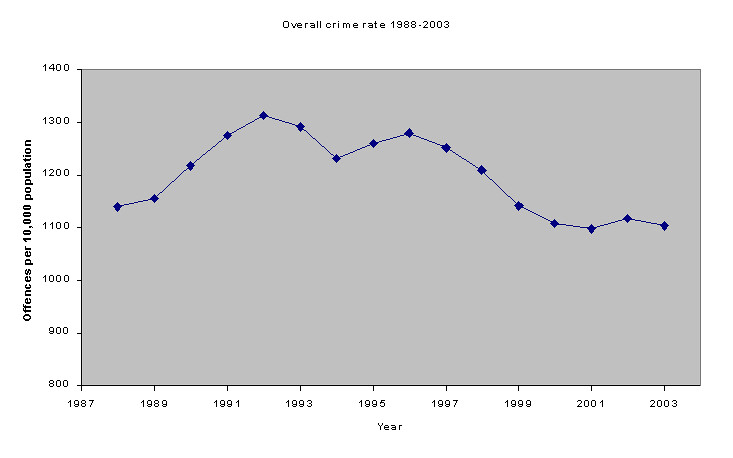
What about the specific examples used by Brash? Family violence? Offences under the Domestic Violence Act have remained constant over the last four years. Random killings? The murder rate fluctuates significantly from year to year - 2003 was a low, with only 46 murders; 2002 was a high, with 66 - but the overall trend has remained constant, as has that for homicide (murder plus manslaughter) in general. Brutal muggings? Robberies have been up the last two years, but are still about the same as they were in 2000, and lower than in 1998. Homicidal drunk drivers? As can be seen from the LTSA's statistics, deaths and injuries in alcohol-related crashes have decreased significantly.
As a caveat to the above, violent crime - assaults and intimidation - is up - but not substantially so, and certainly not sufficiently to justify the level of public panic. It hasn't doubled; it hasn't even increased by 10%. Instead, the last three years have been up by around 6% over the post-1994 average. If we take a longer view, then rates of violent crime have increased since the 80's - and the culprit is fairly clear. It's no accident that the baseline jumped 50% in the early 90's, when "screw the poor" policies had produced massive social dislocation and poverty and created an underclass. Like so many of the problems in modern New Zealand society, the current high trend rate of violent crime (compared with the 80's) can be laid squarely at the feet of Ruth Richardson and Roger Douglas.
And as a caveat to the caveat, our violent crime statistics do not include sexual offences such as rape and sexual assault. They're down - at their third lowest level in fifteen years. New Zealand is certainly a safer place for women and children than it was last year, or five years ago (when sexual offending was 25% higher than it is now). The crimes ordinary people are most likely to be victims of - burglary and car theft - are both down significantly, as are dishonesty offences in general. Contrary to Brash's assertions, you are not more likely to be a victim of crime now that you were last year, or five years ago.
What about the claim that nothing is being done about crime? Hardly. Over the past five years, the government has responded to falling crime rates with harsher sentences and increased use of preventative detention. And on a more everyday level, clearance rates - the percentage of crimes resolved by police - are up across the board. In the case of burglaries and car thefts, they're up significantly (the clearance rate for burglary jumped by 50% in 2000 and has stayed up since). The police are "doing something".
So, where does this leave Brash? I would say that it rather reduces the "urgent" need for his policy prescriptions. But it also once again exposes his tendency to disregard the facts when they are inconvenient. Like the infamous Orewa speech, his law and order address is aimed at creating and manipulating public perceptions and public fear. The Orewa speech made sweeping claims about "Maori privilege" and "race-based policies", based of course on "what we all know" and "what we see on TV" - and when the underlying facts were examined, those claims turned out to be (to use the technical term) bullshit. This is more of the same. Don Brash isn't interested in discussing crime with an eye to extracting sensible policy options which will address the problem; he is interested in stirring up public fear to get votes. It was despicable when he did that with race relations; here it is merely dishonest.
(Appendix: If you want to look at the underlying facts, check out the police crime statistics. The reports include historical data, and I've used the 2000 and 2003 reports to compile 15 year trend info here (Excel 97 format). Longer-term data is available from Statistics New Zealand).