Showing posts with label Climate Change Impacts. Show all posts

Friday, January 23, 2026


Climate Change: Murderers

Aotearoa is currently in the tail end of our first climate disaster of the year, with flooding in Northland, Tairawhiti, and Coromandel, and slips in Mount Maunganui. Two people are already confirmed dead, and more are still missing. The government has been out-to-lunch for most of it, but they've finally realised that the "working from home" prime minister needed to put in an appearance. But when he did, he was greeted by climate protesters. Because while the regime is in denial, ordinary people can see the clear links between these disasters and regime policies.

Weather disasters are worsened by climate change. And this regime has done everything it can to make climate change worse. They've repealed all effective climate policy, destroyed the ETS, and rejected He Pou a Rangi's recommendations for tougher targets. They are a death cult whose policy is to let it burn. And people are dying as a result.

The regime as good as murdered those people in Mount Maunganui. How many more will we let them kill? This regime has to go, and the sooner the better.

Friday, January 27, 2023


Let the farmers pay for their own poor decisions

South Islands farmers are whining about another drought, the third in three years. If only we knew what was causing this! If only someone had warned them that they faced a drying climate!

But we do know what is causing it: climate change. And they have been warned, repeatedly, for more than 20 years. They've chosen to ignore those warnings, pretending they can continue to pollute and escape the consequences by lobbying and whining. Well, the consequences are here, and politicians cannot make them go away. Ignoring those warnings looks like an increasingly poor business decision. And the 85% of us who live in cities will be asking why we should bail out farmers (again) for the consequences of their own actions, or when they steadfastly refuse to adapt to a changing world. Normal businesses which make poor decisions go bankrupt. Its time we let the same happen to farmers.

Monday, May 02, 2022


Climate Change: Here comes the flood

For decades now we've known that climate change will cause sea-level rise. In Aotearoa, the projections so far have been for 30cm by 2050, and 1m by 2100 - a level which is catastrophic to low-lying areas and coastal infrastructure and which is going to cost us billions of dollars to move or replace everything (and likely billions more in pointless attempts to protect it). But its going to be worse than that, because when the underlying geology is factored in, sea-level is actually rising at twice that rate in large parts of New Zealand:

New climate change research has pinpointed the places in New Zealand where sea level rise will greatly outpace the global prediction of 30cm by 2060 which is based on achieving the Paris climate agreement.

For parts of our two biggest cities, Auckland and Wellington, 30cm of sea level rise isn't 40-50 years away, but just 10-20. By 2060 it’s approaching a metre in some places.

That is because New Zealand sits on two tectonic plates and for many parts of the country 30cm is coming in only 10 to 20 years.

By 2060, it's approaching a metre and that will cause dramatic inundation, untold damage and ultimately force people to abandon their homes and businesses and retreat from the coast.

There's a map which will show this on a local level, but its down due to high traffic. But if you're in Wellington, you can get an idea from GWRC's sea-level rise map, and just mentally relabel "2100" to "2060" (you can look at Christchurch here).

Which ought to focus the mind a little. We thought we had time to adapt to this by a gradual shift, and government policy is predicated on that. But it turns out that we don't. The flood is coming. If you don't want to get washed away, you need to move.

Monday, March 07, 2022


The massive cost of climate change

How much will climate change cost us? Waikato Regional Council looked at just one aspect - coastal defences for a handful of Coromandel holiday towns - and found it would cost them $1.1 billion:

[W]hile there are no ballpark costings done yet on a regional basis, a new report is hinting they could be a very hefty burden for ratepayers and other funders.

Information prepared for this week’s Waikato Regional Council climate action committee says there’s a potential $1.1 billion price tag up to 2120 for coastal defence works at eight key Coromandel sites.

To put that in context, that's 10% of WRC's entire rates income, every year, for a century. And that's just to protect these eight towns. The real cost - fire, flooding, relocating infrastructure - will be substantially higher. And that's just one local authority. Other councils all around the country will be facing similar costs, which will likely only get higher as climate change begins to bite.

The "keep rates low" brigade will no doubt be pushing for us (or rather, them) not to pay those costs, or not to pay them yet. Which means pushing them onto future generations, or paying them in fire and flood and cleanup, or in reduced quality of life (or all of the above). But one way or another, we will be paying them; the only question is how.

Of course, we could reduce the amount we have to pay, by reducing emissions instead, and encouraging other countries to do the same. Rapidly cutting the most damaging greenhouse gas - methane - will substantially reduce warming, hence damage and the cost of protecting against it. That means polluters paying now. But that seems significantly fairer, since the costs of climate change are really costs polluters are dumping on the rest of us. The polluters made this problem, so as far as possible, they should be the ones to pay for it.

Thursday, February 24, 2022


Climate Change: Enabling retreat

One of the basic consequences of climate change is sea-level rise. In New Zealand, tens of thousands of homes are currently exposed to this risk, and will be underwater in just a few decades. But thanks to strategic legal action by rich coastal property owners determined to maintain the "value" of their "asset" (and, more importantly, pass it off to some other sucker for a higher price based on fraudulent information), local authorities have been afraid to properly notify of these risks. Now, the government plans to stop that bullshit:

Councils will be required to disclose a wider range of natural hazard risks to prospective home buyers, under a law change to be introduced to Parliament later this year.

Local authorities will in turn be shielded from legal action taken by home owners angry about their properties being added to hazard zones – provided they have disclosed the information in good faith.

[...]

Property owners would still be able to take legal action against councils for failing to include information about natural hazards, but the legal protection would make it easier for them to disclose relevant risks.

This is a good move, which will finally enable the retreat from the coast we should have been planning for the last decade. With hazards properly notified, people will be less willing to buy, and financial institutions less willing to lend or insure. The end result is that people won't buy or build there (at least not if they're intending to stay for any length of time), and high-risk coastal property will become a valueless stranded asset. So I guess we will see a concerted effort by current owners to get the government to bail them out at inflated values, or to sell up and dump their toxic waste on some other sucker before it gets labelled as such. Which sounds a lot like fraud to me...

Tuesday, January 11, 2022


Climate Change: Famers finally paying the price

It's official: 2021 was Aotearoa's hottest year on record. And the climate chaos is now affecting milk production:

Challenging pasture growing conditions have prompted Fonterra to revise its forecast milk collections to 1.5 billion kilograms of milk solids for the year to May 31, a reduction of 25 million kilograms on its opening forecast.

Fonterra chief executive Miles Hurrell said varied weather and challenging growing conditions across many parts of the country earlier in the season resulted in actual milk collections down on the same time last year.

“We were expecting conditions to improve over the Christmas-New Year period, but this has not eventuated,” Hurrell said.

Basicly, its been too hot and too dry. Which is I guess one way of fixing it: you can't grow cows without water, so in the long term dairy emissions should reduce. But farmers seem to be incredibly thick about recognising they are destroying their own livelihoods, and in any case, thanks to past pollution, we no longer have a long term. We need to cut dairy emissions now, through water restrictions, consent restrictions, and directly capping and cutting the number of cows to a manageable level. Waiting for farmers to pollute themselves out of existence simply means letting them take us with them.

Friday, October 08, 2021


Climate Change: Preparing for the flood

The Christchurch City Council has published new "coastal hazards" data, indicating which places are under threat from sea-level rise. And its not good news:

Parts of Christchurch and Banks Peninsula are likely to become unhabitable [sic] as the city council figures out how to adapt to sea level rise.

From Friday, residents will be able to see how their individual properties could be affected by rising sea levels using a new online tool launched by the Christchurch City Council.

[...]

About 25,000 properties in coastal and low-lying areas across the city and Banks Peninsula are at risk of flooding or erosion due to predicted sea level rise over the next 120 years, according to the assessment.

You can view the interactive map here. While it doesn't cover the central city area (which is also under threat), it makes it crystal clear that Christchurch is going to be a very different place in a hundred years, and a lot of its current coastal areas will simply be gone. Even looking at the 30-year timetable, to 2050, there are significant areas of Sumner and New Brighton facing regular inundation. And that's assuming we don't get any tipping point events (which can't be ruled out).

And Christchurch is just one example. Cities all over Aotearoa face this problem, and will need to prepare. The best way of preparing is to end coastal development, so we're not building anything new simply to be washed away. And we'll need to follow that up with other planning changes to ensure that people eventually move out of these areas and to higher ground. Unfortunately, what's likely to happen is what happened in Christchurch five years ago when the council last tried to deal with this threat: rich coastal property owners threatening legal action so as to bully the council into suppressing this information (thus preserving their inflated and artificially high property values, while giving them time to find a sucker to dump the mess on).

Tuesday, March 09, 2021


Climate Change: Heading for uninhabitability

A few years ago, David Wallace-Wells warned that climate change risked making a huge chunk of the planet literally uninhabitable. One of the mechanisms for this is the combination of heat and humidity, which if high enough can kill people outside of air-conditioned spaces. How bad does warming have to be for this to happen? Unfortunately, it looks like just 1.5 degrees will be enough to cook most of the tropics:

The climate crisis is pushing the planet’s tropical regions towards the limits of human livability, with rising heat and humidity threatening to plunge much of the world’s population into potentially lethal conditions, new research has found.

Should governments fail to curb global heating to 1.5C above the pre-industrial era, areas in the tropical band that stretches either side of the equator risk changing into a new environment that will hit “the limit of human adaptation”, the study warns.

[...]

The research team looked at various historical data and simulations to determine how wet-bulb temperature extremes will change as the planet continues to heat up, discovering that these extremes in the tropics increase at around the same rate as the tropical mean temperature.

This means that the world’s temperature increase will need to be limited to 1.5C to avoid risking areas of the tropics exceeding 35C in wet-bulb temperature...

40% of the world's population lives in the tropical belt, including pretty much all of Central America and south-east Asia, and most of Africa, India and Brazil. Closer to home, the area includes most of our Pacific neighbours: Samoa, Tonga, Tokelau, Niue, and most of the Cook Islands. For these countries, stopping climate change is literally a matter of national survival. And if we don't stop emissions, we are basicly murdering them.

Thursday, September 10, 2020


Climate Change: Overshoot

California is burning down again. In Oregon, the city of Medford - a town the size of Palmerston North - has had to be evacuated due to the fires. In the Atlantic, Tropical Storm Rene has become the earliest "R"-storm to form since records began, beating the previous record by 10 days. The Thwaites Glacier is melting from below. If this sounds bad, its because it is: we look to be on track to exceed the 1.5 degree safe limit as early as 2024:

The Paris climate agreement seeks to limit global warming to 1.5℃ this century. A new report by the World Meteorological Organisation warns this limit may be exceeded by 2024 – and the risk is growing.

This first overshoot beyond 1.5℃ would be temporary, likely aided by a major climate anomaly such as an El NiƱo weather pattern. However, it casts new doubt on whether Earth’s climate can be permanently stabilised at 1.5℃ warming.

Despite the promises made in Paris, we've kept polluting, pumping more and more carbon into the atmosphere, driving temperatures higher and higher. We are already beginning to pay the price for that, in fire, flood, storms, and death. And that price is going to get higher the longer we can continue.

We can still stop this. It requires sustained global action to cut emissions and decarbonise our economies. We have the technology to do this. What we need is the policies to make us use that technology. We have an election next month, and that is our chance to make that happen. Or would you rather wait around to burn and drown and die of heatstroke?

Monday, August 24, 2020


This is fine

Monsoons Cause Havoc in India as Climate Change Alters Rainfall Patterns, Voice of America, 14 August 2020:

Searching through the rubble of a tea plantation that collapsed after heavy rains lashed India's southern Kerala state last week, rescuers counted 55 casualties. The resulting landslide buried homes of several workers in the hillside's debris – several children were among the victims.

It was the latest monsoon-related disaster that has taken at least 150 lives in India, where environmentalists say climate change has altered the pattern of the monsoon season – it now brings short, intense bursts of rain instead of the steady showers that historically rejuvenated soil from June to September.

In the north and east of the country, an estimated 8 million grappled with a trail of destruction as swollen rivers inundated vast swaths of farmland and villages, destroying thatched homes and crops in two of India's poorest states, Assam and Bihar.

In just a week, wildfires burn 1 million acres in California, AP, 23 August 2020:
Weary firefighters in California raced Saturday to slow the spread of wildfires that burned nearly one million acres statewide in a week and destroyed hundreds of homes ahead an expected weather change that could bring more lightning strikes like the ones that sparked many of the blazes.

[...]

Two clusters of wildfires in the San Francisco Bay Area grew to become the second- and third-largest wildfires in recent state history by size. Light winds and cooler and more humid nighttime weather helped fire crews make progress on those fires and a third group of fires south of San Francisco ahead of the forecast of warm, dry weather, erratic wind gusts and lightning, state fire officials said.

Twin hurricanes threaten the Caribbean and US Gulf Coast, RNZ, 24 August 2020:
Coastal residents in low-lying areas of Louisiana and Cuba were evacuating on Sunday, while roads turned to rivers in Haiti's capital city, as twin hurricanes threatened the Caribbean and US Gulf Coast.

Marco, which strengthened to a hurricane on Sunday and is forecast to hit the Louisiana coast on Monday, will be followed by Tropical Storm Laura, now over the Dominican Republic and expected to travel across Hispaniola and Cuba and strengthen to a hurricane before striking the Gulf Coast on Thursday.

[...]

Back-to-back hurricanes arriving at the US coast within days "could result in a prolonged period of hazardous weather," National Hurricane Center forecaster Stacy Stewart warned on Sunday.

(The last is worse than reported, because they're currently on track to hit exactly the same patch of coast, just days apart).

Again, the planet is on fire, and our pollution is the cause. We need to stop it. Until we do, we are going to see more of these sorts of disasters.

Monday, August 03, 2020


Climate Change: The risk assessment

In addition to establishing a process for setting emissions reductions plans, the Zero Carbon Act established a process for managing the risks of climate change. The first part of this is the preparation of regular risk assessments, looking at the risks to our economy, society, environment, and ecology. The first of these was released today, and it paints a pretty dire picture. We're looking at extreme risks to our drinking water supplies, to buildings near the coast, and to government finances from paying the repeated ongoing costs of disaster relief and social dislocation. We're also looking at significant risks to social cohesion and of increasing existing inequalities due to who will be impacted and who will pay. Plus, there's serious risks of maladaptation, of responding badly by failing to plan for worst cases or for the longer term. And we need to start doing something about these risks in the immediate future.

The next stage of this process will be to produce an adaptation plan, on how to address those risks. And there will be progress reporting against it, so governments will not be able to stick their fingers in their ears and pretend everything is fine. But pretty obviously, the best way of managing these risks is to reduce our emissions and decarbonise our society, and to work to make that a global policy. And equally obviously, our current policy settings are nowhere near doing that. So, if our government is to pass the laugh test, it needs to significantly strengthen our climate change policies and start decarbonisation. Otherwise it is literally just sitting there waiting for the flood and letting it happen.

You can read the full risk assessment here.

Wednesday, November 06, 2019


Climate Change: Untold Suffering

That's what we face if we don't stop climate change, according to a warning from 11,000 scientists:

The world’s people face “untold suffering due to the climate crisis” unless there are major transformations to global society, according to a stark warning from more than 11,000 scientists.

“We declare clearly and unequivocally that planet Earth is facing a climate emergency,” it states. “To secure a sustainable future, we must change how we live. [This] entails major transformations in the ways our global society functions and interacts with natural ecosystems.”

There is no time to lose, the scientists say: “The climate crisis has arrived and is accelerating faster than most scientists expected. It is more severe than anticipated, threatening natural ecosystems and the fate of humanity.”

The statement is published in the journal BioScience on the 40th anniversary of the first world climate conference, which was held in Geneva in 1979. The statement was a collaboration of dozens of scientists and endorsed by further 11,000 from 153 nations. The scientists say the urgent changes needed include ending population growth, leaving fossil fuels in the ground, halting forest destruction and slashing meat eating.


These changes are achievable: we have the technology. Implementing it, however, requires political will. And that is what is lacking. Worldwide, our political establishments are deeply corrupt, in hock to the polluting industries which have caused this problem, afraid to change the status quo because their backers and funders will lose out (and yes, that means you, James Shaw and Jacinda Ardern, with your chickenshit targets and sellout to farmers). But with no more time for procrastination and fudging, they need to make a choice: act, or be utterly discredited. Because we are going to solve this problem. These industries are going to be destroyed, just as the massive horse industry was with the invention of the motor-car and the tractor, or candles by electric light. The only question for the politicians is whose side they're going to be on, and whether they want to be swept away with their polluter mates.

Meanwhile, the US has begun the process to withdraw from the Paris Agreement, signalling their refusal to take action. The rest of the world should respond with a blockade and trade sanctions. In the interim, you can start reducing American emissions by voting with your wallet and not buying American.

Wednesday, October 30, 2019


Climate Change: California burning

Its fire season in California, and the state is on fire again, with tens of thousands evacuated and millions without power as forests and homes burn. And its so bad now that some are asking whether parts of the state are now too dangerous to inhabit:

Three years in a row feels like – well, it starts to feel like the new, and impossible, normal. That’s what the local newspaper, the San Francisco Chronicle, implied this morning when, in the middle of its account of the inferno, it included the following sentence: the fires had “intensified fears that parts of California had become almost too dangerous to inhabit”. Read that again: the local paper is on record stating that part of the state is now so risky that its citizens might have to leave.

If you're going to be evacuated every year, if your house burns down every three, you can't build any sort of life. And so places where that happens are just going to have to be abandoned, become places that people live in temporarily, rather than year-round. Its going to be a big change, but that's what we've done to ourselves.

California is where the future happens, but unfortunately our climate future is hostile. They're just seeing it before the rest of us. If you need a warning about why we need to cut emissions to zero and start drawdown, what is happening in California is it.

Thursday, October 10, 2019


Climate Change: Paying the price in California

Last year, California burned. This year, to stop it happening again (or rather, to stop themselves from being found liable if it happens again), Pacific Gas and Electric is cutting power to half the state for a week:

Schools are closed. Traffic lights down. Tunnels dark. Businesses unopened. Hospitals running on generators.

Much of northern California is facing life without electricity or gas for as many as five to seven days, after the country’s largest utility company cut power to an unprecedented swath of the state as a preventive measure against wildfires.

The preventive power shutoffs by Pacific Gas and Electric (PG&E) may affect up to 2.5m people by the end of the week. The first wave of shutoffs began on Wednesday to portions of 20 of the state’s 58 counties. PG&E is expected to shut off power to 10 more later in the day.


And that's the price of climate change: a huge chunk of one of the richest parts of the world where you can no longer get reliable electricity for fear of climate-change induced fires. And its a terrible price, because its not just a question of inconvenience - PG&E is basicly leaving anyone medically dependent on electricity to die (the expected cost of that presumably being lower than the expected cost of being found liable for another massive fire). And given the way the climate is going, this is likely to happen every year, until they find a way to stop their lines from causing fires (or until people adopt distributed generation to avoid disruption).

Monday, September 30, 2019


Climate Change: The future comes to Nelson

The moon is at perigee at the moment, which means Nelson got a soggy glimpse of its future:

Nelson has been inundated with seawater during a 4.6 metre king tide.

A king tide flooded several streets near the CBD and encroached houses in the low-lying Monaco area early in the afternoon.

[...]

King tide inundation is not an uncommon occurrence around Nelson, with Wakatu Square carpark flooding early last year in a 4.5m tide event.


Look at the photos. Now imagine them with an extra half-metre (by 2050) or 1.2 metres (by 2100). Those homes and businesses pictured would be flooded. That's nelson's future, its everyone's future, unless we both cut emissions to zero and start drawing down carbon rapidly.

Wednesday, August 14, 2019


Drowning our taonga

The government has announced plans to move the Treaty of Waitangi and other taonga to a new site. Great news! So where are they going? Right next to the old one:

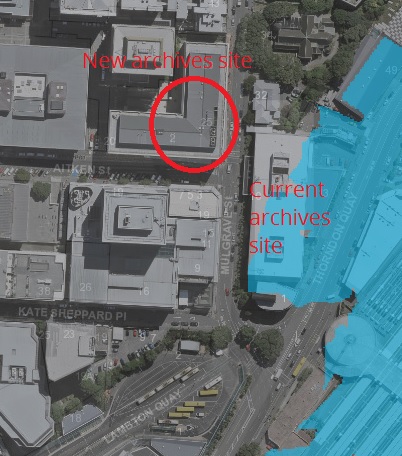
The new plan will see a new 22,000-square-metre archive built on the former site of Defence House - the former Defence Force headquarters demolished after the 2016 Kaikoura earthquake - to home the documents.

Huh. Isn't that close to the pre-colonial shoreline? I wonder how it looks on the Wellington City Council's interactive climate flooding map, with their expected sea-level rise of 1.5 metres?
ArchivesFlood

So basicly, the government plans to move everything to a site which will be on the beach within 80 years, and subject to erosion and flooding. I don't think that's a good idea. Instead, the government should be seeking to minimise its climate risk. And that means taking this opportunity to move the archives out of Thorndon, to somewhere well above sea-level. Like Karori.

Friday, August 09, 2019


Climate Change: The cost of sea-level rise

We've had some grim projections about sea-level rise in the last week, with Wellington Regional Council notifying storm surge risks for a 1m sea-level rise, and Wellington City Council expecting 1.5m by the end of the century. How much is all this going to cost us? A shit-ton:

Every 10cm of sea level rise puts several thousand more New Zealanders in a position they might rather avoid: living in an area that could be flooded by an extreme storm.

Modelling has found that each added 10cm puts at risk another 7,000 New Zealand buildings, worth an estimated $2.48b to replace, 133km of roads and 10km of railway line.

To put this in context, seas have already risen almost 20cm globally since pre-industrial times and 1m of sea level rise is considered a middling projection for 2100.


A metre means $25 billion. Wellington's expected 1.5m means ~$38 billion. The latter is roughly the cost of the Christchurch rebuild, or about 40% of a years government spending, which is a staggering amount. And the way things are going, we'll probably find out that these were conservative estimates.

The even scarier thing is that the amount of carbon we have put into the atmosphere means we are already committed to at least a half-metre by 2100, and more after that (because warming and sea-level rise doesn't just stop after then). So we're going to be paying at least half a shit-ton. The challenge is to ensure we don't have to pay the rest of it.

Climate Change: Don't starve

Since scientists started studying climate change, they have warned that it will reduce food production. And now, its happening:

The climate crisis is damaging the ability of the land to sustain humanity, with cascading risks becoming increasingly severe as global temperatures rise, according to a landmark UN report compiled by some of the world’s top scientists.

Global heating is increasing droughts, soil erosion and wildfires while diminishing crop yields in the tropics and thawing permafrost near the poles, says the report by the Intergovernmental Panel on Climate Change.

Further heating will lead to unprecedented climate conditions at lower latitudes, with potential growth in hunger, migration and conflict and increased damage to the great northern forests.


Our food crops require a specific environmental range - so much moisture, this much heat. Outside that range, they produce less, or just die. And our CO2 emissions are taking the climate in our food-growing regions further and further outside that range. Ironicly, a lot of those emissions are driven by food production itself - deforestation to clear land for agriculture, nitrous oxide from fertiliser, methane from cows and rice paddies. But regardless of the source, the net result is the same: an increased risk of famine, and all the associated disruption it causes.

Somewhat predictably, the media is focusing on the recommendation that rich, western consumers with choices eat a bit less meat - something which is neither particularly hard, nor the end of the world, but which has an outsized impact on emissions and heating. But that's not enough. Food production is responsible for between 23 and 37% of global emissions, and food is essential, so we can only reduce those emissions so far. Avoiding a collapse in global food supplies means solving the climate crisis, which in turn requires the rapid decarbonisation of the economy while planting forests to offset (and ultimately draw down) what we can't cut. And that requires policy change on a national and international level. So the most important individual action you can take is to vote for that change, and to vote out politicians, parties, and governments who oppose it.

Friday, August 02, 2019


Climate Change: Wellington expects to go under

What will climate change do to our capital city? The Wellington City Council has updated its projections, ditching its optimistic 0.6m estimate for sea-level rise in favour of a more realistic 1.5m. And the result is devastating:

Wellington City Council has unofficially ditched an optimistic sea-level rise scenario in favour of one that could see much of the central city and low-lying suburbs under water.

[...]

Under the new scenario, also outlined in the 2013 report, areas in line for "inundation" include much of the area around Westpac stadium, swathes through the central city, as well as lower parts of Oriental Bay, Evans Bay, Kilbirnie, Shelly Bay, Seatoun, and the South Coast bays.

It will mean that without massive mitigation measures - as extreme as reclaiming Wellington harbour east of a line between Freyberg Pool and CentrePort - the Harbour Quays will be in the inundation zone. It is here Wellington's $6.4 billion Let's Get Wellington Moving has its preferred route for mass-transit.

The old best-case scenario was almost-entirely limited to areas immediately beside the sea.


Wellington will basicly return to its pre-colonial shoreline. WCC has an interactive map here, and if you plug in 1.5m, you can see that the Beehive is beachfront property, with the new shoreline running along Thorndon Quay, Lambton Quay and Wakefield St. Parliament, Te Papa, the National Archives and the Green Parrot, along with a huge number of government agencies and private businesses, will all have to relocate. $6.5 billion of property will be at risk, and 2,000 residents displaced. And that's just in Wellington. Petone, Waiwhetu, Makara, Pauatahanui, and Kapiti are all going to be underwater as well.

Fonterra and the fossil fuel industry like to talk about the cost of climate change action, but the cost of inaction is having to relocate the entire CBD of our capital city (and others as well). And that's simply too much to risk.

Thursday, June 06, 2019


Climate Change: An existential threat

How bad is the threat of climate change? Existential risk to civilisation bad:

A new climate report co-authored by a former fossil fuel executive has painted a bleak outlook for the future of human civilisation - including nuclear war.

Existential climate-related security risk: A scenario approach, published by Australian thinktank Breakthrough National Centre for Climate Restoration, suggests climate warnings from the likes of the UN are downplaying the sheer chaos that could erupt by 2050 as the world warms.

If emissions don't start to fall until 2030 - behind the goal set by the 2015 Paris Agreement - the authors say the world could warm 3C by 2050 "due to the activation of a number of carbon-cycle feedbacks". This could result in sea levels rising 0.5m by 2050, 3m by 2100 as ice sheets and permafrost melt, and up to 25m in the longer-term.

"Thirty-five percent of the global land area, and 55 percent of the global population, are subject to more than 20 days a year of lethal heat conditions, beyond the threshold of human survivability," by 2050, the report says."


And what this means is famine, war, and death on a massive scale. Some countries will simply cease to exist. Others, facing starvation or water shortages or just not enough space, will go to war to secure those resources. And the pressure from that could push us into nuclear war. But even if we manage to keep the lid on that particular horror, the loss of farmland and the uninhabitability of major population areas is likely to mean a major population crash, and that's really not going to be pleasant.

As for 25m of sea-level rise, Floodmap shows us what that means for New Zealand: practically every major city will be underwater. Palmerston North will be a beach town. Hamilton, Rotorua, Taupo and Queenstown will be OK, and that's where we'll all have to live. I guess it'll be getting crowded then.

If we don't want this to happen, we need to act like this is an actual crisis, and reduce our emissions as quickly as possible. As for the foot-draggers who want to delay action so they can make a bit more money by destroying the world, we should treat them like they're trying to kill us. Because that is, in fact, what they're doing.