Showing posts with label Emissions Trading. Show all posts

Tuesday, April 28, 2026


Climate Change: He Pou a Rangi's FAFO warning

Since winning power in 2023, the present National regime has Fucked Around on climate change policy. They're repealed a swathe of measures to reduce transport and industrial emissions, reversed course on agricultural emissions and signalled a continued free ride for polluting farmers, promised continued pollution subsidies for industrial emitters, reduced the ambition of future emissions budgets, and decoupled the ETS from international climate goals... its a long list. And they've Fucked Around with the Emissions Trading Scheme itself, saying they were thinking about lowering auction reserve prices before hastily backing away. All of this has had an effect on the credibility of the ETS, and on emissions prices: auctions haven't cleared since December 2024, and the carbon price has crashed and remains below $50 a ton as participants have hedged against the prospect of National crashing it further (or just doing away with the whole thing and leaving them holding a pile of worthless paper).

And now He Pou a Rangi Climate Commission is warning that we're about to Find Out the consequences of all that Fucking Around, with their latest Advice on NZ ETS unit limits and price control settings for 2027–2031 projecting an ETS supply crunch (due to stockpile burning and all those failed auctions) as soon as 2028. But there's no way of fixing it. Because the obvious way - add more credits - would be taken as a further sign of the regime's lack of commitment to climate action. But doing nothing means a credit shortage, price spikes, and demand destruction by the market:

Volatile or rapidly rising NZU prices could also force emissions reductions through reduced production or plant closures (rather than incentivise investments in lower-emissions technologies), and create conditions where the Government is pressured to make ad hoc interventions in the market.
In other words, the sort of deindustrialisation we've already been seeing due to high gas and electricity prices. And TBH, if that happens and knocks over large emitters, I'm happy to take the win. Sure, it's not the best way of doing it - that would be clear regulation and/or a steadily rising carbon price which incentivises emissions reductions over time - but the regime has clearly signalled that they're not interested in doing things the good way, so we're left with the bad way instead. And if your job is affected, you should know who to blame: National, for Fucking Around on this.

He Pou a Rangi can't solve this this year, because the regime basically has no credibility to make changes. So they're recommending hitting pause for a year and staying with the status quo - effectively hoping for a new government with more credibility, which might be willing and able to actually fix things. Because while we've got a short-term problem due to regime credibility interacting with stockpile reduction policy, we also have a long-term problem of too much industrial allocation, no price on agricultural emissions, and the need to decouple forestry from the ETS, which will crash the system in about a decade. National is absolutely incapable of solving that problem. A new government might be able to, if it can overcome the lobbying of all those entrenched interests. And if not, well, I guess we'll get to find out the next bad way of cutting emissions...

Friday, May 30, 2025


Climate Change: Maybe we can take the win after all?

Last month, He Pou a Rangi shockingly recommended increasing the supply of carbon credits auctioned under the Emissions Trading Scheme. Their reason for this was essentially that climate policy had been too successful - plant closures of major emitters had reduced both emissions and pollution subsidies, while auction failures had forced polluters to use stockpiled units. Meaning that the huge pile of the latter was being reduced "too quickly", and we might - gasp - overachieve our goals.

You might think that this was a good problem to have: long-term there's effectively a finite pool of government credits in the ETS, effectively representing a long-term emissions budget, with anything extra having to come from trees. Cancelling some of this pool rather than using it - which is what the auction failures did - reduces total long-term emissions, or at least requires them to be compensated (for what that's worth). And anything which reduces the supply of units increases the price, and hence the economy-wide incentive for emissions reduction. But He Pou a Rangi was weirdly fixated on the idea of reducing the surplus over the period to 2030, and not before. Doing it too early - in 2029, say - was Bad. So it had to increase auction allocations to stop that from happening.

The good news is that they don't get the final say. There's another round of consultation before a Ministerial decision, and the Ministry for the Environment has included an option of maintaining the lower status quo allocations, with a proportionate allocation for 2030. Which would mean auctioning 13.6 million tons less than He Pou a Rangi's recommendation:

ETSvol2025

...which seems like a good idea. Partly because surplus estimates seem to be very uncertain and move around a lot, so its avoiding having to reverse things in a hurry, and partly because insofar it increases the chances of us actually meeting the second emissions budget (something which is now looking in doubt thanks to National's stupidity) - not to mention reduces our Paris liability. But mostly because we should be using every excuse we possibly can to grind down emissions budgets so as to reduce emissions.

The consultation is open until 29 June. I urge people to read the consultation documents and submit on it.

Monday, April 28, 2025


Climate Change: National supports pollution subsidies

When the Emissions Trading Scheme was originally introduced, way back in 2008, it included a generous transitional subsidy scheme, which saw "trade exposed" polluters given free carbon credits while they supposedly stopped polluting. That scheme was made more generous and effectively permanent under the Key National government, and while Labour talked about removing the subsidies, they somehow never got round to it (it would have upset someone, you see). Both the Parliamentary Commissioner for the Environment and He Pou a Rangi have recommended reducing the scheme, and now Treasury and IRD have joined them. But National says "no":

Ministers rejected advice to take a hard look at hundreds of millions of dollars in climate grants to the likes of NZ Steel, Methanex, Rio Tinto, and Fletcher Building.

Inland Revenue and Treasury told the government there was no proper evidence that yearly subsidies to some of the country's biggest carbon polluters were needed.

Their recommendation for a thorough review was met with a no thanks from Minister Simon Watts.

So, a government which endlessly claims that we don't have enough money for schools or hospitals or public transport (or anything other than landlord tax cuts and pointless guns) is happy to continually fork out quarter of a billion dollars a year to encourage some of our worst polluters to keep polluting. You'd almost get the impression that they weren't really serious about either climate action or fiscal management...

He Pou a Rangi has been crystal clear that the current level of subsidies is a long-term threat to the effectiveness of the ETS, and they need to be reduced ASAP. So this is going on the - already long - list of immediate problems the next government will have to sort out. And hopefully, they'll have no time for industry special pleading while doing so. Because these polluters have already had nearly twenty years to clean up their act. If they haven't done it by now, then its time they faced the financial consequences for their stupidity.

Thursday, April 24, 2025


Climate Change: Fucking the ETS again

For a while, it looked like the government had unfucked the ETS, at least insofar as unit settings were concerned. They had to be forced into it by a court case, but at least it got done, and when National came to power, it learned the lesson (and then fucked the ETS in other ways). But now, it looks like He Pou a Rangi is going to fuck it up all over again, proposing a huge increase in auction volumes:

The commission found that the government could increase NZU auction volumes by 13.6m units for the 2026-2030 period, compared with last year’s estimates.

That was largely because surplus units were coming down faster than expected. In addition, industrial allocation of units was forecast to be lower than expected due to plant closures, lower production and updated baselines.

The full advice is available here, and while their reasoning on surplus reduction does not seem unreasonable, it is also risky, because the government won't be able to reduce 2028 volumes if later data shows they're wrong. As for industrial allocations being lower than budgeted, we should be banking this as emissions reductions, rather than immediately giving them away to allow further pollution. But because the government doesn't count the cost of its Paris NDC liability, there's no financial argument for that (and instead a clear financial argument for more auctions to raise revenue to waste on landlord tax cuts and higher salaries for politicians).

In short, this is a mistake. We should be taking every excuse to grind emissions down, and to grind down the total liquidity in the ETS. And it almost makes you wonder whether National's recent crony appointments to the commission are affecting its advice.

Friday, March 28, 2025


Climate Change: More subsidies for Tiwai

In December 2021, then-Climate Change Minister James Shaw finally ended Tiwai Point's excessive pollution subsidies, cutting their "Electricity Allocation Factor" (basically compensation for the cost of carbon in their electricity price) to zero on the basis that their sweetheart deal meant they weren't paying it. In the process, he effectively cut emissions by a million tons a year. But now of course National is reversing it and restoring Tiwai's subsidy:

The Tiwai Point aluminium smelter will receive carbon credits worth an extra $37 million a year to help it pay its power bills, after Cabinet ignored official advice to boost the subsidy by a lower amount.

[...]

When the smelter signed new electricity contracts with higher prices last year, it triggered a process to reevaluate how much the carbon price affects the smelter’s power costs. Officials recommended raising the free allocation by around 340,000 credits a year – worth $22 million on a $64 carbon price – based on independent modelling commissioned by the environment ministry. The smelter asked for a much more significant uplift worth $56 million, based on its own commissioned modelling.

In the end, ministers split the difference, plugging the assumptions from the smelter’s modelling into the officials’ preferred modelling approach and arriving at 581,000 extra credits worth $37 million a year.

So, we get a huge amount of public money being used to subsidise a profitable, foreign owned company to raise power prices for the rest of the country, and a huge increase in pollution to go with it. And its even worse because He Pou a Rangi has repeatedly advised the government that it needs to cut industrial allocations to avoid overallocation and long-term costs - most recently in their advice to a select committee. Unfortunately, the government seems to be completely ignoring it, preferring to undermine the ETS by subsidising twilight industries to continue polluting. Which means this is just going to be another problem the next government is going to have to fix. And the longer National continues to subsidise pollution, the more drastic that fix is going to have to be.

Wednesday, March 19, 2025


Climate Change: Failed again

In what has become regular news, the quarterly ETS auction has failed, with nobody even bothering to bid. The immediate reason is that the carbon price has fallen to around $60, below the auction minimum of $68. And the cause of that is a government which has basically given up on climate change, repealing all useful policy, setting laughably low targets, while making louder and louder noises about refusing to meet our Paris commitments - or even withdrawing entirely. Not to mention refusing to address the fundamental oversupply issues which have undermined the ETS.

Basically, with this government, ETS participants have no confidence that the system will work properly in the future, or even that it will exist in the future. Which naturally affects how much they're willing to pay. The good news is that they're burning some of the stockpile of excess units. But long-term, this lack of confidence in the system is going to be a killer.

As for the auction. 1.5 million tons of unsold units now go into the pile for future auctions. And if they continue to be unsold by the end of the year, they'll simply be cancelled, removing them from the system forever. Which isn't a terrible outcome. But the long-term collapse of the system probably is.

Wednesday, December 04, 2024


Climate Change: The ETS needs reform

The final ETS auction of the year was held today, resulting in a partial clearance: 4 million of the available 11.1 million units were sold, at the minimum price of $64/ton. Once you add in March's partial sale, the government managed to sell just over 7 million tons all year - or just under half of what it had planned to.

Which I guess is a strong argument that the ETS was overallocated. Polluters didn't need all that carbon, so they didn't buy it. Fortunately, the available volume is being brutally cut next year, to just 6 million tons - which should help rebalance things. Unfortunately, National has cancelled expected cuts to industrial allocations (aka pollution subsidies) - and after next year these subsidies will exceed auction volumes. Meaning the benefits of the system will accrue to those subsidised large polluters rather than the public. And the systematic overallocation of subsidies means these polluters are already making out like bandits at our expense.

I don't think this system is sustainable. For the system to work and help us meet our targets, ETS volumes need to decrease every year - and that includes industrial allocations. But beyond that, I don't think there's public support for a tool which simply operates to enrich favoured cronies at public expense - especially when said cronies are (by definition) New Zealand's worst polluters, and some of them are not lifting a finger to change that (while others are demanding that their subsidies continue, even as they take government money to reduce their emissions). If the ETS is to continue, it needs wholesale reform. And that includes ending the subsidy regime. These polluters have been receiving subsidies for 16 years now - more than enough time for them to transition to cleaner technology. If they have not, that is a poor business decision, for which they deserve to be held accountable. End the subsidies, make them pay their full social costs, and if they can't, then they were never really "profitable" anyway.

Wednesday, August 21, 2024


Climate Change: National (almost) does the right thing for once

Back in March, He Pou a Rangi laid down the gauntlet to the government, recommending ETS price and volume settings which would slash the amount of available carbon, in an effort to force polluters to burn their stockpiles. I had low expectations of the government, and expected them to repeat Labour's mistake of ignoring the Commission in order to ensure cheap carbon for their cronies. Fortunately, I've been disappointed: the government has (mostly) accepted the Commission's advice, and even strengthened it in some ways.

The good news is that they've accepted the recommendation to continue the two-tier, high-trigger point cost containment reserve - meaning that it should never trigger and that carbon should stay out of the system. Their annual auction volumes actually total 1.5 million tons less than the recommended amount - though of course National has backloaded this, with slightly higher volumes for the next two years, offset by deep cuts later ("cuts later" is basically their policy in a nutshell). But this is more than offset by higher industrial allocation volumes, signalling that they refuse to end the outrageous pollution subsidies which see NZ Steel given 50% more credits than it actually emits. Which isn't just a commitment to ongoing corporate welfare - its also a refusal to fix an existential threat to the system, kicking the can down the road for the next government to fix (I guess those polluter lobbyists earned their pay). And the upshot is that their total volumes are about half a million tons higher than that recommended by the Commission. Which means half a millions tons we will need to make up later, somehow.

The silver lining is that that extra half million tons might not be emitted. Pollution subsidies are production-based, so if the polluters shut down - due to high electricity prices, say - then they don't get an allocation. Winstone Pulp's announced shutdown will more than offset the extra volume. Of course, if they weren't being subsidised to pollute, we wouldn't have to cheer their destruction. But policy choices have consequences.

Thursday, July 11, 2024


Climate Change: National's gas fantasy

Yesterday the government released the advice on its proposal to repeal the offshore fossil gas exploration ban, including a Climate Implications of Policy Assessment statement, Cabinet paper, and Regulatory Impact Statement. I spent some time looking at these last night, and the short version is that the government's plan is pure madness. It is utterly inconsistent with the 2050 target, and will completely blow our carbon budgets.

First, the CIPA. MBIE uses its own model, rather than He Pou a Rangi's, because they believe (or want Ministers to believe) that gas is declining faster than He Pou a Rangi expected. In this they assess the impact of repealing the ban at 14.2 million tons of CO2 to 2035, and 51.6 million tons to 2050 - basically another year's worth of emissions:

GasbanRepealCIPA

They try to handwave this with reductions from "displaced coal" and more EVs and industrial electrification due to a "stable electricity price", but they don't quantify any of that, so these are the numbers they've got. And if you take them at face-value, and poke into the details of our future emissions budgets and ETS settings, they become very problematic very quickly.

Lets look at the second emissions budget period (EB2, 2026-30). The total allowed for that five-year period is 305 million tons. He Pou a Rangi expects 149 million tons of that to be CO2, and poking into their modelling, they think roughly 71 million tons of that is going to come from energy, industry, and buildings. National's policy would increase that by 5.4 millions tons, right when we need to be cutting.

But its all fine, says MBIE, because:

All emissions in the gas sector are covered by the New Zealand Emissions Trading Scheme (ETS). The ETS has a soft cap which means any additional emissions in the gas sector could be offset elsewhere but due to the stockpile this may take time to happen.
Or, to put it another way, "someone else will have to stop polluting so the gas industry can continue to make money". Which invites the obvious question of "who"? Who will that 5.4 million tons come from? Who will be shut down to protect National's favoured industry? Cars? Trucks? Because that's what they're talking about here: someone else pays the price to protect the gas industry (just as now we are all paying the price to protect farmers).

But perhaps a more pressing question is going to be "how"? Because if you look at the ETS numbers. They are not going to add up. Below is the current recommendation for ETS unit limits, which is going to be adopted by the government (or else it will be imposed on them by the courts again). Those unit limits are designed to burn the entire stockpile of surplus credits in the system by 2030. And as a result, they allow only 18.8 million tons from 2026 to 2030:

07table1

So, throwing another 5.4 million tons of demand in there is going to mean someone is going to miss out. And it will mean higher carbon prices, with a consequent impact on the cost of living, than if we just kept the ban in place and managed the decline of the gas industry like we need to.

And it's all going to get worse in the next emissions budget. EB3 (2031-2035) has a total cap of 240 million tons. 121 million tons of that is estimated to be CO2, and 64 million tons from the energy, industry, and buildings sector. MBIE estimates there will be an extra 8.1 million tons of emissions in that budget period, so a 12.7% increase. we don't have ETS unit settings for that period, but we can work them out: a total cap of 240 million tons, less 192 million tons outside the ETS, leaves 48 million tons of ETS emissions. Industrial allocation - pollution subsidies - will eat 16 million tons of that, and technical adjustments another 3.5, so the final auction volume of 28.5 million tons over 5 years. And National plans to increase demand by 8.1 million tons - almost 30%.

As for EB4 (2036-40), He Pou a Rangi has just recommended a total budget of 134 million tons, including 79 million tons of CO2. To get there, they expect to reduce energy and industrial emissions by 19 million tons from EB3, which does not leave a lot. Meanwhile. National wants to increase emissions by 13.5 million tons.

As MBIE points out, the ETS cap is "soft", meaning people can plant trees to offset increase emissions. But the budgets already assume this, and increased tree-planting is factored into them (indeed, He Pou a Rangi has recommended that EB2 and EB3 be cut by 19 million tons to account for the extra trees that have been planted in the past few years). As for National's carbon capture fantasy, MBIE's numbers are net of carbon capture - meaning, as polluters will refuse to adopt it, actual emissions will be higher.

Basically, there is simply no way that National's bigger gas industry will fit within the budgets. And while primary legislation can't be legally challenged, every administrative decision they make to implement it will be subject to legal challenge for that inconsistency.

On the positive side, national has just made the case for us that we can't go back to gas. That that pollution industry cannot have a future. And while they may be able to pass a law saying otherwise, the sheer inconsistency of this policy with legislated targets and emissions budgets means that the next government will have to repeal it and reinstate the ban. Gas companies being able to read the law as well as anybody else, you'd expect that prospect to deter the investment National hopes to promote.

Monday, June 24, 2024


Climate Change: National's vice-signalling

nzclimatechangepolicy

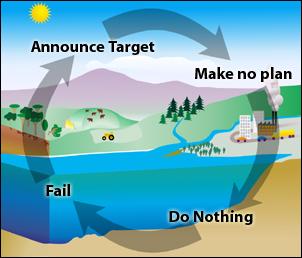
Two weeks ago the climate denier government announced they would be giving farmers what they want and removing agriculture from the ETS. On Friday they introduced the bill for it to the House. Due to past efforts and backdowns, the Climate Change Response Act has a lot of inactive clauses relating to agriculture, with the dates for their activation having been repeatedly delayed over the years. The Climate Change Response (Emissions Trading Scheme Agricultural Obligations) Amendment Bill removes all of that. The immediate impact is small - though it does mean fertiliser companies and meat and dairy processors will no longer have to report their emissions, which sabotages and delays future action. Instead, its about vice-signalling that the present government has no intention whatsoever of doing anything about our worst polluters. As the statutory targets for agricultural emissions reduction are unaffected, it means we're back to the same depressing cycle illustrated above: targets with no plan equals failure.

But while the government of today may be able to deliver to its climate denier donors and cronies in the agricultural sector, it is obviously unsustainable for Aotearoa to refuse to reduce our biggest source of emissions. Which means the next government is going to have to deal with them. And the easiest way of doing this is just to put the removed provisions covering emissions at the processor level right back. He Pou a Rangi has already repeatedly recommended that fertiliser companies be covered, and the he waka eke noa work made it clear that using the ETS at the processor level would be more effective at reducing agricultural emissions than any of the bullshit schemes farmers had come up with. Farmers hate the idea, because it "penalises good farmers" and "doesn't incentivise farm-level reductions", but processors can just handle that by contracts with their suppliers - as they are already doing. So farmers can either reduce their emissions, or not be able to sell their milk to anyone. And if farmers don't like that, they should feel free to fuck off and farm elsewhere, and good riddance to them. Whoever buys their land will put it to a more productive, less emissions-intensive use.

Farmers have used bad faith and predatory delay for twenty years now to avoid paying for their emissions. National's sabotage is just the latest step in that game. But the time for Fucking Around is over. Its long past time farmers Found Out.

Tuesday, June 11, 2024


Climate Change: Farmers get what they wanted - for now

Since entering office, National has unravelled practically every climate policy, leaving us with no effective way of reducing emissions or meeting our emissions budgets beyond magical thinking around the ETS. And today they've announced another step: removing agriculture entirely. At present, following the complete failure of he waka eka noa, agriculture is scheduled to enter the ETS next year at the processor level, with 95% of emissions subsidised. National will reverse this, disband he waka eka noa, and ensure an effective hundred percent subsidy for our worst polluters forever.

...or at least until there's a change of government. Because agriculture is our biggest source of emissions, the next government will have to have a policy to reduce them. And by abandoning the compromise on agricultural emissions pricing, National has effectively given the next government carte blanche to do the same. Meaning they can do what we need to do, immediately price emissions at the processor level, and finally make farmers pay. And in doing so, they won't have to be bound by the policy National just threw in the bin - meaning we can eliminate subsidies and make them pay the full cost of their pollution, just like the rest of us do. Which would be both effective and fair. And if it causes dirty farmers to go out of business, well, that is the purpose of emissions pricing.

So, farmers have got what they wanted for now. But it won't last, and there's good reason to think they'll be worse off in the future as a result. So maybe farmers should have been careful what they wished for?

Wednesday, May 29, 2024


Climate Change: Another budget hole for National?

National's 2023 campaign was all about tax cuts for landlords. And one of the key ways they were planning to fund it was a "climate dividend" - basically, pillaging ETS revenue and redirecting it from decarbonisation straight into the pockets of the rich. But there's a problem: there might not be much ETS revenue this year.

The first ETS auction of the year didn't clear, selling only 2.974 of 3.525 million tons (and that for the minimum price of $64/ton). The second one - for the leftovers plus another 3.525 million tons - is due in three weeks. In the meantime, National has repealed key climate change policies, announced reviews, and promoted fossil fuels - all of which have destroyed confidence in the carbon market. Basically, the government's commitment to climate action is now highly questionable - and so is the future value of carbon. This has flowed into the carbon market, with the spot price reducing to about $45/ton - nearly $20 below the auction minimum price.

The implications for the next round if auctions ought to be obvious: people are unlikely to pay $20/ton more than they have to. It seems unlikely to clear, or indeed, to sell anything. And unless the direction of the government changes significantly, its hard to see that changing for the September and December auctions either. The result will be that 11.125 million tons of carbon will go unsold, and the government will get no money for it - creating a $700 million budget hole.

But while this is bad for National's books, its good for the environment. Unsold ETS credits are cancelled at the end of the year, removing them from the system. So if the auctions fail again this year, its effectively an 11 million ton emissions cut (plus another 7 million tons from the cost containment reserve). Polluters will instead plant trees, or burn down the massive stockpile of credits effectively given to them by the policies of the last National government - both things we need them to do. So, its a direct benefit to the future - unlike the National Party.

National's current consultation on ETS price settings includes a proposal to reduce the price floor, to ensure the government always gets some revenue. But they can't fix that this year, and any proposal which diverges from the recommendations of He Pou a Rangi is likely to face a judicial review. If you're interested in this consultation, you can submit on it here.

Wednesday, March 20, 2024


Climate Change: A failing market

The first ETS auction of the year was held today, and resulted in the market failing to clear. Only 2.97 million of 3.52 million units were sold - and those at the minimum price of $64/ton. Meaning that supply is still exceeding demand - exactly as the Climate Commission warned us a week ago. Which you'd hope would result in the government listening and slashing future supply, since obviously polluters don't need it.

The other consequence is that the government didn't get much money: only $190.4 million. Meaning less money to fund their (vile and unnecessary) landlord tax cuts. So maybe that will sharpen the government's mind as well, given its foolish reliance on ETS revenue to fund its vile and unnecessary landlord tax cuts. But somehow, I suspect it won't. National is full of climate change deniers who see climate change policy - including the ETS - as "red tape". They'll be happy to see it fail, and keep failing, even if it means missing our targets (which of course they claim to still be committed to). Better the planet burn, than any of them or their donors have to change a single thing about their lives or business practices...

Tuesday, March 12, 2024


Climate Change: A test for National

He Pou a Rangi Climate Change Commission has released its latest advice on NZ ETS unit limits and price control settings for 2025–2029. This is, in theory, technical advice on how many units the government should allow to be auctioned. But because the ETS system is under pressure due to an accumulation of past poor decisions, its going to be a real test for National.

What are those past poor decisions? Putting trees in the system, which seemed like a good idea when the system was first designed in the early 1990's, but is now looking increasingly questionable. Handing out millions of tons of free credits every year to large polluters, which looked like a great idea to National in 2009 when it wanted to bribe its cronies, but has also come back to bite us. Having a fixed-price option until 2022, which again seemed like an acceptable transition measure in the 2010s, but was wildly rorted for the profit of polluters when the supply of fraudulent overseas "credits" was cut off, and the system transitioned to full auctions just a few years ago. Together, these poor decisions have led to the buildup of a huge pile of surplus credits in the system. And somehow, it managed to grow by another 15 million tons last year, despite nothing being auctioned.

The Commission's job is to ensure that the ETS settings are in accordance with our emissions budgets, so their solution to this problem is to radically slash auction volumes. There's no side-by-side comparison of the recommendations with the current settings, but you can get a sense of the scale from this graph, which includes 2024's volume:

CC-ETSRec2024

For comparison, the current auction volumes for 2025 - 2028 (New Zealand units available by auction less the reserve amounts; the bit in dark blue on the graph above) are 12.6, 10.7, 9.1, and 7 million tons, so they are basicly halving them. And its clear that unless something is done about industrial allocation volumes, there's going to be very little auction supply from 2030 onwards.

This is, in theory, going to have an impact on prices, though it will be moderated if the surplus is used up. When the previous government faced a challenge like this, they fucked it up, trashing the market and causing a loss of certainty in the entire policy (though in retrospect this ultimately caused the removal of 23 million tons from the system, so: could have been worse). The question is whether National will do the same, trash the budgets and cause another year of chaos before being told to go back and do it properly by the courts. Or whether they'll take the lesson from last time, and accept the advice of the experts Parliament appointed to help them. Sadly, I don't have much confidence that a cabinet stacked with business cronies and climate deniers will do the right thing here.

(There's a number of other interesting things in this advice. Firstly, a warning that governments should not rely on the ETS as a source of revenue, because auction prices are uncertain and volumes will decline to meet budgets. Secondly, a recommendation that the reductions from non-ETS policies like the clean car discount and NZ Steel deal be locked in by ripping them right out of the ETS. Again, it remains to be seen whether National will listen on that, or whether they'll sabotage emissions reductions to make reality conform to their weird economic purism).

Tuesday, December 19, 2023


Climate Change: So much for "leakage"

One of the major arguments climate polluters have deployed against being made to pay for their pollution is the threat of "leakage": that they will simply move production to some country where they don't have to pay, resulting in no actual reduction in emissions. Which sounded superficially convincing back in the 1990's when almost nobody was pricing emissions, but a lot less convincing now when a huge chunk of the world is. But a huge chunk isn't everybody, and there are still holdouts - but there are ways of fixing that too. From 2026 Europe will be applying a Carbon Border Adjustment Mechanism - basicly slapping a carbon price on high-emissions imports at the border, to make sure they pay for their carbon. And now the UK is joining them:

Imported raw materials such as steel and cement will incur a new carbon tax from 2027 under UK plans designed to support domestic producers and reduce emissions, but the government is facing criticism for not moving fast enough.

[...]

The chancellor, Jeremy Hunt, said: “This levy will make sure carbon intensive products from overseas – like steel and ceramics – face a comparable carbon price to those produced in the UK, so that our decarbonisation efforts translate into reductions in global emissions.

“This should give UK industry the confidence to invest in decarbonisation as the world transitions to net zero.”

And the big argument against it? That they're not doing it quickly enough. Which tells you how much the world has changed. Countries with carbon pricing now see no reason to tolerate cheats who dump their pollution on others.

Now of course we just need major importers to do this to dairy products, and that will solve our agricultural emissions argument overnight.

Wednesday, December 06, 2023


Climate Change: Failed again

There was another ETS auction this morning. and like all the other ones this year, it failed to clear - meaning that 23 million tons of carbon (15 million ordinary units plus 8 million in the cost containment reserve) went up in smoke. Or rather, they didn't. Being unsold at the end of the year, the units are scrapped, so no-one will be able to burn that carbon.

This is a great result for the environment, and it has the effect of rebalancing the ETS by accident. In 2021 and 2022 Labour's cheap carbon policy resulted in it dumping 14 million tons of extra carbon into the environment. That's gone now. And all because they destroyed confidence in the market by ignoring the Climate Commission and trying to keep carbon cheap, resulting in low bids and auctions which didn't clear.

It's also a problem for the government, which was relying on the revenue from the auction. But that doesn't really matter now. Under Labour, that revenue would have been spent on further decarbonisation, and its loss would have slowed decarbonisation. But National was just going to use it to fund tax cuts for landlords, so fuck them.

Looking forward, next year has a much lower carbon budget - 14.1 million tons, plus 7.7 million in a high-priced, two-tiered CCR which should never trigger. So we might finally see the system working properly to provide strong incentives for decarbonisation, like it was supposed to. But I'm sure National, ACT and NZ First will find some way of fucking it up. The last thing they want is actually effective climate policy, because then their donors and cronies might have to change what they do or go out of business.

Wednesday, September 06, 2023


Climate Change: The auction fails again!

There was another ETS auction this morning, and like the other two this year, it failed to clear, with no bids above the confidential reserve. Which means another 4.475 million tons of carbon go into the pile for the next auction - and if that one fails, it all disappears, effectively taking 26 23 million tons of carbon - a third of a year's emissions - out of the system forever. Which is a result we should all be hoping for.

As for why, I think that after two failed auctions, there's just too much volume. There were bids for only 57% of the units on offer. Which means that if the bottom bid is below the reserve, nobody gets anything - and the government gets no money. There's now a billion dollar hole in the government's finances. Which ought to give the status quo parties promising to fund tax cuts or other spending with ETS revenue pause for thought.

Meanwhile, congratulations to whoever put in today's low bid - you've done the planet a service. Please do it again in December, and help wipe 26 23 million tons out of the system.

Correction: The December auction volume has been lowered, so the total amount at stake this year is 23 million tons.

Wednesday, August 09, 2023


Climate Change: Fixed

Last December, Climate Change Minister James Shaw introduced a bill to the House which would have massively increased pollution subsidies in the ETS. As introduced, the Climate Change Response (Late Payment Penalties and Industrial Allocation) Amendment Bill would have scaled subsidy eligibility to pre-2020 carbon prices - meaning that every industry currently classified as "moderately emissions intensive" would be reclassified as "highly emissions-intensive", getting them a 50% increase in free pollution permits. In a perfect example of regulatory capture, the proposal was developed by MBIE, primarily to protect a handful of large, status quo polluters, and had been done without any consultation or real analysis. It was, unsurprisingly, not popular with people who wanted the government to actually cut emissions - and plenty of us told them so when the bill went to select committee.

The select committee has no reported back, and the good news is that they've made the changes people wanted, removing the scaling of eligibility, and so the potential for increased allocation. They also introduce a tweak saying the Minister can't reconsider the eligibility of existing activities - which stops them from being reclassified upwards. Unfortunately, it also stops them from being reclassified downwards if their emissions drop - something the Minister should be aggressively looking for opportunities to do - but the committee recommends addressing this through the phase-out rate (which can be set on an industry-by-industry level). The committee also recommends seriously attacking industrial allocation as part of the second emissions reduction plan (which will be developed next year).

All of which is a nice improvement. And fortunately, James Shaw isn't a petulant little baby like Andrew Little, so he'll probably accept the changes, rather than trying to reverse them.

Tuesday, July 25, 2023


Climate Change: Unfucking the ETS

Earlier in the month Lawyers for Climate Action won a historic victory, overturning labour's 2022 ETS settings decision, which had crashed the carbon market. The courts told the government to go back to the drawing board and do it again and come up with ETS settings that complied with the law. Today, the government released its response. The full settings are here, and they have largely followed the Climate Commission's advice. On price, they've adopted the Commission's advice completely, so from December we'll have a CCR trigger price of $173, and from next year we'll have a two-tier CCR triggering at $184 and $230. Which is high enough that it should never happen, meaning those units will never be released. On volume - the measure which matters - they've differed a little from the Commission advice, likely because they're trying to mash two sets of Commission advice together. But the court-granted ability to adjust this year's settings means they've ripped 2.9 million tons out of 2023, giving a number even lower than that originally recommended by the Commission. The table below shows auction volumes without the CCR, to make them easy to compare (the 2023 Commission figures are adjusted to account for the fact that there has been no CCR release in 2023):

YearCurrent settingsNew settingsCC 2022 (p45)CC 2023 (p 42, ignoring step 7a)
202317.915.016.3-
202417.114.215.613.6
202515.312.614.012.0
202613.510.712.210.2
202711.79.110.48.7
2028-6.9-6.6
Total (2023-7)75.561.668.5-
Total (2024-8)-53.5-51.1

So, they've unfucked their previous decision, and once you account for ripping 2.9 million tons out of 2023, actually come in half a million tons lower than the Commission's pathway.

This is a pretty good result, and might finally restore some sanity to the ETS and let it actually function. At least until National breaks it again.

Thursday, July 20, 2023


Climate Change: Getting it done

Back in May, the government signed a $140 million deal with NZ Steel to halve its emissions by 2030. Now, they've followed it up with a $90 million subsidy to Fonterra to bring forward its scheduled emissions reductions:

The Government has announced it will partner with Fonterra in an attempt to cut coal use in the dairy industry, and reduce agricultural emissions.

The relationship will see the dairy giant commit to cutting coal usage across six of its manufacturing sites which it says will result in 2.1 million tonnes of early C02e reductions. This equates to taking 120,000 cars off the road.

The changes are expected to deliver 2.69% of all New Zealand’s required emission reductions between 2026-2030.

This is not as good a deal for us as NZ Steel - the cost of the cuts is $43/ton, vs $16.20/ton for NZ Steel, and there's no subsidy which can be cut to offset costs. Its also morally repugnant that we're further subsidising Aotearoa's worst polluter, to do something that the market looked certain to force it to do anyway. But on the gripping hand, we need to cut emissions as quickly as possible, and this gets it done. And there should hopefully be a nice side-benefit of killing off a bunch of coal mines too.

The important thing now is to rip those savings right out of the ETS to ensure they actually happen, rather than just being emitted by someone else. Otherwise, the government just paid $90 million to shuffle emissions around and make a dirty company look good.