Showing posts with label Forest Sinks. Show all posts

Thursday, April 17, 2025


Climate Change: Kicking the can down the road again

Last week, the Parliamentary Commissioner for the Environment recommended that forestry be removed from the Emissions Trading Scheme. Its an unfortunate but necessary move, required to prevent the ETS's total collapse in a decade or so. So naturally, National has told him to fuck off, and that they won't be changing anything:

But Climate Change Minister Simon Watts, said the government's approach to forestry had already been set in its Emissions Reduction Plan and it did not plan any other changes.

The government had already announced plans to restrict whole farm conversions to forestry on certain classes of productive land.

"The forestry sector will play a key role in driving economic growth by creating more jobs in our regions and boosting the value of exports. It also provides a nature-based solution to climate change, which is a key pillar of the government's climate strategy," said Watts.

So its the usual "policy" from national: do nothing. Kick the can down the road. Leave it for the next government to fix. Because they are going to have to fix it, one way or another, if we want to have a functioning carbon price to reduce emissions. But maybe National - a party still full of climate change deniers and weirdo apocalyptic cultists - doesn't want that either. They may no longer feel that they can openly espouse climate change denial, but they can trash all the policies, do nothing about the threat, and leave us all to burn and drown – which amounts to exactly the same thing.

Monday, June 19, 2023


Climate Change: Too many trees?

The government today announced its review of the Emissions Trading Scheme. As is clear from the media coverage, this is focused on one issue: forestry. The cor problem is summed up in this graph:

ETS-supply

(Note that this chart does not include agriculture, because its currently not part of the ETS)

Basicly, we've planted enough trees already that we're going to have too many carbon credits by the end of the decade, resulting in a falling ETS price, a much lower incentive to reduce emissions, and (eventually) fewer trees. Which is a problem, because we need a lot more trees to meet future climate targets, and (eventually) to draw down carbon from the atmosphere and undo some of the damage we have done.

The review proposes four broad policy options to fix this. The first one - reducing ETS auction volumes - is a non-starter, for reasons which are obvious from the graph above: by the time we have a problem, auction volumes are minuscule compared to forestry removals. The second one - effectively, getting the government to start buying forest credits - is likely to be a part of any solution. In strict ETS terms, this can be seen as offsetting public sector non-ETS emissions (through cancellations) and backing auctions and free allocation units - especially those allocated to agriculture if it enters the ETS. But the real reason is to incentivise the forests we need to keep planting to meet 2050 and post-2050 drawdown targets. The third option is to reduce demand for forest credit by limiting their use and expiring them out of the pool if unused, or just by halving the amount given away. Again, the graph shows why this isn't really going to solve the core problem. The final option - and the one MfE is clearly pushing for - is to split the market in two, and say that polluters can no longer use forest credit to offset their emissions. This has some definite advantages - the ETS cap actually becomes a cap, meaning it drives reductions. But it raises the obvious question of who is actually going to buy forest credits if polluters won't? On this there's the intriguing suggestion of requiring polluters to surrender some proportion (10% say) of additional removal credits in addition to their normal units - effectively legislating for over-performance. But again, looking at the graph above tells us that that's not going to make much difference to the problem, and the ultimate buyer is going to have to be the government. Which Treasury will hate, because it costs money, even if it incentivises the drawdown we need.

Unfortunately, the obvious solution was beyond the scope of the review. The problem is "not enough emissions in the ETS to soak up amount of credits trees are producing". But 50% of our emissions aren't in the ETS. Put them in, and you can make supply match demand by juggling the amount of free allocation and the phase-out rate. On this point, its worth noting that on current policy settings, agriculture enters the ETS at the processor level in 2025, with a free allocation equal to 95% of 2005 emissions, declining by 1% a year. Tripling that phase-out rate means agriculture neatly soaks up the excess credits in 2040 and 2050, assuming it does not reduce its emissions. So we'd really want to set it higher than that if we want agricultural emissions to meet their 2050 target (we'd also face a credit shortage pre-2035 or so, which would mean higher ETS prices, which would help drive the reductions we want).

But even including agriculture simply pushes the problem back a couple of decades, and doesn't solve the eventual problem of too many trees and not enough polluters wanting to buy the credits, which in turn threatens long-term drawdown. Still, that might be enough. And as noted above, there is an obvious solution: if the government wants trees for drawdown, it can always pay for them.

Friday, April 28, 2023


Climate Change: Too many trees?

On Wednesday the Climate Change Commission released its 2023 Draft advice to inform the strategic direction of the Government’s second emissions reduction plan - basicly, what it thinks the government needs to do to meet our statutory emissions reduction targets. It's a long document, but Newsroom's Marc Daalder has a good summary, as does RNZ. The big takeaway is that the Commission thinks we're planting too many trees, and run the risk of just offsetting rather than actually reducing emissions. That's bad, but kindof implicit in the government's pursuit of net-zero, without really trying to think about how much we should be netting out. But its not just a preference for residual emissions to be low - its also a long-term problem, which is displayed in the graph below:

CC-forestry

Basicly: after about 2037, expected forestry credits exceed expected residual ETS-covered emissions, which will cause a collapse in the market, threatening our ability to cover non-ETS emissions (agriculture). Which means we need to fix the ETS long before then to stop it from happening.

While noting that its not really its place to develop policy, the Commission considers and dismisses a wide range of options. partly this is because its policy goal is muddled: encourage forestry, while avoiding "socially unacceptable" levels of tree planting. As someone who thinks that there isn't such a thing, that we need to move beyond net-zero to active drawdown, and that the long-term way to do this is to restore land to nature (or some semblance thereof), that seems like a gap. They're also weirdly unwilling to look beyond the status quo for agriculture, which means they miss the obvious solution: put it in the ETS, with no subsidies. That will increase ETS demand, pushing back that crossover-date. However, it doesn't solve the short-term problem of encouraging offsetting rather than emissions reduction, so its only part of the solution.

On how to solve that, I think there is an answer. The Commission has suggested limiting the amount of forest credits that can be used to offset emissions, and that might work (though it adds complexity). But that misses the real problem. At the moment, trees are a source of credits outside government control, the supply of which is uncapped and which therefore allow emissions above the ETS cap. In a sense, they're no different from the Russian fraud which crashed the ETS in its early years (except of course that trees are real, and we actually want them). The solution is to bring it under government control, by moving to a model where the government buys all forest credits (at a price based on average ETS prices, backed up by a set and rising reserve), and then recycles it into the ETS by auctioning it or using it to back free allocations. That encourages afforestation and discourages deforestation, helping to meet our Paris goals, while controlling supply into the ETS. This also lets them have more honest auction volumes, which map more directly to our desired emissions reduction pathway. If more trees are planted than we need to meet that pathway, great - the government banks the surplus, and we overachieve without crashing the price. If not, the government issues credits as it does at the moment. And if agriculture is in the ETS, and free allocations are eliminated, and there's no bullshit foreign credits, then everyone knows exactly how much we're allowed to emit, and can plan accordingly.

Monday, February 27, 2023


Climate Change: We need more trees, not less

Newshub reports that farmers are outraged that we're planting too many trees:

Newshub can reveal 25 times more land was converted into forestry last year than a decade ago.

It's angered farmers who hope the Government's ministerial inquiry into forestry slash will lead to limits on land conversion. They say the Government needs to answer for incentivising forestry to earn carbon credits.

"We're not absolutely against off-setting, we're certainly not against commercial forestry, but our argument is that there needs to be some limits put on it," Beef + Lamb CEO Sam McIvor told Newshub.

Which is fascinating. Because a decade ago, Aotearoa was in the midst of a boom in dairy conversions, when whole forests were being ripped out and chipped to make way for cows. At the beginning of this boom, when the government was picking up the carbon costs, farmers and their National party proxies in Parliament insisted that land had to be free to change to its highest value use. Now that the value equation has changed, and carbon is more valuable than the dirty, polluting, low-value sheep and beef industries, they're calling for controls. As I noted earlier, these are the final squeals of a dying industry, which is now simply too dirty and inefficient for the modern economy.

Secondly, farmers are complaining about 18,000 hectares of net reforestation. After 25 years, that will have soaked up about 12.6 milion tons of carbon - or less than a third of our annual agricultural emissions (39.4 millions tons in 2020). Farmers oppose any cuts to those emissions, and the government has grovelled to them, with only a weak commitment to cut agricultural methane. As a result, our gross emissions are still expected to be 59.2 million tons in 2050, and our net emissions 19.7 or 31.8 million tons depending on whether you use real or bullshit accounting (weirdly, bullshit is higher, because of course its focused on making things look good in the short term). And this is going to be comprised mostly of agricultural emissions - everything else is basicly expected to hit zero. Which suggests that we actually need more trees, not less, to soak up and draw down our pollution. If farmers don't like that, then the alternative is to radically reduce the size of the agricultural sector (in practice, we are going to have to do both).

Of course, these trees don't have to be production forestry, or pine. Ideally, we'll be returning polluting agricultural land to native forest, like it was before pākehā turned up and ruined the place. But at this stage of the climate crisis, any tree is better than a cow, and turning production pine into permanent forest - locking the gate and just walking away - is an acceptable alternative. The over-riding emphasis must be to get trees in the ground and cows off the land. And we can't let farmers' hurt feelings at the demise of their polluting lifestyle get in the way of that.

Thursday, October 06, 2022


Climate Change: Solving the forestry dilemma

For a long time now the Climate Change Commission has been expressing concerns about the place of forestry in the Emissions Trading Scheme. Our net-zero emissions target encourages us to plant trees to soak up our emissions, but if we plant too many, then carbon prices will be too low to force actual reductions. Meanwhile, the ability of polluters to buy forest credits directly lets them "plant and pollute" and also avoid reductions. The Commission's preferred solution has been to try and limit forestry's place in the ETS, excluding fast-gowing (and therefore fast-soaking) pine in favour of slower native trees, but this would likely result in deforestation and even more emissions. Now, Climate Change Minister James Shaw has presented a better option: the government buys the credits and uses them to back the ETS:

Speaking to Stuff, Shaw said the government was exploring forestry’s place in the ETS. One option was the Government became a buyer – or even the exclusive purchaser – of units from forest owners. These units could then enter the Government pool, to be allocated for free or sold at auction.

The Government would receive a method to incentivise new native and exotic forests plus, potentially, more precise control over gross emissions.

[...]

If the Government purchased forestry units and then auctioned or gave them to polluters, each unit would be net-zero. Overall, this could decrease the country’s gross and net emissions, compared to the current set-up.

I really like this solution. I'd expect the price paid to forest-owners to roughly track the ETS price (using market averages, or the auction price settings), which should provide a strong incentive to keep planting trees. But those trees will no longer allow additional pollution within the ETS. Which means we get a double benefit: the benefit of those trees on the national carbon accounts, reducing the number of credits the government will need to buy on the international market to meet our interim 2030 target, and the benefit of higher ETS prices further reducing emissions (which will also reduce that international liability). It also allows easy incentives for native over pine forestry - either a differential price to recognise the biodiversity benefit, or allowing native trees to remain in the ETS (though that probably just shifts the problem for a decade).

The big risk is that the government faces clear incentives to penny-pinch and set the price it pays for forest carbon too low, both to save money and due to political pressure from traditional farmers, who are being outcompeted by trees. It would also set a clear incentive against updating the carbon tables for native forestry to reflect new data (and so massively increasing the relative value of natives versus pine), because that would cost the government money. Though you'd hope the Greens would be able to apply enough pressure to keep the government from making such mistakes in the short-term.

Monday, May 16, 2022


Climate Change: Craven, status quo policy

The government released its Emissions Reduction Plan today. The plan is required under the Zero Carbon Act and must specify how exactly the government plans to meet its carbon budget (which was announced last week). Which means they need to find another 11.5 million tons of reductions by 2025 - which is a big ask. The plan they've presented might get us there, if things go well, but its going to be dicey. Which suggests that its not strong enough, and they need to do more. The good news, however, is that it looks like some sectors are well on track to exceed their targets for later periods. So if you use the usual metaphor of "turning a supertanker around", the plan seems to turn it for transport and energy.

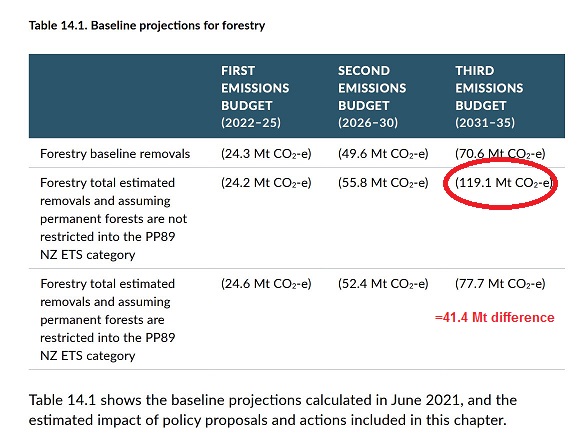
The big exception here is forestry. Unlike the other sectors, it doesn't have a graph showing "emissions with policy" comfortably below the sector sub-target. And that's because they're not. Forestry under the government's proposals fails to meet its targets in every budget. Which is weird, because we're constantly being told that we're planting too many trees and in danger of soaking up too much carbon. But when the government puts down some hard numbers, it turns out we're not, and that the sector we were relying on to save us, won't. Whoops. Note the "under the government's proposals" there, because one of the government's key proposals is to ban permanent exotic forests from the ETS. The government has helpfully shown us the impact of this policy on a table, and its a doozy:

ERP1-forestry

Yes, that's a 41.4 million ton impact in BP3, or about 17% of the total budget. That's carbon we would be soaking up, but the government has chosen to change the rules to stop it from happening, as a sop to farmers who fear being outcompeted by a more profitable industry. And that carbon has a price: $6 billion using the government's internal carbon price of $150 / ton (which, being based on the Climate Commissions' price estimate for 2030, will be underestimating by a billion or two). This is, in short, a very expensive policy decision, made for very poor reasons, which needs to be reversed. If the government is really worried about too many trees and not enough gross emissions reductions, it can always screw the budgets down tighter to eat the surplus, or even just buy the excess itself and use it to offset its past oversupply of ETS units via the cost-containment reserve and fixed-price option (thus removing the units from the system and preventing them from enabling more emissions).

The other big problem with the plan is agriculture. While there is more to be done, the transport and energy sectors - urban Aotearoa - are pulling their weight. And we're paying for it via the ETS. And the government's proposal is basicly to take a huge chunk of that ETS money and use it to subsidise more predatory delay, in the form of yet another agricultural research center to look for a "magic bullet" to reduce emissions (don't we already have one of these?). But we don't need a magic bullet - real ones (or rather, lower rates of replacement) will do the trick. But the necessary policy of capping and cutting cow numbers is apparently anathema to this government, and so this part of the plan relies on magic technology which does not exist yet to achieve reductions. Which sounds more like crossed fingers and hope than an actual plan. (And it sucks more because, as the plan reminds us, agriculture contributes only 10% to GDP, while being responsible for 50% of emissions. So its the dirty, polluting, unproductive bit which we need to get rid of then).

Finally, there is a lot of cruft and padding. Besides the obvious strategy-speak (which is helping set a framework for future reductions), there's a lot of policies which seem not to have much to do with reducing emissions at all, like paying bus drivers more, or installing rural broadband so farmers can watch porn. Because it turns out that if you run under austerity, but tell agencies that there's a special pot of money they can get things funded with if they can pretend that it reduces emissions, then suddenly those policies become "emissions reduction" policies, purely to meet budget rules.

There's a lot more to pick apart here (the missed opportunities in energy, for a start). But the forestry and agriculture subsections show that the government isn't really serious about those sectors, and therefore not serious about meeting our targets. Which is hardly the "nuclear-free moment" we were promised. But I guess that's what you get from a craven, status quo party: craven, status quo policy.

Friday, April 29, 2022


Climate Change: Farmers versus trees

Farmers have been whining for years about carbon forestry, and now they seem to have got their way, with the government proposing to ban permanent pine forests from the ETS. Which is a mistake on multiple levels. The one the government may care about is that it will cost us $64 billion - $870 per household per year. Which is the cost of covering the emissions those trees would otherwise soak up on the international market. But its also a mistake because it doesn't address the political problem it is meant to solve, and its not a problem the government should be trying to solve anyway.

To put the last point first: farmers say they're opposed to carbon forestry because of the "destruction of rural communities": pine means fewer jobs, which means fewer people, which means small rural towns dry up and wither away. But the fundamental driver of this process is that traditional farming is a less profitable land use than simply planting trees and walking away. And this is the case at much lower carbon prices than we have now.

Farmers solution to this problem is their usual one: get the government to step in and protect them, allowing them to continue their unprofitable, inefficient, polluting lifestyle. And when put nakedly like that, you can see how backwards and immoral it is - effectively a return to Muldoon-era protectionism, albeit via regulation rather than financial subsidies. And it has very real costs to Aotearoa. Apart from the higher emissions, the value of the carbon in trees is worth significantly more than the rural economic activity it displaces. So protecting farms leaves us worse off than if we let the market take its course.

So, the complaint of farmers is fundamentally illegitimate, a demand that one of the richest and dirtiest industries in the country be protected by banning their competition, making us worse off in the process. But banning pine doesn't solve the problem. Why? Because the fundamental problem here is that a certain type of farming is uncompetitive against carbon. And you can get carbon from native trees too. It's less efficient - 25 year old native forest has 215 tons of carbon dioxide per hectare, versus 435 to 722 (depending on the region) for pine - but that just changes the carbon price required to break even. And the upshot is that if it pine was more profitable than farming a few years ago when carbon was $25/ton, then in much of the country native trees are already more profitable, and in the rest they will be very shortly (and if the government updates the carbon tables to reflect new data, the difference will disappear).

Farmers say they're fine with native trees. But you can bet if large companies start buying farms to plant them, they'll be whining just as loudly as they are now, and for exactly the same reason: because the world has changed and they are no longer competitive. And fundamentally, I just don't think that's something we should protect them from.

Finally, some people, including the Climate Change Commission, have expressed concerns about the risk of planting "too many" trees, and not cutting emissions fast enough as a result. I think this is misplaced. Obviously, we need to cut emissions as fast as possible, and its good to see the ETS finally paying off on that front, and government policy beginning to bend the curve in other areas. But at this stage of the crisis, we need to do all the things, and not waste time worrying about what is "optimal" or "perfect" or "most efficient". And that means soaking up carbon as well as cutting emissions. Beyond that, when we have decarbonised, we're still going to need to draw down the carbon we have already emitted. And the best way of doing that, the way which doesn't rely on imaginary magic technology and wishful thinking, is trees. we've all heard the saying about the best time to plant a tree being twenty years ago. Well, looking forward, we're going to need some trees in twenty years. So we should really be planting them now.

Tuesday, March 15, 2022


Climate Change: A convenient "error"

Last year, the government released its draft emissions reduction plan. The plan further weakened the Climate Commission's already-weak emissions budget, allowing an extra two million tons of pollution over 2022-25. The "justification" for this was supposedly that "landowners and forest managers [plan] to increase afforestation and decrease deforestation". That explanation was pretty fishy in and of itself - more trees means lower emissions, not higher - but its worse than that: it was simply a lie:

In October, the Government suggested the first budget (2022-25) be loosened, with later budgets tightened, citing a survey of forest owners as justification. But Stuff discovered the data does not support official statements.

The Ministry for Primary Industries (MPI) drafted the faulty explanation in documents provided to the public and Cabinet – who pre-approved the change to the country’s draft budgets. In a statement, the ministry admitted the mistake, which it attributed to “genuine human error”.

The error could mean the 2022-25 budget is brought back in line with the commission’s original advice, after Stuff raised the issue with officials and the Climate Change Minister.

While the public was told that newly planted forests were to blame for the extra pollution in the 2022-25 budget, because the planting would release soil carbon, ministry data shows that an increased appetite to chop down trees is the driving factor.

The Stuff article has more details, but basicly MPI massaged away the increase in deforestation, pretending that it was decreasing, while attributing increased emissions to planting more trees. As noted above, MPI says this was a "genuine human error". Whether that is really believable given their history of total industry capture and opposition to climate action is left as an exercise for the reader.

The good news is that the budget is yet to be finalised, and Cabinet has an opportunity to reverse this change. And hopefully they will. Because fundamentally, the idea that the budget should be increased because polluters plan to pollute more is self-defeating and morally bankrupt. And rather than saying "OK, go ahead", Ministers should be pointing at the ETS cap and saying "good luck with that".

Thursday, November 11, 2021


Climate Change: Support for native forests

While the ETS has many, many flaws, one way it is working properly is encouraging displacement of unproductive agriculture by carbon farming. On current carbon prices - and indeed, anything over ~$20 / ton - its is more profitable to plant trees and collect carbon credits than farm sheep and beef cattle in much of the country. This change is one we should welcome - it reduces emissions, while replacing less profitable economic activity with a more profitable one - but it has led to a lot of angst from old farmers worried about land being taken out of production and communities being destroyed.

The trees planted are mostly pine, because that's what is used for forestry, and because it soaks up a lot of carbon. The Climate Change Commission doesn't like this, and would rather see more native forests (which soak up more carbon because they are longer-lived, and have greater biodiversity benefits as well). But movement in that direction is thwarted by the low rates of carbon absorbtion recognised in MPI's Carbon look-up Tables. Those values are based on regenerating indigenous shrubland, which is a low-cost way of restoring native forest and what people were doing in 2008 when the tables were calculated. But now work has been done on planted native forest, showing that carbon uptake is significantly higher, and comparable to pine after 50 years. They recommend that the look-up tables be updated to include an option for planted native forest.

This seems to be a good idea, and likely to help drive the change the Climate Commission wants. Pine will still be more profitable in the short-term (especially if harvested), but native forests will soak up farm more carbon (and therefore produce far more income from credits) in the long-term. And they can be planted on land unsuitable for forestry. While the work will no doubt need to be checked, and there's a process to follow to update the regulations, the sooner that process starts, the better.

Monday, March 01, 2021


Climate Change: Even dodgier accounting

Last year, Beef and Lamb New Zealand produced a bought-and-paid-for report claiming that their industry was already carbon neutral, so didn't need to do anything to reduce emissions. The report was full of obviously dodgy accounting - basicly, it didn't bother to follow international carbon accounting rules, because they would have given the "wrong" result. But it turns out that accounting was even dodgier than I thought:

Government scientists have busted research claims that our meat farms are close to carbon-neutral.

[...]

The ministry report found several faults with the industry study, which was authored by AUT researchers and peer-reviewed. Firstly, it didn’t account for the trees being chopped down each year.

Since more than 11,000 hectares of farmland are deforested, harvested or cleared each year on average, the ministry report factored this into its calculations.

The Beef + Lamb-backed research also significantly overestimated how much carbon was absorbed by native and exotic shrubs and scrubland, the report concluded.

Basicly the entire thing was an exercise in intellectual dishonesty, which ought to be an embarrassment to its authors. And it really doesn't bode well for the farming industry's promise to develop methods to measure and price emissions themselves under the He Waka Eke Noa – Primary Sector Climate Action Partnership. Rather than engaging in good faith, it looks like they're clinging to the same old denier-industry tactics used previously. And if that's the case, the government should pull the plug on the partnership, bring farmers into the ETS without any subsidies, and force them to pay the full cost of their pollution like the rest of us do.

Thursday, October 08, 2020


Climate Change: Dodgy accounting

Since climate change first became an issue, farmers have been desperately trying to avoid taking responsibility for their emissions - first by outright denial, then by delay, then by various outrageous claims about how we should give them carbon credits for the grass their cows eat. Their latest tactic? Claim they're already carbon neutral:

New Zealand sheep and beef farms are already offsetting the majority of agricultural emissions, new research from Auckland University of Technology shows.

The study led by Bradley Case, a senior lecturer in the university’s applied ecology department, estimates that the woody vegetation on the country’s sheep and beef farms offsets between 63 per cent and 118 per cent of their on-farm agricultural emissions.

The research was funded by Beef and Lamb New Zealand and peer reviewed by chief scientist at Landcare Research, Fiona Carswell and senior ecologist at the University of Canterbury, Adam Forbes.

If the mid-point in the report’s range is used, on average the woody vegetation on sheep and beef farms is absorbing about 90 per cent of these emissions, meaning they are close to being carbon neutral.

If you're in a hurry, "funded by Beef and Lamb New Zealand" really tells you everything you need to know here. And if they really believed this, they'd be demanding the government add them to the ETS so they could start raking in the credits. Again, the fact that they're not tells you something doesn't add up. As for what doesn't add up, the short answer is "everything, because they're not following the agreed rules".

First, under internationally agreed carbon accounting rules, forests which existed before 1990 are incorporated into each country's emissions baseline: they were there, doing whatever they do, so they don't count unless you cut them down. Changes in forest coverage after 1990, whether new forests planted or old ones cut down, represent a change in carbon flows, so do count. Strike one for Beef and Lamb New Zealand is that their report doesn't distinguish between the two - and deliberately so: they chose not to use the LUM dataset which classifies every forest in NZ into these categories for carbon accounting purposes, instead choosing to use a combination of other databases which did not include carbon-accounting types. They were happy to use LUCAS data for how much carbon was being stored however...

Second, those same rules include a definition of "forest": at least one hectare in area, at least 30m wide, at least 30% tree crown coverage from species at least 5m tall at maturity (these rules are also included in the Climate Change Response Act, for obvious reasons). There's some quibbles around temporary changes and regenerating forest, but basicly a forest has to be a decent chunk of actual trees. There are trees in my back yard, but it is not a "forest" for carbon accounting purposes. There may be trees in a farm paddock, but unless they meet the above criteria, it too is not a "forest". Strike two for Beef and Lamb New Zealand is that they don't make this distinction, counting things like scrub and shelter-belts. And they basicly admit this:

Some common farm woody vegetation features are too small to meet criteria for inclusion in LUCAS and are not reported on in the Emissions Trading Scheme (ETS). Burrows and colleagues (2018) provide a comprehensive literature review of available reference carbon stock value and sequestration rate information for non ETS land on farms including; wetlands, riparian strips, pole plantings, shelterbelts, and other retired land that is not eligible for ETS.
So what Beef and Lamb New Zealand's claim basicly boils down to is "we're carbon neutral, if you count all this stuff which doesn't count". In other words, they're not carbon neutral at all, and this is just another attempt to blow smoke - just more predatory delay.

But can't we change the rules so that stuff does count? That's one of the aims of the report: recognising farmers for "non-ETS-eligible woody vegetation elements on their farms". But those rules are set internationally, so good luck with that. And while it seems weird that our carbon modelling doesn't count every tree (like the ones in my backyard), there's some value in a model which underestimates sequestration and overestimates emissions when forests are cut down. "All models are wrong, but some are useful", as the saying goes - and erring on the side of caution seems to be very useful indeed in the face of the current crisis (and the repeated demonstration that all our other models seem to be under-estimating just how fast this thing is moving).

But can't we change it so they just count for the ETS? Not if we ever want to link our scheme with international markets - a core policy goal of the government (and to be blunt, what they're hoping for to hide their massive failure to reduce emissions). If we accept counterfeit "credits" into our ETS, then given their ability to be laundered into other forms of credit, we'd basicly turn our entire system into one of funny money which no-one would be able to trust (so, like Russia and Ukraine, but in reverse). So I don't really see that happening either.

So what should farmers do? Well, if they actually want to be carbon-neutral, they have an easy and obvious way of doing so: plant enough trees in big enough clumps to qualify under the accepted carbon-accounting rules. But that would mean changing what they do. And the whole thrust of everything their peak bodies are doing is an effort to avoid that. So I guess we'll just see more whining and special pleading instead.

Thursday, July 23, 2020


Another environmental crime

A farmer in Te Anau has slashed and burned 800 hectares of native forest:

A Te Anau farmer accused of slashing and burning down 800 hectares of native forest in two years has been served with an interim court order to stop.

Southland District Council says Peter Chartres caused irreparable damage to flora and fauna when he cleared mānuka on his property to make room for pasture - ignoring an abatement notice in 2015 and multiple warnings he needed resource consent to clear trees older than 20 years.

Chartres denies he has done anything wrong and plans to oppose a permanent court order the council is applying for.


800 hectares of native forest isn't just a loss of native habitat and biodiversity - its a loss of carbon as well. Using the look-up tables, 800 hectares of indigenous forest of at least 20 years of age is at least 126,960 tons of carbon, worth at least $4.2 million at current prices (I wonder if he paid for it, or committed carbon fraud?). But its worse in the long-term, because at peak native forest soaks up well over a thousand tons per hectare. Which means this orc's destruction spree cost us at least 800,000 tons of long-term carbon storage, enough to soak up 1% of one year's emissions.

A court order is a good start. But acting without resource consent and ignoring an abatement notice is an actual crime, punishable by 2 years in jail and a fine of up to $300,000. This orc should be prosecuted. Or are farmers above the law?

Monday, June 22, 2020


Climate Change: Undermining their own policy

The most effective way New Zealand has of fighting climate change and preventing the earth from becoming uninhabitable in the short term is planting trees to soak up carbon. And, thanks to the carbon price being hard up against the cap for a few years, this has finally been happening. But now, the government is threatening to stop it:

The much criticised conversion of farm land into forestry could be checked by the government if it goes too far, politicians have been told.

Agriculture Minister Damien O'Connor, who is also Minister for Rural Communities, yesterday told Parliament's Primary Production Select Committee that land conversions might have to be reviewed if they reach 40,000 hectares a year.

The conversion of farmland into forestry has been repeatedly accused of undermining thriving rural communities and replacing them with a green desert.


Which is typical for how climate change policy works in this country: when something looks like being effective, someone whines and the government backs off and stops it. Which is why we have 25 years of failed policy and why we expect to completely miss our targets. Which is great for established interests who want to keep profiting from wrecking the planet, but very bad for everyone else.

We can't afford to do this anymore. We are at 100 seconds to midnight. It was over 30 Celsius in Siberia last week. Parts of Antactica are turning green. Australia burned down last summer, and it'll probably do it again this year. We actually need to act. And if its a choice between futureless rural communities and the planet, I'm voting for the planet.

Wednesday, June 17, 2020


Climate Change: The final squeals of a dying industry

The Climate Change Response (Emissions Trading Reform) Amendment Bill, which finally make the ETS sortof function, over a decade after it was first established. Farmers are naturally unhappy, claiming that the law will see polluters buying farms to plant trees, effectively driving them off the land. To which the only response should be "good" - because we are already better off without those farms.

I did the maths on this last year, when farmers were squealing about rural communities being killed off by tree planting. Their example then was forestry conversions in Tararua, which would lead to the loss of 47,500 sheep, 20,500 cattle, and ~$1.7 million from the local economy. But at $25 / ton, the carbon cost of the avoided emissions from those animals was already catching up with that economic value. And carbon prices are now at $30/ton, making the value of avoided emissions $1.65 million. Last week, they were over $32, and forward units were over $35. So we're basicly in a situation now where the economic benefit of those farms is less than the climate damage they do. Farmers are protected from that reality because they are effectively subsidised by not being included in the ETS. But we are better off as a society if those farms on marginal land shut down. And that's without considering the value of any carbon stored in trees.

Obviously, some farms will be more efficient. But for those that aren't, the best thing that can happen is for the market to take its course. And the sooner it does, the better.

Friday, December 20, 2019


Climate Change: We need this to happen more often

Farmers are outraged over approval being granted to Dryland Carbon - a dedicated New Zealand offsetting firm - to buy 1065 hectares of farmland on the east coast. It's taking land out of production, they say. People will never farm there again!

Yes, and that's the point. Farming is our biggest polluter, and if we want to cut greenhouse gas emissions, we need to do less of it. Which isn't really a problem, because we export 95% of what we produce, so we can do this without any impact on our food supplies. Add on to that that the mass clearance of native bush for farmland is one of the reasons we are in this mess in the first place.

Also, in this case the land in question is east coast hill country, which really shouldn't be farmed anyway. Turning it into a mix of native forest and pine takes it out of production and draws down some of the carbon we've spewed - in this case, about 750,000 tons. Which is quite a lot. Do it a hundred more times, and we've soaked up a year's worth of emissions.

The good news is that we don't need to do much to make this happen. Hill country sheep and beef farming is a marginal economic activity, and thanks to the ETS, its now less profitable than planting trees (and if carbon prices rise much higher, the value of averted farm emissions will be higher than the flow-on local business). Tough for those sorts of farmers, but good for all of us who don't want to burn down or drown. So, the quicker carbon prices rise to further incentivise this, the better.

Thursday, November 14, 2019


Climate Change: We need more trees, not less

Farmers held a hate-march on Parliament today, complete with MAGA hats, gun-nut signs, and gendered insults. While supposedly about a grab-bag of issues - including, weirdly, mental health - it was clear that the protest was about one thing, and one thing only: climate change. And specifically, forestry "destroying" rural communities. They want the latter to stop, with land-use restrictions to prevent sales for forestry.

Think about that for a moment. If at any other time a Labour government proposed preventing farmers selling their land to the highest bidder or putting it to the most profitable use, these rednecks would be screaming "communism!" Now they're demanding it, to protect their unsustainable, unprofitable way of life.

But the blunt fact is that these conversions happen because they are a more profitable use for the land than existing uses. Now that carbon costs are internalised in the non-agricultural economy, the market has shifted, and these farmers are on the short end. And the best thing that can happen, both economically and for emissions, is for them to be planted out.

Cows emit greenhouse gases. Trees absorb them. Any tree, anywhere, is better than a cow. So the faster this transition in rural land use happens, the better, for us, and for the planet. It is that simple.

Monday, September 16, 2019


Climate Change: Trees, aviation, and offsets

With crunch time for new Zealand climate policy approaching, most of the New Zealand media have got on board with a global reporting effort to cover the issue. There's one strand of stories today about polling and what it shows about changing public attitudes to the crisis, but the strand I'm most interested in is the one about trees.

First in that is an excellent in-depth piece by Charlie Mitchell in Stuff about what trees can and can't do to address the climate change crisis. It looks at the different carbon uptake of pine vs native forest, and in passing mentions how much carbon we've got locked up in our existing native forests: 6.5 billion tons of CO2-equivalent, or about 80 years of emissions. That's on one-third of our total land area, but it give an idea of what serious native reforestation can do, and how important its going to be for eventual drawdown: sucking the carbon out of the atmosphere and undoing the damage we've done. But the downside is that its going to take a thousand years to do it. Pine is less efficient in the long-run - 800 tons stored per hectare on good land, rather than 1300 to 1700 - and its a monoculture, with all the problems that entails, but it can do it in thirty years rather than a thousand. And because we only have thirty years, or less, and certainly not a thousand, then if we're serious about solving this problem we're going to have to shoot some cows and plant trees in their place (or, less violently, remove the ETS price cap, let carbon price rise, and let the market do the equivalent - something that is already happening to sheep and beef farming even at current carbon prices).

(Its actually not an either / or choice. We can apparently use pine as a nursery crop for native forest in the same way we currently use gorse. So that might let us combine short and long-term solutions. But low-value, high emissions farming is doomed either way the moment we stop subsidising it through the ETS)

The second piece is from the ODT, about the problem with offsetting. Unfortunately there's an embarrassing problem with it, derived from this paper, which overestimates by a factor of 250 the area needed to soak up aviation emissions (short version: they calculated it using the 3 tons / hectare annually absorbed by regenerating native bush, rather than the 800 tons / hectare sequestered in total by pine. Alternatively, you could view it as a perpetual offset for aviation for the next few centuries, but neither the authors or the ODT piece talks about it like that). But mistakes aside, there is a good underlying point in there: international aviation emissions are large (7.89 megatons CO2-equivalent in 2005 for international tourists coming to New Zealand, and 3.95 megatons for kiwis travelling internationally), they are not counted in anyone's national accounts, and they are increasing. And if we're serious about climate change, we need to do something about them.

As for what that something needs to be, the article points out that international air travel is highly concentrated among the wealthy:

"The vast majority of the world population has never stepped on to an airplane. So, the growth in aviation is mainly among people who have a longstanding habit of flying.

"This huge environmental impact is basically arising from long-standing habits of the rich, or nouveau riche, who fly more and more."


And the most obvious answer to this, as with any other public bad, is to tax the living fuck out of it to change that dirty, destructive habit. Whether this is done at a flat-rate or an escalating "frequent flyer levy" depends on your taste for intrusiveness, but either way, we need to tax it and end the effective ~$200 million subsidy to the tourist industry of letting them have their pollution for free. As an added bonus, we can then spend some of those taxes on soaking up the carbon emitted, but the primary goal has to be behaviour change. The best offset is to not emit in the first place.

Monday, September 09, 2019


Climate Change: The wrong kind of trees?

Newsroom today has an excellent, in-depth article on pine trees as carbon sinks. The TL;DR is that pine is really good at soaking up carbon, but people prefer far-less efficient native forests instead. Which is understandable, but there's two problems: firstly, we've pissed about so long on this problem that we need to soak up carbon really fast; and secondly, that all our tree nurseries are geared for pine and other exotic forest species rather than natives, because that's what commercial forestry uses.

The proposed solution is hybrid forests - using pine as a nursery crop to provide shade and shelter for native seedlings underneath. When the pine dies, you have a native forest waiting to take over. People already do a similar thing with gorse (leave it be and rely on succession to do the rest), and it sounds viable in areas where you can already do that. Though apparently many landowners hate pine enough that they want nothing to do with it - in which case, we'll just see foreign forestry companies buying them out and planting it instead.

One point that needs to be made is that forest sinks aren't a way of avoiding emissions reductions. Yes, you can offset temporarily, but ultimately our emissions are going to have to be reduced to near-zero. Instead, forests are really a mechanism for drawdown: soaking up some of the carbon we've spewed into the atmosphere and locking it away in the biosphere instead. Given the amount we've emitted, we're going to need to plant an awful lot of trees, so we might as well start now.

Tuesday, August 06, 2019


Climate Change: The double benefit of forestry conversions

Rural communities are wailing about forestry conversions "taking land out of production" and putting it into locking up carbon. Its driven purely by economics: there's more money and lower costs in carbon than in sheep or beef, and if carbon prices rise, there'll be more net money than dairy even. But while they're all worrying about the threat to their rural lifestyle, there's an obvious benefit too:

Tararua District mayor Tracey Collis has seen 13 farms in her district sell in the past year. Everyday she is contacted by a worried constituent.

[...]

Collis estimates the sales represent 47,500 sheep and 20,500 cattle gone.


And at 2 tons CO2-equivalent per beef cow and 300 kg per sheep, that's over 55,000 tons of emissions we won't have to worry about every year. Better, as it is methane, the effect is even more significant, because methane is a hugely-powerful (but short-lived) greenhouse gas, and exactly the gas we need to focus on cutting. The carbon price of those avoided emissions is already $1.375 million, and if prices are allowed to rise, it won't be too long before their value exceeds the $1.7 million annual economic activity of the farms they have displaced. In other words, simply shutting down those farms is likely to be more beneficial to the local economy than letting them continue to operate. And that's without even considering the value of the carbon stored.

Looked at like this, the message is clear: the sooner marginal farms shut down and are converted to trees, the better off we'll all be.

Monday, July 08, 2019


The wrong kind of trees?

The government's billion trees program is the sort of policy which could make a real difference to our emissions and the fight against climate change. But climate scientist Jim Salinger isn't convinced:

The Forestry Minister Shane Jones' one billion trees won't reduce carbon emissions, as too few natives are being planted, climate scientist Jim Salinger says.

[...]

Forestry New Zealand figures show in the first year, of the 91m trees planted, only 12 percent were native.

The figures are estimates based on the sale and distribution of exotic and native tree seedlings.

Dr Salinger said that ideally 90 percent of the trees planted would be native species as they store more carbon.

"The ratio of storage to carbon between natural forests and plantations like pine trees is 40:1 - so there's a huge difference. The reason being is with plantation forests, if you're going to grow radiata pine, they'll capture carbon for the first cropping cycle but then it gets harvested and it ends up as pulp and paper and ends up back in the atmosphere.

"So I'm afraid Shane Jones' idea of planting a billion trees, well, it might be good for three decades but then the carbon gets back into the atmosphere."


Of course, that assumes that the trees will be cut down. And I'm not sure we can actually assume that. Firstly, because carbon prices are rising, so in thirty years time it might not actually be economic to cut the trees down, in that the cost of carbon would exceed the value of the wood. This only requires carbon costs to triple or quadruple, and people expect that to happen within a decade if the price cap is removed. And secondly, because as the crisis bites, policy is inevitably going to change, so people who plant trees today may find themselves legally forbidden from cutting them down in future.

But there's a real question on which sorts of trees we should be planting. The government wants two-thirds of them to be natives (and is boosting the native seedling industry to cope with the demand), and this has tremendous environmental co-benefits - basicly we'd be beginning to return part of the country to the state it was in before farmers slashed and burned it all to make way for their sheep and cows. But native trees also soak up carbon more slowly than fast-growing exotics, so the quickest way to draw down carbon is to plant pine, or (worse) eucalyptus - which doesn't provide the environmental co-benefits. They're having a similar debate in Ireland, where the government wants to plant trees, but its all spruce rather than native oak.

And on the gripping hand: we no longer have a long-term, so short-term carbon absorption is all that matters. And TBH, at this stage, I think its a case of plant anything, anything at all that soaks up carbon, just get it in the ground and convert land back to forest as quickly as possible. Native trees are nice, but any tree is better than none.