So, its done - Don Brash has rolled Rodney Hide as ACT leader. The good news is that we'll be rid of Rodney; he'll be gone at the election. The bad news is that we may have to put up with Don Brash instead if he manages to revive ACT's fortunes. The silver lining in that bad news is that the prospect is as discomforting to National as it is to us, not just because he's a toxic threat to their attempts to moderate their brand, but also because his coalition management is likely to be as publicly hamfisted as his two messy coup attempts, with public threats of toy-throwing if he doesn't get his own way, now, on everything. At the least, we can take some pleasure in the discomfort that will cause John Key.
Showing posts with label Rodney Hide. Show all posts
Showing posts with label Rodney Hide. Show all posts
Thursday, April 28, 2011
Thursday, March 31, 2011
Faith-based policymaking
Today Rodney Hide released the official advice [PDF] on his Regulatory Standards Bill. It is the most thorough trashing of a stupid idea I have ever seen in a Cabinet Paper. Starting on page 6, Ministry after Ministry questions the need for action, the chosen principles, the role of the courts under the bill, and the costs of certification and court action. Here's a good sample, from a joint comment endorsed by 11 government agencies, including Justice, Crown Law, and the Parliamentary Counsel's Office:
The principles of responsible regulation in the Bill would be benchmarks against which all legislation would be assessed. They should therefore be clear, well understood, durable and almost universally accepted. That is not the case here. Some are untested, uncertain, and bear little resemblance to the more flexible fundamental common law principles identified in the LAC Guidelines. Given that the principles go wider than those in the LAC Guidelines, the choice of certain principles over others (e.g. a principle against the taking of property is included while the principles of the Treaty of Waitangi are not) requires a more thorough analysis and justification than has been provided.Hide's response? A prolonged injured whine, culminating in this:The novel and wide-ranging nature of the principles could mean that certifying compliance with them becomes a bar even to legitimate law-making. Almost any proposed restriction or requirement in legislation could, for example, be said to diminish a person's freedom of choice or action in some respect, thereby infringing the liberties principle. The certification process may also lead to strained relationships between Ministers and Chief Executives where each reaches a different conclusion about compliance with the principles.
Judges would have to prefer interpretations of legislation that were compatible with the principles, which could produce unintended consequences, such as unexpected changes in the law with retrospective application, as discussed in the RIS. The resulting uncertainty about the meaning of legislation could be significant for business and others with legislative rights and obligations.
The RIS outlines the expected costs for government of complying with the Bill's certification requirements. The cost of vetting the existing stock of legislation against the principles, which apply to them after ten years, would also be significant. Amending legislation to make it compliant would incur additional costs and reduce the House time available for other matters. The Crown would face increased litigation risk and costs, not only due to the need to defend applications for declarations of incompatibility but also due to the risk of other litigation becoming more protracted, particularly litigation under BoRA and judicial review proceedings.
I consider that my officials have overestimated the costs of the Bill while underestimating the benefits.No evidence is presented for this view. No reasons are given to ignore the considered opinions of an army of paid policy professionals, including those best-placed to know, in favour of Rodney's ideological assertions. But that's exactly what Cabinet did [PDF]. Its a perfect example of faith-based policy making. While that is the prerogative of democratically-elected policymakers, at the same time it doesn't exactly make them look good, does it?
Wednesday, March 16, 2011
Irony II
Yesterday, Rodney Hide introduced his Regulatory Standards Bill to the house. The aim of the bill is to improve the quality of legislation by requiring Ministers to certify that new laws comply with a set of highly ideological "principles of responsible regulation". One of the less-contentious of these principles is that a law
be the most effective, efficient, and proportionate response to the issue concerned that is available.According to Treasury's just-released Regulatory Impact Statement [PDF], the bill clearly fails to meet that criteria. In fact, like Kate Wilkinson, Hide appears to have chosen the worst possible option. The short version is in the table below:
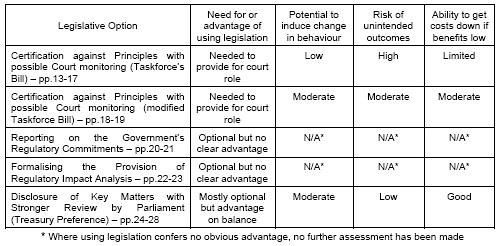
Rodney's bill is the top option. As can be seen, it ranks worse on every criteria than the other possible options. As for why:
- Rodney's preferred principles are highly ideological and therefore will have little buy-in, either from the public or from Ministers. This will reduce certification to a compliance exercise. Meanwhile, the requirement for dual certification by both Ministers and officials creates strong pressure on the latter to agree with the former, reducing the integrity of the process. Ministers aren't qualified to certify, and officials may lack the proper resources to do so.
- The interpretation clause and ability to declare legislation incompatible creates significant legal uncertainty, particularly given the vague nature of some of the principles.
- The resource requirements for certification are extremely high, and will continue to be high even if there is no benefit.
The two major options proposed addressed these flaws. The first of these modified the bill to remove the more ideological principles and the interpretation and incompatibility clauses. But given that this imposition of Libertarianism by stealth was the bill's real purpose, you can see why Hide rejected that option. Meanwhile, Treasury's second option - basically requiring Ministers to highlight potential problems in their bills, and beefing up Parliament's ability to address them either through enhanced select committee support or a dedicated Officer of Parliament would actually significantly improve things, while not costing a lot or tying us to Rodney's peculiar ideology. This option - the most effective, efficient, and proportionate one - was also rejected.
The upshot: if Rodney's bill was law, it would not itself be able to be certified as meeting its own principles. But that's hardly surprising. As noted above, the whole purpose of the bill is to impose those highly contentious and ideological principles, with a right to challenge primary legislation for non-compliance, so as to deter and undermine environmental, health and other regulation and protect the profits of existing vested interests. "Quality legislation" is just right-wing code for further kneecapping government and preventing it from working in the public interest.
Tuesday, March 15, 2011
Irony
One of the "principles of responsible regulation" that Rodney Hide is pushing through his Regulatory Standards Bill is that laws should not be made unless there has been a careful evaluation of the issue, the effectiveness of the proposed measure, the alternative options, and the costs and benefits of each. The government does this at present, through a "Regulatory Impact Statement" attached to each bill (the guidelines for which are here).
Guess what's missing from Hide's bill...?
Friday, November 19, 2010
The cost of the Supercity
When the National government foisted SuperAuckland upon us, it claimed it would save money. The Auckland Transitional Agency even put a number on this saving: $37 million, net of transition costs.
The cost of running the new Auckland Council has risen despite 1200 jobs being cut when eight councils were merged into the one super-city.So, congratulations, Aucklanders - you're paying an extra 1% in rates to pay for Rodney Hide's failed attempt to wrap your city up in a big blue ribbon and give it to John Banks. And now you'll be treated to the sight of him disclaiming all responsibility, and saying that its all your own fault for being "wasteful", despite the fact that it was his handpicked crony in charge of the transition.[...]
However, figures from the new council show that even after cutting the jobs, the merger costs alone will add nearly one per cent to rates, Radio New Zealand said this morning.
Monday, November 01, 2010
Goff still silent on transparency
Rodney Hide, who last year was busted for abusing his Parliamentary travel perks, has come out in support of transparency, saying that it is public money and that the public have "an expectation around transparency and accountability these days". The Greens' Metiria Turei is also backing transparency, as well as calling for a full independent review of Parliamentary perks to remove the taint of MPs setting their own entitlements.
Meanwhile, Phil Goff remains silent. New Zealand's leading progressive party isn't leading on this. That doesn't just put them in the wrong - as Hide says, this is public money, and so we are entitled to see how it is spent - it also puts them on the wrong side of the public.
Saturday, October 09, 2010
Rodney loses
While everyone is congratulating Len Brown for his landslide victory in the Auckland mayoral race, and thanking whatever entities they do or don't believe in for sparing them another term of John Banks, I think we should take some time to remember the real loser in Auckland today: Rodney Hide. Having restructured Auckland's local government in an effort to gerrymander the right a permanent lock on power, his (and John Key's) anointed candidate has just been shown the door by the voters. His chosen party, the CitRats, have likewise been shown the door, winning only half the seats they predicted. The result: instead of handing Auckland to the right, he has instead gifted it to the left. Thanks, Rodney!
Wednesday, September 22, 2010
Key on Hide on Garrett
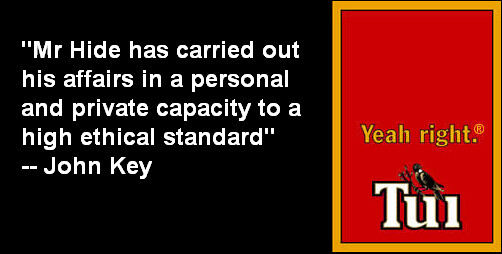
Yes, John Key really said that about Rodney Hide's coverup of David Garrett's criminal past. As was quickly pointed out, he must be about he only person in the country who believes that.
While he was at it, he also claimed that "Ministers are responsible to me for their ethical behaviour, not for their judgment". This is what National calls "higher standards".
Friday, February 12, 2010
An obscene lack of accountability in the supercity
The Herald this morning reports on the government's plans to keep key decisions on governance of the Auckland supercity out of the public eye, by devolving power to a host of Council-Controlled Organisations (CCOs). One example of this is the proposed Auckland Transport Agency:
The Auckland Council will set the strategic direction of the "council-controlled organisation", but Auckland Transport will be responsible for transport matters right down to the location of bus stops and footpaths.This is simply obscene. As Brian Rudman points out, Auckland Transport will spend about half of Auckland's annual budget. That sort of spending requires serious accountability and the ability for the public to oversee exactly what is happening at every stage of the process. Instead, meetings will happen behind closed doors, with the public shut out and only able to access decisions after the fact through the LGOIMA.It will be run by between six and eight directors, two of whom can be members of the Auckland Council. The New Zealand Transport Agency can also appointed one non-voting director.
Local Government Minister Rodney Hide and Transport Minister Steven Joyce will appoint the initial directors.
The core problem here is the decision to devolve key local government functions - roads, sewage, even parks - to undemocratic, unelected, and unaccountable CCOs. And the result of this will be to reduce Auckland's local government to a DHB-like joke: elected, accountable, but with no actual power to do anything the public asks of them. In other words, a blame sink for decisions really taken by central government and imposed by Ministerial appointees.
This is no way to run a city. Auckland belongs to Aucklanders, and it should be run by and for them, not by and for a Minister in Wellington.
Monday, December 21, 2009
One person, one vote
The above is the core principle of democracy. Everyone is morally equal, and so their voices should count equally in choosing a government.
Unfortunately, its not a principle we respect in local government. In local elections - but not national ones - we have a special class of "ratepayer electors", non-residents who pay rates on property, and are thus entitled to vote. Of course, the place they actually live also elects a local government, and so the net effect is that the wealthy get to vote twice (or more, if they own property in more than one local authority). And we wonder why our local government works in their favour...
As Matt McCarten points out, Rodney Hide's latest Auckland dictatorship bill includes a clause extending this process to the new Auckland boards. This seems to be necessary because they are neither "communities" nor local authorities in terms of the Local Government Act. But Hide's clause does not include the safeguard preventing the nomination of multiple individuals by absentees who own multiple properties, and it seems to be privileged above the general bar on multiple voting in the Local Electoral Act - with the net effect that "one person, one vote" is replaced with "one property, one vote". And as McCarten points out, this could shift the results decisively:
This is not a small matter. Almost a third of Aucklanders own or have an interest in a second property, while another third are renters. That potentially means that a third - the wealthiest - Aucklanders will be entitled to double the votes of the renting third. The region's poorest neighbourhoods currently have three-quarters of their houses owned by others. In Labour and Green strongholds in the inner city and the western suburbs of Manukau, absentee landlords would potentially outvote the locals. So much for citizens controlling their own communities.If this bill goes through, people will be disenfranchised in their own communities, outvoted by absentees with a strong interest in undermining the services they depend on in order to minimise their rates bills. And that's simply not democratic.
But while the proximate cause is Hide's bill, the real problem is the archaic retention of "ratepayer electors" in the Local Electoral Act. Its time we did away with this, and returned to "one person, one vote", rather than giving the rich an unequal say.
Thursday, December 10, 2009
Value for money?
Back in September, Local Government Minister Rodney Hide took an official trip with his partner to London, Toronto, Portland and Los Angeles. The trip took a week, and cost taxpayers $100,000. So, how long did he spend on official business during this vital fact-finding mission?
Only nineteen hours, or about two hours a day:
“Aucklanders will be fascinated to learn that, according to the official trip diary, Rodney Hide spent around 10 hours on Auckland governance, three and a half hours on regulatory reform, four and a half hours on ACT party policy, one hour in media interviews, and seven and a half hours having breakfast and lunch with his tour party who accompanied him on the trip,” Mayor Williams said.Hide says the trip was "value for money". I don't think so. Instead, it looks simply like a rort, a taxpayer-funded junket so he could show his new partner the sights on the people's tab. A decade ago, Hide would have been screaming at such an abuse. Now, he is the abuser. How the perkbuster has fallen...“When you break it all down, the trip which is estimated to have cost over $100,000 for the Minister, his companion, and two staff members, bought the taxpayer around 19 hours of official meetings and discussions over 12 days...”
Tuesday, October 27, 2009
We're paying for Rodney's fundraising trip
Last week we learned that Local Government Minister Rodney Hide was treating his job as a corrupt little fiefdom, giving speeches within his portfolio and charging stakeholders a donation to the ACT party if they wanted to hear them in clear contravention of Ministerial guidelines. That's bad enough, but the response to an urgent OIA request has added insult to injury - we're paying for his travel as well:
On Wednesday 4 November, Mr Hide will be in Christchurch on business related to his Ministerial portfolios of Local Government and Regulatory Reform. The purpose of this trip is to deliver a keynote address to the Canterbury Manufacturers Association on the principles behind his Regulatory Reform programme. While he is in Christchurch he will also be making site visits to a local engineering firm and the University of Canterbury. Mr Hide will also be meeting with members of the press and conducting other Ministerial duties.Sure, there's no additional costs to the taxpayer, and it is of course all within the rules, but it is an unacceptable mingling of public and private business. Thanks to some clever scheduling, we're effectively footing the bill for Hide's attendance at his little fundraiser. And we simply shouldn't be. The Ministerial travel budget is to pay for travel as part of Ministerial duties - not for Ministers to zip around the country touching up donors for cash.There will be no additional costs to Vote: Ministerial Services related to Mr Hide's address to the ACT Party at the Heartland Cotswald Hotel.
More generally, Ministers need to be able to maintain a rigid separation between their public duties and their private business. But like some feudal lord, Hide seems unable to tell the difference. If he cannot distinguish between the two, then he is simply unfit to be a Minister.
Wednesday, October 21, 2009
Is it a crime?
Is Rodney Hide's corrupt abuse of office to line the pockets of his party a crime? Section 102 of the Crimes Act 1961 outlaws "Corruption and bribery of Minister of the Crown". The relevant subsection reads:
Every Minister of the Crown or member of the Executive Council is liable to imprisonment for a term not exceeding 14 years who corruptly accepts or obtains, or agrees or offers to accept or attempts to obtain, any bribe for himself or any other person in respect of any act done or omitted, or to be done or omitted, by him in his capacity as a Minister or member of the Executive Council.(Emphasis added).
Is Rodney a Minister of the Crown? Check.
Has he asked for money for himself or any other person? Check.
Is the act he has asked for money to perform - the promotion of policy - one done in his capacity as a Minister? Check.
Is the money a "bribe"? Arguable. Hide calls it a "donation". Whether political donations are bribes or not tends to depend on whether you are a politician or a member of the public.
The latter almost certainly rules our prosecution. But its an awfully thin thread to hang a defence on, particularly when we are talking about public faith in the political system. Regardless of whether you think political donations are bribes or not, this doesn't pass the smell test. Ministers must be seen to uphold the highest ethical standards in the exercise of their office, and they must properly distinguish between their Ministerial and party-political capacities. Hide has failed to make that distinction, and in a way which undermines public faith in our political system. He is simply not fit for Ministerial office.
A perk of office
One of the expectations in our modern, non-corrupt democracy is that government is a free service. If you want your MP to do something for you, you won't be charged a fee, and if you want to know what the government is planning to do, you won't have to give a backhander to a Minister for the privilege. Access to government is not for sale in this country.
Not according to Rodney Hide. He's running a roadshow on his plans for local government - explicitly government business, the sort of thing we expect Ministers to do as a matter of course - as an ACT party fundraiser. If local body members in Christchurch want to know what the Minister has planned for them, they have to pay a fee to his party for the privilege.
This is a gross abuse of office. Promoting policy is explicitly listed in the Cabinet Manual as being something done in a Ministerial capacity. And the rules on how Ministers conduct themselves in that capacity are very clear:
accepting additional payment for doing anything that could be regarded as a ministerial function is not permissible;The payment is to Hide's party, but I don't think that lets him off the hook, any more than paying a partner or relative or business associate would. He profits indirectly through increased election chances, and the perception is that the party is being paid for his services as a Minister. This absolutely fails to meet the requirement that
In all these roles and at all times, Ministers are expected to act lawfully and to behave in a way that upholds, and is seen to uphold, the highest ethical standards.Rodney Hide has failed to meet that standard. He has behaved in a way which is frankly corrupt. But I guess he just regards it as a perk of office.
Thursday, August 20, 2009
Holding the government to ransom
So, after just nine months, Rodney Hide is holding the government to ransom, threatening to resign as Local Government Minister (undermining their confidence and supply agreement) if Auckland gets its own Maori seats. Which just goes to show that ACT are a) rabid zealots; and b) Do Not Play Well With Others. Like National, they're just not used to the ongoing requirement to work with others and consequent need to compromise under MMP; they see coalition management as a one-round rather than multi-round game, and hence as an exercise in power politics rather than an ongoing relationship where there is give and take. Which makes them very poor partners for any government wanting coalition and policy stability.
But in addition to that, they simply can't count - National also has confidence and supply from the Maori Party, which gives them the freedom to tell Rodney to go take a hike (and they'd probably gain public support by doing so). After all, what is ACT going to do - vote against right-wing policy purely out of spite? Actually, given their poor grasp of MMP so far and their ideological purism, I wouldn't be at all surprised...
But what really worries me is that if ACT are willing to go nuclear over something as minor as Maori seats in Auckland, what are they going to do over an issue they really care about, like the ETS? Will they be threatening to pull the plug on the government over that as well? And if so, will we see climate change policy held hostage by a tiny minority of rabid deniers, against the wishes of the vast majority of New Zealanders?
Wednesday, August 19, 2009
Taking Rodney at his word
Tonight on Campbell Live, John Campbell did a piece on Phil Twyford's Local Government (Protection of Auckland Assets) Amendment Bill, which comes before the House tomorrow. The bill would protect Auckland's estimated $28 billion of public assets from privatisation by requiring any sale to be approved by a referendum. Campbell put the Minister of Local Government, Rodney Hide, on the spot over the bill, his comments on privatisation and his commitment to local democracy. Hide said he objected to the bill "because it only applied to Auckland", rather than across the entire country.
A cynic would say that this was his attempt to weasel out of telling his own voters that they shouldn't be allowed to control the fate of their own assets, but I prefer to take Rodney at his word. It would be a trivial matter to tweak Twyford's bill to apply to all local authorities, rather than just those in Auckland. In fact, if Rodney grants leave, then the select committee can be instructed to amend the bill in the fashion he desires. Otherwise, a new bill can be introduced through the normal ballot process - but having committed so publicly to protecting all local authority assets from privatiastion, I'm sure Hide wouldn't want to wait. Especially when doing so would make him look like a liar...
Friday, May 22, 2009
Auckland oligarchy appointed
Rodney Hide has announced his appointments to the oligarchical board which will run Auckland's transitional dictatorship - and as expected, its dominated by businessmen:
Mark Ford, chief executive of the region's water wholesaler, Watercare Services, and chairman of the Auckland Regional Transport Authority is to chair the Auckland Transition Agency, as widely expected.The message couldn't be clearer: Hide thinks goverment is "like a business", to be run "efficiently". Democracy apparently is a waste of time.[...]
Accountant John Waller, who chairs the Bank of New Zealand and the Eden Park Redevelopment Board, and Wayne Walden, a former boss of Farmers Deka and former Maori Television chairman also join the agency, along with former Rodney mayor John Law and lawyer Miriam Dean, QC.
As for accountability, these people aren't elected by the people of Auckland, and they're certainly not responsible to them. They don't have to fear being held accountable by the people in democratic elections. instead, the only person they have to keep happy is the Minister. And when they screw up, the people won't get a chance to summarily de-elect them pour encourager les autres - instead they'll just glide on to their next fat business appointment, with a new bunch of "shareholders" to screw over.
Thanks to Hide, Aucklanders are now subjects rather than citizens in their local government. And while they can't hold the oligarch's democratically accountable, they can certainly do that to Hide and his enablers in the National Party. Something to remember for 2011...
Friday, April 17, 2009
"Consultation"
Yesterday the government "consulted" Auckland's mayors on the proposed Auckland SuperCity plan. Unfortunately that "consultation" wasn't all it was cracked up to be:
But Mr Hide made it clear those who opposed the plans for the Super City and how it was being structured should prepare to be disappointed.Translation: "we've already made up our minds, so don't bother disagreeing with us". Where have I heard this sort of autocratic top-down talk recently? Oh, that's right..."The mayors will have an opportunity to contribute, like the rest of Auckland, to the legislation, but Parliament will ultimately decide it, not me, not the Government, not a particular party - Parliament will decide it.
"We're open to the engagement but what we don't want to hear is particular self-interested groups talking about it."
It's also more than a little disingenuous of Hide to say that the decision will be made by Parliament. While true in a legal sense, National and ACT hold a majority in the House, and will present and pass the options they want. As under FPP, the legislature will be treated as a rubber-stamp for a decision pre-ordained by Cabinet. Which is what happens under a majority government (and given the high level of agreement and virtual coalition deal between National and ACT, that is effectively what we have). Parliament only performs its proper role as a scrutineer of legislation when the House is divided and the government lacks a majority and so must negotiate with multiple parties in order to secure the passage of legislation. The situation we have now is simply a return to the old FPP elected dictatorship - with all the arrogance that that implies.
Wednesday, April 08, 2009
No privatisation of Auckland water
Yesterday, I highlighted a part of the government's response [PDF] to the Royal Commission on Auckland Governance which seemed to indicate they were still thinking about privatisting Auckland's water. Some other people seem to have noticed the uncertainty too, because today we have a press release from Rodney Hide denying any privatisation plans, and stating that Watercare will be the sole provider for the Auckland region.
Minister of Local Government Rodney Hide today confirmed that the transition to the new structure will result in one regional water company for the Auckland region.(Emphasis added)."The transition process will result in the new Auckland Council becoming the owner of Watercare Services Ltd, which will assume statutory responsibility for the delivery of integrated water and wastewater services in urban areas," Mr Hide said.
[...]
"Watercare is a publicly-owned entity and our intention is that it will remain in public ownership under the umbrella of the new Auckland Council.
I'm glad to hear this. Seeing a pro-privatisation ACT MP forced to defend public ownership is just a bonus.
Monday, April 06, 2009
Drowning local government in the bathtub
After less than six months as Local Government Minister, Rodney Hide is moving forward with the first part of his radical agenda: drowning local government in the bathtub:
Relief for rate-paying homeowners could be on the horizon with Local Government Minister Rodney Hide planning on presenting a paper to cabinet in the next few weeks allowing for rates to be capped.Capping rates sounds like a great idea, until you remember that they pay for your streets, water, sewage systems, parks and libraries. Requiring a referendum for local government to raise rates will see that infrastructure and services left to rot as councils cut short-term costs by skimping on maintenance. That's certainly been the experience in California, where a similar provision - the infamous Proposition 13 - starved state and local governments of revenue, leading to a decline in infrastructure, fire departments being gutted, and California's schools falling from the top to the bottom of inter-state educational comparisons as funding declined. Our local government doesn't pay for schools, fortunately - but the list of things they do pay for ought to be more than enough to give pause for thought.It has been suggested by campaigners against rates rises that New Zealand follow the American example and have rates controlled by legislation.
If the plan is approved, councils would have to consult the people to decide when and why there was a rate rise from year to year.
And if its not enough, I have just two words: "flood control". In large parts of the country, rates are what you pay to stop your house from being underwater every time it rains. But I guess people in live in the wealthier parts of Auckland just don't care about that.