[Hat-tip: Scoop]
Monday, July 22, 2013
Friday, July 19, 2013
Bloodsuckers
While we're not technically in recession, things are not going well in New Zealand. Unemployment is at near-record levels, wages are stagnant, ordinary families are struggling. And meanwhile, our foreign banks announce enormous profits again:
New Zealand banks boosted their combined profit to almost $1 billion in the March quarter, but an ultra-competitive lending environment appears to be favouring big players, like ANZ, over smaller operators such as TSB and Kiwibank, according to new research.
KPMG's quarterly Financial Institutions Performance Survey said the collective profit of the nine banks surveyed lifted 12.9 per cent on the December quarter to $971 million.
And of course most of this money went straight overseas to Australia, rather than being reinvested in New Zealand to create jobs for New Zealanders.
This what happens when you have a non-competitive banking sector dominated by a foreign oligopoly: a permanent siphon in our economy which profits from our misery. As for what to do about it, breaking up those banks and returning them to local ownership would be a good start...
Extraditing for rendition
In 2003, Abu Omar was kidnapped in Italy by the CIA. He was rendered to Egypt, where he was tortured. The rendition became public in 2005 and the Italian justice system was eventually forced to act; in 2009 22 CIA agents were convicted in absentia for their role in Omar's kidnapping and torture.
On of them was Robert Lady (who has since gone public claiming he was "only following orders". Spot the lack of historical awareness). He's just been arrested in Panama on an international warrant. The question now is whether he will be extradited to serve his sentence, or whether the US will bully Panama into releasing him.
Thursday, July 18, 2013
Guilt by meta-association
It turns out that the NSA's spying on Americans is far worse than we thought:
The National Security Agency revealed to an angry congressional panel on Wednesday that its analysis of phone records and online behavior goes exponentially beyond what it had previously disclosed.
John C Inglis, the deputy director of the surveillance agency, told a member of the House judiciary committee that NSA analysts can perform "a second or third hop query" through its collections of telephone data and internet records in order to find connections to terrorist organizations.
"Hops" refers to a technical term indicating connections between people. A three-hop query means that the NSA can look at data not only from a suspected terrorist, but from everyone that suspect communicated with, and then from everyone those people communicated with, and then from everyone all of those people communicated with.
So, being a friend of a friend of a friend of a suspected terrorist is now considered "suspicious" by the NSA, and reason to rummage through your life. This is beyond even guilt by association; its now guilt by meta-association. And the US calls itself a land of freedom? It's a freedom only for spies, I think.
The good news is that Congress is getting restless, and is openly threatening not to renew the law empowering this mass-surveillance. But that surveillance gives the NSA the perfect tool to force Congress into line, in that they they can target uncooperative politicians, learn their dirty secrets, and either blackmail or discredit them. That's the really horrifying thing here: once you have set up this surveillance infrastructure, your democracy exists only by the goodwill of the spies.
All of which is an even stronger reason not to let it happen here. John Key's spy bill would hand the GCSB even broader powers than those the NSA is abusing. It cannot be allowed to pass.
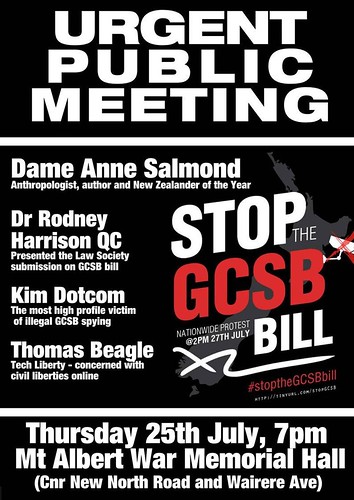
Protest against the GCSB bill next weekend
There will be nationwide protests against John Key's spy bill on July 27:
Bring your banners, your placards, yourselves and your friends and family. This is a family friendly, peaceful protest.
Auckland - Aotea Square - 2pm-4pm
Hamilton - Garden Place - 2pm-4pm
Napier - Memorial Square - 2pm-4pm
Wellington - Cuba St Bucket Fountain (2pm) then march to The Beehive (3pm) for speakers - 2pm-4pm
Nelson - iSite, Halifax St - 2pm-4pm
Christchurch - Bridge of Remembrance - 2pm-4pm
Dunedin - The Octagon - 2pm-4pm
Please stand up for our privacy and democracy while you still can.
The problems of contracting out
Another story on the problems created by contracting out in the UK. last week it was fraud; today its cherry-picking and cost-dumping:
Private companies providing public services are routinely “gaming the system” to make money for their shareholders at the expense of the taxpayer, a major new study finds today.
An analysis of the Government’s controversial £100bn “outsourcing” programmes, such as its scheme to help the unemployed back into work, found private firms “creaming off” easy cases where they could make profits while “parking” problematic ones.
What this means is that welfare contractors focus their efforts on those who don't need help, so as to turn them over quickly; "free academies' (charter schools) push students towards easier vocational qualifications to boost their exam stats; and rest home providers call 999 at the drop of a hat to dump costs on the NHS. And all of this is driven by a focus on juking the stats, maximising profit and cutting costs, rather than actually performing the service.
Meanwhile, our government is moving towards more contracting out with private prisons, charter schools and whanau ora. And the same problems will happen here.
Submit!
The Commerce Committee has called for submissions on the New Zealand International Convention Centre Bill (AKA the crony convention-centre bill). You can submit directly via the link above, or by sending two copies to
Commerce Committee Secretariat
Parliament Buildings
Wellington
Submissions are due by Thursday, 22 August 2013.
Topics to raise: the unconstitutionality of the bill purporting to bind future Parliaments to compensate SkyCity of there is a change of government (and of policy); the anti-freedom of speech clause in the deal and its incompatibility with the Bill of Rights Act. While the latter isn't actually in the bill, criticism by the committee could see it removed from the deal, or make a future BORA case against its exercise substantially easier.
A rotten deal
How rotten is the SkyCity deal? So rotten that even treasury opposed it. In a January 2012 briefing on the government's negotiating position [PDF, p. 11; OCR version here], they laid out their very frank view of the proposed deal:
Treasury is not convinced by the cost benefit analysis for the NZICC. For example, New Zealand already attracts a disproportionate share of the international conference market. In addition, international arrivals for conferences have plateaued since 2005, despite increases in the number of international travellers arriving in the country. Taken together with the international evidence on the low net public benefit of conference centres, these considerations lead Treasury to doubt that an expanded conference centre in Auckland will attract significantly more international conference attendees.
Treasury is also concerned about the social costs to increasing gambling in Auckland, balanced against which are the potential benefits of the NZICC, paid for through the concessions. As soon as the cost of building the NZICC are recouped by SkyCity, public costs will go only to private gain. Given the poor information on the value of the concessions, Treasury has strong concerns that private benefits to SkyCity will exceed public benefits to New Zealanders.
However, if Ministers wish to proceed with a contractual arrangement with SkyCity, Treasury considers that the difficulty of accurately assessing both the costs of the building and the revenue generated by the concessions will inevitably expose the Government to significant risks. These relate to both the information asymmetry between SkyCity and the Crown and costs to the Crown in respect of both negotiating the contract initially and then managing it over an extended period such as 25 years.
In short, the costs would outweigh the benefits, the latter would go solely into private pockets rather than being split fairly with New Zealand, and the government would get rolled in negotiations. On the latter at least, that is exactly what happened, with SkyCity making a deal in May 2012, then playing hard-ball and backing away from it, secure in the knowledge that they would gain further concessions now that John Key and Steven Joyce had put their personal prestige on the line. As for the former, Joyce claims that "We were able to prove Treasury was in the wrong on that one". But no documents have been released suggesting any such thing. Until those documents are released, we must assume he is simply making it up to cover his arse for making a poor deal and selling out New Zealanders.
Wednesday, July 17, 2013
Sky deal included anti-free speech clause
There was a large dump of documents from MED on National's corrupt SkyCity casino deal today (official release here; DocumentCloud with OCR here). I've been slowly reading it and doing my nut about it on Twitter, and there will be more posts later. But one of the more outrageous provisions was this, from a June 2012 briefing on negotiations [PDF, p. 29]
Selecting events for NZICC(Emphasis added)
SkyCity do not want the Crown to have the ability to prohibit them having any events of their choosing at NZICC [REDACTED] MED want the Crown to have the ability to intervene e.g. to avoid having protest groups hiring the NZICC at same time as a government event, and events that might, in the eyes of the government, damage the reputation of its national convention centre).
A compromise proposal was offered by MED. This involves officials meeting six-monthly with SkyCity to discuss forward bookings at the NZICC, with the ability to raise any concerns about proposed bookings from a government perspective and to have those considered seriously by SkyCity. There would also be an expectation that SkyCity would contact officials whenever they had doubts about the wisdom of accepting a potential booking.
So, just to make that clear, the government wanted to limit access to the "national" convention centre to people who agreed with them. Freedom of speech? Apparently the Ministry of Economic Development have never heard of it.
I have no idea whether this has made its way in to the final agreement - but the fact that it was even considered shows that something is deeply wrong with our government, and highlights the dangers of such commercial arrangements.
Update: Yes, its in the final deal, and includes events that would "reasonably be expected to be materially prejudicial to international relations or to national security interests of New Zealand". Which gives the government a veto-power over any event criticising its foreign policy, such as an anti-free trade conference or one against international spying.
Whanau Ora providers must be subject to the OIA
Yesterday, Whanau Ora Minister Tariana Turia revealed how she'd be managing her whanau ora programme: through three NGOs. Unfortunately, she hasn't decided yet whether they will be subject to the Official Information Act:
Three yet to be established non- government organisations (NGOs) will distribute Whanau Ora funds to the North Island, South Island and Pacific communities, a structure which could mean more of the activities escape the scrutiny of the Official Information Act.
[...]
She did not know whether the NGOs would be subject to scrutiny under the act.
They bloody well should be. To point out the obvious, these organisations will be spending public money. Public oversight under the OIA is a fundamental part of that. In this country, not even our spies get to escape that.
But even if Turia doesn't do the decent thing and bring them explicitly under the Act, they're arguably covered anyway due to section 2(5) of the Act:
Any information held by an independent contractor engaged by any department or Minister of the Crown or organisation in his capacity as such contractor shall, for the purposes of this Act, be deemed to be held by the department or Minister of the Crown or organisation.
Turia can either have these organisations answer requests themselves, or she can spend the rest of her Ministerial career demanding information from them so as to answer on their behalf. But she can't just expect to hand over public money with no scrutiny and no oversight.
(And while we're at it: what these bodies will really need is oversight by the Ombudsman. Someone should really be asking Turia about that...)
What the hell?
WINZ cuts off people's benefits for going to training to get a job:
Samara Tuwhangai, 19, has been to three work seminars and was on a stand-down this month because she missed three more in order to attend training for a possible job selling insurance. She says Work and Income is racist.
"When you go into Winz they look at you and your colour," she says. "If you go to white people they will give you a stink attitude compared to the other workers."
When she went in to complain about her benefit being stopped, the staff member wanted her to get a form signed by the insurance company, and refused to read a letter from the company which she says confirmed that she attended the training.
Shouldn't WINZ be encouraging people to do job training? But I guess when the priority is to kick people off benefits so the Minister can get headlines like this, then anything goes.
Disturbing
The UK's Serious and Organised Crime Agency is helping to assemble NATO's Afghan kill-list:
British police have been accused of illegally supplying information on potential targets for a highly controversial military "kill list" in a legal challenge being launched at the high court on Wednesday.
[...]
The legal challenge states that Amin was on the "kill list" and that information from Soca has been used to help the US military decide whom to target.
It cites a report to the committee on foreign relations in the US Senate, which says Soca was one of the agencies providing information for the "kill list".
Papers filed to court say: "The UK's involvement in the list is not limited to military or intelligence officials but includes civilians working for Soca.
"The US Senate report specifically acknowledges such involvement by Soca."
SOCA was established to prosecute drug traffickers and organised crime groups, not help write kill-lists for a foreign power's death squads. its just another example of how the UK's involvement in the US's "war on terror" is corrupting their entire system, and tainting their police agencies with murder.
A surfeit of caution
When Louisa Wall put up her marriage equality bill, senior figures in Labour denounced it as a "distraction" and a "sideshow" and wanted her to drop it. The bill went on to be a great success, exciting people, inspiring people, showing them that Parliamentary politics mattered, and that Labour was relevant and could lead.
Naturally, Labour's dinosaurs haven't learned that lesson:
Labour MP Maryan Street is under pressure to drop a member's bill which would legalise euthanasia because her party is concerned it could be a negative distraction in the lead-up to the general election next year.
If Ms Street's End of Life Choice Bill was pulled from the ballot, the debate could extend into election year, and some Labour MPs felt this could hurt the party's run for Government by distracting from its main policies and deterring more conservative voters.
Euthanasia is not as sexy an issue as marriage equality, nor as morally clear-cut. But like marriage equality, it is one whose support has been building for years and whose time has come. Its also one which reaches across traditional political lines - lest anyone forget, both Michael Laws (then a National MP) and Peter Brown (NZ First) have put up bills on the issue. While religious conservatives will fight it tooth and nail, there aren't very many of them anymore, and marriage equality has burned them. For everyone else - including the elderly, who have watched their friends and family die slowly and painfully, stripped of their dignity - it is largely a matter of getting the safeguards right.
Labour could lead on this issue. Or it could abdicate that leadership to others. But if it does the latter, then it is basicly saying that all it offers is management. And if that's the case, there is simply no reason to care about them.
Equality comes to England and Wales
Marriage equality has passed its third reading in the UK Parliament:
The bill allowing same-sex couples to marry in England and Wales has passed its final hurdle in Parliament.
The government legislation is now due to get royal assent, after which it is likely to become law later this week.
The Conservative, Labour and Liberal Democrat leaderships all backed the bill, after the Lords approved the changes on Monday.
It is expected that the first gay and lesbian wedding ceremonies will take place by summer next year.
Scotland isn't included, but they have their own bill. Which just leaves Northern Ireland...
Tuesday, July 16, 2013
Beneficiaries will be forced to pay for their own drug tests
When the government announced that it would be requiring beneficiaries to pass pre-employment drug-tests, I thought it was a waste of money which would cost twice as much as it was supposed to save. But the government seems to have found a way around the latter bit: they're going to force beneficiaries to pay for the tests, and extract it from their benefits.
It's all there in the tender document for Pre-employment Drug Testing for Work and Income Beneficiaries with Work Obligations (GETS Reference: 39654; login required). According to that,

The tender document notes that WINZ will not actually be entering into a contract with the drug-testing agency, and that they will not be demanding results directly. It will all be handled directly between the agency and the beneficiary, with WINZ acting only as a payment source via a letter of credit as required.
This differs considerably from the scheme originally described by the Minister, debated by Parliament and envisioned in the legislation. That scheme assumed that prospective employers will pay and that WINZ "may" reimburse them for failed tests (s102C(3)), and that beneficiaries would pay only if they challenge a test and fail it (s102D(9)). I am not sure if it is even legal. But it is certainly not moral. Quite apart from charging people for their own persecution, no-one should be forced to pay a charge to receive their statutory entitlements.
But this does make drug-testing a far better mechanism for throwing people off benefits. Previously, Bennett only get to evict those who couldn't pass a test; now she'll get to evict the debt-averse as well. Present people with an up-front charge of a weeks' benefit or more, and some of them will decide that they can't pay and hence "fail" the test. And who cares what ultimately happens to them? What's important for the government's re-election is to get those benefit numbers down (and donations from drug-testing agencies grateful at being funnelled benefit money won't hurt).
This is a vile policy. But isn't it so very, very National?
(Hat-tip: @DeckardPNNZ)
Prince Charles: Tax cheat
So, it turns out that Britain's future monarch is a tax cheat:
Prince Charles has been accused by an MP of "dodging around for tax purposes" during a testy select committee hearing in which the heir to the throne's most senior aides were grilled by members of the Commons public accounts committee over his financial affairs.
The allegation was made in a series exchanges on Monday between MPs and William Nye, the Prince of Wales's principal private secretary, who defended corporation and capital gains tax exemptions enjoyed by his boss's £847m hereditary Duchy of Cornwall estate.
Nye was repeatedly questioned as to why the Duchy was not a corporation, even though it has a head who is effectively a chief executive, it buys and sells assets and has trademarks. Its legal status is that it is a private estate.
"Given the Duchy of Cornwall behaves like a corporation with its income from complex investments … on the face of it many of my constituents would say it should pay corporation tax and capital gains tax," said Labour MP Nick Smith.
Just another example of the contempt Britain's aristocracy has for its citizens - and the law.
As expected
The police have refused to waste their time investigating Winston Peters' allegations of "espionage" against Peter Dunne:
Police has completed its assessment of a complaint laid by New Zealand First regarding the release of information about the "Review of Compliance at the GCSB" report to a Fairfax journalist.
The complaint was assessed in terms of section 78(a) of the Crimes Act 1961 and section 20(a) of the Summary Offences Act 1981.
After considering the information presented by the complainant police are satisfied that no offence is disclosed and that further investigation will fail to provide evidence leading to a prosecution under either piece of legislation.
That's not surprising. Section 78(a) (espionage) requires "intent to prejudice the security or defence of New Zealand" - something difficult to argue in a case of leaking, and impossible when the Prime Minister says that the information was not harmful. The Summary Offences Act charge is even more laughable, since it requires knowledge that an unauthorised release of official information would be likely to prejudice a long list of interests (essentially s6 OIA, minus "national security"), none of which can possibly apply.
But the complaint has served its purpose: Winston has banged the patriotism drum and got his headline. And he can now bang it some more while denouncing the police as "traitors".
(Meanwhile, I'm deeply disturbed to see that we still have criminal penalties for the wrongful release of official information on the books. I thought we'd gotten rid of that shit when we repealed the Official Secrets Act...)
The same problems everywhere
One of the problems exposed by the GCSB's illegal spying is that their "watchdog" - the Inspector-General of Intelligence and Security - is completely ineffective, having failed to detect the illegal spying for a decade, then excused it as it was "arguably" legal. Which is what happens when you have one old duffer, chosen specifically for his subservience to power, doing a part-time job.
It turns out we're not alone. The UK has a similar system: a small office, massively outnumbered and outgunned by the organisation it is supposed to "oversee". And it results in similar problems:
The Independent has established that the watchdog’s annual report had to be delayed and revised because the first draft made no mention of the hi-tech GCHQ spying programmes exposed by the US whistleblower.
The updated 2012 report of the Interception of Communications Commissioner Office (ICCO) will now be published later this month, after hastily organised revisions were ordered by Whitehall officials.
[...]
[T]he small ICCO office based in Whitehall’s Queen Anne’s Gate headed by the retired appeal court judge Sir Anthony May, currently has less than 10 full-time staff to carry out its statutory duty of reviewing the interception activity of the UK spy agencies, the Metropolitan Police, HM Revenue and Customs, the Foreign Office, the Home Office and Ministry of Defence.
In previous ICCO reports, two annual one-day inspections at GCHQ – where only a tiny sample of interception warrants are inspected – provide the basis for the conclusion that the intelligence agency conducts itself with high levels of integrity and legal compliance. Similar biannual inspection visits also take place at MI5 and MI6. How samples are selected, and whether or not Sir Anthony is presented with interception case notes chosen in advance by agencies like GCHQ, is not disclosed.
Understaffed "watchdog" fails to detect unlawful activity! Who'd have thunk it! But the point of such organisations isn't actually to oversee and ensure compliance - it is to build public confidence by creating the illusion of such. They're a sham for the institutional abuse of power, nothing more. They need to either be beefed up, so they can actually do the job they tell us they're doing, or dissolved, to remove the institutional lie.
(As for the "reforms" to the NZ IGSI in Key's spy bill, they're better than nothing, but still not enough for the task. I'll believe in such watchdogs when they show they can bark. Ours never has, and never will).
Unbelievable
John Key's chief justification for his spy law giving the GCSB the right to spy on all New Zealanders is cost: it would apparently cost too much for the police or SIS to be given their own capability for domestic law enforcement / counter-espionage use, so we have to legalise GCSB using theirs instead (and allow them to use it on everybody, just in case). So you'd expect them to have at least done the costings to back that up, right?
Wrong:
The Government has no idea what it would cost to have the SIS eavesdrop on New Zealanders and intercept their emails, despite saying cost is the reason for getting the GCSB to do it.
This is simply unbelievable. Working out how much a policy will cost is a basic part of the policy process - and certainly fundamental to any claim that not doing it would be more expensive. Instead, the Prime Minister just hasn't bothered, relying on the GCSB's aura of secrecy to prevent anyone from challenging his claim. But the result is that his arguments for the bill are an exercise in pure bad faith.
The good news is that Peter Dunne appears to be calling him on it, demanding an analysis before he will support the bill. And given that his vote is crucial, Key may just be forced to either substantiate his claim, or admit that it is bullshit and that he is selling us out for chump change.
Monday, July 15, 2013
Separating church and state in New Zealand
On Saturday I went down to Wellington to attend Victoria University Centre for Public law's mini-conference on Constitutional Conversations on the Separation of Church and State in NZ. A summary:
Gay Morgan (University of Waikato) spoke on the US experience. After some background about how early US colonists fleeing religious persecution became persecutors in turn by establishing theocracies, she got to the meat of the US First Amendment's Establishment Clause, and the difficulties it has had in both defining "religion" and separating it from culture and traditional practice (which may have been religious originally, but have become secularised). She felt that there was a real problem with the broad-brush, constitutional language approach, which has begun to trivialise the real concerns people have in this area. What people object to isn't secularised yoga in school PE classes (irrevocably promoting Hinduism, according to some fundamentalist christian lawsuit), but being forced to go to church, and being forced to support religious groups with their tax dollars. Rather than the top-down approach, she advocated being specific e.g. legislating so that education funding could only be spent on education according to the curriculum, rather than on religious indoctrination.
Dr Caroline Sawyer (VUW) talked about the "UK" (actually English) experience. This was somewhat meandering, starting with the establishment of the Church of England and legal persecution of Catholics and other religious minorities, and went on to talk about marriage law as a specific example of the state recognition of religion in the UK. She tried to use the New Zealand Marriage Act as an example of this, but IMHO missed the key point that here it is a matter of convenience, rather than a recognition of any inherant "authority" to marry people. One of the key points was that establishment was tied to the monarchy, but that because that probably isn't going anywhere any time soon, neither is the church.
Dr Meg Wallace was supposed to talk about the Australian experience. Instead she gave a dull rant about the need for secularism in New Zealand, and invoked article 6 of the (dumped) draft Fijian Constitution [PDF] as a model to be adopted here.
Dave Armstrong talked about the effects of New Zealand culture. Our desire to view religion as a private matter and our dislike of abstract causes meant that we generally got along, but also has led to complacency which is being exploited by a fanatical religious minority. On this front, he expressed thanks to overseas fundamentalists for waking us up to the dangers a little, but thought we still wouldn't care until things had gone to far. The most likely crisis point would be Charter Schools, where the rules are so lax that Al Qaeda could set one up. And when that happens - or more likely some Christian fundamentalist group uses government money to deny evolution and push bigotry at small children - there is likely to be a backlash. He also had concerns about the Treaty of Waitangi as a barrier to seperation, due to the (well justified) consultation requirements.
Ngaire McCarthy rebutted Armstrong's last point, talking about how her language had been hijacked and perverted by Christians and mapped onto their concepts. She explained how wairua was about connection, not spirits, and karakia were not prayers.
Dr Bryce Edwards (Otago University) talked about the way forward, and suggested a sweeping secularisation bill to remove religious references from legislation. He had a long list of these, starting with the obvious - Marriage Act, blasphemous libel, Education Act, Charities Act - to the not so obvious - Broadcasting Act, Sale of Liquor Act, the RMA, the national anthem. And then the bastard made me talk briefly about the practicalities of that, in which I said that no MP would buy that big fight for no political payoff, and that it was probably better to salami the issue, with one or more specific bills on high-profile issues. The best candidates were the Charities Act (where the definition of charitable work is over 400 years old and written in an era when they thought religion mattered) and the Education Act (where secular education is only mandated for primary schools and often abused). Many of the other issues will pass in due course, likely the next time the government revised the law.
One thing which wasn't obvious from the advertising, but which became obvious at the event, was that that was basically the NZ association of rationalists and humanists talking to itself. No-one else was interested in the "conversation"; its just not seen as a priority by New Zealanders. Until, of course, something goes horribly wrong...





