Showing posts with label Labour. Show all posts

Monday, October 05, 2026


A clear choice on transport

There were a couple of campaign announcements today, showing that Aotearoa has a clear choice on transport this election. From national, we have - of course - m0ar roads! Even in the South Island this time, though of course they're spending the big bucks up north, where nobody actually wants the things. Meanwhile from the Greens we have a promise to make the trains run on time - or indeed, run at all - with new intercity routes, light rail or busways in major cities (whichever the Infrastructure Commission recommends), and more regional buses to connect it all. And while its focused on passenger transport, the infrastructure renewal required will help freight too, helping to get trucks off the roads. Its a pretty compelling vision of the future, even if it draws on the past, and one which would massively improve life in our cities and regions far more than a handful of truck mega-highways would.

Labour, meanwhile, is left out of the conversation. All they have is a collection of stronger consumer rights and some policies for marginally cheaper petrol. Its hardly rising to the occasion, and the latter seems to be desperately missing the point. But I guess that's what you're left with when you don't actually want to spend any money, and want to suggest that everything will really be just the same, only with different people in charge. And then they wonder why they're polling so badly...

Thursday, October 01, 2026


Labour on democracy and trust in government

Labour released its democracy and trust in government policy today, and it looks like a good start. They're promising:

  • A lobbying register and code of conduct, and stand-down periods for Ministers;
  • Limiting urgency and requiring post-enactment referral to select committee of any bill which skips the select committee phase;
  • Lowering the voting age for local body elections and abolishing the landlord vote;
  • Mentioned in the full speech, reform of the OIA to codify proactive release and include penalties for ministers who conspire to hide things

Which is all good, but note what's not included: caps on political donations or public funding to get money out of politics; stopping the revolving door for senior public servants as well as Ministers; a lower voting age for general elections. I'm also suspicious of any effort to "reform" the OIA which is government- rather than civil society-led, because their interests are not aligned with ours and they will write the law to suit themselves and enable more secrecy.

Lowering the (general) voting age will be because it is hard, but they're unwilling to say "we will put a bill before the House and make National pay the price if they vote it down". As for donation capping, Labour has never really wanted money out of politics, because they're stupid enough to think they'll get a share of it when they're in power. This election's statistics should disabuse them of that notion: the uber-rich are using their money as a weapon to undermine our democracy, and a genuinely democratic party would wage war on that bullshit. You can draw your own conclusions about what Labour's refusal to do so says about them.

On the other hand, with a donation cap a bottom line for TOP, Labour is going to have to attack the rich if they want to be in government. So they'd better start getting used to the idea.

Friday, September 25, 2026


Taxing the rich is popular

The election is just six weeks away, and the parties of the rich are frantically trying to scare us about tax. If a left-coalition forms after the election, then Labour will impose a capital gains tax! Or they'll be forced to accept the Greens' proposed wealth-tax on the uber-rich! Shock! Horror! Won't someone think of people worth tens of millions of dollars with multiple houses?

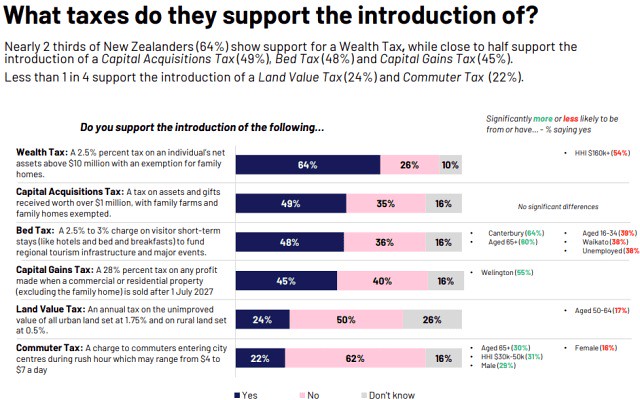
Meanwhile, while they're trying to frighten us, it turns out that the public actually supports these taxes. And they support a wealth tax more than they support Labour's least-they-could-possibly-do, protect the rich CGT:

4JHS6RG_Ipsos_Issues_Monitor_September_20206_tax

[Image stolen from Ipsos Issues Monitor, via RNZ]

Note that this is asking about the specific policy proposals of the various parties, rather than vague propositions. So 64% of those polled explicitly support the Greens' proposed wealth tax. I guess they recognise what the problem is - the rich - and won't accept half-measures. Which includes TOP's land tax, because it explicitly excludes financial capital, while also taxing the urban rich at lower rates than the rest of us (and fuck that).

Labour and the Greens should be taking heart from this. Despite all National's scaremongering, people recognise very well that the only people negatively affected by taxing the rich will be... the rich. Which is why they and their paid stooges are screaming so loudly. As for the rest of us, it means a better life. Taxing the rich is a popular policy, and the left parties should push on it as hard as they can.

Tuesday, September 22, 2026


The Landlord Party

When National introduced its landlord tax-break, Labour's Barbara Edmonds called it a waste of money which would blow the government's books. Then-CTU economist and now Labour candidate Craig Renney was even harsher, pointing out how it would subsidise a handful of mega-landlords by over a million dollars each, funnelling public money into the pockets of the few. But now both of them are going to have to eat those words and pretend they never said them, as Chris Hipkins has decided that actually he wants to subsidise landlords after all:

Labour leader Chris Hipkins has ruled out any changes to interest deductibility settings for landlords, if elected.

The coalition government in 2024 reinstated landlords' ability to claim tax deductions for interest on residential investment properties.

Opposition parties decried the government prioritising "tax cuts for landlords" which cost around $2.8 billion over four years.

But Hipkins on Monday confirmed Labour would not change the policy, because it was committed to a capital gains tax instead.

Which is just another demonstration of Labour's cowardice, its pandering to the rich, and its unwillingness to actually change anything (at least, nothing that upsets anyone important; they'll gladly throw the rest of us under the first bus which comes along). Its also an example of their complete hypocrisy: this was a terrible policy just two years ago, now its suddenly great. Actual policy merit doesn't seem to come into it - just whatever reckons Chris has this week in his desperate effort not to offend his mates in the koru lounge.

Who does this policy appeal to? People on $309,000 plus slush who just got us to buy them another house. Who gets fucked by it? Everybody who wants public services. The problem for Labour is that there aren't a lot of people in the first category, and a fuck of a lot more in the second. Once upon a time the party knew that. Once upon a time it didn't need to even do the calculation, because it knew what it stood for. But it doesn't now, and as a result its pandering to the rich while trying to call itself a "labour" party. Maybe it should rebrand itself as "Landlord" instead.

Fundamentally, voters can't trust a party with no values. And if Labour drives even more voters leftwards or makes them give up voting entirely with this, then it can hardly whinge about the consequences.

Wednesday, September 16, 2026


The Overton window shifts...

Just ten days ago the Greens promised to smash the supermarket duopoly, forcibly breaking up Foodstuffs and (foreign-owned) Woolworths and nationalising part of each to form a state-owned KiwiMart. It may have been a bit tricky to implement (because Foodstuffs is an owner-cooperative), but it clearly caught public imagination. Because today National has been forced to announce that they, too, support smashing the supermarket duopoly, though only after a review, and only by forcibly splitting it up:

National has made a supermarket break-up a key part of its election pitch, proposing to sever Pak'nSave from New World in a bid to drive down grocery prices.

The shake-up would be contingent on a six-month review by the Commerce Commission into whether the split would actually leave shoppers better off.

If the watchdog gave it the green light, National said it would legislate to force through the separation.

The policy is heavily caveated - how many propertarian weirdos and supermarket execs has National appointed to the Commerce Commission? - and clearly subject to a veto by ACT (which they have reliably delivered), so its arguably an insincere PR exercise aimed at providing the appearance of support for change without any substance. But even that is a huge victory. The fact that the party of protecting established economic interests has been forced to publicly support the breakup of one of the most established economic interests in the country shows how far the public mood has shifted, and how desperate National are to avoid being on the wrong side of that shift.

So what about Labour? They've been silent about our cartel problem, and their response to National has been to get pissy about it. Which makes me suspect National has "stolen" their carefully caveated, multiple-outs, aimed at preserving the status quo policy, meaning they'll have to go back to the focus groups and get another one because they have no values or principles to guide them and they can't just agree with National. (They have announced an anti-price-gouging law, but that is only part of a solution, addressing the symptoms while ignoring the cartels in the room). Hopefully Labour's eventual policy - if they manage to get one before the election - will be stronger. But it would not surprise me if they failed to take advantage of the huge opportunity this represents, because it would mean change, and that apparently is what Labour now exists to prevent.

As for the Greens, getting National to support decartelization is a huge victory for them, and a huge victory for their theory of political change (use policy announcements to change the conversation and the political landscape, forcing policy to shift closer to Green outcomes as a result). They've shifted the Overton window such that the status quo of cartels is no longer politically acceptable. The other parties (especially Labour) now have to respond to that.

Thursday, September 10, 2026


Labour on climate change: Not quite the adult in the room

National has abolished all effective climate change policy, and is gaslighting us on the impact of that on emissions targets. National's partners are ouright arsonists and climate change deniers. So where does Labour stand? While they haven't released a full climate policy yet - better start soon? - they did make a small announcement this week, signalling a rapid ETS review to (among other things) look at how to disentangle forestry from the ETS. Good. He Pou a Rangi has been warning about this for years, and a review was in fact scheduled after the last election. National cancelled it. Since then the warnings have only strengthened, and National has kept kicking the can down the road, refusing to be an adult and fix the broken system, because that would upset established interests. The fact that they'll be able to criticise Labour for being the adult in the room is probably seen by them as a bonus - an example of how policy is driven by trolling, rather than any semblance of "responsible government".

Labour's announcement is unclear about whether the review will also consider industrial allocation - another huge distortion of the ETS, which similarly threatens to break it - but hopefully it will. Polluters have already had 18 years of subsidies, and if we want the system to actually be effective, it is long past time they ended.

Unfortunately, Labour is still refusing to be an adult over agricultural emissions, saying that pricing dirty cows was not going to be a default, and that instead

We think that we can work with farmers to do that without putting a price on methane emissions.
Which invites the obvious question: how? Because farmers have never engaged in good faith on this, and every time they pretend to, they simply stab Aotearoa in the back.

Labour is, like National, wanking on about "new technology" which reduces farm emissions. But unless they have actual, concrete policy to make farmers adopt it, that technology might as well not exist, and is simply a rhetorical distraction from the horde of dirty, farting cows which are destroying the climate and not paying their way. Pricing emissions was the way of forcing adoption, either directly at the farm level, or indirectly by getting processors like Fonterra to pass it down the chain. If Labour aren't going to do that, then they will have to use direct regulation instead. And if they refuse to do either, they are simply stupid little children, and not remotely serious about our biggest policy challenge.

And on the gripping hand, both Labour's likely coalition partners want to price agricultural emissions, and its a far more significant issue for them than Labour, so Labour's preferences on this are largely irrelevant. A cynic would say they've only adopted this position so they can "reluctantly" be "forced" into doing the right thing by the Greens and/or Opportunity - a dishonest and cowardly tactic from a dishonest and cowardly party...

There's a lot more questions, of course: what are they actually going to do about the Paris liability (something else National has kicked the can down the road on so they can criticise Labour)? What will they do about EVs? Coal? National's bullshit LNG terminal and the gas industry in general? Will they restore the clean car rebate and the GIDI scheme? Will they listen to He Pou a Rangi and strengthen targets? Hopefully there'll be answers to all of this before the election. But given their position on agriculture, I'm not sure they've going to be entirely adult about it.

Tuesday, September 01, 2026


Labour in a nutshell

In February 2024 the racist regime breached te Tiriti o Waitangi by disestablishing Te Aka Whai Ora, the Māori Health Authority. The agency had been established in response to a previous Waitangi Tribunal inquiry into pervasive racial inequalities in the health system, effectively making it part of a Treaty settlement, so the regime broke that as well.

At the time the Labour party promised they would reverse this, and re-establish the authority. But now they've changed their minds and won't bother. Why not? Because National might just disestablish it again.

This is Labour in a nutshell: pure chickenshittery. Refusing to do anything that National might object to effectively surrenders in advance to the far-right. So what's the point in them holding power if they're not going to actually do anything with it? Its obviously great for the pyramid-climbing Labour apparatchiks who will get huge Ministerial salaries and free housing and transport for doing nothing. But what's in it for the rest of us? Absolutely nothing.

A party which pre-emptively commits to not changing anything, even when it is a blatant injustice and violation of our constitutional foundations is not worth your vote. It is that simple. If you want change, vote for a party which will actually deliver it. In this case, that means voting Green or Te Pāti Māori.

Monday, August 31, 2026


Empty, entitled, arrogant, and exploitative

Another day, another piece about the problems of Labour's "small target" strategy. Today its The Spinoff's Joel MacManus, who argues that Chris Hipkins is batting for a draw. Stripped of the sporting metaphor, the basic argument is that Hipkins has "been so focused on negating the case against Labour that he never built a cohesive argument for Labour." His popularity has declined since he was defeated in 2023 because he's been too afraid to say why he should be in charge. And rather than fighting to win the election, Labour is relying on its prospective coalition partners to win it for them - which is going to create problems:

With Labour batting for the draw, the responsibility of playing for the win (and proposing an actual alternative policy suite) has fallen to its potential coalition partners. Opportunity has been picking up disaffected National voters in recent polling, the Greens are rallying progressives, and Te Pāti Māori’s overhang strategy is tilting the maths in the left bloc’s favour. Labour is just…. there.

[...]

If the left bloc manages to form a government after this election, it will be because Hipkins played a heroically disciplined innings. Labour could snatch a draw from the jaws of defeat. But that may be all it is – a draw. When you take the reins of government without any plan for what you’ll do, is that really a victory at all?

So, basically what happened in the UK with Keir Starmer.

But the UK had FPP and we have MMP, which means any future Labour-led government will be a coalition. McManus (like Daalder before him) points out that Labour "could end up in the same trap as National, with minor coalition parties setting the agenda because they’re the only ones who have one." Labour of course will try and deny this, and are already purporting to veto their partners policies. Which, from a party which is bringing no policies of its own to a coalition, which refuses to fight for victory, and is effectively demanding other parties win the election for them and put them in power, shows a certain level of entitlement and arrogance.

In fact, once you start looking at it like that, it leads to some unpleasant conclusions. Labour is demanding that its potential coalition partners do all the hard work in the election. Claiming the right to set and veto policy is effectively claiming all the profit from that work, while denying the people who did it the fruits of their labour. Which is exactly the sort of exploitative relationship the "labour" party was founded to destroy.

Friday, August 28, 2026


Whining at an open door

Ten weeks till the election, and Labour is in full pre-election cringe mode. They're so afraid of being seen to stand for something, let alone something that Rimmer might consider "left-wing", that they're ruling out policies in advance. Paying for our roads. Paying for local government. Restoring fees-free tertiary education. Shanking Netflix. Notably, they've ruled out all their potential coalition partners' tax plans - the Greens' wealth tax, TOP's land tax, and Te Pāti Māori's stamp duty on house speculators - which raises the question of how they expect to form a government while offering their coalition partners nothing. And meanwhile, while they're doing all of this cringing and cowering from the word "tax", it turns out that the public will happily support higher taxes for better public services:

A survey of 1600 people has found two-thirds of New Zealanders are willing to pay more tax for better healthcare - particularly when it comes to cancer.

The survey, funded by the Cancer Society and published as a nine-paper series in the New Zealand Medical Journal, also found consensus across voters for all major parties about the need for tougher regulation on tobacco and unhealthy foods, and more urgent action on skin cancer prevention, cancer screening and treatment.

A collaboration between University of Otago cancer researchers and the Cancer Society, called Te Rōpu Rangahau ō te Kāhui Matepukupuku, undertook the study.

This is not exactly a new finding. And it suggests a very obvious political slogan of "tax the rich to pay for the health system". But Labour has so afraid of being accused of "taxing and spending" (as opposed to National spending without taxing) that they refuse to take the opportunity which is staring them in the face. They're simply standing in front of an open door leading to government, refusing to take it, while whining about how they can't get inside. And then they wonder why they're stuck on 30%. I'd suggest that part of the reason is that and Labour is not giving people any reason to vote for them. More brutally, no-one likes a chickenshit. And as Marc Daalder points out, their "small target" strategy effectively leaves the entire political field free for other parties willing to make promises and take risks. Labour has only itself to blame if its cowardice results in it being overtaken by parties actually willing to offer something.

Monday, August 24, 2026


You can't run on hope unless you actually offer some

Eleven weeks till the election, and we're now seeing daily stories about the complete collapse of the health system. Decades of austerity and underfunding and a Ministerial hiring freeze aimed at making short-term "savings" have left our hospitals unable to cope, and the usual winter flu season (something normally manageable with vaccination and a public health campaign) has pushed it over the edge. In Palmerston North, multiple key departments have simply collapsed due to lack of staff, while the emergency department - focus of all National's metrics - has wait times of up to 27 hours. In North Shore, patients are left to lie in their own piss and treated in corridors because there is no-one to care for them and no space anyway.

This is what government looks like under National: nothing works, because they simply refuse to pay for it. Why have a health system or emergency accommodation, when the Luxons can have an eighth house and another holiday in Hawaii?

Meanwhile, today Labour unveiled their election slogan: "Better Starts Now", an implicit message of hope. So obviously they'll be fixing all this, right?

Well, no. Because they've also doubled down on their commitment to austerity, promising to keep National's fiscal straitjacket which means government can't do anything, and ruling out their potential coalition partners' alternative policies. Because Hipkins and Edmonds apparently also think that the Luxons getting that eighth house and another holiday in Hawaii is more important than the rest of us having a functional health system and social safety net. The Labour Party which once promised cradle to grave protection is now politically indistinguishable from the party which destroyed that system and which wants to abandon us to the market.

And then they wonder why they're bumping around 30%. Here's a hint: because they don't offer anything. Here's another: because they lie about that. Sure, National will fuck up our lives and wreck the country even more. And with its commitment to austerity, Labour has effectively promised to do exactly the same - except they're going to tell us all that its "better" and we should all be grateful to them or else we'd be having our lives fucked up by National. And then they wonder why people spit at them and vote for parties which actually offer some real change.

Labour doesn't offer hope. They just offer more of the same, with a different bunch of managers collecting the big salaries. They're so unimaginatively status quo their leader even has the same name as the incumbent. But swapping one Chris for another isn't enough for me. I want change. And fortunately the Green Party is offering exactly that.

Tuesday, August 11, 2026


Shaking it up?

Its 88 days until the election, and I had been planning to post about how the electoral landscape is becoming a little clearer. While the polls are statistically tied (still, with this regime, what the fuck are you doing Chris?), Opportunity is increasingly polling above the threshold, meaning they'll be in Parliament and no coalition seems possible without them. Meanwhile Luxon ruling them out basicly means he won't be in government, while Hipkins finally ruling out NZ First removes the big fear on the left: that Labour will once again choose a far-right coalition partner who will proceed to veto its policies, rather than the party which shares them and wants them to go further. It also crystallises the blocs, giving a clear choice between the current dysfunctional National-NZ First-ACT regime, or a Labour-Green-Opportunity-maybe-with-Te-Pāti-Māori, which seems perfectly workable precisely because of that shared agenda.

...And then Luxon goes and decides to put his leadership on the line (again), in a desperate effort to retain control of his clearly panicking caucus, a quarter of whom look likely to not have a job after the election on current polling. I have no idea which way it will go - I'm not any sort of insider, let alone a tory one - but obviously if Luxon is rolled its going to shake things up a bit, and put a bunch of stuff back on the table that Luxon had taken off it. It also means potential coalition instability, because the first thing a new National leader is going to want to do is put their coalition partners in their place, and they are likely to object to that, and maybe even pull the plug. There's a theory that if that happens Labour will step in and clean up the mess, providing confidence to retain the current election timetable at the price of gutting National's legislative program. That would be a sign of weakness and not being ready to fight, so of course I can see it happening because that pretty much describes Labour at the moment. A real opposition would of course be saying "bring it on" and "if you can't keep the government running, that's your problem", and "there are no votes for us [and there are not] in bailing you out", but its been a while since Labour was anything of the sort. And OTOH, that assumes National doesn't want an early election, which they're ready (or at least funded) for while Labour isn't...

Tomorrow might just be more nothing, another round of pointless National squabbling which results in nothing. And that would be the best outcome, because Luxon is such a loser that even Hipkins might be able to beat him (or rather, be carried to victory by his coalition partners). But if something actually happens, then the election is going to change in a big way, and Labour will actually have to do some fucking work if they want to win it. And honestly, I'm not sure they have it in them.

Tuesday, July 21, 2026


Bring on the legislative ping-pong!

In 2020 an independent review suggested a repeal and replacement of the RMA system. The then-Labour government spent years doing the right thing, consulting affected groups and developing consensus policy, before progressing two replacement bills (the Spatial Planning Act 2023 and Natural and Built Environment Act 2023) through parliament under the normal legislative process. They eventually passed right before the 2023 election. The radical far-right National regime immediately repealed them. National unveiled its own version late last year, including American bullshit like "regulatory relief" (a propertarian scam to fiscally intimidate councils against regulating), and of course cutting the public out of environmental decision-making completely so Shane Jones's donors can drive their bulldozers everywhere. It came back from select committee last week, and its now (somehow) even worse, with the regime planning to statutorily nullify existing Mana Whakahono ā Rohe agreements (agreements between iwi and councils to manage the former's statutory consultation rights under both planning law and Treaty settlements) and allowing Ministers to rubberstamp consents despite their being otherwise illegal. The latter is a giant Henry VIII clause, fast-track on steroids, and further entrenches the nexus of corruption which has proven so profitable to government ministers with the fast track law. It is a recipe for further naked corruption and environmental devastation.

This is not what the public wants. According to the bill's departmental report, 74% of submissions were opposed, with only 3.7% in support. But its what donors wanted, and that's who buys this regime. But such overwhelming public opposition is a licence for the next government to take a hatchet to the bill and change it - or simply repeal it outright.

Chris Hipkins has (sadly) ruled out the latter. Its disappointing - I want to see National's legislation, all their legislation, burned to the ground and the earth salted - but understandable. Starting from scratch will take them three years again, just in time for a potential repeal. Chopping the obnoxious features out can be done in one, with a full parliamentary process. Or, if they're in the parts of the bill which take effect immediately and do irreparable harm, it can be done in a day under all-stages urgency. The next government doesn't need to hurry, as if passed the law won't take effect until 2029, but it also shouldn't piss about. Getting it done quickly and embedding the changes in the new planning process so that they are difficult to unpick without everyone having to do a shitton of extra work needs to be a priority.

And sure, if the government changes again, National could just reimpose their radical propertarian bulldozer bullshit. But so what? Let them play legislative ping-pong trying to repeatedly impose their radical, unpopular, weird ideas - and make them pay the price for it. "Environmental law should actually protect the environment", "Ministers shouldn't be allowed to take bribes", and "No-one should be able to approve a nuclear waste dump, no matter how much money someone slips Shame Jones" are not unpopular propositions in this country. Every time National espouses those ideas is going to cost them, and hopefully lose them more support. So make them argue for those unpopular positions as often as possible. Don't let them win by default because labour was too cowardly to fight back.

Friday, July 17, 2026


Eating Labour's lunch

Yesterday the Greens announced a significant election policy: default union membership. New employees would automatically be enrolled in a "default union", but would be able to opt out. Unions approved, of course, but what did Labour, the supposed party of the union movement think about it?

Yes, they were "non-committal". The same way they're "non-committal" about anything actually left-wing these days (when they're not actively hostile to it, like taxing the rich).

Snark about Labour useless aside, this is actually good policy. It's a nudge towards union membership, making it frictionless to join, while still respecting freedom of association. People can easily opt out, and the first month of temporary membership will cost them nothing. The big question is how many will. Union membership dropped to about 20% after National's Employment Contracts Act, and has never really recovered. This will almost certainly see a significant increase, and provide a place to build from.

The core of the Clark government's industrial relations policy was "give unions the tools, and let them fight and win gains for themselves". That worked quite well. And it will work better with stronger unions. Membership by default will enable that, but also put real pressure on the unions to deliver real benefits for those new members, to demonstrate their relevance and utility - because people are not going to stay members if membership delivers nothing. Its a direct recipe for greater union power - a thing employers actually fear.

The Ardern government's alternative was to spend years building supposed consensus with employers for "fair pay agreements" - essentially a system of centrally negotiated industry-specific awards. These would supposedly deliver to workers regardless of union membership (if employers didn't drag out negotiations and litigate to prevent them from being completed). But then after all that work and despite that supposed consensus, the current regime simply repealed them. It turns out that the employers simply lied about supporting them. Who'd have thunk it?

The same can happen to any replacement system, or any legal tweaks a Labour-led government puts in (see National's reinstatement of the 90-day law, its removal of workplace protections for contractors, and what its doing to the Holidays Act). But the beauty of the Greens' proposal is that it is insulated against such moves. While a new government can repeal the law, union members will remain members until they decide not to be. So the boost to union power will survive a change of government, in a way that laws don't. And the concessions unions win in the interim, and the legal minimums they have written into their contracts "just for certainty" will survive too, and be that much harder to get rid of.

The Greens putting this out there puts the pressure on Labour to support it. And if they don't, or if they want to play silly buggers and pretend not to so they can "surrender" it in coalition negotiations, voters can vote for the party which will deliver the policy they like. If Labour doesn't like that, maybe they should start living up to their name, rather than being NeoLiberals in red ties.

Wednesday, July 08, 2026


The bidding war on solar

Last month National announced its solar power policy. It was the bare minimum, a version of the Ratepayer Assistance Scheme expansion advocated by Rewiring Aotearoa, but with the problem that no sane person would trust them to actually deliver on it. Because while they want the positive PR from announcing a solar policy, they don't actually want to spend any time on implementation when they could be doing more important things, like climate change denial and culture war bullshit, instead.

Today it was Labour's turn. And they've announced the same core policy - the Ratepayer Assistance Scheme - backed up with additional loans through lines companies, support for community batteries, and support for renters to get plug-in solar. Which is all good, and unlike National there's no doubts about implementation. Labour will actually do what it promises, at least if there's still a public service to do it with. Not least because their expected coalition partners, the Greens and Te Pāti Māori, will hold them to it (and push it further).

Speaking of the Greens, while they haven't yet announced their solar policy, their 2023 version was twice as generous as Labour's. I'd expect them to be starting from that baseline, and then adding on extra support for renters and community ownership. In the meantime, they're pointing out that with the three largest parties in parliament all supporting the Ratepayer Assistance Scheme, the House can and should just legislate the required tweaks to allow it to be used for solar, rather than making people wait until after the election. But then, that might make National actually deliver on their promise, rather than treating it as a meaningless soundbite.

Wednesday, June 10, 2026


Cheap but effective

Labour has finally announced some policy, with a promise of cheaper public transport:

Labour has vowed to cap public transport fares at $20 a week in main centres and $10 everywhere else if elected.

Its fare cap policy, announced on Wednesday, would put money back into New Zealanders' back pockets, said leader Chris Hipkins.

"This is real cost-of-living relief. It means cheaper commutes, more money left at the end of the week, and a public transport system that works for everyone."

This seems quite effective. Most public transport systems already include weekly fare caps, so it uses existing mechanisms. It will push people to use public transport (so its a climate change and fuel saving and congestion policy), and deliver real savings for doing so (so its a cost of living policy as well). And it costs fuck all - only $65 million a year. What's surprising is that we're not doing it already.

Hopefully there'll be a lot more of this. When parties are standing for election, they owe it to us to tell us what they hope to do in power. Labour's previous "small target strategy" is a strategy of deceit, an attempt to deny us the information we need to make an informed choice on how to cast our vote. It is fundamentally dishonest and fundamentally undemocratic. And we deserve better than that from those who want to be our leaders.

Tuesday, June 09, 2026


Fucking absurd

Since time immemorial - or at least the 1990's - the National party's Big Economic Idea was cuts. Slash the state! Sack people! Give away billions in tax cuts to cronies so future governments couldn't fund anything! And to justify this peculiar fixation, they talk constantly about debt. There's too much of it! We can't afford the interest! We're about to go bankrupt! And sadly, this ideological framework has been swallowed wholesale by Labour, who sternly promise to keep debt low and not increase spending

But as Bernard Hickey points out this morning, none of this is true. Sure, the NZ government has $426 billion of debt - but it has $611 billion of assets, a positive net worth of $185 billion. And interest payments - which are now fixed and in NZ dollars, unlike the 1980's - are just 2% of government revenue. Which is perfectly sustainable.

And yet, National still keeps demanding cuts. Meanwhile, we have failing infrastructure, collapsing public services, and 33,000 homeless children. Hickey asks the obvious questions: would you leave kids homeless when you were worth $207 billion? Would you leave your kids homeless with interest costs of 2% of income? Answering "yes" to those isn't just fucking absurd, it's absolutely sociopathic. But I guess that's the sort of person right-wing politics attracts: the sort of person who wants to deliberately starve and freeze children, while running the country into the ground, all so they and their rich mates can steal more from us.

We need to vote this NeoLiberal plague out. Both sides of it. Because as long as Labour remains committed to NeoLiberalism and the "too much debt" myth, they will continue doing exactly what National does. The only difference is they'll lie to us about how they're helping us while they fuck us over.

Deeply unethical

Yesterday, the Labour party announced its party list, parachuting senior police officer Superintendent Rakesh Naidoo in at 13th place to show how much they care about "law and order". Which immediately caused problems, because Naidoo apparently hadn't told his bosses until the last minute.

Labour leader Chris Hipkins claims this is all OK, because while they had been talking to Naidoo "over a couple of months", his selection "was done at the last minute deliberately" to enable him to stand. But that's not OK. We have a politically neutral public service, and to protect this, section 52 of the Electoral Act 1993 requires public servants seeking office to take leave. This is normally from nomination day, but where candidacy undermines the perception of political neutrality, it may be for longer. While the police are not public servants, these provisions explicitly apply to them. And Naidoo is a senior police manager, working on policy issues, and that's simply not something you can do while seeking political office.

On top of that, the Police Manual chapter on elections and political matters specifically requires police employees seeking public office to

advise their District Commander or Director at the earliest opportunity so that the potential impact on their role as a Police employee and any necessary plan of action can be discussed early.
An ethical person following the rules would have advised their managers when they were considering seeking office, to ensure that risks were managed and they had obviously obeyed the rules. Naidoo didn't do that. Instead, he and Labour seem to have contrived a process, with the latter deliberately manipulating its normal candidate selection procedures so he could pretend not to be running, so he could keep on collecting his salary (and, potentially, accessing police information) right up until the last minute.

This is deeply unethical behaviour which reflects badly on everyone involved. It doesn't meet the standard of ethics we expect from police or political parties. And given how low our expectations are of either, that's pretty damning.

Tuesday, March 24, 2026


Not a government in waiting

The fundamental job of the opposition in a Westminster system is to show us the alternative, both in people and in policies. When the government makes some policy announcement, the opposition is meant to tell us what they would do instead, and how it serves our needs better. But when the government said it would be responding to the American fossil fuel crisis, Labour's Chris Hipkins literally couldn't be bothered:

Labour leader Chris Hipkins isn’t providing an alternative plan of action to help struggling New Zealanders facing pain at the pump and the threat of rising prices elsewhere.

Asked repeatedly what alternatives Labour could suggest, Hipkins said the onus to present ideas was on the current Government.

And it is. But there's also an onus on him to show us what he would do if he was in charge. And not just because its a democratic obligation - its also a way to win votes, to convince people you would do the job better! The Greens understand this: they were ready with a pile of Green policy and an offer of votes to pass it over the objections of National's coalition partners in the unlikely event that national wanted to (they did not). And hopefully they'll reap the reward from that. But Labour just can't be bothered trying to convince us. Its unclear if this is due to arrogance, a belief that they're just entitled to govern and so don't need to convince us plebs, or just because there is genuinely nothing they would do differently from National. But either stinks, and shows that they're not a government in waiting.

As for Hipkins, we're paying him $298,000 a year plus slush, and he's not doing the job! So why are we paying him then?

Monday, March 16, 2026


A government without a plan

Today the regime held an emergency, covid-style one o'clock press conference to announce its response to the US-caused global fuel crisis, at which they announced... nothing. Oh, they're monitoring the situation, and might consider cost of living assistance at some unspecified time in the future, if Rimmer lets them, but for now its strictly do nothing. Which is what you get in a crisis when you elect a bunch of anti-government weirdos who believe that government can only be a problem, and never a solution.

Meanwhile, there's a rising tide of commentary calling the regime's 2023 decision to shitcan the clean car discount, and subsequent decisions to weaken the clean-car standard, shortsighted. This would indeed be the week to be driving an EV, but thanks to this regime's fossil ideology, there are less of them on the roads than we would have had if they'd left it alone. And as we're all learning, electrified transport (and electrified everything else) isn't just about the climate - its also about the cost of living, energy security, and social resilience. National's shit decision-making has locked our country into a high-cost dependency on unstable foreign regimes.

So what should we be doing? Greater Auckland has a list of both short-term and longer-term measures. And while the focus is understandably going to be on getting us through the immediate shortages, now would be a great time for Labour to rise to the occasion, and stand up and tell us how they're going to crash-electrify all the things so that we don't have to deal with this issue again (the Greens of course already have, years ago). But I guess that would require them to have an actual position on something, and that seems beyond them at the moment.

Wednesday, March 04, 2026


Pushing on an open door

RNZ has polling today on taxing billionaires, and its not good for the plutocrats:

The second poll commissioned in February 2026 revealed that 66 percent agreed that New Zealand's economic system was not set up to effectively to address issues like housing, healthcare and climate change.

Half of New Zealanders also agreed that billionaires shouldn't exist while people still struggled with basic necessities like food.

Sixty-eight percent supported billionaires being taxed more to fund public goods like healthcare, housing and climate action.

And another 37 percent were in favour of introducing a billion-dollar wealth cap to minimise the amount of wealth any person could legally hold.

This level of economic dissatisfaction and support for taxing billionaires means that taxing wealth fairly is pushing on an open door. The public is waiting for the government to do it, but so far only the Greens and Te Pāti Māori have committed. Meanwhile, Labour is still flailing around with its weak and pathetic "let's not actually tax anybody" capital gains tax. Will they rise to the occasion and lead people where they want to be led? Or put their own property portfolios before the public and continue to be toadies for the wealthy?


