Showing posts with label Transport. Show all posts

Monday, October 05, 2026


A clear choice on transport

There were a couple of campaign announcements today, showing that Aotearoa has a clear choice on transport this election. From national, we have - of course - m0ar roads! Even in the South Island this time, though of course they're spending the big bucks up north, where nobody actually wants the things. Meanwhile from the Greens we have a promise to make the trains run on time - or indeed, run at all - with new intercity routes, light rail or busways in major cities (whichever the Infrastructure Commission recommends), and more regional buses to connect it all. And while its focused on passenger transport, the infrastructure renewal required will help freight too, helping to get trucks off the roads. Its a pretty compelling vision of the future, even if it draws on the past, and one which would massively improve life in our cities and regions far more than a handful of truck mega-highways would.

Labour, meanwhile, is left out of the conversation. All they have is a collection of stronger consumer rights and some policies for marginally cheaper petrol. Its hardly rising to the occasion, and the latter seems to be desperately missing the point. But I guess that's what you're left with when you don't actually want to spend any money, and want to suggest that everything will really be just the same, only with different people in charge. And then they wonder why they're polling so badly...

Wednesday, June 10, 2026


Cheap but effective

Labour has finally announced some policy, with a promise of cheaper public transport:

Labour has vowed to cap public transport fares at $20 a week in main centres and $10 everywhere else if elected.

Its fare cap policy, announced on Wednesday, would put money back into New Zealanders' back pockets, said leader Chris Hipkins.

"This is real cost-of-living relief. It means cheaper commutes, more money left at the end of the week, and a public transport system that works for everyone."

This seems quite effective. Most public transport systems already include weekly fare caps, so it uses existing mechanisms. It will push people to use public transport (so its a climate change and fuel saving and congestion policy), and deliver real savings for doing so (so its a cost of living policy as well). And it costs fuck all - only $65 million a year. What's surprising is that we're not doing it already.

Hopefully there'll be a lot more of this. When parties are standing for election, they owe it to us to tell us what they hope to do in power. Labour's previous "small target strategy" is a strategy of deceit, an attempt to deny us the information we need to make an informed choice on how to cast our vote. It is fundamentally dishonest and fundamentally undemocratic. And we deserve better than that from those who want to be our leaders.

Monday, March 23, 2026


The right solution for the wrong problem

The regime has been taking a bit of stick about its "policy" of 10,000 new EV chargers, which seemed to have no tracking and no actual means of achieving it. So they've finally been forced to announce something: $50 million in loans to Meridian and ChargeNet to build a quarter of the chargers they'd promised. As a policy it doesn't stink, and has the virtue (to National) of being cheap (a loan from the government is just creating a pair of matching asset and debt entries in the government books, and costs nothing). It might even see some chargers built, which would be good. But its also a solution to the wrong problem.

National's "10,000 new chargers" policy is from 2023, which was a different era as far as EVs are concerned. And its rooted in thinking which is even older, when EVs were short-range luxury vehicles for urban elites. That wasn't really true in 2023, and its certainly not true now; when new EVs have comparable range to fossil vehicles, "range anxiety", the problem the new EVs policy was supposed to solve, simple ceases to be an issue. Sure, we want a comprehensive nationwide network so that vehicles can always get to a charger if they need one. But with most people charging at home, its not the big problem it once was.

So what is the problem? The same as it was before: price (though this is less of an issue now than it was in 2023, because EVs are cheaper as well as better). We had a perfectly good policy targetted at that problem, in the form of the clean car discount, which was self-funding (or meant to be) by charging dirty vehicles to fund clean ones. And that was a good idea, reflecting the significant positive externalities for EVs (and negative ones for fossil vehicles) in the form of emissions, air pollution, public health, and energy security.

But National scrapped that policy. And "10,000 new chargers" was meant to be just rhetorical cover for doing so. "Sure, we're refusing to act on the biggest barrier, but we'll totally act on the imaginary one our outdated preconceptions have invented, and we'll pretend that's the same". But it wasn't the same, and then they didn't do shit about it for two years anyway. Now they've finally been forced to do something, but all it does is expose the massive inadequacy of their policy and the paucity of their thinking. And looking down the barrel of an American fossil fuel crisis, that is something we should absolutely hold them to account for.

Monday, March 16, 2026


A government without a plan

Today the regime held an emergency, covid-style one o'clock press conference to announce its response to the US-caused global fuel crisis, at which they announced... nothing. Oh, they're monitoring the situation, and might consider cost of living assistance at some unspecified time in the future, if Rimmer lets them, but for now its strictly do nothing. Which is what you get in a crisis when you elect a bunch of anti-government weirdos who believe that government can only be a problem, and never a solution.

Meanwhile, there's a rising tide of commentary calling the regime's 2023 decision to shitcan the clean car discount, and subsequent decisions to weaken the clean-car standard, shortsighted. This would indeed be the week to be driving an EV, but thanks to this regime's fossil ideology, there are less of them on the roads than we would have had if they'd left it alone. And as we're all learning, electrified transport (and electrified everything else) isn't just about the climate - its also about the cost of living, energy security, and social resilience. National's shit decision-making has locked our country into a high-cost dependency on unstable foreign regimes.

So what should we be doing? Greater Auckland has a list of both short-term and longer-term measures. And while the focus is understandably going to be on getting us through the immediate shortages, now would be a great time for Labour to rise to the occasion, and stand up and tell us how they're going to crash-electrify all the things so that we don't have to deal with this issue again (the Greens of course already have, years ago). But I guess that would require them to have an actual position on something, and that seems beyond them at the moment.

Thursday, March 12, 2026


An ever-worsening fiasco

Back in 2021, the then-Labour government signed contracts for two new Cook Strait ferries. Costing $551 million for the ferries, it would have come with improved, future-proofed port facilities, making it a generational investment in core infrastructure. The first of them was meant to arrive last month. But it didn't, because National cancelled them out of spite the moment they got elected, at a cost of $671 million.

So now instead of two new, improved ferries operating from improved ports, we have no rail link across Cook Strait, two old rust buckets which are breaking down all the time, and National's planned replacements aren't scheduled to arrive until 2029. And they're already over-budget:

The Cook Strait Ferry Replacement Programme is already $167 million over budget, newly released documents reveal.

The current cost estimate has hit $1.867 billion, already exceeding the $1.7b Crown-tagged contingency approved by Cabinet in March 2025.

The Government is relying on council-owned ports to plug the gap, but the amounts are unknown or not yet approved by ratepayers.

However, as The Post revealed last month binding commercial deals with the port companies are yet to be finalised.

So, they might not have the required port infrastructure, because National is too busy complaining about woke to do the job properly. Assuming they don't just cancel the whole thing again so they can give even more money to landlords.

This fiasco just gets worse and worse. The regime has wasted hundreds of millions of dollars of public money, and destroyed a critical transport link. If you or I did that, it'd be terrorism. But smashing shit and leaving others to pick up the pieces is just how National "governs" now. The sooner we're rid of these muppets, the better.

Monday, November 17, 2025


National cares about nothing but roads

National has announced its latest bullshit roading plan: $4 billion to shove more cars into central Wellington:

The New Zealand Transport Agency has unveiled its proposals for State Highway One in Wellington, which would see a second Mount Victoria tunnel "affect some Town Belt" land.

An additional tunnel was part of the National Party's campaign promise, with improvements in the area discussed for years.

The revamped state highway corridor from the Terrace Tunnel through to Kilbirnie is expected to cost $2.9 to $3.8 billion and is a bid to "alleviate Wellington's longstanding bottlenecks".

The proposal - which is being considered for fast-track approval - includes second tunnels created at Mount Victoria and The Terrace, and sees traffic moving in both directions around the Basin Reserve.

$4 billion is a huge cost, and you immediately have to ask where else it could be better spent. What would it do for housing? For education? For health? For the environment? Or indeed, for public transport in Wellington, to make those giant new roads unnecessary? How many Dunedin hospitals or Christchurch commuter rail networks would it pay for?

But none of these things matter to National. No, what's important is ensuring that rich business fat cats in suits can get to their pointless meetings "up to" ten minutes faster. And said rich business fat cats don't use public schools and public hospitals, let alone trams or trains - and they think they can avoid the current environmental apocalypse by hiding out in bunkers with their rich pedophile mates.

Its a perfect example of National's priorities: they care about nothing but roads.

Thursday, August 07, 2025


RUCs vs excise taxes

The government has problem: it gets people to pay for the roads in part through petrol excise tax. But cars are becoming more efficient, and people are switching to EVs and not using petrol at all, so in the long-term it is going to have to find some other way to pay for it. So yesterday it announced its solution: force everyone to pay road user charges (RUCs) instead. Of course, being National, they're doing it in a way which penalises drivers of clean, fuel-efficient vehicles, while subsidising dirty, inefficient hoons; and of course, being National, they've added in private gouging middlemen and extra surveillance to enable future road privatisation (because of course they have). And their vision of how it should eventually work is

"Eventually, paying for RUC should be like paying a power bill online, or a Netflix subscription. Simple and easy," he said.
Or as someone on Kikorangi put it, the government is going to send you another bill.

And that's what it is going to feel like. Because around 80% of us still drive petrol vehicles, and so we just don't have to think about "paying for the roads" at all. Its invisible to us, because its built into the petrol price. So requiring us to monitor usage and buy the appropriate amount of RUCs like the truckies and Rurals do is going to be pretty alien - and alienating. And it raises the obvious question of whether there aren't better alternatives.

There are a bunch of competing values underlying our existing "pay for the roads" policy. There's a strong one of "user pays", and its converse, "non users don't pay": the roads should be paid for by people who use them, and our means of doing so should generally avoid impacting people who don't (which is why we have RUCs at all, rather than a fuel tax on diesel: because it used too often for non-road uses, so that would be unfair). On top of that, we've got simplicity, efficiency, equity, and ease of enforcement. Petrol excise tax ranks highly on all of these: non-road uses are insignificant, so its user-pays by proxy; its simple, easy to administer, invisible to the end user, and very easy to enforce (it is basically unavoidable, unless you have your own secret oil well and refinery setup). RUCs, OTOH, score poorly: while they charge directly for distance travelled (rather than using a litre of petrol as an increasingly rough proxy), they are administratively complex, and require actual enforcement: someone needs to check that you've paid, and force you to pay if you haven't. They're also "lumpy" - you need to buy them in large blocks with a fixed transaction cost - which means you get sticker shocks and resulting enforcement problems. What they have going for them is that they're fuel-neutral (because they charge directly on distance travelled), and its an existing system which can in theory be expanded. Though whether it can be expanded 500% without horrific teething problems at a time when the government is slashing public service capacity remains to be seen...

(I would also add in "privacy" and "difficult to privatise" as values here, but the governments mileage clearly varies on that one...)

Looking at those policy values, it seems that there are other ways to pay for the roads which would meet those values better than RUCs. And one obvious solution which immediately stands out is some equivalent of petrol excise tax for EVs, charged through (for example) public and private fast-chargers and collected by power / charging companies as part of your regular bill. There are a number of questions that would need to be answered: what proportion of EV charging is done by fast-charger (rather than normal household plugs); how many fast-chargers have separate meters and can power companies bill separately for them; what the cost of installing new meters at existing setups would be; how to deal with things like solar panels and vehicle to grid (because we expect both these things to increase, so the policy should deal with them upfront); How much there might be in residual costs and whether they are best dealt with by over-charging on fast-chargers, through a far lower levy on all residential electricity, or an annual fee somewhere. But the government knows how much it needs for the roads, it knows what proportion of that it wants EVs to pay, it can know or reliably guess how much energy they use, so in theory it can just work out a simple cents / kWh price, just like petrol excise: efficient, invisible, difficult for normal people to avoid, and so not requiring huge effort to enforce.

Such a system would obviously take time to develop. But there doesn't seem to be a huge need for urgency here - this is a policy we need in 2030, not tomorrow. We could take the time to do it properly and avoid lumping ourselves with a complex, difficult to enforce, intrusive and surveillance-and-privatisation-ready system. And it would be nice if opposition parties committed to doing so.

Monday, March 31, 2025


National's ghost ships

Back in 2020, the then-Labour government signed contracted for the construction and purchase of two new rail-enabled Cook Strait ferries, to be operational from 2026. But when National took power in 2023, they cancelled them in a desperate effort to make the books look good for a year. And now today, after first announcing that the market would sort it out, then that they would build two smaller, non-rail ferries, they've finally announced their new plan: to build two new ferries, slightly smaller than the ones they cancelled, including rail tracks. Who's building them? They haven't decided. How much will they cost? They haven't decided that either. About all we do know is that they will be delivered in 2029 - three years later than the original ones. Assuming everything goes to plan and ACT doesn't veto the whole thing, of course. And assuming the Aratere lasts until then, when Kiwirail is saying it won't.

So, we've spent $300 million (and potentially much, much more) to make the government's books look good for a year or two, and get less, later. Great economic management! Excellent use of public funds!

I think its fair to say at the moment that the government doesn't so much have a plan, as the concept of a plan, and that these are basically ghost ships. And we all know what they say about those...

Tuesday, March 04, 2025


A complete fiasco

When National cancelled the iRex ferry contract out of the blue in a desperate effort to make short-term savings to pay for their landlord tax cuts, we knew there would be a cost. Not just one to society, in terms of shitter ferries later, but one to the government, which would eventually show up on its books. And now we know: $300 million:

New documents reveal the coalition has set aside $300 million to cover broken infrastructure contracts and a break-fee with Hyundai, after the government ended a contract with the Korean company to build two new Interislander ferries.

The Cabinet paper was released by Treasury just half an hour after Finance Minister Nicola Willis had repeatedly refused to confirm that figure to reporters.

The broken contracts for associated infrastructure costs - for example, port upgrades - have been resolved, but the exact amount to be paid to Hyundai is still being negotiated.

And note that that's just what they've set aside, not necessarily what the actual cost will be. And on that front, there's this:
The inside word from KiwiRail is that the original contract break cost was the entire $551m and the $300m now budgeted for is Hyundai offering a discount on the break fee *if* they win the new contract to build the reduced capacity/capability ships.
Note that we'd be able to verify this, and hold both the government and KiwiRail to account for fucking this up so badly / agreeing to that contract, if KiwiRail had released the contract. But they refused. And you can see exactly why both parties have a very strong incentive to keep the details completely secret.

This is a complete fucking fiasco. We're going to pay a fucking fortune to get less than what we were going to, and later, just so National could make the books look marginally better in 2024/2025 and pretend to be "better economic managers". But this isn't "better economic management" - it's pure stupidity and waste. And we need to hold the government to account for it.

Friday, February 21, 2025


Investing in a stranded asset

In 2021, RefiningNZ, the owners of the Marsden Point oil refinery, took a hard look at its future, and decided that it didn't have one. The refinery was shut down and dismantled. But now Chris Luxon wants to build a replacement:

Prime Minister Christopher Luxon says the coalition Government is considering whether to build a new oil refinery amid the country’s energy production challenges.

It comes as the Government’s report investigating New Zealand’s fuel resilience, including the potential re-opening of the Marsden Point oil refinery, is expected to be released in the coming weeks.

[...]

Asked if he would build a new refinery, Luxon said: “Well, we’re going to go look at that, that’s something we’re going to look at”.

This is simply madness. The underlying reason for Marsden Point's demise - collapsing demand for fossil fuels - has not gone away, and if anything, has got worse. When banks are refusing lending to petrol stations because they're a long-term credit risk, you know that petrol and diesel just don't have a future. And while Channel Infrastructure projected continuing demand for jet fuel, that's just one technological shift away from a similar collapse.

Basically, Luxon is proposing that we spend $8 billion to build an asset which will likely be immediately stranded upon its completion. This is what Luxon calls "better economic management". And that's not even considering the emissions impact, which will be significant enough that the next government will have to cancel it to stay within our emissions budgets. But clearly Luxon doesn't care about those, despite meeting them being officially on his government's KPI list.

If the government really wanted to invest in fuel resilience, it would be investing in electrifying our vehicle fleet as quickly as possible. Because we don't need to import electrons from unstable foreign despotisms; they're produced right here in Aotearoa, from the wind and the rain and the sun. Every EV we use saves the country money, and is a boot in the nuts to the petro-tyrannies. It means cleaner air, lower health costs, and higher living standards for kiwis. But how does that help Luxon's rich mates?

Wednesday, December 18, 2024


Can the government change its mind on the ferries?

The decision to unilaterally repudiate the contract for new Cook Strait ferries is beginning to look like one of the stupidest decisions a New Zealand government ever made. While cancelling the ferries and their associated port infrastructure may have made this year's books look good, it means higher costs later, and not just for the government. Quite apart from the facts that the ports need to be upgraded anyway and new ferries will be far more expensive than the price Labour negotiated, pursuing a cheap-arse no-rail option will mean clogging the roads with megatrucks, and higher freight costs for everyone. And it makes you wish they could just change their mind again and go back to the original plan.

And it turns out that that may in fact still be an option. Because while National has repudiated the contract, negotiations over the exit price are still ongoing. The information is buried in a provisional opinion from the Ombudsman (which has now become final, so I can talk about it). I'd requested the iReX contract, and KiwiRail had refused, citing prejudice to negotiations. The Ombudsman upheld that decision, but in explaining their reasoning, described the negotiations:

The negotiations involve numerous parties, including KiwiRail, Hyundai, and external counsel. KiwiRail is represented in the negotiations by counsel based in the United Kingdom, as the contract is based in English law. The parties are meeting on an at least weekly basis for negotiations. Information about the negotiations and the contract is treated confidentially and tightly held. KiwiRail staff who require access to the information are required to sign non-disclosure agreements.

The negotiations are highly complex and detailed. They involve Hyundai submitting information to substantiate the costs incurred in various areas relating to the ship build. There are also numerous subcontractors to Hyundai who are making similar submissions, and this contributes to the complexity. KiwiRail has specialist external lawyers, ship architects and ship brokers assisting its verification of the claims.

KiwiRail has provided me with information about the tenor of its relationship with Hyundai. Unfortunately, I am unable to detail this specifically as doing so has the potential to undermine the interests which section 9(2)(j) is intended to protect. However, what I will say is that the nature of the negotiations, including their stage at the time of your request (and now), suggests there is a reasonable likelihood that they would be prejudiced if the information was released.

[Emphasis added]

That opinion was released to me yesterday, and became final today. While the time-lags involved in Ombudsman's decisions may mean the information relied upon is a month old, taken at face value it suggests that contract negotiations are still ongoing. And you'd expect the government to have announced if they'd concluded.

The fact that negotiations are still ongoing also suggests that there may still be space for the government to change its mind, and decide that actually, they'd like those ferries after all. That will not be free. Quite apart from any penalty payment for dicking them around, its clear that the whole negotiation process has cost a lot of people a lot of money, which the government should rightly pay. But their decision is so disastrous that this might still be the cheapest option. Sadly, the unwillingness of politicians to admit they have ever made a mistake means they probably won't take it.

(Meanwhile, the lesson from all of this is to request major government procurement contracts the moment they are announced, and before political interference screws them up and allows the holders to claim “negotiations” as a withholding ground...)

Wednesday, December 11, 2024


A bad joke

That's the only way to describe National's announcement today on replacement Cook Strait ferries. A year ago they cancelled iRex, which would have given us two new, rail-enabled ferries in January 2026 for $551 million (plus port costs). Today, they're promising two smaller, non-rail enabled ferries sometime in 2029, and the cost is secret. But it was leaked last night: $900 million. Excluding port costs, of course, plus contract break fees , and the costs of setting up a new SOE to shift them off KiwiRail's books. Once you include the contract break fees, we're paying twice as much to less, later.

This is not a competent government. Instead, it is one driven by spite and penny-pinching. And this is a perfect example of how this ends up being more expensive in the end. The quicker we throw this bunch of muppets out on their arses, the better.

Tuesday, September 10, 2024


Motorway madness

How mad is National's obsession with roads? One of their pet projects - a truck highway to Whangārei - is going to eat 10% of our total infrastructure budget for the next 25 years:

Official advice from the Infrastructure Commission shows the government could be set to spend 10 percent of its total budget for new infrastructure for the next 25 years on one roading project.

The project "Accelerating Northland Expressway" is a four-lane expressway between Auckland and Whangārei, which the government has agreed in principle to speed up as part of its Roads of National Significance programme.

[...]

Sent in early July, the advice document reads: "Based on historic annual investment by central government and Treasury's projections of future GDP, we estimate this project alone could consume 10 percent of the total non-maintenance/renewal investment for the next 25 years across all types of central government infrastructure (roads, hospitals, schools, defence, justice, public admin, etc)."

[Emphasis added]

And of course, there's a high risk of cost overruns, meaning it could cost twice as much.

The opportunity cost of this is appalling. Every kilometre of this road we build is schools, hospitals, and new government buildings we don't. Not to mention the train tracks and other public transport infrastructure needed to decarbonise our cities. If it actually gets built, people should be thinking "there are our hospitals" every time a truck goes by on it.

This project is simply madness. There are many, many, far better things to build - including, no doubt, other roads in Northland (or maybe some bridges). We should build them instead. National's truck-highway obsession is simply wasteful madness.

Friday, June 14, 2024


The looting is the point

Last time National was in power, they looted the state, privatising public assets and signing hugely wasteful public-private partnership (PPP) contracts which saw foreign consortiums provide substandard infrastructure while gouging us for profits. You only have to look at the ongoing fiasco of Transmission Gully to see how it was a complete disaster. So of course National are going to do it all again:

The infrastructure minister wants more private sector financing, such as public-private partnerships (PPPs), to pay for major projects.

In a speech to Local government New Zealand on Thursday night, Chris Bishop said he wanted government grant funding to become a last resort for councils.

"My speech talks about some of the things we've been talking about as a government for six months, and we've actually campaigned on - so making greater use of tolls, public private partnerships, things like value capture as well," he told Morning Report on Friday.

So, basically National's promised new motorways are going to be for the rich and for businesses, not for actual people, in order to guarantee a privatisable revenue-stream. And they'll be paying foreigners inflated prices to build those roads, to keep debt off the government's books and so meet a completely artificial and self-imposed debt-target.

This is inherently less efficient than simply borrowing to build, because the private providers will be paying higher interest rates while demanding a huge, government-guaranteed profit. That's the clear lesson from the UK's disastrous Private Finance Initiative. The fact that National is persisting with this leads to the obvious conclusion that the purpose of the policy is in fact the looting, not the infrastructure. Like everything else they're doing, its about paying off donors and cronies with public money - corruption on a grand scale.

Friday, April 05, 2024


Climate Change: Spite destroys success

The clean car discount was a real policy success in pushing electrification of transport. It worked so well that EV adoption was running five years ahead of the Climate Commission's targets, giving us a real shot at decarbonising light transport. National killed it out of pure spite. And as expected, EV sales have now collapsed:

Last month’s sales of electric vehicles plummeted to a three year low for the month of March, new data from the NZ Transport Agency shows.

In the wake of the Government’s scrapping of the Clean Car Discount policy, which subsidised low-emissions vehicles, sales have fallen. While EV sales did rise in March as compared to January and February, they remained well below previous levels.

Just 4.5 percent of new vehicles registered last month were fully electric, with another 1.8 percent being plug-in hybrids. That’s less than a third of the market share clean vehicles had in March 2023. On average across the past year, one in five new vehicles sold was electric.

When the numbers for January were released, showing the worst sales month for EVs since 2020, the chair of the advocacy group Drive Electric warned it was “exceptionally unlikely” that figures would return to 2023 levels by the end of the year.

So that's that fucked then. And "an expansion of the charging network" is not going to fix it. But National still has international and domestic emissions-reduction targets, and failing to meet them is going to cost us billions, plus billions more from floods, drought, and sea-level rise. You've got to be a special kind of arsehole to destroy a highly effective policy out of spite. And you've got to be a particularly stupid one to do it at that cost. But apparently that's National's new standard of governance: stupid, spiteful arseholery.

Friday, March 15, 2024


National's clean car tax advances

The Transport and Infrastructure Committee has reported back on the Road User Charges (Light Electric RUC Vehicles) Amendment Bill, basicly rubberstamping it. While there was widespread support among submitters for the principle that EV and PHEV drivers should pay their fair share for the roads, they also overwhelmingly disagreed with the government over what that rate should be, preferring something equivalent to a modern petrol vehicle and proportional tot he damage that light vehicles actually cause. The National majority dismissed this, because, and I quote "very efficient petrol vehicles pay less than their fair share." Very efficient petrol vehicles are usually very efficient because they are light, and therefore cause less damage to the roads than a hulking Ford Ranger. But I don't think we can expect the ute-brained MPs of the National party to understand that.

So, EV and PHEV drivers are going to be taxed at a far higher rate than they would pay in an equivalent modern petrol vehicle, in what is transparently both an attempt to punish those doing the right thing and decarbonising, and a desperate revenue grab to help pay for National's landlord tax cuts. That stinks, but its going to get worse, because National have announced that they want to move all cars onto the RUC system. We currently have a simple and efficient system of petrol taxes which is completely invisible to drivers and which is pay-as-you-go, and National wants to replace that with a complex system which requires people to pay large sums in advance, and at a higher rate than they do now, requiring actual enforcement by police rather than the money being invisibly extracted at the pump. Which sounds like both an enforcement nightmare, and an election-losing policy. So good luck with that.

Tuesday, March 05, 2024


Climate Change: The opposite of what is needed

Yesterday the National government announced its new draft Government Policy Statement on land transport 2024, which was of course all about roads. While the media is focusing on increases to car registration and fuel tax (both justified, and the latter should be done sooner IMHO), the real news is that they're paying for those roads (and their tax cuts for landlords) by ripping $1.5 billion out of public transport and half a billion out of walking and cycling. Oh, and banning Waka Kotahi from building footpaths. If that seems petty and stupid, well, those are the hallmarks of this government.

There are lots of ways this is stupid, but the big one for me is the climate. We are - optimistically - on the brink of a climate disaster. The government is meant to be doing something to help stop that, and its policy framework for doing so is the five-yearly process of budgets and emissions reduction plans under the Zero Carbon Act. They're currently meant to be finalising their second Emissions Reduction Plan, and in December 2023 He Pou a Rangi / Climate Change Commission provided them with advice on what should be in it. Here's what it recommended for transport:

  1. Simplify planning and and increase investment in integrated transport infrastructure and services that optimise public and active transport.
  2. Provide dedicated long-term funding for the construction of integrated cycle and rapid transport networks in major population centres.

Instead of doing that, the government is cutting both, to build more roads for utes.

The recommendations also included a handy graph about the emissions impact of various transport policies:

ERP2-fig-15-2

[Carbon reduction efficiency per dollar spent (USD). CC-BY 4.0 He Pou a Rangi / Climate Change Commission]

While the transport policy statement doesn't cost National's truck mega-motorways, they have previously costed tham at $24.8 billion. That's committing us to roughly 124 million tons of additional future emissions - just over 10% of our remaining emissions budget until 2050. This is the exact opposite of what is needed, and it seriously calls into doubt National's commitment to meeting its legislated emissions reduction obligations.

Wednesday, January 17, 2024


From a clean car discount to a clean car tax

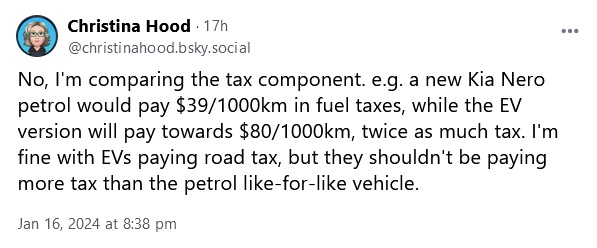
One of the first things the new coalition government did on gaining power was repeal the clean car discount. It was an act of pure climate vandalism, eliminating an effective policy which was significantly shifting the long-term emissions profile of the light vehicle fleet, basicly because it made farmers and the rest of Ute New Zealand may for their desire to pollute and hog the roads. But it gets worse. Because they've now followed that up with making EVs pay road-user charges. "Fair enough," you might say. "After all, we've got to pay for the roads". Sure. But they're making them pay at twice the amount an equivalent modern vehicle would pay in petrol excise tax:

Hood-EV-RUCs

So we've basicly gone from having a clean-car discount to having a clean-car tax, all because of National's climate denial and ingrained hostility to environmentalism.

This is clearly unfair. It is also, in the long-term, unsustainable. The RUC system is complicated, avoidable, easily rorted, and has high compliance costs. The only reason it exists is because farmers didn't want to pay excise tax on diesel used in their tractors (which they then drive on the roads anyway). When normal people, used to invisible, pay-as-you-go petrol taxes, are exposed to it, it is likely to lead to problems. And with National committing to moving all vehicles to RUCs as their "solution" to an expected decline in revenue, those problems are only going to get larger, and pressure is going to build for change. As for what that might look like, its worth pointing out road damage increase with the fourth power of mass, and so almost all of it is caused by trucks (which are already heavily subsidised by the RUC scheme). So we could just charge the people who do the damage, keep RUCs only for heavy vehicles, and let the rest of us pay through general taxation, thus avoiding all that bullshit paperwork. But why would National - heavily funded by the road transport industry - ever go for that?

Friday, December 22, 2023


Climate Change: A stupid move

National has finally proactively released the regulatory impact statement, briefings and cabinet paper on their repeal of the clean car discount scheme. And reading them, you can see exactly why they kept it secret until after parliament ahd voted: because the RIS is crystal clear that this is a stupid move, and that retaining the discount is the best option in the short-term to drive and lock-in emissions reductions:

Of the two options, retention of the scheme will best meet the objective to continue the momentum in shifting the light vehicle fleet to be low-emission as a means to reduce transport emissions.

The Ministry’s modelling suggests that if the scheme ended on 31 December 2023 the expected emission saving from the Clean Car Discount would reduce by between 1,104–2,181 kilotonnes to 2050.

It also points out that the benefits of repeal (in terms of avoided costs) are less than half those of retention. So much for "rigorous cost benefit analysis". Meanwhile, the initial briefing has huge sections redacted for legal advice. A table at the end and the cabinet paper however reveal that this is because repealing the discount threatens our ability to meet out second and third emissions budgets, potentially putting the government in violation of the Zero Carbon Act scheme and at risk of legal action. Repealing it was simply a stupid move.

This is not to say the clean car discount is perfect. The briefing itself points out that it would need to be changed over time as the EV market matured, and eventually phased out. But as a measure to boost initial uptake and shift the market away from dirty killer utes, it has been a stunning success. But the orc government regards that as a bug, not a feature.

Wednesday, December 13, 2023


Secrecy is a fraud upon democracy

Last week, we learned that the coalition had suspended the normal regulatory impact analysis process for its "100 day" policies. Their pretence was that it wasn't necessary to assess the costs and benefits of simple policy repeals. The real reason? It lets them hide the true costs, while ramming stuff through Parliament:

The new Government is sitting on a potentially damning review of its decision to get rid of subsidies for electric vehicles (EVs), despite saying yesterday it would be released.

[...]

The temporary suspension of RIS reports was to help officials faced with “extreme time pressures”. However, transport officials, anticipating the new Government would make good on campaign promises to get rid of the scheme, drew up a draft regulatory impact statement early - meaning the RIS already exists. Brown has confirmed he has seen it.

Green Transport spokeswoman Julie Anne Genter believed the Government was sitting on the RIS because it did not like what it said.

“What possible other reason would the minister have for withholding the RIS analysis? If it supported his case, surely he would release it.

It is unlikely to support the Minister's case. I requested Ministy of Transport's estimates of the emissions costs of repealing the clean car discount back in October. They refused to provide them, claiming they were "confidential" (a withholding ground that almost certainly no longer applies now the bill has been introduced), but did point me at modelling from July 2021. That shows that the clean car discount was expected to save 1.5 to 6.1 million tons of CO2 from 2024 and 2030, and 3.4 to 13.5 million tons to 2040. Those numbers will have gone down due to Hipkins' chickenshit policy bonfire, but they're what we have. And using Treasury's estimated cost of $227 / ton in 2030 to meet our Paris shortfall, that's between $340 million to $1.4 billion.

(To use another metric, the US EPA estimates 226 excess deaths per million tons of carbon. So National's orc policy will murder between 339 and 1379 people by 2030...)

Hiding these costs from Parliament before it debates legislation is simply a fraud upon democracy. But that's how National plans to get away with its climate crimes: through lies and fraud.



