Friday, July 17, 2009


Reviewing the OIA

There's an interesting titbit hidden away in the Law Commission's latest Statement of Intent [PDF]: they're reviewing the OIA:

We have commenced work on two new projects this year that were given to us last year. These are a review of the law relating to trusts and charitable trusts and the Official Information Act 1982.
There's no other details, and nothing on the website, but there will apparently be an issues paper sometime in December.

The Law Commission has already reviewed the OIA once, back in 1997, and recommended [PDF] reducing the time limit from 20 to 15 working days. This has not been acted upon. I doubt their view has changed - if anything, the improvements in information technology which led to their recommendation have only grown stronger, meaning it should be reduced even further. So, we may see another recommendation for reduction, which will likewise be ignored by self-interested politicians.

Says it all

There was a telling comment buried at the end of TV3's story tonight on Chief Justice Sian Elias' speech on the failure of "tough on crime" policies. At the end of the video version, Scott Campbell says:

I also spoke to several sources in both the major political parties about these ideas, and many of them say that they have merit, although they won't say so publicly. To admit that giving prisoners lighter sentences or some amnesty would be political suicide.
That's right: the politicians know these policies don't work, but they continue to publicly support them out of fear of being called "soft". And so we continue down a futile path to expensive failure.

Climate change: the real culprits

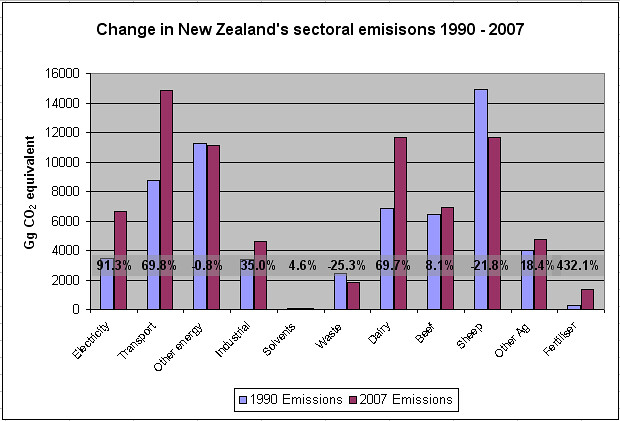
Over on Frogblog, Frog draws attention to the dodgy graphs used by Nick Smith in his consultation meetings, designed to mask one of the real areas of growth in our emissions: the dairy industry. They ask for disaggregated data, similar to that already provide don a sector level, which shows both the absolute and percentage growth for the farm sector and allows a real comparison with electricity and transport emissions.

Ask and ye shall receive...

nzemission1990-2007sector

(Sector information from the 2007 inventory. Dairy, beef and sheep emissions computed from 1990 and 2007 CRF files, and include enteric methane (burps), methane from solid waste (cowshit) and direct nitrous oxide emissions (cowpiss). "Other energy" and "Other agriculture" categories computed by subtraction. Percentages show the percentage growth or decrease in emissions since 1990).

This shows the truth that the government wants to mask: that there has been massive growth in the dairy industry, that it massively exceeds electricity-sector emissions, and that its rate of growth is the same as that of the transport sector. Dairy cows are among our worst polluters. And it is time we stopped subsidising them and forced them to pay their own way.

Thursday, July 16, 2009


"Tough on crime" isn't working

Today the Herald reported on a speech by Chief Justice Sian Elias to the Wellington branch of the Law Society, in which she suggested an amnesty to reduce prison numbers and so avoid "significant safety and human rights issues". In the subsequent and predictable howl of outrage from the right and denial by the government, the real message of her speech was lost: that the present "tough on crime" approach of harsher and more punitive sentences and limited access to bail and parole simply is not working.

The full speech is here [PDF]. I suggest reading it in full. There is a lot of good stuff in there about how the increased involvement of victims is undermining justice and turning sentencing into "a test of [loyalty] and a mark of personal respect" for victims, about the utter ineffectiveness of prison in reducing crime rates, about the failure of non-custodial sentences due to government under-resourcing, and the need to reduce crime and reoffending by targeting its actual causes (including the high rates of mental illness and substance abuse among prisoners) rather than by building a prison at the bottom of the cliff. She also talks about solutions to this: not least, politicians having the honesty to front up to the public and tell them that vengeance and brutality does not work and never has.

Channelling public anxiety into effective strategies is not easy when the first task is to get across the unwelcome message that there are no simple or quick answers. And it is difficult for the public and political debate to be properly informed in an age where our news and comment is geared to simple messages and the stories of individual crimes are readily and graphically communicated. But if we are not to lurch from one increasingly punitive and expensive reaction to another, we all need to take responsibility for understanding the options and for buying in to the strategies that work, rather than knee-jerk responses. Those strategies require social change, not demands for easy quick fixes now...

[...]

Information the community needs to know has to be got across. The message that imprisonment does not reduce crime, that the criminal justice processes are largely irrelevant to crime reduction and that the causes of crime have to be directly addressed must be communicated and understood.

(The Herald's response to her speech rather proves her point, and exacerbates the problem rather than helping us solve it. But I guess real solutions - and the reduction in crime they would entail - don't sell newspapers.)

The solutions Elias suggests are not easy: early intervention to prevent kids from turning into criminals; a more active and better resourced probation service with a focus on personal involvement and rehabilitation rather than risk-management to reduce reoffending; proper mental health services, both in and out of jail, to prevent prison being used as a dumping ground for the mentally ill, and finally, reducing prison numbers through better use of bail, parole and community sentencing - and amnesties if necessary - because it costs an absolute fortune and doesn't do anyone any good.

Drinking Liberally returns to Palmerston North

After a six month break, Drinking Liberally will be returning to Palmerston North next Thursday. The guest speaker will be Green co-leader Metiria Turei on the upcoming s59 referendum:

When: 17:30, Thursday, July 23
Where: Brewers Apprentice, 334 Church St, Palmerston North

[Hat-tip: The Standard]

Climate change: ambitious

The UK government has just announced an ambitious plan to meet its 34% by 2020 climate change target. The details look like nothing less than a green revolution:

  • requiring 40% of electricity to be generated from "low carbon" sources by 2020. This includes nuclear, but given the construction timelines, in practice it will almost all have to come from wind. This means a tenfold increase in wind generation in just 11 years.
  • a massive investment by electricity companies in home insulation - £3.2 billion over four years to insulate 7.5 million homes.
  • Smart meters in every home by 2020, and feed-in tariffs (meaning a guaranteed price) for distributed generation.
  • far tougher CO2 emissions standards for cars.
  • financial assistance "in the region of £2,000 to £5,000" to reduce the price of plug-in hybrids and electric vehicles.
  • including air traffic in the EU ETS.
  • hundreds of millions of pounds on R&D for wind, wave, and other forms of renewable power.
The UK can do this because unlike us they are not completely in thrall to a dead ideology of NeoLiberalism. They are not afraid to regulate, or to tell businesses how to spend their money (currently UK electricity generators must purchase a certain percentage of renewable energy, and spend a certain amount on providing energy efficiency and insulation to their customers). And they are not afraid to face up to the costs, and (more importantly) engage in redistribution where necessary to lessen their impact on the poor. As a result, they can set strong targets, and actually have a decent chance of meeting them. Meanwhile, our NeoLiberal metapolicy of eschewing intervention and regulation and "leaving it all to the market" has resulted in self-induced helplessness. Because of our ideological blinkers around what constitutes "acceptable" policy, we think we can't do anything. And as a result, our emissions have risen 25% while our policymakers have sat around wringing their hands and engaging in abstract and sterile debate about Hayek and Friedman.

If John Key was really "ambitious for New Zealand", he would set a strong target for 2020 emissions reductions. If John Key was really "ambitious for New Zealand", he would look at this policy, clone it (with suitable local adaptations around renewables and agriculture), and actually make us live up to the "clean and green" rhetoric his tourism ministry uses to sell us overseas. Instead, he will make sympathetic noises and talk up the costs and the "threat to jobs" - really the threat to his corporate mates' profits - while doing nothing. And so our emissions will continue to rise, and the planet will continue to burn.

Sabotaging Lisbon

So, just a few months before the Irish go to the polls again for another vote on whether to ratify the Lisbon Treaty on strengthening the EU, the UK announces that they are formally pushing for Tony Blair to be EU President:

Tony Blair is a contender to become the first president of the EU with the full backing of the British government, the new Europe minister said today.

Glenys Kinnock, in Strasbourg for the opening session of the new European parliament, said that although the former prime minister had not formally declared his candidacy, it was "certainly" the government position to support him.

"I am sure they would not do it without asking him," Lady Kinnock said. "The UK government is supporting Tony Blair's candidature for president of the council."

The post will only be created if the Irish vote "yes". And by announcing this, the UK have just given them a powerful reason to vote "no" ("Vote against the rat! Vote against the war criminal! A vote for Europe is a vote for Blair!") Are they trying to sabotage Lisbon?

No freedom of speech in Azerbaijan

Adnan Hajizada and Emin Milli are Azeri bloggers. Last month they made a parody video [in Azeri, but with subtitles] mocking the Azeri government's policy of importing donkeys at exorbitant prices. And then things got weird:

Mr. Hajizada, 26, and his fellow activist Emin Milli, 30, were arrested last week in Baku, the capital, in an event their supporters say could signal the beginning of a crackdown on online media. Azeri authorities said the two physically attacked other men, though witnesses have challenged that account. They are awaiting trial on charges of hooliganism, which carries a sentence of one to five years in prison.

According to a motion filed by Mr. Hajizada’s lawyer, the two men were with friends at a restaurant last Wednesday, engrossed in political debate, when two strangers broke into their conversation and started a fight. Mr. Hajizada and Mr. Milli went to file a complaint about the assault, but instead an investigator opened a criminal case against them, the motion said.

This is apparently how the Azerbaijani government deals with its critics. Last year Qanimat Zahid, an opposition newspaper editor, was jailed for four years for "hooliganism" after a similar attack. Amnesty International considers him to be a prisoner of conscience, jailed for his journalistic work. In 2006, satirist and poet Sakit Zahidov was jailed after being framed on drug charges- again as a consequence of his journalism. He was pardoned earlier this year after serving almost three years in prison. Other journalists have been harassed, intimidated, assaulted, and even murdered [PDF] by a government desperate to suppress all criticism. And now the same seems to apply to bloggers.

Wednesday, July 15, 2009


Beaking the silence on Israeli war crimes

Israeli human rights group Breaking the Silence has published a new report [PDF] in which Israeli soldiers describe in their own words the war crimes they perpetrated on Palestinian civilians during Israel's recent bombing of Gaza. From the summary in the Independent:

The first eye-witness accounts of the war by serving Israeli reservists and conscripts describes the Israeli use of Palestinian civilians as "human shields". They detail the killing of at least two civilians, the vandalism, looting and wholesale destruction of Palestinian houses, the use of deadly white phosphorus, bellicose religious advice from army rabbis and what another battalion commander described to his troops as "insane firepower with artillery and air force". The reports amount to the most formidable challenge by Israelis since the Gaza war to the military's own considered view that it conducted the operation according to international law and made "an enormous effort to focus its fire only against the terrorists whilst doing the utmost to avoid harming uninvolved civilians".
Using human shields is a war crime. Murdering civilians is a war crime. Looting and wanton destruction are war crimes. Using disproportionate force without regard for civilian lives is a war crime. A responsible state which conformed with international law would investigate these offences and put those on trial for violating the laws of war (if only to prevent the international community from doing it). Instead, Israel will deploy its PR flacks and accuse its own soldiers of anti-Semitism for daring to tell the truth about how their military and their government has lost its way.

Climate change: meeting the target

At the moment the government is consulting on its 2020 target for reducing greenhouse gas emissions. In the face of overwhelming public support at the meetings for deep cuts, they have responded by demanding that the public do their job for them and explain where those cuts are going to come from. It's an abdication of responsibility, but it is also disingenuous, because the government already has the tool to achieve the desired cuts: the Emissions Trading Scheme.

For those who don't know, the ETS works by establishing a cap on emissions, and issuing permits to the level of that cap. Every year, polluters must hand over enough permits to the government to cover their emissions, or get a whopping fine. Polluters can buy and sell permits off each other, and from the international market, so reductions happen where they are cheapest. In other words, once you set the target, the market sorts out all the details.

From that capsule description, it is very clear that if the government wants to achieve an arbitrary reduction (say, 40% from 1990), all it has to do is set the cap at an appropriate level. And that's it. It is that simple. Polluters will either cut their emissions, or buy permits on the international market to cover the excess - meaning that someone else cuts their emissions. Either way, global emissions are reduced, and the New Zealand government meets its international obligation. Cut the cap, and the market will sort it out.

So, no more pretending that there is no solution or that the environmental movement must provide it. The government already has one, and it has nowhere to hide. And if they don't want to use it, the onus is on them to explain why.

No freedom of speech in Egypt

Moneer Said Hanna is an Egyptian civil servant. One day, he wrote a satirical poem about Egyptian President Hosni Mubarak. For this, he was arrested and jailed for three years for "insulting the head of state".

Egypt is not alone in having laws aimed at protecting the "dignity" of the leader. Like the old law of lese majeste, they are based on medieval conceptions of what peasants were allowed to say (and think) about their "betters". Such laws - and indeed, the underlying conceptions of "peasants" and "betters" - have no place in a modern democracy. But that's the problem: Egypt isn't a democracy, but a dictatorship, where the government holds power by systematically terrorising the population and "wins" elections by beating, gassing, and shooting the opposition.

No solutions from Key

This morning, Prime Minister John Key was supposed to give a speech "detail[ing] the problems and solutions for New Zealand's economy". You'd expect such a speech to have some information on how the government was planning to deal with the recession. If so, you'd be disappointed. Key's sole tip to the recession is this:

We cannot magic away a deep recession; nor can we turn back the tide of rising unemployment.

What the Government can do, however, is take the sharpest edges off the recession.

And that's it. Key's response to the thousand people a week signing up for the dole and the 60,000 more likely to follow them is, as the Standard says, to grin blankly and shrug his shoulders. Because as he admits, he's not really interested in them, the human victims of what Key disarmingly calls one of the economy's "worse-than-average periods", the actual people who the economy is meant to exist to serve. He's interested in the longer-term picture and climbing some pointless OECD economic penis-size comparison "ladder". And to do that, he proposes the same tired old recipe we have come to expect from National: deregulation (you know, the stuff that led to this economic disaster in the first place), public service cuts, and tax cuts for the rich. Oh, and "productivity growth", which is business code for "wage cuts".

Naturally, the business community lapped it up. As for the rest of us, I'd prefer to have a government which was actually focused on the problems at hand, rather than trying to use them as an excuse to ram through neo-liberal "reforms" which actively make things worse for ordinary people.

Tuesday, July 14, 2009


Good clean internet censorship

The Department of internal Affairs is currently working on a "voluntary" internet filtering scheme to make objectionable content disappear from the internet as far as New Zealand users (well, those too stupid to use a proxy server or a secure encrypted subnetwork) are concerned. Disturbingly, it has chosen to do this in total secrecy. Why? To prevent the sort of opposition that has organised around the Australian government's efforts to oppose their own filtering scheme. Opposition like this:

(If you are Australian and want to protect the internet, then you can take action here)

[Hat tip: Sydney Morning Herald]

The last thing we need

The Herald is running its annual "mood of the boardroom" survey today, in which they ask a tiny minority of uber-rich top business executives how they think the country should be run, then pretend their opinion counts for more than the other 4 million of us, and unsurprisingly they've found someone to say that "New Zealand should be working like a small business". So, according to our business "leaders" - the people responsible for such stunning business successes as EquitiCorp, Air New Zealand (pre-takeover), and BridgeCorp and its assorted clones - this country should:

  • be run at a loss as a tax dodge;
  • never have any investment made in it;
  • be systematically asset-stripped, and milked for short-term profit rather than long-term yield;
  • have a 60% chance of going out of business within 7 years.

"Running the country like a small business" is the absolute last thing we need - and the self-important, self-interested neo-nobility who advise it are the last people we should listen to.

Climate change: Queenstown and Hamilton

The government's climate change target consultation hit Queenstown and Hamilton on Friday and Monday respectively. SignOn has the reports here and here. As expected, support for strong action declines when you start going out into the ignorant wops, but even in Hamilton - cow central - there was still majority support for a 40% target. Unfortunately, after a week, the Minister seems to have given up any pretence at listening.

Tonight its New Plymouth, then Napier, and finally Nelson on Friday. The latter is important - its right there in Nick Smith's own electorate, and a strong showing is thus a clear electoral threat. We need to make it clear to the government that if they do not act, they face de-election (which under MMP, requires a vote swing of only a few percent). So, if you live in Nelson and care about climate change, turn up this Friday.

America's death squads

Over the weekend a scandal erupted in Washington over the revelation that then-Vice president Dick Cheney had illegally ordered the CIA not to brief Congress on a special operations programme. That is enough for careers to end and people to go to jail, but today it got worse, when the nature of that secret programme was revealed: death squads:

Former counter-terrorism officials who retain close links to the intelligence community say that the hidden operation involved plans by the CIA and the military to launch operations, similar to those by Israel's Mossad intelligence service, to hunt down and kill al-Qaida activists abroad without informing the governments concerned, even though some were regarded as friendly if unreliable.

The CIA apparently did not put the plan in to operation but the US military did, carrying out several assassinations including one in Kenya that proved to be a severe embarrassment and helped lead to the quashing of the programme.

The plan was apparently intended to apply to "friendly countries that don't want to co-operate or maybe we don't have enough confidence to entrust them with information" - in other words, countries with laws against murder who are unwilling (or unable, because they are democratic and have independent police and media) to look the other way when people are shot execution-style or blown to bits in a car-bomb. Countries like the UK. You can see why Congress would be concerned about that.

The proper response to terrorism is a legal one: arrest, prosecution, and trial. It is only the pathological secrecy of spies - their refusal to put their "evidence" before the courts - which prevents this. But their preferred methods - rendition, torture, death squads - simply incite more terrorism. Which suggests that we should really be prosecuting the CIA as accessories...

Dodgy as hell

Jim Anderton has uncovered some dodgy dealings between WaterCare Services and the various Auckland councils which seem to be aimed at preventing any public scrutiny under the Local Government Official Information and Meetings Act of the new Auckland water monopoly. As part of the Auckland reorganisation, local councils' water assets will be transferred to WaterCare, the new monopoly provider. But WaterCare is forcing the councils to sign a confidentiality agreement purporting to prevent them from disclosing any information to the public under the LGOIMA - meaning that there will be no oversight of and accountability for what goes on. The kicker? WaterCare is owned by the very councils it is signing these agreements with. In other words, they're effectively (via a few legal cutouts) signing a contract with themselves to insulate themselves from public oversight in a particular area.

This simply stinks. But it's National's "SuperAuckland" down to a "T": secretive and unaccountable. As Anderton says, first they've taken away Aucklanders' democracy; now they're taking away their right to know.

Monday, July 13, 2009


Must read

Over on Public Address, Emma points to some very good OIA work by Thomas Beagle about the Department of Internal Affairs' plans for internet filtering. The short version: DIA are about to implement an internet filtering system in secret. It will be voluntary for ISPs and aimed only at child pornography - but we know from experiences elsewhere that such schemes never stay that way, and inevitably suffer from mission creep (up to and including covering criticism of the scheme itself). And naturally, they are refusing to release the blacklist, on the basis that it is a shopping list for paedophiles. The fact that it means they never have to admit to, let alone answer for, the inevitable mistakes and abuses of course has nothing to do with it.

(Fortunately, we have an answer to secretive, unaccountable bureaucrats: the Ombudsmen. And if that fails, there's always WikiLeaks...)

I am dubious enough about internet filtering - it is IMHO simply a pointless waste of time (in that such measures can be trivially circumvented), while being ripe for abuse. But the fact that this is being done in secret with no publicity, consultation or debate is beyond the pale. That is not how things are supposed to be done in a democratic society. If the government wants to do this, it should own its policy and say so openly so they can be held democratically accountable for it. Of course, that is the last thing any government wants to do...

Climate change: we are not helpless

Faced with a problem like climate change, it is easy to give up and adopt an attitude of helplessness. The problem is so big, we are so small, emissions keep on rising, and there seems to be little we can do about it.

That attitude is wrong. We already have many of the solutions we need to reduce our emissions to a sustainable level: wind, hydro, geothermal and solar-thermal power, hybrid vehicles, biofuels (if grown sustainably), even planting trees. Others we can see are just around the corner: wave power, cellulose ethanol, hot rock geothermal. In an effort to find more, the Guardian convened a think tank at the Manchester International Festival, getting people to pitch their ideas to save the world. Some of them were things seen before - biochar (turning trees into charcoal to lock away the carbon and then burying it), using the Sahara to generate solar power (something which is already happening), and increasing the planet's albedo with a fleet of cloud-making ships (which does nothing about the real problem, but does buy us a bit of time). Others, such as liming the oceans (absorbing carbon and reducing acidity) or using CCS with biomass (effectively removing carbon from the atmosphere) aren't really a go-er at present, as they rely on the coal industry's imaginary carbon capture and sequestration technology, which won't be around for 25 years, but they might be doable then. But even so, there are still plenty of solutions there. The problem isn't one of technology - it is purely one of political will; politicians in hock to established and unsustainable economic interests being unwilling to enact the policies which would push us down those technological pathways. Which in turn suggests the solution: de-election of anyone who refuses to act.

New Fisk

The story of Baha Mousa


