Wednesday, March 17, 2010


Worrying II

The other day I blogged about the Samoan government's plans to review freedom of religion. Today, Radio New Zealand confirms that the review is explicitly aimed at limiting the access of non-Christian religions into Samoa. Faced with potential competition and decline, Samoa's Christians have decided, like a monopoly company, to try and restrict access to the marketplace of ideas and so force people to buy their product.

This is simply monstrous. Freedom of religion is a fundamental human right. Just as the government has no business in our bedrooms, it has no business in our heads. A government which tries to force us to believe or not believe particular things, or circumscribe our thoughts, is the worst sort of tyranny.

As a voice for human rights in the region, New Zealand should be speaking up about this. Samoa is its own country, run by and for Samoans, but we can and should at least try and persuade them not to take this backwards step, and remind them of their obligation to protect the rights of all, not just the majority.

(More on Talamua)

National hates Members Day

Just before the recess, National again abused urgency to bump the first scheduled Member's Day of the year. As a result, today is a Member's Day - but looking at the Order Paper [PDF], the government has decided to schedule a two-hour debate on the Budget Policy Statement. There will still be a Member's Day (assuming that the government doesn't call urgency again) - but it will be two hours shorter.

Budget debates are government business. They should be heard in government time. Scheduling one for today steals time from members which they could be using to debate their own bills. But that, it seems, is the point. Last year it systematically abused urgency to rob members of Member's Days. This is just more of the same. National views Parliament not as a legislature, but as their rubberstamp, to be used solely to progress their agenda. The idea that the opposition has time set aside specifically o debate their own alternatives to government policy is anathema to them. The hypocrisy here is breathtaking - just a few years ago, National was willing to die in a ditch to protect Member's Day (and for the benefit of other parties, at that). Now they're government, they seem to want to eradicate it.

The House should not put up with this. Just before the recess, we had a powerful example of what happens if the opposition withdraws their cooperation in the House. They should do it again, and keep doing it, until the government agrees to respect the sanctity of Member's Day.

Tuesday, March 16, 2010


Fiji: Where is Peceli Rinakama?

Two weeks ago, Fijian politician Peceli Rinakama was abducted by soldiers in Suva. Publicity around the case forced the regime to admit after a week that Rinakama was in custody, and then to claim that he had been released. A victory for human rights, right?

Except that according to Coup 4.5, nobody has seen Rinakama since his "release":

Coupfourpointfive has been trying to verify his release as reported last week, but no one has been able to say for sure if Rinakama is out of custody and where he is now.

We have now been told by a SDL member that Rinakama's family is also still in the dark.

It's been confirmed to us that he was arrested with SDL's national director, Peceli Kinivuwai, who has been released but family and party members have no iea of Rinakama's current whereabouts.

Coupfourpointfive's source says the whole situation is uncertain at the very least and there are very real fears for Rinakama's safety.

So, where is Peceli Rinakama? His family don't know, his friends don't know, and the only natural conclusion is that the regime lied about his release and that he is still - unalwfully - in custody.

A good idea

Over on Kiwiblog, DPF has a good idea for open government:

That all papers and reports considered by Cabinet and/or a Cabinet Committee be automatically placed on the Internet within six months.
Many government departments already do this, and proactively release cabinet papers on significant issues the moment they have been signed off by Cabinet. But not all do, it certainly doesn't cover every issue, and you get the information at the end of the policy development process rather than during it. Requiring proactive release would give us far greater scrutiny of what the government is up to, and the possibility of objecting at a much earlier stage, rather than being presented with a fait accompli.

One potential downside is that proactive release could give Ministers an excuse to refuse requests under s18(d) on the basis that the information "will soon be publicly available". It will need heavy initial policing by the Ombudsmen to prevent this.

So, who wants to take an Official Information (Proactive Disclosure of Cabinet Papers) Bill?

How much is it all worth?

For the past six months, the government has been threatening to dig up our national parks. They justify this by arguing that New Zealand has immense mineral wealth - supposedly as much as Australia - but its all kept "off limits" due to conservation laws. But as Gordon Campbell points out, their preferred figure - $140 billion - is a "back of the envelope" estimate from a mining lobbyist. If you trust that figure, I have a beehive-shaped building in Wellington to sell you.

So how much is it really worth then? Back in 2002, Statistics New Zealand began work on preparing a system of natural resource accounts [PDF] in order to better measure the sustainability of the New Zealand economy. Part of this involved generating a monetary and physical stock account for minerals [PDF]. This used an internationally accepted methodology based on the NPV of resource rental (the same methodology used by mining companies in making their economic decisions), and covered all major minerals currently economically extracted in New Zealand - gold, silver, iron, aggregate, and others. Minerals not currently or recently extracted could not be valued, as there was no way of calculating resource rental for them. A similar exercise was conducted for energy resources [PDF], including coal and petroleum. Combining the two - minerals plus non-renewable energy resources - gives a total figure (for 2000) of NZ$3,683.2 million. Quite a difference from $140 billion, isn't it?

A couple of caveats. First, as will be apparent if you look at the tables, these figures vary depending on market prices. Historically, the value for minerals has varied between $100 million and $1 billion, that for petroleum and coal between $1.6 and $5.5 billion. 2000 was a bad year for minerals but a good year for oil. But even if we take the maximum values for each, we're still looking at $6.5 billion - around 20 times lower than the government suggests. Second, these figures are ten years old - sadly, Statistics New Zealand doesn't seem to have continued the project. But they're at least a ballpark indication, and they show that the ballpark is somewhere vastly different from where National puts it.

In short, National's quest to dig up our natural heritage is based on poor numbers and mining industry hype. And whichever side of the fence you're on, that's a very poor basis for a decision.

Exclusive: An appropriate process?

Back in December, Justice Minister Simon Power appointed a number of National party cronies, including former MP and arch-bigot Brian Neeson, to the Human Rights Review Tribunal. I've been digging into it ever since. Last month, I highlighted the irregular process used to appoint these cronies: their names appeared apparently from nowhere, and contrary to the view of HRRT chair Royden Hindle, he was appointed without any sort interview. Yesterday, I received a further OIA response [PDF] which casts more light on the subject.

Firstly, it confirms that the cronies were appointed without any interview or formal process. They were "well known to Ministers" who were "satisfied as to their suitability for appointment". And that, apparently, was the end of the matter. There was no examination of qualifications beyond a standardised curriculum vitae form, and certainly no formal test of their ability to contribute meaningfully to the work of the Tribunal as recommended by its chair. They were "well known to Ministers", and so they were in. Whether this is a suitable appointments process for a quasi-constitutional body with power to overturn legislation such as the HRRT is left as an exercise for the reader.

To add insult to injury, the nomination of these cronies displaced more qualified candidates. Power had initially proposed the reappointment of eight existing, experienced members of the HRRT. Four of them were dumped to make room for these cronies. These included all three legal practitioners, who the chair had specifically requested be retained to provide a core of legal capability "to ensure continuity in the decision-making process of the Tribunal". Faced with a choice between an effective human rights body, and jobs for their mates, National chose the latter.

Secondly, I asked about the processes' conformance with SSC guidelines, which require [PDF] that candidates be assessed against formal skill requirements and for conflicts of interest and the process documented. That drew the following response:

The SSC guidelines to which you refer are designed to ensure Ministers receive consistent information on candidates being recommended for appointment, about whom they often have no prior information. The guidelines are just that. It is wholly up to Ministers to determine to what extent the guidelines need to be applied in any appointment process or part thereof.
(Emphasis added)

So when Power certified to his Cabinet colleagues in the Cabinet paper recommending the appointments that

an appropriate process has been followed in selecting the proposed appointees, in terms of the SSC appointment guidelines
...it doesn't mean what it appears to mean. In fact, it doesn't mean anything at all. What constitutes an "appropriate process" is "wholly up to Ministers". According to Power, he could pull the names out of his arse (which is effectively what he did), and it would still constitute an "appropriate process".

I'd like to think that a Minister's certification in a Cabinet paper means a little bit more than that.

Monday, March 15, 2010


Burying the death penalty

Last week, Australia passed a law abolishing the death penalty. Which seems odd, given that no Australian state uses it, and the last execution in Australia was in 1967. But while no Australian state currently practices state murder, there's nothing stopping them from doing so (despite Australia's ratification of the Second Option Protocol to the ICCPR), and there were concerns that a "tough on crime" state government could regress in future. The passage of the Crimes Legislation Amendment (Torture Prohibition and Death Penalty Abolition) Bill 2009 effectively stops that, as state law must not be inconsistent with federal enactments.

So the death penalty is now effectively dead and buried in Australia. If only states like Tonga and Fiji would follow suit.

Peter Bethune

On Friday, anti-whaling activist Peter Bethune arrived in Japan, and was arrested for illegally boarding a Japanese whaling ship. Since then, there has been a storm of protest in New Zealand, with demands for the government to step in and ensure Bethune's release. In response, the government has said that they cannot intervene in Japan's legal processes. Mostly, this is making excuses - the prosecution is transparently political, an act of vengeance against a protestor who has successfully shamed Japan in the eyes of the world and exposed its aggressive and unlawful actions in the Southern Ocean (pro-whaling National is probably right behind that, and wishes they could do it here - their fans in the Kiwiblog Right certainly are). But formally, at least, they're right. But that doesn't mean they should wash their hands of the affair and hang Bethune out to dry.

According to the US State Department's 2009 annual human rights country report, Japan has significant problems around fair trials and detention conditions. Australian Senator Bob Brown alludes to this when he says that their courts "have nearly a 100 per cent conviction rate". According to the US State Department Report, they achieve this by coerced confessions, lengthy pre-trial detention during which defendants are interrogated without access to legal counsel, and stacked trial procedures which favour the prosecution. Once convicted, prisoners (particularly foreigners) are frequently subject to abuse and solitary confinement, while poor conditions, notably lack of heating in winter, results in preventable injuries and illnesses.

The New Zealand government should not abandon any of its citizens to this sort of system. It should make it clear to the Japanese authorities that it will be watching the trial like a hawk, to ensure that it is fair and abides by international standards. If Bethune is convicted, they should monitor his detention to ensure that it too meets international standards. And they should make it clear that any failure to provide a fair trial or any abuse in prison will result in diplomatic protest and complaints to UN human rights bodies.

The government won't want to do this. we should make them. Our government should look out for all its citizens, no matter where they are, and no matter what their political opinion. And if they fail in this, we should hold them accountable for it.

No control

Writing in the Herald, ARC chair Mike Lee details how little control the new Auckland council will have over Auckland Transport:

  • The Auckland Council will be unable to appoint (or dismiss) the Auckland Transport chair and deputy chair.
  • Auckland Transport is not required by legislation to act in accordance with the requirements of its shareholder (the Auckland Council).
  • The Auckland Transport Board is not made accountable to the Auckland Council.
  • The Auckland Council may be able to make changes to Auckland Transport's statement of intent but, unlike the Crown Entities Act, this bill has no specific provision requiring Auckland Transport to act in accordance with this statement of intent.
  • Auckland Transport is not required to give effect to the Regional Land Transport Strategy, or any other Auckland Council policy that relates to the transport agency.
  • Auckland Transport could set up companies, sell assets and enter into major financial commitments without the approval of Auckland Council, even where the transactions may leave the council with significant liabilities or commitments.
  • Auckland Transport won't be required to have regard for the wider land use and development objectives of the Auckland Council.
With governance arrangements like this, describing Auckland Transport as a "council controlled organisation" is simply oxymoronic. Instead, Aucklanders will effectively be getting a separate local government for transport issues - unelected, unaccountable, but still paid for by them.

They shouldn't put up with it. Transport is a key function of local government, and it should be subject to democratic control. Arguments over the differing visions for the future of Auckland's transport network should be resolved through the democratic system, by Aucklanders. This whole "CCO" scam is simply an attempt to prevent that, and to allow rich men in Wellington to impose their vision on Aucklanders unilaterally and without their consent.

But Aucklanders will be paying the bills for that vision. And I suggest that they should make it clear that they will not be paying them unless they have control. Auckland transport shouldn't be given a cent of ratepayer's money unless they build the roads and rails Aucklanders want, where Aucklanders want them.

Using the power of the purse in this way has a long history in promoting democracy. Its what allowed the UK Parliament to wrest control from an undemocratic monarchy, and put it into the hands of elected representatives. The Auckland Council should follow in their footsteps. If Wellington wants to dictate the shape of Auckland's future, then let them pay for it.

Worrying

Today's worrying news: the Samoan government has established a Commission of Inquiry to review freedom of religion.

As the RNZI article notes, freedom of religion is guaranteed by the Samoan Constitution, and by the ICCPR, to which Samoa is a party. But it is not widely respected. In addition to government-mandated religious indoctrination in schools, there is also a significant problem of local village matai using their powers to punish and victimise those who do not conform to the predominant local faith. In one recent example, a Seventh Day Adventist man was banned from his village for holding prayer services at his house (the story also notes that his house was burned down by the village in 2000 over the issue). Other villages prohibit conversion in an effort to maintain the power of the monopoly faith.

According to the RNZI story, the government has established the inquiry at the behest of local Christians, and that is concerned about challenges to village authority and "other religions, yet to arrive in Samoa, which strongly advocate beliefs that are contrary to Christianity" - which suggests the review is aimed at repealing freedom of religion and establishing a formal, legal, Christian theocracy. And that would be a very worrying step indeed.

Government of orcs

Forest & Bird has leaked the government's plans for mining in national parks - and they're not pretty. The government plans to dig up parts of the Te Ahumata plateau on Great Barrier Island, which includes critical habitat for the endangered brown teal, as well as for plants found only on the island such as the Great Barrier Island tree daisy and the Great Barrier Island kanuka; the Otahu Ecological Area in Coromandel, recognised as “outstanding” by DoC and home to the threatened Hochstetter’s frog as well as rare native fish; other parts of the Coromandel peninsula; and part of the Paparoa National Park near Reefton, which is untouched forest. Contrary to the government's propaganda, these are not areas of low conservation value or farmland which just happens to be managed and protected by DoC. Rather, they are some of the most sensitive areas in New Zealand, home to some of our most endangered species.

Worse, the mining is not going to be "surgical":

Minerals targeted in the Government’s stocktake are found in low concentrations so open-cast mining – not “surgical” mining – is the most likely way to extract them. “In New Zealand, you get an average 3 grams of gold for every 1400 kilograms of rock that’s dug up. A mining company is not going to drill small, unobtrusive holes to process huge quantities of rock,” Kevin Hackwell says.

“In Paparoa National Park, for example, river terraces are being looked at. Open-cast mining is the only way to get at any coal or gold there,” he says.

So, the government's plan is to tear up some of our most beautiful and sensitive forest, and turn it into giant stinking pits. We're governed by orcs. Its the only way to describe them.

People are going to oppose this physically. Particularly in Coromandel, people use these areas for recreational purposes, and they will speak out and lie down in front of bulldozers to protect them. But there's another way to stop this as well: we have an election in 19 months. Change the government, change the policy...

Sunday, March 14, 2010


New Fisk

Try this reading list if you want to understand the Middle East

Friday, March 12, 2010


Completely out of touch

Colin Espiner, blogging about the government's plans to sell New Zealand residency (and by extension, voting rights) to those willing to invest $750,000, makes this comment:

Three-quarters of a million dollars is a paltry sum in most countries - including New Zealand actually.
Really? The median income in New Zealand is around $23,000. Assuming someone works nonstop from age 20 to 65, the median person will earn $1.075 million over their working life. What Espiner calls a "paltry sum" is in fact around three-quarters of the median lifetime earnings in this country. But clearly, Espiner can't see beyond his own high salary or recognise that the vast majority of New Zealanders - and his readers - are not in his privileged position.

Expenses fraud here and there

Former National MP and Children's Commissioner Roger McClay appeared in court today on fraud charges over misuse of his parliamentary perks. It seems like it was a quiet affair. It was a different story in the UK, where three Labour MPs and a Tory peer appeared on theft charges over expenses rorts - and were greeted by protestors:

Outside Westminster magistrates court a vast crowd of photographers had gathered, and a somewhat smaller crowd of protesters. What they lacked in numbers they made up in spray-gunned anger: placards denounced "Bakers, politicians, rozzers, grasping, corrupt, filthy pigs the lot …" Some wore pig masks, others were dressed as Guy Fawkes.

[...]

Outside the court there was chaos. "Oink, oink, oink" yelled the people dressed as pigs. "Bye, bye, scum, bye!" said someone else – and he was a photographer. The three MPs and their brief somehow struggled into a cab which managed – just – to drive away without crushing a dozen cameramen's feet.

The hate is palpable - but then, that's understandable. Rather than accepting they are subject to the same laws they make for others, these MPs have declared themselves above it, and are trying to hide behind Parliamentary Privilege. Its utterly shameless - but so typical of a political system which still sees the people as something to be ruled over, rather than represented.

Offensive, but not unlawful

That's the verdict of the Human Rights Commission on Hone Harawira's infamous "white motherfuckers" email. While the Human Rights Act criminalises the incitement of racial disharmony, the Bill of Rights Act's affirmation of freedom of expression means the bar for prosecution is very high. Not that it was ever low - the Race Relations Act 1971 had a similar provision, and in the almost 20 years it was in force, there was just one prosecution, of neo-Nazi Colin King-Ansell over an anti-Jewish pamphlet, which resulted in a small fine. I don't think there's been a single prosecution since. While complaints are frequent, as the HRC notes in its Action Plan for Human Rights,

the offensiveness of a race-related comment is not sufficient on its own. The comment must also be a probable cause of ethnic hostility or contempt. The vast majority of comments that are complained about are unlikely to contribute to serious ethnic unrest.
While Harawira's comments deeply offended some people, it didn't meet that standard. Indeed, it seems to have had the opposite effect, attracting hostility against Harawira rather than the group criticised.

As for allegations of the HRC having a double standard, that's the same standard they apply to Nazis, the same standard they applied to Paul Holmes over his "cheeky darkie" comment (which likewise attracted a large number of complaints), and indeed the same standard they applied to the 3% of complainants who took the opportunity to make comments that were "extremely racially offensive about Hone Harawira and about Māori in general." Free speech means that only the most extreme comments are unlawful. Unless we're talking specific and immediate incitements to genocide, of the sort seen in Rwanda, the law is basically a dead letter.

But while not unlawful, the HRC are very clear that Harawira's comments were offensive, and argues that political parties should control and discipline such behaviour through codes of conduct. Which is what the Maori Party did. Ultimately, they're accountable to their voters, who will no doubt pass their judgement on Harawira at the next election.

Somehow, I think this is unlikely to satisfy the complainants. But then, this whole incident seems driven not so much by Harawira's offensiveness (and I agree, he was offensive),1 but by the rage of Pakeha rednecks upset that any Māori would express anger over the past. Their problem wasn't so much with "white motherfuckers" (which just makes him an offensive dick, and if you turned the tables it would still make him an offensive dick), but "white motherfuckers have been raping our lands and ripping us off for centuries". There are some people in this country who do not like to be reminded of the truth about our past: that our ancestors, genetic or political, stole this country by fraud and violence from its inhabitants. This fact has been exhaustively detailed in numerous Waitangi Tribunal reports, as well as in popular histories. But there are some who still refuse to accept it, who think the process of trying to right those wrongs and give some compensation for those injustices is a fraud and a scam (and not because that compensation is a tiny fraction of what was stolen), and that Māori should just shut up and accept what happened to them. And for them, anything less than a public lynching of the uppity Māori shows that the state has double standards and is racist against Pakeha. Fortunately, the HRC is comprised of better people than that.

The HRC's full report is here [DOC].

1 Emphasis added so that dickheads can't ignore it. But I'm sure they will anyway.
Bigots hurt everyone

Itawamba County Agricultural High School is a normal high school in Mississippi. Unfortunately, its board is run by bigots, who wanted to ban a lesbian student from taking her partner to the school prom. The ACLU objected to this, pointing out the basic principle of non-discrimination - that you cannot provide a service to some while denying it to others. In response, the bigots cancelled the prom. Rather than providing the service to all without discrimination, they decided to provide it to none instead.

The lesson: bigots don't just hurt gays - they hurt everyone.

A giant effluent pond

Over on Frogblog, Green co-leader Russel Norman blogs about his trip to Lake Ellesmere, which he described as having the consistency of "toxic pea soup". This is what he found:

There were signs by the boatramp that said not to touch the water, as it’s a health hazard due to toxic algae. That made us extra careful not to fall in. Monique and I did manage to splash ourselves while Jolyon avoided all contact, showing what a pro he is.

Currently the Canterbury Regional Council says that groundwater levels in the Central Plains are at an all time low, and flows in the Selwyn and other rivers such as the Irwell and the Boggy that feed the lake are at minimum or lower. Irrigation is sucking the rivers and groundwater dry. This, combined with big inflows of nutrients and warm weather, has led to the toxic algal blooms.

And the reason for that irrigation and nutrient loading? Dairy farming. The quest for "white gold" has turned Lake Ellesmere into a giant dairy effluent pond. It has also polluted the drinking water supply of local communities, who are having to invest in expensive water treatment facilities. Another example of how dairy farming externalises its costs onto the rest of us.

The solutions to this are known and simple: reduce irrigation, so the lake can fill again and there is less runoff. And restrict nutrient loading by farmers so it doesn't overload the ecosystem. The farmers will scream, but its basically them or us - because what is happening to Lake Ellesmere today will happen to Christchurch's drinking water tomorrow. But these necessary measures seem to be the exact opposite of what National is planning...

Rinakama in custody

Last week, Fijian politician Peceli Rinakama was abducted by soldiers in Suva. Today, after a week of silence, the regime has finally admitted that he is in custody, though they will not say where or by whom. Neither will they say what he is being held for, though there should be some answers on that soon. Even Fiji's authoritarian Public Emergency Regulations only provide for detention for up to ten days; if Rinakama had been arrested under ordinary law, then the new Criminal Procedure Decree requires prisoners in custody to be taken before a Magistrate "as soon as practicable". The regime wouldn't break its own law, would it...?

(Interestingly, their new Crimes Decree provides for a penalty of seventeen years imprisonment for enforced disappearance - though this must be carried out as part of a sustained campaign against a civilian population. Fortunately, things in Fiji haven't sunk to that level yet)

Its a good example of how making noise about human rights abuse makes a difference. Since being raised on the Fijian blogs, Rinakama's plight has been mentioned in media around the Pacific - in New Zealand, in Tonga, and in the Solomon Islands. If that noise hadn't been made, he'd still be being detained in secret.

Thursday, March 11, 2010


A warning on social mobility

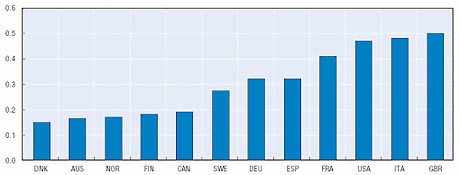
The Guardian highlights an OECD report [PDF] which shows that the UK has the worst social mobility among developed OECED members:

Children from poor families in Britain have a greater chance of struggling on low incomes than their counterparts in the west's other rich countries, the Organisation for Economic Co-operation and Development (OECD) said today.

Highlighting the UK's lack of social mobility, the Paris-based thinktank said the chances of a young person from a less well-off family enjoying higher wages or getting a higher level of education than their parents was "relatively low".

Its rather graphically shown below:

Unfortunately there's no data in the report on New Zealand, and I haven't been able to find any on the web, but there seems to be a strong correlation between NeoLiberalism and low social mobility, which isn't a good sign. New Zealand also has a very strong relationship between parental socioeconomic background and educational achievement (see the graph on p. 188), which given the causal model they lay out, suggests our mobility will be more like the US and UK than Australia or Sweden.

As for what to do about it, the report has this to say:

Education policies play a key role in explaining observed differences in intergenerational social mobility across countries. For example, higher enrolment in early childhood education is associated with a lower influence of parental background on students’ achievement in secondary education. By contrast, school practices that group students into different curricula at early ages come with less social mobility in educational achievement. Moreover, increasing the social mix within schools appears to boost performance of disadvantaged students without any apparent negative effects on overall performance.

Redistributive and income support policies seem to be associated with greater intergenerational social mobility.

Unfortunately, our government is doing the opposite, treating ECE as babysitting rather than real education, and increasing subsidies to snob schools so the rich can exclude themselves from society (oh, and cutting taxes for the rich and raising them on the poor, reducing redistribution, as well). But then, they're not interested in social mobility. Rather, they're interested in protecting and enhancing the privilege of the rich, by stamping on the fingers of the poor.

National to Auckland: Fuck you

For the past couple of weeks the Auckland Governance Committee has been hearing submissions in Auckland on the latest phase of the government's "supercity" reforms. The message from submitters has been universal: they want to live in a democracy, not a corporation. They want things like transport, water, and the waterfront to be controlled by democratically elected and accountable councillors, not unelected, unaccountable party hacks appointed from Wellington.

Today, Infrastructure Minister responded to those concerns. His response was simple: fuck you. Aucklanders will not get to control their own city. The most the government is prepared to offer is "consultation" on which hacks it will appoint. And he sees no problem with Aucklanders paying for local services they have no control over.

If we tried to run Tokelau like this, the UN would be breathing down our neck for unacceptable colonialism. But National is planning to run our largest city through what is effectively a colonial administration, with key decisions kept out of the hands of the "natives". We didn't accept that overseas, and we shouldn't accept it in Auckland.



