Wednesday, December 04, 2013


More police spying

Operation 8, the police's "unlawful, unjustified and unreasonable" attack on Tuhoe, involved widespread surveillance, including wiretaps, computer searches, and unlawful video surveillance. Now it appears that the surveillance dragnet was even wider than we thought:

Well-known New Zealanders not associated with paramilitary training in the Te Urewera National Park were monitored by police during Operation 8, Maori Party co-leader Te Ururoa Flavell says.

Flavell, who said the surveillance carried on for some time after the raids, is demanding answers from police.

A surveillance log obtained by Flavell and which he has asked police to verify relates to the 2007 armed raids near the eastern Bay of Plenty town of Ruatoki.

The log, given to him by a member of the public, details who was being surveilled, what they were doing and who was nearby and records information such as internet searches.

It covers a period of three years before Operation 8 and some time after, he said.


This raises several questions: most obviously, why exactly were the police spying on these people? If they weren't associated with the paramilitary training, then there appears to be no case to justify surveillance. But beyond that: if the police have obtained internet searches from these people, it means they either obtained interception warrants, or they got the GCSB to use PRISM to obtain them in violation of New Zealand law. Either way, it is a gross intrusion of privacy, and one we deserve serious answers on. While we expect the police to protect the public, they must be proportionate in exercising their powers - and on its face, this appears not to be.

Something to be proud of

We've topped the Transparency International Corruption Perceptions Index as the world's least corrupt country again:

New Zealand has retained its top spot and gained a point from last year in the latest Corruption Perceptions Index.

Both New Zealand and Denmark received a score of 91 out of 100 for joint leadership in the index, which ranks the transparency of public sectors across 177 countries.

The figures, released by the Transparency International Secretariat in Berlin, rank countries and territories based on how corrupt their public sector is perceived to be.

Australia came ninth on the list, below the Netherlands and Switzerland.


But while this is good news, you do have to wonder how much that perception reflects reality. There have been several disturbing cases of public service corruption in recent years (and our politicians remain as venal and self-aggrandising as ever). Which really does make you wonder how much is going on undetected...

Member's Day

Today is a Member's Day, though a fairly boring one. There's a couple of boring local bills to get out of the way first, followed by Paul Goldsmith's uncontroversial Electronic Transactions (Contract Formation) Amendment Bill, which should whizz through. Then we have Home Harawira's Education (Breakfast and Lunch Programmes in Schools) Amendment Bill, which National will vote down on the basis of their one-off charitable donations to their corporate friends. If we're lucky, the House will make a start on Clare Curran's Electronic Data Safety Bill.

There should be a ballot for two or three bills tomorrow. The only new bill to be put in the ballot since last time is Brendan Horan's Land Transport (Promoting Safe Driving and Compliance with Speed Limits) Amendment Bill, which requires speed cameras to be clearly signposted so everyone can slow down for them.

Good riddance to John Banks

So, John Banks has finally admitted that he's a political dead duck, and decided not to stand for re-election. Good riddance. Quite apart from the alleged electoral expenses fraud, this is an MP remember who said that the problem with homosexual law reform was that "so many of these creeps have now boldly crept out of the wardrobe", and that "six inches of barbed wire shoved up gay mens arses" would be "a waste of good barbed wire". And this wasn't back in the dark days of the 80's; he was still spouting his homophobia, bigotry and hate only five years ago. So I'm not in the least bit sorry to see him go (and in fact, I'd like him to go sooner). And maybe this time ACT can find a candidate who is actually a liberal, rather than a conservative bigot solely interested in the "freedom" of the rich not to pay taxes.

Tuesday, December 03, 2013


The cost of anti-environmentalism

National's refusal to protect the critically endangered Maui's Dolphin has been making international headlines. And now its drawn the inevitable response: a call for a boycott from a German environmental group:

A German conservation group is calling for a boycott of New Zealand seafood over our Government's heavily-criticised protection plan for Maui's dolphins.

NABU International says it will challenge what it believes is an inadequate approach to saving the critically endangered cetaceans in the High Court.

It's also urging the world not to buy New Zealand seafood.


This is what happens if the government deliberately undermines our "100% Pure" image: those industries who rely on it suffer.

An explosion of spying

The SIS's Annual Report was released today, and as usual I've been browsing through it. There's some interesting news in it: apparently the SIS deployed people to Afghanistan to provide "intelligence support" to the NZDF Provincial Reconstruction Team prior to its withdrawal. As for their annual excuse for their increased budget and intrusive powers, this year it is the "threat" of kiwis returning home after fighting in the Middle East and Northern and Eastern Africa, and "new manifestations of traditional threats (espionage and, potentially, sabotage) through the medium of cyber [sic]". That's right, hackers are the new security "justification". Keith Ng, they're coming for you.

siswarrants

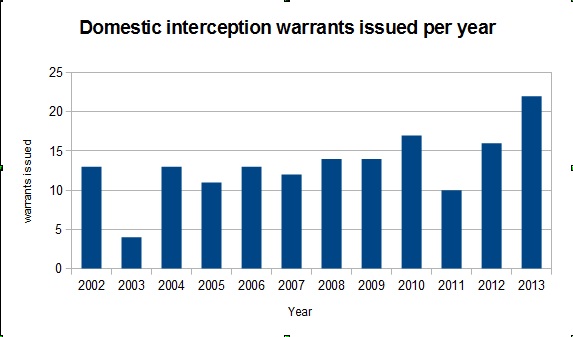
[New SIS domestic interception warrants by year. Data extracted from SIS Annual Reports here]

There's also this worrying data point: the number of domestic interception warrants issued last year increased to 22, the highest on record. There seems to be no public threat to justify such an increase, so either we are looking at a massive new security threat which is completely invisible to the public, or the threshold for granting such warrants (which allow phones to be tapped, computers hacked, and homes burgled) has reduced significantly. Unfortunately, because its all done in secret, we'll never know.

Naylor's cossacks

In Wellington, the city council uses an "alternative giving" campaign in an effort to sweep away the human reminders of economic failure. In Palmerston North, the mayor wants to threaten them with rugby players:

Rugby players have been suggested as a better deterrent than a bylaw in discouraging begging in Palmerston North.

Mayor Jono Naylor said rather than spend about $10,000 making a bylaw that would achieve "zip", he would rather give the money to the Kia Toa Rugby Club to get players out on Broadway Ave to discourage beggars.

"If we could get them to shadow these people around the streets, we would have it solved by Christmas."


So, his preferred way of dealing with economic distress is thuggery and intimidation. I'm very glad I didn't vote for him.

[Thanks to @SirWB for the post title]

David Cunliffe: Bullshitter or muppet?

So, David Cunliffe may have broken the law against election-day advertising by tweeting in support of Poto Williams on the day of the Christchurch by-election. On the face of it, no harm seems to have been done - the tweet was deleted almost immediately - and given past practice from the Electoral Commission I do not think it will result in prosecution. At the same time, Cunliffe's explanation doesn't quite wash:

"I take responsibility for that, the tweet was sent in error and deleted within seconds and it was reported as soon as possible to the returning officer," he said.

It was a draft which he sent unintentionally and deleted immediately before reporting it to his campaign who he said reported it to the returning officer.

He was not aware of the rules at the time it was sent but said no one else pointed out his mistake to him before he deleted it.


So, it was a draft which he sent "unintentionally" - but if it was a draft, then that strongly suggests an intention to send it later, despite clear law that that would be illegal. He claims to have been ignorant of that law, but immediately deleted the tweet and reported it to the campaign - why do that unless you knew it was illegal? Finally, Cunliffe has been an MP for 14 years, and fought 5 election campaigns - and we're supposed to believe he's unaware of one of the most fundamental rules of New Zealand electoral law? I don't think I'm the only one who will be smelling bullshit here.

But even if we do accept his explanation, then Cunliffe has admitted being a total muppet who doesn't learn from his campaigns and cannot be trusted in possession of a social-media account. And that's hardly any better. Either way, he needs to get his shit together.

But do we believe them?

John Key says the GCSB is not engaged in the "wholesale collection" of metadata:

Prime Minister John Key yesterday sought another assurance from GCSB director Ian Fletcher that the spy agency had not been involved in wholesale collection of metadata on New Zealanders - and was given it.

But Mr Key was unable to tell reporters later whether the United States National Security Agency collected wholesale information on New Zealanders for its purposes.

"I don't know," he said.

[...]

Mr Key said yesterday: "I rang the head of the agency and said, 'Can you confirm for me that New Zealand didn't collect wholesale metadata about ordinary New Zealanders?' and the answer was, 'We didn't, and because we didn't, we couldn't have shared it'.


But do you believe them? There's plenty of wiggle room in that denial - how widespread is "wholesale", for example? - and this is an agency with an established track-record of lying. Given their apparent reinterpretation of their governing to permit domestic metadata interception (despite a clear prohibition on anything of the sort), we would be fools to just take them at their word.

Meanwhile, Key has opened another can of worms with this comment:
"We share information in isolated cases about New Zealanders with our partners, and we do that when there's a really good reason to do that."

Obvious question: was this shared information intercepted communications? If so, the GCSB have been breaking the law. Key needs to come clean about exactly what these "isolated cases" are. In the meantime, the only way to restore public trust in the GCSB is through a full public inquiry with full access to all their collection programmes.

Monday, December 02, 2013


Tax-cuts and asset-sales

The Greens' Russel Norman points out the obvious: National's asset sales are driven by the need to make up revenue given away in tax cuts. And the plan is failing:

National’s tax cuts for the top 10% of income earners are costing more than the revenue generated by National’s asset sales, Green Party Co-leader Dr Russel Norman said today.

Parliamentary Library and Green Party calculations show that, by the time of the 2014 election, the reduction of the top income tax rate for the top 10% of income earners will have cost over $4.5 billion. The asset sales programme produced only $3.9 billion worth of proceeds to the Crown to date, even before sales costs are deducted.

“National isn’t selling our assets to pay for schools and hospitals; they’re flogging them off to fill a hole left in the budget by the tax cuts that they gave the top 10%,” said Dr Norman.

“John Key’s assets sales are part of a money go round. The well-off got tax cuts from National, they then bought shares in National’s asset sales, and the sale proceeds are going towards covering the cost of those tax cuts.


If we hadn't had tax cuts for the rich, we wouldn't "need" asset sales, and we wouldn't be driving ever faster towards a more unequal society. But National probably regards the concentration of wealth in the hands of its donors and cronies as a feature, not a bug.

Australia offered to spy on its own citizens

The latest NSALeak: Australia's Defence Signals Directorate offered to spy on their own citizens:

Australia's surveillance agency offered to share information collected about ordinary Australian citizens with its major intelligence partners, according to a secret 2008 document leaked by the US whistleblower Edward Snowden.

The document shows the partners discussing whether or not to share "medical, legal or religious information", and increases concern that the agency could be operating outside its legal mandate, according to the human rights lawyer Geoffrey Robertson QC.

The Australian intelligence agency, then known as the Defence Signals Directorate (DSD), indicated it could share bulk material without some of the privacy restraints imposed by other countries, such as Canada.

"DSD can share bulk, unselected, unminimised metadata as long as there is no intent to target an Australian national," notes from an intelligence conference say. "Unintentional collection is not viewed as a significant issue."


The offer was made at a meeting of "Five Eyes" partners in the UK in 2008. GCSB was in attendance, which invites the obvious question: what did the GCSB offer? And what have they ended up sharing?

(It would of course have been illegal for GCSB to offer and share anything, as it would involve intercepting the communications of New Zealand persons. But we already know that the GCSB had "reinterpreted" the law to exclude metadata, in apparent violation of Parliamentary intent. And now John Key has legalised that practice, rewriting the law so that it excludes only "private" communications. Law changes like that happen for a reason - and the obvious reason is to provide legal certainty to an existing program of bulk metadata collection and sharing).

Juggling MMP

One of the common questions that arise when considering changes to MMP is what effects those changes will have. While this is difficult to do for future elections, as voting patterns inevitably change with the system, we can judge from past elections. And now Keri Henare has developed an online calculator to do it automatically, allowing you to set thresholds and whether overhangs are allowed. It automatically calculates both the results and the Gallagher Index, allowing the proportionality of various systems to be compared.

You can play with it here.

New Fisk

Nearly a century after the Armenian genocide, these people are still being slaughtered in Syria

Margaret Thatcher: Tax cheat

Who'd have think it? The hero of the right, Margaret Thatcher, was a tax cheat:

Flag-waving former PM Margaret Thatcher may have avoided millions in inheritance tax by keeping a chunk of her fortune offshore.

A copy of Tory Baroness Thatcher’s will shows she left a £4.7million estate to be shared among family members.

But the £12million Central London mansion where the Iron Lady spent the last years of her life is owned by an anonymous trust registered in the British Virgin Islands – a ­notorious tax haven.

Through this arrangement she could have avoided up to £5million in inheritance tax – the 40% that would have been due if it was owned by a UK individual.


I guess £100,000 a year in "expenses" and an enormous pension just wasn't enough for her. And then, having cheated on her taxes, she got a £3.2 million public funeral (most of it the cost of suppressing the public's real verdict on her).

Tax cheats are not deserving of public honours or public funerals. Her estate should pay those costs back.

Friday, November 29, 2013


Misson creep

For the past decade, the UK internet industry has had a voluntary blacklist to block child pornography. Now, the government wants to impose one for "extremist" content as well:

The government is to order broadband companies to block extremist websites and empower a specialist unit to identify and report content deemed too dangerous for online publication.

The crime and security minister, James Brokenshire, said on Wednesday that measures for censoring extremist content would be announced shortly. The initiative is likely to be controversial, with broadband companies already warning that freedom of speech could be compromised.


Today the target is Muslim extremists and terrorist "sympathisers" - that is, people who criticise UK government policy. But its worth remembering who else the British government regards as "extremists" to be surveilled, databased, and tracked: environmentalists, peace activists, students, and those supporting equality. Given those anti-democratic attitudes, an "anti-terrorism" blocklist seems to be the thin end of the wedge for widespread political censorship.

Spherical politicians in a vaccuum

I have no special knowledge of the Green Party leadership challenge. I am not a member of the party, and I have no useful sources. More importantly, I think its a matter for party members, rather than random bloggers, to resolve. But the general consensus is that there's nothing really to it, and that Green members are a little annoyed at having it raised (oh, and apparently having a democratic party which permits the leadership to be challenged is "crazy" - another sign of the anti-democratic strain in our political journalists).

And then there's Rachel Smalley:

[L]et me tell you something - in politics, there is never smoke without fire. [Hay] wouldn't have done this if he didn't have the numbers. I think the Greens are frustrated at the moment, possibly a bit anxious, and this is why...

The big problem with this? It assumes that those involved are uber-rational Machiavellians. And the conclusion is entirely an artefact of that assumption.

Real politicians are not spherical entities moving in a perfect vaccuum (or that other simplifying assumption, the "perfectly-informed rational market actor"). They are frequently egotistical, lack perfect information, and are not solely driven by the acquisition of power. We've seen plenty of examples in recent years of politicians who can't count, and who have launched leadership challenges without having the numbers - the present Leader of the Opposition among them. Absent compelling evidence to the contrary, this looks like more of the same.

More blowback

Last week we learned that Australia had been spying on Indonesia. The Indonesians are naturally furious, and have already ended co-operation over people-smuggling. Now they've gone one further and stopped co-operating on terrorism and crime as well:

National police chief Sutarman told the Indonesian parliament’s Commission I on foreign affairs that there was now no cooperation between his forces and Australia on counter-terrorism, information sharing and international crime.

Defence minister Purnomo Yusgiantoro told parliament that three joint exercises with Australian troops had been cancelled — one involving the elite Kopassus special forces troops, one in Darwin and another — a navy counter-terrorism exercise in Manado, North Sulawesi — later this month. He denied there would be any disadvantage for Indonesia over these suspensions.

“Joint exercises are important, coordinating patrols is important, but how can we do it if there is lack of trust among the crews or among the soldiers?” Mr Purnomo said.


Spies justify their powers and budgets with the claim that they keep their citizens safe. Instead, the excesses of Australia's spies are now actively endangering Australians. Time to shut them down.

Britain's dirty colonial laundry goes public

Last year, we learned that viciously culled the official records of its imperial crimes, incinerating documents and keeping the surviving records in an illegal secret archive. Those records have now been publicly released - including records on how the cull was conducted:

Known in several former colonies as “Operation Legacy”, Whitehall set out a list of the types of material it wanted removed, including anything which “might embarrass members of the police, military forces, public servants (such as police agents or informers)”. Once “dirty” documents had been removed the remaining “clean” material was passed to a new strata of administrators overseeing independence processes who were deliberately not told about the sifting process.

It also ordered the destruction or removal of “all papers which are likely to be interpreted, either reasonably or by malice, as indicating racial prejudice or bias”.

Under the rules, all material marked “Top Secret” or “Secret” was either sent back to Britain via the RAF or the navy, or destroyed either by burning or “placed in well-weighted crates and sunk in deep and current free water at the maximum practicable distance from shore”.

Among the documents is a note that officials should carefully control any bonfires of secrets and avoid a situation similar to Indian in 1947 when the local press was filled with reports about the “pall of smoke” which fell over Delhi at the end of the Raj as British officials burnt their papers.


If anyone tells you that Britain was a "good empire", they're lying. They're simply an empire which burned all the evidence. And as a result, they've largely gotten away with their crimes.

Canadian spies broke the law

Today's NSALeak: the Canadian Communications Security Establishment allowed the NSA to spy on the 2010 G8 and G20 summits in Canada:

Top secret documents retrieved by U.S. whistleblower Edward Snowden show that Prime Minister Stephen Harper's government allowed the largest American spy agency to conduct widespread surveillance in Canada during the 2010 G8 and G20 summits.

The documents are being reported exclusively by CBC News.

The briefing notes, stamped "Top Secret," show the U.S. turned its Ottawa embassy into a security command post during a six-day spying operation by the National Security Agency while U.S. President Barack Obama and 25 other foreign heads of government were on Canadian soil in June of 2010.


The spying was to "provid[e] support to policymakers" - that is, spy on other parties negotiating positions to advantage the US (and presumably Canada, though who knows?)

The head of CESC says that he does "not ask [partners] to perform actions that is against the law for me to perform in Canada". But he also says that "CSEC, under its legislation, cannot target Canadians anywhere in the world or anyone in Canada, including visitors to Canada". So we have two options: either CESC invited the NSA to set up temporary listening posts on Canadian territory to spy on Martians, or they broke the law. And the fact that they refuse to answer when asked whether they got a warrant for the NSA to spy tells us all we need to know.

Intercepting communications without a warrant is of course illegal in Canada. So the head of CESC and everyone who negotiated this sordid deal should be going to jail for conspiracy.

(There's no obvious question about GCSB behaviour here because they are allowed to spy on non-New Zealanders within New Zealand, so they don't need to invite foreign spies in to circumvent the law. But its an illustration of the mindset of the Five Eyes spies that they see their own governing legislation as something to be circumvented rather than obeyed).

Thursday, November 28, 2013


Our dishonest police

It looks like the police have been withholding evidence in the Kim Dotcom case:

Lawyers for Kim Dotcom have threatened to summon government spies to give evidence in court to obtain information they say they need for his compensation claim.

They have raised the possibility after the Green Party on Tuesday released a police summary of their investigation into whether the internet businessman was spied on illegally.

Mr Dotcom's lead lawyer Paul Davison, QC, told a hearing in the High Court in Auckland on Wednesday that neither he nor a court-appointed special advocate have ever been given the summary or the full report.


As Davison points out, this raises the obvious question of what else the government is hiding. But beyond that, if they can't follow the basic rules of disclosure in this case, how many others are they messing up in a similar way?


