Friday, September 25, 2026

Taxing the rich is popular

The election is just six weeks away, and the parties of the rich are frantically trying to scare us about tax. If a left-coalition forms after the election, then Labour will impose a capital gains tax! Or they'll be forced to accept the Greens' proposed wealth-tax on the uber-rich! Shock! Horror! Won't someone think of people worth tens of millions of dollars with multiple houses?

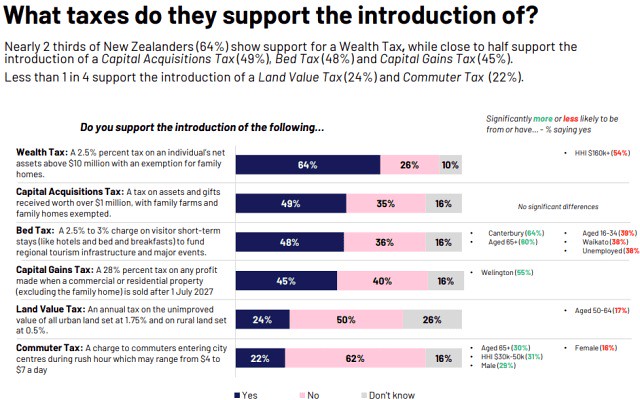
Meanwhile, while they're trying to frighten us, it turns out that the public actually supports these taxes. And they support a wealth tax more than they support Labour's least-they-could-possibly-do, protect the rich CGT:

4JHS6RG_Ipsos_Issues_Monitor_September_20206_tax

[Image stolen from Ipsos Issues Monitor, via RNZ]

Note that this is asking about the specific policy proposals of the various parties, rather than vague propositions. So 64% of those polled explicitly support the Greens' proposed wealth tax. I guess they recognise what the problem is - the rich - and won't accept half-measures. Which includes TOP's land tax, because it explicitly excludes financial capital, while also taxing the urban rich at lower rates than the rest of us (and fuck that).

Labour and the Greens should be taking heart from this. Despite all National's scaremongering, people recognise very well that the only people negatively affected by taxing the rich will be... the rich. Which is why they and their paid stooges are screaming so loudly. As for the rest of us, it means a better life. Taxing the rich is a popular policy, and the left parties should push on it as hard as they can.

Wednesday, September 23, 2026

Good riddance to LNG

Back in February, in an effort to keep gas prices (and gas retailer profits) high, National announced a mad plan for an LNG import terminal, to be fast-tracked by a special law, with contracts signed before the election. It was a stupid plan, locking us into high-cost, highly vulnerable, highly polluting energy for decades, right when we are on the verge of eradicating it from our local energy mix. Fortunately, it now looks like its just not going to happen, with both of National's coalition partners vetoing the idea:
The Government’s hopes of signing a contract for an LNG terminal before the election appear in tatters after NZ First leader Winston Peters revealed Cabinet “decided not make a decision today” and the ACT Party voiced objections.

ACT leader David Seymour said the Government should leave the decision on whether to underwrite an LNG import terminal until after the election. Signing a contract before then would be “irresponsible”, he said.

NZ First deputy leader Shane Jones, who has referred to potential misgivings over a quick decision on LNG, hinted that was also NZ First’s view, but said he would leave it to Peters to make any announcement.

And hopefully that will be the end of it. When even corrupt, fossil-mad NZ First and ecocidal arsonists ACT can recognise its a stupid idea (in addition to every other party along the political spectrum bar National), then its a strong suggestion that it really is stupid. And hopefully after the election we'll have a new government which will end this stupid plan for good, and the gas industry can die a quiet death.

Submit!

Last week the regime introduced three anti-Tiriti bills under urgency, then rammed them through their first reading in a rare Saturday afternoon sitting to avoid public scrutiny. Those bills were sent to the Justice Committee, which has now called for submissions on them. There is no formal submissions deadline, but they encourage submissions by 1 December 2026 so they can be ready to be handled by the next Parliament. Submissions can be made on the form linked above, or by post (free!) to:
Justice Committee Secretariat
Justice Committee
Parliament Buildings
Wellington
The committee is handling all three bills as a group due to their closely related subject matter. If you're looking for things to say (beyond that they are a racist pile of shit and a horrific breach of Te Tiriti which will cause a generational delegitimisation of Parliament and the New Zealand state), they have been denounced by both the Waitangi Tribunal and Human Rights Commission. In terms of the committee's proposed new mandate to focus on producing "high-quality legislation", I suggest that is impossible. The only way to ensure high-quality legislation is not to pass them.

And if parliament complains again about getting "too many" submissions, I'd suggest that if Parliament keeps trolling the public like this, they can hardly complain when the public responds in kind. If they want fewer submissions, and less heat in their committees, maybe they should stop doing that, and just be less shit.

Tuesday, September 22, 2026

The Landlord Party

When National introduced its landlord tax-break, Labour's Barbara Edmonds called it a waste of money which would blow the government's books. Then-CTU economist and now Labour candidate Craig Renney was even harsher, pointing out how it would subsidise a handful of mega-landlords by over a million dollars each, funnelling public money into the pockets of the few. But now both of them are going to have to eat those words and pretend they never said them, as Chris Hipkins has decided that actually he wants to subsidise landlords after all:
Labour leader Chris Hipkins has ruled out any changes to interest deductibility settings for landlords, if elected.

The coalition government in 2024 reinstated landlords' ability to claim tax deductions for interest on residential investment properties.

Opposition parties decried the government prioritising "tax cuts for landlords" which cost around $2.8 billion over four years.

But Hipkins on Monday confirmed Labour would not change the policy, because it was committed to a capital gains tax instead.

Which is just another demonstration of Labour's cowardice, its pandering to the rich, and its unwillingness to actually change anything (at least, nothing that upsets anyone important; they'll gladly throw the rest of us under the first bus which comes along). Its also an example of their complete hypocrisy: this was a terrible policy just two years ago, now its suddenly great. Actual policy merit doesn't seem to come into it - just whatever reckons Chris has this week in his desperate effort not to offend his mates in the koru lounge.

Who does this policy appeal to? People on $309,000 plus slush who just got us to buy them another house. Who gets fucked by it? Everybody who wants public services. The problem for Labour is that there aren't a lot of people in the first category, and a fuck of a lot more in the second. Once upon a time the party knew that. Once upon a time it didn't need to even do the calculation, because it knew what it stood for. But it doesn't now, and as a result its pandering to the rich while trying to call itself a "labour" party. Maybe it should rebrand itself as "Landlord" instead.

Fundamentally, voters can't trust a party with no values. And if Labour drives even more voters leftwards or makes them give up voting entirely with this, then it can hardly whinge about the consequences.

Monday, September 21, 2026

Ignoring the elephant in the House

The Standing Orders Committee has finally reported back on the Review of Standing Orders 2026, proposing amendments to parliament's rules for the next term. In a term dominated by the constant abuse of urgency and related anti-democratic efforts to restrict public participation, people really only had one question about this review: what would it do to curb these abuses? The committee's response? Nothing. And fuck us for asking.

I'm serious. What people wanted was checks and balances to limit the use of urgency - a supermajority, a requirement that there be an actual state of national emergency to justify interference with the normal democratic process, or something similar. Some rules so that the government of the day couldn't just say "fuck you, urgency!" and ram through hugely controversial legislation overnight without scrutiny, or steamroll it over exhausted MPs at the end of a week of midnight sittings. The committee refused to consider any of that. The furtherest they will go is a default rule that a bill go to select committee after first reading, unless the member responsible moves that it go immediately to second reading, in which case there's a requirement that they "inform the House with some particularity of the reason why the omission of select committee consideration is warranted." And there's a similar requirement where select committee consideration periods are shortened.

Such a requirement already applies to urgency itself, and the record abuse of urgency this term is absolute proof of its ineffectiveness. But that's the sort of shit you get from a legislature which began as a rubberstamp for a hereditary tyranny. Unfortunately for them, some of us would like them to grow out of that and be something more.

Parliamentary apologists will no doubt point at the rest of the chapter on legislative procedures, the proposed new Legislative Scrutiny Committee and rules to allow various sorts of technical bills and revisions of the statute book to go much faster. But this is just missing the point. Because urgency overwhelmingly isn't used for those sorts of bills (if it was, it would be far less controversial). Instead, urgency is used to introduce hugely controversial legislation in secret; to ram it through quickly to prevent opposition; to shove it through its final stages again to limit the window when it is in the news. It is not used because there is any sort of "crisis" or (non-self-inflicted) time-limit - it is being used as a political management strategy by an anti-democratic regime.

Parliament claims to be the centre of our democracy. It cannot credibly make that claim so long as it retains this tyranny at its heart. Its refusal to deal with this problem further erodes its legitimacy and social licence and strengthens the perception that it is an undemocratic, out-of-touch institution, now actively ignoring the people it claims to represent.

But urgency isn't the committee's only area of failure. They've also dismissed calls to limit the use of discriminatory and unparliamentary language, saying that that's up to the Speaker. The constant racism from the regime benches, the questioning of MPs' citizenship or right to be there by racist Ministers, that's all OK apparently. Certainly nothing the House should take a stand on. As opposed to overdeclarations of pecuniary interests by MPs wanting to set a good example by being transparent, which must be stomped on lest anyone be forced to follow suit or be publicly shamed if they do not. Similarly, they view the record number of submissions this term (due to troll legislation and an increasingly active and engaged public) as a problem, rather than a positive development (the engagement, not the trolling), and so propose ways of dismissing or ignoring submissions which - in the eyes of the political class - are not focused on producing "high-quality legislation". Which also means that when the regime says "people will get to have their say at select committee" - something it does whenever it has refused to consult before legislating - it will be a lie. The regime might not care about that - they're anti-democratic scum - but you'd think that an institution which purports to be representative and to provide the people with a voice might. But it seems parliament doesn't care about that either. Instead, they're interested in insulating the political class as much as possible from what people think.

Parliament has failed here. And by failing so publicly and arrogantly, they have reduced their legitimacy, their social licence, their mana. The public deserved much more than a "fuck you" in response to our concerns about the erosion of democracy. And Parliament will have only itself to blame if we start saying "fuck you" right back at them.

Friday, September 18, 2026

Using austerity to attack democracy III

Back in June I posted about the regime's efforts to use "high costs" to limit the public's right to freedom of information, via a consultant's report which claimed that handling OIA requests costs $185 million a year. The numbers were bogus, of course - based on an Australian estimate, which is four time higher than the actual measured cost of handling requests at police - but of course Ministry of Justice's fancy consultants haven't corrected that in their followup report. Instead, they've doubled down, claiming that the true costs are two to three times higher than their initial estimate. Like I said, you hire consultants to deliver the answers you want, and TBL has just handed Goldsmith a huge number - half a billion dollars! - with which to attack our democracy.

Ministry of Justice's proposed response to this is all about weakening the OIA: limiting the definition of "official information" and the agencies covered; expanding withholding grounds; increasing charges; more refusals for "substantial collation and research"; giving agencies the ability to declare requesters (rather than specific requests) "vexatious”. Plus of course their regular demands like impunity for government doxxing. Most of which misses the point. Because while the consultants report does talk about repeated and complex requests as one cost driver, the overwhelming thrust is that the reason the OIA costs so much is that public sector agencies are just a bit shit. Some examples:

  • Most agencies are terrible at information management, meaning they can't find anything and have to talk to subject matter experts, which takes a lot of time and distracts them from doing other things;
  • Staff training is "highly variable" and documentation of OIA policies is often poor, meaning everything takes longer and costs more than it needs to, and wheels are constantly reinvented;
  • Workflow management is mostly manual, which means poor coordination and tracking (unmentioned: requests falling through the cracks or being delayed because someone is sick or has gone on holiday);
  • Risk-aversion, review, and executive-level sign off adds more expense and delay. The report frames this as wanting to avoid the time and expense of complaints to the Ombudsman (which agencies should be wanting to avoid, by making clearly lawful decisions), but a huge amount of it is just political arse-covering.

Tackling that stuff, through systematised training, common workflow and tracking software, and improvement of information management would go a long way towards lowering overall costs. But that would all cost money up front. And unfortunately the regime seems to be moving in the opposite direction, with planned cuts at the National Archives likely to lead to worse information management across the public sector.

There are some other useful suggestions - increased proactive release, assessing OIA withholding grounds when documents are created (allowing staff to assess risk early and not use as much SME time), standard legislated pathways for release of common types of information, greater resourcing. But you know that this government at least is going to ignore those suggestions. Instead, they'll be focusing on Ministry of Justice's proposals to limit the OIA rather than actually improve things. Still, at least the really radical ideas, like requiring RealMe to make a request, or ongoing tracking and surveillance of requesters (sorry, "systemic requester profiling") so they can be refused, didn't make it into the advice to the Minister. Meaning they'll probably be popped in at the committee stage of any resulting legislation in order to avoid consultation and scrutiny.

There will supposedly be "consultation" on any changes - brief, and after Cabinet has made its decisions, of course. But the entire process will be managed by Ministry of Justice. This is inappropriate. The OIA is constitutional legislation. It was drafted by a full government inquiry (the Danks Committee). Reviews have typically been conducted by neutral, independent bodies - the Law Commission in 1997 and 2012, and the Ombudsman in 2015 and 2019. By contrast, a Ministry is both institutionally captured, and the servant of the government of the day - a body totally inappropriate to be considering changes of this scope to constitutional law. If the government wants to fuck around with the fundamentals of transparency - the definition of "official information", the scope of the Act, withholding and refusal grounds - or tilt the playing field towards charging and providing less information - then that is something which needs an independent eye. The regime's indicated "reforms" and proposed pathway is a recipe for deceased social licence and trust in government - the very opposite of what transparency legislation is meant to do.

Wednesday, September 16, 2026

More tyrannical over-reach from Parliament

Two weeks ago The Post's Tom Hunt published a story about the select committee inquiry into FENZ, which apparently found that the FENZ board is dysfunctional and should be replaced. There is a related followup today, about its disastrous firetruck purchase, which was (weirdly) done without an open tender. Both stories relied upon material leaked from the Governance and Administration Committee's inquiry into FENZ (which released its report today).

Parliament's Standing Orders claim that select committee reports are confidential until publication, and that breaching this confidentiality is a breach of privilege. The committee's deputy chair, Tim Costley, complained to the Speaker about this, and Gerry Brownlee has obligingly referred it to Parliament's kangaroo court:

Speaker Gerry Brownlee has referred a report in The Post to the Privileges Committee.

The high-powered Parliamentary committee has the power to censure members of the public and could bar The Post’s political team from entering Parliament.

The story in question referred to a leaked select committee report about Fire and Emergency New Zealand (FENZ). It was not written by a member of The Post’s Parliamentary press gallery team.

The latter is important. In similar cases in the past, the journalists responsible have been members of the press gallery, and so the Privileges Committee has referred them to the gallery, which has suspended or demoted them for breaching their (parliament-imposed) rule that members must obey Parliament's standing orders. But no such lever is available here. So Parliament is claiming a right to punish random journalists for reporting on matters of clear public interest, simply because the reporting was "too soon" for the politicians' taste. Which is simply tyrannical bullshit. Even more so when you remember that the Privileges Committee is a partisan kangaroo court, whose procedures and biases would be laughed out of court were it ever able to be subjected to proper judicial oversight.

Tyranny from the Speaker and parliamentary institutions has been an unpleasant theme this term. We've had threats to use the Privileges Committee to imprison without charge or trial (which fortunately resulted in the purported power to imprison being removed); an outright Parliamentary lynching of Te Pāti Māori MPs for too effectively representing their constituents; and an utterly lawless Speaker applying the rules in a nakedly biased, partisan, and sexist manner. This is just the latest in a long line of abuse. But where previously the abuse has been confined to MPs, or members of the wider parliamentary community, here they're targeting someone with no connection to the institution at all, before a partisan kangaroo court.

This tyranny cannot be tolerated. Our over-mighty parliament needs to be brought under control, because it is currently a threat to our democracy. As for the solution, a good start would be repealing the 350 year old law which gives them their impunity, and bringing them under the oversight of some neutral adults - the courts.

The Overton window shifts...

Just ten days ago the Greens promised to smash the supermarket duopoly, forcibly breaking up Foodstuffs and (foreign-owned) Woolworths and nationalising part of each to form a state-owned KiwiMart. It may have been a bit tricky to implement (because Foodstuffs is an owner-cooperative), but it clearly caught public imagination. Because today National has been forced to announce that they, too, support smashing the supermarket duopoly, though only after a review, and only by forcibly splitting it up:
National has made a supermarket break-up a key part of its election pitch, proposing to sever Pak'nSave from New World in a bid to drive down grocery prices.

The shake-up would be contingent on a six-month review by the Commerce Commission into whether the split would actually leave shoppers better off.

If the watchdog gave it the green light, National said it would legislate to force through the separation.

The policy is heavily caveated - how many propertarian weirdos and supermarket execs has National appointed to the Commerce Commission? - and clearly subject to a veto by ACT (which they have reliably delivered), so its arguably an insincere PR exercise aimed at providing the appearance of support for change without any substance. But even that is a huge victory. The fact that the party of protecting established economic interests has been forced to publicly support the breakup of one of the most established economic interests in the country shows how far the public mood has shifted, and how desperate National are to avoid being on the wrong side of that shift.

So what about Labour? They've been silent about our cartel problem, and their response to National has been to get pissy about it. Which makes me suspect National has "stolen" their carefully caveated, multiple-outs, aimed at preserving the status quo policy, meaning they'll have to go back to the focus groups and get another one because they have no values or principles to guide them and they can't just agree with National. (They have announced an anti-price-gouging law, but that is only part of a solution, addressing the symptoms while ignoring the cartels in the room). Hopefully Labour's eventual policy - if they manage to get one before the election - will be stronger. But it would not surprise me if they failed to take advantage of the huge opportunity this represents, because it would mean change, and that apparently is what Labour now exists to prevent.

As for the Greens, getting National to support decartelization is a huge victory for them, and a huge victory for their theory of political change (use policy announcements to change the conversation and the political landscape, forcing policy to shift closer to Green outcomes as a result). They've shifted the Overton window such that the status quo of cartels is no longer politically acceptable. The other parties (especially Labour) now have to respond to that.

Tuesday, September 15, 2026

This isn't accountability

Less than a year ago nearly-Police Commissioner Jevon McSkimming was convicted of possession of child sexual abuse material. In the aftermath of the prosecution, the police began auditing police computer use to see who else among them might be a child pornographer. That review has now found 21 police officers looking at things which are illegal or breach police policy. But we're not allowed to know what, if anything, the police did about it:
The review identified 21 employees who had used the police network or police-issued mobile devices to conduct searches containing terms that could indicate access to pornography or other concerning material, the Independent Police Conduct Authority (IPCA) said on Tuesday.

Four cases were considered serious enough to require separate investigations, which remain ongoing under IPCA oversight.

Investigations into the other 17 employees have now concluded.

[...]

The IPCA did not disclose how many employees were dismissed or detail the sanctions imposed, but said it agreed with the outcome reached in each of the 17 cases.

Knowing what happened, so we can judge whether it is sufficient or inadequate, is the absolute basic of accountability. But when it comes to the police, we are denied that. The police won't tell anyone, calling it a "confidential employment process". Neither will the IPCA. And if you try and OIA the details, the police will refuse, and the Ombudsman will back them, and say that the IPCA's report fulfils the public interest in accountability. Which is simply bullshit. We have no idea what happened here. All we know is that a bunch of boys in blue say everything is OK, and a bunch of ex-boys in blue say "yeah mate, you can trust them".

I've previously called the IPCA a fraud on the New Zealand public. I see no reason here to change that conclusion. They're not providing accountability here; instead they're just colluding in a cover up for an institution which is rotten to the core.

A regime of trolls

Its 53 days until the election, and Parliament is in its last sitting block desperately trying to pass the last of the regime's agenda before it rises. So naturally, the regime has chosen this moment to troll the country with its latest racist pile of shit:
A contentious bill to repeal references to the principles of the Treaty of Waitangi in laws has been introduced to Parliament today.

The highly anticipated policy, baked into New Zealand First’s coalition agreement with National, proposes reviewing references to the Treaty of Waitangi in 19 pieces of legislation.

Parliament will begin its last sitting block before the election tomorrow.

It is expected to use urgency and extended sitting with bills likely to be debated into the weekend. It is unclear when this bill will be debated.

Except its three separate bills - one to delete references, one to amend them, and one to standardise (weaken) them. Which means if they want to send them to first reading its three hours of debate rather than just one. And all so a gaggle of racist parties can troll the people of Aotearoa and show off how racist they are.

But I'm not sure the regime will want to send them to first reading - because that in turn means sending them to select committee, which means submissions, which will coincide with the election. National's previous act of trolling, its racist Treaty Principles Bill, energised the left. It activated thousands of previously uninterested people to engage with the parliamentary process, resulting in the largest number of submissions ever received on a bill. It also saw the second-largest petition in Aotearoa's history, and one of the largest protests in our history. By trolling us like this, National is inviting a similar response. And if it wants a similar protest, right at the start of the advance voting period, with a clear message to vote the racists out, then it can have it.

...which makes these bills even more of an exercise in bad faith, introduced simply to upset and annoy, but with no real intent of advancing them. Which is basically this regime in a nutshell: trolls. They're a regime of trolls. And the sooner we are rid of them, the better.

Thursday, September 10, 2026

Labour on climate change: Not quite the adult in the room

National has abolished all effective climate change policy, and is gaslighting us on the impact of that on emissions targets. National's partners are ouright arsonists and climate change deniers. So where does Labour stand? While they haven't released a full climate policy yet - better start soon? - they did make a small announcement this week, signalling a rapid ETS review to (among other things) look at how to disentangle forestry from the ETS. Good. He Pou a Rangi has been warning about this for years, and a review was in fact scheduled after the last election. National cancelled it. Since then the warnings have only strengthened, and National has kept kicking the can down the road, refusing to be an adult and fix the broken system, because that would upset established interests. The fact that they'll be able to criticise Labour for being the adult in the room is probably seen by them as a bonus - an example of how policy is driven by trolling, rather than any semblance of "responsible government".

Labour's announcement is unclear about whether the review will also consider industrial allocation - another huge distortion of the ETS, which similarly threatens to break it - but hopefully it will. Polluters have already had 18 years of subsidies, and if we want the system to actually be effective, it is long past time they ended.

Unfortunately, Labour is still refusing to be an adult over agricultural emissions, saying that pricing dirty cows was not going to be a default, and that instead

We think that we can work with farmers to do that without putting a price on methane emissions.
Which invites the obvious question: how? Because farmers have never engaged in good faith on this, and every time they pretend to, they simply stab Aotearoa in the back.

Labour is, like National, wanking on about "new technology" which reduces farm emissions. But unless they have actual, concrete policy to make farmers adopt it, that technology might as well not exist, and is simply a rhetorical distraction from the horde of dirty, farting cows which are destroying the climate and not paying their way. Pricing emissions was the way of forcing adoption, either directly at the farm level, or indirectly by getting processors like Fonterra to pass it down the chain. If Labour aren't going to do that, then they will have to use direct regulation instead. And if they refuse to do either, they are simply stupid little children, and not remotely serious about our biggest policy challenge.

And on the gripping hand, both Labour's likely coalition partners want to price agricultural emissions, and its a far more significant issue for them than Labour, so Labour's preferences on this are largely irrelevant. A cynic would say they've only adopted this position so they can "reluctantly" be "forced" into doing the right thing by the Greens and/or Opportunity - a dishonest and cowardly tactic from a dishonest and cowardly party...

There's a lot more questions, of course: what are they actually going to do about the Paris liability (something else National has kicked the can down the road on so they can criticise Labour)? What will they do about EVs? Coal? National's bullshit LNG terminal and the gas industry in general? Will they restore the clean car rebate and the GIDI scheme? Will they listen to He Pou a Rangi and strengthen targets? Hopefully there'll be answers to all of this before the election. But given their position on agriculture, I'm not sure they've going to be entirely adult about it.

Tuesday, September 08, 2026

Luxon is gaslighting us on climate change

Our CEO Prime Minister is very big on self-written KPIs, and has produced his usual quarterly bullshit report before the election. Given the state of things, this one quite rightly shows he's failing to meet his targets for employment, education, and health. In fact, the only targets he claims that he is meeting are those for crime and climate change. Climate change? Really?

Luxon claims to be "on tack" to meet the first and second emissions budgets, on the basis that MfE's emissions for the period are (just) below the budgets. Those projections were last updated in January, and do not include uncertainty ranges. From the latest inventory report (p 20), the uncertainty in annual emissions is around 8.6%. So against that, claiming to "meet" a budget by 3% (EB1) or 0.7% (EB2) is simply an accounting fiction. Its probable on the numbers that we'll meet EB1, but for EB2, its around 50-50. No honest person would claim that we are going to meet that target.

But don't take it from me. The official judge of whether we are meeting our targets is He Pou a Rangi, the Climate Commission. They produced an annual monitoring report on exactly this question, assessing progress towards our budgets and longer-term targets and assessing whether current policies are sufficient or not. What did they say about the targets in their latest one?

The first emissions budget is likely to be met

Projections show net emissions in the first emissions budget period are expected to be 282.3 MtCO2e against the budget of 290 MtCO2e, an overachievement of 7.7 MtCO2e (see Figure 2.4). This will be formally assessed in the end of budget report in 2027.

However, that came with a caveat that He Pou a Rangi had recommended that the budget be revised to 283 million tons due to methodological changes in how emissions are measured - a recommendation the regime had not just rejected, but legislated to make it impossible for any future government to accept. So what about EB2?
The second emissions budget is at significant risk and that risk has increased in the last year (Figures 2.5 and 2.6). Our 2025 report largely showed moderate risks. This is mostly from increased risks around electricity generation, agriculture and passenger transport.
And later:
Although the Government’s projections indicate the second emissions budget (305 MtCO2e) is likely to be met, the available buffer is smaller than the emissions reductions that are at risk. The budget should therefore still be regarded as at risk. The central estimate (the figure Government modelling expects to happen) of 301.4 MtCO2e in 2030 is 3.6 MtCO2e below the budget (Figure 2.7). Our assessment shows 12.4 MtCO2e of the planned emissions reductions are at significant risk. The high estimate would exceed the budget by 21.7 MtCO2e (Table 2.3).
Basically, a bunch of the emissions reductions the regime is relying on to meet the budget, in agriculture, energy, transport, and industry, are far less likely to happen due to policy changes (such as, oh, abolishing GIDI and the Clean Car Standard, or cancelling the gas phase-out and agricultural emissions pricing), while the regime is also pursuing explicit emissions increases via an LNG terminal and offshore gas drilling. And the expected impact of these policy changes is three times higher than the tiny margin the regime expects to meet the budget by. Again, no honest person would call that "on track". Luxon's claims to be meeting these targets are pure gaslighting.

The reality is simple: if we want to meet our emissions budgets, we need actual policy to do it. We won't get that policy from National, or its arsonist partners. If we want to save ourselves, we need regime change.

Monday, September 07, 2026

Time to smash the supermarkets

While Labour is reflexively cowering and refusing to release any policy, the Greens released a cost of living policy we can all get behind: breaking up the supermarket dupoly:
The Green Party is campaigning on establishing a publicly owned supermarket chain to break up the duopoly and drive down food prices.

[...]

Co-leader Chlöe Swarbrick said successive governments had failed to lure an existing chain to New Zealand to introduce competition in the sector, which is dominated by Foodstuffs and Woolworths.

"That's why today we are announcing the real solution: a supermarket owned by all New Zealanders, for all New Zealanders," she said.

"We're not short of supermarkets, we're short of competition. As experts have noted, divestment - that is, buying already existing stores - is key to breaking up the duopoly."

There are complications - one half of the duopoly (Foodstuffs) is a cooperative, so Foodstuffs doesn't actually own those stores. But that's just a matter of legislative language. The key is legislating them out of the cooperative and into a viable competitor, while also stopping the fragments from reuniting into a duopoly again. And while it would undoubtedly be cheaper to simply force the split, and hope some foreign chain buys in to provide competition, their demonstrated reluctance counts against it, and even if they did they could just sell up again and leave us right back where we started. Nationalisation gives us protection against that. It gives us control, allowing us to set policy direction (not just on competing on price, but also on employment standards). Another foreign-owned chain won't do that. Meanwhile the government buying an asset doesn't cost anything in a budget sense - it simply moves money from one column (cash) to another (assets), with no change in the overall balance.

And forced divestment and nationalisation is clearly necessary. Because despite all the status quo parties' pleading, the market is clearly not going to provide, and the current situation (where the duopoly makes a million dollars in excess profits a day, money which could be in our pockets rather than theirs) is clearly unsustainable. We can no longer afford to allow these tyrants to gouge us. Time to smash their cosy cartel and get some real competition. And while we're at it, do the electricity companies, the fuel retailers, and the banks.

Wednesday, September 02, 2026

Finally

Methanex is one of Aotearoa's biggest and least efficient polluters, burning 37% of our entire natural gas supply to produce a few hundred thousand tons of methanol, a low-value commodity. Meanwhile, they cheat on their taxes. And weirdly, we pay them to do this, with enormous pollution subsidies underwriting their local profits.

But now, finally, the scam is coming to an end. Having written the value of their local business down to zero earlier in the year, they have finally announced they are shutting down:

Methanol producer and major gas user Methanex says it will sell its New Zealand gas entitlements and “indefinitely idle” its plant in Taranaki after 40 years of operation.

Methanex said it had struck a deal to sell substantially all of its New Zealand natural gas contractual entitlements, starting in the first quarter of 2027 and continuing through to the end of the decade when the entitlements expire.

The company employs about 160 people in New Zealand.

And good fucking riddance to them. They were a foreign parasite who stole our natural resources and destroyed our environment for private profit. Now we can use the gas they consume for something else (like keeping the lights on in a dry year) - or if we're lucky, not use it at all.

It also destroys any case for National's corrupt boondoggle LNG plant. The electricity system doesn't need the gas anymore because they've just got Methanex's supply. Hopefully National will scrap their stupid plan immediately, rather than forcing the next government to go to the effort of legislatively cancelling any contract they purport to sign.

Member's Day

Today is a Member's Day, and probably (this time!) the last one of the parliamentary term. First up there is a pair of private bills: the Ōtautahi Community Housing Trust (Trust Variation) Bill and the Trust Horizon (Trust Variation) Bill. The committee stage and third readings of these bills has been combined for speed by agreement, so I'm expecting them to whizz through. Following that is the third reading of Shane Reti's (now renamed) Maritime Transport (Lifejackets on Recreational Craft) Amendment Bill. The House will probably make it to the second reading of Laura McClure's Employment Relations (Termination of Employment by Agreement) Amendment Bill (more radical ACT bullshit), and if it moves very quickly it might make a start on Lan Pham's Crown Minerals (Prohibition on Mining on Conservation Land) Amendment Bill. If that happens there'll be a ballot for one bill tomorrow.

While the last week on the sitting calendar should include a member's day, I expect there to be urgency somewhere along the line to disrupt it. So this is probably it for the term, unless National and Labour really want to vote down that mining ban bill.

Tuesday, September 01, 2026

Labour in a nutshell

In February 2024 the racist regime breached te Tiriti o Waitangi by disestablishing Te Aka Whai Ora, the Māori Health Authority. The agency had been established in response to a previous Waitangi Tribunal inquiry into pervasive racial inequalities in the health system, effectively making it part of a Treaty settlement, so the regime broke that as well.

At the time the Labour party promised they would reverse this, and re-establish the authority. But now they've changed their minds and won't bother. Why not? Because National might just disestablish it again.

This is Labour in a nutshell: pure chickenshittery. Refusing to do anything that National might object to effectively surrenders in advance to the far-right. So what's the point in them holding power if they're not going to actually do anything with it? Its obviously great for the pyramid-climbing Labour apparatchiks who will get huge Ministerial salaries and free housing and transport for doing nothing. But what's in it for the rest of us? Absolutely nothing.

A party which pre-emptively commits to not changing anything, even when it is a blatant injustice and violation of our constitutional foundations is not worth your vote. It is that simple. If you want change, vote for a party which will actually deliver it. In this case, that means voting Green or Te Pāti Māori.

Is petitioning parliament effective?

Aotearoa is ostensibly a democracy, and in a democracy there is a spectrum of methods you can use to register discontent, from writing letters to the media or starting a blog, to organising protests to occupations to civil disobedience to smashing and burning stuff. One of the tactics pushed by politically institutionalised people is petitioning parliament. But is it effective?

In the past, Parliament would take your petition, and assign it to the most relevant select committee, who would basically ignore it, before producing a three-line "report" where they said they had "no issues to bring to the attention of the House". But one of the major reforms of the current parliament was to introduce a specialist Petitions Committee, whose job was basically to hear these things. And as a result, petitions are more likely to actually get looked at. While some are still quickly dismissed, petitioners are more likely to at least be asked to give evidence on their petitions, and agencies and other groups are more likely to give a response, which the committee weighs. And the committee is more likely to make formal recommendations, which the government has to respond to. Sometimes, the government just says "go fuck yourself" in its usual, evidence-free way. But usually their response at least looks like they're taking the issue seriously, and promises action of some sort at some stage in the future.

So how does that work out? Unlike the old system, the Petitions Committee actually does followup, reviewing the government's actions against what it promised. Their latest report on this was released yesterday, and its dismal. Of 9 petitions reviewed, the government had failed to keep its promises on 5 of them:

  • A 2024 petition to limit light pollution resulted in recommendations to immediately develop national guidelines on the matter. The government responded that it wasn't going to do that, but that MfE and MBIE were investigating how to gain accreditation as a "dark sky" nation. But it turns out they hadn't done anything beyond sending an initial letter - a perfect example of how agencies inflate what they're doing to prevent action.
  • In 2025 the committee recommended that MPI the use of shock collars on dogs. The government said it would do this as part of a review that the National Animal Welfare Advisory Committee was doing at the time. Associate Agriculture Minister Andrew Hoggard then killed that work in favour of changing animal welfare codes for livestock instead. MPI promises that it will be done "as soon as the NAWAC work programme allows", but that doesn't appear to be any time soon.
  • Around the same time, the committee made a similar recommendation to review the use of "virtual fencing" for cattle. MPI said that the relevant animal welfare code was being reviewed (see above). They then promised it would be released in 2026. It hasn't been yet.
  • In 2025 the committee recommended the the government prioritise a survey and risk assessment of the RMS Niagara - a major environmental disaster waiting to happen. The government promised it would "continue to monitor the situation", but didn't fund any actual monitoring, so none happened. Presumably, their plan is to simply read the news to find out when oil starts washing up on Auckland's beaches.
  • In 2025 the committee recommended the government review gambling advertising. The government said it would, then folded that work into existing work on online gambling. So advertising for online gambling was regulated, but not advertising for offline gambling. Another example of how the public service avoids work, pretending existing work is what is wanted, rather than actually looking at the request.

In addition, there are two followup reports on earlier petitions, which outline continued non-compliance by the government. So that's 7/11 failures.

The overall conclusion has to be that petitioning parliament is not effective. While things are better than they used to be, when the petitions committee makes recommendations, they are overwhelmingly either rejected or ignored. But at least we know this now - under the previous system there was no followup (because committees had too much other stuff to do and did not regard petitions as a priority), and so no feedback.

As for what can be done about it, I think the petitions committee needs to be more aggressive about policing its recommendations, and start summoning Ministers and officials to question them about their implementation (or non-implementation). Because both clearly hold the petitions system, petitioners, and parliament in contempt, and the latter is something parliament can not afford to tolerate.

As for those considering a petition, looking at this record, I'd suggest not wasting your time. Politely asking power to be nice and reasonable does not work. The only value in a petition is to highlight an issue to build support for less polite action.

Monday, August 31, 2026

Empty, entitled, arrogant, and exploitative

Another day, another piece about the problems of Labour's "small target" strategy. Today its The Spinoff's Joel MacManus, who argues that Chris Hipkins is batting for a draw. Stripped of the sporting metaphor, the basic argument is that Hipkins has "been so focused on negating the case against Labour that he never built a cohesive argument for Labour." His popularity has declined since he was defeated in 2023 because he's been too afraid to say why he should be in charge. And rather than fighting to win the election, Labour is relying on its prospective coalition partners to win it for them - which is going to create problems:
With Labour batting for the draw, the responsibility of playing for the win (and proposing an actual alternative policy suite) has fallen to its potential coalition partners. Opportunity has been picking up disaffected National voters in recent polling, the Greens are rallying progressives, and Te Pāti Māori’s overhang strategy is tilting the maths in the left bloc’s favour. Labour is just…. there.

[...]

If the left bloc manages to form a government after this election, it will be because Hipkins played a heroically disciplined innings. Labour could snatch a draw from the jaws of defeat. But that may be all it is – a draw. When you take the reins of government without any plan for what you’ll do, is that really a victory at all?

So, basically what happened in the UK with Keir Starmer.

But the UK had FPP and we have MMP, which means any future Labour-led government will be a coalition. McManus (like Daalder before him) points out that Labour "could end up in the same trap as National, with minor coalition parties setting the agenda because they’re the only ones who have one." Labour of course will try and deny this, and are already purporting to veto their partners policies. Which, from a party which is bringing no policies of its own to a coalition, which refuses to fight for victory, and is effectively demanding other parties win the election for them and put them in power, shows a certain level of entitlement and arrogance.

In fact, once you start looking at it like that, it leads to some unpleasant conclusions. Labour is demanding that its potential coalition partners do all the hard work in the election. Claiming the right to set and veto policy is effectively claiming all the profit from that work, while denying the people who did it the fruits of their labour. Which is exactly the sort of exploitative relationship the "labour" party was founded to destroy.

Friday, August 28, 2026

Whining at an open door

Ten weeks till the election, and Labour is in full pre-election cringe mode. They're so afraid of being seen to stand for something, let alone something that Rimmer might consider "left-wing", that they're ruling out policies in advance. Paying for our roads. Paying for local government. Restoring fees-free tertiary education. Shanking Netflix. Notably, they've ruled out all their potential coalition partners' tax plans - the Greens' wealth tax, TOP's land tax, and Te Pāti Māori's stamp duty on house speculators - which raises the question of how they expect to form a government while offering their coalition partners nothing. And meanwhile, while they're doing all of this cringing and cowering from the word "tax", it turns out that the public will happily support higher taxes for better public services:
A survey of 1600 people has found two-thirds of New Zealanders are willing to pay more tax for better healthcare - particularly when it comes to cancer.

The survey, funded by the Cancer Society and published as a nine-paper series in the New Zealand Medical Journal, also found consensus across voters for all major parties about the need for tougher regulation on tobacco and unhealthy foods, and more urgent action on skin cancer prevention, cancer screening and treatment.

A collaboration between University of Otago cancer researchers and the Cancer Society, called Te Rōpu Rangahau ō te Kāhui Matepukupuku, undertook the study.

This is not exactly a new finding. And it suggests a very obvious political slogan of "tax the rich to pay for the health system". But Labour has so afraid of being accused of "taxing and spending" (as opposed to National spending without taxing) that they refuse to take the opportunity which is staring them in the face. They're simply standing in front of an open door leading to government, refusing to take it, while whining about how they can't get inside. And then they wonder why they're stuck on 30%. I'd suggest that part of the reason is that and Labour is not giving people any reason to vote for them. More brutally, no-one likes a chickenshit. And as Marc Daalder points out, their "small target" strategy effectively leaves the entire political field free for other parties willing to make promises and take risks. Labour has only itself to blame if its cowardice results in it being overtaken by parties actually willing to offer something.

Wednesday, August 26, 2026

So when is he resigning?

Today, the Privileges Committee found that MBIE chief executive Nic Blakeley and former Deputy Secretary of Immigration Alison McDonald deliberately misled Parliament, by knowingly withholding information from a select committee conducting a review of ImmigrationNZ. Which invites the obvious question: when is Blakeley resigning?

As the committee noted in its report,

officials appearing before select committees have an absolute obligation to tell the truth. Being truthful, responsible, and acting in good faith is the very essence of public service. To fail to meet these obligations is an insult to the entire public service.
Public servants lying to Parliament fundamentally undermines Parliament's ability to perform its function of scrutinising the executive and holding it to account for its expenditure of public funds. It is fundamentally incompatible with both the values of the public service, and our constitutional system of government. It is simply untenable for a public servant who has been found to have deliberately misled Parliament to remain in their position. So, again: when is he resigning? And if he's not going to, when will the Public Service Commissioner fire him? Or are we going to be treated to another public spectacle of elite impunity, which will further degrade both our democracy and our public service?

Update: So, Blakeley offered his resignation, both to the Public Service Commissioner when the matter first arose, and today to the Minister. Both refused. I guess if they allowed him to do the proper thing, then people might expect them to do the same in the future, and they can't be having that. So instead, we get impunity.

Tuesday, August 25, 2026

Bankrupting local government

Local government in Aotearoa is in a crisis. For decades, Boomers have voted to Keep Rates Low, running the infrastructure paid for by previous generations into the ground, while refusing to invest in more (or even repairing what they have). The bill for that is coming due in all sorts of ways - shit on the streets in Wellington, a lethal campylobacter crisis in Hastings, no money to maintain council housing. So rates are going to have to go up. But Boomers still don't want to pay. So National's solution is simply to outlaw rates increases.

I'm struggling to describe the stupidity of this. Rates pay for things. Things we actually need. And those things get more expensive with time, thanks to inflation and population growth. Meanwhile, central government keeps loading costs on councils, with demands for roads, fast-track projects with no infrastructure support, and the never-ending cycle of vetoing and over-riding planning documents, wasting millions of dollars in planning and consultation costs. And now the regime plans to effectively forbid local councils from keeping up with that. Which means declining council services - roads, rubbish, sewage, social housing, parks, libraries - and of course nothing new unless something is cut. It is a recipe for stagnation and decline, central government sabotaging local government, preventing it from meeting its statutory obligations to its people.

As for the "why", apart from the obvious one of pandering to greedy, freeloading Boomers, there's another equally obvious underlying agenda: privatisation. Local councils still own stuff - ports, airports, electricity lines companies, buildings, land. Strangling them financially by diktat will force them to sell that stuff to National's donors and cronies, finally achieving the mass-looting they've been slavering for since the 1990's. And if everything has to be destroyed so the billionaires can steal what is ours, well, that's a price their collaborators in the National Party are willing to pay.

This is not a good policy for New Zealand. It is being sold on short-sighted greed, and being used to deliver public assets into private hands. We need to stop it. And the way to do that is to vote the regime out in November.

No-one wants National's internet tyranny

Yesterday the National Party introduced its bill to ban young people from social media to Parliament. While ostensibly about "protecting children", the bill in fact establishes a "papers, please" regime to use the internet, exactly like that used in tyrannies like Russia and Iran. Users will have to prove their identity to access our most common communications platform, effectively ending anonymous speech and deterring political communication, while in the process giving all our personal information to foreign privacy-raping fascists.

(Yes, I know the bill says its illegal for companies to retain identity verification information for longer than required. And if you think that means anything, against either companies whose business model is destroying privacy, or our own government, I have a bridge across Cook Strait to sell you).

The good news is that no-one is buying it. National's policy - developed by public servants at public expense - has already been disowned by its own coalition partners, who are also upset at the way it has been announced and introduced despite their opposition. The Greens have said "fuck no!". And even notoriously-chickenshit Labour has said its in no hurry to announce its position. And its not hard to see why: because in addition to the privacy nightmare highlighted above, the simple fact is that these bans don't work. Just look over the Tasman, where 80% of under-16s are still using social media despite being officially banned from it. And that's also perfectly understandable: because this is how we live our lives now. People of all ages organise their work, their education, their social lives over social media. And trying to ban them from that, from hanging out with their friends, herding cats for their local sports or cultural group, or organising politically to change the government and the world, is a recipe for widespread non-compliance and entrenched contempt for the law.

This is not to understate the harm caused from and on social media. But trying to blindfold and gag kids, while making the rest of us live in a tyrannical surveillance nightmare, is not a solution.

What might be solutions? Much of the harm is caused by social media platforms themselves, invading privacy and pushing harmful content. So outlaw those things, and make those platforms responsible! Platforms currently enjoy "third party" protection for the harmful content they push, on the basis that they're just a neutral carrier. But if they're running an algorithm which puts stuff on people's timelines, they're making editorial choices, and they can and should be held accountable for them. Or, to put it in English, if Elon Musk's Nazi site pushes the Christchurch murder video onto people's feeds, then it should be held legally responsible for that and fined into oblivion. Likewise, we can impose a duty of care on social media platforms - and Labour has a member's bill for this. Either would have a lower impact on the human rights of New Zealanders than National's internet tyranny, while being far more effective at protecting all of us. But national clearly isn't interested in "effective"; they're interested in posturing before an election. And Aotearoa deserves better than that from its supposed government.

Oh FFS! I just got this posted, and then I see Labour has decided to support National's bill to select committee, solely so National can't spend the runup to the election bashing them on this. "A shiver looking for a spine to run down" indeed.

Monday, August 24, 2026

You can't run on hope unless you actually offer some

Eleven weeks till the election, and we're now seeing daily stories about the complete collapse of the health system. Decades of austerity and underfunding and a Ministerial hiring freeze aimed at making short-term "savings" have left our hospitals unable to cope, and the usual winter flu season (something normally manageable with vaccination and a public health campaign) has pushed it over the edge. In Palmerston North, multiple key departments have simply collapsed due to lack of staff, while the emergency department - focus of all National's metrics - has wait times of up to 27 hours. In North Shore, patients are left to lie in their own piss and treated in corridors because there is no-one to care for them and no space anyway.

This is what government looks like under National: nothing works, because they simply refuse to pay for it. Why have a health system or emergency accommodation, when the Luxons can have an eighth house and another holiday in Hawaii?

Meanwhile, today Labour unveiled their election slogan: "Better Starts Now", an implicit message of hope. So obviously they'll be fixing all this, right?

Well, no. Because they've also doubled down on their commitment to austerity, promising to keep National's fiscal straitjacket which means government can't do anything, and ruling out their potential coalition partners' alternative policies. Because Hipkins and Edmonds apparently also think that the Luxons getting that eighth house and another holiday in Hawaii is more important than the rest of us having a functional health system and social safety net. The Labour Party which once promised cradle to grave protection is now politically indistinguishable from the party which destroyed that system and which wants to abandon us to the market.

And then they wonder why they're bumping around 30%. Here's a hint: because they don't offer anything. Here's another: because they lie about that. Sure, National will fuck up our lives and wreck the country even more. And with its commitment to austerity, Labour has effectively promised to do exactly the same - except they're going to tell us all that its "better" and we should all be grateful to them or else we'd be having our lives fucked up by National. And then they wonder why people spit at them and vote for parties which actually offer some real change.

Labour doesn't offer hope. They just offer more of the same, with a different bunch of managers collecting the big salaries. They're so unimaginatively status quo their leader even has the same name as the incumbent. But swapping one Chris for another isn't enough for me. I want change. And fortunately the Green Party is offering exactly that.

Friday, August 21, 2026

No way to run a country

Twenty years ago I joined a protest march over the Manawatū River. Fonterra and local farmers were using the river as a sewer, making it one of the most polluted in the western world, and people were sick of it. The march was a success: the state of the river became a serious issue in subsequent local body elections, and Horizons, the regional council was forced to act. They began a series of public consultations on cleaning up the river, and in 2010 they introduced the One Plan, which set limits for pollution, particularly nitrogen.

Basically, farmers wouldn't be allowed to shit in the river anymore, and they hated it. So they engaged in their usual tactic of predatory delay, dragging the plan through the courts on any excuse in an effort to prevent its implementation. But their appeals backfired, with the Environment Court strengthening the plan and the High Court upholding that. Even then, Horizons tried to rubberstamp pollution, until the courts stopped that as well, and made them actually enforce the law. But the Council's reliance on a tool called Overseer to calculate nitrogen loads caused further litigation, which eventually resulted in a change to the plan.

Which brings us to "Plan Change 2". It updates the nitrogen limits in the One Plan to account for Overseer's software change, and sets out pathways by which farmers who currently exceed them can get temporary consents. Like the One Plan itself, its the result of a careful process of consultation and consensus-building, and has been approved by the Environment Court. It should be becoming active any time soon. But it won't - because the regime has decide to simply overturn it by legislative fiat to protect its donors and cronies and let them keep on shitting in the river. Twenty years of democratic action and tens of millions of dollars in planning costs and legal fees gone, because one man - Andrew Hoggard - never liked the outcome, and decided to abuse his ministerial position to put his thumb on the scale, outside the normal process.

It's not just the One Plan - Hoggard will also be over-ruling Waikato Regional Council's similarly long-consulted rules to protect the Waikato, outraging Tainui (who view it as undermining their Treaty settlement). Its not just rivers - they're also stomping all over local councils who, after consulting their communities in accordance with the law, decided to use the RMA to regulate inshore fishing to mitigate its destructive effects. And it continues a trend displayed on climate change, transport, Māori representation, of the Beehive arbitrarily overturning court decisions and/or well-consulted local government decisions to impose their own views from above, without consultation or evidence, usually at the behest of some deep-pocketed industry lobby and tens of thousands of dollars in "donations". That's just how this regime operates. Its an affront to democracy, the rule of law, and local decision-making. Instead, we have arrogance, dictatorship and corruption.

This is no way to run a country. Local decision-making should mean exactly that. We can't have our lives micromanaged by Wellington, intruding into our lives and vetoing our decisions at the behest of lobbyists or their own weirdo freak ideology.

We need to overthrow this regime. Vote it out in November, prosecute those responsible for their corrupt practices and ban them from office, and reform the system so that it cannot happen again.

Thursday, August 20, 2026

An easy policy

Up until the 2023 election Aotearoa had an effective school lunch program. Kids got fed on locally-produced food, improving educational and employment outcomes. But National hated that, so they wrecked the system and replaced it with Seymour's Slop - mass-produced by the lowest-bidder (a massive foreign multinational with a shady record of course), which has burned, poisoned, or otherwise endangered students. The regime calls the programme a "success", but its only success has been in saving money by not feeding kids properly. In reality its a disaster.

Sacking the current providers, restoring funding, and going back to what we had before ought to be an easy policy for the next government. And the Greens have actually promised to do it:

The Green Party wants to bring back the school lunch programme to what it was, and then expand it to more schools.

The party says if it is part of the next government, it will also permanently fund the Ka Ora, Ka Ako programme (which was renamed Healthy School Lunches in October).

This is great to see. But it also raises the obvious question: where's Labour? Shouldn't they be promising this? Or are they too tied up in trying to appear "responsible" (NeoLiberal) and not spend money on anything other than their fellow rich people? And on the gripping hand, who cares? They can do this, or they can be in opposition. Their choice.

Monday, August 17, 2026

An urgent move to not fix anything

National's corrupt Muldoonist fast-track legislation has a problem: in addition to being corrupt and Muldoonist, it allows developers to buy approval for projects where there isn't the infrastructure to support them. For example, the recently approved Delmore development in Ōrewa, which will require wastewater to be trucked out for the forseeable future, because there's no sewage connection there. Normally councils deal with this sort of problem by charging developers a development contribution to pay for the required infrastructure - something the right absolutely hates. But fast track bypasses all that, with the result that fast-tracked developments are artificially cheap, effectively subsidised by other residents. Which in turn means other areas get starved of their infrastructure or face higher rates to pay for the costs of ministers' special projects.

To their credit, National recognises this inability to make fast track projects pay for their infrastructure is a problem. They consider it so urgent a problem that they plan to fix it with completely out-of-the-blue committee stage amendments to an unrelated local government bill. But - and here's the kicker - they won't actually fix it. According to the Beehive press release,

The amendments will not apply to fast-track developments that have already been approved or where a substantive application has already been lodged with the EPA.
So, its "urgent" enough to "justify" doing further violence to our democratic system - but not urgent enough to actually fix. I guess they wouldn't want their pet developers to feel ripped-off, that they hadn't got their money's worth from their "donations". So we get performative bullshit instead.

Meanwhile, I remember when National thought development contributions held up development and discouraged growth. I'm glad to see they've finally realised that they actually pay for necessary things rather than just being made up by councils to spite the Mighty Lords of Real Estate. I wonder when they'll realise that about taxes?

Friday, August 14, 2026

National channels Orban

Last year, at the behest of its Five Eyes "allies", the regime passed a tyrannical anti-"foreign interference" law, criminalising "improper conduct" on behalf of a "foreign power". The law effectively allows the regime to criminalise anyone based on its own fantasies and misconceptions, and would have outlawed virtually every major protest movement in Aotearoa's history. It is a horrific assault on our democracy. And the National Party thinks it didn't go far enough.

National's Tim van de Molen has introduced a new Foreign Influence Transparency Bill to the ballot. The TL;DR is that it requires "foreign agents" to register. Sounds pretty mild, right? Except that when you unpack it, its even more horrific than than the "foreign interference" law.

Who needs to register? Anyone conducting any "political influence activity that they are directed to undertake by a foreign principal". Unpacking this:

  • A "foreign principal" is a foreign government, a foreign political organisation, a foreign public enterprise, or an entity acting on their behalf. This is not the same definition as used in the "foreign interference" clauses of the Crimes Act - it is both broader and narrower, excluding some "foreign public officials" and all government-supporting companies, but including "foreign political organisations", which encompass not just governing political parties and their agencies (which are in the foreign interference law), but also
    any political party, political movement, or other organisation operating in a country or territory outside New Zealand that has as one of its primary purposes the participation in, or influence of, political processes or public office in that country or territory
    In other words, any formal or informal political group, and any NGO engaged in "politics". Which basically means everything: any non-NZ environmental, human rights, consumer rights or privacy NGO. It also covers international political groupings such as the Global Greens, Socialist International, International Democracy Union, and foreign think-tanks such as the Heritage Foundation, Institute of Economic Affairs, and the Canadian Taxpayer's Federation. The Atlas network is absolutely covered.
  • "Directed" means requests as well as instructions. It likely covers the sharing of common tactics and strategies.
  • "political influence activity" is where it really gets weird, covering not just formal lobbying, but also "communicating to the new Zealand public" about any election, bill, policy, or exercise of power; as well as "organising, coordinating, or funding any campaign, network, or activity" to mobilise individuals to lobby or protest or attend meetings, as well as collecting information to tailor activities. In the Crimes Act, there's specific protection for engaging in protest, advocacy, or dissent. Here, those things are specifically covered.

So basically any democratic activity which can be imagined to be connected to a "foreign principal" requires registration. All NZ political parties will be required to register, because they are members of international networks. So will most major NGOs. Because this is the modern world, with easy travel and the internet, and we talk to each other, share problems and tactics and what-worked-in-our-country and maybe-you-could-try-this, and that's apparently suddenly suspicious and foreign and practically seditious.

People engaged in these activities would be required to register. Failing to register or providing false or misleading information is an offence punishable by two years in jail (which is... pretty severe for an administrative offence – the same penalty for fixing an election!) There are open-ended administrative search powers, not subject to judicial oversight, to allow the registrar to investigate suspected offences. Finally, the government can designate “specified foreign powers” as posing an “enhanced risk” on very broad criteria, though this doesn’t seem to have any actual effect. Finally, every election candidate must be vetted against the register to see if they are on it, and the government must publish a gazette notice identifying them, the foreign principal, and the registrable activity. In other words, legally required state propaganda against candidates the regime doesn’t like.

Meanwhile, look at who is not covered:

  • Billionaires: they're not governments, so they can do as much lobbying, electoral manipulation, and influence-buying as they want.
  • Foreign corporations: These routinely engage in "political influence activity" in Aotearoa - witness the "grassroots" campaigns by dairy owners against tobacco regulation, or in favour of Pharmac buying the latest expensive new drug, or just the regular lobbying by the oil and gas or money laundering industries. This is all aimed at changing law or influencing the exercise of government power. But apparently its all OK because its "just business". But actual grassroots organisations - Amnesty, Greenpeace - are not.
  • Diplomatic activity: foreign governments and groups like the Five Eyes (and all its spinoffs) get to lobby us to change our intellectual property laws, our privacy laws, outlaw encryption, criminalise protest, or indeed pass laws like this. But they get to be exempt from them.

While this is a member’s bill, being put in the ballot means it has the backing of the National caucus. They are all on board with this.

If this all seems awfully familiar, its because its a basic part of the "illiberal democracy" pioneered by Victor Orban in Hungary, and indeed of Russian tyranny. Call your enemies "foreign agents". Demand they register. Use the registrar to force searches and gather intelligence. Then jail them or shut them down. And while van de Molen points to similar laws passed by "like-minded liberal democracies" such as the UK and Australia, I would instead classify them as democratic backsliders hellbent on reintroducing tyranny.

These are not countries we want to be like. If this bill is drawn, it must be rejected.

Thursday, August 13, 2026

Why I'm not voting for Opportunity

This morning one of my bleeps took one for the team and asked to be convinced not to vote for Opportunity. Like me, they're a long-time Green voter. Like me, they see Opportunity as having some attractive policies on land taxes, the environment, and Te Tiriti. And with the party now consistently polling over 5%, but not so high that we can be sure they'll make it, is it worth left voters to lend their votes to get them over the line?

It was a really useful discussion, and you should read the whole thing. If you're that interested, you should probably read Josh Drummond's take on it from last month as well. Meanwhile, here's my thoughts.

I have a lot of problems with TOP. Their origins as the vehicle for rich prick Gareth Morgan's political ideas around taxation and UBI. Their past arsehole behaviour under both Morgan and later leaders. Their undemocratic and completely top-down party structure. Their dodgy techbro funders. I also have some problems with their political philosophy - a naive-to-arrogant technocratic rationalism which fails to consider or simply does not think it is important that other people might not see their conclusions as "obvious", or might even disagree with them, and so struggles to deal with that fact. I'm somewhat sympathetic here, because you need idealists in any productive political coalition, to drive things forward - but TOP's demonstrated inability to cope when their ideas met opposition in the past (see: TOP 2017 and the Gareth Morgan / Sean Plunket shitshow) is not a good sign, and suggests a party culture problem as well.

But fundamentally, it comes down to one simple fact: I do not know these people. Not in a personal sense - I don't hang around with politicians - but in the sense that without a demonstrated track record, I do not know if they are serious about their policies, and I do not know what their values are.

As a contrast, I know the Greens. They've been in Parliament for 30 years, and around for over 50 (if you count Values, and they do). They've been demonstrating their policies and values for long enough that one any issue I can reasonably predict which way they'll go. I know what they stand for, and I know what I am voting for when I vote for them. What would I be voting for if I voted for TOP? Their candidate lineup is pretty good, a collection of public servants, environmentalists, many of whom would fit in very well in Labour or the Greens, plus some startup bros (Eww). Many of them would be an asset to parliament. Against that, they're complete political naifs, and there are a bunch of failure modes here, both in coalition talks and later, which are waiting to eat them. The collapse of NZ First in 1998 and the problems with United Future in its 2002 term are instructive here.

And then there's the big one: coalition options. Or, as we say in Aotearoa, "who are they going to go with?" TOP leader Qiulae Wong says "anyone", and if you're on the left and want to see the regime toppled, its policies repealed, and the earth salted, that is absolutely an issue. Why would I give my vote to someone who might keep the racist, tyrannical, election rigging pricks in power? Why would I risk that, when I can give it to a party who absolutely won't? So that's an absolute deal-breaker for me (and if you don't want the regime toppled, why are you reading this blog?)

So that's why I won't be voting TOP. If they get in, I'll be pleased, because there's clear potential for them to be a valuable part of the left coalition in future. But ATM they're just too uncertain, too big a risk, too untrustworthy to get my vote.
Wednesday, August 12, 2026

One Country at a time...

The Lebanese parliament has voted to abolish the death penalty:
Lebanon's parliament has voted to abolish the death penalty, a move that would make it the first country in the Middle East to formally end capital punishment.

A majority of MPs in the 128-seat parliament backed the measure on Tuesday, while Hezbollah's parliamentary bloc voted against it.

The legislation will now go to the cabinet before being passed to President Joseph Aoun for signing. The government has already expressed its support for the measure.

This would make Lebanon the first country in the Middle East to abolish the death penalty. Hopefully more will follow (Israel had abolished the death penalty for civilian crimes, but has just passed a law requiring the mandatory execution of Palestinians convicted of "terrorism" by kangaroo courts - so they're officially a murder state now as well as a genocide one).

Chris wins!

So, after a three hour emergency caucus meeting, Chris Luxon has emerged to claim that he has the National Party's full support and that his caucus is united. Which is obviously why he had to have a three hour meeting about it. Which means National will be going into the election with a historically unpopular Prime Minister - unless they change their mind about it next week.

Meanwhile Chris (the other one) will be overjoyed that the political landscape won't be shaken up after all, and he can continue trying to sleepwalk to victory. It would be nice if he actually put some effort in and tried to win, but he seems to have taken the journalists' "oppositions don't win elections; governments lose them" to heart, and interpreted it as meaning he has no agency whatsoever. Which I guess is consistent with his belief that politicians have no agency over the public either, and can't change hearts and minds - but its awfully disappointing tot he rest of us. And it invites serious questions about why we pay him so much - $309,000 plus rorts and slush - to basically do nothing.

As for Chris and Chris, I guess they'll be hoping for a National loss. Otherwise, they probably don't have a place in the post-election Cabinet. Oh dear. How sad.

Tuesday, August 11, 2026

Shaking it up?

Its 88 days until the election, and I had been planning to post about how the electoral landscape is becoming a little clearer. While the polls are statistically tied (still, with this regime, what the fuck are you doing Chris?), Opportunity is increasingly polling above the threshold, meaning they'll be in Parliament and no coalition seems possible without them. Meanwhile Luxon ruling them out basicly means he won't be in government, while Hipkins finally ruling out NZ First removes the big fear on the left: that Labour will once again choose a far-right coalition partner who will proceed to veto its policies, rather than the party which shares them and wants them to go further. It also crystallises the blocs, giving a clear choice between the current dysfunctional National-NZ First-ACT regime, or a Labour-Green-Opportunity-maybe-with-Te-Pāti-Māori, which seems perfectly workable precisely because of that shared agenda.

...And then Luxon goes and decides to put his leadership on the line (again), in a desperate effort to retain control of his clearly panicking caucus, a quarter of whom look likely to not have a job after the election on current polling. I have no idea which way it will go - I'm not any sort of insider, let alone a tory one - but obviously if Luxon is rolled its going to shake things up a bit, and put a bunch of stuff back on the table that Luxon had taken off it. It also means potential coalition instability, because the first thing a new National leader is going to want to do is put their coalition partners in their place, and they are likely to object to that, and maybe even pull the plug. There's a theory that if that happens Labour will step in and clean up the mess, providing confidence to retain the current election timetable at the price of gutting National's legislative program. That would be a sign of weakness and not being ready to fight, so of course I can see it happening because that pretty much describes Labour at the moment. A real opposition would of course be saying "bring it on" and "if you can't keep the government running, that's your problem", and "there are no votes for us [and there are not] in bailing you out", but its been a while since Labour was anything of the sort. And OTOH, that assumes National doesn't want an early election, which they're ready (or at least funded) for while Labour isn't...

Tomorrow might just be more nothing, another round of pointless National squabbling which results in nothing. And that would be the best outcome, because Luxon is such a loser that even Hipkins might be able to beat him (or rather, be carried to victory by his coalition partners). But if something actually happens, then the election is going to change in a big way, and Labour will actually have to do some fucking work if they want to win it. And honestly, I'm not sure they have it in them.