Friday, June 26, 2026


This seems awfully familiar...

Last year, we saw almost-Police Commissioner Jevon McSkimming convicted for possessing child sexual abuse material. The conviction was an accident, something which came up during an investigation of McSkimming's past history of alleged sexual abuse. McSkimming had worked hard to gaslight his colleagues and discredit his victim, with the result that the police as an institution (and a bunch of very senior police officers as individuals) dragged their feet and systematically looked the other way on complaints about him, protecting their own while persecuting his victim. But eventually, an audit of his computer system turned up his criminal activity, and he became impossible for them to protect.

But there's a sequel. Because around the time new Police Commissioner Richard Chambers was denouncing his former colleague, people were complaining about him. And the police and IPCA sat on it for six months, not bothering to actually investigate it until early June. And the only reason we know about it at all is because it was leaked to RNZ. Which sounds exactly like the sort of foot-dragging that happened with McSkimming. From the police's response, you'd get the impression that they would have kept the whole thing secret if they could.

This isn't good enough. The police need to retain public trust, and that means they must be seen to be trustworthy and to obey the law. If something calls the trustworthiness of the Police Commissioner into question, the public deserve to know about it. And if he's actually under investigation, he needs to stand down and let someone else do the job - because its pretty obvious that he can't. It's that simple. And if this is too hard for police - if they can't follow the basic norms of ethical behaviour we expect from other public officials - then they should fucking quit. Otherwise people will draw the natural conclusion: that they're a corrupt shitshow interested in protecting themselves over the public, and we're better off without them.

Thursday, June 25, 2026


Screaming works

Last month, the regime introduced the Conservation Amendment Bill, a steaming pile of shit which would allow it to sell off huge chunks of the conservation estate while opening up more of it to mining, development, and exploitation. Pretty obviously, this did not fit with the public's expectations and the value it placed on our natural taonga, and people started screaming about it. This week, after being challenged in the House, Chris Luxon tried to claim it was just about selling a few old buildings - but no-one believed him. And so just like that, the regime has backed down:

Conservation Minister Tama Potaka has announced the controversial exchange and disposal provisions for conservation land will be dropped from the Conservation Amendment Bill.

The minister said he never intended to dispose of vast swathes of the conservation estate, but acknowledged the public outcry over the bill. He took personal responsibility for giving New Zealanders that impression. “That’s on me – that’s on us,” he said at the Environmental Defence Society conference in Auckland. “We were not clear enough.”

Good. Our taonga places are exactly that - taonga, to be kept for future generations. No government has any right to sell or despoil them.

Obviously there's more work to do here. The bill guts regional boards, compromises Treaty settlements, and includes an odious "economic opportunities" clause in the department's functions which push it towards enabling rather than stopping the bulldozers. But stopping conservation land from being sold is a good first step. And if it helps drive a wedge between National (who want to get re-elected) and NZ First (who want to pay off their mining industry donors with public taonga) then that's a bonus. The sheer scale of public opposition has also opened space for a serious push-back - something the Greens have recognised - which could be leveraged into giving our taonga places greater protection. Hopefully people will push on that as hard as they can.

Meanwhile, the lesson in this is that if we scream loud enough, the regime backs down. Their desire to be re-elected is a weapon we can use against them. So keep screaming. Screaming works.

The bare minimum

Household solar power is having a moment at the moment, and encouraging it is looking like a total no-brainer for any government. Even National has got on board, announcing a loan scheme as an election policy:

National has promised to help households shift to solar power through low interest loans, if it's re-elected.

It planned to introduce a Home Energy Fund offering low-interest, long-term loans that are repaid through rates so households can invest in solar, batteries, insulation and heat pumps, without big upfront costs.

Which sounds good, and it is, but it is also the bare fucking minimum now. Low-interest loans are something offered by every major bank. Handling them through rates allows broader access and easier repayment, and that will boost uptake, but you could also get more (at higher cost) through direct subsidies, or by regulating for higher payback rates or net metering. And of course there's still landlords to tackle.

There's also serious doubts over National's actual delivery on its promise. Councils have been asking them for this exact policy since last year, and National has stalled them, apparently so it can cynically announce it as an election policy. They considered, then chucked solar incentives last year, so there's a real question of commitment. And of course lurking in the background is their "promise" last election of 10,000 EV chargers, which due to a complete lack of implementing policy has resulted in fewer than 500 extra actually being built. Its easy to imagine this promise going the same way - once they've got the headline, they simply won't pass the legislation, won't allocate the trivial amount of money required, and so won't do the thing. Other parties are likely to be more committed.

What it does show is how comprehensively the Greens have won the argument on this. They've been advocate solar loans for a decade, and now even National has to pretend to agree with them. Which just goes to show the value of advocacy - and invites the question of how Labour could have changed the political landscape if they'd bothered to argue for anything, rather than hiding and triangulating.

Wednesday, June 24, 2026


National gets Winstoned

"Reform health and safety law and regulations" is one of the commitments in the National-ACT coalition agreement, and ACT has advanced it with the Health and Safety at Work Amendment Bill which (somewhat predictably) guts workplace health and safety, letting employers maim at will. The bill is currently up for its second reading, and the plan was clearly to pass it before the election. But there's a problem: Winston Peters:

New Zealand First leader Winston Peters says he will not vote for the government's health and safety reforms if there are not changes to the legislation, after earlier saying he was hamstrung by the coalition agreement.

Pike River campaigners Anna Osborne and Sonya Rockhouse are in Wellington, hoping to persuade politicians to reject legislation they say risks a workplace disaster.

The Health and Safety at Work Amendment Bill proposes a radical shake up of New Zealand's health and safety laws.

Speaking to RNZ's Checkpoint after meeting with Osborne and Rockhouse, Peters said he did not have confidence in the Bill as it stood.

Winston did a lot of this when he was in coalition with Labour, agreeing to something, then threatening to veto it at a late stage unless changes were made. While its entertaining to see National getting the same treatment, its a sign that he simply cannot be trusted, and there is no good faith in any coalition relationship he is a party to.

He's since changed his tune, saying he can't vote against it and instead promising to fix it after the election. That seems unlikely to satisfy his supporters, who are demanding action. But voting against it won't satisfy his donors, who have given him half a million dollars to keep propping up ACT, so he's kindof fucked either way. Which is exactly what he deserves for being such a duplicitious shit.

If we're lucky, Winston's prevaricating will be enough to stall this bill at the committee stage. Otherwise, its just something else for the Omnibus Repeal Bill, with or without Winston.

Monday, June 22, 2026


Time to tax the rich

Aotearoa has a problem: the rich don't pay their fair share. They benefit from our society: the state protects their wealth and provides peaceful conditions allowing them to carry on business without fear. And yet they refuse to pay for it. Meanwhile, their cartels suck the money out of ordinary New Zealanders, so they can spend it on bigger and bigger houses, bigger and bigger yachts, helicopters, and so on.

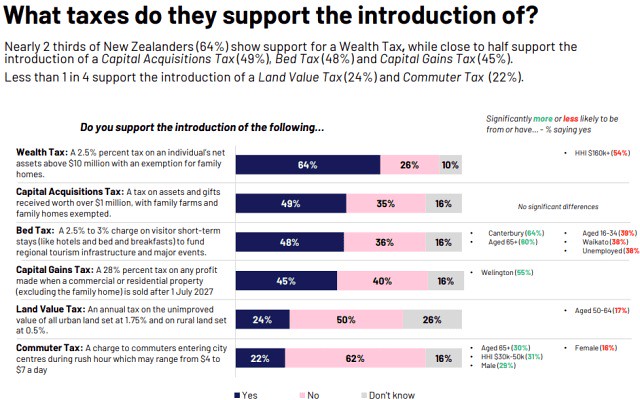
Its time we made them pay their fair share. And over the weekend, the Greens put up their election year tax policy, which will make them do it. A wealth tax, targeted at the super-rich, which will finally bring them into the tax system. A new top income tax rate, for those earning top incomes. A capital acquisitions tax, targeting gifts and inheritances over $1 million, to limit intergenerational accumulation and tax-dodging. A higher corporate tax rate for big companies. A bank-levy, targeting our biggest cartel parasites, Aussie banks. Stopping foreign tech companies from dodging New Zealand taxes by pretending the profits happen elsewhere. And reversing Luxon's landlord and property speculator tax cuts.

These are not radical socialist policies. They are all perfectly normal overseas. But the rich have bought so much power in our society since 1984 that they've been able to gaslight us into thinking that the normal is abnormal, that other countries don't have wealth taxes, inheritance taxes, more progressive income taxes, restrictions on tax cheating. And they've been able to do that, in part, because they can use their money to buy politicians and media outlets, steering our society in their preferred direction, despite huge public support for taxing them.

Taxing the rich and limiting their ability to accumulate and weaponise their wealth is a necessary thing for the preservation of our society. And the best bit is that it won't affect the vast majority of New Zealanders. Only a tiny proportion of people - the Chris Luxons of this world - have more than $10 million. Only a tiny proportion of people inherit or are given more than $1 million. Only a tiny proportion (which includes every MP) "earn" more than $160,000. None of that affects us. Instead, what we get in practice from this policy is a reduction in inequality, a restriction on the power of the rich, better-funded public services, and a tax cut! Because most of us will end up better off, thanks to a shift in the tax burden from the poor to the rich. Which is perfectly sensible the moment you think about it. There's no point taxing people who don't have any money. Instead you go after the people who do have it, the bloated accumulators who have sucked all the wealth out of our society into their own pockets.

Sadly, Chris Hipkins - a man paid $305,900 a year plus slush, who rorted his parliamentary superannuation scheme into buying his holiday home and then said "it's my money" - is saying that none of this will happen if he's in charge. Voters should take that as a challenge: if we want these policies, we have to vote for them. We need to put the Greens in a position where they can force this policy on Labour. Otherwise, nothing will change, and the rich will just keep on leaching and looting us.

Friday, June 19, 2026


Something we need to fix

An OIA request on FYI has alerted me to an unpleasant quirk in Parliament's rules. Someone has asked Jenny Marcroft, who is Parliamentary Under-secretary for media and communications and fisheries, for information she holds about her hateful terf bill. The request will be refused, because Marcroft will play the hat game, and claim that any information she holds on the bill is held in her capacity as an MP, rather than her capacity as a Parliamentary Under-secretary. But it does raise the question: given her role, why was she allowed to advance the bill at all?

The short answer, given by McGee, is that "[a] Parliamentary Under-Secretary may introduce a member’s bill." In other words, it is "within the rules" (as members of the political class love to say).

But again, we can ask why? Because member's bills are meant to be for members, not the executive. And Parliamentary Under-secretaries are absolutely members of the executive. They're defined as such in the Cabinet Manual, and effectively recognised as such in various parts of Parliament's Standing Orders. For example, they are treated as members of the executive when allocating oral questions under Standing Order 391, and they do not count for support to immediately introduce a member's bill under Standing Order 288. If Standing Orders were consistent, they would also be excluded from entering member's bills into the ballot.

The answer is almost certainly historical. While Parliamentary Undersecretaries were always part of the system, they'd fallen into disuse in favour of Associate Ministers. They were revived comparatively recently thanks to MMP and its need to hand out official baubles as bribes to supporters, some of whom might not have the pull or experience to merit even an associate ministerial position. So John Key made Rimmer an undersecretary in 2014, and since then every coalition government has included them as a bribe to its minor partners and as training wheels for those who might one day be Ministers. The present regime includes a PUS from each party (Marcroft from NZ First and Simon Court from ACT), giving each of them a fat salary bump and a bunch of perks to rort - which will help keep everyone sweet and not wanting to rock the boat. And the rules have struggled to keep up - undersecretaries were excluded from the OIA until 2016, despite being members of the executive, simply because no-one had really thought of it.

This is another example of the rules failing to keep up with practice. And its something we should fix. While its far too late for it to go into the review of standing orders, hopefully the next government will bring a sessional order to remove this oddity.

Thursday, June 18, 2026


Good riddance

Shame Jones' corrupt Fisheries Amendment Bill is dead:

Controversial fisheries reform led by New Zealand First minister Shane Jones is being abandoned until after the election.

Jones, appearing before a select committee in his role as Oceans and Fisheries Minister, told MPs his “much-beloved bill could use some more panel-beating” and as such, would not be progressed in this term of government. The Fisheries Amendment Bill had caused division within the coalition, particularly with National which faced a backlash from recreational fishers over changes to minimum legal-size limits for commercial fishing operators.

Plus of course there's the quota changes, which let fishers over-fish; the restriction of judicial review, so we'll never be able to force the Minister to follow the law; and of course the absurd secrecy for camera-footage, which existed solely to protect criminal fishers from public scrutiny. The entire bill was bought and paid for by fishing industry donations, the public could see that, and they responded with utter revulsion.

And now its "delayed", which basically means dead. But if we want it to be gone for good, we need to throw the corrupt regime which advanced it out of office.

Tuesday, June 16, 2026


The price of justice

Last year, the regime rammed through the Equal Pay Amendment Act under urgency, gutting pay equity laws, dumping all claims, and stealing $13 billion from New Zealand women. Labour wants to reverse that. So naturally, they're getting the usual bullshit question from the regime and its stooges: "how will you pay for it?"

The short answer to this is "who the fuck cares?" It is fundamentally immoral to pay people less because of their gender. The state has been committed to eliminating this form of discrimination for over fifty years. It is appalling that it has taken so long to do so. It is even more appalling to see people quibbling about the fucking cost. Do they think we should pay women less? This is justice; we pay whatever it costs. It's that simple.

And the substantive answer is that we could afford it up until last year. What changed then is the government's priorities: they decided to spend all the state's money on landlord tax cuts and stupid fucking roads, and that these things were somehow more important than justice. That was an appallingly immoral decision, which shows what disgusting sexist pieces of shit the present regime are. But a different government can change those priorities. It can not be sexist, and put justice ahead of greed and stupidity. So, it can "pay for it" by simply reversing National's landlord tax giveaway. Or maybe just by cancelling some stupid roads.

Either way, the people asking these questions should be asked one in return: do they think women should be paid less? If so, they're ghouls and weirdos who have no place in the modern world and can be simply ignored. If not, then why are they even asking? Either way, maybe they should be thinking about the values underlying the policy, rather than the details.

Thursday, June 11, 2026


Out of touch

There's been some stuff over the last few weeks about how MP's high salaries and extensive perks put them out of touch with normal people. How out of touch are they? Revenue Minister Simon Watts thinks that people with $50,000 invested overseas aren't wealthy:

Inland Revenue figures suggest only tens of thousands of New Zealanders have directly invested more than $50,000 in overseas shares.

But Revenue Minister Simon Watts has rejected the assertion that those whose purchases total less than $100,000 and who stand to gain from a tax change in Budget, could be described as mostly wealthy.

Watts has four houses, three trusts, and a salary of $320,600, plus perks (including $52,000 a year for housing and a tax-free "expense allowance" of $19,000). With all that, I think its fair to say that he has a certain level of wealth, and might not see $50,000 as a big deal, and certainly not real money. But $50,000 is vastly more than most kiwis have - median savings balances are less than a tenth of that, and a third of kiwis don't even have $500. Only 38% have a Kiwisaver balance of more than $40,000, so Watt's "not wealthy" is more than most people's entire lifetime savings.

You'd think as Revenue Minister, Watts might have some acquaintance with these facts. But wealth is something this regime steadfastly refuses to look at, because if it did, it might face pressure to do something about it. So he just falls back on his own reckons as a four-house, three-trust, $300K salary guy. $50K isn't a lot of money to him, so ergo people who have it aren't wealthy.

Which just goes to show that ministers and MPs are in a completely different boat from the rest of us. And that calls into question their claim to be "representatives".

Wednesday, June 10, 2026


Cheap but effective

Labour has finally announced some policy, with a promise of cheaper public transport:

Labour has vowed to cap public transport fares at $20 a week in main centres and $10 everywhere else if elected.

Its fare cap policy, announced on Wednesday, would put money back into New Zealanders' back pockets, said leader Chris Hipkins.

"This is real cost-of-living relief. It means cheaper commutes, more money left at the end of the week, and a public transport system that works for everyone."

This seems quite effective. Most public transport systems already include weekly fare caps, so it uses existing mechanisms. It will push people to use public transport (so its a climate change and fuel saving and congestion policy), and deliver real savings for doing so (so its a cost of living policy as well). And it costs fuck all - only $65 million a year. What's surprising is that we're not doing it already.

Hopefully there'll be a lot more of this. When parties are standing for election, they owe it to us to tell us what they hope to do in power. Labour's previous "small target strategy" is a strategy of deceit, an attempt to deny us the information we need to make an informed choice on how to cast our vote. It is fundamentally dishonest and fundamentally undemocratic. And we deserve better than that from those who want to be our leaders.

Tuesday, June 09, 2026


Fucking absurd

Since time immemorial - or at least the 1990's - the National party's Big Economic Idea was cuts. Slash the state! Sack people! Give away billions in tax cuts to cronies so future governments couldn't fund anything! And to justify this peculiar fixation, they talk constantly about debt. There's too much of it! We can't afford the interest! We're about to go bankrupt! And sadly, this ideological framework has been swallowed wholesale by Labour, who sternly promise to keep debt low and not increase spending

But as Bernard Hickey points out this morning, none of this is true. Sure, the NZ government has $426 billion of debt - but it has $611 billion of assets, a positive net worth of $185 billion. And interest payments - which are now fixed and in NZ dollars, unlike the 1980's - are just 2% of government revenue. Which is perfectly sustainable.

And yet, National still keeps demanding cuts. Meanwhile, we have failing infrastructure, collapsing public services, and 33,000 homeless children. Hickey asks the obvious questions: would you leave kids homeless when you were worth $207 billion? Would you leave your kids homeless with interest costs of 2% of income? Answering "yes" to those isn't just fucking absurd, it's absolutely sociopathic. But I guess that's the sort of person right-wing politics attracts: the sort of person who wants to deliberately starve and freeze children, while running the country into the ground, all so they and their rich mates can steal more from us.

We need to vote this NeoLiberal plague out. Both sides of it. Because as long as Labour remains committed to NeoLiberalism and the "too much debt" myth, they will continue doing exactly what National does. The only difference is they'll lie to us about how they're helping us while they fuck us over.

Deeply unethical

Yesterday, the Labour party announced its party list, parachuting senior police officer Superintendent Rakesh Naidoo in at 13th place to show how much they care about "law and order". Which immediately caused problems, because Naidoo apparently hadn't told his bosses until the last minute.

Labour leader Chris Hipkins claims this is all OK, because while they had been talking to Naidoo "over a couple of months", his selection "was done at the last minute deliberately" to enable him to stand. But that's not OK. We have a politically neutral public service, and to protect this, section 52 of the Electoral Act 1993 requires public servants seeking office to take leave. This is normally from nomination day, but where candidacy undermines the perception of political neutrality, it may be for longer. While the police are not public servants, these provisions explicitly apply to them. And Naidoo is a senior police manager, working on policy issues, and that's simply not something you can do while seeking political office.

On top of that, the Police Manual chapter on elections and political matters specifically requires police employees seeking public office to

advise their District Commander or Director at the earliest opportunity so that the potential impact on their role as a Police employee and any necessary plan of action can be discussed early.
An ethical person following the rules would have advised their managers when they were considering seeking office, to ensure that risks were managed and they had obviously obeyed the rules. Naidoo didn't do that. Instead, he and Labour seem to have contrived a process, with the latter deliberately manipulating its normal candidate selection procedures so he could pretend not to be running, so he could keep on collecting his salary (and, potentially, accessing police information) right up until the last minute.

This is deeply unethical behaviour which reflects badly on everyone involved. It doesn't meet the standard of ethics we expect from police or political parties. And given how low our expectations are of either, that's pretty damning.

Monday, June 08, 2026


Time to end MPs' property rorts

Last week we had the unseemly sight of Social Development Minister Louise Upston cutting housing for the needy, while being paid $1,000 a month to live in an apartment she already owns. It was "all within the rules", of course - because politicians write the rules to suit themselves - but it was all a bit Marie Antoinette. And its not just her. Politicians have claimed over $2.5 million so far this term to live in their own houses - a practice which makes it clear how low the ethical standards of our rulers are.

As Thomas Coughlan points out, it is entirely right and proper that MPs are paid, and paid expenses, for doing their jobs. But this is taking the piss. And if you made expenses claims like this in a normal employment situation - demanding to be compensated for living in your own fucking house, in some cases the house where you had always lived - you would be fired, if not prosecuted.

The practice of rorting expenses delegitimises parliament, and it delegitimises the political class as a whole. They're nothing but thieves and fraudsters, unfit to rule over us. Once again, they are earning their reputation...

So what can be done? Coughlan has a good suggestion:

The obvious fix is a simple one: ban related party leases for electorate offices and Wellington accommodation, and tidy up Parliament superannuation scheme rules to ensure MPs aren’t using private super schemes to build property portfolios.

It’s this particular issue that’s at the nub of most expenses scandals in the past decade or so: an MP claiming an awful lot of money to rent accommodation that they or a related entity own.

It’s within the rules now. But it shouldn’t be.

It is blatantly obvious that we need to do this, and blatantly obvious why: because it is a naked conflict of interest. It is dishonest, and it is corrupt. I'd throw in preventing MPs from effectively moving their place of residence after election in order to access a higher allowance. If you live in or near Wellington already, then that's where you live for the term, and we're not going to pay for you to pretend to live elsewhere so you can campaign and/or get a holiday home (this means you, Andy Foster).

MPs complain constantly about how the public perceives them. I suggest that if they don't want to be viewed as corrupt and dishonest, they should stop behaving that way, and amend the rules so that they can't. Its that simple. And if they don't, the public will continue to hold them in the contempt they deserve.

Thursday, June 04, 2026


Parliament fails to defend transparency

The Economic Development, Science and Innovation Committee has reported back on the Commerce (Promoting Competition and Other Matters) Amendment Bill. The bill makes various changes to competition law, which the National-dominated committee has naturally gutted. It also includes an odious secrecy clause, effectively granting the Commerce Commission a ten year exemption from the OIA, which is renewable, meaning it is really an indefinite exemption. The case for this was exceedingly weak, it was denounced as "unnecessary and excessive" by the Ombudsman, and it seems to have been driven by misunderstanding of and hostility to transparency from senior Commission staff (here are the receipts; if you keep scrolling you'll also see they also admitted that it was completely unnecessary). So what did the committee thing? Rather than standing up for transparency or conducting a first-principles analysis, they simply split the difference, reducing the exemption to five years. But its still renewable, meaning its still effectively indefinite, unless the commission fails to do the paperwork).

In talking about the Fisheries Amendment Bill, which also included a secrecy clause, the Ombudsman noted that:

In circumstances where the OIA already protects the relevant interests, only an extraordinary harm to those interests would justify a permanent exclusion of information from the scope of the OIA.
In this case, the OIA also protects the relevant interests, and the Commission (in advice it attempted to keep secret) admits that. There is no extraordinary harm to justify exclusion. Secrecy cannot be justified.

Using austerity to attack democracy II

Back in March, Newsroom's Sam Sachdeva reported that the regime was planning to use high costs as an excuse to limit access to the Official Information Act, and had commissioned consultants to build them a case. Obviously, I was quite curious about this, so I fired off a series of OIA requests to government agencies. Some were about costs, and revealed (unsurprisingly) that no-one (at least, no-one in the sample of core government agencies I checked) had any idea how much the OIA cost them, and that no-one was counting. Some, aimed at understanding recent large increases, were about the types of requests received, and when they had started being counted in statistics, and they were quite illuminating. And of course there was a request for the policy advice underlying the regime's plans. A request for Te Kawa Mataaho's advice got bounced to Ministry of Justice - saving me the effort of asking them directly - where it was delayed, and then delayed, and then delayed again. They finally responded yesterday, having illegally delayed the response until a related proactive release was signed off.

The response letter, with links to the released documents, is here. There's a lot of emails (some of which are significant), a couple of contracts, and notes from a meeting with the Ombudsman which suggests the regime's intent is to use this as an excuse to declare requesters "vexatious" - something both the Law Commission and the Ombudsman have opposed in the past. The Ombudsman is clear, both there and elsewhere, that one of the drivers of costs is increasingly convoluted agency review and sign-off procedures, where every response is scrutinised by multiple layers of management for arse-covering and "no surprises" reasons. This frequently results in delays, and it has been a frequent topic of the Ombudsman's practice reviews.

As for the costs themselves, they're in the proactively released Tregaskis Brown report and accompanying briefing. You hire consultants to deliver the answers you want, and TBL has delivered in spades, with a headline cost estimate of

$183.6 million for the 2024/25 financial year, within a possible range of $175 million – $250 million depending on estimated complexity of OIA requests.
They've calculated this by (roughly) taking the number of requests, estimating the proportion per agency which are complex (expensive) vs routine (cheap), and multiplied by the relevant cost per request, based on Australian data. They correctly highlight that 77% of requests come from 6 agencies (Police, Natural Hazards Commission (EQC), Department of Corrections, NZ Defence Force, Fire and Emergency NZ, and NZ Customs Service), and (sensibly) recommend further work to understand both actual costs, and what is driving them, as well as strengthening proactive release. Those bits are fine, but the cost estimate is absolutely absurd. How? The accompanying A3 (p10 of the proactive release) estimates the police's annual OIA costs at $50 million. But the police are actually one of the few agencies we have good OIA cost data for! A November 2025 request made on FYI, the public OIA request site, included both the numbers of requests processed, and the staff numbers and costs for both the police Ministerial Services OIA group, and the Information Requests Service Group (IRSG), for exactly the time period TBL is looking at. Ministerial services processed 1014 requests in the second half of 2024, and 832 in the first half of 2025, for a total of 1846 in 2024-25. IRSG processed 28921 and 25280 respectively, for a total of 54201. (Yes, there's a discrepancy between these numbers and those published by TKM. The reason for that is speed cameras and media requests, which are handled by other groups).

As for costs,

Police advises that there are 13 people in Ministerial Services who process OIA requests. As at 1 November 2025, the annual total for their salaries is $1,547,991.

There are 53 people who work in the Information Request Service Group and the annual total for their salaries is $4,489,296.

This gives a cost-per-request for police ministerial services (which handles the most complex requests) of $838.57, and for IRSG as $82.83. While there's no cost-estimate for speed cameras and media requests, both are likely to be at the lower end (the former because they are routine, the latter because anything non-routine gets kicked into the formal OIA process and handled by Ministerial Services). These are obviously far lower than TBL's estimates of $3530 for complex requests and $353 for routine ones. Even allowing for overheads (which TBL estimates at 66%), TBL's costs are inflated by a factor of 2.5.

You would hope that TBL's followup work will reveal that. In the interim, though, Goldsmith has got what he paid for: a big, scary number for costs, which he can decry as "waste", plus the inevitable line-go-up graph, showing those costs will increase into the future. Which he will probably consider to be a case for action.

The proactively-released briefing notes that the OIA is of constitutional significance, and that any change will attract significant interest. It recommends 10-12 weeks of public consultation on any proposal. That's clearly not happening on the original proposed timeline of "before July", so it may have been kicked back until after the election. Alternatively, Goldsmith being Goldsmith, he may just not bother with proper process. This regime has established a terrible reputation for ignoring advice and enacting radical, anti-democratic, even constitutional vibe-based policy under urgency. Sadly, we can't rule out them acting as they have in the past, and wrecking the OIA in the same manner. The only way to stop them is to throw them out of office as quickly as possible.

Tuesday, June 02, 2026


A crime

Last week, we learned that climate polluters had been writing our climate laws, and trying to hide the evidence by handing over their demands in hardcopy (which was then conveniently "lost" and so unavailable to an OIA request). That was highly suspicious, suggesting a deliberate attempt to thwart the Public Records Act and its requirement to create and maintain full and accurate records of official business. And now it gets worse, with news that prime ministerial staffer and former far-right lobbyist Matt Burgess was getting official documents sent to his private email account.

Once is suspicious. This however suggests a pattern of behaviour to hide public records, a deliberate non-compliance with the Public Records Act. And that is a crime. While the penalty is pathetic, he needs to be prosecuted, pour encourager les autres. Failing to do makes a mockery of the law.

But that's not enough. We clearly need law reform here to protect transparency. This must include explicit penalties in the OIA, stronger (and matching) penalties in the Public Records Act, and a tweak to the Electoral Act declaring violation of either to be a corrupt practice - meaning anyone convicted will be automatically removed from parliament. Add a legal principle of absolute ministerial responsibility for the actions of their subordinates, and we would finally have proper incentives for open government.

If Ministers refuse to do this, it is effectively an admission that they are guilty. The question is, how shameless is how political class?

Friday, May 29, 2026


Sabotage and spite

What is the purpose of the state? What is our government for?

If you ask the average New Zealander, you'll likely get some variation on "he tangata, he tangata, he tangata". But from today's budget, National clearly thinks the sole purpose of the state is to balance the books. The stuff government does doesn't matter; what matters is that the numbers all add up (sortof), and - if suitably heroic assumptions about growth and global peace are made - there's some sort of mystical government surplus in the far-off future.

But this sort of government by spreadsheet puts the outdated technological metaphor before the other thing. The numbers are less important than what government actually does. And what National is telling us is that, under them, its going to do less. Its going to support fewer people with state housing, even though need is growing. Its going to support fewer of us to university as well. While they're touting big headline numbers for health and education, when you poke at them, it turns out that its all sub-inflation increases, which means - you guessed it - doing less. And of course they're going to cut the core capabilities of the state, sacking 8,700 public servants to meet some arbitrary target.

Normal governments reprioritise spending to do other things - social spending for labour governments, tax cuts for National ones. Here, the cuts seem to be an end in themselves, driven by a desire to shrink the state, reduce its capacity, and stop it from being able to do things in the future. It's pure vandalism, the American dogma of "drowning the government in the bathtub", with a side-order of "fucking things up for next year", as a poison pill if they lose the election. Because the next government will have to undo a bunch of this damage, if they want government to be able to function at all. At which stage National will scream "waste" and accuse them of excessive spending. It's simply an exercise in sabotage and spite.

Most governments want to leave a better legacy than that. But clearly, the National party is now run by weirdo cultists intent on destroying the very state the purport to want to govern. The sooner we are rid of them, the better.

Wednesday, May 27, 2026


Taking the piss

National is busy cutting social housing, which has resulted in increased scrutiny of politicians' housing entitlements. First, there's Social Development Minister Louise Upston, who is being paid $1000 a week to live in her own house while cutting payments to everyone else. She's "comfortable" with that, and of course she is - because she's being paid $1000 a week when she doesn't even have a mortgage! But the worst case so far is NZ First's Andy Foster. Foster is a former mayor of Wellington, and he's lived there for over twenty years. But now, for entitlement purposes, he's suddenly contriving to "live" somewhere else, so he can trouser more money from the rest of us:

Despite owning a home in Wellington for 26 years, Foster is claiming a $36,400 per year taxpayer-funded accommodation subsidy intended for non-Wellington MPs. Foster’s parliamentary expense reports show he claimed $22,700 in 2025, starting with $3,100 in the April-to-June quarter, followed by the maximum possible amount of $9,800 in every quarter since. He confirmed to The Spinoff that he continues to claim the allowance.

MPs are eligible for the accommodation subsidy if they live “outside the Wellington commuting area”. In 2025, Foster purchased a second home in Wairarapa, where he intends to run as a candidate in the 2026 election. He now lists the Wairarapa property as his “family home”. Foster still owns his Karori home and stays there during parliament sitting blocks but told The Spinoff it was “no longer my primary place of residence”.

At this stage, I must point out that this is not theft and it is not fraud, because - as the politicians love to say - it's "all within the rules" (which the politicians wrote to suit themselves). I must also point out that paying MPs to live in Wellington so they can do the job properly is good. We don't want only rich people or people who live in Wellington to be able to be MPs. But in this case we're not paying Foster to live in Wellington. Instead, we're paying him to not live there, so he can campaign for election elsewhere. And that's just taking the piss. Its not necessary for him to do his job, and arguably is an unlawful use of parliamentary funds for a political purpose (subsidising his election campaign).

MPs rorting their expenses like this delegitimises parliament and is one of the reasons they regularly feature below real estate agents on public trust surveys. Fortunately there are solutions. They clearly can't be trusted to manage their own accommodation arrangements ethically, so its time Parliamentary Services bought an apartment block to house them. And if this results in them being less comfortable than they are at present, they will only have themselves to blame.

(And while we're at it, we should do the same for ministerial housing, and electorate offices. If these thieves can't help themselves from double-dipping, then the decision needs to be taken completely out of their hands, and suitable workplaces and accommodation provided for them).

Tuesday, May 26, 2026


Naked corruption

That's the only way to describe today's exposure by RNZ that over $1 million in political donations is linked to fast-track applicants. But it gets worse:

More than $1 million in political donations linked to fast-tracked projects have been made since 2022.

An RNZ analysis of the latest donation data reveals $400,000 was donated to National and NZ First in 2025 from people or entities linked to fast-track projects. Labour received $8620.

The introduction of the fast-track approvals process was part of NZ First's coalition deal with National. Since 2022 almost 90 percent of donations from people or entities also linked to projects have gone to the two parties.

Since the act came into effect in 2024, a total of 23 fast-track projects have been approved. Of these, seven are linked to people or organisations that have made a political donation.

As the latter makes clear, these companies are basically buying themselves an outcome. Thanks to Shane Jones and Chris Bishop, resource consents and the pillage of conservation land are effectively for sale in New Zealand. And the governing parties are profiting from it.

Which is why the next government will have to not just repeal fast-track, but also force all decisions to be reconsidered under the normal process, according to normal rules. Otherwise there can be no faith that decisions are not being bought. But beyond that, we clearly need a ban on large political donations, and an Independent Commission Against Corruption to perpetually investigate donors, parties, MPs, and ministers, and prosecute them for any wrongdoing. That os the only way public faith in the state can be restored.

Monday, May 25, 2026


Climate Change: A weak policy

Back in 2023, Aotearoa had a serious climate policy. Non-agricultural emissions were covered by the ETS, and despite some initial hiccups, there was reasonable certainty that carbon prices (and so benefits from decarbonisation) would steadily increase into the future. ETS funding was recycled to fund further decarbonisation through the GIDI fund, which had funded Aotearoa's biggest decarbonisation initiative: halving NZ Steel's ongoing emissions. Then National came in, repealed all that, fucked up the ETS, and now we have businesses shutting down due to high gas costs rather than shifting into a cleaner, electric future.

National's response to this has been to threaten an LNG import terminal, and to make you pay for it - an insane plan which will result in high prices and high emissions for the forseeable future. But with their ally Trump's bombing of Iran and the consequent closure of the Strait of Hormuz, that might be off the table, so they've been forced to look at other options. Unfortunately, what they've come up with is a piddly loan-guarantee scheme, the weakest of all policies:

Businesses will be able to access cheaper loans to help reduce their dependence on gas as part of a new scheme in Thursday's Budget.

[...]

Under the lending initiative, the government would guarantee 80 percent of eligible loans, allowing banks to offer lower interest rates to companies switching to alternative energy sources, such as electricity or bio energy.

Finance Minister Nicola Willis said the Budget would put aside $48 million to cover potential losses, unlocking an estimated $1.2b in bank loans.

Which is better than the nothing we have at the moment, but its still shit. Why? Because as He Pou a Rangi reported last month, the core problem for decarbonisation is total uncertainty about costs and benefits. No-one can build a business case for decarbonisation because they can't be sure that the present regime won't just abolish the ETS, or withdraw from our international climate obligations, or otherwise Fuck Around and make it all worth nothing. "Cheaper loans due to government guarantees" doesn't change this, and if anything is setting the whole process up for failure because the banks actually making the loans will look at the situation and go "fuck no; that's too risky". The only way that the policy can be successful is if there is a massive restoration of credibility in government climate change policy - in other words, if there is a change of government.

But national won't care about this. All they want is a headline to suggest they are Doing Something, at the lowest possible budget cost. And if it underspends because no-one can actually get a loan in this environment, they'll think that's a bonus. But its unlikely to significantly reduce emissions, and we'll have shutdowns and bankruptcies instead. Which isn't the best way of reducing emissions, but its the one the regime has left us with.

Meanwhile, this is a reminder: if we want effective climate change policy, we need to change the government. That's the only way to restore credible policy. As long as this regime is in power, there’s simply no hope of any credible policy.

This is why we need criminal penalties in the OIA

Last night TVNZ revealed an outrageous act of corruption by the Luxon regime. Earlier in the month, Luxon had promised a law to prevent polluters being sued over their pollution - a direct attack on the rule of law to benefit favoured donors and cronies. Now it turns out that they were given that law by the polluters themselves. The polluters had lied about that to the courts, and Luxon's office had lied about it in an OIA response:

Official documents released Sunday, and seen by RNZ, reveal a briefing document provided to the Prime Minister's office regarding Smith's case against Fonterra and other major emitters.

Z Energy confirmed to RNZ it had provided a document to government in 2024 and Fonterra confirmed it had done the same with a hard copy.

Smith explained the defendants in his case had been ordered to release documents relating to their lobbying efforts by the end of March 2026, but the briefing note was only released this month, through the discovery process in the High Court.

The documents also showed the information was not disclosed by the Prime Minister's office, when requested as part of a separate Official Information Act request by an environmental group.

The polluters' non-compliance with court-ordered discovery is something for the courts to resolve. But the Prime Minister's non-compliance with the Official Information Act should concern us all. If taken at face value, Luxon claims to have no idea what is happening in his office, and also to be violating the Public Records Act, which requires him to create and maintain full and accurate records of his affairs (including when lobbyists slip him a policy "suggestion" - something which, as it requires the exercise of ministerial power, can only be official business). That's bad enough - bad enough to be an actual crime, though the penalty is derisory even for deliberate official wrongdoing. But the alternative - that he did know, and had complied fully with the record-keeping requirements of the Public Records act, and instead had simply lied in that OIA response - is worse. Because obviously, if Ministers and officials can simply lie in response to a request for official information, there might as well not be a law at all.

And this is why we need criminal penalties for the OIA: because we can not tolerate that sort of lying, and so it needs to be deterred. And that means both ensuring a principle of absolute ministerial responsibility for OIA responses, so that ministers cannot hide behind their minions, and defining the offence of lying in a response of destroying or hiding or not creating records to evade one as a "corrupt practice" in the Electoral Act, so that any Minister convicted is automatically removed from Parliament. The question is, what Minister will stake their career on proper ethical behaviour and following the law?

Thursday, May 21, 2026


A vicious, corrupt and insane policy from a vicious, corrupt and insane regime

Albert Einstein reportedly said that insanity was doing the same thing over and over and expecting a different result. And that's basically National's housing policy. Back in the 1990's, they sold state houses, raised rents, and handed out money to their landlord cronies via the accommodation supplement. The result was poverty, overcrowding, the resurgence of third-world diseases, and the creation of a permanent underclass. There was some relief from the Helen Clark-led labour government, which built state houses to replace some of what had been sold, and replaced market rents with income-related ones, but it didn't undo the damage. Then, in the 2010's, under the Key-led national government, Paula Bennet did it all over again. That time we got all the previous bad effects, plus a homelessness crisis, people living in cars, then WINZ putting them up in motels at enormous cost (and then trying saddle them with odious debt) to avoid the resulting bad headlines, and finally a bipartisan acknowledgement that it hadn't worked. The following Labour governments again managed to undo some (but nowhere near all) of the damage, started a building programme and so on. And now its 2026, the end of the first term of a national-led regime, and Chris Bishop is back, doing it all again, this time with the added insult of pretending state house tenants are "lotto winners":

"If you're in a state home and you compare how much income you have with someone in a private rental who's got exactly the same income as you, you're $110 a week better off," she said.

"These changes are about making the system fairer. At the moment, people in social housing effectively have won the lotto, they get so much more support than a family with just as lower income in a private rental. That's not fair, and our changes are about fixing it."

So her solution to that unfairness is to make things worse rather than make things better. To kick those on the bottom of the heap and steal from them in order to enrich her cronies. Because increased accommodation supplements don't help renters - they go directly to landlords, who immediately hike rents to capture the entire increase. So the only people who benefit from this policy is them. And the national MPs they kick back to with donations, of course. It is a vicious, corrupt policy from a vicious, corrupt government. And thinking it will lead to a different result from the previous times it has been imposed is pure insanity.

Drawn

A ballot for six member's bills was held today, and the following bills were drawn:

  • Local Government (Management of Local Authorities) Amendment Bill (Stuart Smith)
  • Crown Minerals (Prohibition on Mining on Conservation Land) Amendment Bill (Lan Pham)
  • New Zealand Humanitarian Aid and Disaster Relief Medal Bill (Tim Costley)
  • Oranga Tamariki (Suitable Accommodation on Leaving Care) Amendment Bill (Marama Davidson)
  • Residential Tenancies (Requiring Landlords to Provide Curtains) Amendment Bill (Helen White)
  • Crimes (Impeding Major Bridges, Tunnels, and Roads) Amendment Bill (Catherine Wedd)

So parliament is going to be forced to go on record about pillaging the conservation estate, or protecting it, right before an election. Unfortunately we also have another national anti-protest law being pushed as a member's bill, fronted by the ever-tyrannical Catherine Wedd (who pushed the teen social media ban / give all your private info to foreign privacy-raiding megacorps bill). But hopefully that one will be nuked by the next government.

Wednesday, May 20, 2026


Member's Day: Parliament is a house of hate

Today is a Member's Day, and one which is going to see Parliament turned into a hate-platform. Because NZ First has delayed the second reading of its anti-"woke banking" bill (recommended to be dumped by select committee) in order to bring forward its anti-trans hate law. Which National and Act are going to vote for, because they clearly feel they have no hope of winning the election unless they whip up a tide of hate against Māori, immigrants, and trans-people.

Once upon a time National PM Jim Bolger refused to run on hate, because "he had to run the country in the morning". Luxon clearly feels differently - either he doesn't want to actually run the country, or he thinks he can just rely on the police and anti-protest laws and beating people in the streets to get his way. But I don't think that's the kind of government any of us want, and it is utterly shameful to see a New Zealand government going down that path. It is also utterly shameful to see such a platform enabled by Parliament, and it allowing this legislation to proceed brings the entire institution into further disrepute. If Parliament is a house of hate, then it cannot be said to represent Aotearoa.

As for the rest of the day's business, first up is Laura McClure's Deepfake Digital Harm and Exploitation Bill, which will be followed by Catherine Wedd's Social Media (Age-Restricted Users) Bill. The government has said they're withdrawing that bill, but clearly its sponsor feels differently, and it will be interesting to see what happens. Following that is Rima Nakhle's Public Finance (Prohibition on Providing Public Funds to Gangs) Amendment Bill - a shitty little piece of racism from a shitty little racist. And then there's the main hatefest, probably around 8 p.m. Hopefully multiple people disrupt it, because fuck a "parliament" which does this sort of shit. If the House manages to complete that piece of business, then it will move on to Tim Costley's Better Regional Boundaries Bill, a moronic piece of legislation from someone who thinks all lines on a map should match, regardless of their purpose. If the House manages to move quickly it may make a start on Tom Rutherford's Concealment of Location of Victim Remains Bill. There will be a ballot tomorrow, probably for five bills.

Monday, May 18, 2026


"Full and final" goes both ways

Last week National introduced its plans to privatise the conservation estate and allow miners free reign to dig up our taonga places. One of the ways it does the latter is by gutting the Conservation Authority and local Conservation Boards, which act as independent advisors to DoC and the Minister on a number of crucial decisions. But having Fucked Around, they're now about to Find Out, with Ngāi Tahu signalling that any change will require a renegotiation of their Treaty settlement:

Ngāi Tahu kaiwhakahaere Justin Tipa said the amendment strips power from the iwi “by turning those boards and the Authority into advisors only and handing decision-making powers to the Minister.”

“Ngāi Tahu was guaranteed a voice on the New Zealand Conservation Authority and conservation boards which currently hold decision making powers.”

[...]

“The Bill includes proposed arrangements to uphold Treaty Settlements, but it puts iwi in the position of being forced to renegotiate important parts of their settlements to fit within a narrow framework.

“Under the new regime, where elements of a settlement do not fit neatly within that framework, the Crown would only be required to meet them ‘to the greatest extent possible’. In no world does that align with a ‘full and final’ settlement.”

They're not the only iwi affected. The bill amends 57 different Treaty settlements to reflect the regime's preferred new way of doing things - unilaterally and without consultation. Those settlements are literally the work on an entire generation of politicians and iwi leaders. And the overall change - to remove iwi voices and make settlements binding only "to the greatest extent possible" - is an overall weakening of them. It is impossible to see this as anything other than the regime trying to cheat on its agreements, something that is both a clear breach of the state's duty of partnership and consultation under te Tiriti, and which invites renegotiation.

But that's not the only problem. Every settlement made has been negotiated against the backdrop of a strengthening web of Treaty clauses which have variously spelled out the state's obligations and embodied the Treaty principles of partnership, consultation, and active protection. These Treaty clauses have meant that a lot of things which might otherwise have been formalised in settlements has been able to be taken as read. And those clauses have been crucial in protecting Māori rights, including rights under Treaty settlements. For example, the Treaty clause in the Exclusive Economic Zone and Continental Shelf (Environmental Effects) Act 2012 was crucial in stopping seabed mining because it required decision makers to protect existing interests, which included customary interests.

The regime has already attacked these clauses and removed several (notably in the Oranga Tamariki Act, and Education and Training Act), and now they are coming for the rest. Which again seems to be cheating on the settlements, removing a key way for them to be enforced and protected. And that in turn invites renegotiation, including renegotiation on redress for losses. Because the redress you negotiate with a party which at least makes a show of working in good faith and wanting the settlement to endure is very different from what you demand from one which works in bad faith and gives every sign that it will cheat.

I've said before that Treaty settlements are only "full and final" by Māori goodwill, and whether they stick or not is a political question for each generation of Māori, no matter what the law says. In such a situation, the state would be wise not to call those settlements into question. If it wants them to have any chance of enduring, the state needs to uphold the settlements, including their wider context. Because "full and final" goes both ways, and if the government cheats, the settlements are neither.

Thursday, May 14, 2026


Another anti-protest law

National has introduced its new anti-homeless law to Parliament, and it will receive a first reading next week (which puts them up against it if they want it to pass before the election). The law is a disgusting piece of social cleansing, drafted to enable the police to hide the consequences of National's failed economic policies. But its worse than that, because in addition to enabling social cleansing, it is also, like their anti-boy-racer law, an anti-protest law. The new "move-on" order powers apply not just to people begging or rough sleeping (which is bad enough), but also to anyone "behaving in a manner that is disorderly, intimidating, or threatening", "behaving in a manner that is disruptive" (being "disruptive", whatever the fuck that means, is not a criminal offence), "unreasonably obstructing, hindering, or preventing someone from entering or leaving a place where a lawful trade, business, or occupation is being conducted", or "breaching the peace".

As noted previously, the government and police have a habit of regarding protest as inherently disorderly and disruptive, if not as a "breach of the peace". And the application to the common protest tactic of blockading a building is obvious.

Fascinatingly, the bill's BORA vet finds that the anti-begging and anti-rough sleeping provisions are disproportionate limitations on the freedoms of expression and movement, but does not consider the obvious application to protests at all. Which both shows a distinct lack of imagination and is a complete dereliction of duty on the Attorney-General's part.

This law can be used to limit fundamental rights to protest. Given police attitudes, it will inevitably be used to do so. If that is not the intent, then it needs a Terrorism Suppression Act-style clause excluding its application to any protest, strike, or lockout. If the regime fails to add one, then we should regard the suppression of protest as their intent, and the destruction of our democracy as their ultimate goal. It is that simple.

Wednesday, May 13, 2026


The regime is out of time

The regime introduced its appalling Conservation Amendment Bill, which allows widescale privatisation of the conservation estate, last week, and rammed it through its first reading yesterday. Submissions aren't open yet, but the good news is that the bill got the normal six months select committee consideration - meaning that it isn't due back until after the election. So, if you want to stop it, if you want to protect our taonga places, then one way of doing it is to vote out the regime.

Which illustrates the wider problem for the regime: they're out of time. Normally bills get six months at select committee, and anything less than four requires a vote and (time-consuming) debate. National hates democracy, and hates debate, so they've been tending to go for the minimum four months in an effort to limit both. But the calendar no longer works for that tactic. A bill passed through its first reading today with the minimum four months select committee time will be due back on 13 September. Normally there's a three working day wait before the report can be considered, giving just three sitting days (13 hours of sitting time) before the House rises. Each remaining stage - second reading, committee of the whole, and third reading - must occur on a separate sitting day, so they might just be able to squeeze it in under normal procedures. After today, it simply can't be done constitutionally.

What about unconstitutionally? This regime loves to shit on our democracy, loves to abbreviate select committee stages, loves to ram stuff through under urgency to limit debate. The last sitting weeks before an election tend to be wall-to-wall urgency as governments try and clear the order paper of all the bills they didn't get round to (the end of year "wash-up"). But the window is closing on that too. After next week, a bill given a minimum four month select committee phase won't be back in time to make it into an urgency motion at the end of the final sitting week. They can shorten the select committee stage - spending time on debate now, but because of recesses and scrutiny week, their window for a three month committee phase effectively closes on budget day. And anything less than that is simply a bad joke. Obviously, they can use all-stages urgency to ram stuff through, but the price of that is to absolutely delegitimise the law passed (as well as the state which passes it), and invite immediate repeal by the next government.

So, basically, their time is up. Any policy they offer up now is a hostage to the election. And if we don't like it, we can and should vote for a different government which will throw it in the bin.

Luxon dogwhistles racism

Prime Minister Chris Luxon gave a pre-budget speech to the Auckland business community today, in which he promised even more austerity. But he also made a play for ACT and NZ First's racist, anti-immigration voters, with a warning to his listeners:

"And you should expect to see careful policy on immigration from National as we get closer to the election ... when it comes to immigration, when faced with a choice between social stability and your bottom line, I will choose the former every single time."
Which is bullshit, firstly because immigration is not a threat to "social stability"; and secondly because the greatest historic threat to social stability has been inequality, the greed of the rich. But on that front Luxon has their back. He's perfectly willing to destabilise Aotearoa's society to enrich his mates, promising austerity and asset sales while doing nothing to limit inequality or the runaway wealth of the few, preferring instead to rely on ever-more tyrannical anti-protest laws for protection. And of course when it comes to coalition parties pushing white supremacy, tearing up te Tiriti, and attempting to eradicate te reo from public life, he's all in.

But I don't think an unequal, racist tyranny, divided between a small clique of rich Auckland arseholes and a mass of renters forced to work minimum-wage jobs is the sort of society most kiwis want to live in. And hopefully we will tell Luxon that forcefully in November.

Tuesday, May 12, 2026


Climate Change: Putting polluters above the law

That's the only way to describe the regime's plans to outlaw civil climate suits against polluting companies:

The government announced on Tuesday it would amend climate laws to prevent companies from being sued over damage caused by greenhouse gas emissions.

The change will prevent findings of liability in torts - a type of civil case where one person or entity claims another has caused them harm.

Justice Minister Paul Goldsmith said it would apply to current and future cases - stopping a landmark case against Fonterra and five other major emitters in its tracks.

The actual policy is an ACT party member's bill, which has been hanging around on the ballot for a while. I guess they just got sick of waiting.

If this passes, polluters will be able to lobby the government to prevent action on climate change, pollute with abandon, destroy the global climate, inflicting harm on people all over the world - including in Aotearoa - and face no consequences whatsoever. The courts will be specifically forbidden from doing what the government refuses to do. And this, despite well-established legal principles around public nuisance and negligence.

If someone nearby starts a fire which burns your house down, there's a legal remedy. If they build a shitty dam, collect a pile of water, then deliberately or by negligence release it and flood your neighbourhood, there's a legal remedy. But the regime is saying that there will be no legal remedy for climate change. Someone can literally burn the world, and there will be nothing legal you are allowed to do about it.

This is a naked case of regime corruption, of them serving the interests of big donors and polluters. And its just another example of the need for the next government to pass an Omnibus Repeal Bill, to revoke everything this corrupt, tyrannical regime has done.

If the government wants to avoid private suits over climate change, the solution is simple: have a robust climate change regime which actually reduce emissions. If they don't, then they only have themselves to blame if people pursue other strategies to do the job for them.

Wednesday, May 06, 2026


More culture-war bullshit

That's the only way to describe the regime's announcement today that new citizens will be forced to pass a test on the "responsibilities and privileges" of citizenship, "covering topics like the Bill of Rights Act, voting rights and the structure of government." Which is a bit rich coming from a regime which has shat all over the BORA, restricted voting rights, and abolishes core government agencies and capabilities at a whim because they said something a Minister doesn't like (or applied the law to someone the Minister does).

Winston Peters says this is because "some of the people who have come here who don't salute our flag, don't honour the values of our country, don't respect the people living here", which again shows how out of touch that fossil is. Real kiwis don't "salute the flag" unless they're in a job which requires it. Anyone who does is some sort of weirdo. We're not Americans, and we don't want to be like them.

But Winston is right about one thing: there are people here who don't honour the values of our country or respect the people living here. They're in the Beehive, running the place, doing shit like this. And the sooner we vote them out on their arses, the better.

41,000 unemployed under National

The March labour market statistics are out, showing unemployment has dropped slightly, to 5.3%. But there are still 163,000 people unemployed, 41,000 more than when National took office.

It ought to be clear by now that National's economy just isn't working. Yes, there are global crises. But everything they do - the austerity, the perpetual restructurings, the random cancellation of major projects because they were Labour's projects - just makes things worse. Its almost as if business dudes have no idea how government finance actually works, and don't really care, because they have a fat salary and a crony job waiting for them when they're de-elected. Meanwhile, everyone else gets to suffer for their mistakes.

If we want any of this to change, the message is clear: we need to de-elect the regime, and get a new government which will end austerity and stop fucking around and making us find out. Fortunately, we'll have a chance to do that in six months time.

Tuesday, May 05, 2026


The opposite of localism

At the 2023 election, National promised "localism", the devolution of power from central to local government. How's that working out? Today, they're demanding local authorities amalgamate or be punished:

The government has given councils an ultimatum: come up with amalgamation plans within three months or the government will do it for you.

Local Government Minister Simon Watts and RMA Reform Minister Chris Bishop announced the move on Tuesday afternoon, giving a three-month deadline for reorganisation plans to be delivered.

It followed an announcement in November that groups of city and district mayors - with some government oversight - would be formed to come up with such plans.

But the ministers on Tuesday said if councils failed to make use of the new 'Head Start' approach, they would be forced into changes.

The three-month deadline leaves no chance for public consultation, which is fundamental to local body reorganisations. And of course there's no mention of examination by the Local Government Commission, or referenda to approve any changes. Instead, National seems to think it can do all this by central government fiat.

The amalgamations must be to become "unitary authorities". In other words, its about abolishing regional councils and turning their regulatory functions over to local authorities. So in Palmerston North, it would mean the same people who want to pump shit into the river would be in charge of deciding whether people should be allowed to pump shit into the river - an inherent conflict of interest. It would also mean abolishing our Māori wards (which two-thirds of us voted to retain just last year) - as well as those pesky Ngai Tahu seats that ECan refuses to get rid of. Meanwhile the fixed size of councils would effectively mean reduced representation for everyone, while allowing National to gerrymander disproportionate representation for its rurals. They might also take the opportunity to do away with STV, allowing all local government to be dominated by narrow pluralities via the undemocratic block-vote.

National's August deadline is a clear attempt to pre-empt the election and present the next government with a fait accompli. But councils could just refuse to play along. There's no law saying they have to do this, only Trumpian threats from two regime Ministers. And that seems a weak justification for spending a lot of time and money, especially when there may be a new government in November which will throw it all out the window. Its probably better to just wait and see, rather than waste time and local money on National's bullshit.

National's attempt to dictate the merger of councils, abolish regional government, and reduce local representation is the very opposite of localism. There is an established process for this. Councils can use it if they want to, after consulting their electorates. The fact that so many have chosen not to speaks for itself about what they want.

Monday, May 04, 2026


Climate Change: Make farmers pay

Last year, the corrupt National regime lowered our methane reduction target, while ruling out pricing agricultural emissions for as long as they were in government. We would rely on technology, they said, while talking up all the blue-sky research into ways of getting cows to burp less. But now the other shoe has dropped, with their own technology partnership demanding that farmers be subsidised to use their product:

At the annual Agriculture and Climate Change conference in Wellington last week, AgriZeroNZ chief executive Wayne McNee said some of the technologies had a commercial benefit because they also improved animal productivity.

However, many - including a methane-inhibiting capsule or 'bolus' being developed by New Zealand company Ruminant Biotech - did not.

"In the absence of productivity improvement, which is often quite hard to prove, there will need to be an incentive," he said.

[...]

"If there's a productivity improvement, great, that''ll be a key driver. If there's not, there'll need to be some sort of payment to the farmer to take the technology up."

Of course, we had an incentive: agriculture was scheduled to enter the ETS at the processor level from 2022, creating a clear price on emissions and financially incentivising processors to lower them (for example, by contractually demanding use of technology and changes in farming practices as a condition of getting your milk collected). But Labour chickened out, and National is corrupt, and so here we are, with goals, but no way of meeting them, and technology, but no way of getting anyone to use it unless the government pays money (which seems unlikely to happen under bipartisan austerity, and will come directly out of your schools and hospitals if it does). And so agricultural emissions continue to rise, the storms and floods and fires get worse and worse, while our biggest polluters evade any responsibility for their crime.

Pretty obviously, this isn't good enough. We can't reduce our emissions meaningfully while declaring 50% of them off limits. Quite apart from the fairness issue, the maths just doesn't work. Farmers have to do their bit, and that means reducing the herd or them using technology to reduce its emissions.

"Polluter pays" should be a bedrock of our environmental policy. Polluters need to take responsibility for stopping, cleaning up, or mitigating the impacts of their pollution - for meeting its full social costs. And if they can't or won't, they need to be regulated out of existence and/or jailed. The current situation, where a rural elite gets to destroy the world with abandon, directly and indirectly imposing costs on the rest of us, is neither fair nor sustainable. It needs to end. Farmers must pay. And if this government won't make them, well, in November we can elect a better one which will.

Friday, May 01, 2026


Public expenses should be public as a matter of course

The cover story of today's Substandard is the forced release of Palmerston North Mayor Grant Smith's credit card expenses. The actual expenses show nothing much - a bunch of work-related travel and hospitality spending, in accordance with policy. Smith travelled for work, attending meetings with Ministers and other significant, job-related events, and so of course his employers - the people of Palmerston North - paid for that, as any normal employer should. The release of the expenses is useful in exposing some of those policies - for example, around alcohol and hospitality - allowing us to update them to meet modern public expectations. But I don't see any real suggestion that Smith has done anything wrong, or spent outrageously or anything like that. There's no reports of huge drunken dinners or lonely late-night porn movies - unlike Shane Jones or Murray McCully.

The real story here is that Hayden Fitzgerald - a cooker and TPU stooge on city council - had to ask in the first place. Because official credit card spending is public money, and it should be proactively released at regular intervals as a matter of course - as happens with Ministers and public sector chief executives (example). Which makes it all the more outrageous when Smith complains about it:

Smith hit back, saying it had cost the council $10,000 to fulfill Fitzgerald's Local Government Official Information and Meetings Act request when his "sensitive expenditure" was already published every three months.
Firstly, the council only had to spend "$10,000" (a suspiciously round number, and unlikely to be true) because they tried to hide this information, rather than publishing it regularly like they should. Secondly, the claim that the existing reports (example on p113 - 116) are remotely useful is laughable. Like "reporting" on MPs' expenses, they are a category summary only, with no information on what, when, or why, and so allowing no analysis of whether particular spending was reasonable and necessary. That doesn't mean it wasn't - again, from the reporting, there's no real suggestion the spending was inappropriate - but if public bodies want to enjoy public trust, they need to earn it. And the way to do that is to be open and transparent. Which means that PNCC should respond to this by immediately moving to a proactive release model for all mayoral and councillor official expenditure.

Finally, I guess the other story here is that this request was made by Hayden Fitzgerald, a city councillor, rather than the Substandard themselves. Ministerial expenses have been public for 17 years, and I'd have thought that mayoral expenses would just be a regular part of the local government beat by now. You're really earning that nickname there, guys!

Thursday, April 30, 2026


Terrible instincts

The Herald has a story today about emails released by Winston Peters under the OIA, showing that prime minister Christopher Luxon wanted to go all-in on backing Trump's stupid and illegal war against Iran. A lot of the story and subsequent material is about the subsequent coalition ructions - who is undermining who, and whether the regime will last until the election in November. But what it shows is just how truly terrible Luxon's instincts are, and how politically out of touch he is. American wars have universally turned out to be unjutifiable disasters, and as a result are not popular with New Zealanders - and this one is no exception. Trump's illegal bombing has taken the world from uncomfortable stability, to a global fossil fuels and economic crisis, while killing and maiming thousands of people. And it is about as popular here as dogshit and politicians. And fundie weirdo armageddon-cultist Luxon wanted to - and still wants to - support that?

The first instinct of past New Zealand leaders - Helen Clark, for example - has been to keep us well away from American wars. Its a good rule of thumb. Luxon's abandonment of it shows how terrible his instincts are. And if he's that unthinkingly American, maybe he should go back there?

Drawn

A ballot for four member's bills was held today, and the following bills were drawn:

  • Better Regional Boundaries Bill (Tim Costley)
  • Concealment of Location of Victim Remains Bill (Tom Rutherford)
  • Criminal Records (Clean Slate) (Additional Eligibility) Amendment Bill (Tangi Utikere)
  • Crimes (Virginity Testing Practices) Amendment Bill (Priyanca Radhakrishnan)

So, could be better, and looking at some of what is in the ballot, it could have been a lot worse.

These bills are unlikely to come up for first reading until June, or even July, depending on how much the regime abuses urgency in the next month.

Wednesday, April 29, 2026


Member's Day

Today is a member's day. First up is the third reading of the Carter Trust Amendment Bill, a boring private bill to tidy up the lingering effects of some rich peron's will. Then its the first reading of Camilla Belich and Greg Fleming's Modern Slavery Bill, which has gone straight to the top of the Order Paper after a majority of MPs signed up to support it. Its the first time that provision has been used, and hopefully it won't be the last. Then its another bunch of first readings - Arena Williams' Financial Markets (International Money Transfers) Amendment Bill, Jenny salesa's Residential Tenancies (Registration of Boarding House Landlords) Amendment Bill, and Kahurangi Carter's Drug Overdose (Assistance Protection) Legislation Bill (which will be quite illuminating about which MPs want to murder people). Tomorrow should see a mega-ballot for four bills.

And because people have been asking: NZ First's terf bill is currently down the bottom of the Order Paper. With the expected progress today, it might get a first reading next member's day (currently scheduled for 20 May), but their anti-"woke banking" bill is due back from committee tomorrow and will push everything out of the way, meaning it'll likely be delayed until 24 June.

Tuesday, April 28, 2026


Climate Change: He Pou a Rangi's FAFO warning

Since winning power in 2023, the present National regime has Fucked Around on climate change policy. They're repealed a swathe of measures to reduce transport and industrial emissions, reversed course on agricultural emissions and signalled a continued free ride for polluting farmers, promised continued pollution subsidies for industrial emitters, reduced the ambition of future emissions budgets, and decoupled the ETS from international climate goals... its a long list. And they've Fucked Around with the Emissions Trading Scheme itself, saying they were thinking about lowering auction reserve prices before hastily backing away. All of this has had an effect on the credibility of the ETS, and on emissions prices: auctions haven't cleared since December 2024, and the carbon price has crashed and remains below $50 a ton as participants have hedged against the prospect of National crashing it further (or just doing away with the whole thing and leaving them holding a pile of worthless paper).

And now He Pou a Rangi Climate Commission is warning that we're about to Find Out the consequences of all that Fucking Around, with their latest Advice on NZ ETS unit limits and price control settings for 2027–2031 projecting an ETS supply crunch (due to stockpile burning and all those failed auctions) as soon as 2028. But there's no way of fixing it. Because the obvious way - add more credits - would be taken as a further sign of the regime's lack of commitment to climate action. But doing nothing means a credit shortage, price spikes, and demand destruction by the market:

Volatile or rapidly rising NZU prices could also force emissions reductions through reduced production or plant closures (rather than incentivise investments in lower-emissions technologies), and create conditions where the Government is pressured to make ad hoc interventions in the market.
In other words, the sort of deindustrialisation we've already been seeing due to high gas and electricity prices. And TBH, if that happens and knocks over large emitters, I'm happy to take the win. Sure, it's not the best way of doing it - that would be clear regulation and/or a steadily rising carbon price which incentivises emissions reductions over time - but the regime has clearly signalled that they're not interested in doing things the good way, so we're left with the bad way instead. And if your job is affected, you should know who to blame: National, for Fucking Around on this.

He Pou a Rangi can't solve this this year, because the regime basically has no credibility to make changes. So they're recommending hitting pause for a year and staying with the status quo - effectively hoping for a new government with more credibility, which might be willing and able to actually fix things. Because while we've got a short-term problem due to regime credibility interacting with stockpile reduction policy, we also have a long-term problem of too much industrial allocation, no price on agricultural emissions, and the need to decouple forestry from the ETS, which will crash the system in about a decade. National is absolutely incapable of solving that problem. A new government might be able to, if it can overcome the lobbying of all those entrenched interests. And if not, well, I guess we'll get to find out the next bad way of cutting emissions...