In 2013, New Zealand announced its intention to join the Open Government Partnership. I've already criticised the mockery of a consultation process they held in developing their action plan, but how did it go so wrong? Because they were never committed to public consultation in the first place. For the past eighteen months I've been seeking their advice on this process, and finally (after the intervention of the Ombudsman's office) its been released. And the key revelation? They never intended to meaningfully consult anyone. Here are the "consultation" options they proposed to take to Cabinet:
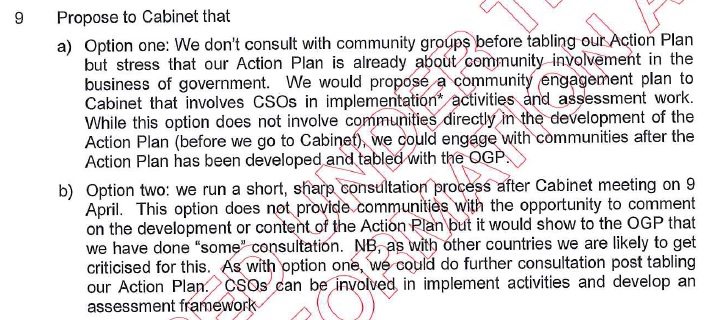
In the end they went for option b, which as they note "does not provide communities with the opportunity to comment on the development or content of the Action Plan" - that is, does not comply with basic OGP principles. Their excuse for this was tight timelines - but their own timeline shows months of consultation with other government departments. The public, though, we're an afterthought - when we were supposed to be at the heart of this process.
This is a basic failure to comply, right from the very beginning. And we deserve to be internationally criticised for it.
Tuesday, November 10, 2015
Open Government: Doing it wrong from the very beginning
Posted by
Idiot/Savant
at
11/10/2015 12:10:00 PM
Labels:
Freedom of Information,
OGP,
OIA,
Participation
A government not worthy of the name
Yesterday, after months of abuse, tensions at Australia's immigration gulag on Christmas Island boiled over, with protests and riots. While the protests were triggered by the suspicious death of an escaped prisoner, they had apparently been brewing for some time, with Serco guards accused of brutal assaults. The Australian government has apparently refused to negotiate to enable a peaceful de-escalation, and the prisoners are now worried that they will be shot or brutalised when the guards invade.
There are 40 New Zealanders among the prisoners, and yesterday John Key was asked what he was going to do to protect their safety. His answer? Nothing:
Mr Key said his office had received a briefing on the riot and he understood a small number of New Zealanders might have been involved.A government which will not even raise its voice to protect its citizens is not worthy of the name. And the leader of such a government? They're just a spineless quisling.
However, any incidents at the detention centre were a matter for the Australian government, he said.
"If there was a problem at Paremoremo [Prison, in Auckland], I don't think the Australian Prime Minister would fly over or the Australian officials would fly over to Paremoremo," he said.
"[Christmas Island] is an Australian Corrections facility."
There are kiwis on Christmas island, and our government ought to be concerned about their safety. They should immediately send an observer to provide consular assistance to those in detention, and make it very clear to the Australians that they will be held accountable if any of our people is injured by its goons. While prisoners have protested and rioted, and Australian law must take its course, it does not permit beatings and broken bones as punishments, and it does not permit indiscriminate violence against suspects, let alone bystanders. Australia needs to know that we will be watching, and asking questions, and demanding prosecutions for abuses if necessary. And fuck our "friendly relationship". "Friends" don't stick each other in indefinite detention for petty crimes, and "friends" don't beat and brutalise each other. And if Australia persists in being the sort of country which does this, I think we need to make it clear that we can no longer be friends.
Posted by
Idiot/Savant
at
11/10/2015 11:31:00 AM
Labels:
Australia,
Detention Without Trial,
Foreign Policy,
Immigration
Monday, November 09, 2015
The cost of defending the indefensible
Last month the NZDF settled a four-year defamation case brought by investigative journalist Jon Stephenson, admitting that they lied to damage his reputation. So how much did it cost them to defend the indefensible? Over $600,000:
How many taxpayer-funded lawyers does it take to fight a journalist?
In the case of the defamation action brought against the New Zealand Defence Force by war reporter Jon Stephenson, the answer is 15.
In response to an Official Information request by the Herald, the Defence Force revealed it used 12 lawyers - including six senior practitioners - from the Government's legal arm, Crown Law, plus three external barristers.
In total it spent $643,000 defending itself, of which $468,000 was spent on the external barristers.
And once you factor in the cost of the confidential settlement (which may have included paying Stephenson's legal fees as well), we're looking at anywhere from three-quarters of a million to one and a half million dollars. And all because the NZDF attempted to undermine a factual story by lying to damage a journalist's reputation.
That's a very expensive "mistake", not to mention a complete waste of public money. And the people at NZDF who made it need to be held accountable for it.
Posted by
Idiot/Savant
at
11/09/2015 03:06:00 PM
Labels:
Defence,
Freedom of Information,
Media
Being a decent human being is now "terrorism"
The latest terror threat according to the UK? Helping refugees:
British volunteers on a humanitarian aid run to refugees in Calais were detained by police under legislation meant to be used against suspected terrorists, an aid group has told the Independent.
Two people working with the London2Calais group said they were stopped and held for three hours under Schedule 7 of the Terrorism Act 2000 while returning to the UK at Calais.
[...]
London2Calais, which has raised around £13,000 on the crowd funding website IndieGoGo, has run a number of convoys delivering aid to refugees trapped on the other side of the channel.
The group has since August distributed thousands of food packages at “the Jungle” refugee camp and says it has also delivered clothes, sleeping bags, a water pump, and a power generator intended to be used for a school located in the camp.
Schedule 7 powers allow people to be stopped and searched at the UK border to determine if they are a "terrorist" - that is, someone who has committed or is preparing to commit various offences relating to membership of, funding, or support for a terrorist group. The subtext: the British state either thinks refugees are terrorists, or that aid groups are. Or, to put it another way: being a decent human being is now defined as "terrorism" in Britain. Which, given that their establishment has been deliberately inculcated with sociopathy by their private schools, is sadly unsurprising.
This is a disgusting abuse of anti-terrorist powers to harass and criminalise those attempting to assist with an appalling humanitarian crisis the British state has helped cause and now seems intent on turning its back on. But isn't that so very, very British?
Posted by
Idiot/Savant
at
11/09/2015 01:30:00 PM
Labels:
Refugees,
UK,
War on Terror
Standing for nothing
The Labour party held its annual conference in Palmerston North over the weekend, and the big news is that they dumped their core policies from last election. A capital gains tax to fix the housing market and stick it to MPs? Gone. Their reason? Not because they'd carefully studied the empirical evidence on such instruments and decided that it wouldn't achieve their goals, or even that they've abandonded those goals for other priorities, but because (in the words of Grant Robertson):
"We didn't do well at the election last year and we have to have a look at the policies that were part of that."And so instead, we have a bunch of mild tinkering around the edges. And that's supposed to inspire people to vote for them?
This is Labour's problem in a nutshell: the party is empty at its core. They don't stand for anything, except possibly for Grant Robertson getting paid $250,000 a year instead of Bill English. They have no values, and no policies that won't be chucked away after the next poll. And as a result, you can't trust them to deliver, because what they're offering will change three times over before the next election. Do they favour raising the superannuation age or not? They did, now they don't, and who knows what they'll think next week. While I'm pleased they dumped that policy, the fact that they didn't do it for any principled reason - or any reason at all, other than "we lost an election and need something to blame rather than ourselves" - means I can't have any confidence that it won't be back. And as a result, I can't possibly vote for them.
And you can repeat that narrative for every other policy they have. I'm not saying that parties should have their policies fixed in stone and unchanging. But they need to have something at their core, something they can point to to justify changes, something to stand for. Because if your value proposition is just "our bums on seats instead of theirs", sorry, I'm not buying.
Posted by
Idiot/Savant
at
11/09/2015 10:52:00 AM
Labels:
Labour
Friday, November 06, 2015
National's failure on housing
Two years ago National announced its "solution" to the housing crisis: the creation of "special housing areas", with fast-track consenting. This was supposed to unlock new land for new houses, increasing supply and making homes more affordable. So how has it worked out in practice?
Badly:
Two years after auckland council and the government signed a "housing accord", only 102 houses are known to have been built under its "fast-track" rules.
All of them have been constructed in just two areas: Weymouth and northern tamaki. The council is not aware of any homes being completed under the fast-track provisions in any of the other 95 special housing areas (SHAs).
Instead, at least two blocks of land and a commercial property have been put up for sale after their value was boosted by being designated as SHAs. One was advertised as "a land-banking option".
At least one other property owner has opted out of the fast-track provisions allowed under the SHA rules because these require a proportion of "affordable" housing.
This is simply dismal. Instead of new houses, National's policy has simply resulted in more speculation by land-bankers. Heckuva job you've done there Nick. You can be really proud of yourself.
It is clear by now that the market will not solve the housing crisis. In fact, it is not interested in solving the housing crisis, because there's no profit in that. If we want every kiwi to have a home, we're going to have to fall back on the tried and tested solution, the one we know works: getting the government to build them.
Posted by
Idiot/Savant
at
11/06/2015 12:30:00 PM
Labels:
Housing,
National
Thursday, November 05, 2015
"Oversight"
Yesterday, in her annual report, the Inspector-General of Intelligence and Security claimed that Ministers provided oversight of intelligence agencies. The reality is a bit different:
Under questioning by the Green Party, the Minister in-charge of the SIS admitted that he was only told of the breach of law in relation to visual surveillance in October. This was four months after the reporting period of the Inspector-General of Intelligence and Security's annual report which ended in June 2015. The Minister was only told two weeks before the report was released.
“The visual surveillance laws are new powers and it is unsettling that the Minister wasn’t monitoring their implementation very closely,” said Green Party Co-leader James Shaw.
“These breaches of law happened between January and June, and the Minister was only told in October, which means he was in the dark for at least four months. That is not a Minister who knows what is going on in his department.
Some "oversight".
But its not just the Minister who looks bad (in fact, he looks like a complete fool at best, if not a willing accomplice to wrongdoing who actively turns a blind eye). Because its clear from that timeline that the SIS concealed their unlawful behaviour from him, and didn't tell him until their hand was forced by the Inspector-General's impending publication of her report. And that's fairly and squarely on their Director, Rebecca Kitteridge. Its unacceptable behaviour from a chief executive, and she should be sacked for it.
Posted by
Idiot/Savant
at
11/05/2015 04:05:00 PM
Labels:
Democracy,
SIS
"Threats"
The New Zealand Herald has a scoop this morning - the New Zealand Intelligence Community's 2014 Briefing to the Incoming Minister, extracted from the government at Ombudsman-point. The BIM includes the "six security problems that [the government] should really worry about": violent extremism, loss of information and data, hostile intelligence operations in and against New Zealand, mass arrivals, trans-national organized crime, and instability in the South Pacific. These "threats" are used to justify a demand for more money and more powers. But what's apparent is just how insignificant and unlikely those threats actually are.
The biggie of course, is "violent extremism". Our spies are concerned that kiwis might become radicalised and start conducting terrorist operations here in New Zealand. And they point to "significant migration... creating communities [in New Zealand] with distinct identities and links to overseas". Like pakeha, I guess. But what's worth remembering is that this has never happened here, and that, on current tolerance settings, it seems highly unlikely. And looking at Australia and the UK, SIS or police intervention to spy on those targeted communities is likely to increase any risk rather than reduce it, by creating a sense of oppression and encouraging retaliation. On our biggest threat, the only thing our spies can do is make it worse.
What about the rest? Mass-arrivals in an Aussie beat-up, driven by Australian racism rather than New Zealand's interests. "Loss of information and data" and "hostile intelligence operations" are the same thing, and ought to be SIS and GCSB's bread and butter - but again, doesn't seem like a huge threat, and is driven by economic rather than physical security concerns. Trans-national organised crime is a police matter, not something for the spies. As for South Pacific instability, there's nothing we can do about it anyway, so there's little purpose in worrying about it.
(Our spies also see one of their chief purposes as "help[ing] protect and grow the economy". I don't think most New Zealanders would agree with this at all).
Basicly, these threats are small, unlikely, and unable to be effectively responded to anyway. And once again, it looks like our spies are engaging in cargo cult policy, hyping the threats of concern to their overseas partners in an effort to be part of the club. Meanwhile, the real threats to New Zealand - like climate change - are entirely unmentioned.
In conclusion, its difficult to see why we're throwing a hundred million dollars a year (and increased powers) at these muppets to produce bullshit like this.
Posted by
Idiot/Savant
at
11/05/2015 02:55:00 PM
Labels:
Freedom of Information,
GCSB,
SIS,
SMERSH
Doubling down on tyranny
Since Edward Snowden exposed the Five Eyes' unlawful mass surveillance two years ago, there has been public outrage around the world. In the US, this has resulted in a pushback against spying, and some limitation of the NSA's powers. In the UK, however, the government is doubling down on tyranny, introducing a comprehensive domestic mass-surveillance regime:
The draft investigatory powers bill explicitly puts into law for the first time the surveillance activities of the intelligence agencies and police and proposed new powers requiring internet and phone companies to track every website visited for a maximum of 12 months.
[...]
The security services’ ability to hack computers and phones around the world – for purposes of national security, serious crime and economic wellbeing – is also explicitly recognised in the draft bill. The security services only acknowledged they had these powers in February.
They're also planning to ban encryption and require ISPs to collaborate with the spies in hacking their customer's data. The net result is totalitarian mass surveillance, with anyone's online life able to be excavated and scrutinised if they ever come to the attention of the state for any reason. In the process, it creates huge security flaws: backdoored encryption means online transactions (such as your banking) simply cannot be trusted, while the huge new repositories of people's data can be hacked and used for blackmail (and I think that'll be a fun game: hacking the online records of MPs who voted for this and exposing all their dirty little secrets). But the British government doesn't care about that; all it cares about is handing more power to spies to suppress dissent. And while this is supposedly all targeted at "Islamic terrorists" who want to kill people, past practice tells us that the real targets will be human rights activists, anti-war protestors, environmentalists, politicians, and others exercising their right to advocate for peaceful, democratic change.
But its not really about the targets. No government should have these powers. They are fundamentally incompatible with democracy. They are fundamentally incompatible with freedom. And again, my recommendation to people living in the UK is simple: if you want your freedom, leave.
Posted by
Idiot/Savant
at
11/05/2015 01:13:00 PM
Labels:
Democracy,
Privacy,
UK
Wednesday, November 04, 2015
Choices
In Parliament today, the opposition rightly grilled the government over this morning's appalling unemployment figures. Which led to this little exchange:
Andrew Little: What responsibility, if any, does he take for unemployment rising to 6 percent?
Hon BILL ENGLISH: Of course, if unemployment was a direct choice of the Prime Minister of New Zealand, there would be none of it. You would just decide to have none. But, of course, it is not.
Except that it is. To point out the obvious, past New Zealand governments kept unemployment close to zero by the simple expedient of hiring people. That's the extreme case, but more generally, policy has an impact (if it didn't, National wouldn't fight so hard to control it, and their backers wouldn't fund a party to do that). And policy is chosen by the government.
So what has our government chosen? It has chosen to sustain unemployment consistently at around 6% (vs the less than 4% chosen and sustained by the previous Labour government). It has done this to keep wages low and workers insecure. It is in denial, and the mechanisms by which it chooses this are fairly indirect - inflation targeting and government spending - but it is still a choice. And it should own and be honest about that choice. The reason it doesn't, of course, is because it is an unpopular choice, and because saying "we have chosen to have 6% unemployment" fatally undermines their punitive campaign against the victims of that choice, the unemployed. And fundamentally, they refuse to own that choice for fear that we might hold them accountable for it.
The same goes for other areas. Child poverty is a choice. A housing crisis is a choice. The gender-pay gap is a choice. All of these areas are subjects of, influenced by and amenable to government policy. National has chosen poor outcomes in all of these areas while pretending powerlessness and disclaiming responsibility. And we should hold them accountable for that.
Posted by
Idiot/Savant
at
11/04/2015 04:07:00 PM
Labels:
National,
Unemployment
Democracy stops bombing
In 2003, in the leadup to Iraq, the UK government sought the consent of Parliament to go to war. While aimed at provided Tony Blair PR cover and making the opposition complicit in his decision (thus making it harder for them to criticise it), the vote also established a constitutional convention. That convention was reinforced in 2013, when David Cameron sought Parliamentary approval to bomb Syria, and was voted down. And now, the need for a Parliamentary vote has deterred another bombing campaign:
David Cameron is to shelve plans to call a House of Commons vote to approve British airstrikes against Islamic State (Isis) targets in Syria in a belief that he has failed to win over enough Labour MPs and a recognition that Russia’s military intervention has complicated the picture.
Downing Street has decided that RAF involvement in coalition airstrikes against Isis targets should not be extended from Iraq. There are fears that the prime minister would be weakened on the world stage by a second parliamentary defeat over military action in Syria.
Ministers had been discussing a potential Commons motion with Labour MPs as recently as 10 days ago, but the government has undergone a change of heart after failing to win the support of sufficient Labour MPs to be confident that it can overcome what is likely to be a sizeable Conservative rebellion.
Of course, the US is still bombing Syria (as is Russia), but the UK won't. And stopping them from becoming further entangled in that clusterfuck and making things even worse is a Good Thing.
...which illustrates why we desperately need Parliamentary approval for military deployments here. It would bring democracy to our most important foreign policy decisions, while ensuring that there is in fact majority support for it. But the latter is precisely why successive governments have opposed this change.
Posted by
Idiot/Savant
at
11/04/2015 02:43:00 PM
Labels:
Democracy,
Syria,
UK
More fraud from Volkswagen
First, Volkswagen was found to be cheating on their particulate emissions tests from their disel cars. Now, they've admitted cheating on CO2 emissions as well:
The crisis at Volkswagen has deepened after the carmaker found “irregularities” in the carbon dioxide levels emitted by 800,000 of its cars.
An internal investigation into the diesel emissions scandal has discovered that CO2 and fuel consumption were also “set too low during the CO2 certification process”, the company admitted on Tuesday night.
The dramatic admission raises the prospect that VW not only cheated on diesel emissions tests but CO2 and fuel consumption too.
VW said it estimated the “economic risks” of the latest discovery at €2bn (£1.42bn). The company said the “majority” of cars involved have a diesel engine, which implies that petrol cars are involved in the scandal for the first time.
The diesel emissions fraud was clearly pre-meditated, and it looks like this is too. So we have a company with an institutional culture of trying to cheat its way around the law and basic vehicle environmental standards rather than comply with them. And it needs to be held to account for that, by fining it into bankruptcy if necessary.
Posted by
Idiot/Savant
at
11/04/2015 02:28:00 PM
Labels:
Crime,
Environment
46,000 unemployed under National
The Labour Market Statistics were released today, showing that unemployment has risen again to 6%. There are now 151,000 people unemployed, 46,000 more than when National took office.
And its worse than Monday's dismal expectations - employment has fallen. So rather than the economy simply failing to keep up with the number of people wanting a job, it is actually shrinking.
But that doesn't matter to National. Their economic policy has all along been focused on creating and maintaining a reserve army of labour to keep wages down. And provided their mates at the top are making out like bandits, they don't care what happens to ordinary kiwis.
Posted by
Idiot/Savant
at
11/04/2015 02:06:00 PM
Labels:
Inequality,
Left,
Unemployment
The SIS is unfit for purpose
The Inspector-General of Intelligence and Security released their annual report [PDF] this morning. The headline news is buried in a single sentence right near the end:
I cannot conclude that NZSIS had sound compliance procedures and systems in place.
Given the importance of that statement - it is basicly saying that the SIS is unfit for purpose and that we have no robust way of determining whether they are obeying the law - you'd expect it to be headlined at the front of the report. Instead, its buried on page 48 (of 52). Doing that shows a fundamental misunderstanding by IGIS of their purpose. They're meant to be a watchdog, and when they find that scale of failure, they need to bark, and bark loudly. Instead, they've given us a quiet little whisper, in a manner apparently designed not to be noticed. To point out the obvious, this is unlikely to build public trust in the office, the utility of its "oversight", or in the institutions it is supposed to be watching.
As for the rest of the report, its a litany of abuse and failure. Some highlights:
- The SIS bullshitted their Minister in applications for certain complex and sensitive warrants, deliberately omitting information on the operations and "cooperation" with (or it seems, instigation by) other agencies which if included, might have meant that "the application might not have in fact met the statutory criteria" and/or "those involved in authorising each warrant might have reached different conclusions on these applications" (p. 21). Which shows the lie behind the claim (made by the IGIS at the beginning of their report) that Ministers are an effective check and balance. The spies control the information, they determine "need to know", and they can and clearly do mushroom Ministers to get the outcomes they want.
- The SIS has persistent and systemic problems with the fairness and accuracy of vetting for security clearances. They don't collect all relevant information, they don't assess it for bias, and they certainly don't allow applicants for security clearances to respond to concerns as required by the right to natural justice. These problems have featured in IGIS reports since at least 2008, and SIS has done nothing about them. SIS now claims to have done something, and I guess we'll see whether these problems keep popping up in future reports.
- Despite a clear legal requirement to provide visual surveillance warrants to the Inspector-General for review "as soon as practicable", SIS didn't bother to do this.
- Remember John Key's claim that the GCSB isn't collecting metadata on kiwis? They might not be, but our "partners" are, and so much of it that they accidentally access it with a typo (p. 36). Unstated: because its all in the same spy-cloud, its all there should the GCSB or SIS ever want to look.
- Despite revelations of persistent wrongdoing from both Edward Snowden and IGIS, the Inspector-General hasn't had a complaint under the Protected Disclosures Act in the past ten years (and maybe ever), and didn't even have a procedure for handling one. This has been fixed, but it points to a significant cultural problem in our spy agencies.
- IGIS is inquiring into what the SIS does with vetting material. As this is basicly blackmail on every senior public servant in Wellington, there are obvious questions around both security and retention.
- IGIS is inquiring into whether NZ intelligence agencies' "engagement" (knowledge / benefit / contribution to) US torture.
The overall picture is that SIS is a mess and highly resistant to change, or basic compliance with the law and democratic norms. GCSB seems to be more open to reform, but there still clearly huge problems, both with what they do (regardless of legality) and with their internal culture. The complete lack of whistleblowing complaints speaks volumes.
As for the SIS, the failures disclosed in this report should be a death-knell for granting them any further powers - they clearly cannot be trusted with the ones they've got. Sadly, I expect these failures will be ignored by Ministers and their rubberstamp review team.
Posted by
Idiot/Savant
at
11/04/2015 01:51:00 PM
Labels:
GCSB,
SIS,
SMERSH
Tuesday, November 03, 2015
Ending a sham collaboration
Five years ago the government launched the Land and Water Forum, a "collaborative process" between polluters and environmental groups aimed at producing "a common direction for water management in New Zealand". Now, Fish and Game has called bullshit on that process and pulled out:
A key member of a national water use and quality taskforce has quit, blaming the Government for "a lack of good faith" over collaboration.
Fish and Game New Zealand - the first to coin the phrase "dirty dairying" - formally resigned from the Land and Water Forum last week.
Chief executive Bryce Johnson said changes to the forum's rules around membership and restrictions on the ability to speak out had "essentially compelled us to resign".
And judging by Forest & Bird's press release today on the McKenzie Basin, where they accuse the government of ignoring its own collaborative process to undermine conservation goals, they're set to follow. And they should. Because an OIA release from MBIE on the Extractive Industries Transparency Initiative (which uses a similar "stakeholder engagement group" model) made it very clear how the government sees such processes: as a way of suborning and silencing critics while increasing "social licence" to pollute. And faced with such bad faith "engagement", environmental groups are far better to refuse to engage.
Posted by
Idiot/Savant
at
11/03/2015 04:35:00 PM
Labels:
Dirty Dairying,
Environment,
Participation,
Water
Leeches
Its business results season, with the usual announcement that Australian banks are helicoptering huge piles of cash over the Tasman:
All four major Australian-owned banks have continued record runs of profitability, with a combined haul of $4.59 billion.
The staggering figure represents more than $1000 for every person in New Zealand, but an expert says the scale of the business justifies the rewards.
Really? To put that in context, our GDP is $240 billion. So, they're taking two percent of that, simply as profit. Its like an Aussie bank tax, but instead of being re-invested in New Zealand to benefit kiwis, it goes straight back to Australia.
This is why we need Kiwibank, and why ultimately we need to regain control of our own financial sector. Because Aussie banks are a huge drain on our economy, a permanent siphon which robs us of the capital we need to grow. They're leeches, sucking us dry.
Posted by
Idiot/Savant
at
11/03/2015 01:44:00 PM
Labels:
Economic Policy,
Inequality,
Left
Bigotry and homophobia are a core part of Northern Irish Protestantism
At least, they are if you believe the Democratic Unionist Party, which today vetoed Stormont's passage of a marriage equality bill on the basis that it undermined protestant rights:
Northern Ireland’s assembly voted narrowly in favour of gay marriage equality but the largest party in the devolved parliament, the Democratic Unionists, have since vetoed any change in the law.
Four independent unionist assembly members joined nationalists and others with 53 votes in favour of same sex marriage – just one vote ahead of the main unionist parties who oppose any reform.
But the motion in the regional parliament fell after the DUP used a “petition of concern” to argue that the law change that would allow same-sex couples to marry in Northern Ireland did not command sufficient cross-community support.
Under the complex rules of power sharing in the region, parties from either the unionist or nationalist community can use this mechanism if they feel there is not enough backing from Protestants or Catholics for particular legislation. It was designed to ensure no one community dominated the other following the 1998 Belfast agreement.
So, we have a mechanism designed to protect minority rights, being used by bigots to suppress the rights of other minorities.
Northern Irish Protestants are surely better people than this, aren't they? And if they are, they really need to find a better party to represent them.
Posted by
Idiot/Savant
at
11/03/2015 01:22:00 PM
Labels:
Homophobia,
Marriage,
Northern Ireland
John Key loves feudalism
Yesterday Australia abolished its use of feudal titles (again). But John Key says it will never happen here:
Prime Minister John Key says knighthoods and damehoods are more popular than ever in New Zealand, with no plans to follow Australia in scrapping them.Of course not - he has donors and cronies to pay off. Because that's what knighthoods are actually used for: as a corrupt source of revenue and patronage for the National Party.
Australian Prime Minister Malcolm Turnbull announced a decision to remove knighthoods on Monday, saying the Cabinet had decided the titles were "not appropriate in our modern honours system".
Key, who restored titular honours in 2009, said he stood by the decision and had no plans to follow Turnbull.
The sooner we abolish them, the better.
Posted by
Idiot/Savant
at
11/03/2015 01:16:00 PM
Labels:
Corruption,
John Key,
Republicanism
Monday, November 02, 2015
Australia abolishes feudalism again
Tony Abbott is fortunately gone, but one thing he will be remembered for is his "captain's call" to bring back knighthoods and award them to "pre-eminent Australians" such as Phillip Schleswig-Holstein-Sonderburg-Glücksburg. It reminded everyone of why they hated feudalism, and made Abbott a laughing-stock. But Abbott was overthrown as Australian Prime Minister last month, and his archaic feudal titles have been dumped with him:
Prime Minister Malcolm Turnbull has dumped knights and dames from the Order of Australia, after Cabinet agreed they were not appropriate in Australia's modern honours system.
Former prime minister Tony Abbott re-introduced the old-style imperial honours in 2014 and at the time, said up to four would be bestowed each year.
Mr Turnbull has released a statement saying the Queen has agreed to remove the honours.
"The Cabinet resolved to recommend to Her Majesty that she amend the Letters Patent, which establish the Order of Australia, so that Knights and Dames would no longer be appointed to the Order," the statement said.
Good riddance. Australia had gone 25 years without tugging the forelock to feudalism, and its good to see that reassert itself. And hopefully, a future government will do exactly the same here.
Posted by
Idiot/Savant
at
11/02/2015 01:06:00 PM
Labels:
Australia,
Republicanism