Friday, September 29, 2017


This is not what phone taps are for

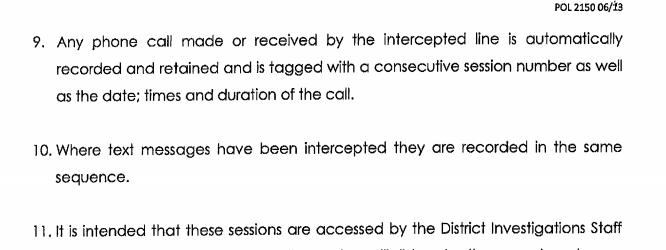
Yesterday I ranted about the police spying on People Against Prisons Aotearoa. That rant was mostly predicated on the idea that the police had gained a production order for "call associated data" - call records, text messages, and voicemails - from the protesters. But the case has been covered in international media today, including parts of the police statement to the court. And that statement implies that the police didn't obtain a production order, but a full surveillance device warrant:

A police statement to the court, obtained by VICE, said the phone calls and text messages of those members were continually monitored and recorded, and accessible by the direct investigation staff.
1506635656627-Screen-Shot-2017-09-29-at-104546-AM.png
That's right: the police tapped people's phones and recorded their calls in a trespass case. One which was so serious that when it went to trial, it resulted in a discharge without conviction.
Supposedly, surveillance warrants are only available for serious crimes - either those with a penalty of 7 years or more in prison, or certain drug and firearms offences. It is difficult to see how a political protest could possibly fall into either category, and therefore how the police could legally have obtained this warrant. And these are certainly not the circumstances which Parliament or the people of New Zealand expected or permitted these spying powers to be used. It is a gross abuse of power, and one which directly threatens our democracy. We should not tolerate it. The police - and the judge who granted this odious, abusive warrant - must be held to account.

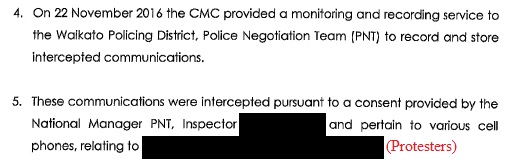
Update: This gets worse. I've obtained the police statement, and there's no mention of a warrant at all - just a "consent", given by a police officer, to tap the phones of other people:
ProtestWiretap

This may be internal police bureaucratese, but you'd expect a statement to a court about an interception to state the legal basis under which it was carried out. None is included, leaving only this "consent". Which is obviously a nonsense - a police officer can no more "consent" to tap your phone as you can "consent" to tap theirs. So I really am wondering what the hell went on here. Its outrageous enough if the spying was legal - but if it was illegal, it makes it orders of magnitude worse. And either way, this is not what police, or interception powers, are for.

New Fisk

I'm all for war crimes trials in The Hague – so long as we agree to prosecute every possible war criminal

Climate change: Good news for once

Some good news about climate change for once: emissions have stalled again:

Global emissions of climate-warming carbon dioxide remained static in 2016, a welcome sign that the world is making at least some progress in the battle against global warming by halting the long-term rising trend.

All of the world’s biggest emitting nations, except India, saw falling or static carbon emissions due to less coal burning and increasing renewable energy, according to data published on Thursday by the Netherlands Environmental Assessment Agency (NEAA). However other mainly developing nations, including Indonesia, still have rising rates of CO2 emissions.

Stalled global emissions still means huge amounts of CO2 are being added to the atmosphere every year – more than 35bn tonnes in 2016 – driving up global temperatures and increasing the risk of damaging, extreme weather. Furthermore, other heat-trapping greenhouse gases, mainly methane from cattle and leaks from oil and gas exploration, are still rising and went up by 1% in 2016.


And even flat emissions are easily enough to cook the planet. We're already seeing the results, with heatwaves, hurricanes, and droughts. And if we want to avoid them getting much, much worse, we need emissions to seriously reduce, not just stay static.

As for what the New Zealand government is doing, the answer is of course nothing. National has committed us to high emissions in the name of protecting trucking and dairy industry profits, apparently in the belief that they can just buy their way out of this. But money doesn't stop tropical cyclones, and it doesn't stop the east coast from drying up and blowing away. If we want to stop those things, we need to actually do our bit, so others will do theirs too.

Thursday, September 28, 2017


More police spying

Apparently the police "wiretapped" members of human rights group People Against Prisons Aotearoa over a protest in 2016 in which they occupied a Department of Corrections office. Its unclear whether the wiretapping was of live phone calls (requiring an interception warrant, in theory only available for offences with a penalty of seven years imprisonment or longer), or of text messages under a production order (which has a much lower threshold). But even if it is the latter, it is highly disturbing. Spying on people's private communications should require a high threshold. Here, the police are using it for trespass. Which isn't exactly what most people consider to be serious crime. Instead, it looks as if the police used the excuse of the protest to pillage the communications of their critics to gather intelligence - aided and abetted by their phone companies (who obligingly retain messages and call data for three to six months just in case the police want them).

The Bill of Rights Act is supposed to protect us against unreasonable search and seizure. This seems to be the very definition of "unreasonable". It is neither necessary nor proportionate to the offence for the police to be able to snoop through all your private messages in such circumstances. And they need to be stopped from doing so. A requirement restricting the use of production orders to crimes carrying a penalty of a year or more in prison would be a good start.

New Fisk

Saudi Arabia lifting the driving ban is little more than a glitzy distraction from its continued geopolitical problems

An opportunity for fixed-term Parliaments

Post-election, we've had days of feverish speculation about coalition alignments and bottom lines, as political journalists desperate to make wordcount interview their keyboards rather than kicking back and taking the opportunity for a holiday. But in all that speculation, one thing that hasn't cropped up yet is how Winston will protect himself from whoever he chooses as a coalition partner. Because an obvious nasty strategy for the big parties is to wait until NZ First's popularity drops, then call an early election, resulting in their being eliminated from Parliament (and in the case of National, likely winning 3 years of single-party government).

There's an easy solution to this, of course: fix the date of elections. This disarms the Prime Minister and makes it clear the public expect the politicians to play the hand we deal them, rather than being able to roll the dice to get another one. Germany does this, with its Basic Law requiring that elections be held between 46 and 48 months of the beginning of the legislative session (and prohibiting early ones unless the government votes itself out of office). And the UK passed the Fixed-term Parliaments Act 2011 in an effort to prevent the Tories screwing over their then coalition partners (but coalition did that quite nicely by itself). Given that both the German and UK provisions have been abused, I think that we'd want stronger ones: a fixed election date (the first Saturday after September 19 every three years has been suggested), and a requirement for a two-thirds majority to call an early election. This would allow Parliament to be dissolved early if in absolute deadlock, while preventing a government voting itself out of office for electoral advantage.

The only question is whether Winston trusts National and Labour, or whether he wants to protect himself (and us) against their potential abuse of power. Personally, I'm hoping for the latter.

Wednesday, September 27, 2017


Something to go to in Wellington

Tomorrow is Right to Know Day, and the Ombudsman and Privacy Commissioner are celebrating it with a livestreamed discussion of transparency and privacy rights:

Ombudsman Leo Donnelly, former Assistant Privacy Commissioner Katrine Evans, and Bryce Edwards from Transparency International will discuss the importance of the right to access information. The forum will be chaired by Radio New Zealand News Director and former political editor Brent Edwards.

‘The Privacy Act and the Official Information Act are among New Zealand’s most important pieces of legislation’, Leo Donnelly said, ‘giving New Zealanders the right to request personal information that organisations hold about them or that affects them, and to complain if the information is withheld’.


The discussion will be held from 12:00 - 13:00 in the Mokopuna Room, Te Wharewaka o Poneke Function Centre, Wellington Waterfront. If you want to attend in person, register here. Otherwise, it'll be livestreamed on Periscope and you'll be able to watch it on YouTube.

A democracy does not do this

Spain has ordered police to blockade polling places to prevent Catalonia from voting on independence:

Police will be deployed at polling stations to prevent people from voting in the Catalan independence referendum, the Spanish government has confirmed.

Although the Catalonia regional government has insisted the unilateral poll will go ahead on Sunday, the Spanish government has vowed to stop the vote, which it says is a clear violation of the constitution. Spain’s constitutional court has suspended the legislation underpinning the referendum while it rules on its legality.

A spokesman for the Spanish government’s Catalan delegation said on Tuesday that the region’s prosecutor had ordered the Mossos d’Esquadra, Catalonia’s police force, to take control of polling booths and identify those in charge.

“The order has been conveyed and it will be executed with all normality,” he said.


The Spanish government has already seized the ballot papers, so the point may be rather moot. At the same time, its a democratic outrage. This is not how democracies behave. Instead, it seems like Spain is regressing back to its days of fascism and cultural suppression (not helped by the fact that its current government are the unapologetic heirs of Franco).

But as well as being outrageous, it is hugely counter-productive. 70% of Catalans support a referendum. That number is likely to increase. And faced with this sort of oppression, support for independence is likely to increase as well. If Spain wants to radicalise the Catalan population and drive them towards unilateral secession, they couldn't have picked a better strategy for doing so.

This is MMP working, not failing

Writing in Stuff, Julian Lee argues that MMP has failed because so few minor parties were elected to Parliament this election. I share the disappointment at the lack of diverse representation and the apparent narrowing of our political sphere, but that isn't due to any failure of MMP. With a Gallagher Index of 2.7, this election wasn't especially unrepresentative in terms of votes equating to seats. MMP seems to have done a better job at ensuring that seats reflected public support than it did last time (when the Gallagher Index was 3.82), or in 2008 (when it was 3.84). Instead, the reason there are so few minor parties represented in Parliament this time is because people didn't vote for them. And that's not the fault of MMP - or at least, no more so than in any previous MMP election.

So whose fault is it? Minor parties can fairly point the finger at the media, who excluded them from debates and whose horse-race style of journalism implicitly stacked the deck against them. And they can point the finger at the election broadcasting rules, which seem designed to lock in a big party duopoly by preventing other parties from buying advertising. But that's the unfair game they've had to play for the last 21 years. They've done better at that game in the past, so fundamentally they have no-one to blame but themselves for their worse performance this time.

That's not to argue that MMP is perfect. As Lee notes, many countries use no-threshold electoral systems, and this would have produced a much more proportional result (and TOP would probably be showing us right now whether their plan of supporting environmental vandals to save the environment would work). As I've argued before, the 5% threshold is an arbitrary and undemocratic barrier to political competition, and it needs to go. But even without it, the blunt truth remains: if parties want to be represented, they need to persuade people to vote for them. And if they can't, they have no-one to blame but themselves.

Tuesday, September 26, 2017


Renationalisation in the UK?

In the UK, successive governments under Thatcher and Blair privatised everything they possibly could, hocking off public assets at bargain-basement prices to donors and cronies. Those privatisations were (naturally) a disaster, with railways, water companies, and even the royal mail gutted and falling into ruin as the new owners looted them for dividends rather than providing the services they were supposed to. And now, UK Labour has had enough, with Shadow Chancellor John McDonnell promising to take it all back:

The Shadow Chancellor also vowed to press ahead with Labour’s nationalisation programme, saying: “Rail, water, energy, Royal Mail – we’re taking them back.”

Earlier, he hinted Labour would deny shareholders full compensation if the private firms currently running key utilities have behaved badly.

Politicians would decide if full market value would be awarded when were taken back into public ownership, with the price affected by “perceived behaviour”.


They're also promising to unravel corrupt PFI (public-private partnership) contracts as well, to cut the bankers and looters out of government services.

We need to do the same here with the strategic assets that National has stolen from us (or at least the ones worth keeping). Meridian Energy, Mighty River Power, Air New Zealand, we need them back in public ownership (fossil-fuel-powered Genesis OTOH can simply be regulated into oblivion with the rest of that industry). Our electricity sector is too important to be left to private sector mismanagement.

Monday, September 25, 2017


It could be worse

While New Zealand's post-election negotiations look unpleasant, they could be worse. Germans voted today in federal elections, and dealt their parties a really shit hand:

Germany is braced for a period of fraught and protracted coalition talks after Sunday’s elections left an unprecedented number of parties jostling for influence in the next parliament.

With Angela Merkel’s Christian Democratic Union, the centre-left Social Democratic party (SPD), rightwing populist Alternative für Deutschland, pro-business FDP, leftwing Die Linke and the Green party, six parties will crowd into the Bundestag’s plenary chamber, a first since the introduction of a 5% hurdle for parliamentary seats in 1953.

Having gained the largest percentage of the vote despite her party suffering its worst result since 1949, Merkel’s CDU will still need to find one or more coalition partners in order to find a governing majority, or pursue a minority government.


AfD are Nazis, and everyone has ruled out working with them. The CDU won't work with the Left, and vice-versa. The SDP has already refused to sign up for another suicidal grand coalition. So the only viable government seems to be the Christian Democrat / Free Democrat / Green "Jamaica" coalition. In NZ terms, that's National-ACT-Green, which gives you an idea of how likely it is. And yet, this is the hand the politicians have been dealt, and they need to find some way of making it work. And in Germany they can't just call another election in the hope of getting a better deal...

Now there's a surprise

ECan is saying that it is failing to meet its water-quality targets, while meeting its irrigation ones:

Canterbury is behind on its regional water quality targets, but is making strong progress on irrigation goals.

[...]

The report showed nitrate levels were increasing in about 25 per cent of monitored wells, and decreasing in about 4 per cent.

The target is to show "a demonstrable decrease in nitrate concentrations in shallow groundwater in priority areas" by 2020.

It was a poor result, said Canterbury medical officer of health Dr Alistair Humphrey.


This isn't that surprising, because irrigation means more cows, which in turn means more nitrates. So the targets are in direct opposition to each other. Canterbury has to choose between more irrigation, or safe water. And the only reason they haven't been able to choose the latter is because National has suspended their local democracy.

The only way is Winston

So, the election happened. And rather than seeing the stunning Jacindamania victory we were hoping for, instead we're left with an uncomfortable situation for everyone. National has clearly lost its mandate: their vote dropped, despite sucking up the 4% bigot vote from the Conservatives, and their coalition partners were eliminated. But Labour hasn't won one either, even in combination with the Greens. While the special votes will probably shift a few seats around, that overall outcome won't change. The Greens have already said that they won't support National, and despite the verbage from pundits desperate to make word-count, they're not going to change their mind (hint: its in the name. They're Greens, so supporting dolphin-murdering, river-poisoning, National-Park-mining environmental vandals is off the table, even if you ignore the commitment to social justice). So its basicly a question of who Winston decides to support.

If he supports National in a Black-Blue government, its pretty much a re-run of 1996: tough on crime, shitting on immigrants and beneficiaries. No more privatisation, and no increase in the pension age, but it will also mean broadly the status quo with added nastiness. Especially to Maori. Winston wants to eliminate the Maori seats, and English has refused to rule it out. Which tells us that the big difference between English and John Key is that English is a racist, just like Don Brash.

If he supports Labour, then things get messier, because it will also need to involve the Greens. There's significant common ground there over housing, worker's rights and economic justice, but also significant differences around climate change and fresh water. While a Red-Black-Green "Kenya" or "Afghan" coalition with all three parties in Cabinet is possible, the differences (and Winston's hostility to the Greens) may mean that one party sits out and simply provides confidence and supply. And TBH, given how government with Winston usually goes, I think the Greens should take that option: demand one big concession for confidence and supply, but promise nothing else, and effectively sit on the cross-benches to keep Winston honest. They'd lose the ability to push the government in a greener direction, but TBH I think the extra power to veto stuff is more important - and more likely to appeal to their supporters. Being in Cabinet with Winston when he shits on immigrants and refugees is probably not a place the Greens want to be.

Regardless, I expect whatever government which emerges to be unstable. Winston will throw a tantrum and walk out, or he'll want to retire to a corrupt sinecure appointment in London or Washington. And if he goes left, there's the added danger of National encouraging waka-jumpers. On current numbers, they only need to bribe two junior NZFirst MPs with Ministerial salaries to have a majority, and as we've seen from 1997, they're not above that. Its not going to be a comfortable term. But it will probably be an exciting one.

Friday, September 22, 2017


National's New Zealand

How bad is National's New Zealand? Whole families are homeless and sleeping in doorways:

A homeless family-of-eight are among those sleeping rough on the streets of south Auckland.

The couple and their six children were recently found lying in the entry of the Manurewa Citizens Advice Bureau by its board chairman Gordon Myer when he arrived for work two mornings in a row.

"They lay matting in the area and set their beds up in the foyer," he says.

"There's another group of people who sleep around the back. There's about seven or eight of them."


This is simply indecent, reminscent of the Victorian cities many of our ancestors fled here to escape. And we should not tolerate a government which permits it, which allows families to be left homeless and on the street and without support. Instead, we should take our opportunity tomorrow to vote to end this indecency.

New Fisk

A year on from the murder of Christian writer Nahed Hattar in Jordan, many questions remain unanswered

Last day to enrol

Today is the last day on which you can advance vote. It is also the last day you can enrol to vote - for some odd reason we don't allow enrolment on election day. So, if you're not enrolled, get along to an advance voting station and do it. Likewise if you think you might be busy tomorrow (and don't want your two hours paid time off to vote), or just want the whole thing to be over, get out there and vote! The polls are tight, so no matter who you support, every vote is going to matter.

The Electoral Commission has a list of advance voting locations here.

Thursday, September 21, 2017


WINZ steals from the poorest

Hot on the heels of yesterday's news of WINZ lawlessness, we learn that WINZ has been illegally underpaying the poorest beneficiaries:

More than 7000 of New Zealand's most-desperate beneficiaries have been short-changed by the Government - and they're about to get payback.

A Ministry of Social Development report has found 7148 people on Special Benefits have been underpaid by the Government since 2006, and they have known about it for two years. MSD have estimated the amount could be up to $9.5 million.

In 2015, MSD was advised that it needed to offer the Temporary Additional Support (TAS) to beneficiaries if they were better off on it.


And the short version is, they didn't. Instead, they deliberately kept people on the lower benefit and didn't inform them of their entitlement to the higher one, in order to keep benefit costs low. The good news is that they're going to have to pay it all back - but you can guarantee that they will make that process as slow and difficult as possible to ensure they don't have to. Because that's just how WINZ are: lawless, and focused on cost-cutting rather than helping people.

This agency needs a complete culture change. And that change needs to start by sacking the entire senior management who have allowed this toxic culture to grow and fester. And its lawless chief executive needs to be the first to go...

Suspicious

Remember National's court case with Eminem? A decision was supposed to be issued within three months of the trial ending in May. But strangely, its late:

Justice Helen Cull reserved her decision on May 12 - noting at the time that decisions were usually delivered within three months.

That three-month deadline was reached on August 12, not long before Parliament was dissolved and the election campaign period began on August 22.

It is now more than four months since the decision was reserved.

The Herald has formally asked the High Court if the verdict has been delayed because of its political sensitivity in the election period.

There has been no response so far.


I think the court owes us an explanation for this, because it certainly looks suspicious. As the article points out, 90% of court decisions are delivered on time. If there's a reason for the delay, then we deserve to hear it. Otherwise, the judiciary has only themselves to blame if people believe the worst of them.

New Fisk

If Donald Trump is going to use WW2 to justify his UN speech, it would be good if he got his facts right

A positive sign

While Donald Trump seems trying to start nuclear wars with both North Korea and Iran, there's abeen a positive sign: the UN has outlawed nuclear weapons. And New Zealand was one of the first countries to sign up to the ban:

Dozens of countries, including New Zealand, have signed a treaty to ban nuclear weapons amid tensions over North Korea's nuclear and missile tests.

The US, Britain, France and others, including Australia, boycotted the event at the annual United Nations gathering of world leaders.

The treaty on the prohibition of nuclear weapons will enter into force 90 days after 50 countries have ratified it. Only a few states were due to deposit their ratification on Wednesday.


No nuclear states are signing - but the treaty effectively criminalises them in international law and declares them to be outlaw regimes, providing a solid basis for international justice if they ever use the things. Assuming there's still people left to care, that is. And while a treaty without the nuclear powers doesn't sound like much of a step forward, its a start towards a safer world.