A YES vote in the upcoming referendum protects children and supports parents

Friday, July 31, 2009


What regulation can do

Back in May, the US government set tough new standards for vehicle fuel efficiency as part of its efforts to reduce greenhouse gas emissions. The regulations applied to the average fuel efficiency of new vehicles sold, which obviously does nothing to improve the efficiency of the existing vehicle fleet. So in order to handle that aspect of the problem, the government also introduced a "cash for clunkers" scheme, which would pay people to take inefficient vehicles off the road. The scheme offered up to US$4,500 for replacing an inefficient car with a more efficient one. And it has proved so popular that it has exhausted its funds in less than a week.

what this tells us is that a) the incentive - 10% of the average cost of a car - was very generous; b) Congress didn't allocate enough money; and c) these sorts of schemes work. Which raises the question of why we don't have a similar policy here. The government's obvious rejoinder would be to argue that they don't have any money and so can't afford it. But beyond that, the US has a large domestic car industry, while we do not. Over there, it was also a disguised stimulus, to prop up domestic manufacturing; in New Zealand, the money would go straight overseas. OTOH, we'd get more efficient cars out of it. We don't need to be as generous as the US - we could use much narrower targeting, for example - but we could certainly do something to get the most inefficient vehicles off our roads.

MPs' expenses

I was rather busy yesterday, so I didn't get round to commenting on the release of MPs' expenses. Unfortunately a lot of the media reporting and commentary has focused on criticising them for spending so much money. IMHO this is a crock of shit. In the real world, if you have to travel as part of your job, and spend nights away from home, then your employer pays for it. In their role as legislators, MPs have to spend at least three nights per sitting week in Wellington. But MP's aren't just legislators - they are also representatives, and in this role they must also travel frequently to different parts of the country (or even overseas) as part of their portfolio duties or to represent their wider constituency. This is a vital part of our democratic conversation, and a vital part of their jobs, and I'm more than happy to foot the bill for it. Our democracy would be a lot poorer if MP's were intimidated by negative press coverage from performing this function - not to mention a lot more stacked in favour of the wealthy.

Post-retirement entitlements, such as those enjoyed by Roger Douglas, are a different story. That's no part of the job, and that's why those entitlements were discontinued. Unfortunately, there's still a few people who enjoy them - in a grossly hypocritical fashion, in Douglas' case.

I do want more transparency around these entitlements, and the best way to do it is to extend the OIA to cover Parliament. But the general principle of paying the necessary and reasonable expenses for MP's to do their jobs properly should be absolutely uncontentious. We'd expect it if we had a job with those travel requirements, and we should extend them the courtesy of being consistent.

How to support a yes vote

An email from the Yes Vote campaign:

Now is the time to engage support for the Yes Vote

With the referendum so close, now is the time to reach as many New Zealand voters as possible with the Yes Vote message.

People have asked how they can help. Here is what you can do:

  1. Have a conversation. Encourage people to vote. A strong Yes Vote outcome will help secure the 2007 law – now and in the future. A Yes Vote is a strong statement in support of the law, not voting, or spoiling the ballot paper, leaves the floor open to the No Vote.
  2. Visit the website [www.YesVote.org.nz] – there is a wealth of information there about why New Zealanders should be voting yes.
  3. If you have not already done so sign up as a supporter – individually and also get your agency to join – this way we can keep in touch with you. The list will also be useful evidence of support for the law if we need to resist the reintroduction of legal assault on children in the future. Type your e-mail address in the box on the right of our web page [www.YesVote.org.nz].
  4. Visit our website and download the flyer [http://yesvote.org.nz/resources/free-stuff/] print this off and give to friends, family and clients. Take a walk in your local neighbourhood and distribute the flyer in letter boxes.
  5. Tell your MP you are voting Yes by using our website to send the message. [http://write.yesvote.org.nz/home.asp]

The 2007 law change plays a part in reducing violence to children and within families in New Zealand. It will play a part in securing more positive outcomes for many children. Please help us keep this law secure by supporting a YesVote in the 2009 referendum.

Please pass this on in email or printed form to your contacts and their networks.

(The date of this post has been changed to keep it at the top of the blog)

Compassion wins in the UK

There's been an important victory for compassion and clarity of the law in the UK today, with the Law Lords ruling that the UK's Department of Public Prosecutions must give clear guidelines on when a person may face prosecution for assisting suicide. The case was brought by Debbie Purdy, who suffers from multiple sclerosis. She wants to travel to Switzerland, where assisted suicide is legal, to die with dignity at the time of her choosing, but was afraid her partner would be prosecuted if he accompanied her. While no-one has ever been prosecuted in such a case (and over a hundred people have used the free market in legal jurisdictions to end their lives), several have faced investigation, and the uncertainty was a significant deterrent. If it continued, Ms Purdy would not only have been forced to choose to die earlier, while she was still able to manage it herself - but also been forced to die alone. A clear statement from the DPP on what constitutes criminal behaviour around assisted suicide will hopefully help her to avoid that fate.

In passing, the Law Lords also upheld the right to die in the manner of one's own choosing, saying:

Everyone has the right to respect for their private life and the way that Ms Purdy determines to spend the closing moments of her life is part of the act of living.

Ms Purdy wishes to avoid an undignified and distressing end to her life. She is entitled to ask that this too must be respected.

It's not a legalisation of assisted suicide - the court notes that the House of Lords recently rejected such a measure - but it is a recognition of personal autonomy and a right to at least die with dignity if you want to.

The full judgement is here [PDF].

A yes vote

(Image deleted to avoid breaching electoral law)

Today I got a letter from the Orange Man. It had one of these in it. I ticked the box, and sent it back.

(Hopefully blacking out the barcode and writing "sample" on it is enough to make it clear that I have no intent to forge, counterfeit, or fraudulently deface a ballot. I am proud of my vote, and I'm quite happy to show it to people).

Thursday, July 30, 2009


Subverting the OIA

A couple of months ago, the Herald reported that National MP Kanwaljit Singh Bakshi was suspected by the Immigration Service of paying off a woman at the centre of allegations he had made bogus job offers. The information - a report on the investigation from the Immigration Service - was obtained by the Herald under the Official Information Act. In response, Immigration Minister started a witch-hunt to find out why the information was released without his permission.

I was appalled by this outrageous attempt to limit OIA releases on political grounds, so I did some digging. Unfortunately, Immigration's parent body, the Department of Labour, would not release the report of Coleman's witch-hunt on a number of spurious grounds, including s6(c) (maintenance of the law) and s9(2)(e) (potential loss to the public, though given that no civil or criminal proceedings can be brought for a good-faith release under the Act, I am left wondering as to what that "loss" might be). They did, however, provide a summary [PDF], which listed the conclusions as:

The process followed was not as robust as it should have been. It was noted that there was:
  • little consideration of the reputational risk in dealing with this OIA request;
  • misinterpretation of the meaning of the legal advice received; and
  • no management oversight of the material released.
(Emphasis added).

It goes on to recommend establishing "a process for triaging OIA requests" - i.e. identifying those which might be "politically sensitive" and ensuring that they are appropriately buried. A briefing for the Minister [PDF] expands on this:

Immigration NZ has recently put in place a further OIA triage process. This includes a panel to decide how and by which workgroup each OIA should be dealt with and to provide advice.

[...]

All OIA requests, including those received in regional offices, must be registered centrally in the Government, Executive and Ministerial Unit (GEMS).

GEMS will allocate all OIAs to the relevant 3rd tier manager.

GEMS will provide advice, assistance and monitor timelines.

(The briefing also contains an Orwellian note that the Herald reporter, Patrick Gower, has since lodged six further OIAs in the week leading up to the briefing. because obviously, the Minister needs to know that).

All of this is contrary to the spirit of the Act. As the Danks report noted way back in 1980,

The fact that the release of certain information may give rise to criticism or embarrassment of the government is not an adequate reason for withholding it from the public.
The Department's own updated OIA policy agrees with this, listing political sensitivity and the potential for Ministerial embarrassment as unacceptable reasons for withholding information. But the processes the Department has established seem to be aimed at withholding or denying information on those very grounds. And that is simply unacceptable.

Progress and regression on the death penalty

China has decided to reduce the use of the death penalty to "an extremely small number". It's slow progress, but progress all the same - and given the massive use of capital punishment in China, we should take all the progress we can get (and then ask for more).

Unfortunately, its not all good news. Following some particularly heinous murders, the Papua New Guinea government is apparently planning to enforce its death penalty (on the books since 1991, but never used). If they actually do it, it will be the first execution in the South Pacific in over 25 years. Human rights groups are lobbying the PNG government, but New Zealand could also help, by speaking out against the reinstatement of the death penalty at the Pacific Islands Forum meeting in Cairns this weekend. If you'd like to encourage them to do this, I suggesting emailing John Key and Murray McCully and ask them politely to do what they can to convince Papua New Guinea not to regress to barbarism.

Drawn

The usual ballot for member's bills was held today, and the following bills were drawn:

  • Social Security (Benefit Review and Appeal Reform) Amendment Bill (Sue Bradford)
  • Crimes (Abolition of Defence of Provocation) Amendment Bill (Lianne Dalziel)
  • International Non-Aggression and the Lawful Use of Force Bill (Kennedy Graham)

All three have been previously covered in "In the ballot", here, here, and here. The drawing of provocation is timely, given recent events - as is Kennedy graham's non-aggression bill given the government's plans to send the SAS off to Afghanistan again.

The full list is on Red Alert here. There were no new bills this week.

I'll try and put together an "In the ballot" post sometime soon, when I gather some more bills.

More bullying

Hot on the heels of Paula Bennett's ugly information thuggery, we have more bullying - this time from ACT's David Garrett. At a hearing of the Law and Order Committee yesterday on the government's private prisons bill, Garrett explicitly threatened a group of prison officers opposing the bill with retribution in the employment market:

After Bart Birch, Uaea Leavasa and Satish Prasad criticised how Auckland Central Remand Prison was run under private contractor GEO between 2000 and 2005, Mr Garrett weighed in.

"You say that you don't want to go back to working in this environment - to the private [sector]. You'd be aware that given your submission here, you wouldn't get offered a job anyway, would you?"

To their credit, other MPs were appalled by this - perhaps because they understand that such future victimisation would interfere with the right of the public to give evidence before committees and so constitute contempt of Parliament under Standing Order 401(w). To the extent that he has intimidated other witnesses from speaking, Garrett himself may have committed a contempt under Standing order 401(t). But none of that seems to matter to him - incredibly, he claims not to have been interfering with free debate at all.

Some on the right (e.g. the sewer) seem to take positive delight in this sort of bullying and thuggery. But there should be no place for it in our political system. And those MPs and parties who support it need to be driven out.

National votes for slavery

This evening, Maryan Street's Customs and Excise (Prohibition of Imports Made by Slave Labour) Amendment Bill went before the House for its first reading. It was defeated 63-58, with National and ACT voting against.

I am absolutely appalled by this. Slavery is one of the worst human rights abuses on the planet. Despite being defined as a crime against humanity in international law and banned in practically every country in the world, between 12 and 27 million people are still slaves. Their exploitation is a US$100 billion a year industry. This bill would have helped, in a small way, to do something about that - and by providing a positive example, might have encouraged other countries to take action as well. It would have been in the best tradition of New Zealand human rights policy: acting, and by doing so, setting an example for others to follow.

But National and ACT didn't support it. Oh, they made it quite clear that they disapprove of slavery. But they were unwilling to actually do anything about it.

Edmund Burke once said that all that is necessary for the triumph of evil is that good men do nothing. National has helped evil triumph tonight. Their votes supported the continuing existence of slavery as a blight upon the human conscience. And that is absolutely unforgivable.

Wednesday, July 29, 2009


A disclaimer

On this blog it is likely that, from time to time, the authors and commenters will criticise government policy, speeches, and political tactics.

We would like to reassert that this is neither explicit nor implicit consent to release any private information about the authors or commenters that is held by any government agency, minister’s office, local government organisation, political party, or any other person, organisation or agency.

For the purposes of clarification this non-consent includes, but is not limited to, the following information:

  • benefit status or history;
  • family status or history;
  • ACC status or history;
  • health status or history – including information held by DHBs, PHOs, central government agencies and private providers whether directly or indirectly contracted by the state;
  • interactions with justice or law enforcement – including complaints, interviews, interactions, documents supplied;
  • employment status or history;
  • any grants applied for or received; and
  • tax payments, status or history.

In addition we would like to restate that posting or commenting here does not give implicit or explicit consent for any private information held about any author or commenter to be used for a purpose other than the purpose for which is was supplied. This non-consent includes, but is not limited to, the reuse of personal information for political purposes.

(Stolen, with permission, from KiwiPolitico)

Shorter Nick Smith

"Ministers should not have to answer questions if they criticise the government."

Yes, really (transcript to follow here).

Which makes you wonder: what does he think Question Time is for?

Unimpressed III

Last night Social Development Minister Paula Bennett was interviewed about her information thuggery on Campbell Live (video here; for some reason it doesn't work in Firefox, but does work in IE). During the interview she specifically and repeatedly claimed to have received advice before deciding to release personal information about solo mothers Jennifer Johnston and Natasha Fuller, saying

there's Ministerial guidelines and they are there and I looked at them before I did it, took some advice...
and
Bennett: I certainly took advice before I did it.

Campbell: Who from?

Bennett: From my office. I've got people there to give me this sort of advice and I took that advice.

So, naturally, I asked for that advice. What did I get in response?
The Minister has forwarded me your information and I would like to refer you to the following website.

http://www.privacy.org.nz/checklist-for-ministers-and-departmental-officials/?highlight=ministers

I hope this is helpful

I am currently seeking clarification as to whether this is their full and final response, and whether it should be interpreted as the Minister not in fact having received any advice (despite her public claims to the contrary), or simply as an egregious refusal of my request, in which case the ombudsmen will have my complaint by the end of the day. Either way, I am decidedly unimpressed.

Update: The website Bennett's flack pointed at me has been pulled (it was there last night); the link now points to a cached version.

Update 2: Bennett's office have now assured me that my request will be put through appropriate channels and will be responded to in due course. I guess they are afraid of the Ombudsmen then.

New Fisk

Gulf War legacy flares as 'stingy' Kuwait puts the squeeze on Iraq

Member's day

Today is a member's day, with another four bills up for first reading. First up is Jeanette Fitzsimons' Sustainable Biofuel Bill, which reinstates the sustainability standard for biofuels removed by National last year. National has said it supports it, so this one should go quickly. Then we have Meyt's Marine Animals Protection Law Reform Bill, which improves protection for dolphins and whales. Third we have Maryan Street's Customs and Excise (Prohibition of Imports Made by Slave Labour) Amendment Bill, which does exactly what it says on the label; I have no idea yet whether National will vote for it or vote it down as a "non-tarriff trade barrier". And finally, there is Rahui Katene's Te Rā o Matariki Bill/Matariki Day Bill, which would make Matariki a public holiday. Again I have no idea where the government stands on it (and their support is necessary for it to progress) - but the desire for good coalition relations with the Maori Party should at least see it sent to select committee.

With no local business to distract them, the House should get through the first three and make a start on the fourth - which means a ballot tomorrow for three bills.

For those interested in listening in, the slavery bill should be up around 20:00, with a vote around 21:00.

The Privacy Commissioner on Bennett

The Herald has finally got a response from the Privacy Commissioner on Paula Bennett's information thuggery:

Ministers and departments need to consider the Privacy Act when they release personal information, Privacy Commissioner Marie Shroff says.

[...]

Ms Shroff did not say whether she believed a breach had occurred, but would consider any complaint made.

"When an issue is raised publicly, it will often require the minister to make a careful judgment about how far he or she can go in response," Ms Shroff said.

Considering a complaint she would look at "whether the person involved had authorised a minister to talk about their case publicly, or whether their authorisation can be inferred from their statements in going public with their case".

Another consideration was whether disclosing the information directly related to the purposes for which the information was obtained.

There are limits on what Shroff can say due to the fact that she will be judging any complaint, but her summary of what she would need to look at - whether there had been authorisation for disclosure and whether such disclosure was directly related to the purpose the information was collected for - is pretty damning. If those are the key questions, Bennett is toast. The only question is how much her bullying has cost us.

Another reason to vote "yes"

New Zealand Herald: Man convicted for breaking son's leg

A man whose kick broke his three-year-old son's leg was convicted when he appeared in Blenheim District Court yesterday.

Otto Lereiti Misivila, 51, had admitted kicking out at his son with a socked foot to halt boisterous play with his one-year-old daughter.

From the rest of the story, it is clear that Misivila did not intend to cause grievous bodily harm. But that's what happens when you use physical violence against children, and why we should vote to retain the ban.

Tuesday, July 28, 2009


"Implied consent"

In Question Time today, the opposition began excavating Social Development Minister Paula Bennett's appalling information thuggery. The Herald's headline on the matter says it all about what a shallow lightweight thug the Minister is: Bennett: I consulted website before releasing mums' benefits:

Paula Bennett has this afternoon told Parliament that, apart from reading the Privacy Commission's website, she did not seek any advice before releasing personal details about the benefits received by two solo mothers.

Ms Bennett told Parliament that guidelines for ministers on the Privacy Commissioner's website allow people to give "implied consent" for their details to be released.

The website in question is here. And what it makes very clear is that in such circumstances Ministers should disclose no further information, and that if the public is not getting the full story, merely say that there are undisclosed facts and publicly ask for permission to release them. Consent to disclosure can only be implied if the individuals concerned ask specifically through the media for a public response on their particular case (and even then, it can only be claimed for information directly relevant to the particular decision in question). It cannot be claimed where people are criticising a general policy, rather than asking for reasons in their particular case. It certainly cannot be claimed, as Bennett suggests, simply because someone is criticising the government.

Bennett has seriously abused her powers here, resulting in a significant breach of privacy and a serious attack on freedom of speech. This is simply not acceptable in a government Minister. If Bennett does not apologise, then she needs to be relieved of her portfolio. And if the Prime Minister indulges this bullying behaviour, then he needs to be relieved of his at the next election.

More at KiwiPolitico and The Standard.

New Fisk

Why does life in the Middle East remain rooted in the Middle Ages?

Espiner on Bennett

Colin Espiner weighs in on Paula Bennett's information thuggery:

Ministers have to be extremely careful about using the power of their office to come down on pesky complainants like a tonne of bricks. Bennett has extraordinary access to beneficiaries' private lives through the Ministry of Social Development.

The concern with something like this is that it sends the message that if you criticise the Government, it will hit you back 10 times as hard. And while I think actually that this information WAS relevant in this case, I'm not sure it was up to the minister's office to release it.

The other question is where the matter stops. What say a minister decided to release the tax return details of a complainant? Or their shonky work history? Or some criminal conviction that had been long buried? Let's face it, it's not a fair fight.

And that's the real problem here. The government collects all sorts of information about us as part of its ordinary business - information on tax, crimes or criminal complaints, health, travel, education - and we expect that the relevant departments will generally keep that information private. We do not expect it to end up in the Minister's hands to be used as political ammunition if we dare to raise our voice.

Bennett has committed an extraordinary abuse of power here, which reminds us of the bad old days under Muldoon or Shipley. It is authoritarian, it is totalitarian, and it shows no respect for individual's rights or privacy. But apparently, these things now come second to government spin.

Climate change: the government gives up

It's official: National has given up on doing anything about climate change. At this press conference yesterday afternoon, Prime Minister John Key said that New Zealand would aim for an emissions cut of about 15% by 2020.

This is far lower than the 25% - 40% recommended by the IPCC, far lower than what is necessary to convince China and India to come on board, and far lower than what is being offered by countries which are serious about the problem. On the latter front, the EU is offering 20% unilaterally, and 30% if others come on board; the UK has a legislated binding target of 34%, Germany is going for 40%, and Scotland has set a target of 42%. Costa Rica, which isn't even an Annex I party, is offering 100% - as are tiny Tuvalu, the Maldives, Niue and Tokelau.

What Key's statement tells the world is that New Zealand isn't serious about climate change. What it tells our Pacific neighbours is that we are happy to see them drown. Either way, the consequences for our global "clean and green" brand - the foundation of our tourist and agricultural wealth - cannot be good.

Information thuggery

Last week, Jennifer Johnston and Natasha Fuller, two ordinary solo parents, publicly criticised the government's plans to cut the training incentive allowance, which allows solo parents like them to gain qualifications and escape the DPB. Their cases were later used in Parliament to illustrate the effect of National's cuts. Today, Minister of Social Development Paula Bennett retaliated by releasing details of the benefits they were receiving.

This is an appalling abuse of the Minister's powers, and aimed purely at political intimidation. The message is clear: shut up and don't criticise us, or we will publicise your private details. Ugly, ugly stuff, reminiscent of Muldoon at his worst.

But in addition to being ugly, it is also illegal. The Minister and her department have almost certainly violated the Privacy Act by using and disclosing personal information without permission and other than for the purpose for which it was collected. In addition, WINZ have likely violated legislation regarding the secrecy of benefit and income information. This bullying behaviour has exposed the government to legal action, and the taxpayer to financial penalties. But hey, the Minister got her headline, so I'm sure it was worth it.

Trade and slavery

Maryan Street's Customs and Excise (Prohibition of Imports Made by Slave Labour) Amendment Bill was drawn from the ballot last week, and is likely to come before the House on Wednesday. The bill does exactly what it says on the label: adds goods produced by slavery alongside those produced by prison labour as prohibited imports.

The bill is a moral necessity. While slavery is unambiguously banned in international law, and illegal in practically every country, it still exists [PDF]. There are an estimated 27 million slaves around the world, including hereditary slaves in Mauritania and Niger, child slaves in the plantations of West Africa, bonded debt-slaves in India, Brazil, Peru and the Philippines, illegal forced labour in China, and trafficked sex-slaves on every continent. The trade will only stop when the world unites not just to stick slavers in jail, but also to prevent them profiting from their crime. Street's bill will help do that.

The US does it already. The Tarriff Act of 1930 prohibits the entry into the US of

all goods, wares, articles, and merchandise mined, produced, or manufactured wholly or in part in any foreign country by convict labor or/and forced labor or/and indentured labor under penal sanctions...
The US law defines "forced labour" as including "all work or service which is exacted from any person under the menace of any penalty for its nonperformance and for which the worker does not offer himself voluntarily". It includes both slave and forced child labour.

Some (including, sadly, the government-dominated Foreign Affairs, Defence and Trade committee [PDF]) interpret trade agreements such as the General Agreement on Tariffs and Trade and prohibiting such a ban. This relies on an extremely narrow interpretation of the GATT, and ignores the provision in Article XX to ban imports where necessary for the protection of human life and health or public morals. That article also includes a specific provision allowing the prohibition of goods produced by prison labour. It would be odd, to say the least, if this did not also extend to worse forms of forced labour produced under prison-like conditions, particularly when those forms are banned under international law and their use invites prosecution in New Zealand or in The Hague for crimes against humanity. But conceivably, another country could complain about it. And to that, I say "bring it on!" - this is exactly the sort of fight a progressive country like New Zealand should be picking.

Unfortunately it is not clear yet whether the government will support the bill. But hopefully they will. I find it difficult to imagine that even National would vote in support of slavery.

Monday, July 27, 2009


A real threat to our security

In my last post, I asked the question of what threat the Americans would be defnding us against in exchange for us sending people to die for them in Afghanistan. I'd been thinking of something external - penguins, alien invasion, Aussie bankers - but in fact the real threat to New Zealand's national security is internal: cows with guns:

The joys of a benign strategic environment

The US's latest tactic in their attempt to bully us into sending troops to Afghanistan is to suggest that if we help them, they'll help us:

"God forbid there be a threat directly to New Zealand. Wouldn't it then be good for a country like Holland or Canada or Slovakia or the US to be there [for you]?"
Which sounds good in theory. But in reality, the chances of our being invaded by penguins from Antarctica are rather low. So, what "threat" would we be being "defended" against? Seriously?

Climate change: Our policy is a joke

Scoop's Lyndon Hood on the government's inaction on climate change:

Climate Change: New Zealand To Stand On Proud Record Of Doing Nothing

In the face of mounting international consensus on the need for action on climate change, New Zealand intends to rely on its reputation for vague intentions backed by no action.

After the results of widespread public consultation favour strong action, Climate Change Minister Nick Smith has explained that New Zealand's emissions target should take into account the way "we haven't done anything towards it in the past and don't want to do anything in the future."

Since human-induced climate change was recognised as a problem, New Zealand has failed to introduce a carbon tax, then briefly introduced an emissions trading scheme, until we realised it wasn't watered-down enough.

"This Government has delayed the ETS and taken a range of other policy decisions such as cutting funding for public transport," said Smith, "So really, we're starting at a disadvantage. Is that fair?"

"Let me be clear: Doing nothing is no longer an option," he said.

"The time has come to do as little as possible."

I guess National are hoping that overseas governments planning border carbon taxes will also see the funny side.

Climate change: Another strapped chicken

The government is currently pretending to consult on its international climate change target for the upcoming post-Kyoto negotiations in Copenhagen. And right on time, Nick Smith has released an "independent" report [PDF] from NZIER and Infometrics to show that its all too expensive, and that therefore we shouldn't bother making any real effort.

I've commented on the work of the Minister's chosen economic mercenaries before, and like their last one, its an exercise in dishonesty, what is known in the trade as a "strapped chicken". They assume carbon prices of NZ$100 - NZ$200 per ton - between two and four times the worst estimate used by the US Congressional Budget Office in their modelling. More importantly, they assume that this will not result in any increased tree planting. That's right - our most important means of offsetting emissions, and these clowns assume it out of existence from the outset. And so you get the usual dire predictions of economic catastrophe.

How much of a difference does the exclusion of forestry make? The Business Council for Sustainable Development points out that the report itself notes that MAF predicts that a $20 / ton carbon price would in the long term lead to increased planting of 100,000 hectares per year, sucking 30 MTCO2-e (around 50% of 1990 emissions) out of the atmosphere by 2020. MAF's previous work on forestry has been hideously wrong before, and I think this particular one should be taken with a grain of salt (I'll be using the OIA to try and get to the bottom of it) - but the BCSD is undoubtedly right in saying that the ridiculously high carbon prices used in the report would lead to an enormous land-use change, and likely to the conversion of most existing sheep and wool farms to forestry (compare: $400 - $500 per hectare for sheep farming in Gisborne, vs an average $1700 per hectare from $100/ton carbon assuming pine on a low-fertility site and a 30-year rotation (table here); or you can use LandCare's carbon calculator (designed for natural manuka / kanuka in hill country), and just multiply the revenue at the maximum price ($25) by 4 or 8 to get a rough ballpark figure).

It ought to be clear from the above that NZIER's report simply isn't worth the paper it is written on.

As for the Minister, he obligingly takes the worst case scenario - a 40% target with no international trading, and presents it as the baseline, conveniently neglecting to mention that we expect there to be trading so the price will halve, that the cost excludes our biggest, cheapest and easiest form of response, and indeed that we'll all still be better off under his strapped chicken scenario, and that that "cost" is merely forgone growth rather than money taken out of your pocket now. But he has a very clear agenda of scaring us all into doing nothing, so National's polluting donors and cronies (including the biggest polluters of them all, the farming sector) can continue to get us to subsidise their profits.

The amazing shrinking cycleway

Back in February, John Key came up with a bold plan to stimulate the economy, create jobs, and end the recession: a cycleway the length of New Zealand. Today, he announced the first possible components of it - a series of local cycleways [PDF] in Northland, the Waikato, the central North Island, Whanganui, Marlborough and Southland. In the process, the cycleway has shrunk from a single national trail to a series of interconnected local "great rides", and the number of jobs it is expected to create from 3,700 to a paltry 300. Meanwhile, more than 1,300 people a week are signing up for the dole. So, for the whole of this year, the cycleway should generate as many jobs as were lost on Monday and Tuesday this week.

But it gets better. According to the cabinet paper [PDF] on the issue, projects were supposed to be chosen and assessed by an advisory group. But according to the Commerce Committee's report on the estimates for Vote Tourism [PDF], the group has not yet been appointed, and isn't expected to be until the end of August? So how were these proposals chosen? They seem to have been pulled out of the Prime Minister's arse (and at this stage, it is worth noting that every single one of them is in a National-held electorate). Early advice on the project [PDF] noted that one of the risks was "being seen to be inequitable" in the choice of early projects, and that

Announcing early projects by name before proper assessment may compromise the chance to negotiate later.
The Prime Minister seems to have ignored this warning. By naming these projects, he has effectively committed to fund them, regardless of whether they later turn out to be unsuitable, and regardless of whether other projects are a better investment of the governments money (e.g. produce more jobs and economic activity per dollar spent).

I have already submitted an OIA request to find out whether (unlike the scheme as a whole) any of these projects have been subjected to any cost-benefit analysis. The response should be illuminating.

Spin instead of policy

The UK government is apparently planning a referendum on electoral reform at the next election. But not because they're actually committed to electoral reform themselves - their timid push for the "alternative vote", the electoral reform you have when you don't really want electoral reform, shows that. No, they're doing it solely in an effort to paint Conservative leader David Cameron as an opponent of reform.

And that's the entire New Labour project right there in a nutshell: policy pulled out of their arse, driven not by any principle, but by spin.

New Fisk

Lessons in justice and fairness from a no-nonsense historian

Sunday, July 26, 2009


Disproportionate interest

This morning's Sunday Star-Times reveals the shock news that people don't trust the financial sector. Next they'll be "revealing" that the sky is blue. But the story included this little bit on the correlation of distrust with income:

There was also a correlation of lower trust with lower incomes sharebrokers, for example, were trusted not at all by 32% of respondents with household income below $60,000. The corresponding figure for incomes over $150,000 was 19%. However, the different income groups appeared to share a similar low opinion of insurance advisers.
What's the problem with this? Well, for a start, their definition of "lower incomes" includes 86% of all New Zealand taxpayers. Meanwhile, the contrasting figure - for those earning over $150,000 a year - represents about 1% of New Zealand taxpaers, or around 12 people if their 1200 person sample is representative (which means that they're also not particularly statistically reliable).

It's just another example of how the media dialogue - around tax, around benefits, and now around trust - disproportionately focuses on the views of and impact on a tiny wealthy elite, while ignoring or discounting the vast majority of kiwis. We just don't exist as far as they are concerned.

Saturday, July 25, 2009


Fresh Python

Terry Jones: He's not a very naughty boy

Friday, July 24, 2009


Thwarting Parliamentary oversight

One the chief purposes of Parliament is to oversee the government and hold it to account. An important part of this is the annual Estimates cycle, in which Ministers appear before select committees to answer questions on their appropriations for the year and how they will be used. Select committees must report back on these hearings within two months of the budget - i.e. by Monday or Tuesday next week - and so the reports are flooding in.

Unfortunately, it seems the government has been abusing its majority on the committees to prevent proper oversight. So for example, we have this complaint from the Law and Order Committee's report on the 2009/10 Estimates for Vote Police [PDF, p. 4]:

The ability of opposition members of Parliament to scrutinize the Executive is a critical part of our democracy in order to ensure accountability and transparency especially those that relate to the expenditure of public money. It is anti-democratic to prevent open questioning of the Executive and promotes the notion that the interests of the Executive are being protected. Labour members are very concerned at the Chair’s refusal to accept a list of supplementary written Estimates questions that we would like to gain answers to even though there was surplus time available to the committee for consideration of the questions. Therefore, Labour members had no choice but to submit the questions via the Parliamentary written question process. We append that list of questions for the record
The list is four pages long. It includes basic questions about budgetary allocations and the performance of police - how much money they're getting for specific types of crime (gangs, drugs, illegal street racing) and its allocation, where the money saved in the "line by line review" came from, how many vehicles will be cut from each district, how much it is having to pay out in redundancy and in personal grievance payments, how many staff they have in various roles etc. This is all basic stuff, the bread and butter of a select committee holding the government to account; the chair abused their power and the government abused its authority because the Minister couldn't be bothered answering any of it.

There's a similar complaint (with 6 pages of questions the Minister - Judith Collins again - thought were beneath her) in the committee's report on Vote: Corrections [PDF], and judging from this question in the House on Tuesday (the first of four), there will be more in the Education and Science committee's report on Vote: Education.

And so one of the best changes of MMP - increased accountability of the executive to Parliament - has been rolled back in an instant by a government with an easy majority. The result is the 80's all over again - committees reduced to a rubberstamp, and a government free of oversight. And that is something we should all be afraid of.

Reported back

The law and order committee has reported back [PDF] on the Gangs and Organised Crime Bill. The bill is part of the government's "tough on crime" posturing, and makes several changes to the law around organised criminal groups - notably doubling the penalty for participation and allowing judges to consider gang membership as an aggravating factor at sentencing. The bill would also broaden the definition of a criminal group, and broaden police wiretapping powers.

The "gang membership as an aggravating factor" provision constitutes collective punishment, and arguably punishment without trial (in that gang members convicted of a crime by a jury will effectively also be convicted of and punished for a second crime based on the actions of their associates). Increasing sentences for a crime nobody is ever prosecuted for may get headlines, but it is unlikely to be an effective deterrent. The broader definition is an attempt to "solve" that, by lowering the threshold for prosecution - so if the police are too lazy to do their jobs properly and convict people of real crimes, they can convict them of crimes of association instead. Which is beginning to smell a lot like the bogus "crimes of association" the French government uses against those they want to call "terrorists"...

Finally, the wiretapping threshold. Wiretaps have a definite role in solving serious and organised crime. But under this bill, the government would be able to tap people's phones for anything with a penalty of more than 7 years - which includes burglary and robbery, about as ordinary as you can get. And so the exceptional becomes the mundane, and no doubt will soon become the trivial. It's a perfect example of the authoritarian slippery slope in action, and why should be very careful indeed about granting additional powers to police.

No "right" to discriminate in Saskatchewan

The issue of "conscientious objection" and same-sex marriage has reared its head again in the Canadian province of Saskatchewan, after a marriage commissioner (what we would call a celebrant) lost his appeal of a Human Rights Commission ruling that he had unlawfully discriminated in refusing to solemnise a same-sex marriage. The full ruling (Nichols v Human Rights Commission, 2009 SKQB 299) is here [PDF]. The key part:

I agree with the tribunal’s finding that Mr. Nichols performs a governmental activity when he acts as a marriage commissioner. As a government actor, he is not permitted to consider his personal religious views when performing his public functions.

I also agree with the tribunal that there is nothing in the [Saskatchewan Human Rights] Code, or in The Marriage Act, that provides Mr. Nichols with a defense of bona fide justification based upon his religious beliefs. Mr. Nichols has a personal right to freedom of religion, but it is not a right enforceable against M.J. It is not M.J. who is interfering with his religious beliefs, but the duties imposed upon him by The Marriage Act.

M.J. and other members of the public do not have to depend upon encountering a marriage commissioner who has no moral or religious objection to performing a same sex marriage in order to gain access to an entitlement to be married without discrimination. Regardless of the religious basis of Mr. Nichols’ views, his acting on them in this manner constitutes discrimination in the provision of a public service on the basis of sexual orientation. Any accommodation of Mr. Nichols’ religious views, if the duty to accommodate exists, is not the responsibility of those who seek the services that he is legally empowered to provide. If any accommodation is due to Mr. Nichols for his religious views, it must be accomplished without risking what occurred here – where the complainant sought a service and was expressly denied it on the basis of his sexual orientation.

(Emphasis added)

And there you have it: your freedom to discriminate on religious grounds stops when you start performing a public function. The Saskatchewan government is talking about legislating to allow "conscientious objection", but given the rulings cited in that judgement, it is difficult to see how it would survive a test of constitutionality under the Canadian Charter of Rights and Freedoms.

The interesting point is that the same logic would almost certainly apply in New Zealand when we legalise same-sex marriage. Marriage celebrants do not solemnise marriages as private individuals, but as people performing a public function - which means the Bill of Rights Act applies to the performance of that function. And the BORA forbids discrimination by the government on any of the grounds listed in the Human Rights Act - grounds which include sexual orientation. The same already applies should a celebrant refuse to solemnise a marriage on the basis that someone is Maori, or pregnant, or does not share their religion - and the fundamental point is that homophobic discrimination is no different from, and no less vile, than these other forms.

Unsafe prisons

On Wednesday, Clayton Weatherston was convicted of the murder of Sophie Elliot. Today, the prison guards are saying that they can't guarantee his safety in prison. So why are we paying them again?

The job of prison guards is not just to keep prisoners from escaping, but also to keep them safe. Having incarcerated people, the state is totally responsible for their care and wellbeing. If its agents cannot do that then they are not doing their job properly. It is that simple.

Another reason to vote "yes" next month

Steel-capped kick 'over the top'

A Waitara widower kicked his teenage daughter in the backside with steel-capped boots and tweaked her ear when he caught her smoking, the New Plymouth District Court was told.

Graeme Taputu, 41, pleaded guilty yesterday to a charge of assaulting a child on July 1.

His lawyer, Patrick Mooney, said Taputu's wife, the mother of their three teenage daughters, had died 18 months ago and Taputu had been struggling to bring them up on his own.

He came home to find his 13-year-old daughter smoking after warning what he would do if he caught her.

"He was endeavouring to discipline his young child and was somewhat aggrieved to find her smoking."

The girl had not been injured, Mr Mooney said.

This is the behaviour - along with punching children in the face and repeatedly shoving them over - that the child beaters are defending. Under the old law, it would likely never have been prosecuted, due to the defence of "reasonable force for the purposes of correction". Now it can be. And that is a Good Thing.

Thursday, July 23, 2009


Power on Provocation

This afternoon Justice Minister Simon power gave a speech to the Institute of Policy Studies on his plans to reform criminal justice policy, in which he announced his plans to repeal the archaic defence of provocation:

Finally, the partial defence of provocation in homicide cases will be the subject of reform.

I want to say right now that I do not believe this defence has any place on the statute books.

It wrongly enables defendants to besmirch the character of victims, and effectively rewards a lack of self-control.

Unfortunately, he gave no timeline, so it could sit around in the queue for years - just like it did under Labour. But hopefully, they will listen to the public mood and move quickly.

Climate change: More shame

Tokelau has become the latest Pacific island nation to declare a 100% renewable energy target. Like Tuvalu and the Maldives, Tokelau has a strong incentive to act: at only 4 metres above sea level, climate change could literally wipe their country off the map. And they can already see it happening...

The irony here is that Tokelau is still part of New Zealand, and every single one of its inhabitants is a kiwi. Our government's current policy is that their homes and livelihoods should be sacrificed without compensation in the name of higher profits for our polluting farmers. It is not "foreigners" our governments inaction is threatening - it is us.

Once again, the poor, who have the least responsibility for the problem and the least ability to respond, are being forced by necessity to lead the way, while the rich make excuses and lag behind. It makes a complete mockery of the principle of "common but differentiated responsibilities", and we ought to be deeply ashamed of it.

An end to provocation?

With a public groundswell in favour of removing the archaic partial defence of provocation from the books, the opposition is planning to put the government on the spot by seeking leave to introduce their member's bill on the issue. But it looks like the government will pre-empt them. Good - a government bill means it will likely happen faster, and avoid taking up valuable space on the member's section of the Order Paper. And it doesn't matter who gets the credit, provided it gets done.

Update: The government has just denied leave for Dalziel to introduce her bill. This may mean a quicker repeal in the long run, but it looks pretty petty.

Drinking Liberally tonight in Wellington and Palmerston North

Drinking Liberally is happening tonight in both Wellington and Palmerston North. In Wellington, the guest speaker will be Geoff Keey from Greenpeace, who will be talking about their Sign On campaign. In Palmerston North, we'll have the Greens' Metiria Turei, talking about the upcoming "anti-smacking" referendum.

When: 17:30, Thursday, July 23
Where: Southern Cross, Abel Smith Street, Wellington

When: 17:30, Thursday, July 23
Where: Brewers Apprentice, 334 Church St, Palmerston North

Wednesday, July 22, 2009


Climate change: "taking the problem seriously"

This afternoon in Question Time, Green MP Dr Kennedy Graham asked the Prime Minister a series of questions on climate change, starting with this:

Dr KENNEDY GRAHAM to the Prime Minister: Did Pacific Island leaders with whom he met during his recent trip convey any concerns over the threat climate change poses to vulnerable Pacific island countries; and, what expectations, if any, did they raise with him regarding New Zealand’s policy in response to that regional threat?
This was then followed up by serious questions on climate change targets and plans to accept climate change refugees. The Prime Minister's response was to endlessly repeat his soundbite of the day: that we are "taking the problem seriously".

No we're not. If we were taking the problem of climate change seriously, we'd actually be doing something about it. Instead, the government has put the ETS on hold, repealed all existing policy, and is currently desperately trying to avoid setting a credible emissions reduction target. If that's "taking the problem seriously", then I'd hate to see what doing nothing looks like...

Something to be proud of

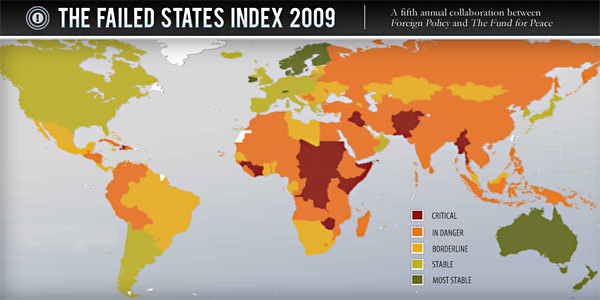
Foreign Policy magazine has released a failed states index, which tracks the stability of states using indicators such as demographic pressure, human rights, the number of refugees and so forth. Obviously, New Zealand comes out as "stable" - but interestingly, we come out as more stable than Australia, more stable than the UK, and more stable than the US. As usual, we lag behind the Scandinavian countries - but clearly we are doing something right (and much better than the countries National keeps telling us we lag behind). The full rankings are here.

Weatherston

Well, I'm glad that tawdry spectacle is over. And now, can we perhaps repeal the law which allowed him to drag his victim's bleeding corpse through the mud again and effectively blame her (if unsuccessfully) for her own death?

Update: And according to The Press, the government is working on it. But they've got competition - and with anothe rballot next week, there's a chance that Dalziel's bill will be drawn first...

A success for ProgBills

Earlier in the year, I set up the New Zealand Progressive Bills Project to develop ideas for progressive, left-wing legislation. That project had its first success today, with the drawing of Maryan Street's Customs and Excise (Prohibition of Imports Made by Slave Labour) Amendment Bill (developed here; initial draft here) from the ballot. Hopefully it will be the first of many.

Drawn

Thanks to a couple of deferrals, a ballot for Member's Bills was held today, and the following bills were drawn:

  • Customs and Excise (Prohibition of Imports Made by Slave Labour) Amendment Bill (Maryan Street)
  • Te Rā o Mātāriki Bill/Mātāriki Day Bill (Rahui Katene)

I've previously covered both bills here and here.

Lianne Dalziel's bill to repeal provocation finally made an appearance, and there were five other new ones: a Te Ture Whenua Maori Amendment Bill from Meyt, and four bills from Labour MPs attempting to force a referenda for various parts of the Auckland SuperCity. I'll try and cover some of them in an "In the Ballot" post later this afternoon.

What is productivity anyway?

With the appointment of Don Brash to lead the government's new 2025 Taskforce into restoring parity with Australia, its worth asking: what is this "productivity" thing that the politicians are obsessing about? below is my attempt at a simple answer.

At its simplest, productivity is the ratio of economic output / inputs. While there are a lot of inputs, the common international comparison is GDP per hour worked. New Zealand does badly on this measure, with a productivity 25% lower than the OECD average, and 33% lower than Australia.

From the mathematics of the thing, it should be clear that there are two ways to increase productivity: you can increase output, or lower inputs. The first can be done by investing in a better widget-maker, or teaching people how to make them better, or coming up with new widgets which you can sell for more money - in other words, it needs investment by business in plant, training, or R&D. New Zealand's business "leaders" are fundamentally averse to that - investment requires money which they could instead take as profits - and so they have instead chosen to do it the other way: by lowering wages. That's what the Employment Contracts Act (and more recently, the 90 Days of Slavery bill) were all about: lowering wages and cutting workplace entitlements so they could get the same amount of work for less money, producing a boost in productivity. But this was counterproductive in the long term, leading to stalled capital investment and the opening up of the "productivity gap" with Australia (it was also politically unacceptable to most New Zealanders, leading eventually to the election of a Labour government, changes in employment law, and wage rises - which in turn decreased productivity - hence the current bout of whining).

Which path will the government take? Their statements in opposition are enlightening. As leader of the opposition, Don Brash pushed for weaker employment laws, fewer workplace entitlements, and a return to the "low wage, low skill, hire another warm body" economy he presided over as Reserve bank Governor in the 90's (John Key followed the same path). Meanwhile, Bill English was complaining that large wage rises in the health and education sectors (brought on by a decade of erosion under National) had decreased productivity. Which means we are likely to see more of the same: wage cuts by erosion, and a consequent lower incentive for real productivity gains. This will lead to strikes, particularly in the health and education sectors (teachers, doctors and nurses all know their power, and will use it to defend their position against this sort of madness) - but their business mates will book an easy profit by doing so, and that is all National cares about.

Tuesday, July 21, 2009


The OpenLeft Project

With the UK currently witnessing the final death of the New Labour project, thoughts are beginning to turn to what comes after. Not in terms of government - sadly, that answer is likely to be a Conservative government, which makes New Labour look good by comparison - but for the left. In an effort to find an answer, the Demos thinktank has launched the OpenLeft Project:

Open Left is about rediscovering the Left’s idealism, pluralism and appetite for radical ideas. It starts from a belief that the future of the Left requires a new openness for a new era of open politics:
  • Idealism: open about its political values and goals.
  • Pluralism: open about disagreement and debate.
  • Radicalism: open to new ideas and policies.

We want to hear views and ideas from across the family of the Left, whether people identify with a political party or not. We welcome debate about political values and goal, and don’t presume to have a monopoly of knowledge about how to bring about effective and enduring change.

We are starting by asking an essential but contested question: what does it mean to be on the Left today? We’ve asked ten leading Left wing thinkers to answer six questions about their political motivations and beliefs. Check out what they said and then contribute your own perspective.

There's some interesting essays up already - check out Polly Toynbee's, or Billy Bragg's - but also a few too many by Blairites desperately trying to spin themselves a future.

Meanwhile, The Standard suggests that it "wouldn't be a bad idea here". I agree. The New Zealand Labour Party did not betray its base in anything like the same way the UK one did, but it still needs to reconnect. This sort of two-way conversation about ideals and principles would help.

[Hat-tip: Crooked Timber]

Banning cluster bombs

Last year, the New Zealand government was one of the first to sign the new Convention on Cluster Munitions, an international treaty banning the use, production and stockpiling of cluster bombs. Today, they introduced a bill into Parliament to enable ratification - the Cluster Munitions (Prohibition) Bill. The bill would ban anyone in New Zealand from using, possessing, developing or transferring cluster munitions, and more importantly, would ban members of the New Zealand armed forces from requesting the use of cluster munitions when they are operating with other states overseas. So for example, if John Key sends the SAS to Afghanistan to fight the US's losing war there, they would not be able to call in US airstrikes which use cluster munitions to indiscriminately massacre Afghan civilians. And this is a Good Thing.

I'm now wondering whether to adapt some of this language for the Depeleted Uranium (Prohibition) Bill...

The cost of unsustainability

Bottom trawling is a hugely destructive form of fishing which bulldozes whole swathes of the seafloor in an effort to get a few more fish. It is, by definition, unsustainable. So naturally, our dirty fishing industry uses it.

Now they are beginning to pay the price, with a UK supermarket chain refusing to stock New Zealand Hoki because it was bottom trawled. This despite it being certified as "sustainable" by the greenwash Marine Stewardship Council.

Hopefully this will provide an incentive for New Zealand's fishing industry to clean up its act. And if not, then as more markets refuse to stock unsustainable fish, hopefully it will drive them out of business.

(There is more information on the unsustainability of New Zealand's Hoki fishery here)

The ghosts of National's past

So, just nine months into National's term, and suddenly all the ghosts of its past, which it had tried to sweep under the carpet, are crawling out of the woodwork.

First, we have Treasury, returning to its 80's and 90's mentality with a call for public sector cuts and privatisation. Naturally, this call doesn't extend to itself - they increased their core departmental budget by 10% this year [PDF] so they could give better advice on how to further gut the public service.

Second, we have the Business Roundtable, crawling out from under its rock to call for the unemployment benefit to be replaced by loans (so the unemployed can be forced to borrow to eat and turned into debt-slaves for the rich), for privatisation of welfare services (complete with financial incentives for providers to reduce numbers i.e. deny legal entitlements), and for the DPB to be abolished to "discourage pregnancy". It's like a blast from a particularly noxious group of nineteenth century social darwinists. Which is essentially what the BRT's brand of free market fundamentalism amounts to.

And finally, we have failed opposition leader Don Brash being appointed to head the government's new 2025 Taskforce on productivity. As Reserve Bank Governor during the 90's, Brash was infamous for stepping down hard on "wage inflation" - workers getting a fair day's pay for a fair day's work - and for hiking interest rates to keep unemployment high and wages low. His recipe to improve productivity is likely to be more of the same: lower wages, worse conditions, longer hours.

National was elected in 2008 on a centrist platform. It promised that it would not restart the Revolution and take us back to the 90's, but would continue Labour's policies with a fresher face. It must keep that promise. Otherwise, they are likely to be de-elected with extreme prejudice.

A bully pulpit

Over the past few months, concerns have been rising about profiteering by the major trading banks during the recession. Reductions in interest rates by the Reserve Bank have not been passed on, instead going straight into the coffers of the major banks' Aussie owners. The Reserve bank is concerned about this, but earlier in the month, government MP's prevented the Finance and Expenditure Committee from holding a formal inquiry into bank profiteering. So today the opposition decided to launch one of its own.

The inquiry has no official status and will have no formal powers. OTOH, banks refusing to cooperate with it can expect to be named and shamed in the media and have their name dragged through the mud under the full protection of Parliamentary privilege. It's an excellent use of Parliament as a bully pulpit by the opposition, and hopefully it'll result in some change from the Aussie profiteers.

If you'd like to submit to the inquiry, details are on its website here.

Climate change: we should be ashamed II

Back in 2006, Helen Clark showed some vision for once and announced a bold plan to make New Zealand carbon neutral. The new National government has since abandoned that goal in favour of a relaxed "50% by 2050 (and nothing now)" - but in the meantime others are moving ahead with it. The latest is Tuvalu, a tiny Pacific island nation, which has just announced that it plans to be carbon neutral by 2020:

The tiny Pacific island state of Tuvalu has said it wants all its energy to come from renewable sources by 2020.

Public Utilities Minister Kausea Natano said his nation of 12,000 people wanted to set an example to others.

[...]

The government hopes to use wind and solar power to generate electricity, instead of imported diesel.

"We look forward to the day when our nation offers an example to all - powered entirely by natural resources such as the sun and the wind," Kausea Natano said.

The BBC article is slightly misleading, in that Tuvalu is targeting only electricity rather than primary energy (which would include transport fuels) - but still: another developing nation is adopting an ambitious climate change goal, despite the principle of "common but differentiated responsibilities", and more importantly, taking concrete steps to achieve it. And this despite the cost - $20 million is peanuts to our government, but its one and a half years of Tuvalu's GDP. They are taking climate change seriously - not least because with a highest point only 4.5 metres above seas level, they're in danger of being washed away if the oceans rise. And meanwhile, our government, with vastly more resources at its disposal, is trying to get away with doing the least amount possible - in the process shifting the burden of paying for it from countries like us, who caused the problem in the first place, to countries like Tuvalu and the Maldives, who didn't and have far less ability to pay for it. This is fundamentally unjust, and we should all be ashamed of it.

Monday, July 20, 2009


Abortion rights under threat

Abortion is back before the High Court, in a case which could see a dramatic restriction of a woman's right to an abortion. Following a ruling which impugned the legality of most abortions performed in New Zealand and a farcical appeal, Right To Life were back before the High Court today arguing that they should force the Abortion Supervisory Committee to act as "an advocate for the unborn child" and micromanage the medical decisions of certifying consultants. The decision has been reserved, but there's a real risk here of a restriction on abortion rights - which in turn means dangerous backstreet abortions, smuggled Chinese pharmaceuticals, expensive trips to Australia, and ultimately women being forced to have children they do not want.

That situation is likely to be even more unacceptable to New Zealanders now than it was in the 70's. If the courts send us back three decades, then Parliament must be prepared to legislate immediately to clarify the law and restore the status quo. In the longer term, as the fundamentalists are clearly not willing to respect our ugly compromise, then its time we overturned it, and joined the modern world by allowing abortion on demand.

Climate change: Nelson and Napier

SignOn reports from the final climate change target consultation meeting in Nelson:

Last night, the final public climate change 2020 target consultation wrapped up in Nelson. It was a lively crowd with 180 odd people packing the Rutheford Hotel. The mood was upbeat, and like all the consultations I’ve attended, the call was loud and clear for 40%. We kicked off the night with a giant projection of messages from Sign On supporters on to the Rutherford Hotel.

The Minister, must be exhausted after this two week tour but I couldn’t help but notice his optimism or ambition from these consultations haven’t improved. He’s still framing the debate squarely around the economic costs, and downplaying the chances of a needed and ambitious target. From soil carbon experts, to geologists, from community board representatives to high school students (and Trevor, who is recently back from a training session with Al Gore) the message was – we need leadership and to focus on the enormous opportunities.

Meanwhile, out in the wops, they're still mired in Denial. The irony here is that Hawkes Bay is one of the areas most at risk from climate change, with severe drought expected to become eight times more frequent by 2080 in the medium-high warming scenario (which is looking more and more likely). That means a (currently) "one in twenty year drought", costing farmers around $500 million, every two to three years. These people aren't just ignorant - they're completely stupid.

Geneva for me, but not for thee

In February 2002, following extensive discussions about what to do with prisoners captured in the US's (then) new war in Afghanistan, President Bush issued an order [PDF] declaring that the Geneva Conventions did not apply to captured Taliban soldiers on the grounds [PDF] that Afghanistan was a "failed state" and the Taliban was "not a government but a militant, terrorist-like group". It then proceeded to detain Afghan prisoners without trial, render them to Guantanamo and its network of "black sites", photograph them for the purposes of public humiliation, and torture them.

Which makes the US's current complaint that the Taliban parading a captured US soldier on camera violates international law just a bit rich. Having denied the protection of international law to their opponents, they can hardly claim it for themselves.

No blood for trade

John Key is hinting strongly that the SAS will be sent back to Afghanistan to fight and die for America. On Q&A on Sunday, he said:

"I do think it's important that New Zealand plays its role, and plays its part in trying to get on top of what is a terrorist hotspot,"
I have just one question for Mr Key: why?

Why would we want to fight in a war without any legal mandate from the UN?

Why should we prop up a government whose policies include theocracy, legalised spousal rape, unfair trials and the death penalty, where people who protest against these things are publicly stoned?

Why should we send people to die for nothing in a pointless war which has already been lost?

If the first two reasons are not enough, the final one should be absolutely compelling. One of the basic considerations in any decision on whether to use force is whether it will be effective in achieving your goals. But the war in Afghanistan was lost long ago, and sending more people to die in the graveyard of empires will not change this. It would simply be an empty gesture of loyalty to the US, a modern echo of the immoral "blood for butter" policy which saw Key's ideological predecessors sacrifice 18,000 kiwis on the altar of our previous imperial patron. Which begs the question: if this is about sacrificing lives to prove loyalty, why not do it here - say, shoot a handful of SAS soldiers on a US flag outside Parliament? Obviously, that would be monstrous. But is it any less monstrous to send them to be shot in Afghanistan instead? The only difference is the location.

IMHO, we should not be participating in illegal wars, we should not be propping up immoral governments, and we should not be engaging in human sacrifice for imperial favour. We should tell the US to fight its own stupid war, and that we want no part of it.

Carnival of the Liberals

The 95th Carnival of the Liberals is now up at the Neural Gourmet.

A difference between Australia and New Zealand

Currently Taito Phillip Field is on trial on 15 counts of bribery as an MP. If found guilty, he would become the first NZ MP ever convicted of this offence.

Meanwhile, over the ditch, former Queensland Cabinet Minister Gordon Nuttall has just been convicted on 36 charges of receiving secret commissions while in office and sentenced to seven years. And he's not the first. He's the fifth Queensland Cabinet Minister to be jailed for corruption (four were jailed as a result of the Fitzgerald Inquiry) - and that's just Queensland. Other Ministers have been jailed for corruption in New South Wales, where Corrections Minister Rex Jackson took bribes to let people out of jail, and Western Australia, where two former Premiers and a former Deputy Premier were jailed after a Royal Commission into corruption.

While we have a lot in common, this is a fundamental difference between our two countries. Despite the ravings of the sewer, New Zealand is fundamentally not a corrupt country. Meanwhile, tight connections between business and government mean that high-level political corruption is endemic in parts of Australia. So how did things manage to go so wrong over there?

Sunday, July 19, 2009


New Fisk

Some lessons in sacrifice from Liverpool in two world wars

Friday, July 17, 2009


UK government to repeal sedition

First, we take Wellington. Then we take London:

Laws dating from the Star Chamber that can see people jailed for speaking out are to be abolished after a campaign by writers and actors, lawyers and politicians.

Lord Bach, the Justice Minister, has bowed to the weight of criticism and agreed that the offences of sedition and criminal libel are “outdated” and should be abolished. “Sedition and defamatory libel are arcane offences from a bygone era when freedom of expression wasn’t seen as the right it is today,” he said.

But it was not just a case of removing some redundant offences. The laws may not have been used much lately in Britain, but their significance was the legitimacy they provided to other countries to suppress public criticism.

As Lord Bach acknowledged: “The retention of these obsolete offences has been cited by other countries as justification for the retention of similar laws that have been used to restrict press freedom.”

This is an excellent move, and long past due. The UK Law Commission recommended the abolition of sedition in 1977, but it has hung around on the books like a bad smell for a further 30 years. Meanwhile, this bit illustrates perfectly why sedition has to go
The offences date from the time of the Star Chamber and were used in 1792 against Thomas Paine on the ground that the Rights of Man brought into hatred and contempt the present sovereign, Parliament, kingdom, constitution, laws and government.
Paine's "crime"? He advocated democracy. There's no better example of how sedition has been used by bad governments in an effort to suppress good ideas.

Double bunking is murder

The government is currently planning to use double-bunking as a "solution" to the crisis in prison numbers bought on by their failed "tough on crime" policies. Greg Newbold has warned that this will lead to rapes, bullying and violence. He'd know - he spent time in prison in the 70's before becoming a criminologist. But that's not the half of it. As this piece in the Guardian points out, double-bunking is a recipe for murder:

In September 2003, Anthony Hesketh was forced to share a cell with Clement McNally, who was serving a life sentence for stabbing a friend to death. McNally was known to have a personality disorder and was prone to uncontrollable outbursts. He had daubed the walls of his cell with satanic symbols and told other prisoners that he was "Satan's hands and eyes". A prisoner told the jury that "everyone could see that McNally was losing his mind" and alleged that officers "laughed off" suggestions that he had serious mental health issues. The jury found that staff failed to carry out a CSRA on McNally before putting him in a cell with Hesketh, who was garrotted by his killer.

A year after that killing, another prisoner, Shahid Aziz, was beaten and stabbed to death by his cellmate, Peter McCann, at Leeds prison. McCann had a history of violent attacks on fellow prisoners. The day before the killing, a probation officer phoned the prison warning that McCann was a threat to prisoners. Her warning was ignored and, in 2007, an inquest jury heard that the CSRA process was confined to staff asking McCann if he was dangerous. McCann said he was not.

The piece lists other examples, including one in which a racist prisoner beat his young Asian (in the UK sense) cellmate to death with a tableleg, and another where a prisoner not only killed his cellmate, but started to eat him. All told, there have been 14 deaths due to double bunking in the UK in the last nine years - and there is no sign of it stopping. In overcrowded and chaotic prisons there is no time to do proper psychological assessments and ensure that risks are managed, while staff institutionalised not to care have no interest in protecting prisoners from each other. The upshot is that despite the abolition of the death penalty in the UK, people die as a direct result of their imprisonment, in a completely preventable way. And if we follow in the UK's footsteps and introduce double-bunking, the same will happen here.

Espiner's constitutional illiteracy

Over on his blog, Colin Espiner comments on Sian Elias' speech on the failure of "tough on crime". In passing, he claims:

So we'll just build more prisons. Lock more people up. The crime rate will continue to rise. And Dame Sian will be quietly replaced, probably within the next year.
The clear implication is that the government will "replace" the Chief Justice - a position Espiner continued to cling to when challenged on it:
You're an intelligent guy, so I'd expect you to know that while the government can't sack judges, the Chief Justice essentially serves at the Government's pleasure. Yes, she's appointed by the Governor-General - on the recommendation of the Attorney-General. But you can't tell me that the Government has no influence over that appointment, and its lifespan.
And
Judges may be appointed for life, but in reality chief justices serve for ten or eleven years (check if you don't believe me) each. Dame Sian has served for ten.
And
Of course the Government doesn't have the power to remove her. I never suggested it did. Neither does it have the power to sack a single state servant. But there are ways and means of getting the message across.
Espiner isn't just utterly constitutionally illiterate here, but dangerously so. The government cannot sack a High Court (or Court of Appeal, or Supreme Court) Judge in New Zealand. Section 23 of the Constitution Act makes it clear:
A Judge of the High Court shall not be removed from office except by the Sovereign or the Governor-General, acting upon an address of the House of Representatives, which address may be moved only on the grounds of that Judge's misbehaviour or of that Judge's incapacity to discharge the functions of that Judge's office.
That motion can only be initiated by the Attorney-General, and then only in response to the recommendation of a Judicial Conduct Panel or if they are convicted of a serious offence. The reason for this is that we learned back in the seventeenth century that judges needed to be secure in their tenure so they could rule without fear or favour according to the law, rather than in the interests of the government of the day. Hence appointments to the judiciary are permanent, and judges hold office until they hit the mandatory retirement age (currently 70, increased from 68 in 2007).

The reason Chief Justices have tended to hold office for ten years in recent times is because the last couple were appointed at the age of 58, and served until retirement. Looking further back, judges served until the age of 72, and even longer before the 50's. One - O'Leary - died in office. The rest hung around until retirement, which in the case of Stout was for 27 years. None have ever been sacked, or "quietly replaced", or eased out. In the case of Elias, she was appointed at age 50, and can serve until she is 70. Meaning she will, barring accident or retirement, serve for another ten years.

As for Espiner, I'd expect a basic degree of constitutional literacy from a gallery journalist, particularly one as senior as himself. It's his job to know, so he can put politics in context for the rest of us. Unfortunately, in this case he doesn't seem to be doing it very well.
Reviewing the OIA

There's an interesting titbit hidden away in the Law Commission's latest Statement of Intent [PDF]: they're reviewing the OIA:

We have commenced work on two new projects this year that were given to us last year. These are a review of the law relating to trusts and charitable trusts and the Official Information Act 1982.
There's no other details, and nothing on the website, but there will apparently be an issues paper sometime in December.

The Law Commission has already reviewed the OIA once, back in 1997, and recommended [PDF] reducing the time limit from 20 to 15 working days. This has not been acted upon. I doubt their view has changed - if anything, the improvements in information technology which led to their recommendation have only grown stronger, meaning it should be reduced even further. So, we may see another recommendation for reduction, which will likewise be ignored by self-interested politicians.

Says it all

There was a telling comment buried at the end of TV3's story tonight on Chief Justice Sian Elias' speech on the failure of "tough on crime" policies. At the end of the video version, Scott Campbell says:

I also spoke to several sources in both the major political parties about these ideas, and many of them say that they have merit, although they won't say so publicly. To admit that giving prisoners lighter sentences or some amnesty would be political suicide.
That's right: the politicians know these policies don't work, but they continue to publicly support them out of fear of being called "soft". And so we continue down a futile path to expensive failure.

Climate change: the real culprits

Over on Frogblog, Frog draws attention to the dodgy graphs used by Nick Smith in his consultation meetings, designed to mask one of the real areas of growth in our emissions: the dairy industry. They ask for disaggregated data, similar to that already provide don a sector level, which shows both the absolute and percentage growth for the farm sector and allows a real comparison with electricity and transport emissions.

Ask and ye shall receive...

(Sector information from the 2007 inventory. Dairy, beef and sheep emissions computed from 1990 and 2007 CRF files, and include enteric methane (burps), methane from solid waste (cowshit) and direct nitrous oxide emissions (cowpiss). "Other energy" and "Other agriculture" categories computed by subtraction. Percentages show the percentage growth or decrease in emissions since 1990).

This shows the truth that the government wants to mask: that there has been massive growth in the dairy industry, that it massively exceeds electricity-sector emissions, and that its rate of growth is the same as that of the transport sector. Dairy cows are among our worst polluters. And it is time we stopped subsidising them and forced them to pay their own way.

Thursday, July 16, 2009


"Tough on crime" isn't working

Today the Herald reported on a speech by Chief Justice Sian Elias to the Wellington branch of the Law Society, in which she suggested an amnesty to reduce prison numbers and so avoid "significant safety and human rights issues". In the subsequent and predictable howl of outrage from the right and denial by the government, the real message of her speech was lost: that the present "tough on crime" approach of harsher and more punitive sentences and limited access to bail and parole simply is not working.

The full speech is here [PDF]. I suggest reading it in full. There is a lot of good stuff in there about how the increased involvement of victims is undermining justice and turning sentencing into "a test of [loyalty] and a mark of personal respect" for victims, about the utter ineffectiveness of prison in reducing crime rates, about the failure of non-custodial sentences due to government under-resourcing, and the need to reduce crime and reoffending by targeting its actual causes (including the high rates of mental illness and substance abuse among prisoners) rather than by building a prison at the bottom of the cliff. She also talks about solutions to this: not least, politicians having the honesty to front up to the public and tell them that vengeance and brutality does not work and never has.

Channelling public anxiety into effective strategies is not easy when the first task is to get across the unwelcome message that there are no simple or quick answers. And it is difficult for the public and political debate to be properly informed in an age where our news and comment is geared to simple messages and the stories of individual crimes are readily and graphically communicated. But if we are not to lurch from one increasingly punitive and expensive reaction to another, we all need to take responsibility for understanding the options and for buying in to the strategies that work, rather than knee-jerk responses. Those strategies require social change, not demands for easy quick fixes now...

[...]

Information the community needs to know has to be got across. The message that imprisonment does not reduce crime, that the criminal justice processes are largely irrelevant to crime reduction and that the causes of crime have to be directly addressed must be communicated and understood.

(The Herald's response to her speech rather proves her point, and exacerbates the problem rather than helping us solve it. But I guess real solutions - and the reduction in crime they would entail - don't sell newspapers.)

The solutions Elias suggests are not easy: early intervention to prevent kids from turning into criminals; a more active and better resourced probation service with a focus on personal involvement and rehabilitation rather than risk-management to reduce reoffending; proper mental health services, both in and out of jail, to prevent prison being used as a dumping ground for the mentally ill, and finally, reducing prison numbers through better use of bail, parole and community sentencing - and amnesties if necessary - because it costs an absolute fortune and doesn't do anyone any good.

Drinking Liberally returns to Palmerston North

After a six month break, Drinking Liberally will be returning to Palmerston North next Thursday. The guest speaker will be Green co-leader Metiria Turei on the upcoming s59 referendum:

When: 17:30, Thursday, July 23
Where: Brewers Apprentice, 334 Church St, Palmerston North

[Hat-tip: The Standard]

Climate change: ambitious

The UK government has just announced an ambitious plan to meet its 34% by 2020 climate change target. The details look like nothing less than a green revolution:

  • requiring 40% of electricity to be generated from "low carbon" sources by 2020. This includes nuclear, but given the construction timelines, in practice it will almost all have to come from wind. This means a tenfold increase in wind generation in just 11 years.
  • a massive investment by electricity companies in home insulation - £3.2 billion over four years to insulate 7.5 million homes.
  • Smart meters in every home by 2020, and feed-in tariffs (meaning a guaranteed price) for distributed generation.
  • far tougher CO2 emissions standards for cars.
  • financial assistance "in the region of £2,000 to £5,000" to reduce the price of plug-in hybrids and electric vehicles.
  • including air traffic in the EU ETS.
  • hundreds of millions of pounds on R&D for wind, wave, and other forms of renewable power.
The UK can do this because unlike us they are not completely in thrall to a dead ideology of NeoLiberalism. They are not afraid to regulate, or to tell businesses how to spend their money (currently UK electricity generators must purchase a certain percentage of renewable energy, and spend a certain amount on providing energy efficiency and insulation to their customers). And they are not afraid to face up to the costs, and (more importantly) engage in redistribution where necessary to lessen their impact on the poor. As a result, they can set strong targets, and actually have a decent chance of meeting them. Meanwhile, our NeoLiberal metapolicy of eschewing intervention and regulation and "leaving it all to the market" has resulted in self-induced helplessness. Because of our ideological blinkers around what constitutes "acceptable" policy, we think we can't do anything. And as a result, our emissions have risen 25% while our policymakers have sat around wringing their hands and engaging in abstract and sterile debate about Hayek and Friedman.

If John Key was really "ambitious for New Zealand", he would set a strong target for 2020 emissions reductions. If John Key was really "ambitious for New Zealand", he would look at this policy, clone it (with suitable local adaptations around renewables and agriculture), and actually make us live up to the "clean and green" rhetoric his tourism ministry uses to sell us overseas. Instead, he will make sympathetic noises and talk up the costs and the "threat to jobs" - really the threat to his corporate mates' profits - while doing nothing. And so our emissions will continue to rise, and the planet will continue to burn.

Sabotaging Lisbon

So, just a few months before the Irish go to the polls again for another vote on whether to ratify the Lisbon Treaty on strengthening the EU, the UK announces that they are formally pushing for Tony Blair to be EU President:

Tony Blair is a contender to become the first president of the EU with the full backing of the British government, the new Europe minister said today.

Glenys Kinnock, in Strasbourg for the opening session of the new European parliament, said that although the former prime minister had not formally declared his candidacy, it was "certainly" the government position to support him.

"I am sure they would not do it without asking him," Lady Kinnock said. "The UK government is supporting Tony Blair's candidature for president of the council."

The post will only be created if the Irish vote "yes". And by announcing this, the UK have just given them a powerful reason to vote "no" ("Vote against the rat! Vote against the war criminal! A vote for Europe is a vote for Blair!") Are they trying to sabotage Lisbon?

No freedom of speech in Azerbaijan

Adnan Hajizada and Emin Milli are Azeri bloggers. Last month they made a parody video [in Azeri, but with subtitles] mocking the Azeri government's policy of importing donkeys at exorbitant prices. And then things got weird:

Mr. Hajizada, 26, and his fellow activist Emin Milli, 30, were arrested last week in Baku, the capital, in an event their supporters say could signal the beginning of a crackdown on online media. Azeri authorities said the two physically attacked other men, though witnesses have challenged that account. They are awaiting trial on charges of hooliganism, which carries a sentence of one to five years in prison.

According to a motion filed by Mr. Hajizada’s lawyer, the two men were with friends at a restaurant last Wednesday, engrossed in political debate, when two strangers broke into their conversation and started a fight. Mr. Hajizada and Mr. Milli went to file a complaint about the assault, but instead an investigator opened a criminal case against them, the motion said.

This is apparently how the Azerbaijani government deals with its critics. Last year Qanimat Zahid, an opposition newspaper editor, was jailed for four years for "hooliganism" after a similar attack. Amnesty International considers him to be a prisoner of conscience, jailed for his journalistic work. In 2006, satirist and poet Sakit Zahidov was jailed after being framed on drug charges- again as a consequence of his journalism. He was pardoned earlier this year after serving almost three years in prison. Other journalists have been harassed, intimidated, assaulted, and even murdered [PDF] by a government desperate to suppress all criticism. And now the same seems to apply to bloggers.

Wednesday, July 15, 2009


Beaking the silence on Israeli war crimes

Israeli human rights group Breaking the Silence has published a new report [PDF] in which Israeli soldiers describe in their own words the war crimes they perpetrated on Palestinian civilians during Israel's recent bombing of Gaza. From the summary in the Independent:

The first eye-witness accounts of the war by serving Israeli reservists and conscripts describes the Israeli use of Palestinian civilians as "human shields". They detail the killing of at least two civilians, the vandalism, looting and wholesale destruction of Palestinian houses, the use of deadly white phosphorus, bellicose religious advice from army rabbis and what another battalion commander described to his troops as "insane firepower with artillery and air force". The reports amount to the most formidable challenge by Israelis since the Gaza war to the military's own considered view that it conducted the operation according to international law and made "an enormous effort to focus its fire only against the terrorists whilst doing the utmost to avoid harming uninvolved civilians".
Using human shields is a war crime. Murdering civilians is a war crime. Looting and wanton destruction are war crimes. Using disproportionate force without regard for civilian lives is a war crime. A responsible state which conformed with international law would investigate these offences and put those on trial for violating the laws of war (if only to prevent the international community from doing it). Instead, Israel will deploy its PR flacks and accuse its own soldiers of anti-Semitism for daring to tell the truth about how their military and their government has lost its way.

Climate change: meeting the target

At the moment the government is consulting on its 2020 target for reducing greenhouse gas emissions. In the face of overwhelming public support at the meetings for deep cuts, they have responded by demanding that the public do their job for them and explain where those cuts are going to come from. It's an abdication of responsibility, but it is also disingenuous, because the government already has the tool to achieve the desired cuts: the Emissions Trading Scheme.

For those who don't know, the ETS works by establishing a cap on emissions, and issuing permits to the level of that cap. Every year, polluters must hand over enough permits to the government to cover their emissions, or get a whopping fine. Polluters can buy and sell permits off each other, and from the international market, so reductions happen where they are cheapest. In other words, once you set the target, the market sorts out all the details.

From that capsule description, it is very clear that if the government wants to achieve an arbitrary reduction (say, 40% from 1990), all it has to do is set the cap at an appropriate level. And that's it. It is that simple. Polluters will either cut their emissions, or buy permits on the international market to cover the excess - meaning that someone else cuts their emissions. Either way, global emissions are reduced, and the New Zealand government meets its international obligation. Cut the cap, and the market will sort it out.

So, no more pretending that there is no solution or that the environmental movement must provide it. The government already has one, and it has nowhere to hide. And if they don't want to use it, the onus is on them to explain why.

No freedom of speech in Egypt

Moneer Said Hanna is an Egyptian civil servant. One day, he wrote a satirical poem about Egyptian President Hosni Mubarak. For this, he was arrested and jailed for three years for "insulting the head of state".

Egypt is not alone in having laws aimed at protecting the "dignity" of the leader. Like the old law of lese majeste, they are based on medieval conceptions of what peasants were allowed to say (and think) about their "betters". Such laws - and indeed, the underlying conceptions of "peasants" and "betters" - have no place in a modern democracy. But that's the problem: Egypt isn't a democracy, but a dictatorship, where the government holds power by systematically terrorising the population and "wins" elections by beating, gassing, and shooting the opposition.

No solutions from Key

This morning, Prime Minister John Key was supposed to give a speech "detail[ing] the problems and solutions for New Zealand's economy". You'd expect such a speech to have some information on how the government was planning to deal with the recession. If so, you'd be disappointed. Key's sole tip to the recession is this:

We cannot magic away a deep recession; nor can we turn back the tide of rising unemployment.

What the Government can do, however, is take the sharpest edges off the recession.

And that's it. Key's response to the thousand people a week signing up for the dole and the 60,000 more likely to follow them is, as the Standard says, to grin blankly and shrug his shoulders. Because as he admits, he's not really interested in them, the human victims of what Key disarmingly calls one of the economy's "worse-than-average periods", the actual people who the economy is meant to exist to serve. He's interested in the longer-term picture and climbing some pointless OECD economic penis-size comparison "ladder". And to do that, he proposes the same tired old recipe we have come to expect from National: deregulation (you know, the stuff that led to this economic disaster in the first place), public service cuts, and tax cuts for the rich. Oh, and "productivity growth", which is business code for "wage cuts".

Naturally, the business community lapped it up. As for the rest of us, I'd prefer to have a government which was actually focused on the problems at hand, rather than trying to use them as an excuse to ram through neo-liberal "reforms" which actively make things worse for ordinary people.

Tuesday, July 14, 2009


Good clean internet censorship

The Department of internal Affairs is currently working on a "voluntary" internet filtering scheme to make objectionable content disappear from the internet as far as New Zealand users (well, those too stupid to use a proxy server or a secure encrypted subnetwork) are concerned. Disturbingly, it has chosen to do this in total secrecy. Why? To prevent the sort of opposition that has organised around the Australian government's efforts to oppose their own filtering scheme. Opposition like this:

(If you are Australian and want to protect the internet, then you can take action here)

[Hat tip: Sydney Morning Herald]

The last thing we need

The Herald is running its annual "mood of the boardroom" survey today, in which they ask a tiny minority of uber-rich top business executives how they think the country should be run, then pretend their opinion counts for more than the other 4 million of us, and unsurprisingly they've found someone to say that "New Zealand should be working like a small business". So, according to our business "leaders" - the people responsible for such stunning business successes as EquitiCorp, Air New Zealand (pre-takeover), and BridgeCorp and its assorted clones - this country should:

  • be run at a loss as a tax dodge;
  • never have any investment made in it;
  • be systematically asset-stripped, and milked for short-term profit rather than long-term yield;
  • have a 60% chance of going out of business within 7 years.

"Running the country like a small business" is the absolute last thing we need - and the self-important, self-interested neo-nobility who advise it are the last people we should listen to.

Climate change: Queenstown and Hamilton

The government's climate change target consultation hit Queenstown and Hamilton on Friday and Monday respectively. SignOn has the reports here and here. As expected, support for strong action declines when you start going out into the ignorant wops, but even in Hamilton - cow central - there was still majority support for a 40% target. Unfortunately, after a week, the Minister seems to have given up any pretence at listening.

Tonight its New Plymouth, then Napier, and finally Nelson on Friday. The latter is important - its right there in Nick Smith's own electorate, and a strong showing is thus a clear electoral threat. We need to make it clear to the government that if they do not act, they face de-election (which under MMP, requires a vote swing of only a few percent). So, if you live in Nelson and care about climate change, turn up this Friday.

America's death squads

Over the weekend a scandal erupted in Washington over the revelation that then-Vice president Dick Cheney had illegally ordered the CIA not to brief Congress on a special operations programme. That is enough for careers to end and people to go to jail, but today it got worse, when the nature of that secret programme was revealed: death squads:

Former counter-terrorism officials who retain close links to the intelligence community say that the hidden operation involved plans by the CIA and the military to launch operations, similar to those by Israel's Mossad intelligence service, to hunt down and kill al-Qaida activists abroad without informing the governments concerned, even though some were regarded as friendly if unreliable.

The CIA apparently did not put the plan in to operation but the US military did, carrying out several assassinations including one in Kenya that proved to be a severe embarrassment and helped lead to the quashing of the programme.

The plan was apparently intended to apply to "friendly countries that don't want to co-operate or maybe we don't have enough confidence to entrust them with information" - in other words, countries with laws against murder who are unwilling (or unable, because they are democratic and have independent police and media) to look the other way when people are shot execution-style or blown to bits in a car-bomb. Countries like the UK. You can see why Congress would be concerned about that.

The proper response to terrorism is a legal one: arrest, prosecution, and trial. It is only the pathological secrecy of spies - their refusal to put their "evidence" before the courts - which prevents this. But their preferred methods - rendition, torture, death squads - simply incite more terrorism. Which suggests that we should really be prosecuting the CIA as accessories...

Dodgy as hell

Jim Anderton has uncovered some dodgy dealings between WaterCare Services and the various Auckland councils which seem to be aimed at preventing any public scrutiny under the Local Government Official Information and Meetings Act of the new Auckland water monopoly. As part of the Auckland reorganisation, local councils' water assets will be transferred to WaterCare, the new monopoly provider. But WaterCare is forcing the councils to sign a confidentiality agreement purporting to prevent them from disclosing any information to the public under the LGOIMA - meaning that there will be no oversight of and accountability for what goes on. The kicker? WaterCare is owned by the very councils it is signing these agreements with. In other words, they're effectively (via a few legal cutouts) signing a contract with themselves to insulate themselves from public oversight in a particular area.

This simply stinks. But it's National's "SuperAuckland" down to a "T": secretive and unaccountable. As Anderton says, first they've taken away Aucklanders' democracy; now they're taking away their right to know.

Monday, July 13, 2009


Must read

Over on Public Address, Emma points to some very good OIA work by Thomas Beagle about the Department of Internal Affairs' plans for internet filtering. The short version: DIA are about to implement an internet filtering system in secret. It will be voluntary for ISPs and aimed only at child pornography - but we know from experiences elsewhere that such schemes never stay that way, and inevitably suffer from mission creep (up to and including covering criticism of the scheme itself). And naturally, they are refusing to release the blacklist, on the basis that it is a shopping list for paedophiles. The fact that it means they never have to admit to, let alone answer for, the inevitable mistakes and abuses of course has nothing to do with it.

(Fortunately, we have an answer to secretive, unaccountable bureaucrats: the Ombudsmen. And if that fails, there's always WikiLeaks...)

I am dubious enough about internet filtering - it is IMHO simply a pointless waste of time (in that such measures can be trivially circumvented), while being ripe for abuse. But the fact that this is being done in secret with no publicity, consultation or debate is beyond the pale. That is not how things are supposed to be done in a democratic society. If the government wants to do this, it should own its policy and say so openly so they can be held democratically accountable for it. Of course, that is the last thing any government wants to do...

Climate change: we are not helpless

Faced with a problem like climate change, it is easy to give up and adopt an attitude of helplessness. The problem is so big, we are so small, emissions keep on rising, and there seems to be little we can do about it.

That attitude is wrong. We already have many of the solutions we need to reduce our emissions to a sustainable level: wind, hydro, geothermal and solar-thermal power, hybrid vehicles, biofuels (if grown sustainably), even planting trees. Others we can see are just around the corner: wave power, cellulose ethanol, hot rock geothermal. In an effort to find more, the Guardian convened a think tank at the Manchester International Festival, getting people to pitch their ideas to save the world. Some of them were things seen before - biochar (turning trees into charcoal to lock away the carbon and then burying it), using the Sahara to generate solar power (something which is already happening), and increasing the planet's albedo with a fleet of cloud-making ships (which does nothing about the real problem, but does buy us a bit of time). Others, such as liming the oceans (absorbing carbon and reducing acidity) or using CCS with biomass (effectively removing carbon from the atmosphere) aren't really a go-er at present, as they rely on the coal industry's imaginary carbon capture and sequestration technology, which won't be around for 25 years, but they might be doable then. But even so, there are still plenty of solutions there. The problem isn't one of technology - it is purely one of political will; politicians in hock to established and unsustainable economic interests being unwilling to enact the policies which would push us down those technological pathways. Which in turn suggests the solution: de-election of anyone who refuses to act.

New Fisk

The story of Baha Mousa

Undermining democracy in Samoa

Last week I blogged about the Samoan government's attempt to throw nine opposition MPs out of Parliament for daring to organise themselves into a new political party. The attempt failed after Samoa's Supreme Court ruled that the anti-"party hopping" sections of the Electoral Act could apply only to registered political parties, and that as Tautua Samoa was not even eligible to be registered, the members should retain their seats. The government's initial response was to threaten to amend the law to allow them to kick out the opposition - and now they seem set on moving ahead with this plan. The pretty heavy hints in the ruling that such bans violate the freedom of association affirmed in the Samoan constitution seem lost on them.

Meanwhile, since the ruling, the opposition MPs have been forbidden to attend select committee meetings and are no longer being paid. In other words, the Speaker of the House is refusing to accept the court's decision. And that apparently is how democracy works in Samoa.

An even bigger joke

So, it turns out that John Key's $50 million1 monument to his own ego is an even bigger joke than first suggested, with plans not just for a cycleway from one end of the country to the other, but a race as well:

The Government had originally hoped a race the length of the country, named after Sir Edmund Hillary, could have been held on a new cycleway.

[...]

Initial plans were even more ambitious, with One News reporting a race like the Tour de France had been planned and was to be named the Sir Edmund Hillary Explorator.

And this is how National planned to solve the recession and keep kiwis in work: dreams and managementspeak. And next, they'll be building a giant fibreglass vegetable. It's the same small-town cargo-cult mentality: "if we build it (whatever 'it' is), they (whoever the hell 'they' are) will come". Can we have the adults in charge again please?

1 Some accessories sold separately. Cycleway may be smaller than it appears.

No sense of humour

Should-a.com, the referendum parody website, has apparently been issued a "cease and desist" notice by the humourless bastards at the Electoral Commission.

I suggest using it to mock them mercilessly while you are still able.

[Hat-tip: Kiwipolitico]

Sunday, July 12, 2009


New Fisk

You won't find any lessons in unity in the Dead Sea Scrolls

Friday, July 10, 2009


Not theirs to sell

Labour's Phil Twyford has launched a new campaign in support of his Local Government (Protection of Auckland Assets) Amendment Bill: Not Yours To Sell. From the campaign's opening blog:

No one trusts Rodney Hide and his cronies to keep Auckland community assets in public hands so my member’s bill will put any decision to sell community assets firmly into the hands of Aucklanders. The bill requires the sale or privatisation of any assets to be first put to a public referendum.

[...]

I think one of the big anxieties underlying the super city debate is the fear that the super city is just the prelude to corporatisation of local government, and privatisation of our assets: the ports, the water, and our transport infrastructure, not to mention libraries, parks, halls and other assets. These fears have been fueled by Local Government Minister Rodney Hide’s proposed reforms of the Local Government Act which seek to reduce council activities to core services. And by ACT’s stated policy to force Councils to sell off their commercial enterprises. Bear in mind also that it is only a decade or so since the right wing were trying to hock off the ports.

Given the ideological agenda of the right and their past behaviour when in power, those fears are fully justified. Twyford's bill would put them to bed, by requiring that any significant asset sale be approved by the relevant local authority. And that's a principle which shouldn't just apply in Auckland - but across the whole country.

If you'd like to support the campaign, sign up and take action.

Washington DC recognises same-sex marriages

Washington DC has recognised same-sex marriages performed in other states. It's not much, but its a definite move in the right direction. With more and more states and countries legalising same-sex marriage, and the US's high level of interstate mobility, there are more and more couples who are legally married but whose marriages are not recognised by their local jurisdiction. This in turn creates an unrelenting pressure, if not for performing same-sex marriages, then at least recognising those conducted legally elsewhere. And that pressure has just gone federal, with Massachusetts filing a federal court case challenging the US Defence of Marriage Act (which bars federal recognition of same-sex marriages) in order to defend the rights of its citizens to receive federal assistance. This one will go all the way to the Supreme Court, and if it succeeds, then at the minimum the US government will no longer be able to treat married gays as unpeople.

Which raises the question: why haven't we done the same? While the Civil Union Act allowed foreign civil unions to be recognised by regulation, there is no provision for recognition of foreign same-sex marriages, as the government refuses to recognise them purely as a matter of public policy. That position is morally unsustainable, and given its discriminatory nature, may be legally unsustainable. More importantly for this discussion, it is practically unsustainable. With more countries allowing same-sex marriage, it is only a matter of time before a Canadian, Dutch or South African same-sex couple moves here and then needs to get divorced, or one party dies causing legal hassles over succession, which means the courts will have to make a decision - and given the requirement to interpret through the lens of the BORA, the expansiveness of New Zealand family law and the precedents in this area (see the discussion here [PDF]), that is likely to be for some form of recognition simply to avoid the practical problems. The government's refusal to recognise is thus simply putting off the problem, while unfairly dumping the costs on the parties in the eventual test case.

Of course, the easiest way to recognise foreign same-sex marriages under New Zealand law is simply to legalise them here. But I think that's still a few years off. And until it happens, we are going to face a legal problem, unless the government legislates to fill the gap.

Ireland goes medieval

Last year, the UK abolished the archaic offence of blasphemous libel, and New Zealand will almost certainly follow suit if anybody has the courage to actually bring a bill on it. Meanwhile, Ireland is moving in the opposite direction, with the Dail passing a new defamation bill which included the following:

36. Publication or utterance of blasphemous matter.

(1) A person who publishes or utters blasphemous matter shall be guilty of an offence and shall be liable upon conviction on indictment to a fine not exceeding €100,000. [This has now been amended to €25,000 - I/S]

(2) For the purposes of this section, a person publishes or utters blasphemous matter if (a) he or she publishes or utters matter that is grossly abusive or insulting in relation to matters held sacred by any religion, thereby causing outrage among a substantial number of the adherents of that religion, and (b) he or she intends, by the publication or utterance of the matter concerned, to cause such outrage.

(3) It shall be a defence to proceedings for an offence under this section for the defendant to prove that a reasonable person would find genuine literary, artistic, political, scientific, or academic value in the matter to which the offence relates

So, in Ireland, the easily outraged religious now get a veto on free speech. Say that "god doesn't exist", make a great TV comedy mocking the Catholic church, tell those people worshipping the latest slightly Virgin Mary-shaped object that they're credulous fools, and get a whopping fine. Because their right not to be offended apparently outweighs your right to express the blatantly obvious.

This is a medieval law. And by passing it, the Dail have marked Ireland as a medieval country, on a par with Afghanistan, Iran and similar backwards places.

Climate change: a clear message

SignOn reports from last night's climate change target consultation in Dunedin:

The mood in the meeting was electric. 200 people packed into the Dunedin Centre and with only 100 seats, people were jammed in and pouring out the doorways. Once again, the audience was invited to stand if they supported 40% and all bar six stood up and waved the ‘40% by 2020’ signs that Sign On community organisers were handing out outside the meeting. Local sustainability educator Maureen Howard called for a motion to be passed for this meeting to adopt 40% by 2020 to loud cheers and claps and when she asked “…are there any objections?…” you could have heard a pin drop.
350 Aotearoa reports that that motion had near-unanimous support. They also highlight that much of the audience were young - people whose future is on the line, and who can expect to be living with the consequences of the government's policy for a long time to come. Unlike Nick Smith or the dinosaurs running the National Party.

Tonight its Queenstown. So if you're there and you care, turn up. Otherwise your voice will be taken by a farmer.

Thursday, July 09, 2009


It's not murder if they're gay

In 2007, two men were drinking together. One allegedly made an unwanted sexual advance. The other beat him to death with a banjo and rammed the stump down his throat, killing him. Today, the second man was convicted - but of manslaughter, not murder. The message is clear: it's not murder if the victim is gay.

This is another victory for the provocation defence - and another reason why it must be repealed. The law as it stands gives cover to those committing anti-gay hate-crimes, allowing them to minimise their offending. It allows them to use the sexuality of their victim as a defence. "He came on to me" is apparently a justification for murder. If that standard - or its misogynistic equivalent, "the bitch tried to leave me" - applied to straight men, there'd be a lot less of them about.

This law rewards violent, brutal people who refuse to exercise self-control. It encourages lawyers to pander to the bigotry and misogyny of juries to essentially blame victims for their own deaths. It is, in short, a murderer's charter. And its long past time we got rid of it. It is time to ecrasez l'infame and repeal provocation.

Another reason to vote "yes"

Hell yes!

Man beat daughter over church refusal, court told:

A 55-year-old man who beat his daughter over the head with a lump of concrete when she refused to go to his Mormon church "does not understand what all the fuss is about", Hastings District Court has heard.

Uluia Muliipu appeared in court after pleading guilty to one count of assault with intent to injure.

Judge Geoff Rea said on February 22 this year Muliipu had become involved in an argument with his daughter who refused to attend church.

He chased her down the street and back into the house picking up a lump of concrete along the way.

He then whacked her over the head in a bedroom with the concrete causing skin on her head to split and start bleeding.

They were both "covered in blood" and he kicked her in the face causing bruising.

"When police arrived you told them your daughter was lucky you did not kill her," Judge Rea said.

This is what the opponents of the child disciple law are implicitly defending - and it is what we are voting against next month. Two years ago, this unrepentant sadist would have been able to claim a defence of "reasonable force" for his brutality. As a result, the case might never have gone to court. Now he can't do that. And I am very glad of it.

Reminder: Drinking Liberally in Wellington tonight

Drinking Liberally is on again in Wellington tonight, with guest speaker Mark Eden, from the Wellington Animal Rights Network, on sow crates and battery hens.

When: 17:30, Thursday, 9 July
Where: Southern Cross Bar, Abel Smtih St, Wellington

[Hat-tip: The Standard]

Climate change: consulting in Christchurch

SignOn reports on last night's climate change target consultation meeting in Christchurch:

Christchurch had its consultation this evening and nearly 200 Cantabrians came out to have their say to Climate Change Minister Nick Smith and NZ Climate Ambassador Adrian Macey. There were 40 by 2020 stickers and signs galore and nearly every comment made from the floor was supporting a 40% target and from very interesting angles too. A Neptune Power rep talked about the lack of support for ocean based energy so far and the need to invest in this area; Gareth Renowden, of Hot Topic fame discussed the need for an updating of the 450 ppm two/degrees target and suggested at least 80 per cent by 2050; and Don Murray, from a group I haven’t heard of before, Grandparents for Action on Greenhouse Gases, suggested NZ should adopt a unilateral 20 per cent target, and a 40 per cent target if developing nations come on board in someway.
(I'm sure Hot Topic will have their own report up soon)

So, the turnouts are still high and there is still overwhelming support for action. But after doing Dunedin tonight, the meetings go off into the sticks - Queenstown on Friday, Hamilton on Monday, then New Plymouth, Napier, and Nelson. So, if you live in any of those places - and especially the last one - it is important to go along and show your support for a strong 2020 target. Otherwise, the final media on the consultation will be dominated by the views of polluting farmers - which is exactly what National is hoping for.

"Boy racers": "severe punishment"

Yesterday the Herald reported on the Transport and Industrial Relations committee's hearings into the government's "boy racer" laws, and specifically on the Motor Trade Association pointing out that crushing cars rather than selling them is mindlessly vindictive and makes no financial sense. It also reported the Police Minister's response:

But Police Minister Judith Collins says this is unlikely and public support for severe punishments for the worst offenders is overwhelming.
I'll leave aside Collins' characterisation of people who drive round and round in circles as "the worst offenders" for the moment, because I have a bigger target. Crown Law's advice that the bills complied with the Bill of Rights Act relied very heavily on the view that confiscation and crushing was not in any way a punishment for offending, or that if it was, it was "of a limited character". Here we have the Minister admitting not just that its a punishment, but a "severe" one. Which rather blows Crown Law's arguments (and the BORA-consistency of the bills) out of the water, neh?

Collins can't have it both ways. If confiscation and seizure are punishments, then the bills are inconsistent with the BORA, as those punishments are disproportionate and intended to be inflicted without trial. But if they're not, she doesn't get to grandstand. I wonder which one she'll choose?

Write your own referendum question

I know, it's the same as The Standard's. But it really gets to the heart of what this referendum is about: whether parents should be allowed to punch their children in the face, or shove them to the ground repeatedly, or beat them with soup ladles, or string them up as part of some twisted and sadistic ideal of "good parenting"?

The child-beaters say "yes". I say "no". If it would be criminal to do it to an adult, it can be no less criminal to do it to a child. If the law fails to protect the most vulnerable among us, and specifically allows them to be victimised and abused by sadists, then it is worthless.

(Oh, and you can write your own question here)

Wednesday, July 08, 2009


Victory for disability support workers

Disability support workers have won a historic victory, with a ruling from the Employment Court that they are in fact working when doing "sleepover" shifts, and should thus be paid at least the minimum wage for the full duration:

The case involved disability support worker Phil Dickson. He works at an IHC community house that is home to five service users with intellectual disabilities.

As part of his job Mr Dickson does ‘sleepover’ shifts from 10pm to 7am for which he’s paid $34. This amounts to $3.77 an hour, less than a third of the minimum adult wage of $12.50 an hour.

Mr Dickson is allowed to sleep during the shift but is frequently disturbed and often has to get up to provide support for the service users living in the community house. The court described the responsibilities he has during sleepovers as ‘weighty’ and ‘critical to the business of the employer.’ The IHC argued that doing a ‘sleepover’ shift is not work and so Phil does not have to be paid the adult minimum wage while doing the shift.

“The Employment Court did not accept the IHC argument,” says SFWU national secretary John Ryall. “The court has ruled that doing a ‘sleepover’ shift is working and Mr Dickson should be paid the minimum adult wage for a ‘sleepover’ shift.”

“This is a significant and historic decision because there are thousands of workers being paid less than the minimum wage for ‘sleepover shifts,” says John Ryall.

The ruling will mean that these workers will be about $80 a shift better off - a pretty significant difference.

Climate change: people want action

Greenpeace's SignOn blog reports on last night's 2020 target consultation meeting in Auckland:

The Auckland target consultation meeting last night was full to the brim. By my rough calculations, about 450 people attended, including media, politicians, greenies and business people. Latecomers were forced sit on the floor or stand around the back of the auditorium. By another rough calculation, about 80 per cent of attendees supported the 40 per cent by 2020 target. We know this because those who did were asked to stand. It was a beautiful moment and I actually saw a nervous blush creep up Climate Change Minister Nick Smith’s neck. Many people waved banners promoting the target.
People clearly want real action on climate change. Unfortunately, Climate Change Minister Nick Smith is just spouting the same old excuses and peddling the same old policy of delay. But if the other meetings produce this sort of turnout and this sort of response, then he will have been given a very clear message: either he takes real action, or we do - by de-electing him and his government.

BTW, if there's anybody reading this in Nelson who wants to do something useful, I'd suggest going to 350 Aotearoa and signing up to organise a protest right outside Smith's electorate office on October 24. If we want them to listen, we need to make them afraid, and that means making a clear electoral threat right there in their electorates.

In the ballot XXVI: Outlawing aggression

In his opening speech, Green MP Kennedy Graham proposed a truly ambitious plan for New Zealand: outlawing the international crime of aggression:

It is time to ensure that we live up to our binding international obligations. It is time that the state responsibility New Zealand has assumed not to commit aggression is implemented in domestic legislation. Over the years we have translated international obligations into our own legislation – in 1946 to abide by economic sanctions of the Security Council, in 1987 to forswear nuclear weapons. In 2002, we made it a criminal offence for any New Zealander to commit genocide, war crimes, or crimes against humanity.

Now is the time to take the next step – to make it a crime in domestic law for any New Zealander, including its leaders, to commit aggression, as defined by the UN General Assembly in 1974. This requires simply the adoption, by this House, of legislation to that effect.

Graham's bill for this - the International Non-Aggression and Lawful Use of Force Bill - appeared in the ballot last week. He officially released it yesterday, and it does exactly what it says on the label, defining aggression and making it a criminal offence punishable by ten years' imprisonment for any New Zealand leader to
plan, prepare, initiate or execute an act of aggression which by its character, gravity and scale, constitutes a manifest violation of the Charter of the United Nations.
It contains a specific exemption for force exercised in individual or collective self-defence or authorised by the UN Security Council, and creates a special prosecutor for aggression as an independent agent who can bring charges. The latter is likely to be the biggest problem with the bill, as I don't think anyone would ever really expect it to be used, making such a position unjustifiable. OTOH, in the event we did have to use it, the government cannot be left to prosecute itself.

Oh, and as a bonus, the bill requires the Attorney-General to provide a written legal opinion to both the government and the House before any decision to commit the NZDF to any action involving the use of force. That would be worth a bill on its own.

This is a solid and worthy bill, and one I hope is drawn and passed. At Nuremberg, the US prosecutor, Robert Jackson, said that aggression was "the supreme international crime differing only from other war crimes in that it contains within itself the accumulated evil of the whole". It is outlawed by the Rome Statute of the International Criminal Court, but its parties have not yet agreed on a definition to bring the clause into effect. But our acceptance of the ICC does not stop us outlawing it in domestic law as well - and given our support of international law and our love of peace, it is one we should take as soon as possible.

An end to male infertility?

UK scientists have successfully differentiated human sperm from stem cells in a petri-dish. The article itself talks worriedly about "the end of men", but its not about that. Instead, it means an end to male infertility - either directly, because infertile men will just be able to submit some skin cells and have sperm for IVF grown to order, or indirectly, due to the massive research avenues it opens up. As the article points out,

"Sperm production takes 15 years in a human and there are thousands of factors that could affect it," said Professor Nayernia. "We can investigate these factors in the laboratory in a matter of months with this technique."
Unfortunately, they didn't have success in producing sperm from female stem-cells (allowing women to be fathers in a genetic sense), and they think that this is impossible - but its still a stunning breakthrough and thrilling stuff.

More on UK torture

The Guardian has a long piece on the evolution of the UK's policy of torture. It sounds like a lot of people in the UK's security apparatus should be going to jail - and, because of their stupid and criminal actions, a lot of terrorists will ultimately have their convictions overturned on appeal. But this being the UK, the establishment will protect its own, they'll cover it up and bribe a couple of people with knighthoods, and the scum responsible will escape justice to plan torture another day.

Conspiracy to torture

A year ago, we learned that the UK had actively colluded in the torture of Binyam Mohamed, forwarding questions to the Pakistani, Moroccan and American interrogators who systematically and repeatedly tortured him, while turning a blind eye to the abuse. Since then, others have alleged similar treatment. But the exact details of the UK's guilt have remained hidden behind court suppression. But not any more. last night, Conservative MP David Davis - who resigned and fought a by-election over the issue of 42 days detention without trial - used Parliamentary privilege to reveal the depths of British collusion in detail. And they're not pretty:

Davis told MPs that although sufficient evidence had been gathered to ensure [Rangzieb] Ahmed could be prosecuted for serious terrorism offences, he was permitted to fly from Manchester to Islamabad, the Pakistani capital, in 2006 while under surveillance. He then detailed the way in which the British authorities:
  • Tipped off the ISI that Ahmed was on his way.
  • Told the ISI he was a terrorist and suggested that he should be detained.
  • Were aware of the methods used by the ISI while questioning terrorism suspects.
  • Drew up a list of questions for the ISI to put to Ahmed.
  • Questioned him themselves after he had been in ISI custody for around 13 days.
The officers from MI5 and MI6 who interrogated Ahmed should have known his detention was unlawful because he had not been brought before a court. Ahmed says he told these officers he was being tortured and that signs of his mistreatment would have been evident.

He says he was whipped, beaten, deprived of sleep and sexually humiliated. At one point three fingernails were ripped out of his left hand. He says this was done slowly, over a period of days, while he was being asked questions which he believes were handed to the ISI by British and US authorities.

Oh - and then when he went public, they tried to pervert the course of justice by buying his silence. Another example of how torture rots the system.

The UK has spun allegations of collusion by suggesting it was opportunistic and the fault of the people on the ground - another country fortunately arrested someone the UK was interested in, so they questioned them; the torture was incidental. But from the above, it seems that it was planned at a senior level, and torture was the intended outcome of the whole exercise. This isn't "collusion" - it's conspiracy. And the people involved should be prosecuted and jailed for it.

Tuesday, July 07, 2009


Massacre and mass arrests in Urumqi

Over the weekend, the Chinese government brutally suppressed a peaceful protest by Uighirs in Urumqi, Xinjiang, sparking off riots that killed at least 156 people and left at least 800 injured. Since then they have followed up the only way they know how: with repression and mass arrests. Almost 1,500 people have been rounded up by police, sparking further protests from their families. As in Tibet last year, the root of the problem is the colonisation of the region and cultural genocide of its inhabitants by China; Xinjiang's Uighurs face systematic discrimination in their own country, are denied the freedom to practice their religion, and are gradually being displaced and reduced to an underclass by Han immigrants from the rest of China. The old capital, Kashgar, is being "remodelled" in an effort to destroy Uighur culture - just like Lhasa. But unlike Tibet, there has so far been no international condemnation. The Chinese government is murdering its own citizens and engaging in widespread repression - and the world does nothing.

The trouser problem again

What is it with monarchs and trousers? First there was the Queen, now we have the King of Tonga objecting to the presence of women wearing trousers. And then just to rub it in,

The Tongan King's pet dogs were given free rein though, leaping around the Prime Minister and the King for their photo shoot, before one of the King's favourite mutts - Estelle - made a break for it and headed out onto the road.
So, the King of Tonga thinks dogs are higher in the pecking order than women. Classy.

It would be nice if he dragged himself into the twentieth century to recognise that what you wear is your own choice, and not something which should be dictated to you - either by goverments or monarchs.

Climate change: choosing the target

This week the government is consulting on its 2020 emissions target, essentially its negotiating position at Copenhagen, with a series of public meetings around the country (though surprisingly not in Palmerston North - too many climate scientists here, I guess). Greenpeace and other environmental NGOs are pushing for it to adopt an ambitious target of 40% by 2020, the polluters are already issuing dire warnings of the cost of doing anything, and the deniers are sticking their fingers in their ears and going "La la la I can't hear you!" So what should the target be? As you might expect, I favour a high target, in the range of 30% - 40%. Here's why.

  • Firstly, the problem is urgent. The science is telling us that the situation is increasingly dire. Thanks to past pollution and a decade of inaction, we are now basically committed to the critical level of 2 degrees of warming. If we want to stop it getting any worse, emissions need to peak and decline in the next six years. If we write off the Greenland ice sheet and decide to gamble with the future of the Amazon rain forest, then we can stretch that out to 2020. Thats how urgent this problem is. If we want to turn this around, we need to start making real cuts now.
  • Secondly, the risks are not symmetric. Because of the lag in the system, action now is better than action later. If we make deep cuts now, and later find out that the situation is not as serious as it looks, then we can always slacken off (and in the process we will have greened our economy). But if we leave action till the last minute, then find out its worse, we're fucked. This again points to acting sooner rather than later.
  • Thirdly, we don't know how bad it will get. The IPCC's projections are extremely conservative, and don't account for positive feedback in the climate system. Since the publication of their latest assessment report, the risk of those has grown. We're already seeing methane bubbling up out of the ground in Siberia, and we may have hit the tipping point for Arctic methane clathrates. If we want to avoid those risks, then we need to make deep cuts sooner rather than later.
  • Fourthly, we need to show the world we're serious. New Zealand is a small country, and by themselves our emissions make little difference; solving this problem requires action from the US, EU, China and India on board. And we can't expect them to do that if we won't. For the more mercenary, then the question is purely one of financial force: the US and EU are getting very keen on border taxes. A high target will mean not being squicked by them.
The countries which are "serious" about climate change - Germany, the EU, the UK - are all committing to targets in the 30% to 40% range (Scotland is committing to 42%). We need to be up there with them, not back with the US and Japan.

Are deep cuts achievable domestically? Certainly not if the government maintains its traditional "policy" of doing little or nothing. But in some ways that's irrelevant. Kyoto-2 will continue to include international carbon trading, and so if the government fails to enact sufficiently strong domestic policy, it will have to buy credits o the international market from those who do (or back green development projects in the developing world, hopefully under much stricter conditions than at present). In other words, in the worst case, the target is simply setting how much we will pay. The question then is how much are we willing to pay to get others to act? Or, to put it back into its proper moral context, how much are we willing to pay to stop the Pacific from drowning? How much are we willing to pay to avoid global drought? How much are we willing to pay to avoid 184 million deaths? Because those are the consequences of a weak target, and they will be on our consciences if we choose not to act.

More casual lies

It turns out that John Key isn't the only one casually lying to Parliament at Question Time. Now we can add Nick Smith to the list:

Papers released under the Official Information Act indicate that ACC Minister Nick Smith has mislead Parliament, and tried to unfairly blame his department for his pre-emptive announcement of redundancies in late May, Grant Robertson, Labour State Services Spokesperson says.

“Nick Smith told Parliament in June that he had only learned ‘subsequently’ that he had announced redundancies at ACC before staff were to be told,” Grant Robertson said.

“However papers from the ACC show that he was briefed twice, once in writing, and once orally that staff were to be told about the redundancies the day after he made his statement.

Lying to Parliament is a serious offence, and one Ministers in particular should be held accountable for. But as I noted before, its what happens when you have government-by-spin: casual lies to avoid a temporary bad headline.

Unfortunately Smith will almost certainly escape accountability. Standing Orders require that Privilege complaints be laid at the earliest opportunity, which usually means that sitting day. Which means that if you have to wait for the evidence to emerge through the OIA process, the Minister can lie with impunity.

Doing the right thing

The government is set to endorse the UN Declaration on the Rights of Indigenous Peoples. Good. As a country which thinks of itself as having got its relationship with Māori right (or rather, a lot less wrong than anywhere else), we should have been supporting it all along. Instead, we clubbed together with Australia, the US and Canada - countries whose treatment of their indigenous peoples is charitably described as "racist", and more accurately as "genocidal" - to oppose it.

The declaration affirms human rights recognised in the Universal Declaration of Human Rights and international law, and highlights the right against discrimination. It affirms collective and community rights against genocide, dispossession, assimilation, integration and relocation - all wrongs which have been inflicted on indigenous peoples in the past. It includes rights to maintain their own language and culture and traditional ways, to education in their own language, and to protection of their traditional medicinal plants. None of this is controversial, and these are already well-respected in New Zealand.

What is controversial are the provisions in two areas: land and self-determination. On the former, the declaration affirms the right of indigenous peoples to maintain their lands, and to receive restitution and just compensation where they have been forcibly dispossessed of them. That's what our Treaty process is about (though the compensation is hardly just), but you can see why countries such as Australia (where the process is less advanced) and the US (which is still in deep denial about their genocide of native Americans) have a problem with it. On the latter, the declaration affirms that indigenous peoples,

as a specific form of exercising their right to self-determination, have the right to autonomy or self-government in matters relating to their internal and local affairs, including culture, religion, education, information, media, health, housing, employment, social welfare, economic activities, land and resources management, environment and entry by non-members, as well as ways and means for financing these autonomous functions.
We've come a long way in our recognition of iwi self-government. But we haven't quite gone this far yet. But it is already there in the Treaty's guarantee of rangitiratanga. The complicating factor is that unlike many countries where indigenous peoples live exclusively on their lands, past dispossessions and internal migration mean that Māori and Pakeha are well mixed. So we are not going to be able to use the same sorts of solutions as Brazil, for example. Instead, our solution is likely to involve more devolution of educational, health and social services to iwi - something we are already doing simply out of pragmatism. Some iwi, such as Tūhoe, which have maintained a distinct and largely exclusive territory, may be able to take this further into a more territorial-based autonomy - but very few others will.

Monday, July 06, 2009


Climate change: bad faith from ACT

During the last election, ACT campaigned on scrapping the ETS. As a result, they got a full select committee review of the legislation. Having achieved this, you'd expect them to participate, right? Wrong! According to an article in The Press last Wednesday (offline), they've missed half the meetings:

ACT has provoked outrage by demanding the emissions trading scheme (ETS) be reviewed and then failing to attend almost half of the public hearings.

Emissions Trading Scheme review committee minutes show ACT MPs Rodney Hide and John Boscawen turned up to five of nine meetings between February and May to hear public submissions.

[...]

Select committee chairman and United Future leader peter Dunne said Boscawen, who replaced Hide, had been ill. "Notwithstanding this, they have not attended as much as I would have expected," he said.

It's so typically ACT. A few years ago they weren't even bothering to turn up to vote, while collecting their full parliamentary salaries for not doing so. Looks like nothing has changed there, then.

Still, there is a positive side: without ACT there to act as a spoiler, the committee might actually be able to reach a sensible agreement. And OTOH, ACT knows it can just veto that outside the committee room, so its no real wonder they're no longer bothering with the charade.

Answers on LAVs

Last month, we saw unprecedented scenes in Napier, as NZDF LAVs were deployed to assist police in dealing with an armed gunman. I was curious about this, and so used the OIA to ask some questions. It seems I wasn't the only one, and the NZDF has gone for a public response. The bits of interest to me:

During the armed siege NZDF Light Armoured Vehicles (LAVs) were used to provide armoured protection to help recover the body of the Police Officer tragically killed earlier in the armed stand-off. NZDF has also confirmed that all Defence Force personnel were unarmed throughout the siege and the LAVs carried no ammunition.

[...]

“The decision to use the LAVs was made by the Chief of Defence Force in consultation with the Minister of Defence under section 9(1) (b) of the Defence Act 1990 following a request from the Police” says Cdr Fogarty.

[Link added]

I'd asked for a little bit more than this, but not a lot, and the answers are generally satisfactory (though I'm now wondering whether to go after all correspondence between the Minister, NZDF and the police on the issue to see how insane the Minister and the police are). But this sort of public release is usually used to screw up requestors. And in this case, its pretty obvious who: the person who'd asked whether Jan Molenaar had bought some of his guns from the army.

Against Demeny voting

Over on Red Alert, Phil Twyford considers the problem of intergeneration equity raised by National's suspension of contributions to the Cullen fund, and floats a solution: Demeny voting - that is, giving parents the right to vote on behalf of their children.

Cue predictable outrage, including some from DPF which confirms his retreat into a parody of thrusting Thatcherism.

But this idea is actually consistent with the moral basis of democracy in the moral equality of all people. Those children have interests, which are no less important than anybody else's. Those interests should therefore be counted. In practice, this principle runs up against practicality: children are usually unable to express their interests clearly, though this could (and arguably should) also be seen as a failure of adults to listen to children when they say what their interests are (I'm not interested in the argument that children lack information to judge their own interests because a) its solvable by education; and b) we would never accept that as a reason for denying the franchise to an adult).

Demeny's solution is to let parents exercise their children's vote, on the basis that they are the best judges of their interests. But the danger here is that it would simply see the interests of children conflated with and supplanted by the interests of their parents, and those policies which see parents getting tax cuts while their children are burdened with debt giving a false cloak of consent. This is exactly why liberals cling so tightly to the principle that people are the best judges of their own interests, and reject second-guessing and appeals to "false consciousness". In such circumstances it seems better to have no-one pretend to speak for you than to have them speak falsely "on your behalf" and imply your consent.

But the most telling rebuttal comes from Graeme Edgeler:

Would Kate Sheppard had accepted that an interim solution to women being denied the vote would have been to accept that men with wives would get a second vote?
The answer, of course, is a resounding "no", for exactly the reasons I express above.

So what should we do? As I've said before, I think the answer is to lower the voting age. Not everyone will count, but more will. And its a better solution than having people falsely pretending to speak for others.

Mission creep

When the police were trialling tasers, their opponents (including myself) warned that their introduction would inevitably result in "mission creep", from being used as a "less than lethal" option in dealing with violent suspects to being used casually to induce compliance for the police's convenience. It gives me no pleasure to be able to say I told you so:

The man at the centre of a stand-off with police in Hamilton this morning has given himself up after police pointed tasers at him.

[...]

The bare-chested man kept police at bay for close to three hours as he waved sticks in the air.

He occasionally used the sticks to beat on the ground and slash at surrounding bush.

Think about that for a moment: faced with a violent, but contained and not immediately threatening suspect, police threatened him with electrical torture purely for their own convenience. They couldn't be bothered waiting around for a few more hours while they talked the suspect down, so out with the tasers.

This is not how we were told tasers would be used. When they forced them on our society, the police said they would only be used to deal with violent offenders in immediately threatening conditions, and that they would be subject to the same restrictions as firearms. They would not have dreamed of threatening this man with a gun. Therefore they shouldn't have threatened him with a taser. It is that simple.

The taser experiment has failed. It is producing a shift from "policing by consent" to US-style "compliance policing", where the police routinely threaten force against the population in order to ensure their obedience. And that is not the sort of police force or the sort of society that New Zealander's want.

The police need to have their electric torture toys taken off them. And the officers who threatened to use them today in circumstances where they clearly amounted to unreasonable force should be prosecuted for assault.

Revoking their delegation

The hot topic of the day seems to be Phil Twyford's member's bill [not online yet] to protect Auckland community assets from privatisation. DPF naturally hates it, calling it "scaremongering", Brian Rudman thinks it is addressing a non-existent problem, and Russell Brown is a bit dubious about increased use of referenda, though thinks its a great way of hoisting Rodney Hide by his own TABOR petard. So, what do I think? I don't think it goes far enough.

Having lived through the 90's, when central and local government sold our assets in corrupt sales to their criminal mates, this is not an issue I trust any politician on. And judging by the unpopularity of asset sales in general, neither do most New Zealanders. The solution then is to revoke politicians' delegation on the issue, and require them to go to the people for any significant non-business-as-usual asset sale, dilution or privatisation.

In other words, we don't just need Twyford's bill for Auckland - we need one covering local body assets across the whole country. And we don't just need a bill for local body assets - we need one for SOE's and Crown-Owned Companies (such as TVNZ, Radio NZ, and the majority-owned Air New Zealand) as well.

While the tide has clearly turned on this issue and the message is finally sinking in - witness National's wariness on asset sales and its fear of the "p"-word - that is no reason not to have safeguards. These are our assets, and so we should have the final say on what happens to them - not politicians.

Sunday, July 05, 2009


New Fisk

Tanks roll and guns fall silent, but the clichés go on for ever

Saturday, July 04, 2009


Democracy wins in Samoa

Last month, I blogged about some troubling news from Samoa. The Speaker of the Samoan Fono evicted the opposition from the House, disqualifying nine MPs from their seats for the "crime" of establishing a new political party. It was a classic example of how Samoa's Human Rights Protection Party has retained its twenty-year grip on power. But fortunately, it has been defeated. The Samoan Supreme Court has overturned the Speaker's ruling and cancelled the by-elections as the decision did not comply with the Electoral Act, and the MPs will resume their seats when Parliament reconvenes in August. They are now considering whether to sue the Speaker for damages. Meanwhile, the government is considering further amendments to the Electoral Act to prevent new parties from rising. Because obviously that's the last thing anyone would want in a democracy.

Carnival of the Liberals

The 94th Carnival of the Liberals is now up at Submitted to a Candid World.

Friday, July 03, 2009


Brownlee bullshits on bank insulation loans

Last month, the government unveiled the second half of its home-insulation policy: getting banks to waive extra fees on loans for insulation. Unlike me, the government believes this will be effective in getting people to install insulation, and the Minister of Energy Gerry Brownlee stood up in the House and declared

We welcome the support of the banking industry in delivering this important initiative. It will create warmer, drier, and healthier homes for many thousands of New Zealanders.
and
tens of thousands of households will pick up on the scheme and will be delighted that the bank will allow them that extra lending at no additional fee
What basis did he have for making these claims? According to EECA, none at all:
Thank you for your email of 19 June 2009 in which you request, under the Official Information Act 1982 (the Act), information regarding the effectiveness of the Bank Loan Scheme which is part of the Warm Up New Zealand: Heat Smart programme.

Under section 18(e) of the Act, EECA is declining your request because the information you have requested does not exist.

The utilization of the banks was explored because of the opportunity for existing bank mortgage customers to extend their mortgage to cover the costs of their participation in the Warm Up New Zealand: Heat Smart programme. EECA will monitor the uptake and effectiveness of the scheme during the first year of the Warm Up New Zealand: Heat Smart programme.

(Link added)

Its understandable that EECA didn't assess the effectiveness of the scheme - it costs the government nothing, and while it might not help much, it certainly isn't going to do any harm, so there's little point wasting time on it. But it does mean the Minister was simply bullshitting. Which unfortunately seems to be a habit of this government.

(With thanks to EECA,who processed my request in just 10 working days)

"Boy racers": Submission II

Below is the draft of my submission on the Vehicle Confiscation and Seizure Bill, which I'll be emailing away before Friday. It has been informed by posts here and here.

  • I oppose the Vehicle Confiscation and Seizure Bill and ask that it not be passed.
  • The chief purpose of the bill is to allow the confiscation and destruction of vehicles as punishment for illegal street racing offences. According to the government’s own advice, there is no evidence that this measure will work, and no empirical case has been made for it. According to Treasury comment on the Cabinet paper approving the proposal, there was “no analysis, evident in the paper, that any of the measures proposed are likely to be effective in influencing behaviour and achieving the stated objectives”.
  • Policy should be evidence-based. This is not. It seems to be aimed primarily at securing “tough on crime” headlines for the Minister. That is not a proper goal for public policy.
  • Recommendation: the entire confiscation and destruction regime should be removed from the bill.
  • As part of this goal, the bill allows the confiscation and destruction of vehicles from third parties as “punishment” for the crimes of others. It uses the Orwellian phrase “substitute for the offender” to refer to these third parties. A better term would be “scapegoat”.
  • Such collective punishment is as absurd as it is immoral. It violates fundamental standards of justice and ignores completely the link between behaviour and punishment. If it was performed in time of war, it would be considered a war crime. This bill would impose it in time of peace.
  • In addition to being collective punishment, this confiscation of third-party vehicles also constitutes punishment without trial. Under the bill, person A is tried, and as a consequence person B’s vehicle may be confiscated and destroyed. Person B has not been charged with any offence, let alone been tried, and has had no chance to defend themselves. While they have access to an appeals process, this is with a reverse onus of proof which stacks the legal deck against them. This would not be an appropriate process for a speeding ticket, let alone the confiscation of a vehicle potentially costing tens of thousands of dollars.
  • Crown Law has argued that as this confiscation “[does] not involve any penalty other than the loss of the vehicle”, it is not a punishment, and as there is no trial, it does not constitute punishment without trial. I hope that the committee can see the absurdity of such arguments. As with impoundment under the Land Transport (Enforcement Powers) Amendment Bill, it is performed by agents of the state, using the coercive power of the state, and inflicted explicitly for violation of the law (albeit by another). It is explicitly intended as a deterrent. These are all the hallmarks of a punishment, and it will be understood as such by those it is inflicted upon.
  • Recommendation: if the confiscation regime is preserved, those sections allowing confiscation and destruction of vehicles owned by a “substitute for the offender” should be removed.
  • I do not wish to make an oral submission to the Select Committee.

New kiwi blog

Open New Zealand - "News and links on Open Government in New Zealand".

People might also want to check out the NZ Open Government Online Groups.

In the ballot XXV

Another batch of Member's Bills currently in the ballot. Previous batches are indexed here:

Crimes (Reasonable Parental Control and Correction) Amendment Bill (John Boscawen): John Boscawen's section 59 revanchist bill. This would replace the existing section 59 with a version modelled heavily on Chester Borrows' (later Rodney Hide's) committee stage SOP [PDF], explicitly allowing force for the purposes of correction provided it causes no more than "transitory and trifling" harm, does not use a weapon or implement, and is not inflicted in a cruel or degrading manner. In short, the rule of thumb for child-beaters. That version was defeated overwhelmingly during the committee stage of the original bill, and I doubt it has any more support now. But the purpose of the bill isn't really to pass - its to get National to vote against it, thus allowing ACT to claim that it is the champion of child-beaters.

Injury Prevention, Rehabilitation and Compensation (Change of Date for Full Funding) Amendment Bill (David Parker): This would amend the Injury Prevention, Rehabilitation and Compensation Act 2001 to extend the date for full funding of ACC claims from 2014 to 2019. The government has manufactured a "crisis" in ACC by scaremongering over the short-term (and self-correcting) effects of the economic crisis. It has used this as an excuse to increase levies, in the hope of increasing dissatisfaction with ACC as a prelude to privatisation. Parker's bill would solve the problem in a flash, by pushing the date for full-funding out to 2019, allowing ACC to look past the effects of the crisis and reducing the need for a levy increase.

As a side-note, this was recommended by ACC in its Briefing to the Incoming Minister, and really the government should be doing this itself. But if they're not going to govern responsibly, the opposition will just have to do it for them.

Smart Meters (Consumer Choice) Bill (Jeanette Fitzsimons): This bill amends the Electricity Act 1992 to give effect to the Parliamentary Commissioner for the Environment's recommendations on smart meters [PDF]. Smart meters would be required to have automatic load control and the ability to talk to smart appliances, while power companies installing them would be required to offer customers an in-home display and (if they are a retailer) a choice of pricing schemes including a flat-rate (so no mandatory TOU metering, and no exposure to the spot market). The overall thrust is to make the technology work for consumers, not greedy power companies - and that's something we should all support.

As usual, I'll have more bills as I acquire them.

In appreciation of Red Alert

Over at the Standard, Marty G posts in praise of Red Alert (the Labour caucus blog). And I have to agree. It's a fantastic tool for connecting MPs with the online and getting them to front up and explain themselves. It's also great for showing us parts of Parliamentary business - such as select committee hearings, written questions and overseas trips - that we don't normally see. And they clearly listen to the feedback - there have been Parliamentary questions asked based on material in the comments. Though sadly, this isn't true in every case.

The Greens have been doing this for ages at Frogblog, and an increasing number of their MPs are posting to it, but its still a party blog rather than the individual voices of their MPs, and it has a different focus - more on the issues, less on the day to day work. And there seems to be less direct feedback between the MPs and the readers (though given the colonisation of Frogblog's comments by hecklers from the sewer, that's hardly surprising).

It's a fantastic experiment in direct communication between a caucus and its political activists, and IMHO a massive success. Every party should have one.

How to vote in the referendum

Courtesy of Scoop's Lyndon Hood:

Unfortunately, it did miss a perfectly good opportunity to ask whether the present King of France is bald. OTOH, the answer to that should probably be which bloody one?

Politics, not justice

So, it seems that former National MP and cabinet minister Richard Worth will escape prosecution. The police have concluded that there isn't enough evidence to bring a prosecution, and as a result the victim has dropped her complaint. The former sadly isn't that surprising - sex cases are notoriously hard to prosecute, as by their nature there tend to be no other witnesses, so it comes down to a credibility contest between the victim and alleged offender in which the latter has the advantage of being able to put the former on trial. Mucking about with offence and conviction statistics, it seems that only half of sexual assault cases are "resolved" (meaning an alleged offender is identified - this roughly translates into the number of prosecutions), and only a third of those brought to trial result in conviction (the average for murder is over half, and manslaughter around two thirds). And that's without even getting into what proportion of such crimes are ever reported. Basically, if Worth did do anything, the odds were in favour of him getting away with it.

But while he may have escaped legal sanction, the behaviour alleged is sufficiently dubious that no-one in their right mind would want that smell around their cabinet table - or in their party (political or otherwise). That is apparently some consolation to the victim, but its politics, not justice.

Climate change: inappropriate technology

The Listener this week has an article highlighting a recent paper which argues that carbon capture and sequestration (CCS) is an inappropriate technology for New Zealand. Unfortunately, the Listener doesn't make its content available online - but the paper it is talking about is here [PDF]. The short version is that even if we are the fastest follower on the block, CCS is unlikely to be available before 2030, making it useless in meeting an interim 2020 emissions reduction target. In the longer term, CCS could be fitted to Huntly - or rather, its successor - which would make a substantial dent in our annual emissions. But there would be a substantial energy penalty (~5% - 20% assuming a modern plant) in doing so - and that's only considering the capture and compression, without transport and storage (which is site specific). This won't outweigh the benefits, but it will mean having to mine a lot more coal for the same net amount of electricity. Given this, the authors question whether money spent on CCS research is a good use of resources, given that it can't possibly help us until it is too late.

So far, so good. But then they suggest an alternative that that research money should be spent on: woody biomass. As in burning trees for electricity. The technology is mature - they do it in Scandinavia apparently - and wood gasification is pretty efficient. They go on:

A recent study has indicated that realistic areas of 2.5-2.7 million ha are available for planting without competing with food crops (Hall and Gifford, 2007). We estimate that a plantation of about 434,000 hectares (using marginal farmland) could produce the same amount of electrical output as the Huntly power plant in 2006, at arguably less risk (financially and environmentally) and with a greater chance of public acceptance.
To put that number in context, we currently have about 1.8 million hectares of production forest, so we're looking at a roughly 25% increase. 434,000 hectares is 4,340 square kilometres - or about 1.6% of the total landmass of New Zealand. It's about two and a half times the area of Stuart Island. For one power plant.

Or, we could build a couple of windfarms...

Thursday, July 02, 2009


Medicinal cannabis: the vote

Last night, Metiria Turei's Misuse of Drugs (Medicinal Cannabis) Amendment Bill was voted down, 84 - 34. So, who did it? Who are the guilty, without compassion, who would rather see people suffer than let them legally use a drug which helps them? Thanks to the Long-nosed Potaroo, I've got a little list:

Noes:

  • The entire National Party, who bloc-voted against it
  • Jim Anderton (Progressive Coalition, Wigram)
  • Rick Barker (Labour, List)
  • Ashraf Choudhary (Labour, List)
  • Clayton Cosgrove (Labour, Waimakariri)
  • Clare Curran (Labour, Dunedin South)
  • Lianne Dalziel (Labour, Christchurch East)
  • Kelvin Davis (Labour, List)
  • Peter Dunne (United Future, Ohariu)
  • Te-Ururoa Flavell (Maori Party, Waiariki)
  • Phil Goff (Labour, Mt Roskill)
  • George Hawkins (Labour, Manurewa)
  • Parekura Horomia (Labour, Ikaroa-Rawhiti)
  • Darren Hughes (Labour, Otaki)
  • Raymond Huo (Labour, List)
  • Rahui Katene (Maori Party, Te Tai Tonga)
  • Luamanuvao Winnie Laban (Labour, Mana)
  • Nanaia Mahuta (Labour, Hauraki-Waikato)
  • Trevor Mallard (Labour, Hutt South)
  • Stuart Nash (Labour, List)
  • Damien O'Connor (Labour, List)
  • David Parker (Labour, List)
  • Mita Ririnui (Labour, List)
  • Ross Robertson (Labour, Manukau East)
  • Pita Sharples (Maori Party, Tamaki Makaurau)
  • Su'a William Sio (Labour, Mangere)
  • Tariana Turia (Maori Party, Te Tai Hauauru)

Ayes:

  • Jacinda Ardern (Labour, List)
  • Carol Beaumont (Labour, List)
  • John Boscawen (ACT, List)
  • Sue Bradford (Greens, List)
  • Brendon Burns (Labour, Christchurch Central)
  • Steve Chadwick (Labour, List)
  • Charles Chauvel (Labour, List)
  • David Cunliffe (Labour, New Lynn)
  • Catherine Delahunty (Greens, List)
  • Ruth Dyson (Labour, Port Hills)
  • Darien Fenton (Labour, List)
  • Jeanette Fitzsimons (Greens, List)
  • David Garrett (ACT, List)
  • Kenedy Graham (Greens, List)
  • Kevin Hague (Greens, List)
  • Hone Harawira (Maori Party, Te Tai Tokerau)
  • Rodney Hide (ACT, Epsom)
  • Chris Hipkins (Labour, Rimutaka)
  • Pete Hodgson (Labour, Dunedin North)
  • Sue Kedgley (Greens, List)
  • Annette King (Labour, Rongotai)
  • Iain Lees-Galloway (Labour, Palmerston North)
  • Keith Locke (Greens, List)
  • Sue Moroney (Labour, List)
  • Moana Mackey (Labour, List)
  • Russel Norman (Greens, List)
  • Lynne Pillay (Labour, List)
  • Rajen Prasad (Labour, List)
  • Grant Robertson (Labour, List)
  • Heather Roy (ACT, List)
  • Carmel Sepuloni (Labour, List)
  • Maryann Street (Labour, List)
  • Metiria Turei (Greens, List)
  • Phil Twyford (Labour, List)

Grant Robertson is listed as voting both ways, and I am seeking clarification as to his actual vote (update: he voted in favour). Roger Douglas was overseas. Chris Carter and Shane Jones apparently did not vote.

There's a very obvious division there in the Labour Party, with most of the Labour MPs voting against being electorate MPs, and most of those voting for being list MPs. This could reflect the differing pressures on list and electorate MPs, or it could reflect age, as the list MPs are generally younger. It does bode well for the future of Labour, though - the "class of 08" are considered to be the futue of the party, and the vast majority of them voted to send the bill to committee.

And ACT, for once, lived up to its "liberal" branding, with David Garrett showing himself more liberal on this issue than John Key or Phil Goff. That has to hurt...

UK Labour abandons equality

Equality is a cornerstone of left-wing values. The most basic difference between left and right is that the left care about people at the bottom, while the right care about people at the top. Now the UK Labour party has decided to abandon this core value:

The political left must stop "holding up egalitarianism as the ideal", Communities Secretary John Denham has told the Fabian Society think tank.

Basing fairness purely on "society's response to those in greatest need" risked being unpopular, he said.

He called for a "different, more nuanced view of fairness and equality".

That "different, more nuanced view" being one which allows City shysters to rake in million pound bonuses for ruining the economy and dodge their taxes while the poor and homeless starve.

This is the final act in New Labour's long betrayal. "Electability" has driven them into the arms of the rich. And they wonder why their traditional voting base has abandoned them, why they are sneered at and spat at in the streets? This is why.

Must-read: Pablo on coups

over at Kiwipoliticao, Pablo dissects the Honduran coup. It's well worth reading. His conclusion? The Honduran military overstepped the mark in kidnapping the President and forcible exiling him from the country when there were clear constitutional means to remove him (such as impeachment, or, if their allegations of drug smuggling are correct, arrest and trial).

In passing, Pablo also considers whether any coup against a democratically elected government can be justified. And he draws the line roughly where I do:

when a freely-elected government suspends democratic rights (including elections, civil liberties and rights to fair trial), imprisons and kills its opponents, outlaws competing political parties, censors or closes down the media, destroys opposition (or “suspect”) organisations, and in general assumes an authoritarian character once it is installed in office (NOTE: to my mind nationalisation of foreign businesses or private property is NOT a justification, although fair compensation and legal disputation is expected).
The classic right-wing justification - that you can overthrow a government to prevent it from going "socialist" (raising taxes) - is simply a refusal to accept democracy.

Drawn

The usual ballot for Member's Bills was held today, and the following bills were drawn:

  • Local Government (Protection of Auckland Assets) Amendment Bill (Phil Twyford)
  • Marine Animals Protection Law Reform Bill (Metiria Turei)

Twyford's bill was covered in "In the ballot" last week.

There were eight new bills as Green MPs shuffled their pack and Labour slowly got its act together. Fortunately, Trevor Mallard's execrable Official Secrets Act for schools was not among them. Labour MP Ashraf Choudhary has a bill on airline consumer rights, which could be of interest to JetStar customers, while Jeanette Fitzsimons has one on smart meters just a week after the Parliamentary Commissioner for the Environment reported on them. I'll try and cover some of them in an "In the Ballot" post later this afternoon.

Prendergast is dead. Get over it.

Yesterday's release of the review of the Foreshore and Seabed Act [PDF], with its recommendation that the Act be scrapped and that the government work towards a settlement with iwi and hapu, has caused predictable outrage on the right. Down in the sewer, National's carefully cultivated following of rednecks is going feral, while in the comments on Colin Espiner's blog, the ignorance has reached toxic levels, with claims of racism, threats of race war, and the usual allegations of cannibalism forming a poisonous brew of Pakeha entitlement. In the process of course the actual facts underlying the foreshore and seabed debate are completely ignored. What follows is an (almost certainly futile) attempt to reintroduce them.

Firstly, and most importantly: this is not about race, it is about property rights. And those property rights are not "race-based" except in an accidental sense that the rightsholders happen to be Māori; they are the same damn property rights that everyone else has. The best analogy is to think of it this way: you own a house, and so your descendents or appointed heirs and successors continue to own it unless either someone sells it or the government legislates those rights away. And that is exactly what is going on with the foreshore and seabed.

The key point, which a lot of rednecks seem to want to deny, is that Māori had a system of land ownership. It was based on custom, rather than written statute (much like the Anglo-Saxon system before someone bothered to write it down), but iwi and hapu owned land and recognised each other's claims to it. These claims were based on widely recognised principles, chief among which was ahi kā - occupation or "keeping the home fires burning" - but was also possible through discovery and ancestral rights (take tupuna), gifting (take tuku) or conquest (take raupatu). Importantly, if occupation and use was not sustained - if the fire was not kept burning - rights could lapse and be appropriated by others.

The second point, which a lot of rednecks have similar trouble understanding, is that that system survived the Treaty. It is a well-established fact of common law that changes in sovereignty do not affect property rights. Where the change is between two "civilised" powers - e.g. England's occupation of Quebec in the 18th century - this is uncontentious; everyone understands that just because the rulers have changed, people do not lose their property. If the government signed a treaty ceding Auckland to Australia, people wouldn't lose their houses. But the same applies when a government acquires sovereignty from an "uncivilised" (to use the language of the C18th) people - whatever system of property rights, customary or otherwise, which prevailed at the time continues, and rights held under that system continue until they are explicitly extinguished or transferred onto a new legal basis (this is known as the doctrine of aboriginal title).

This has been recognised in New Zealand law since the earliest days of settlement, for example in the 1847 case R v Symonds ("Whatever may be the opinion of jurists as to the strength or weakness of the Native title... it cannot be too solemnly asserted that it is entitled to be respected, that it cannot be extinguished (at least in times of peace) otherwise than by the free consent of the native occupiers"). However, it was brutally denied by the racist Chief Justice James Prendergast in his 1877 ruling on Wi Parata v Bishop of Wellington, in which he declared that Māori were "primitive barbarians" with no system of customary property, and that the Treaty of Waitangi was "a simple nullity". Despite being rejected by the Privy Council as early as 1901 in Nireaha Tamaki v Baker, and repeatedly since then, the Prendergastian view has continued to hold sway in both the courts and public mind. It was finally put to bed by Ngati Apa v Attorney-General - the foreshore and seabed case.

The question then becomes a factual one: whether Māori (or rather, individual iwi and hapu) held such property rights over the foreshore and seabed, and if so, whether they had been extinguished. In Ngati Apa, the Court of Appeal rightly ignored the first question as a factual matter for lower courts (specifically, the Māori Land Court). But - partly because increased respect for the Treaty meant that any law must be very explicit - it found that there had been no general extinguishment. Meaning that if an iwi or hapu owned a patch of foreshore or seabed in the past according to Māori customary law, it still owned it, unless there had been a specific extinguishment in that area (for example, due to a sale which included the foreshore and seabed, or an Act of Parliament which asserted crown ownership). The Foreshore and Seabed Act 2004 changed that, of course - but what was done can be undone. And if the government has any sense of justice, it will.

Update: clarified final paragraph to make clear the possibility of local extinguishment. This will certainly have happened in some places, as the government has passed various Acts e.g. harbour board legislation asserting ownership and placing it in the hands of a specific body. But whether it has or has not over a specific piece of coast is a question of fact which can be investigated by a court.

Wednesday, July 01, 2009


Foreshore and seabed: "simply wrong in principle and approach"

That is the conclusion of the Ministerial Review into the Foreshore and Seabed Act 2004. The Act discriminated against Maori by stripping them of their right to their day in court, it was based on foreign legal principles of Crown ownership which have no place in New Zealand law, the thresholds it set to prove customary ownership were too high, and even if iwi and hapu managed to meet them, they would gain very little by doing so. The review regards this as unfair (so unfair in fact that the law would not have passed constitutional muster in Australia or the United States), and recommends repeal. In its place, they recommend an interim law recognising customary rights and establishing a framework for settlement. Iwi and hapu would be able to have their day in court, but it is expected that such cases would be rendered unnecessary by a settlement process providing for recognition, co-management, and ultimately ownership or co-ownership with a share of revenues. Protecting the customary recreational rights of all New Zealanders would be a key part of the Act, so there is no reason to fear that people will not be able to use the beaches.

This is basically what the government should have done all along: taken a deep breath, then sat down and talked to Maori in good faith about how to move forward. And it is deeply ironic that the party whose shameless pandering to racism prevented that will be the ones to fix it. Assuming, of course, that they do. But the pressure from the Maori Party to accept the report's findings will be intense. Hopefully they will seize the opportunity to right this wrong, rather than further perpetuating it.

Fiji: what are they doing for the next three years?

Fijian dictator Voreqe Bainimarama gave a speech today outlining his plans for change and to fulfil his "mandate" for elections in 2014. The key announcement?

Consultations with the various stake holders for the drafting of the new constitution shall also commence in September 2012. These consultations shall be extensive and will not just be limited to political parties. It shall include civil society including NGOs and citizens of our country. Consultations shall include discussions on the size of the new parliament, the appropriateness of bi-cameral system, the length of the term of office of a Government and the systems of checks and balances.
That's right - work won't even begin on a new constitution and electoral system until 2012. Which begs the question: what the hell will they be doing for the next three years?

The Prime Minister just lied to Parliament

Phil Goff just asked John Key whether his Department had done analysis of the costs and benefits and jobs created by his cycleway plan. Key's response? "Rigorous analysis was done".

I call bullshit.

Misleading the House is a serious contempt, and I am appalled the Prime Minister would do it, let alone so flippantly. But that's what you get when you have government by spin: casual lies.

Correction: corrected quote. Transcipt here.

Privilege protects its own

Michael Martin, the former Speaker of the House of Commons who was forced to step down over his role in the Parliamentary expenses scandal (and his shameless response to it), has been elevated to the House of Lords. Apparently, this is the way things work in the UK: get sacked, get a peerage.

Still, there is a positive side: its another reason to get rid of the Lords. Not that we really needed any more.

Climate change: a border tax

The US's emissions trading legislation passed the House last week, but in the process it gained a sting in the tail: a border adjustment tax aimed at punishing countries which do not do enough to fight climate change:

The House bill contains a provision, inserted in the middle of the night before the vote Friday, that requires the president, starting in 2020, to impose a “border adjustment” — or tariff — on certain goods from countries that do not act to limit their global warming emissions. The president can waive the tariffs only if he receives explicit permission from Congress.
President Obama opposes this because he sees it as a threat to free trade. The WTO disagrees.

The bill has not yet been approved by the Senate, but if it is and this section survives, there are two important consequences for New Zealand. Firstly and most obviously, it means we have to actually get our shit together and impose a solid price on carbon by 2020 (something which isn't certain judging by our past failure in this area). Otherwise the US - our second biggest export market after Australia, and our second biggest destination for agricultural exports after Europe - will impose one for us on everything we send them. And secondly, it blows the whining from polluters (and particularly from the agricultural sector) about how their competitiveness is "at risk" if they have to pay for their pollution out of the water, because any inequities will be resolved at the US border. Everyone will pay for carbon; its just a question of who they pay.

The US is just one country - but it is an important one, and if it adopts a border adjustment tax, others will surely follow suit. It has been a hot topic in Europe for a few years already, and if they do likewise, then the problem of "carbon leakage" and international competitiveness will be solved overnight.

Member's day

Today is a Member's Day, and the big debate today is likely to be on Metiria Turei's Misuse of Drugs (Medicinal Cannabis) Amendment Bill. The goal of the bill is to allow people with severe medical conditions to use cannabis for pain and nausea relief - something which ought to be a straight medical question of whether it is safe and effective. But the bill muddies the waters by letting those sick people get a license to grow their own or buy it from a designated agent - something which significantly reduces the cost, but which is bound to inflame the anti-drug wingnuts.

The Health Committee recently considered this issue in response to a petition from NORML [PDF]. Despite being told by the Ministry of Health that cannabis was a safe and effective medicine for some conditions with fewer and less dangerous side-effects than medicines currently in use, the furtherest it would go was recommending that one (prohibitively expensive) cannabis-based medicine be made easier to prescribe. Based on that, I think there's no enthusiasm to pass this bill in this Parliament. Which means that people who find cannabis effective in treating their ailments will just have to keep breaking the law.

The other bills up for debate today are Jeanette Fitzsimons' Climate Change (Transport Funding) Bill, which would funnel an increasing proportion of transport spending to public transport; Metiria Turei's Liquor Advertising (Television and Radio) Bill, which would ban all broadcast advertising of alcohol; and Jeanette Fitzsimons; Sustainable Biofuels Bill which would impose a sustainability standard on all biofuels sold in New Zealand. That's right - all four bills are from the Greens. Which is what happens when everyone sticks a bill in every ballot without fail.

The House should get through the first three of those bills today, and at least make a start on the fourth. Which means a ballot tomorrow for another three (three because Catherine Delahunty's sustainable forestry bill will be back on the Order Paper, having been delayed by a day for some unknown reason). It will be interesting to see what makes it in...