Showing posts with label Aid. Show all posts

Tuesday, January 30, 2024


Morally bankrupt

Over the weekend the International Court of Justice found that there was a real risk that Israel was committing genocide in Gaza, and ordered it to stop. Israel responded by accusing the UNRWA, a UN agency which feeds refugees in Palestine, of supporting Hamas, and persuaded their allies the US and UK to cut funding - basicly making them complicit in Israel's genocide. And now, to our shame, Chris Luxon has decided to join them.

This is utterly morally bankrupt, and it clearly aligns us with Israel and the US and makes our government complicit in Israel's actions in starving the Palestinian people. Maybe we should be sending them to The Hague for that.

Monday, October 18, 2021


Climate Change: A good move, but not enough

The government has announced that it will quadruple climate aid to developing nations, from $300 million to $1.3 billion over four years. This is good: "climate finance" - aid to developing nations to decarbonise and offset the damage caused by rich-country emissions - is going to be a flashpoint at COP26, thanks to rich countries' effectively reneging on their previous promises, and it looks like we'll at least be doing our bit there. And unlike some countries, Aotearoa will probably actually pay it, rather than announce funding which mysteriously never arrives.

At the same time, what really matters is actual emissions cuts, and on that front we're a foot-dragger, with a weak target (one which relies on buying "offsets" from other countries to boot), and constantly special pleading to protect our dirty agricultural industry. The emissions reduction consultation last week effectively abandoned ambition, allowing higher emissions while ignoring agriculture. If we want to actually do our bit, we need to do better than this, with strong commitments for real emissions cuts, including a 30% reduction in agricultural methane by 2030. Shaw has said he will be taking a stronger target to Glasgow, but given Labour's past performance, I'm not expecting anything other than the usual disappointment.

Monday, November 04, 2019


New Zealand should not fund bigotry

Two years ago, the Cook Islands government announced that it was planning to join the civilised world and decriminalise consensual homosexual sex between men. Now, they've reversed their position, and decided to criminalise lesbians into the bargain:

Two years ago, in a step welcomed by many people including the gay and lesbian communities, the Pacific nation's Parliament removed "indecent acts between men" and sodomy from a draft Crimes Bill.

On Saturday, select committee chairman Tingika Elikana said they would reinstate the clause.

In fact, in an unintended consequence of moves to make legislation gender-neutral, the anticipated effect of the bill will be to also criminalise sex between women, as well as between men.

The select committee's recommendation to Parliament would reinstate a penalty of up to five years' imprisonment, and a sentence of seven years' prison for consensual sodomy.


New Zealand currently provides $66.17 million a year to the Cook Islands in development assistance - about a quarter of their entire government budget. I doubt New Zealanders are very happy with the thought of their taxes supporting a foreign government to support bigotry and put gay people in jail. Respect for basic human rights should be a fundamental condition of any funding, and if the Cooks refuse to observe them, we should cut it entirely.

Wednesday, May 09, 2018


About time

Yesterday the government announced there would be more money for MFAT in the upcoming budget - including a big boost to foreign aid:

Foreign Minister Winston Peters has secured $900 million in extra funding for more diplomats and international aid in the Budget, saying the extra spending is needed in a "turbulent" global environment.

The funding over four years will include $191m for an extra 50 diplomats and the reopening of New Zealand's embassy in Stockholm, Sweden.

However, the vast bulk of it, $714m, will be in aid spending targeting the Pacific, and going into the UN and World Bank. Peters said he expected more to follow.

Peters said that would be aimed at responding to climate change, contributions to the United Nations and the World Bank and helping humanitarian agencies respond to natural disasters.


About time. New Zealand spends pathetically little on foreign aid, less than half of the 0.7% of GNI target we have publicly committed to. This new spending will boost it from 0.23% of GNI, where it had slipped to under National, back up to 0.28%, which is where it was when they took power. So, it undoes the damage of the past nine years, but doesn't really fix the underlying problem. But hopefully with a government which takes aid seriously rather than seeing it as a vehicle for cronyism, we might finally start heading in the right direction.

Thursday, February 01, 2018


Time to increase aid spending

Stuff reports that the government is reviewing its level of spending on foreign aid. Good. As the article shows, our level of foreign aid - which was never particularly good - was systematically underfunded by National, and has eroded from 0.3% to 0.23% of GNI. This compares badly with Australia (0.27%), the OECD average (0.4%), and our longstanding international commitments (0.7%). If we're to meet the latter, we're going to need to more than triple our funding to ~$1.5 billion a year.

This is a big ask, both in terms of priorities, and MFAT's capacity to actually do it. Its likely that we'll see a much smaller increase initially. But it would be good to see a pathway laid out for us to meet our international obligations.

Friday, March 03, 2017


Is New Zealand backing the "She Decides" campaign?

One of the Trump regime's first acts in office was to reinstate the Regan-era "global gag rule", forbidding the use of US aid for NGOs that provide or even advocate for abortion - effectively cutting funding to all family planning and sexual health organisations. In response, a hastily-organised coalition of countries have raised €181 million to plug the gap. That's good news, but I'm wondering: is New Zealand part of this? Whose side are we on? The world's? Or Trump's?

I think the government owes us some answers. And if it is not already backing the She Decides campaign, it needs to get on board ASAP. Women's health is too important to be left in the hands of the religious right.

Meanwhile, individuals can contribute to the campaign as well. If you're interested, you can do so here. Maybe you could even do it in the name of Donald Trump, 1600 Pennsylvania Avenue, Washington DC, USA.

Thursday, September 22, 2016


Against restoring aid to Nauru

In 2015, New Zealand suspended all aid to Nauru after the country sacked its chief justice and suspended opposition MPs from Parliament. Now, Murray McCully is apparently thinking of restoring it:

New Zealand is considering whether to restore its aid spending to Nauru.

[...]


The New Zealand Prime Minister John Key met with Nauru President Baron Waqa during the recent Pacific Islands Forum summit in Pohnpei.

Mr Waqa said Mr Key indicated New Zealand would look to restore some of the $US878,000 in aid that had been suspended.

An official with the New Zealand Ministry of Foreign Affairs said they were exploring whether the unspent justice funding could be redirected to other projects in Nauru.


To which the obvious question is "why?" Nothing has changed - Nauru's judiciary is still not independent, and opponents of the government still face persecution for their views. Most recently, the Nauruan government is attempting to murder an opposition MP by arbitrarily cancelling their passport, preventing them from travelling for life-saving medical treatment. And of course they're still hosting an Australian concentration camp...

Nauru is not a regime we should be supporting in any way. We should not be restoring aid.

Friday, October 30, 2015


Paying to be robbed

The UK is paying millions a year in aid to tax havens:

Millions of pounds in British aid money is being used to subsidise public services in overseas tax havens, The Independent can reveal.

Tax havens including Belize, Anguilla, and Panama have such high poverty levels that they qualify for substantial UK development grants, an investigation by this newspaper has found.

In just one year, Britain paid out £45m a year in development aid to 13 countries included on a tax haven “blacklist” drawn up by the European Commission.

This is despite estimates from campaigners that the abuse of such offshore havens costs the UK Treasury around £18bn a year.


So basicly the UK people are paying extra tax and suffering worse public services because tax cheats won't pay their far share, and at the same time are paying to support the tax havens those tax cheats use to cheat their taxes. They're paying to be robbed.

And the reason they're doing this is because tax havens refuse to collect sufficient taxes to support themselves (that's why they're tax havens). Its simply obscene. As for the solution, one part of it surely has to be to stop providing foreign aid to the governments of tax havens, and instead focus it solely on poverty alleviation for those country's people instead.

But its not just the UK: locally, we bankroll the governments of the Cook Islands and Niue, both of which appear on the EU blacklist. We should be rethinking our aid to those countries accordingly.

Thursday, July 02, 2015


Getting the message on Nauru

I've been watching with concern as the pressure created by acting as Australia's gulag guards has undermined Nauru's democracy. The destruction of judicial independence, the erosion of free speech and the right to protest, the suspension of opposition MPs and now their effective detention through the cancellation of their passports all show a clear trend away from democratic norms, driven by a desire by the Nauruan regime to avoid criticism and challenge over detention and corruption. And New Zealand is helping to pay for all of this - New Zealand aid money helps fund Nauru's yes-courts and the police who beat protesters and the prisons their opponents are stuck in. But that might be about to stop:

Foreign Minister Murray McCully has sought a meeting with the Nauru Government and indicated New Zealand's $2.3 million annual aid funding is under review because of growing concern about civil rights abuses.

A group of prominent legal university academics released an open letter to Mr McCully, in which they urge him to take a "more forceful approach" to Nauru and withdraw New Zealand aid funding for Nauru's justice department if the Nauru Government did not respond.

In a statement in response to the letter, Mr McCully said he had asked representatives of the Nauru Government for a meeting in Sydney next week.

"We take our responsibilities as a donor to the justice sector seriously, and we will be discussing our contribution with the Nauru government in light of recent events." New Zealand gives $2.3 million a year in aid to the justice and education sectors in Nauru. Of that $1.2 million goes toward funding its justice department.

Good. Because if Nauru is going to behave like a dictatorship, they can fucking well pay for it themselves. The only money we should be giving them now is money for new elections.

Thursday, December 06, 2012


Climate change: The rich cheat again

Back in 2009, at the Copenhagen climate change conference, rich nations agreed to contribue US$30 billion of new and additional funding to establish a Green Climate Fund to fund mitigation and adaptation in developing countries. Three years on, have they met their promises? Of course not:

Wealthy countries have not only failed to provide cash to help poor people adapt to climate change, but much of what they have agreed to give so far has come out of existing aid budgets or in the form of loans that will need to be repaid, new research by two international agencies shows.

The EU and nine countries including the US, Canada and Australia agreed at the Copenhagen climate talks in 2009 to make a downpayment of $30bn (£18.7bn) by the end of this year on the eventual $100bn that must be raised by 2020.

But separate analysis by Oxfam and the International Institute for Environment and Development (IIED), shows only $23.6bn, or 78%, has been committed and much of that is not "new and additional" to existing aid, as was agreed.

"Just 43% has been given as grants; most of it was in loans that developing countries have to repay at varying levels of interest. In addition only 21% of funds have been earmarked to support adaptation programmes to help communities protect themselves from the effects of climate change," said Oxfam in its The climate fiscal cliff report (pdf).

In a separate report, IIED argues rich countries have collectively failed to meet their pledges. The funds, it says, are not transparent; only Japan and Norway have contributed their fair share of money; very little has gone to help countries adapt; funds are not being channelled through the UN as agreed; pledges made have been not been delivered to the poor; and the most vulnerable have not been helped first.


New Zealand is part of this problem. As the government admitted in the House today, our US$70 million contribution is neither new nor additional, but is instead coming out of the existing aid budget. Those solar power stations we're funding in Tokelau and Tonga? We're cutting other programmes to fund them.

This is not acceptable. Our governments are lying to other countries, and they are lying to us. We need to hold them accountable for those lies. Otherwise, they'll just keep on doing it.

Friday, August 10, 2012


A good move

We've just helped Tokelau become the world's first solar-powered nation, with the commissioning of the first stage of the Tokelau Renewable Energy Project. Good. If we're to get out of the technological hole we've dug ourselves and avoid dangerous levels of climate change, we need completely change our energy infrastructure. Tokelau is tiny compared to the scale of the problem - but switching them over will both show the world what can be done, and hopefully encourage other states to do likewise.

Wednesday, June 09, 2010


Vindictive

The Council for International Development is an umbrella organisation for aid groups operating from New Zealand. Last year, it criticised the government's disestablishment of NZAID and shift in the focus of aid from poverty reduction to business growth. In retaliation, Murray McCully has just cut all their funding, resulting in 10 of its 11 staff being laid off.

This is a vicious, brutal, vindictive act of political thuggery. But its also stupid. Those staff perform a vital role in coordinating the efforts of relief groups during disasters. Without them, aid money is likely to be poorly spent. And when the government's preferred response to disasters is to channel relief funding though NGOs, that will have a direct impact on the effectiveness of that spending.

Stupid, shortsighted, and vindictive. It's McCully to a T, isn't it?

Friday, March 27, 2009


Context

From the fuss being made over Helen Clark's nomination to head the UNDP, you'd think she was going off to head something big and important. And she is. But last night, I was shocked when I heard a reporter breathlessly mention the UNDP's total budget: US$5 billion, or about NZ$9 billion. NZ$9 billion for the entire world.

To put that in context, its just under an eighth of the NZ government budget [PDF], and smaller than our education, social development, or health budgets. We alone spend more money on any one of those things than the UN gets for the entire developing world.

Kindof puts it in context, neh?

Wednesday, October 15, 2008


Something to go to in Auckland

Oxfam has been holding a series of political debates to highlight important issues in the election campign. On Monday, they held one on "Tackling Climate Poverty" in Auckland (the Herald has some video here). Last night it was "Make Trade Fair" in Wellington. And next week, they're in Auckland again, debating on the topic of "Ending Global Poverty and Building a Safer World". Speakers include Phil Goff (Labour), Keith Locke (Greens), Kath McCabe (ACT), and someone unnamed from National.

When: 19:00, Tuesday, October 21
Where: Lecture room WA 220, WA building, AUT, Wellesley St East.

Monday, April 07, 2008


Lacking in credibility

Helen Clark spent the weekend in London attending the 2008 Progressive Governance Conference. While there, she put her name to a communique calling for immediate action on the UN Millenium Development Goals:

Leaders who gathered for a progressive governance roundtable in Watford, London on Saturday have called for immediate global action to put the Millennium Development Goals (MDGs) at the forefront of international agenda.

They maintained that it was only by recognizing that this was truly an emergency that concerted global action could be brought about.

The MDGs, which range from halving extreme poverty, spread of HIV/AIDS and providing universal primary education, all by the target date of 2015, form a blueprint agreed to by all countries and development institutions. The about 20 leaders, in a communiqué, noted with concern that despite pledges to spare no effort at achieving these goals and the unprecedented global wealth, global inequalities had become more acute with some 2.5 billion people still living on less than two dollars a day, while many countries were significantly behind the goals for 2015 in health and child education.

So, does this mean we'll finally see that timetable for how New Zealand plans to meet its commitment under the MDG to increase aid to 0.7% of GNI? Somehow, I think not.

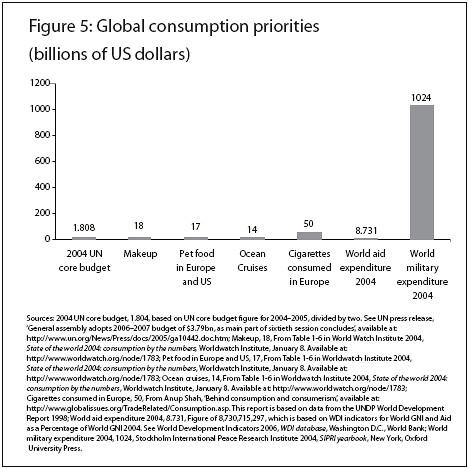
Meanwhile, here's a graph of our twisted priorities around aid, from one of the PGC papers (David Held: Global challenges: accountability and effectiveness):

aidpriorities2

That's right - we spend twice as much on makeup as we do on aid. It makes you realise how little the rich world values the lives of the poor.

Monday, November 26, 2007


Climate change: the rich renege - again

Early next month, parties to the United Nations Framework Convention on Climate Change are meeting in Bali to discuss a successor to the Kyoto Protocol. An important part of these negotiations is likely to be a promise by rich nations to help fund adaptation and emissions reduction in poor nations in exchange for the latter agreeing to gradually accept binding emissions reduction targets. But there's a problem: rich nations have promised this before, and are spectacularly failing to live up to those promises.

According to the Guardian yesterday, at the UNFCCC summit in Bonn in 2001, rich nations pledged a total of US$410 million per year to the Global Environment Facility to fund adaptation and reductions in Annex II countries. The funding was due to start in 2005, and so so far the GEF should have received US$1.2 billion to help fight climate change. But according to a report [PDF] presented to a GEF meeting last month, total contributions over three years amounted to a paltry US$177 million - just 15% of the total. Another US$106 million has been pledged, but not actually paid, and whichever way you look at it, wealthy nations are falling well short.

This seems to be a disturbing habit; I've posted before about how the rich nations have reneged on promises to increase aid spending. This is both wrong and stupid. On the moral front, we should keep our promises, and not promise things we have no intention of delivering. And on the pragmatic front, this continued reneging devalues our word, and reduces the utility of such promises as a negotiating tool. To put it bluntly, given our failure to live up to the promises made at Bonn, why should poorer nations accept any promises we make at Bali?

Tuesday, May 29, 2007


Australian "generosity"

Over the past few years, the Australian government has significantly increased its aid spending after Prime Minister John Howard pledged to work towards the millennium development goals. Normally, this would be welcome; however, there's a dark secret in Australia's aid program. According to a report by the NGO AidWatch [PDF], up to a third of Australia's "foreign aid", almost A$1 billion per year, either flows straight back to other government departments or is spent on promoting Australia's security and commercial interests rather than on poverty alleviation. And almost half of that - A$470 million - goes on debt relief, most of it on "forgiving" debts owed by Iraq which had already been written off and paid out by insurers.

Some of the spending the Australian government is calling "aid":

  • $29.4 million on bribing the government of Nauru to host the "Pacific solution" prison for refugees;
  • $21 million for "offshore management of unauthorised arrivals" - in other words, to run the prison;
  • $112.8 million to support refugees in Australia, something that other countries do not count as aid;
  • $112 million for the Australian Federal Police serving as part of the RAMSI mission in the Solomons, whose primary aim is ensuring Australian security;
  • $61 million on governance in the Solomon Islands, most of which is paid to Australian consultants. By contrast, education in the Solomons receives only A$2 million (I guess they don't need to learn to read over there);
  • $20 million in unspecified defence spending counted as aid;
  • $150 million on scholarships for foreign students, money that would be arguably better spent as direct aid to foreign educational institutions rather than a hidden subsidy to Australian ones;
  • Most egregiously, $27,758 for legal advice over the Cole inquiry into corrupt dealings by the Australian Wheat Board under the Un oil-for-food programme.

(Actually, there's something even more egregious: In 2001, they spent $2.08 million on the interception of the SIEV 4 by the HMAS Adelaide - an incident known as the "children overboard affair" - then called it refugee aid despite the fact that the none of the asylum seekers involved were granted refugee status or even allowed to set foot on Australian soil).

And naturally, what they do spend overseas is "tied", meaning that much of it must be spent through Australian companies. So they're also running it as a giant kickback and corporate welfare scheme for Australian businesses (perhaps Howard has been learning a few tricks from Dick Cheney here).

These are deeply dishonest practices, many of them actively harmful to the real goals of aid: poverty alleviation and sustainable development. Unfortunately, the Australian government doesn't seem to care. Instead, it's more important to make their stats look good.

Tuesday, May 15, 2007


120,000 reasons to increase aid

Yesterday the government announced a welcome increase in our foreign aid budget, laying out a pathway to increase it to 0.35% of GDP by 2010. However, it still has a long way to go if it is to meet its commitment to boost it to 0.7% by 2015. Today, it received 120,000 reasons to push towards that target, in the form of a petition from the New Zealand branch of the Make Poverty History campaign. That's a massive petition for New Zealand, and one that makes it clear that we expect our government to do better in this area. Hopefully they'll take the message to heart, rather than ignoring it.

Monday, May 14, 2007


Increasing Aid

Foreign Minister Winston Peters has announced a major increase in aid spending - $70 million this year, and $250 million over the next four years. This will mean that Labour will meet its election pledge to increase aid to 0.35% of GDP by 2010 - the highest level in thirty years, though still not a touch on the 0.52% reached under the Kirk government. Still, it is an extremely welcome increase, and one the government can be proud of.

Next step: getting them to lay out a pathway to meet their commitment under the Millenium Development Goals to increase aid to 0.7% of GDP by 2015.

Monday, April 23, 2007


Aid and the Pacific

In a spech to the United Nations Association on Saturday, National's foreign affairs spokesperson Murray McCully called for New Zealand to focus its aid on the Pacific. But while McCully had clearly done his homework on the sorts of projects NZAID funds in other parts of the world, he omitted one vital fact: the government already does exactly what he is suggesting. A quick look at the 2006 estimates of appropriation for Vote: Official Development Assistance [PDF] shows that approximately two-thirds of our current aid spending is classed as "Pacific Development Assistance", and only one third "Global Development Assistance" ($466.72 million vs $224.43 million over three years) - up from 47% five years ago. "A core geographical focus on the Pacific" was a key part of NZAID's mandate when it was split off from MFAT in 2002, and so far it has lived up to it.

As for the wider point, it is appropriate that we focus our efforts on our immediate neighbours. We have close cultural ties with many of the Pacific islands (sometimes as a former colonial master; more often because we have large expat communities living here), it is logistically easy to assist them, and few other countries are interested in the region. That means that if we don't help, no-one else will. In addition, we have an interest in ensuring that our neighbours are peaceful and stable, and aid is a way of promoting this. However, that doesn't mean we should completely ignore the rest of the world. There are problems beyond our backyard too, and we should do what we can to help with them.


