The Extractive Industries Transparency Initiative is an international organisation to promote transparency and reduce corruption around mining. In the past, the New Zealand government has been reluctant to join, seeing no value in membership other than the possibility of silencing critics. But the organisation has just nominated former Prime Minister (and UNDP head) Helen Clark as its chair. Which raises the obvious question: will New Zealand be joining now? Has MBIE even bothered to look at it since 2014?
Showing posts with label Helen Clark. Show all posts
Showing posts with label Helen Clark. Show all posts
Thursday, January 31, 2019
Tuesday, August 02, 2016
Helen Clark, the UN, and politicians' priorities
Yesterday the Maori Party announced that they opposed former Prime Minister Helen Clark's bid to become United Nationas Secretary General due to the foreshore and seabed, the Tuhoe raids, and her opposition to the United Nations Declaration of Rights of Indigenous Peoples. The reaction of the establishment parties was instantaneous: Labour said it was "political hysteria", while Winston Peters called it "treachery". Really? Given what they stand for, the Maori Party's position is perfectly reasonable and well-founded. Helen Clark hurt Maori in many ways, and she still hasn't apologised for it. And its perfectly fine to be upset by that. In a mature democracy, we don't all have to get along, and there should certainly be no expectation that we should all support the same things (the mere existence of a democratic system of government and politics is proof that we don't).
Meanwhile, you really have to wonder about the priority establishment politicians assign to one of their own getting a prestigious post-political career. Sure, Helen Clark becoming UN Secretary General or Tim Groser become Director of the WTO is good for them. But why should we care about it? National pride is puerile, and an expectation that they will somehow use the office to benefit New Zealand is corrupt. Sure, she'd be good at the job, but thinking that she'd be better than all the other candidates is just parochial (and probably makes some assumptions about what the UN wants which might not be true). The size of her expense account doesn't matter to us. Basicly, there's no good reason for any of us to give a shit about it (or more of a shit beyond a vague positive "good for her").
And yet, establishment politicians do care and are seemingly highly invested in these personal employment campaigns. Why? Is it because they all hope for a (well-paid) international career after Parliament and club together to support one of their own? Or is it because one of them in one of those jobs creates opportunities for patronage and more jobs for the boys (both Charles Chauvel and Chris Carter landed at UNDP). Either way, its got nothing to do with us, and to the extent that they're investing public resources promoting the private interests of former politicians, is an abuse of office.
Friday, June 13, 2014
David ain't no Helen
With Iraq turning into a mess again, and the US refusing to rule anything out while pointedly saying it can always count on Australia, people in New Zealand are asking the obvious question: if the US starts another war, will our politicians join it?
John Key hasn't spoken up yet. As for David Cunliffe, he's just been asked about it by Newstalk ZB's Felix Marwick. His response is pure mush:
Cunliffe on troops to Iraq: wd dep' on the circumstances when request made. Won't hypothesize what answer wd be w/out having specific facts.And there you have it: David Cunliffe ain't no Helen Clark. If you want New Zealand to stay out of America's stupid wars, you'll need to vote for someone else.
a difficult decision and would rely on the position taken by the United Nations and our partners. Can't rule anything in or out.
Update: And meanwhile, John Key says the chances of his government contributing to any intervention are "remote". Its a sad day when Labour looks more warmongering than National.
Wednesday, December 22, 2010
Denied
Both Helen Clark and Phil Goff have denied the US embassy's claim that they traded blood for butter over Iraq, calling it "ridiculous" and "preposterous". Which is what you'd expect them to say. But if they want to prove it, then they have an obvious avenue to do so: request and release all the advice they received on the issue, unredacted, so we can see that they are telling the truth. Anything less, and we can only conclude that they have something to hide.
(This is the problem with secrecy: by its nature, it invites suspicion. Only total transparency allows us to see that our politicians are in fact doing what they have said they will do, rather than betraying us behind our backs).
Meanwhile, if Clark and Goff are telling the truth, and the dairy trade had nothing to do with their decision, we also have to ask why "senior MoD officials" thought that it did. Are they that far out of the loop, or is the culture within the MoD really that toxic?
Monday, December 20, 2010
Blood for butter
Back in World War I the New Zealand government made a cynical decision to sacrifice kiwi lives on the altar of empire for the sake of trade - a decision referred to by critics as "blood for butter". Now it seems Helen Clark (of all people) made exactly the same cynical decision over Iraq - literally:
One of nearly 1500 secret US cables obtained from WikiLeaks details Cabinet decisions in which Helen Clark's government did an about turn on sending troops to Iraq because of fears Fonterra would miss out on lucrative Oil for Food contracts.Fortunately Clark's decision worked out rather better than Massey's. But the mere idea that we would risk lives for the profit of a few farmers is utterly abhorrent, and Labour should be deeply ashamed of itself for doing so.[...]
"Senior MOD officials (strictly protect) tell us it was not until Finance Minister Michael Cullen pointed out in a subsequent Cabinet meeting that New Zealand's absence from Iraq might cost NZ dairy conglomerate Fonterra the lucrative dairy supply contract it enjoyed under the United Nations Oil for Food program, that the prime minister found a face-saving compromise and sent combat engineers in a non-combat role to Basra, where they were embedded with British forces.
Meanwhile, the fact that senior MOD officials were secretly briefing the Americans on the inner workings of our Cabinet is deeply disturbing. And when you combine it with all the other secret briefings mentioned in the cables, you have to ask: is there anyone in our public service who actually works for us, as opposed to a foreign power?
Wednesday, April 08, 2009
Member's Day
Today is a Member's Day, and the big drawcard is Helen Clark's valedictory speech at 17:00. If you're online, you'll be able to watch it here; otherwise I'm sure it'll get plenty of coverage on the evening news.
Actual business is fairly boring. The House is still bogged down in the Committee Stage of Chester Borrows' Wanganui District Council (Prohibition of Gang Insignia) Bill, which will take up most of the time. There's another local bill on the Order paper to fiddle around with the Eden Park Trust, but that should be dealt with relatively quickly unless someone wants to filibuster. If we're lucky, they'll get to spend some time on the Committee Stage of Darien Fenton's Minimum Wage and Remuneration Amendment Bill - but after last week I'm not regarding that as a strong likelihood. Next week maybe.
Still no chance of a ballot anytime soon, though MPs are increasingly announcing that they have bills. So we have National's Todd McClay taking another go at the ever-popular topic of Easter trading (but only for people in his electorate, mind), and Palmerston North MP Iain Lees-Galloway trying to ban the "powerwall" - the wall of cigarettes the tobacco companies use in an effort to circumvent advertising restrictions. But it is likely to be months before any of these bills - or any of the others I've heard about - has any chance of seeing the light of day.
Correction: Todd McClay's bill would allow communities to decide on Easter trading through their territorial authorities - making it a clone of Stephanie Chadwick's bill of a few years back. Somehow I'd got the wrong impression from my brief perusal of the press release last night...
Wednesday, April 01, 2009
Confirmed
Helen Clark has been confirmed as director of the UNDP by the UN General Assembly. She is expected to start by 20 April - just three weeks away. Which means there will be a by-election - and soon. Section 129 of the Electoral Act requires the Governor-General to issue a writ for a by-election within 21 days of a vacancy being declared; s139 states that the latest day a writ can be returned is 50 days after its issue. So, that's 71 days for the entire process, which means that if Clark resigns on the last possible day the by-election will have to be held and the results certified by 1 July.
An interesting question is whether the Electoral Commission has the money to do it. As their Briefing to the Incoming Minister [PDF] made clear, they are grossly underfunded; their budget has not been increased since 1994, and it has got to the stage where they can now no longer afford to fund basic election education (all those orange man ads). One of the things I'll be watching for in the upcoming Budget is whether the government corrects this, or whether it continues to let our basic electoral infrastructure rot in order to save a few dollars.
Correction: Whoops! The Electoral Commission has nothing to do with by-elections; they're handled by the Chief Electoral Office.
Friday, March 27, 2009
Context
From the fuss being made over Helen Clark's nomination to head the UNDP, you'd think she was going off to head something big and important. And she is. But last night, I was shocked when I heard a reporter breathlessly mention the UNDP's total budget: US$5 billion, or about NZ$9 billion. NZ$9 billion for the entire world.
To put that in context, its just under an eighth of the NZ government budget [PDF], and smaller than our education, social development, or health budgets. We alone spend more money on any one of those things than the UN gets for the entire developing world.
Kindof puts it in context, neh?
Wednesday, March 25, 2009
Has Clark got the job?
The Herald reports that Helen Clark has got the job as head of the UN Development Programme. Good news if its true - Clark is a natural for that sort of work. But it will also mean a by-election in Mt Albert - our first since the Te Tai Hauauru by-election in 2004. By-elections used to be fairly common, with an average of almost one a year between 1945 and 1985. Now we get them once every five years. MMP plays a role here, reducing sharply the number of by-elections arising from resignation, but there's another reason too: MPs just aren't dying in office anymore...
Monday, October 20, 2008
Closing the wallet
I've been impressed over the last two weeks by Labour's solid response in the wake of the PREFU. Where National was trying to pretend nothing had changed (or, alternatively, to pretend they had changed their policies in response when they had done nothing of the sort), Labour has addressed the problem head on, moving to help the banks while minimising the impact of the recession on ordinary people. They've also clearly scaled back their election promises to a few key packages, including raising benefit abatement thresholds and ending the obscenity of forcing students to borrow to eat - both fundamentally fair measures which needed to be done regardless of circumstance, and whose costs are spread over the long-term. Now they've gone one further: at Labour's Wellington campaign launch yesterday, Helen Clark announced that they had closed the wallet entirely:
I have not come here today to announce any more significant spending initiatives.It's a responsible move; big promises now will simply end up saddling the next generation with debt. And having just dug ourselves out of that hole, we shouldn't go back to it. But I'd like to see more from Labour - specifically, an inkling of how they plan to reduce that debt path while protecting public services. I can think of one very big, very obvious area of spending to cut, where the effect will be purely distributional (and not harm the poor); the question is whether Labour will do it.Nor do I plan to announce more.
Monday, July 28, 2008
Shaking hands with a torturer

(Image stolen from 3 News)
Nice to know where our "human rights supporting" Prime Minister really stands on US torture...
Thursday, May 01, 2008
An awkward question
If the government is planning to do nothing about climate change, does this mean Helen Clark will be returning her award...?
(Of course, it was hot air to begin with, but its even moreso now...)
Wednesday, April 23, 2008
Hot Air
The UN Environment Programme has honoured Helen Clark at its annual Champions of the Earth awards for her work on pushing climate changing policy:
By setting a carbon neutral goal for New Zealand, Prime Minister Helen Clark has put her country at the forefront of today's environmental challenges. Three major policy initiatives launched by Miss Clark are also blazing new trails for sustainability and the fight against climate change: the Emissions Trading Scheme; the Energy Strategy; and the Energy Efficiency and Conservation Strategy.But while its great policy, none of this stuff has actually been implemented yet, so Clark has essentially been given this award on the basis of hot air.
Tuesday, April 08, 2008
Asking the obvious questions
Over the past few weeks, as debate raged about the morality of signing a free trade agreement with China while it was shooting protestors and jailing dissidents, Prime Minister Helen Clark repeatedly promised to raise the issue of human rights with the Chinese regime. Which begs the obvious question: did she? Fortunately, we have an Official Information Act, which means I can ask the government:
- What exactly did Helen Clark say about human rights to the Chinese government, and to whom?
- Which human rights issues, if any, did she raise?
- What was the Chinese response, if any?
Their response should be interesting. Of course, it could always be refused under s6 (a) (international relations) - but then that's really inviting the conclusion that they never raised it at all, and were just lying to us to distract us for long enough to get the deal through.
Update: Stuff this morning has an answer:
Miss Clark met with Premier Wen Jiabao before the agreement was signed and said the situation in Tibet was discussed.It's good that Clark raised Tibet. But there are other human rights issues in China, and she should have been raising them too.New Zealand had concerns around the violence and called on China to urge restraint and enter into dialogue with the Tibetan independence movement, she said.
The Dalai Lama has called for an end to violence, the start of talks with China and for countries to attend the Olympics.
These three statements opened up the way for talks between the two sides, Miss Clark said.
Premier Wen had argued China's response had been appropriate in the circumstances.
"The issue has been to see that there is a proportionate response," Miss Clark said.
She did not believe that the Chinese would take New Zealand's signature on the trade deal as condoning its human rights record.
"I don't think there is any crossover between the two. The premier specifically stated that he wished to strengthen the human rights dialogue with New Zealand."
Monday, April 07, 2008
Lacking in credibility
Helen Clark spent the weekend in London attending the 2008 Progressive Governance Conference. While there, she put her name to a communique calling for immediate action on the UN Millenium Development Goals:
Leaders who gathered for a progressive governance roundtable in Watford, London on Saturday have called for immediate global action to put the Millennium Development Goals (MDGs) at the forefront of international agenda.So, does this mean we'll finally see that timetable for how New Zealand plans to meet its commitment under the MDG to increase aid to 0.7% of GNI? Somehow, I think not.They maintained that it was only by recognizing that this was truly an emergency that concerted global action could be brought about.
The MDGs, which range from halving extreme poverty, spread of HIV/AIDS and providing universal primary education, all by the target date of 2015, form a blueprint agreed to by all countries and development institutions. The about 20 leaders, in a communiqué, noted with concern that despite pledges to spare no effort at achieving these goals and the unprecedented global wealth, global inequalities had become more acute with some 2.5 billion people still living on less than two dollars a day, while many countries were significantly behind the goals for 2015 in health and child education.
Meanwhile, here's a graph of our twisted priorities around aid, from one of the PGC papers (David Held: Global challenges: accountability and effectiveness):
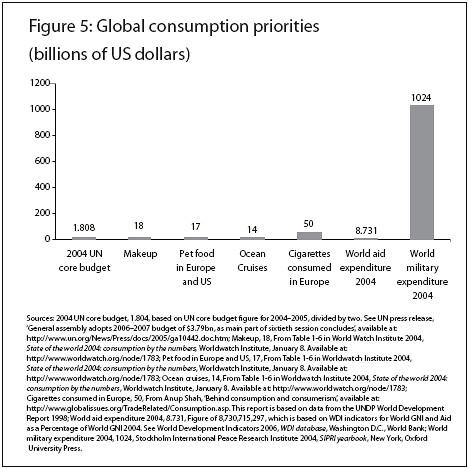
That's right - we spend twice as much on makeup as we do on aid. It makes you realise how little the rich world values the lives of the poor.
Tuesday, March 18, 2008
A shameful straw man
In the wake of her failure to properly criticise Chinese human rights abuses in Tibet, Helen Clark has attempted to defend her government's unconscionable decision to continue pursuing a free trade agreement with the Chinese regime. Her basic argument?
If New Zealand traded and entered into trade agreements only with countries with which it had identical interests and views, "then apart from Ireland and Switzerland and Scandinavia, it would be pretty thin pickings".This of course is a straw man. It's not a question of us only trading with countries with "identical interests and views" (something which doesn't exist between individuals, let alone countries); its a question of us going out of our way to offer preferential access to a country whose actions clearly put it beyond the international pale. While Clark shamefully attempts to paper over this difference, it's real, and reflected in our foreign policy. We're not negotiating an FTA with Zimbabwe. We're not negotiating an FTA with Uzbekistan. We're not negotiating an FTA with Belarus or Burma. So why the hell are we negotiating one with China?
Tuesday, October 02, 2007
Impose sanctions on Burma
In her address to the Oxford Union this morning, Helen Clark highlighted human rights as a core interest of New Zealand's foreign policy:
As one of the world’s oldest continuous democracies, with our first Parliament elected in 1854, we do stand up for the rule of law and the human rights upheld by the United Nations. Many of us in our current government cut our teeth in politics on the issue of South African apartheid. Sadly too few people around the world enjoy the personal freedoms we in western democracies take for granted.It's a nice motherhood statement which will appeal to many New Zealanders' sense of national identity. Unfortunately, our government is failing to live up to it. While Clark was giving that speech, her government was refusing to impose sanctions on Burma. Her foreign minister obediently trotted out exactly the same excuses used by those opposing sanctions against South Africa all those years ago - that sanctions don't work, and that they hurt ordinary people. But as the case of South Africa shows, sanctions are a good way of increasing pressure on a government. And as for the people of Burma, according to a report from the Burma Campaign UK, the fact that the formal economy is small and dominated by the regime and its cronies, while most Burmese are in the informal economy means that
sanctions targeting foreign investments and international trade will impact on the regime while having a minimal impact on the majority of ordinary civilians.Furthermore, the NLD and its leader Aung San Suu Kyi have been calling for sanctions since the mid 1990's.
Our government has a clear mandate for sanctions, from an unquestionably legitimate source. While we have only a small amount of trade with Burma, it would be a strong statement of our country's values and commitment to human rights, and the best means within our power of supporting Burmese democracy. The government should walk its talk, live up to its rhetoric for once, and impose sanctions.
Thursday, March 22, 2007
Paying homage
Helen Clark has been in Washington for the last few days, meeting President Bush and various other US officials. So far the trip has had its expected outcome: none. So why did she bother going?
It's a question worth asking, because the brutal fact is that we have very little to talk about with the US. We are not interested in talking about the things they want to talk about (Iraq and Iran), and they are not interested in the things we want to talk about (human rights free trade). And there's little point in "building relationships" with a lame duck administration which has only 670 days left in office. The sorts of things we both want to talk about can easily be handled by officials - so why a high profile (for us) Prime Ministerial visit?
The answer is that we are paying homage to the hegemon. Just as the feudal nobility would travel to court to kneel on bended knee, we are making a public display of friendship and loyalty. But with the US further from our shared values than it has ever been, I don't think that is something we should be doing.
Thursday, March 15, 2007
Not on her agenda
For the past five years, the United States has been engaged in serious human rights abuses. It has detained hundreds of people without trial in its Caribbean gulag at Guantanamo Bay, it has introduced the practice of extraordinary rendition, kidnapping suspected terrorists and flying them to third world countries so they may be tortured, they have admitted torture in the form of "enhanced interrogation techniques" completely recognisable to the Spanish Inquisition and Gestapo.
Where you stand on this is, as Keith Locke has said,
an acid test of whether you really stand for justice and human dignity.
So where does the Prime Minister stand on it? In Question Time yesterday she was asked, and her answer speaks for itself:
Keith Locke: What will she say to George Bush about the United States’ barbaric treatment of prisoners at Guantánamo Bay, and the American Government’s practice of rendering prisoners to torture in third countries?Rt Hon HELEN CLARK: It is not on my agenda to raise issues of that kind with the President.
That's right: torture just isn't on her agenda. The policy of shameful, sycophantic silence, continues...
Thursday, March 01, 2007
Shaking hands with a torturer
What is it with Helen Clark and torturers? First, she shook hands with Pakistan's President Musharraf - an unelected dictator who presides over the widespread use of torture and state impunity. Then she did it with General John Abizaid, the US general responsible at the time for the occupation of Iraq, who bore command responsibility for the abuses of Abu Ghraib and the massacre of Fallujah, and who reportedly deliberately looked the other way on torture committed by US forces. And now she's going to Washington to shake hands with president Bush
Just in case anyone has forgotten, this is a man who lied his way into a war which has now led to the deaths of 655,000 Iraqis. A man who is now planning to do it all again in Iran. A man who authorised an illegal and immoral system of disappearance and torture, in which suspected terrorists are kidnapped, flown halfway around the world, imprisoned in "black sites" in foreign countries, and subjected to strapado, waterboarding - techniques used by the Spanish Inquisition, the South American juntas, and the Nazis.
Any decent person would refuse to meet with such a person. Any decent person wouldn't piss on him if he was on fire. And our Prime Minister is going to shake his hand on our behalf.
It's nice to know where Labour really stands, isn't it?





