Showing posts with label Fiscal Policy. Show all posts

Thursday, September 20, 2018


Better than expected

When the news emerged two weeks ago that the Tax Working Group had backed away from recommending a capital gains tax, I was angry. After all, producing such a recommendation was the purpose of the group, and imposing such a tax the purpose of this government. But the Working Group released its interim report today, and it turns out that they do support a capital gains tax - they just haven't worked out what it should look like yet:

Two ways of taxing capital have been proposed by the Tax Working Group, including extending the current income tax regime.

[...]

The group is proposing two options for taxing capital gain: any gain from the sale of assets taxed at roughly the marginal income tax rate, and the second a regime under which a portion of the value of certain assets would be subject to tax, for example rental properties, to be paid each year.

However, Sir Michael said neither of these options were actual recommendations.


Delving into the report, they're doing detailed design of the two options to work out which will work best, and it looks like they will in fact produce a recommendation at the end of it. Of course, the government (which is composed purely of rich people who will have to pay this tax) might still chicken out or put their own interests first, but its looking a lot more hopeful for progressive change than it was.

In the meantime, we can no doubt expect more wailing and piteous whining from the rich and the business community, who find the thought of paying their fair share for once erodes their "confidence". Which says rather a lot about their lack of ethics. Taxes are what pay for the safe society which allows them to do business. And if they want to dump the costs of that on other people, then they're simply parasites, and we're better off without them.

Monday, September 10, 2018


We've been had

When Labour formed a government last year, there was an expectation that they'd finally do what National had refused to, and introduce a capital gains or wealth tax to remove the richs' tax loopholes. But their tax working group apparently isn't going to recommend anything of the sort:

The Tax Working Group is understood to have stopped short of recommending a broad-based capital gains tax, in an interim report due out within days.

The working group chaired by Sir Michael Cullen was tasked with designing a capital gains tax for consideration by the Government, but is expected to push back any firm recommendation to its final report which is due to be published in February.

It had been widely expected that the Tax Working Group (TWG) would recommend a broad-based capital gains tax on the likes of sharemarket and property investments as the centrepiece of tax reforms on which Labour would fight the next election.

However, doubts began creep in earlier this year that the Government would ultimately back the plan, amid concerns the new tax would be unpopular and would cause rents to rise without delivering much in the way of extra revenue for at least a decade.


The tax working group has also ruled out environmental taxes, so that basicly means that the entire exercise has been a waste of time. Rather than designing us the tax system we needed to reduce inequality or pollution, we'll simply have paid Michael Cullen a thousand dollars a day for nothing.

Which invites the question of Labour: if you're not going to fix this, what is the fucking point of you? This is supposed to be a core issue, what you stand for. But if you're just going to sit there and do nothing about it, people might start to wonder whether there is any point to your being in government, or why they bothered to vote for you in the first place.

Wednesday, July 19, 2017


Labour finally opens its wallet

Labour has announced a massive spending package this morning, aimed at restoring our health, education and welfare systems after National's neglect:

Labour has run its numbers and opened its books, promising multi-billion-dollar injections into health and education.

If elected, Labour leader Andrew Little said he would pump $8b more over four years into health and $4b into education, all the while maintaining surpluses of more than $4b.

The party has released its fiscal plan at an event held in Wellington's Kilbirnie Medical Centre. It provides the broad-brush numbers of what Labour would spend in key social areas, of health, education and housing.


These are big numbers, even over four years, and National will no doubt cry "fiscal irresponsibility". But they add up. And what's amazing is how easy it is to enable that level of spending on core services simply by tweaking a few parameters: the net debt target (20% vs 15%), and the annual surplus (a billion dollars lower in 2022). And by cancelling some tax cuts. And it makes it crystal clear how National's brutal austerity, which is seeing the homeless freeze to death and the sick waiting in ambulances at A&E, is entirely a matter of choice, of their prioritising numbers on a spreadsheet and giving money to their mates rather than delivering the core services the public expects from government. We can afford to have decent public services - its just that National chooses not to. And they do it, bluntly, because they are vicious arseholes.

As with the Greens' families package, this is a negotiating platform rather than a concrete promise. But if Labour manages to lift its vote, then it becomes the framework its coalition partners' policies will fit within. And what's clear is that they have plenty of room to manoeuvre, and deliver a kinder, fairer New Zealand, if we let them. Or we can have three more years of National giving themselves tax cuts, while telling you that you'll have to wait for that operation or pay a thousand dollars in "donations" to keep your kids' school operating. I know which one I prefer.

Friday, July 07, 2017


"Surplus"

Housing New Zealand waiting list quadruples in Palmerston North, Stuff, 5 May 2017:

The waiting list for Palmerston North's state homes has quadrupled for the second year in a row.

There were 193 applications on the Housing New Zealand waiting list in March. A year ago it was 44, and two years ago there were only 10.

Manawatu Tenants' Union co-ordinator Kevin Reilly said the union was dealing with people struggling just to get a roof over their heads.

For the past few years, the cost of living – the amount needed to cover essentials such as food, rent, and electricity – had increased faster than incomes, he said.


Almost 40% of Manawatu schools report operating deficits, Manawatu Standard, 25 June 2017:
Almost 40 per cent of Manawatu schools outspent their income during 2015, data shows.

The figures back up what many principals are saying – schools are struggling to make ends meet with current funding, Central District Secondary Principals' Association chairman Peter Brooks said.


'Cruel' ministry rejects Canterbury's 'urgent' mental health funding plea, Stuff, July 4 2017:
The Government has rejected an "urgent" request for millions of dollars of additional mental health funding for Canterbury.

A Canterbury District Health Board (CDHB) member has labelled the rejection "brutal, cruel, unfair and wrong" and warns mental health staff are under such pressure that "we're heading towards a service failure".

CDHB chief executive David Meates told the Ministry of Health in March about a proposal to request "urgent additional mental health funding of $7.2 million to address increasing demand", documents obtained by Stuff reveal.

Director general of health Chai Chuah responded in a letter to CDHB acting chair Mark Solomon that such a proposal for additional funding was "inappropriate" as it was the responsibility of the board to ensure the provision of services for its resident population.


Govt surplus beats expectations, Radio New Zealand, 6 July 2017:
A higher tax take and lower spending has helped boost the government's coffers.

Excluding investment gains and losses, the operating surplus stood at $4.49 billion for the 11 months to May, compared with the $2.9bn surplus that had been forecast.

[...]

Expenses came in below expectations, at $69.3bn.


[Emphasis added]

So, the government apparently is rolling in money, while health, education, and state housing are all chronicly underfunded. This isn't a "surplus" - or if it is, its the "surplus" you have when you haven't paid for rent or food and are putting off that visit to the doctor. In other words, not a surplus at all. In reality, our government is deeply in debt: a social, infrastructural, and health debt, accumulated over thirty years of NeoLiberalism. But because that misery is not counted on the government's books, it doesn't exist in government thinking, and so it's "yay, tax cuts", rather than "we need to fix this".

This is simply not sane. Our government is like a drunk, ignoring basic costs in order to feel rich and splurge on its mates. And that is not "good economic management".

Friday, February 25, 2011


An earthquake levy

Now that the extent of the damage caused by the Christchurch earthquake is becoming clear, people are beginning to wonder how to pay for it. On the one hand, this is exactly what we have EQC for: saving for that rainy day when the big one hits. On the other, after two major earthquakes in Christchurch, EQC is looking pretty cleaned out, so there will be problems if we have another serious natural disaster in the next decade or so. In Australia, the government imposed a disaster levy - a temporary rise in income tax, with the revenue tagged to disaster relief - in response to the Queensland floods. Now the Greens are proposing a similar measure here.

Its a good idea. We need to raise the money somehow, and doing it through income tax is the fairest and most effective method. The Greens' proposal would raise between $460 and $920 million a year, depending on the rate at which it is imposed - which is enough to make a serious difference. And while it means that people in Auckland and Wellington will be helping to pay for Christchurch's earthquake, that's what living together in the same country means: sharing the burden and bailing each other out.

John Key is reportedly lukewarm on the idea, so I guess we'll get to see who he puts first: the people of Christchurch, or his rich mates. Time to choose, John...

Tuesday, February 22, 2011


Tax cheats III

It seems that someone was listening to yesterday's post. From todays Questions for Oral Answer:

RAHUI KATENE to the Minister of Revenue: Is it true some of our biggest companies are paying a lower tax rate than the average pensioner; and if so, how can private company tax which enables companies to benefit from huge tax breaks be considered morally fair or acceptable?
And that's the key question: not whether it is legal, but whether it is fair. While tax accountants can come up with all sorts of legal scams to shuffle money around to hide it from the IRD, if they do so, they are evading their social responsibility. And ordinary people, who pay their taxes automatically with their wages through PAYE and recognise that those taxes mean schools for their kids, hospitals when they're sick, a social safety net when the bankers fuck the economy and throw them out of work, and a pension in their old age, can recognise the blatant unfairness on display here. If companies are using these scams, then they are not paying their fair share - and stealing from all of us in the process.

Monday, February 21, 2011


Tax Cheats II

Spurred by my previous post, I've spent the afternoon browsing annual reports of NZSX50 companies. Its been an interesting exercise. And its turned up some shockers:

  • Abano Healthcare Group Limited reported a 2010 pretax profit of $81.5 million, but paid only $2.6 million in tax - an effective rate of 3.19%.
  • Ryman Healthcare Limited [PDF] reported a 2010 pretax profit of $83.8 million, but paid only $5.4 million in tax - an effective rate of 6.5%
  • Infratil [PDF] reported a pretax profit of $106 million, but paid only $11 million in tax - an effective rate of 10.4%
  • The NZX [PDF] itself reported $43.4 million in profit, but paid only $4.7 in tax - a rate of 10.9%.

(And that's not even including the worst of them: Goodman Property Trust [PDF] paid only 1.9% tax on its $506 million profit. But they're Australian, so its the Aussie taxpayer they're ripping off, not us).

Given that we had a headline corporate tax rate of 30% last year (dropping to 28% from this year), companies paying less than half that rate deserve intense scrutiny. While I'm sure that everything they are doing is legal, just as everything Barclays Bank is doing in the UK is legal, that does not mean it is moral, or acceptable. I think the average kiwi would be appalled to discover that some of our biggest companies are paying a lower tax rate than the average pensioner. It suggests that these companies are conniving to avoid paying their fair share. And that is something we should not tolerate.

Tax cheats

Barclays bank is one of the largest banks in the UK. In 2009 it booked profits of £11.6 billion pounds, despite the financial crisis, and paid out £1.5 billion in bonuses. So how much tax did it pay on its enormous profit? Just £113 million - a rate of less than 1%:

Barclays Bank has been forced to admit it paid just £113m in UK corporation tax in 2009 – a year when it rang up a record £11.6bn of profits.

The admission stunned politicians and tax campaigners. It was revealed on the eve of a day of protests planned against the high street banks by activists from UK Uncut, a group set up five months ago to oppose government cuts and corporate tax avoidance.

The Labour MP Chuka Umunna, who lobbied Barclays' chief executive, Bob Diamond, to reveal the tax paid by the bank, described the figure – just 1% of its 2009 profits – as "shocking".

While some of its profits will have come from overseas subsidiaries - many deliberately established in tax havens such as the Cayman Islands and Guernsey precisely to evade tax - this is still tax cheating on a grand scale. The headline company tax rate in the UK is 28%. And Barclay's is pretty obviously not paying its fair share. And the result of that cheating is to rip more than three billion pounds out of the public purse - three billion pounds that could be used to pay for hospitals, schools, and public libraries.

In the UK, people have made the connection between corporate tax evasion and government cuts, and this weekend they retaliated by occupying and shutting down banks. We should look into this in NZ. Are our leading corporates really paying their fair share? In the UK, Barclays' shocking figures emerged from select committee hearings. We should do the same here, and hold a select committee inquiry into corporate tax evasion. Unfortunately, such an inquiry's natural home - the Finance and Expenditure Committee - is tightly controlled by National. And I doubt they would be interested in inquiring too closely into whether their donors and cronies are paying their fair share.

Tuesday, January 25, 2011


A good policy ruined by magical thinking

Phil Goff gave his "state of the nation" speech today, aimed at launching Labour during election year. Last year, he targeted inequality, focusing on the need to narrow the gap between rich and poor. Today he gave some details about how Labour plans to do that. Their first step? A $5,000 tax-free bracket, to be paid for by cracking down on tax avoidance and restoring the top tax bracket. It's good, redistributive, left-wing policy. The problem is that Goff's numbers on how to do it don't add up.

According to Treasury's 2010 tax model data, a $5,000 tax-free bracket would cost $1.58 billion (10.5% of all income in the zero - $5,000 range). Reintroducing a 39% top tax-bracket on "incomes comfortably into six figures" would claw back only $290 million if the threshold is $150,000, or $558 million if it is $100,000. Which means that 60 - 80% of the threshold will be paid for by reducing avoidance. Goff's statement that

No one knows exactly how much is lost by people dodging their tax - but it’s been estimated in the billions.
is carrying an awful lot of weight here.

Like Goff, I want to see those loopholes closed and that avoidance stopped. People should pay their fair share, and those who don't are cheats and parasites. It speaks volumes about National that in a recession when the government needs all the money it can get, they're not doing this. But the core problem here is that we just don't know how successful those efforts will be, and how much money they'll yield. Which makes relying on them to fund over a billion dollars in low-income tax cuts an exercise in magical thinking, about as intellectually defensible as right-wing promises to fund tax-cuts for the rich by "cutting waste". And when you've just promised that you "won’t make any promise that I can’t keep or that the country can’t afford" and to "be more fiscally responsible than National", you've just handed them a stick to beat you with (and that's without getting into the risk that some Labour MP, somewhere, will be cheating in exactly the same way).

And all of that said: this is a good, principled position taken by Labour, and one which clearly puts them on the side of the many against the few. Its also good politics - in a recession, the idea that some people are not paying their fair share attracts even more moral outrage than usual; if National dismisses it with their usual claim of the "politics of envy", then they're on the side of the cheats, if not cheats themselves. I just wish Labour had presented it more carefully, as something that would take them a few years to implement after they found out how much more revenue a crackdown would yield, rather than exposing themselves in this manner. Overpromising and relying on magical thinking benefits no-one; it just leads to disappointment and adds to the public's cynicism about politicians. And that's something Labour should be trying to avoid.

Tuesday, August 17, 2010


Income splitting discriminates

Today Peter Dunne introduced his bill for income splitting to the House. As widely explained everywhere, this would allow couples with children to split their income for tax purposes. The Standard has already pointed out how this benefits a tiny clique of wealthy couples at the expense of everyone else, but there's another reason to oppose it as well: as pointed out by the Attorney-General in a report to the House today, the bill is discriminatory and violates the Bill of Rights:

The ISTC takes a narrow view of family, parenting, and family care arrangements for children because there must be a "couple" with dependent children. the ISTC gives rise to a distinction on the ground of marital status because it explicitly distinguishes between couples with children and sole parents. For the purposes of this report, sole parents include caregivers without a partner, widows and widowers with children but without a partner, separated parents who have not repartnered and sole parents who share childcare responsibilities with another person.

The ISTC results in a comparative financial disadvantage for sole parents of up to $9,080. In effect, the ISTC also stigmatises sole parents as less worthy of tax relief than couples and perpetuates the stereotype that to be a "real" family there must be two parents in a relationship to raise children.

But that's not the only problem. The bill also indirectly discriminates on the basis of sex, as 83% of sole-parent families are mother-only families. While it is not mentioned, the bill obviously also discriminates on the basis of family status, because it applies only to people with children.

Is this discrimination justified? No. While supposedly aimed at allowing couples more flexibility to spend more time with their kids (something which would unquestionably be an important public purpose), the actual effect is to allow couples more flexibility to spend more time with their kids than sole parents. Furthermore, the means the bill proposes to achieve this is not rationally connected to the objective:

Income and marital status determine the amount of and eligibility for the ISTC. However, the need to work fewer hours or more flexible hours in order to care for dependent children flows from the age of the children (infant versus school-age), the individual needs of the children, the number of dependent children and the availability of support and assistance from other people. However, the actual needs of parents do not change the amount of the ISTC available to couples.
Basically what we have here is not a child welfare scheme, but conservative bigotry through the tax system. And that's just not acceptable. National will have to vote this bill to select committee as the price of Dunne's support, but that is more than it deserves. Instead, it should be dumped.

Friday, January 30, 2009


Bad advice

Bill English has released the second part of Treasury's Briefing to the Incoming Minister [PDF] - the part focusing on the specifics of National's policies. He's released it on a Friday - the traditional time to bury bad news - and I can see why. There's a lot in here people should be interested in, either because it calls the government's programme into question, or because it raises significant questions about what exactly they plan to do. And our politicians and journalists should be asking those questions now.

On the first front, Treasury is surprisingly in favour of Labour's R&D tax credits and "Fast Forward" fund, both of which it sees as making a positive contribution to innovation (National has scrapped both to pay for its tax cuts to the rich - something which promotes only holidays in Hawaii for the few). They oppose National's changes to KiwiSaver on the grounds that there is no evidence that the 4% payments are a barrier to access, while reducing them could lead to inadequate retirement savings and lead to people's balances simply being eaten up by fees. And they oppose National's plans to "fund" infrastructure by having the Cullen Fund purchase government-issued infrastructure bonds is simply a financial merry-go round in which the government would be both the issuer and holder of debt. In other words, it is a way of effectively reducing contributions while disguising the fact that they are doing so - a pure PR scam. Treasury frowns on such Enron-style accounting, and the rest of us should too.

On the second front, Treasury continues in the vein of its triennial ideological burp, recommending more market fundamentalism in response to the economic crisis. So we have the usual calls for tax cuts for the rich, poorer working conditions for the rest of us, and no increase in the minimum wage. Then they get worse.

They recommend "fiscal consolidation" (spending cuts), to be achieved by setting a GDP target for government spending or revenue, "a commitment not to change the allocation once set during the Budget cycle", or just slashing departmental budgets and leaving chief executives to sort out the mess. At the least, they recommend the return of the "sinking cap" which caused so much damage to our public services under the last National-led administration in the 90's.

They recommend higher student loan repayment rates for those on higher incomes - a shockingly progressive move, but one which would effectively claw back National's tax cuts for (recent) university graduates. Then they suggest lowering the repayment threshold. It's already well below the full-time minimum wage - a situation which makes a mockery of the claim that it is repaying the private benefit of education - and they want it lower? This is simply madness.

In places, the advice is almost comical. They recommend against "opening the books on waiting lists" because this could create "unrealistic expectations" that the health system would be properly funded to deal with basic demand, and create a risk that "ministers could become responsible for fixing every vulnerable service or unmet need" (hint to Treasury: they already are, and we punish governments who evade that responsibility). And in response to National's plans for a "crime tax", they suggest replacing it with "targeted support for the 13% of victims (particularly victims of serious violent crime) currently reporting dissatisfaction with the support they receive". I believe that's what Treasury would call "creating an incentive"...

But the worst bit is their proposed response to the international financial crisis. Their proposal? Nothing. Treasury thinks the market is best left to sort itself out. A fiscal stimulus package could upset the markets and "work against the unwinding of imbalances in the economy that need to happen". In English, that means stop firms from going bankrupt and people being thrown out of work. Furthermore, the effects are not predicted to be that bad - we're only expected to see 6% unemployment, "which until this decade was seen as the lowest rate of unemployment before inflationary pressures emerged". I'd like to see them tell that to the 75,000 families they're saying we should do nothing for. Assuming they can see them from their corner office fifteen floors up on the Terrace, that is.

It's appalling advice, both in its laissez faire attitude (the financial crisis apparently not having done anything to Treasury's religious belief in rampant capitalism) and its sheer inhumanity. And it makes me wonder: if Treasury's advice on any significant issue is inevitably "do nothing; let the market sort itself out (oh, and give tax cuts to the rich)", couldn't we get that advice a lot cheaper? Currently, we pay them about $40 million a year for policy advice. Couldn't we save all that money and spend $10 (once!) for a "Treasury says..." sign on the Minister's wall?

Humour aside, we should be asking the government how much, if any, of Treasury's recommendations they plan to implement. They publicly rejected the other proposals in the BIM, and we should make sure they do the same here as well.
Tuesday, November 25, 2008


Compare and contrast

The UK and NZ governments responses to the international financial crisis make an interesting contrast.

In the UK, Chancellor Alistair Darling has just announced a package of tax-cuts to stimulate the economy. But these are not your usual tax cuts. Instead of focusing on the rich, he is instead temporarily reducing the rate of VAT (the UK's version of GST) from 17.5% to 15% - a change that will primarily benefit the poor. And to pay for it he's hiking the top tax rate from 40% to 45%. This is not, as DPF is trying to spin it, another example of how NZ Labour was "out of step" on tax cuts. Rather, it is UK Labour finally finding itself and reconnecting with its left-wing roots. Taking a page from the neo-liberals book, they are using the crisis as an opportunity to shift the tax system in a more progressive direction, taking from those who can afford it to help those in need. I doubt DPF would welcome such moves if they were replicated here.

Compare this with the NZ response. National's tax package, signalled long before the election then spun as a response to the crisis, focuses on top-income earners. The half of New Zealand who earn below the median income get practically nothing, while the top 11% of taxpayers, those who need it least, get 40% of the package. In other words, it's the 90's "trickle down" theory all over again - and we saw how well that worked last time. But this doesn't just show that National is still in the grip of a dead ideology - they're also simply not interested in responding properly to the crisis. Instead, in classic neo-liberal fashion, they are trying to use it to enrich themselves and their supporters at the expense of the rest of us. And it will be interesting to see how that flies with an electorate promised centrism and moderation.

Monday, October 20, 2008


Closing the wallet

I've been impressed over the last two weeks by Labour's solid response in the wake of the PREFU. Where National was trying to pretend nothing had changed (or, alternatively, to pretend they had changed their policies in response when they had done nothing of the sort), Labour has addressed the problem head on, moving to help the banks while minimising the impact of the recession on ordinary people. They've also clearly scaled back their election promises to a few key packages, including raising benefit abatement thresholds and ending the obscenity of forcing students to borrow to eat - both fundamentally fair measures which needed to be done regardless of circumstance, and whose costs are spread over the long-term. Now they've gone one further: at Labour's Wellington campaign launch yesterday, Helen Clark announced that they had closed the wallet entirely:

I have not come here today to announce any more significant spending initiatives.

Nor do I plan to announce more.

It's a responsible move; big promises now will simply end up saddling the next generation with debt. And having just dug ourselves out of that hole, we shouldn't go back to it. But I'd like to see more from Labour - specifically, an inkling of how they plan to reduce that debt path while protecting public services. I can think of one very big, very obvious area of spending to cut, where the effect will be purely distributional (and not harm the poor); the question is whether Labour will do it.

Thursday, October 16, 2008


"One of the highest in the OECD"

A couple of weeks ago, Russell Brown pointed people at Richard Prebble's claim in the Herald that "Government expenditure as a percent as GDP is now one of the highest in the OECD". Interestingly, the OECD has just released their latest annual revenue statistics, which show that Denmark and Sweden were the highest tax OECD countries. As for New Zealand, we ranked right in the middle of the table - 15 countries were lower than us, 14 higher. And our overall tax rate hasn't changed significantly since 1990.

In short, Prebble is simply talking out of his arse. By the OECD's measure, we are not a highly taxed nation. Sure, we have higher taxes than the US, which they look to for leadership - but its the US which is aberrant, not us.

A razor gang

National has announced its "solution" to the deficit - a "Cabinet Expenditure Control Committee" which would examine all public spending looking for things to cut. Or, in English, a razor gang - just like the 90s.

As for their example - the doubling of departmental communications and public relations staff, there's an obvious change over the last six years which has driven that growth, and you're reading it. The public has much greater expectations that information will be made available quickly over the web, requiring each public sector body not just to have a website, but to update it frequently and have real information on it. And that's a Good Thing - more publicly available information means that we as citizens have much greater ability both to scrutinise government and debate policy. If Key cuts those people, we will lose that ability, and that will undermine our democracy. But given that Key also wants to get rid of MMP, he's hardly likely to care about that.

Wednesday, October 08, 2008


How they're paying for it

National plans to give away far more money to the rich than Labour by cutting taxes. So, how do they plan to pay for it? Firstly, by canning the R&D tax credit [PDF]. Their research, science and technology policy [PDF] had previously said they would cut it, and distribute the money to universities and CRIs (on the basis they were better at research than business); now they're just killing it. Secondly, by ending government subsidies to employer contributions to KiwiSaver (something which was worth doing anyway - but see below). Thirdly, by promising to "control government expenditure" - which means sacking public servants (starting with MFAT). Overall, this gives them a slight saving on Labour's financial pathway - but its worth remembering that that's a financial pathway which includes all of those things. National is cutting services in order to get more money to hand out to their rich mates.

With Kiwisaver, the actual cut to funding won't make any difference - it was a subsidy to employers to do what they should be doing anyway, and a prime target for cutting. What will make a difference is gutting the scheme so that employers only have to contribute 2%, rather than it increasing to 4% over the next two years. They're also planning to allow employers to discriminate on the basis of membership in KiwiSaver, and effectively pay people less if they join, or rip their contributions right out of workers' pay packets. There are 800,000 KiwiSaver members - and National has just promised every single one of them a pay cut. I wonder which way they'll be voting in November?

Saturday, June 07, 2008


Who benefits from United Future's tax proposals?

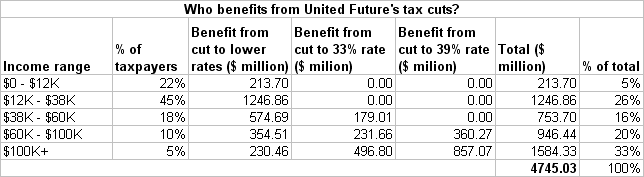
United Future is holding its annual conference this weekend, and have used the opportunity to enter the tax-cut bidding war, with a program costing $4.5 billion a year (a staggering figure equal to the entire cost of primary and secondary schools, or the whole law and order plus defence budgets [source]). So, who benefits? Who do you think?

(Methodology: Total cost calculated from Treasury's 2008 detailed model data; percentage of taxpayers taken from Who pays tax... and how much?, with some kludging from the model data around the 38K and 12K limits. Benefits to each group were calculated from the detailed model and the annual benefit of lower changes; the benefit to the final group was calculated by subtraction. Note that this includes no information on the effects of income splitting).

While it doesn't appear as grossly inequitable as the BRT's proposal, that's because it kludges an extra $2.6 billion a year of lower-rate cuts onto it in an effort to appear to not be pandering solely to the rich. And in fact the rich get even more in the hand from United Future, to the tune of an extra half billion a year. In the end, more than half the benefit flows to the top 15% of the population, and over a third to the top 5%. Meanwhile, the middle classes - the people Dunne claims to represent - get shortchanged, while the poor (who Dunne as a Catholic claims to be interested in) get nothing. And this, apparently, is what passes in Peter Dunne's mind for "moderate centrism".

Monday, May 26, 2008


Illustrating the difference

For those who are interested in tax cuts, Keith Ng has an interesting analysis of the government's Budget package. The upshot: Labour's tax cuts are significantly more generous to the 70% of us who earn less than $40,000 a year than anything National has offered in the past (graph here). They are of course less generous to those on higher incomes, but you expect that from a centre-left government.

And that's the difference between National and Labour in a nutshell. While I have no enthusiasm for tax cuts, Labour is at least trying to ensure that the many benefit. National is interested only in the few. And as far as they're concerned, the rest of us - the vast majority of New Zealanders who earn less than $75,000 a year - simply don't exist.

Friday, May 23, 2008


Treasury does it again

Frogblog has a nice sideline in tracking Treasury's ludicrous projections of oil prices - they always pick oil to peak in the near future and then decline to a stable level well below current prices. So last year for example they picked oil to stay flat at just short of US$70/bbl. That projection rather speaks for itself.

And today? They expect oil prices to peak at around US$115/bbl sometime next year, and then decline to a nice, stable US$100/bbl. In reality, its just hit US$135/bbl, and setting a new record price every other day.

This isn't just an amusing cock-up which shows how divorced from reality Treasury is; the economic projections underlying Treasury's core forecasts of things like economic growth, unemployment, tax revenue and social spending depend critically on that number. And they're not even in the ballpark. While its good enough for astrophysics (astrophysicists usually being happy if something is within an order of magnitude), it's not good enough for economics. As we may well find out next year when actual revenue and spending bear no relation to Treasury's "projections".

Thursday, May 22, 2008


Who benefits from Labour's tax cuts?

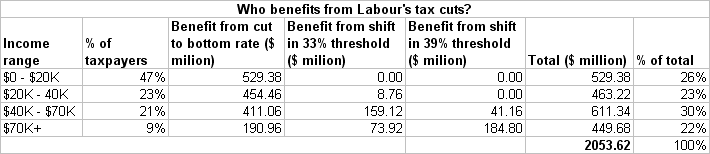
Do Labour's tax cuts really favour the poor over the rich? I spent much of this afternoon sitting down crunching numbers, and the answer is "not really". OTOH, given the chosen mechanism - lowering the bottom rate and some bracket adjustments to reflect shifts in income over the past few years, this is probably about as good as it gets. Anyway, here's the benefit to various groups of the first phase as calculated from Treasury's Who pays tax... and how much? data:

(Methodology: the lack of proper income distribution data forced me to do this backwards. The total cost of the package was calculated from Treasury's detailed model data (it came out to $2,053.615 million per year). The benefit to each group but the lowest was calculated using the number of taxpayers in that group and the annual benefit of lower changes; where a threshold change fell within a group, its effect was calculated from the detailed model data. The benefit to those in the 0 - $20,000 category was calculated by subtraction. 2007/08 data was used because there is no detailed model data for 08/09 yet).

So, it's nowhere near as grossly inequitable as the BRT's proposal, which cost about the same but funnelled 92% of the benefits into the pockets of those earning $60,000 a year and over, but it still disproportionately benefits the wealthy. But as mentioned above, it is probably about the best that could be managed given the methods chosen.

Interestingly, dividing the cost equally among all 3.2 million taxpayers could have produced a social dividend of $635 a year - more than most of the population get under the current scheme, without the disproportionate benefits to the rich. Cullen would have been better off by pursuing egalitarian distribution.