United Future released its party list over the weekend. I'm not going to bother reproducing it in full below, because there's no point - there's only two other people besides Dunne (Damian Light and Bryan Mockridge) who were on it last time, and realistically neither is likely to get elected. The usual problem of small-party churn is compounded by the fact that Dunne really is a one-man band now, his party one in name only, his list a formality to keep up appearances. And the fact that its dropped from 22 people to just 11 now is a tacit admission of this.
Showing posts with label United Future. Show all posts
Showing posts with label United Future. Show all posts
Monday, August 04, 2014
Thursday, November 28, 2013
So much for the copper tax
Since the Commerce Commission ruled against the government's plan to subsidise Chorus' profits by letting them charge extortionate and unwarranted broadband prices, the government has been sabre-rattling and threatening to legislate. But the minor parties have just blown that plan out of the water:
New Zealand First, the Maori Party and United Future are all vowing to oppose any legislation which would overrule the Commerce Commission on broadband pricing.Which means that there's simply no majority for legislation. Cheaper broadband is here to stay. As for the government cronies in Chorus, they'll have to actually work for their money, rather than just engaging in lazy rent-seeking.
In what appears to be a series of coordinated releases this afternoon, all three parties have said they would respect the regulators determination, which would see the price of wholesale broadband drop from December 2014.
NZ First IT spokesperson Tracey Martin said in a statement that the party supported the commission's final recommendation on pricing, and opposed ''any deal that puts the interests of a publicly listed company ahead of New Zealand families and businesses''.
"We will vote against any legislation that seeks to overrule the Commerce Commission's final pricing recommendation or that tries to delay its implementation from 1 December 2014," she said.
But apart from enjoying the government's discomfort, its an interesting development, because it suggests the minor parties have finally learned to count. Without Peter Dunne, National no longer has an easy majority - they have to work for every vote. And on some things - e.g. RMA "reform" - they are no longer going to be able to get their way. The question now is whether they throw their toys and call an election to avoid such democratic "instability", or whether they simply make Peter Dunne a Minister again so he goes back to being a reliable footstool.
Wednesday, September 11, 2013
MMP saves the Environment
National hates the Resource Management Act. Since being elected in 2008, they've been on a crusade against it, passing five bills "reforming" the law - an average of one a year. And at every stage they have reduced public input, weakened environmental protection, and moved decision-making further away from local communities and into the hands of a distant "Environmental Protection Authority" answerable to the Minister and developers, not voters.
Their latest "reforms" - finalised by Environment Minister Amy Adams at the National party conference last month - would continue this trend, making development a "matter of national importance" and allowing Ministers to micromanage local plans to advantage crony developers, removing democracy and providing a blank cheque for mining, drilling, and urban sprawl. But that's too far for National's coalition partners, who have pulled the plug:
United Future and the Maori Party have teamed up to block the Government's major reforms of the Resource Management Act.
The two parties said this morning they could not support the latest changes to the Act and had written to Environment Minister Amy Adams with their concerns.
Government needed either United Future or the Maori Party's support to get the legislation over the line.
This is great news for the environment - and bad news for National. It shows that their coalition partners are getting thoroughly sick of their new, radical turn, and will no longer support it. Which does not bode well for them in 2014, either electorally or in subsequent coalition talks.
Now, if only Dunne and Turia will show the same opposition to National's plans to remove our right to oppose offshore drilling...
Thursday, June 20, 2013
Geddis on the Electoral Commission
So Peter Dunne got his hearing before the Electoral Commission, and as expected they clung to bronze-age technology and demanded signed physical forms as proof of membership. Their sole concession to the 21st century was that they would accept scans of those forms - but in their view, the only valid way to join a political party is to make scratches on a piece of compressed plant matter. On Twitter last night there wre a few people saying "its the law" - but its not the law. The law says that evidence of membership must be submitted "in a form approved by the Electoral Commission". It does not say what that form must be. This is a purely administrative decision of the Commission, and one which seems completely at odds with modern society. Its like requiring payment by cheque or cash, or requiring job applications to be handwritten rather than typed.
Writing on Pundit, Andrew Geddis has a suggestion:
I do wonder, therefore, if there might not be some room for the Commission to think about developing a process whereby parties can accept online membership applications in place of paper ones. After all, there is no statutory requirement that a party member physically sign a membership application in order to count as a "current financial member" (as there presently is to enrol to vote - which is the main obstacle to any move to full online enrollment). And it is not an offence for someone to falsely sign up as a party member using a fake name and address, so someone adding a made-up signature to a document doesn't carry any extra legal consequences.I agree. And as for suggestions that this will encourage party secretaries to make false claims about membership, the law requires them to sign a statutory declaration. The penalty for doing that falsely is three years imprisonment. If that was actually enforced, them it should provide a strong incentive for party officials to get things right.
Therefore, it is not clear what added value there is in a requirement that parties only may claim "current financial members" using physical membership forms with signatures attached. A printout of 500 completed on-line forms containing the information necessary for the Commission to check whether each person really is eligible to enrol as an elector, along with evidence that the person has paid any relevant membership fee, would seem just as able to provide the necessary basis for the Commission to accept that the party has met the legislative requirement to register.
Wednesday, June 12, 2013
No wonder people don't join political parties
So, United Future is apparently ready to re-register as a party, but has been held up by the Electoral Commission's insistence on paper membership records.
As someone who has grown up in the internet age, this is simply backwards. In an age where I can get a passport, do my taxes, or submit on legislation online, the idea that I have to fill out an actual paper form to join a political party (as opposed to any other organisation) is just arcahic. But its also possibly illegal. Why? Because in 2002, Parliament passed the Electronic Transactions Act 2002, the thrust of which is basically "electronic stuff counts". While a lot of the specific requirements of the Act do not apply to meeting the legal requirements of the Electoral Act (because if we're going to do electronic voting, it has to be right), the general provisions, including the overarching one that "to avoid doubt, information is not denied legal effect solely because it is in electronic form or is in an electronic communication", do. So is there a specific reason under the Electoral Act to deny an electronic membership form legal effect?
No. When it comes to proof of membership of a political party, all the Electoral Act says is that applications to register must
be accompanied by evidence, in a form approved by the Electoral Commission, that the party has at least 500 current financial members who are eligible to enrol as electorsSo basically the Electoral Commission could accept electronic membership records; they just choose not to. And that choice appears to be contrary to S 8 of the Electronic Transactions Act 2002.
Administrative decisions cannot trump the law. The Electoral Commission needs to drag itself into the 21st century and start accepting electronic memberships. And who knows? Perhaps if you don't need to use bronze-age technology to participate, people might actually start joining political parties again.
Friday, May 31, 2013
The end of Peter Dunne?
United Future has been deregistered after failing to attract 500 members. While the party claims it is "temporary" and that it can re-register any time before the next election, no party has come back from de-registration yet. And while Dunne will still be able to contest the Ohariu seat, unregistered parties cannot contest the list vote - which means that there is no prospect of him bringing anyone along with him, and therefore no reason at all now for National to stand aside for him. In other words, we may just have seen the beginning of the end of Peter Dunne's political career.
But while it brings a warm feeling to my heart to see Dunne's demise, the political landscape is now looking a little thin. All told there are now only a dozen registered parties, and three of those - the Alliance, Democrats for Social Credit, and Libertarianz - do not look long for this world (having each received just over a thousand votes last election). While one party (FocusNZ) might possibly gain registration this election cycle, overall we are looking at a pattern of long-term decline. Which isn't exactly healthy for our democracy.
Friday, December 07, 2012
Daily cronyism
The government has just announced a pile of new SOE board appointments, including appointing Robin Gunston to the board of Airways Corporation. Who?
Robin Gunston is an engineer, currently National Director of Prison Fellowship New Zealand, and previously Head of Safety at the New Zealand Refining Company Ltd.
Unmentioned: he's also the President of United Future NZ, one of National's coalition partners. I guess United Future want to share in the spoils of government too...
Monday, December 05, 2011
The deals
A bit over a week after the election, and National has signed its confidence and supply agreements with United Future and ACT. We don't have a government yet - that will have to wait for the final results - but we've certainly got the core of one. So what have they agreed to?
The United Future deal [PDF] is fairly moderate. Peter Dunne agrees to roll over and do whatever National tells him to - including further abuse urgency if Gerry Brownlee so desires - and in exchange he gets a Minister's salary. And that's about it - because there's certainly no substantive policy in there. Oh, there's a pile of kibble - the Game Animal Council, reinstatement (but not passage) of income splitting, an end to helihunting - but its either all minor (as in those examples), or stuff National wanted to do anyway (e.g. not selling KiwiBank or Radio New Zealand, and limiting sale to 49%). Dunne is crowing very loudly about this indeed, with three seperate press releases - but this is just compensation behaviour. OTOH, its not as if Dunne has voters to deliver to, so I'm wondering why he's bothering to make the noise.
ACT's agreement [PDF], OTOH, is of a decidedly different and more threatening nature. In exchange for exactly as many votes as Peter Dunne, ACT (well, really John Banks) gets not only a Minister's salary and perks, but also to inflict all manner of madness upon the rest of us. Charter schools (state funded, but not state-regulated, and free to teach any old quackery), legislated spending limits, a further gutting of the RMA, the total privatisation of ACC's work account (saving the new providers from the risk of being outcompeted by ACC), and the worst aspects of welfare "reform". Given the wildly different outcomes from identical bargaining positions, its pretty obvious that National is using ACT as cover to do to us exactly what it wanted to do anyway. The question is whether the media will go along with that story, or sheet the blame for these policies home where it belongs: to National.
Friday, July 22, 2011
Another sensible deal
National will back Peter Dunne in Ohariu, and campaign only for the party vote. Again, its a sensible deal. Dunne looked set to lose his seat this time round to Charles Chauvel, and while he probably won't bring anyone else with him (unlike Banks in Epsom), he provides National with something else it needs: the illusion of moderation. After all, a government backed by that nice, "centrist" Peter Dunne (who supports asset sales and radical tax cuts) can't be a bunch of radical market fundamentalists, can it?
Tuesday, May 12, 2009
The ghost of the 90's
In its confidence and supply agreement with National, United Future secured a promise that the government would
Maintain the policy, research and advocacy role of the Families Commission...Somehow, I don't think the appointment of former WINZ boss, childbeating advocate and celebrity racist Christine Rankin was what he had in mind. National will no doubt argue that it has kept to the letter of the agreement - the commission will continue in its role; it will just change from being a neutral advocate of all New Zealand families in their many forms to being a government-sponsored voice for the hardline Family First / Destiny Church married-heterosexual-breeder-childbeater view - but that is not a recipe for a happy coalition relationship. But I guess National doesn't think it needs Peter Dunne that much. After all, they can always get a majority with ACT...
Monday, November 17, 2008
The third agreement
I've finally got round to reading National's confidence and supply agreement with United Future [PDF]. Because he's a one-MP party, and was so eager to crawl into bed with National from the outset, Peter Dunne gets few gains. He gets to retain his outside Cabinet positions of Minister of Revenue and Associate Minister of Health, and his pet project, the Families Commission. He gets promises to use the health system to direct more public money into private pockets by contracting operations out to the private sector (something National was keen on anyway) and to use PPPs for roads "such as the Transmission Gully highway" (ditto). He gets a Big Game Hunting Council for the gun nuts. And, most interestingly, he gets support for an income splitting bill to select committee, but not necessarily any further. These are small gains, but ones Dunne can feel proud of; for a small party leader, he's been a quiet achiever, and his willingness to cooperate with anyone has seen him having quite an influence over the years.
He also makes a stab at stealing Winston's Super Gold Card. Which means we can expect to see United Future reinvent itself as the centre liberal immigrant Christian gun nut sensible pensioner party forthwith.
As for the strings, he's agreed to support the implementation of National's manifesto, and is subject to the same "we tell you about it, we outvote you, so you must support it" bullshit as ACT. But this is unlikely to rankle much - Dunne is a cooperative guy, and National's policies are more to his liking anyway (he did, after all, support Roger Douglas in the 80's - something we should never forget). Interestingly, the agreement includes the same "cabinet manual" provision on Ministerial conduct and standards seen in the Maori Party agreement, which means the question is not why the Maori Party has such a clause, but why ACT doesn't. Is there something Rodney should be telling us...?
Sunday, September 07, 2008
United Future's List
United Future has released its party list. There's been a lot of turnover since last election, which is understandable given that the party has schismed and shed its alliance with Outdoor Recreation, but one thing hasn't changed: the list is overwhelmingly white and male, with even less diversity than National. On the plus side, they've put two of their female candidates - sitting MP Judy Turner and party president Denise Krum - in very winnable positions, but overall, its not a very impressive showing. And OTOH, culturally, United Future represents the past. Which I guess makes its name false advertising.
As with other parties, I've done a table showing the top candidates relative placements with last time.
| 2008 Rank | Name | 2005 Rank | Difference |
| 1 | Hon Peter Dunne | 1 | 0 |
| 2 | Judy Turner | 2 | 0 |
| 3 | Denise Krum | -- | -- |
| 4 | Graeme Reeves | 10 | +6 |
| 5 | Selio Solomon | -- | -- |
| 6 | Murray Smith | 6 | 0 |
| 7 | Neville Wilson | 14 | +7 |
| 8 | Frank Owen | -- | -- |
| 9 | Janet Tuck | 8 | -1 |
| 10 | Karuna Muthu | -- | -- |
| 11 | Robin Loomes | 27 | +16 |
| 12 | Greg Graydon | 30 | +19 |
| 13 | Damian Light | -- | -- |
| 14 | Vanessa Roberts | 25 | +11 |
| 15 | Aaron Galey-Young | -- | -- |
| 16 | Ian McInnes | 17 | +1 |
| 17 | Kelleigh Sheffield-Cranstoun | -- | -- |
| 18 | Brian Ward | -- | -- |
| 19 | Vaughan Smith | -- | -- |
| 20 | Jim Stowers | -- | -- |
| 21 | Bryan Mockridge | -- | -- |
| 22 | Jayati Prasad | 24 | +2 |
Further details for most candidates can be found here.
Friday, August 08, 2008
United Future wants to give away our wealth
The upcoming election has provoked a lot of discussion over National's plans to sell state assets such as Kiwibank to its rich Aussie mates. Meanwhile, a rather nastier form of privatisation has slipped completely under the radar. The other day I was reading United Future's Energy Policy, and came across this bit:
It is UnitedFuture policy to... oppose a standard royalty rate on new offshore oil discoveries being fixed in advance. We believe that the general policy should be a zero royalty rate with the government reserving the right to apply a royalty, on a case-by-case basis specific to rate of any medium to large oil field discovered.What does this mean? Well, firstly, under existing law, all petroleum, gold, silver, and uranium in New Zealand belongs to the crown. So do a lot of other minerals, due to its ownership of land and non-transfer of minerals on alienation. In exchange for the right to extract and sell publicly-owned minerals, the government demands a slice of the pie, in the form of royalties. The rates have varied depending on when a discovery was made and permits granted, but from the end of next year it will be a straight 5% of the value of any oil or natural gas extracted, plus 20% of accounting profits. This earned us about $135 million in 2006 [XLS], and it will be much higher now due to the Tui oilfield. That's $135 million we don't have to pay in taxes. And Peter Dunne wants to reduce it to zero, effectively giving away our mineral wealth for free.
Strangely, Dunne hasn't exactly been highlighting this policy. Neither has he been asked questions about it. Its time he was. This is a serious policy, with significant effects, which signs away public property to multinational corporations like Shell for free. Dunne should front up and explain why he thinks that is desirable.
Friday, July 18, 2008
United Future's education policy
United Future released its education policy [PDF] today - a relatively hefty 12-page document packed with specifics. The contrast with National - which has made some vague promises of "change" but hasn't issued detailed specifics outside of a few very narrow areas - couldn't be more obvious.
As I'm not an educationalist, I don't feel qualified to comment on the specifics of UF's plan (any teachers out there want to take a detailed look?). One thing I do note though is that they strongly favour greater investment of resources in education, with lower student:teacher ratios in primary school, better working conditions for teachers, much greater funding for ICT, ESOL and students with disabilities, and the reintroduction of a universal student allowance. All of which is likely to be a real problem if they are successful in their desire to form a coalition with National post-election. In fact, with an education policy like this - one that seems to have been written by actual teachers, rather than economists - you really have to wonder what they think they have in common with National at all.
Saturday, June 07, 2008
Who benefits from United Future's tax proposals?
United Future is holding its annual conference this weekend, and have used the opportunity to enter the tax-cut bidding war, with a program costing $4.5 billion a year (a staggering figure equal to the entire cost of primary and secondary schools, or the whole law and order plus defence budgets [source]). So, who benefits? Who do you think?
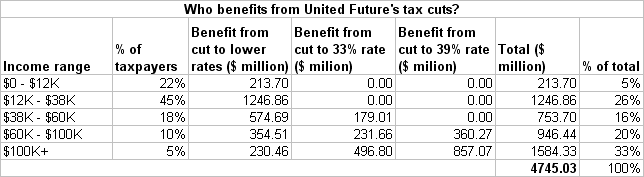
(Methodology: Total cost calculated from Treasury's 2008 detailed model data; percentage of taxpayers taken from Who pays tax... and how much?, with some kludging from the model data around the 38K and 12K limits. Benefits to each group were calculated from the detailed model and the annual benefit of lower changes; the benefit to the final group was calculated by subtraction. Note that this includes no information on the effects of income splitting).
While it doesn't appear as grossly inequitable as the BRT's proposal, that's because it kludges an extra $2.6 billion a year of lower-rate cuts onto it in an effort to appear to not be pandering solely to the rich. And in fact the rich get even more in the hand from United Future, to the tune of an extra half billion a year. In the end, more than half the benefit flows to the top 15% of the population, and over a third to the top 5%. Meanwhile, the middle classes - the people Dunne claims to represent - get shortchanged, while the poor (who Dunne as a Catholic claims to be interested in) get nothing. And this, apparently, is what passes in Peter Dunne's mind for "moderate centrism".
Friday, March 28, 2008
A politician with ethics
Next month, Helen Clark will be flying to Beijing to sign a preferential free trade agreement with the Chinese regime. Several other MPs are supposed to accompany her, but there's a fly in her ointment: United Future leader Peter Dunne is refusing to go in protest at China's bloody crackdown in Tibet. It's good to see that someone in Parliament (a Minister, even) has a backbone over this.
Meanwhile, what I want to know is who else has been invited - and whether they will also refuse to go, or whether they are willing to cuddle up to a regime which imprisons dissidents, denies freedom of speech, and murders protesters in the streets?
Tuesday, March 18, 2008
Dunne and MMP revanchism
With an election due at the end of the year, we're seeing the usual calls from the right to roll back MMP and return to the "good old days" of first past the post. The latest to join the chorus is United Future's Peter Dunne, who thinks its time for another referendum on the issue. His reasons are the usual laundry list you expect from the grumpies:
We have seen MPs defeated in their electorates returning to Parliament via the party list. There has been the list MP, elected solely on the basis of his party crossing the threshold by virtue of winning an electorate seat, claiming to remain in Parliament after deserting his party.But the first is a feature, not a bug, while the second can occur under any electoral system and is a normal part of the political process. Reform was formed this way, Labour was formed this way, National was formed this way, even Dunne's own party was formed this way, when he and some centrist friends deserted their parties just before the 1996 election - and I didn't see him wailing about how the voters were betrayed then (I also didn't see him wailing about defeated electorate candidates entering Parliament via the list when his own party collected seven such MPs in 2002, and two in 2005).
But Dunne reserves the bulk of his criticism for the Maori seats (which, as I recall, were also present under FPP), raising fears of an overhang preventing National from forming a government. But as I've pointed out before, overhangs are not a "Maori seat" problem - any electorate can cause them. They're the price we pay for having a mixed-member system and an archaic attachment to local constituencies. And if we want to solve this problem and reduce disproportionality, the answer isn't to move back to an electoral system which entrenched it and manufactured a majority for whichever party wins a plurality (or indeed, allowed a party to win a majority of the seats without even winning a plurality of the vote) - but to move to a list-only system where the only thing that matters is the proportion of the party vote. But you won't see Dunne advocating that because he wouldn't be in Parliament under such a system.
(And again, there's a rich irony in seeing Dunne complain about the prospect of an overhang, when on current polling and with his party vote fragmented, he looks highly likely to be an overhang MP himself by the end of the year).
Dunne's concern about National being prevented from forming a government is telling. Most MMP-revanchism is driven not by principled concern for a more democratic electoral system, but by partisan concern for electoral outcomes. By guaranteeing a more democratic outcome and requiring every government to have the support of the majority of the electorate, MMP makes it more difficult for the right to win. And it says something about their attitude to democracy that their preferred response to this is to try and restore an undemocratic political system, rather than change their policies so as to better win over the people.
Friday, May 25, 2007
Who's next?
Yesterday saw some amusing snark from Peter Dunne over Gordon Copeland's leap of faith, with Dunne reminding people that Copeland - a self-proclaimed "man of integrity" - had supported the United Future caucus' position that list (but not electorate) MPs should resign on leaving their party. I don't for a moment think that Copeland would apply the same rules to himself that he would seek to impose on others - but what if he did? Who would be the next United Future MP if he resigned?
Here's the first 10 places on United Future's 2005 party list:
- Peter Dunne
- Judy Turner
- Gordon Copeland
- Marc Alexander
- Larry Baldock
- Murray Smith
- Paul Check
- Janet Tuck
- Bernie Ogilvy
- Paul Adams
Of these, Alexander famously left the party citing "religious differences". Murray Smith is currently serving as party vice-president - or at least was the last time UF's website was updated. He's also a fundy originally from Future New Zealand, so may not be sticking around. Baldock has already left. Paul Check was the leader of Outdoor Recreation New Zealand and likewise departed after the election. No-one knew who janet Tuck was during the election campaign, and we know even less about her now. Which may leave "Dr" Bernie Ogilvy as the last man standing. Though given that he was also a fundamentalist whackjob, there may not be much hope there either...
Wednesday, May 16, 2007
Toys overboard!
Gordon Copeland is throwing a sulk over the impending passage of Sue Bradford's Crimes (Substituted Section 59) Amendment Bill and is quitting United Future to form his own party with former MP (and fellow Christian extremist) Larry Baldock. While this obviously affects the government's majority in the House, the abstention of the Greens assures them of confidence and supply (59 votes out of 115), and this will be tested in the next few days following the Budget debate. However the loss of Copeland's vote spells even more problems for the government's legislative program. On the positive side, it means they are going to have to rely on the Greens and Maori Party more often to get legislation passed - which will give them greater power to demand concessions and stall bad bills such as the Criminal Proceeds (Recovery) Bill.
The bigger picture in all of this is the breakup of United Future. This was originally a conglomeration of Peter Dunne's United New Zealand (a centrist, liberal party) and Future New Zealand (the rump of the 1996 Christian Democrats), which subsequently turned into a takeover. Now the Christians are walking, hopefully Dunne will be able to return to his centrist, secular roots. Though given past polling, he'll almost certainly be doing it all by himself again. As for the "new" Future New Zealand vehicle, it'll likely follow in the footsteps of other such groupings and quietly disappear thanks to the undemocratic threshhold.
Finally, there's a lesson in this for our politicians: you can't trust Christian parties to deliver the votes they have promised - they will flake and betray you. Hopefully this will introduce a note of caution into any future negotiations with such groupings.
Tuesday, April 24, 2007
Working together to repeal sedition

I was in Wellington today, but I was able to stop past the joint United Future - Green - Maori Party - ACT press conference in which they announced the formation of a joint coalition to repeal New Zealand's sedition laws. All four parties are concerned about the law's impact on freedom of speech and the ability of people to criticise the government. And all are united in their desire to see it repealed as quickly as possible. I think Keith Locke said it best; "we shouldn't have thoughtcrime on our statute books" (amusingly, after explaining that sedition criminalised "exciting disaffection" against the government, and that "every day in Parliament we do just that", he felt the need to proclaim his support for the government. Clearly he's worried about prosecution...)
Both Peter Dunne and Heather Roy said that this was a good sign that MMP is working - and I agree. When the Greens and United Future can agree on something, its almost certainly a sensible idea. And when ACT and the Maori Party can join them in finding common ground, I'd have thought that makes it pretty much a no-brainer. There's support from right across the political spectrum for repeal, and a majority in Parliament if anyone wants it. The question now is which of the major parties will step up and put forward a bill.
DPF has more on the press conference here.