Showing posts with label 2014 Election. Show all posts

Wednesday, June 03, 2015


Still dysfunctional

A big part of the Labour party's failure over the last six years is that it is a dysfunctional organisation, riven by ambition and backbiting, where MPs constantly leak against the party in order to advance their own agendas. We saw this with every change of leadership, and we've just seen it again with the leaking of Labour's post-2014 election review. The full text of the review's findings is here, and they're pretty much what you'd expect: the party was disorganised and underfunded, and its many of its electorate candidates put their own success ahead of the party's. As for solutions, it states the obvious: message discipline, a clear relationship with potential support partners so voters can see what a Labour-led government would look like, a focus on the party list - there's also demands for Labour to be "seen as pro-business" and for it to pillage local branches assets to fund the central organisation (good luck with that). But the best bit is this:

It is imperative that Labour acts - and is seen to act - as a disciplined and coherent team that is ready for government if it is to win the trust of voters in 2017.

The mere fact that we are reading this suggests that not all of Labour's MPs agree with that. And as long as they don't, they will continue to lose. To go back to Danyl's hierarchy of political needs, nobody votes for a fratricidal gaggle of rivals and enemies, and nor should they.
Wednesday, May 06, 2015


There is too much money in our politics


The Electoral Commission released political parties 2014 donation returns yesterday. DPF has the usual breakdown here. The highlights:

  • National raised twice as much money as Labour and the Greens combined. They received significant funding from Auckland property developers and real estate agents. Which might explain why they're opposed to doing anything about the Auckland housing bubble.
  • the Greens out-fundraised Labour for the first time. This hasn't come at the cost of Labour - they raised slightly more money than they did in 2011 - but it suggests that the Greens have got a far more organised fundraising infrastructure than they did in the past. The Green's donors were mostly MPs, as usual. Labour, as befits a labour party, was primarily funded by unions.
  • No-one accepted money from SkyCity this time.
  • the total amount raised (and presumably spent on getting elected) by parties last year was $14.36 million - over twice the $5.5 million raised in 2011. Even discounting the crazy millionaires, the amount of money raised by the parties has still increased by more than 40%.
The latter point is the most disturbing. Our political system is awash with money. There is clearly an arms race going on where the largest party is trying to spend everyone else into the ground. But this creates a perception of corruption and cynicism about our democracy. If we want to protect the latter and ensure a level playing field, we need to eliminate private money from the political system and replace it with public funding.

Thursday, April 02, 2015


Political satire is legal again


Back in August, Darren Watson and Jeremy Jones put this amusing political song on the internet and offered it for radio broadcast. The Electoral Commission immediately banned it as an "electoral advertisement" - in the process effectively declaring effective political satire to be illegal. Watson and Jones challenged the Commission's interpretation, and the court has finally ruled - finding that the song and video aren't advertisments at all, but comment, speech and content. Which should have been pretty bloody obvious the moment anyone stopped to think about it.

The full judgement is here. There's a long traversal of the legislative history of the relevant parts of the Electoral Act and Broadcasting Acts, and a discussion of the interests Parliament is trying to protect through the electoral law requirements to attach promoter statements to advertisements and the prohibition on election programmes. And the short version is that they're trying to prevent people from buying elections, not from commenting on politics or producing protest songs. A rights-consistent interpretation of our electoral law has to support that, and fortunately one could be found by highlighting the distinction between advertising and actual content. That works very well for this situation (where, pretty obviously, its not an "advertisement" at all), but there are likely to be further interpretational questions around stealth advertising campaigns. but I guess the Commission, with the guidance of the courts, will deal with them as they come up.

In passing, its also worth noting that the Electoral Commission really did try and ban satire. Yes, they deny it, but that would have been the effect of their argument at paragraph 90 where they argue for a top-down "encourages votes / specified exception" scheme and that

Satirical speech might or might not be an election advertisement, depending upon the “may reasonably be regarded” assessment.

But no reasonable person would conclude that effective satire didn't encourage people not to vote for its targets. While it may not be its purpose, that's the effect of a thorough skewering - to highlight views the public may find repulsive, and lower the public's opinion of the target. And the idea that such speech might be forbidden in a free and democratic society is simply laughable. Which may explain why we don't see very much of it on NZ television (that, and NZ On Air is hardly going to allocate funding to content which skewers the people who set its budget).

But I guess that's what you get when your Electoral Commission is more worried about getting flak from politicians rather than protecting the public's democratic rights.

Friday, February 27, 2015


National is laundering donations

On Wednesday I highlighted a disturbing trend in the 2014 election candidate donation returns, where National Party candidates were almost entirely funded from the party's head office - suggesting that the party was laundering donations to hide the identity of donors to local campaigns. Yesterday, National MP Jono Naylor (who has prior on hiding the identity of donors, then paying them off with big favours) effectively admitted that was the case:

National Party list MP Jono Naylor was the highest spender in Palmerston North - he declared $22,048.97 in expenses and $25,688.34 in donations. Naylor said the money was drawn from donations to the party's Palmerston North branch.

[Emphasis added. The donation from the National Party was his only declared source of funding]

So, to make that clear: people donate to the Palmerston North branch to support National's campaign there. That money is then given to the local candidate. Meaning that the donations aren't party donations, but candidate ones, and the party is acting as a transmitter and should be identifying the contributors.

I'm sure that, like the banks who facilitate tax cheating, the National Party has a lawyer who says its all legal. But its certainly not within the spirit of the law. And if we want to end this sort of scam, we need to lower the party donation disclosure threshold so it is equal to the candidate one: $1,500. That way there's no benefit in this sort of laundering.

Wednesday, February 25, 2015


The latest election donation scam

Back in 2007 the then-Labour government passed the Electoral Finance Act. One of the key provisions of the Act was to end the National Party's practice of laundering party donations through trusts. While supposedly hugely contentious, this provision - and the rest of the Electoral Finance Act structure - was retained when National "repealed" it in 2009.

Why is this relevant? Because 2014 election candidate returns were released yesterday. And they show that the practice hasn't really ended. Instead, its shifted to the candidate level, with the National Party as the laundry.

Take a look. National candidate after National candidate gets tens of thousands of dollars donated by the National Party. Often, these are their only donations. These donations are clearly made up of contributions from donations to the National party. But no contributors are identified. Clearly National thinks that these donations have not been made specifically to be passed on to specific candidates - or that no-one can prove it. But Jami-Lee Ross's $25,000 returned donation from Donghua Liu - declared in his return, and indeed the only donation he declares from outside the National Party - shows that "Cabinet club" donations are in fact given to specific candidates, and that they do know where the money comes from. Which makes all those large donations from the party look very dodgy indeed.

The scam here exploits the declaration threshold between parties and candidates. Candidates must declare any donation over $1,500, but parties only have to declare donations over $15,000. So, donate to the party, six months later it gets passed on, no-one has to declare anything, and no-one knows who an MP is beholden to or how much for. It may be entirely legal - because MPs with no interest in transparency wrote the law to suit themselves - but its not transparent and doesn't provide confidence in our electoral system or that our MPs are not secretly doing favours for donors.

As for how to fix it, its simple: lower the party donation threshold to $1,500, the same as the candidate threshold. Then no-one will be able to escape scrutiny for large donations.

(I should note: the Internet Party did this too, but its pretty clear where their money come from. Labour's local electorate committees also donate to their candidates, but in much lower amounts; it seems to be a case of localised fund-raising from small donors rather than centralised funding from big ones).

Tuesday, February 24, 2015


The hollowing out of the Labour Party

Party returns of election expenses are out, and the big news is that the Greens outspent Labour:

Labour spent half as much as National on last year's election campaign and was outspent by the Greens for the first time.

Parties' election advertising expenses were released yesterday and show Labour spent $1.27 million - slightly less than the Green Party on $1.29 million and half the National Party's $2.6 million.


Which means that the Greens had more money than Labour. And this isn't due to a massive increase in the Greens' fundraising (yes, they spent half a million more than they did last election, but still less than they did in 2008), but due to Labour's spending declining. Big donors have abandoned them because they're not in government and unable to deliver policy in return, while small donors have switched their support to the party which actually advocates for the left. Which is going to make them even more beholden to corporate money in the long term, and correspondingly less appealing to their traditional voters.

DPF has his usual dollars-per-vote breakdown here.

Tuesday, November 04, 2014


Submit!

The Justice and Electoral Committee has begun its regular Inquiry into the 2014 general election. This is part of the election process and is basically a general look at electoral law and processes in light of the most recent election. So, if you noticed any problems on election day, or you want to raise any general issues about advance voting, election advertising, public funding, donation disclosure, overseas-voting, electronic voting or whatever, then you can fill out the form here.

Tuesday, September 23, 2014


ACT are rorters

ACT, the party "standing on your own two feet" and opposing rorts is to be offered a Ministerial role explicitly to give it more resources for party business:

The Prime Minister was today is talking up the possibility of making the [ACT's David Seymour] Associate Education Minister.

"When they have more staffing and resources as a result of a junior ministerial role it is easier from both their perspective and ours - otherwise we'd have an MP pretty much on his own with an EA (executive assistant) and it's very difficult to manage that overall party-to-party relationship."


So, very clearly, this is supposed to benefit ACT as a party. But while its ironic, contrary to my first impression its not illegal. While ministerial funding can only be used for "ministerial business", this includes:
hav[ing] a political role in maintaining government stability, which requires maintaining close working relationships with all other parties as issues arise.

Interestingly, this clause appears to have been added in 2009, to reflect a wider definition of Ministerial roles in the Cabinet Manual. Which was made in 2008 (compare earlier version) by the incoming National government, precisely so they could channel state resources to support their coalition partners.

If ACT stood by its principles, they would reject this, and demand reform of the Cabinet Manual to stop this backdoor state funding. But we know they won't.

Monday, September 22, 2014


Deranged

Saturday's result was a shock for the left. And for some, it was apparently so shocking that it can only have been the result of fraud. So they're petitioning the head of the Electoral Commission for a recount.

Naturally, they present no evidence - just their feeling that "something doesn't seem right", and that the result "makes no sense". Scarily, over 7,600 people agree with them.

This is utterly deranged. Any fraud would have to be widespread, across multiple polling places and districts. There would be evidence. And the thousands of party activists who volunteered to scrutinise the poll and the count would be speaking up about it. As would the electoral commission staff, returning officers and poll workers. Democracy goes deep in New Zealand, and people of all parties would be affronted by attempts to undermine it. Its just not the New Zealand way.

But the dumbest thing: every New Zealand election already receives a full recount (during which special votes are counted and the rolls are scrutinised to detect dual voting and failed personation). Only after that do the results become official. And after that, there's a whole judicial recount process if anyone has any concerns.

Still, there's a small mercy: at least they're not petitioning the Governor-General in the misguided belief that they have any constitutional role on this...

The threshold has to go

Another election, and once again we've been reminded of the unfairness the two major parties built into MMP in an effort to stack it for themselves and prevent competition. ACT got 14,510 votes and one seat in Parliament, while the Conservatives got 86,616 votes - almost six times as many - and none. While I do not like the Conservatives, that is not fair and it is not right.

This is not about the "electorate lifeboat" (which this election benefited the Maori Party and no-one else). It is about the threshold. It is an anti-democratic measure whose sole effect is to limit political competition and silence small parties unless they are lucky enough to win an electorate seat (or, in the case of ACT and United Future, be patronised by a larger one). We've seen that small parties can function effectively in Parliament as a voice for their voters, and we've seen that this doesn't affect the stability of the government one bit (to the contrary - a plurality of options means the government has an easier time passing legislation). And the counterfactual cases show that there is nothing to be afraid of here (though of course people would vote differently in such cases, just as they voted differently when their votes counted under MMP). There is simply no reasonable argument for maintaining such an anti-democratic measure in a democracy. The threshold has to go!

MMP, electorates, and misaligned incentives

Amongst the post-election entrail reading, I've seen a couple of people suggest that one of the reasons labour lost was due to a lack of tactical voting by Greens. If only Green supporters had held their nose and voted tactically in Auckland Central, Christchurch Central, Ohariu, and other close electorate races, the left would be better off.

These people do not understand MMP.

In MMP, there is one vote that matters: your party vote. Unless you live in Epsom, Ohariu, Te Tai Tokerau or Waiariki (electorates where strong candidates from minor parties could have brought in more MPs), your electorate vote is irrelevant to the outcome. All it does is select who your local representative is. But because the overall distribution of seats in Parliament is set by the party vote, it doesn't change the final numbers unless there's an overhang.

And to use some specific examples: Green voters voting tactically for Jacinda Ardern in Auckland Central or Clayton Cosgrove in Waimakariri wouldn't have changed anything. These MPs would simply have become electorate MPs rather than list ones. Green voters voting tactically for Labour candidates in Ohariu or Christchurch Central would simply have traded Virginia Anderson or Tony Milne for Andrew Little or Sue Moroney (the last two people elected on Labour's list). In Ohariu, it would also have got rid of Peter Dunne, but as he's not bringing any extra MPs in, that's really just a question of how much you dislike him.

Basically, under MMP, unless you live in one of a handful of seats, electorates don't matter to the outcome, so you might as well vote for whichever candidate you like best.

What electorates do matter for is the prestige, survival and political careers of individual electorate candidates. And in the case of Labour, with a mix of electorate and list MPs and a strong FPP heritage, this causes misaligned incentives. The party wants party votes, but candidates - and especially candidates who have a low list ranking, or who have refused to go on the list - want your candidate vote. And so Labour had the joy of seeing a bunch of its electorate candidates put themselves first and run electorate-only campaigns, while letting the party vote wither. Their "success" in holding or taking electorates made no difference to the outcome, but did cost their party new blood (and the ability to get it through mid-term retirements) through the list. In some cases, it would have been better for the party if those candidates had lost, because while their list replacements are mediocre, they could at least have been forced out to make way for the new blood the party desperately needs.

Sunday, September 21, 2014


A trifecta of electoral suck

This week has been a trifecta of electoral suck. First, Fiji voted for dictatorship. Then Scotland voted to remain subjugated to Westminster. And finally, New Zealand voted for a third-term majority National government.

The last boggles me. Not the fact of National's victory - that was expected, despite my hopes. But the fact that their vote went up, and delivered them an absolute majority on election night. The public appears to have endorsed National's dirty politics. And that's horrifying.

With a third term and an absolute majority (or, if they loose a seat on the specials, a de facto one from their ACT poodle), I doubt National will feel constrained by the moderation it has been forced to practice thus far. We've seen privatisation and assaults on the education system, the RMA and worker's rights. We can expect more. And we can expect the cuts to social support and working for families National has always wanted to make. Its not going to be pleasant to be poor or even middle class in New Zealand for the next three years. But it'll be great to be a millionaire banker like the Prime Minister. We won't get action on climate change. We won't get action on inequality and child poverty. We won't get measures to deflate the housing bubble and allow kiwis to own their own homes again. But the rich will get a tax cut in 2017, funded by increased misery for the poor. Because at the end of the day, that's what National stands for.

I don't expect Labour to provide credible opposition to this. They've had an influx of right-wing cuckoo electorate MPs to add to the usual suspects, and so they'll spend the next three years engaged in the same division and backbiting they've wasted the last three on. Instead, the heavy lifting will be left - again - to the Greens. They underperformed as well this election, but at least have held their own against the landslide. So they'll spend another three years winning the argument and reshaping the policy landscape in their image. Its not change, but it lays the foundations for the future. And hopefully, one day, we'll get to see those policies in action.

Still, every cloud has a silver lining: a majority National government means that I get three more years of easy bloggage. I'd rather I didn't though.

Friday, September 19, 2014


Vote

Today is Suffrage Day, the 121st anniversary of the day women won the right to vote in New Zealand. Its rightfully a day on which we celebrate our democratic heritage (and it should be a public holiday, dammit).

Its also the last day of the 2014 general election campaign.

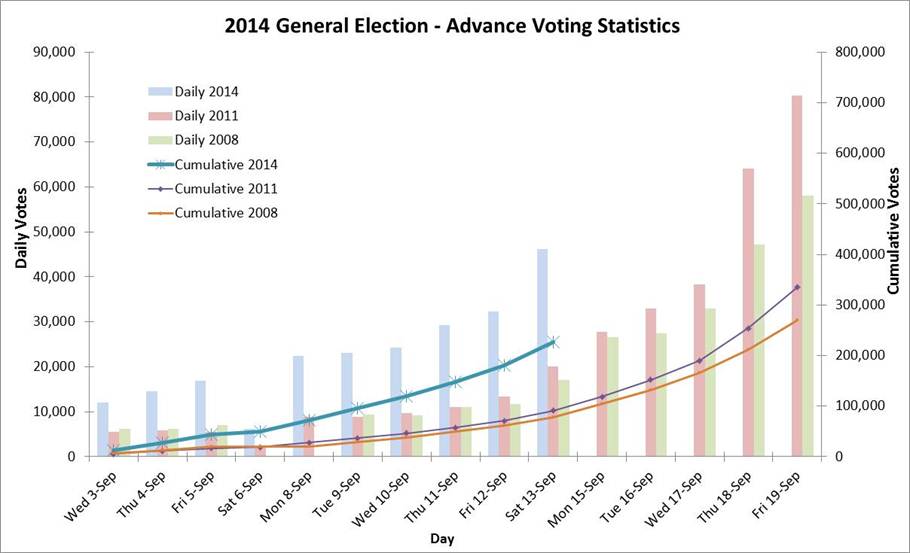
Whatever the result, the campaign has already been a tremendous success for democracy, with over 550,000 advance votes recorded. Add in today, and we're looking at anywhere from 700 to 800 thousand - over 20% of the entire electorate. Its a tremendous level of engagement, and it shows the value of the New Zealand way of making voting easy.

In previous elections, I've pushed people to party vote left. It doesn't matter which of Labour, the Greens, or Internet-Mana you vote for, because any of them will support a change in government and a dramatic shift in policy. As for myself, I'll be voting Green again. I seriously considered Internet-Mana, because I want to see the internet freedom agenda (and Laila Harre's left-wing take on it) represented in Parliament. But in the end, I like the Green lineup better than theirs. I'll give my electorate vote to Iain Lees-Galloway, because I like him both as an electorate and Labour MP (and Jono Naylor is corrupt and dishonest). Your mileage may vary, of course. But no matter what your political opinions, vote. Your voice may be one in 3.4 million, but it still matters. As Kate Sheppard said,

Do not think your single vote does not matter much. The rain that refreshes the parched ground is made up of single drops

Keep that in mind on election day.

Because of the "no campaigning on the day" rule, I won't be blogging or tweeting on election day. I'll be tweeting after 19:00, and I'll probably post something on Sunday once the results sink in a bit.

Thursday, September 18, 2014


A hole in our democratic protections

There's been a couple of stories in the media over the last few days about voting by the intellectually disabled, focusing on the risk of abuse. The right, as always, are using this as an argument to limit the franchise by imposing a competency test (at which point we should keep in mind that many of them are quite open in their belief that anyone who doesn't vote for ACT is literally insane and cannot be trusted to vote "properly"). Meanwhile, they've missed the bigger problem:

In Hamilton, Bupa Rossendale and Dementia Care Hospital manager Adriana Ciolpan said their 90 residents were deemed incompetent by medical professionals and could not vote.

"Medically, they are not deemed able to vote. They are all under power of attorney," Ciolpan said.

"We follow legal requirements.

"We can't make them vote. We cannot accept voting papers for them because we don't want someone else to abuse them. They have been deemed incompetent and that's a legal document," she said.

"All the letters we receive, we send them back saying they're incompetent and can't vote. It should be the same everywhere," Ciolpan said. "But if they are not deemed incompetent by a doctor, we cannot stop them from voting."


Andrew Geddis thinks this is OK because those affected lack the requisite intention to vote. Which may or may not be true depending on the particular individual. But there's also the fact that electoral enrolment is compulsory and failing to do so is a crime. And by doing this, this hospital is making criminals of its residents.

And this exposes a bigger problem. I looked in vain for a clause in the Electoral Act which made preventing someone from registering to vote a crime, and could not find one. And this is a huge hole in our democratic protections. We rightly protect the right to vote with the secret ballot and protection from intimidation; we do this because in the past the rich have threatened to punish the poor for voting against them, or for voting at all. But they don't need to do any of that if they can just stop you from registering as an elector. Clearly, we need to protect the right to register in the same way.

Tuesday, September 16, 2014


Advance voting again

Another day, more incredible advance voting statistics:

advance_voting_stats_15_09

287,735 of us have already voted. And with four days to go, I think we can safely assume that it will reach 650,000. Which on current enrolment figures, means almost 20% of the potential electorate will have voted in advance.

Historically, advance votes have tended to swing right. But with twice as many as before, its anyone's guess. Its also anyone's guess how much of this represents increased turnout versus people getting it done early. But I'd guess that we're probably going to see a slight bump in turnout, perhaps as much as 5%. Which should be good news no matter who you support.

A solid policy

While National is teasing people with promises of tax cuts maybe sometime, the Greens have introduced another small but solid policy: a maternity box. Based on the Finnish maternity box (which reduced their infant mortality and is one of the reasons it is among the lowest in the world), its basically a start kit for new parents. If Finland is anything to go by, its likely to have a dramatic effect on newborn health, and all for a mere $15 million.

It also shows how cheap it can be to solve some of our pressing social problems. Baby boxes and food in schools don't cost the earth (on the government spending scale these are trivial policies, just above pocket change) but they can have a dramatic effect. National's refusal to implement them is purely a matter of choice and priorities, not cost. And when the cost is so low, and the evil they address so great, you really have to wonder how twisted and selfish our government's priorities are...

Monday, September 15, 2014


The other option for the left

While everyone was rightly paying attention to the Key / Dotcom / GCSB revelations today, Winston Peters made a modest proposal: another Labour-NZ First coalition:

New Zealand First leader Winston Peters said today that voters should consider a Labour-New Zealand First as a potential alternative Government, not Labour and Greens, in what is the most definitive statement from him yet on post-election options.

That suggests that would keep the Green Party away from the cabinet table in any Labour-Led Government as he did in 2005.


I would prefer to see a Labour-Green government, and it would be very disappointing to see the Greens shut out again. But even Labour-NZ First would be better than what we have at present. If the numbers work, I can't see the Greens as having any real choice over supporting such a government over confidence and supply. And given the policy convergence on the left (which includes NZ First), I think they'd be happy with the broad general direction of such a government, even though many of the specific policies would not go far enough. Provided they get some redlines thwarting Winston on immigration in exchange for confidence and supply, they could then negotiate policy MOUs in areas of interest - or just sit on the crossbenches and subject every proposal to a Green veto to maximise concessions.

Key lies to us again

When Gleen Greenwald spoke on Saturday morning and accused the GCSB of engaging in mass-surveillance, John Key was absolutely unequivocal: it didn't happen. His spies had apparently looked into a mass surveillance program, but it had never been implemented.

Now he's telling us that part of it was implemented:

Mr Key has said the GCSB was working on a business study for a form of "mass cyber protection" following cyber attacks on several large New Zealand companies. Mr Key had told them it was too broad a net. However, this morning he indicated it had gone ahead on a limited capacity.

"I said I think it's too broad .. so in the end I said let's set it at a much more narrow level."


And tomorrow he'll no doubt be telling us that OK, he gave them everything they wanted, but its not "mass surveillance".

He was also quite unequivocal this morning that "we don't use our partners to circumvent the law" (another claim he has made repeatedly). Greenwald apparently has documents that show they do. What will it be then? "we only circumvent the law a little bit?"

And this is the problem in a nutshell: Secrecy lets our leaders lie to us. It lets spies get away with breaking the law (88 cases revealed as a result of Dotcom, plus whatever we learn tonight), and no-one can be held accountable for it. And when there's a hint of transparency around wrongdoing, we get selective declassification to protect the Prime Minister's reputation (something which raises some very pointy questions).

That's just wrong. When government agents break the law, they should be punished just like any other person. And the Ministers and officials who are supposed to make sure they don't need to lose their jobs. Secrecy and spies are a barrier to that. And that's why we need to end both.

Friday, September 12, 2014


Lets do the time warp again

A week out from the election, and we're back in 2011, with political journalists (whose mindset is still stuck in FPP's two opposing tribes) boggling over the Greens statement that they are "highly unlikely" to work with National, and (purely on the basis that they won't rule it out) suggesting that the Greens must therefore be planning to give confidence and supply to the current National government.

As Russel Norman makes clear in that interview, the Greens' position is set by their membership, which reconfirmed their 2011 position. You can read it here. And to save myself the effort of writing another post, I'm simply going to quote what I said about it last time:

Being a party of policy rather than tribalism, they're not willing to rule [support for National] out entirely. But being a party of policy, any assessment is going to be based on the merits, and the degree of compatibility between National and Green positions. And any honest assessment would show that the two parties are deeply incompatible.

The Greens support clean rivers. National wants farmers to dirty them for greater profits. The Greens want action on climate change. National is still a party of deniers, who wants to subsidise polluters. The Greens want an end to offshore drilling. National's plans for economic growth are predicated on it. The Greens want to reduce inequality. National wants to increase it. Unless National changes its position on most of these issues, then there is no hope of the Greens putting National into government. And if people think that the Green leadership will be seduced by the baubles of office, remember that its the wider membership who will have the final say on any arrangement. I think its "highly unlikely" that they would support any arrangement which saw the Greens providing confidence and supply to the current National Party. But if they do, well, they'll get what they vote for. Coalition with a friendly party with a high degree of policy compatibility is fraught enough. Coalition with a party fundamentally opposed to your values seems to be a slow and unpleasant form of suicide.


The other point I'd make is that being a party based on policy means always being open to the possibility of cooperation, even if you recognise that in practice, its never going to happen.

What is interesting in that interview is Norman's wriggling over the question of their relationship with Labour. Espiner (in horse-race mode as usual) interprets this in terms of coalition preferences, and so misses the real picture. In the long term, the Greens want to throw off their "junior partner" status and be recognised as the leading party on the left (rather than just being it in practice). This means eating Labour's vote and supplanting them as the largest party. Labour's failure to gain any traction during this campaign is an opportunity to advance that project, and present themselves as an effective, growing, principled party in contrast to a bunch of stagnant tired has-beens. That's pretty obvious, but there's a world of difference between recognising it, and telling Labour MPs openly on the radio "we're coming for your jobs".

Thursday, September 11, 2014


A clear difference on child poverty

Last night's 3 News leader's debate finally gave us a clear difference between the leaders. On the subject of child poverty, David Cunliffe was absolutely clear:

I have to say that I was pretty shocked to see those schools that have the empty desks on your show where children like mine and yours went to school with no lunches. And I was just as shocked to see the empty fridges. And at the end of the day that's what this is about. We've got a hundred thousand children in New Zealand that are growing up in working families, working families, who just don't earn enough to feed them. And then we've got another 160,000 children growing up on benefits, or sole-parent households, who haven't got a chance. And so we just simply must help this. And I want to say this: if I'm elected Prime Minister, this will be my personal number one priority. This is why I am in politics. I will not stand by and see kids hungry when they go to school. It is not good enough. We are better than that!

I'm going to come back on this program, each and every year as Prime Minister, and I am going to give you hard data on exactly how many children our programmes, like Best Start, $60 a week per child, have lifted out above the poverty line. It will be my top priority. I say that solemnly.


Its even more powerful when you watch it [from 3:05]. Yes, Labour helped create this problem. But I don't think we can doubt that Cunliffe recognises it as a moral challenge which we have to solve. Compare that to Key. He dodges. He minimises. He blames the victims. The short version of his response is that "of course" we have to do something, but its not really as bad as you think, and it only affects poor people anyway, so we don't actually need to do any more than we are at present. Its just not a priority for him, and certainly less of one than seeing his rich mates get a tax cut in three year's time.

And that's our choice right there: between a man who recognises child poverty as a moral challenge we must rise to, and one who views it as a PR problem to be minimised and dodged.

Remember that when you vote. If you vote for Key, you're voting for a monster who doesn't care that children are starving.