Showing posts with label Children's Rights. Show all posts

Tuesday, July 01, 2025


National is afraid of kids

As the government - or one of its Ministers, anyway - keeps reminding us, Parliament is meant to be a place of free speech, where MPs (but not apparently select committee witnesses) need to be able to robustly criticise government policy and hold Ministers to account. But Youth MPs at this week's Youth Parliament won't be able to experience this. Instead, they're being censored, to stop them from criticising the government:

Some young people taking part in Youth Parliament 2025 say they’ve been censored and told to avoid speaking on major political issues — including voting rights, climate action, pay equity and financial literacy — or being critical of ministers.

“We’ve been told to soften our language, drop key parts of our speeches, and avoid criticising certain ministers, as speaking out could ‘cause problems’,” said Nate Wilbourne, founder of Gen Z Aotearoa and Youth MP for Labour’s Damien O’Connor. “That isn’t guidance — it’s control.”

In a statement, the coalition of youth organisations accused the Ministry of Youth Development of censorship, saying decisions made by officials have undermined the event.

Youth MPs have been specifically banned from speaking on the issues that matter most to them, including voting rights, pay equity, and climate action. And they have been banned from clapping or "expressing dissent" in the chamber. The RNZ version of the story suggests that the Ministry of Youth Development is trying to enforce "political neutrality" on youth MPs - a standard which applies only to public servants, not young members of the public.

This is pathetic. But it is certainly revealing about what the regime is afraid of. And what they're afraid of are young people who overwhelmingly disagree with them freely expressing their views. But if they won't let youth MPs properly express themselves in Parliament, maybe they should do it outside, and make it clear how rotten this dogshit government is.

Tuesday, June 17, 2025


Dismantling the state

The New Zealand state has traditionally taken an expansive role in our society, providing health, education, and welfare systems to enrich and enable all our people. But ACT's weirdo radicals want to change that, and are directing the weak National government into enacting their agenda of dismantling the state. There's charter schools, obviously - publicly funded, at inflated rates, but not accountable; as well as funnelling public money into private schools to subsidise the rich. But today they've taken two other significant moves. Firstly, there's directing Te Whatu Ora to outsource all routine operations on ten-year contracts, intended to strip the public health system of capacity while granting windfall profits to the providers. And then there's "reviewing" - meaning cutting - ECE funding, while "making trade-offs between the quality of early learning and its cost" (meaning dumbing it down, deskilling the workforce, and turning it back into a high-profit, low-skill business for their donors in the kiddy-farm industry).

The latter is especially stupid. We've known for literally decades that arly childhood education is one of the best investments we can make in the future of our society, with enormous returns in future education, wellbeing, and earning potential (and savings on crime and welfare). It should be nationalised and incorporated in the state education system, to ensure everyone gets a good start in life. But National simply sees it as babysitting; a cost on the state, rather than a positive benefit. And their cheapness here is going to have long-term consequences for the future.

The good news is that their stovepiped "review" won't report back until this time next year, meaning there will be little time for them to do anything about it before we throw them out on their arses at the next election. As for the health system changes, if the contracts do not allow Te Whatu Ora to set the volume of operations and bring them back in-house, I would expect a future government to simply legislate them away. We should not let this temporary regime steal our health system from us piece by piece, for the profit of its private donors and cronies.

Thursday, May 29, 2025


Getting what they paid for

So, having stolen $13 billion from New Zealand women by shitcanning pay equity negotiations, the National government is again attacking women - this time by reversing long-standing pay equity provisions for ECE teachers and allowing ECE providers to go back to paying them minimum wage:

The Associate Education Minister is changing who decides how much new Early Childcare Education (ECE) teachers can be paid, leaving it up to individual centres to determine their starting salary - rather than be set by the government according to the pay parity scheme with primary school teachers.

David Seymour says it will help ECE centres stay "viable" and not pass on costs to parents.

The education union says the change scraps pay parity rates for new teachers, undermining the scheme which took decades to secure. The Greens are concerned it will drive down wages and Labour says it means new ECE teachers will be at the "whim of their employers".

What this actually means is bigger profits for corporate baby-farms. And on that front, its worth noting that the Wright family - who own and profit from the biggest corporate baby-farm, Best Start - donated $32,450 to the National Party in 2016.

I guess they got what they paid for.

Monday, February 17, 2025


Restore birthright citizenship

In 2005, Labour repealed the long-standing principle of birthright citizenship in Aotearoa. Why? As with everything else Labour does, it all came down to austerity: "foreign mothers" were supposedly "coming to this country to give birth", and this was "put[ting] pressure on hospitals". Then-Immigration Minister George Hawkins explicitly gave this as the reason during the law's first reading debate, saying:

Some people may come to New Zealand on temporary permits solely to give birth, so that their New Zealand - born children are citizens. Under current law those children are entitled to access publicly funded services such as health care and education. Restricting citizenship by birth will ensure that citizenship and its benefits are limited to people who have a genuine and ongoing link to New Zealand.
Twenty years later, and we're seeing the cost of this change: kiwi kids being threatened with deportation to foreign countries. And while public outrage seems to have caused the Minister to rethink, this should never have happened. People who were born here, have grown up here, have never known anywhere else should not be exiled from their country, or victimised due to the legal mistakes of their parents.

We should learn this lesson, and fix the underlying law which threatened to result in this injustice. And that means restoring birthright citizenship, not just to those born here in future, but also to those immorally deprived of it by the Clark government's cruel penny-pinching. And if the current government wants to quibble over this, we should ask them: are they really that small?

(And while we're at it: we should restore relationship rights too, so kiwis can be with the people they love).

Wednesday, November 13, 2024


Injustice for torture

Between 1950 and 1993 the New Zealand government tortured and abused up to 250,000 children in residential care facilities. Yesterday, following formal findings from a royal commission, it finally apologised for that abuse. The next step is redress and restitution - compensating the surviving victims for the appalling harm they have suffered. But it turns out that maybe not every victim is going to get compensated, with the government refusing to say if it plans to exclude gang members:

Asked on Wednesday whether gang members would be eligible for redress, the relevant minister, Erica Stanford, declined to say.

"I have not made any decisions and neither has Cabinet. All of these things have to go to Cabinet," Stanford said.

"I'm not going to tell you today what's in and what's out and how much, because we haven't made any of those decisions yet."

Pressed again, Stanford said the question of whether gang members would be eligible was "one of the things that we have to be looking at".

So, they're considering it (and the fact that she refuses to say and hides behind cabinet confidentiality tells us that). So the position of at least some parties in this government is that the government can torture and abuse people, ruin their lives, and that if it decides it doesn't like you, they can refuse to compensate you. That is unjust. it is indecent. And it makes a total mockery of yesterday's "apology".

As the royal commission found, "Gangs provided survivors with the care (that is, attachment and belonging) and protection that state and faith-based institutions should have given." If abuse victims turned to gangs as a response to abuse, that seems to be the government's fault; and maybe it neds to think about compensating those institutions for the care they gave, and that the government did not.

Tuesday, November 05, 2024


National's privatised child-abuse camps

National has a hard-on for "boot camps" as part of its desperate attempt to grub "tough on crime" votes from sadistic geriatric pedophobes. That's bad enough, but its gets worse: the camps will be privatised. And they will be allowed to use force against children:

A leaked ministerial document from the Children’s Minister shows an admission that giving military-style academy providers the power to use force against children may be seen as “increasing the potential risk of abuse in custody”.

[...]

Cabinet agreed that military-style academy providers – including “third-party providers” – will have the power to use force against young people outside of a residence, such as on overnight camps or rehabilitative programmes. Currently, powers only exist when a person is at a residence.

Providers would be able to use physical force, no greater than reasonably necessary, to restrain a young person attempting to abscond or harm themselves or others.

The problem of course is that Oranga Tamaraki already treats those in its care as sub-human, and physically abuses them; private providers will likely be worse, and certainly be far less accountable. While Karen Chhour is denying it, this is a recipe to repeat the abuses of the past, and Chhour and National need to be held accountable for that.

Meanwhile, Luxon is all over the place about this, first pretending he "wasn't briefed", then, when it was pointed out that that made him look like a stupid fool who had no idea what was happening around his own Cabinet table, admitting that he was. Which I guess shows us the dishonesty of his claims to be "unaware" of things, and how he uses them to try and kill questions and avoid accountability.

Thursday, July 04, 2024


Nobody wants to run a boot camp

National has a problem: they've promised boot camps by the end of July to grub votes from pedophobic old zombies kick kids into line, but nobody wants to run them. NZDF has said "fuck no! Never again", and Oranga Tamariki - the organisation formally responsible for them - can't find anyone to do it:

Just weeks out from the start of the government's young offender boot camps, Oranga Tamariki is still discussing who will take on the critical role of intensive mentoring.

[...]

It confirmed last month Oranga Tamariki had contacted a number of community organisations to see if they were interested in doing that work.

[...]

However, RNZ has seen an email from Oranga Tamariki telling the groups the date for the intensive mentor role has been pushed back to mid-August.

The ministry has told RNZ the boot camp pilot will still start in late July.

As they say, "good luck with that". Because boot camps don't work, so no reputable NGO will touch them. And the less reputable ones understand that there will be a certain reputational (and financial) cost to being involved, not to mention total organisational destruction when the inevitable stories of sadism and abuse come out. But the Minister needs to meet their arbitrary, self-imposed deadline for the implementation of their terrible idea, so they'll insist that Oranga Tamariki look beyond the bottom of the barrel, and ignore any red flags in order to find a contractor. Because they care more about avoiding ad headlines than about the safety of children.

Which means they'll probably appoint some Destiny Church member who was sacked from the military for sadism, or some foreign mercenary mate of Mark Mitchell's with a history of war crimes to do it - and then say "we had no idea" when it inevitably turns into a complete shitshow.

Thursday, May 23, 2024


Submit!

The Social Services and Community Committee has called for submissions on the Oranga Tamariki (Repeal of Section 7AA) Amendment Bill. Submissions are due by Wednesday, 3 July 2024, and can be made at the link above.

And if you're wondering what to say: section 7AA was enacted because Oranga Tamariki was systematically stealing Māori children. The consequences of its repeal should be obvious (and the clauses repealing information reporting requirements seem calculated to hide that impact). The Waitangi Tribunal has also found that the bill breaches te Tiriti, and no Parliament should pass legislation which does that.

Tuesday, April 30, 2024


A clear warning

The unpopular coalition government is currently rushing to repeal section 7AA of the Oranga Tamariki Act. The clause is Oranga Tamariki's Treaty clause, and was inserted after its systematic stealing of Māori children became a public scandal and resulted in physical resistance to further abductions. The clause created clear obligations towards Māori children, enabled partnerships with Māori organisations to provide support, and helped rebuild some of the trust Oranga Tamariki had lost. So naturally National and ACT want to get rid of all of that, as part of their uber-policy of being as racist as possible.

The Waitangi Tribunal has been conducting an urgent inquiry into the proposed repeal, and yesterday they issued an interim report. While they it makes no formal findings or recommendations, it clearly warns the government that continuing down this path will breach te Tiriti and cause actual harm to children. It also politely suggests that maybe pursuing a (required anyway) statutory review would be a better way to consider the issue. It is also absolutely scathing about the policy process and evidentiary basis "justifying" repeal:

To the extent there is any evidence to support the idea that section 7AA is causing unsafe practice, it is entirely anecdotal. We have seen none. Crown counsel and Crown witnesses have confirmed that the government’s decision to repeal section 7AA is not based on an empirical public policy case. The Minister’s repeal proposal as approved by Cabinet is said to reflect a political or philosophical viewpoint not reduceable to empirical analysis. Accordingly, officials were instructed to proceed in an instrumental way to give effect to the policy, representing as it does a commitment in the coalition agreement between the National party and ACT.
(So much for the "evidence-based decision-making” promised in the National-ACT coalition agreement...)

The problem for the government is that, as Ministers, their obligations under te Tiriti override any commitments made in a coalition agreement, as "once Ministers are sworn in and the government is formed, the executive so constituted are responsible for meeting the Crown’s obligations to Māori under the Treaty of Waitangi". The Tribunal also notes:

It is a Treaty of Waitangi, not a proclamation of Waitangi, and the Crown does not have a unilateral right to redefine or breach its terms. The obligation is to honour the Treaty and act in good faith towards the Treaty partner.
...which sounds like a shot across the bow on ACT's efforts to unilaterally redefine te Tiriti with their "Treaty Principles Bill" as well.

Another point to note is that this interim report was released to get these findings out there, and prevent the government from silencing the Tribunal again by introducing a bill to deprive them of jurisdiction. Which is not the sort of relationship you normally see between different branches of government. But I guess its what you get when you have a government that believes "comity" is a one-way street, owed solely to them.

Of course, the government can ignore this report, as it has ignored many before it. But the cost of that is further delegitimisation. National and ACT might not care about that. But the rest of us should, and should be asking the other parties what steps they will take to undo whatever damage these racist vandals cause.

Wednesday, August 30, 2023


A violation of the rights of children

Last week, in a desperate attempt to get some "tough on crime" and "we hate children" headlines before the election, the government introduced the Ram Raid Offending and Related Measures Amendment Bill. The core provisions increase penalties for ram-raiding, allow children to be prosecuted as adults for it, allow them to be stuck in a police DNA databank for the rest of their lives as a result, and allow them (and other people) to be punished more heavily if they livestream or post a video of a criminal offence. In other words, stop those annoying kids from posting tik-tok videos which undermine the government's "tough on crime" narrative. Now, the Attorney-General has warned that it violates the Bill of Rights Act:

The Government’s plan to crack down on ram raids has been given a stinging rebuke by Attorney-General David Parker, who says it is inconsistent with the Bill of Rights Act (BORA) on multiple grounds.

[...]

Parker, in vetting the bill against the protections in the BORA, said it appeared to be inconsistent on three grounds: the right of a child to be dealt with in an age-appropriate way, the right to be free from unreasonable search or seizure, and the right to freedom of expression.

The bill might be justifiable if the benefits outweighed the harms, but Parker said that “a court is, having considered relevant evidence, likely to conclude that the harms outweigh the benefits”.

“In terms of benefits, it is unlikely that the new pathway into the Youth Court for 12 and 13-year-olds will, as a general proposition, result in a systematic benefit of reducing criminal offending or improving child outcomes,” he said.

...which is obvious: while the Boomers love it, sticking kids in jail never helps, and usually makes things much, much worse, for them and for everybody else. Meanwhile, on the anti-tiktok provision, its clearly punishing people for expression, and its not hard to see cases where such expression has significant value. To point out one obvious example, a political protest which is livestreamed engages exactly the core values section 14 of the BORA exists to protect, and punishing people more harshly for doing so is a gross violation of that right. It is easy to see a future court overturning sentences, convictions, and the law itself if it is used in that manner (as it almost certainly will be by police looking to throttle protest).

So, did Parliament take the Attorney-General's warning seriously, and send the bill back to the drawing board for further work before considering it? Of course not - they sent it straight to select committee. And if it emerges without significant change, it will be another example of how Parliament doesn't take its responsibilities under the BORA seriously, and why we need ultimately to take the job off them and give it to judges, rather than headline-chasing politicians.

Wednesday, March 08, 2023


Can our government really hold itself to account for torture?

Newsroom has an important story on the Royal Commission into State Abuse's formal finding of torture at Lake Alice, and what it means for the government. Firstly, in terms of legal liability, which the government response has always been focused an avoiding, and how the tactics used in that avoidance - hiding evidence and impeding investigations - seems to cross the line and make a bunch of government lawyers accessories after the fact, in turn exposing them to criminal charges. But as the article points out, there are huge conflicts of interest which may undermine any prosecution and prevent justice for these crimes:

Since the Crime of Torture Act was passed in 1989 there have been no prosecutions for torture in New Zealand, despite a number of examples of abuse of children by the state that clearly qualify. Part of the problem is that the legislation is aimed at government officials but prosecutions have to have the approval of the Attorney General, which creates an inherent conflict of interest. To prosecute a state employee raises the possibility of creating legal liability for the Crown. New Zealand also expressed reservations about article 14 of the Convention about providing compensation, and reserved the right to only provide compensation to victims of torture at the discretion of the Attorney General. This effectively gives the government control over how the crime of torture is handled by police, even though the legislation is aimed at Crown officials. This completely blurs the line of separation of powers.

The perpetrator – and the Crown is now officially a perpetrator of state-sponsored torture – gets to decide whether its own officials should be charged and punished. Other criminals do not get this unusual privilege. It also creates a legal and political riddle – how are the police to assess certain actions by Crown Law, like not providing evidence to the police? Who do they seek advice from on whether that was criminal – the Solicitor General? The Attorney General? They were in charge when some of these actions happened.

Another complicating factor, not mentioned in the article, is that public servants have long enjoyed immunity for "good-faith actions or omissions when carrying out or intending to carry out their responsibilities". So there's going to be an interesting (and potentially devastating) question there of whether covering up a crime can ever be considered to be in "good faith".

I want to see justice for these crimes, and I want to see those responsible - including those responsible for systematically covering them up - prosecuted. It needs to happen, not just to provide justice, but also to provide a warning to future public servants and guide their behaviour. Maybe we can resolve these conflicts by getting the police outside legal advice and outside prosecutors (but then: the police work for the government too, and they never forget that). But if we can't resolve those conflicts, then we should turn the case, and the suspects, over to an appropriate independent international tribunal. After all, torture is a crime in all civilised states, and many claim universal jurisdiction for it. If our government can't provide impartial justice, we should ask another country or international body to do it for us.

Secondly there's a huge issue lurking for the government on its routine and ongoing subjection of children to prolonged solitary confinement, which has been ruled to be torture by the European Court of Human Rights. If the Royal Commission recognises the obvious and makes a similar finding, then the government will be facing liability for tens of thousands of cases, as well as having to change policies throughout the metal health, youth justice and corrections systems. Pretty obviously, they're not going to want to do that. But I'd like to think that legislating to legalise a specific, recognised form of torture, knowing that it is torture, is a bit far, even for our Hilary Calvert Parliament.

Thursday, February 16, 2023


The police knew coercing photographs from kids was illegal

In September last year, the Privacy Commissioner and Independent Police Conduct Authority issued a joint report on their investigation into the police's practice of coercing "voluntary" photographs from young Māori on the street. The report uncovered illegality, systematic racism, and widespread ignorance among police officers of the limits on their behaviour, including some practices so obviously illegal that the Privacy Commissioner was forced to issue a Compliance Notice to stop them. The report mentioned that the police had conducted their own internal review into the issues it covered, and a sharp-eyed person used FYI, the public OIA request site, to request a copy. Today, three months after the statutory deadline, the police finally provided a response, including a copy of the report. That report shows that, contrary to their public statements, the police's processes for handling this data are not robust, and they know it (or at least, they would if they read beyond the summary, which in usual police fashion, minimises their own wrongdoing and buries the true scale of their non-compliance). But it gets worse, because the report included legal advice, which was not properly redacted. This shows that:

  • Photographing and fingerprinting children and young people is likely inconsistent with the UN Convention on the Rights of the Child and its principle that the best interests of the child be a primary consideration in all actions concerning children;
  • They know that their claims of "consent" where children are concerned are pure bullshit. "There are a number of barriers to obtaining full and informed consent including the power imbalance between the young person and the Police officer, literacy issues, and communication disabilities... These factors can make it difficult for an officer to adequately explain the points in the POL545/545A forms to the level required not least because the officer does not have the training to recognise them or to address them." There are multiple cases already where evidence coerced from children and young people in this way has been thrown out by the courts on these grounds.
  • Even if officers were properly trained, "some young people, particularly those aged under 15 years are not usually able to provide full and informed consent".
  • These concerns effectively poison all existing material taken from young people.
  • The nature of the youth justice system and its focus on allowing young people to make amends and leave offending in the past means that indefinite retention of information on children and young people is not a "lawful use", regardless of "consent".
Chris Hipkins is on record as saying that he wants to simply legalise the police's criminal behaviour, effectively putting them above the law. But this wouldn't just involve overturning the most basic principles of the Privacy Act - it would also require overturning fundamentals of the youth justice system. Which in turn would put us in violation of UNCROC, which has been incorporated into New Zealand law through the Oranga Tamariki Act. And as with "three strikes" and mandatory minimum non-parole periods, I'm not sure the courts would stand for that.

Update: The report is now on DocumentCloud. To read the redacted bits, click on "Document" (on the bottom left) and change it to "Plain text".

Monday, November 07, 2022


Labour's morally indefensible choices

Labour held its party conference over the weekend, and the government announced a minor expansion of its free ECE policy - actually a subsidy to ECE providers - to try and shore up middle-class support. And in the Herald today, Jacinda Ardern said she'd go further if money was no object:

Prime Minister Jacinda Ardern says the one big idea she would have if money was not a factor would be to make early childhood education completely free.

[...]

“One of the things I know makes a difference to kids’ lives in the long term is their access to early childhood education.

“It is the most important part of our education system and yet in some ways for many, it is the most inaccessible.

“I’d make it completely free. Completely free. And when I say completely free, I’d also give choice to families about at what point and stage their child accesses it. Because for some we know it provides stability to kids that they might not have in their home life.”

She's right, and its worth doing: investing in children is one of the best things our society can do. But she's not doing it, because supposedly, the government can't afford it. And at the same time, she's shovelling $3.3 billion every year at subsidising agricultural emissions by farmers - which is more than enough to cover the expansion she wants (and then some). So, its not that the government can't afford it. Instead, it has made a choice, that the profits of a tiny rural elite are more important than a good start in life for every kiwi kid. And coming from a Labour government, that choice looks morally indefensible.

Monday, October 17, 2022


User-pays democracy for some, but not for others

Back in September, the Wellington City Council effectively killed the School Strike for Climate march by demanding they pay an unaffordable "traffic management fee" to a council crony. I was curious about the council's practice in this area, so I asked the obvious question about another high-profile protest: Destiny Church's August 23 hate-march. Did the council also demand they pay for "traffic management"? Of course not.

New Zealand Police requested that Fulton Hogan provided a Temporary Traffic Management (TTM). The TTM was then charged back to the Council via the CBD maintenance contract to the amount of $16,577.48. It is important to note that the TTM was requested by Police & in no way was there any request from the protest organisers, nor dialogue between the Council and the protest organisers regarding the TTM.
According to a subsequent email, the fee was then charged back to police. It is unclear if they actually paid.

There's an obvious followup here of how many other protests the council tried to charge fees, or whether they only target socially conscious kids who will be too scared to fight back. Meanwhile, the clear takeaway message is that if you're planning a protest in Wellington, don't talk to the council. Let the police handle traffic management. It's their job, after all, and if they choose to outsource it to a contractor, that's on them.

Wednesday, September 14, 2022


Wellington's user-pays "democracy"

In the face of a rising tide of climate protest, governments are cracking down. In the UK, the only-partly-elected government has effectivley banned protests, just like they did in the eighteenth century. In Wellington, they're more subtle, simply imposing unaffordable costs for "traffic management fees":

Wellington City Council left school strikers scrambling to raise $5000 for private traffic management services because the students wanted to march against Government climate inaction.

School Strike 4 Climate Wellington – a group of school-aged students – planned to walk to Parliament next Friday, but did not have the money or options to raise the cash. The council covered the costs for two previous marches.

The council’s actions infringe on their civil right to protest, the students argue.

But the council says it covered the costs twice before and explained to the strikers in June that it wouldn’t fund a third march.

It is of course perfectly legal to march without paying vig to the council's cronies (the council of course doesn't charge people itself - that would be too obvious. Instead, they demand protesters pay Fulton-Hogan, effectively giving them a private taxation right over democracy). But the council threatened a bunch of schoolkids with unspecified legal consequences if they exercised that right, and so as a result there won't be a march. Whether the Council's actions are consistent with the right to freedom of assembly afirmed in the BORA, or with its own climate emergency declaration is left as an exercise for the reader.

Meanwhile, if I was in Wellington, I'd be asking candidates for council what they think about this, and what they're going to do to protect democratic rights if they're elected. And if they support the council's decision, vote the bums out.

Tuesday, June 21, 2022


Why the Ombudsman should not oversee Oranga Tamariki

Last week the Social Services and Community Committee reported back on the Oversight of Oranga Tamariki System and Children and Young People's Commission Bill. The bill attracted an unprecedented three minority reports and universal opposition from other parties, but Labour is going to ram it through anyway. Among other things, the bill would make the Ombudsman the sole agency able to hear complaints against Oranga Tamariki - a move criticised by submitters as they are not child-focused and lack specialist skills. But there are other reasons to oppose this move - after all, just look at how they handle the OIA jurisdiction, where they:

The core idea here isn't about getting justice for complainants - instead, its about managing caseload and taking the path of least resistance. The results of this approach can be seen in the general contempt successive governments have had for the OIA, and their utter lack of fear about behaving unlawfully. If they take the same approach with Oranga Tamariki, the results will obviously be much, much worse.

Wednesday, January 19, 2022


Hiding their dirty laundry

The government is trying to "reform" Oranga Tamariki, and has a bill before the House to do so: the Oversight of Oranga Tamariki System and Children and Young People’s Commission Bill. Submissions on the Bill close next Wednesday, and children's rights campaigners are horrified by it - and in particular by the way it will replace the statutorily independent Children's Commissioner with a subservient Children and Young Person's Commission. I guess fierce and independent advocacy is not what the government thinks children - particularly children in its care, and who may be abused there - need.

My interest in the bill is mostly on its multiple secrecy clauses. I've been able to excavate some of the policy background to these using the OIA, and they seem even less justifiable as a result. The first of these excludes non-investigation-related communications with the Ombudsman about Oranga Tamariki issues from the OIA (communications around formal investigations are already exempt). What situation is this supposed to prevent? The Ombudsman helpfully provided one:
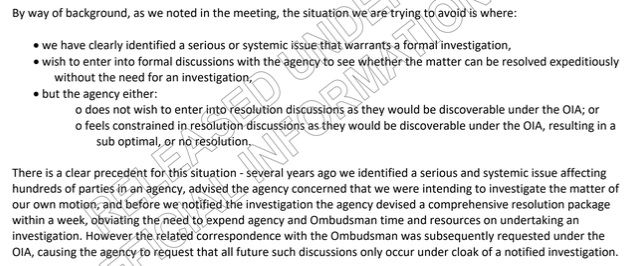
OTOmbSecrecy1

Note that the underlying situation, whatever is going wrong, would still be OIA-able; the amendment is aimed at making it harder to find by preventing journalists and advocacy groups from taking the shortcut of "so, what has the Ombudsman asked you to fix" (with the obvious followup of "and have you actually fixed it?"): this is about hiding dirty laundry, not about actually fixing anything. And the primary drivers here are the Ombudsman's preference for quick, informal resolution, and the desire of agencies to avoid embarrassment and public oversight. Its about bureaucratic arse-covering and a chummy desire to get along by covering for each other, not child-welfare. For the Ombudsman to be advocating for secrecy for such reasons is frankly disgusting, and calls into question their fitness to oversee the official information system.

Bluntly, if agencies are reluctant to cooperate with the Ombudsman, then the Ombudsman has the necessary powers to deal with that, and the solution is for them to start fucking using them (also to publicise non-cooperation to encourage compliance). Its a criminal offence not to cooperate with an Ombudsman's investigation or refuse their request for information, and those provisions should be used. The Ombudsman is not there to "get along" with government agencies; they are there to police them, and it is time they started acting like it.

Then there's the new secrecy clause for the Children and Young Person's Commission. The official reason for this is to enable children to engage with the Commission:

CYPCSecrecy

Which sounds like a good reason, but falls apart when you stop to think about it. If a child makes a complaint to the police, the details will be fully subject to the OIA. There may be good reason to withhold them ("maintenance of the law" if it is being prosecuted, plus obviously privacy), but the presumption is that the information is subject to the law. And that's fine, because the privacy interests of children are very strong, and the OIA provides sufficient protection. Does the government think the new Commission will fail to apply OIA withholding grounds sufficiently vigorously to protect children, or that the Ombudsman will ignore the strong privacy interest of children in deciding any complaint? Its a ridiculous idea. So who and what does the secrecy clause actually protect? The agencies being complained about. And they seem to be unworthy of any protection whatsoever; in fact, there is a strong public interest in poor government behaviour being exposed. And once again, if this is a question of "engagement", the Commission will have the required powers to force disclosure. But I guess the whole point is that the new, subservient Commission isn't really meant to inquire into anything...

One of the purposes of transparency is to make it easier for the public to find and correct abuses by government. The new secrecy laws in this bill work directly against that. And when the welfare of children is on the line, the consequences can be horrific. The government is currently conducting an inquiry into decades of abuse in care. Changing the law to make it easier for the government to hide its dirty laundry seems like a recipe for another such inquiry in a few decades' time.

Tuesday, November 09, 2021


More Labour secrecy

The government introduced a new bill reforming oversight of Oranga Tamariki today. The bill establishes an "Independent Monitor of Oranga Tamariki System" with oversight functions, expands the functions of the Ombudsman in investigating complaints, and replaces the existing Children's Commissioner with a full Children and Young People’s Commission. These all seem to be good changes, but like so many other recent Labour bills, it includes multiple secrecy clauses.

The first is a direct amendment to the Official Information Act removing communications between the Ombudsman and child-support agencies from the coverage of the OIA. Not just investigation-related communications - they're already exempt - but everything, no matter how trivial. So for example if Oranga Tamariki (or whatever succeeds it) proposes doing something, and the Ombudsman says "don't do that, it would be a bad idea", it would not be "official information" and would effectively be secret forever. We wouldn't even be able to ask how many times an agency had sought or received guidance to see whether the new monitoring functions were working effectively. The effect of this on the public accountability of Oranga Tamariki for the routinely terrible policy decisions it makes is left as an exercise for the reader.

The second is a non-standard secrecy clause binding the new Children and Young People’s Commission to eternal silence, effectively its own little version of the old Official Secrets Act. This is very clearly modelled on the Children's Commissioner's existing secrecy clause, which might sound OK, until you realise that the Commissioner and the Commisison have very different functions. Most importantly, the Commissioner had an investigative function, to "investigate any decision or recommendation made, or any act done or omitted... in respect of any child". That function has been split off, and now effectively belongs to the Ombudsman. Instead, the new Commission's functions are primarily advocacy and awareness-raising. They can inquire into "any systemic matter", but its clear from context that this is about policy and legislation. Their role in investigating individual complaints has been removed. Which seems to remove any justification for a secrecy clause, predicated as it was on a semi-judicial function and the privacy of children.

But more generally, when legislation is reviewed and re-enacted, this should be taken as an opportunity to review secrecy clauses and decide whether they are really necessary. For example, does the proposed Children and Young People’s Commission really need to provide absolute secrecy over "national security" and international relations, Tokelau, or Cabinet deliberations? Is that actually a necessary part of their functions? Or is it just mindless copy-paste legislation thoughtlessly repeating a clause originally drafted in 1962? And if the latter, shouldn't Parliament actually do its job, and think before it legislates?

Thursday, May 27, 2021


Climate Change: A duty of care

Hot on the heels of last night's decision in the Netherlands that the right to life requires Shell to reduce emissions, an Australian court has ruled that ministers owe young people a duty of care over climate change:

The federal court of Australia has found the environment minister, Sussan Ley, has a duty of care to protect young people from the climate crisis in a judgment hailed by lawyers and teenagers who brought the case as a world first.

Eight teenagers and an octogenarian nun had sought an injunction to prevent Ley approving a proposal by Whitehaven Coal to expand the Vickery coalmine in northern New South Wales, arguing the minister had a common law duty of care to protect younger people against future harm from climate change.

Justice Mordecai Bromberg found the minister had a duty of care to not act in a way that would cause future harm to younger people. But he did not grant the injunction as he was not satisfied the minister would breach her duty of care.

In other words, the decision hadn't been made yet. But the strong implication of the last bit is that if the Minister approves the project (especially without strong consideration of climate change impacts and how they may be mitigated), the decision will be overturned.

New Zealand has both an enforceable right to life in the BORA, and similar common law to Australia on the duty of care. So while not precedent here, both cases could be persuasive to New Zealand courts, and provide further weight to the Zero Carbon Act's "permissive considerations" clause. But we won't really know that until its argued.

Monday, May 03, 2021


Government of kindness?

Remember John Campbell's "Feed the kids" campaign? Free school lunches are one of the most effective education policy interventions we can make, boosting attendance and improving learning outcomes. Currently the government funds them for the 25% of children living in the poorest areas of New Zealand. But poor kids whose schools aren't in South Auckland or Aranui or Highbury miss out. Newshub is pushing again for the programme to be expanded so that everyone gets fed. Jacinda Ardern's answer? No:

But despite overwhelming evidence free lunches work to keep students in school and learning, the Government won't commit to making it universal.

Prime Minister Jacinda Ardern told The AM Show although she, in principle, supports universal free school lunches, it's "a matter of prioritisation".

"I don't have a problem with unlimited lunches. I think that would be great... But I have to prioritise, and it is quite costly to roll out and I have to ask the question 'is that the next step for us?'"

The Government hasn't costed what it would take to provide free lunches across Aotearoa, but Ardern says the current program costs "hundreds of millions".

The current cost is $220 million to feed 200,000 children. According to Wikipedia there are around 760,000 schoolkids in New Zealand. So, quadruple it, and we're talking around $850 million. This is serious government money, but to put it in context, its less than the cost of a single road in Auckland - or just one of the gold-plated anti-submarine warfare aircraft the government is buying to prop up the American weapons industry.

Decisions on spending at this level are fundamentally about priorities. And Jacinda Ardern, who promised to "bring kindness back", would rather have pollution-boosting roads and war-toys for the generals than well-fed, well-educated kids. I guess she just has a different definition of "kindness" to the rest of us.