Showing posts with label Freedom of Movement. Show all posts

Thursday, May 14, 2026


Another anti-protest law

National has introduced its new anti-homeless law to Parliament, and it will receive a first reading next week (which puts them up against it if they want it to pass before the election). The law is a disgusting piece of social cleansing, drafted to enable the police to hide the consequences of National's failed economic policies. But its worse than that, because in addition to enabling social cleansing, it is also, like their anti-boy-racer law, an anti-protest law. The new "move-on" order powers apply not just to people begging or rough sleeping (which is bad enough), but also to anyone "behaving in a manner that is disorderly, intimidating, or threatening", "behaving in a manner that is disruptive" (being "disruptive", whatever the fuck that means, is not a criminal offence), "unreasonably obstructing, hindering, or preventing someone from entering or leaving a place where a lawful trade, business, or occupation is being conducted", or "breaching the peace".

As noted previously, the government and police have a habit of regarding protest as inherently disorderly and disruptive, if not as a "breach of the peace". And the application to the common protest tactic of blockading a building is obvious.

Fascinatingly, the bill's BORA vet finds that the anti-begging and anti-rough sleeping provisions are disproportionate limitations on the freedoms of expression and movement, but does not consider the obvious application to protests at all. Which both shows a distinct lack of imagination and is a complete dereliction of duty on the Attorney-General's part.

This law can be used to limit fundamental rights to protest. Given police attitudes, it will inevitably be used to do so. If that is not the intent, then it needs a Terrorism Suppression Act-style clause excluding its application to any protest, strike, or lockout. If the regime fails to add one, then we should regard the suppression of protest as their intent, and the destruction of our democracy as their ultimate goal. It is that simple.

Wednesday, June 05, 2024


SIS "evidence" isn't, again

Back in 2016, then-Internal Affairs Minister Peter Dunne cancelled a New Zealand woman's passport, claiming she was a terrorist. The basis for his decision was a secret briefing by the SIS, which claimed that if she was allowed to travel, the woman would "engage with individuals who encourage acts of terrorism". The Supreme Court has now ruled that that decision was unlawful and invalid:

In its judgment released today, the court found the minister did not have reasonable grounds to believe the woman intended to facilitate an act of terror, and the briefing paper provided to the minister by the SIS was not fair, accurate, or adequate.

The judgement said Dunne's reliance on the woman potentially travelling to Syria to join a terrorist group fell short of the requirement under the law that the person be an actual danger to a country, not just a potential one.

The judges also found the law required there be evidence that the passport holder intended to travel and facilitate in a terrorist act, and Dunne did not have reasonable grounds to believe this - a higher standard than just suspecting it.

So, once again, SIS "evidence" turns out to be a tissue of lies and assertions when subjected to independent judicial scrutiny - just as it was in the Zaoui case. No wonder they kept the entire trial under a cloak of secrecy.

Obviously, this invites serious questions about why the SIS is so bad at its job, and why Ministers persist in relying on their "evidence" when it so obviously and so publicly gets it wrong whenever tested. And it invites serious questions about the quality of the "security assessments" they apply to visa applicants, and whether those assessments are also similarly unfair, inaccurate, and inadequate. A serious government, and a serious opposition, would be asking those questions. But given the way these things normally go, instead we'll see legislation to prevent judicial scrutiny of such decisions, rammed through under all-stages urgency, with the full support of the Labour Party.

Monday, September 28, 2020


Racism loses in Switzerland

Over in Switzerland, the racist "People's Party" tried to have a Brexit-style referendum on ending freedom of movement with the EU, so they could stop the "flood" of foreigners. But the Swiss people said No:

Swiss voters have resoundingly rejected an attempt to tear up the country’s agreement with the EU on the free movement of people, in a referendum that echoed the Brexit vote.

The largest party in the Swiss parliament, the rightwing, anti-immigration Swiss People’s party (SVP), called the referendum, arguing that the country must be allowed to set its own limit on the number of foreigners coming in to work.

However, the initiative – opposed by government, parliament, unions, employer organisations and all other political parties because it would put Switzerland’s overall relations with the EU in jeopardy – was rejected by 61.7% of voters, final results showed.

The EU had made it clear that freedom of movement was indivisible from the rest of their relationship, and that ending it would also mean ending trade, research and transport treaties, just as for the UK. Swiss voters clearly value those. And hopefully, it'll mean a fall in the fortunes of the People's Party as well.

Wednesday, August 19, 2020


"Justified but unlawful"

That is the finding of the High Court on the first nine days of New Zealand's lockdown, when we were all "ordered" to stay in our bubbles by the Prime Minister on television. Which is fairly unsurprising. We've known since Fitzgerald v Muldoon that you can't legislate by press release, and that the Prime Minister saying something doesn't give it legal effect. In this case, the order was eventually given legal effect, in the form of formal orders issued under the Health Act (the legality of which the court has upheld: it turns out that the Health Act quarantine power really does apply to everyone in the country all at once). But for those first few days, until those orders were issued, the lockdown order was unlawful and had no legal effect, which meant that it also breached our freedoms of association and movement (because justified limitations must be prescribed by law). At the same time, it was also a justified and proportionate health response, and this was recognised when the legality of the subsequent orders was upheld. So basicly the government's problem here is failing to do its paperwork properly. Which is understandable given the speed at which things were happening, but does actually matter when you're a government.

What does this mean in practice? Anyone prosecuted in those first few days for breaching lockdown has an easy appeal. Apparently that is unlikely to affect many people, but it still matters. There's no issue of potential liability for business closures because, unlike the instruction to stay at home except for essential travel, they actually had an order legally closing all premises. But the chief effect is to remind the government that we are not a monarchy, and that the Prime Minister cannot purportedly order us around from a podium like a King. When they want us to do something, they actually need to pass a law or use some other effective legal instrument. And hopefully in future they'll remember that.

Wednesday, July 29, 2020


Kindness wins after all

Last week, after Judith Collins announced that National would be cruel and vicious to kiwis caught overseas by the pandemic, and rob them at the border if they returned home, Labour looked like it was falling all over itself to cry "me too". But now, it looks like kindness has triumphed after all: there will be border fees, but only for people who leave New Zealand after the law passes, and for some people on temporary visas (basicly "essential" workers; families of returning kiwis will be exempt). This is a position that there's widespread support for - frankly, if you leave NZ now to go on holiday or some money-grubbing business junket, then you're not just a fool who is risking your own life, but someone who is deliberately choosing to endanger us all by potentially bringing the disease back with you. Deterring such stupidity is reasonable. But charging kiwis caught overseas was never just, fair, or reasonable, and I'm glad the government has backed away from it.

But its also worth noting that this victory belongs fairly and squarely to the Greens. Winston wanted to charge everyone. Jacinda Ardern - who supposedly wanted to govern with kindness - initially wanted to do the same. By standing firm and denying a majority for such viciousness, the Greens have given us a better, kinder policy.

Tuesday, July 28, 2020


A tight timeline

The bad news: Jacinda Ardern still wants to bill exiled kiwis for returning home. The good news: it would require a law change, which the Greens won't back, so she'll need to go grovelling to National. The other good news: she's running out of time to do it.

This is the second-to-last sitting week before the election. The government basicly has six days to pass everything it wants done before then. They can get more time with urgency, but that just means they get this Friday as well. And a lot of that time will be eaten by stuff they need to get done before then, notably the New Zealand Public Health and Disability Amendment Bill (due to come into force on 30 September), the Veterans’ Support Amendment Bill (No 2) (due to come into force on 1 October) and the renewal of the COVID-19 Public Health Response Act (which must be done by August 11). Plus there's a bunch of appropriations stuff to get through. The government could do it, but they'd need to use all-stages urgency, which is hardly going to help the legitimacy of the law. Alternatively, they could introduce it under urgency and send it to select committee for the next Parliament to pick up. Which means no billing until maybe December.

As for whether they will, Gerry Brownlee is asking them in Question Time today. So I guess we'll know by three o'clock what is going on. Unless the government tries to lie and dissemble to the people whose votes it needs. Which would be stupid, but the habit of trying not to answer anything in Question Time is deeply ingrained, and it may be difficult for them to break.

(And again: if you are a kiwi overseas and you don't like this idea, enrol so you can vote to punish the fuckers planning it. Your vote is a weapon. use it.)

Monday, July 20, 2020


So much for "kindness"

JacindaFuckOffSml

Over the weekend, National leader Judith Collins announced that her party would bill exiled kiwis $3,000 to return to their own country if elected. Its a cruel and vicious policy of questionable legality which entrenches socioeconomic barriers and sends a clear message that poor kiwis are not welcome home. So naturally, Labour fell all over themselves to say "me too".

And then Labour wonders why people have such contempt for them. 46 MPs and not a backbone or shred of decency among them. Because if it goes further than charging people who voluntarily leave now to take a holiday in a plague-pit - something we really don't want people to be doing - this is simply indecent and immoral. These people are kiwis. This is their home. They have a right to return. It is that simple.

(And reminder: if you are a kiwi overseas, you can enrol and vote. If you don't want the government to treat you like this, then vote for one which won't.)

Wednesday, April 29, 2020


Defending the indefensible

This morning Winston Peters dropped a bombshell: the Ministry of Health had recommended closing the border to returning New Zealanders, effectively summarily exiling every kiwi caught overseas by the pandemic:

The Government rejected advice to close New Zealand's border to anyone coming to the country amid the Covid-19 crisis, it has been revealed.

"The Ministry of Health recommended a total shutdown of the border, including to returning New Zealanders," Foreign Affairs Minister Winston Peters revealed in a speech this afternoon.

"From its health perspective this was understandable and appropriate advice," Peters said.

"But the Coalition Cabinet rejected that advice because it was and is inconceivable that we will ever turn our backs on our own."

They were right to do so, because it would be both immoral and illegal. The right to freedom of movement is affirmed in the Bill of Rights Act, which states clearly that "[e]very New Zealand citizen has the right to enter New Zealand". And that's given practical application by s13 of the Immigration Act 2009, which makes it clear that New Zealand citizens may enter and be in New Zealand at any time, and that the whole bullshit of visas and so on simply don't apply to us (you do however have to establish citizenship). So, it was a terrible idea, illegal, it should never have been made (or made it to Cabinet), and Cabinet was right to reject it.

And yet, as I type this, the Prime Minister is at the podium defending the Ministry of Health, and saying explicitly that they didn't need to consider human rights, or not consider them themselves. Bullshit. Firstly of course there's s3 of the BORA, which makes it clear that the Act applies to the legislative, executive, or judicial branches of the Government of New Zealand. So if they're not considering it in their decisions, they're both breaking the law, and simply not doing their job properly. And that's backed up by the Cabinet Guide - the government's guidance for doing Cabinet stuff - which has an entire section on human rights compliance in bills and Cabinet papers, which is crystal clear:
It is the responsibility of each department to make its own assessment and sign off on human rights implications in the department’s area of responsibility.
She's also pretending that the Minister of Health has no responsibility for the papers which go to Cabinet under his name, and which he (for OIA purposes at least) legally owns.

Its bad enough for a Ministry to apparently ignore the law and give terrible advice. But its worse for the Prime Minister to defend them and rewrite core government processes (designed to institutionalise human rights protection) by press conference in an attempt to minimise a bad headline. And I guess it shows us that politics-as-usual - the deceit, the lying, the spin, the bullshit - is back, and ugly as ever.

(None of this detracts from the amazing response of the Ministry of Health to the pandemic. They've literally saved tens of thousands of lives. But fuck, something went seriously wrong here).

Wednesday, November 20, 2019


The APEC police state enabling bill

I've joked before about how hosting international summits effectively turns part of your country into a police state for the duration. Well, New Zealand is hosting APEC in 2021, with events throughout the year in Christchurch, Wellington, and Auckland. And the government has put up a bill to give itself police-state powers for those events. The Asia-Pacific Economic Cooperation (APEC 2021) Bill allows the government to put the army on the streets as "police" with full arrest and search powers, let foreign security staff bring pistols and automatic weapons into New Zealand and use them, arbitarily close buildings, roads and public places, require proof of identification ("papers, please") from anyone wanting to enter, jam WiFi and any other radio communications. Appeals against these decisions are strictly limited, with no appeal against closures, removals or most other decisions permitted. And of course the government will not compensate anyone for the disruption or any abuse of rights.

(Coincidentally, unless Winston explodes prematurely, this will all be happening smack-bang in the middle of an election campaign, with the potential to disrupt access to advance polling places. Oh joy).

But what about the Bill of Rights? The bill overrides it, along with every other Act. There's no BORA vet on the bill available yet, but I expect our supine Attorney-General will rubberstamp it in the name of "security", just like he did for control orders. But we've hosted such events in the past without this sort of statutory violence to our constitution and way of life, so you really have to ask why it is all necessary.

More generally, if the security requirements of hosting such meetings require this sort of sustained violation of of human rights, the price is not worth paying and we should not host them. If Jacinda Ardern wants to wear a silly jacket and hob-nob with the elite, she should do it somewhere else, somewhere which doesn't require her to impose a police state on New Zealanders for the duration. Because the elite's networking and photo opportunities are not worth a single compromise to our human rights, and anyone who tells you they are is simply pushing feudalism.

Thursday, March 15, 2018


Unlawful and unaccountable

The Independent Police Conduct Authority report on the police's use of a fake breath-testing checkpoint to collect the names and addresses of members of political group Exit International has been released, and it makes the expected finding that the checkpoint was an unlawful use of police power, and interfered with the right to freedom of movement. Oddly, though, it concludes that the police's subsequent visits to Exit International members - which the Privacy Commissioner considered to be an unlawful use of personal information - were justified as they were consistent with police policy. In other words, the IPCA thinks that it is just fine for the police to act on unlawfully obtained information.

And then we wonder why the police keep violating the law. The answer is right in front of us: because the IPCA consistently refuses to hold them to account for it.

Meanwhile, there's further disturbing information in the full report: the police didn't just spy on the meeting from outside and use a fake checkpoint to identify people - they also obtained a surveillance warrant to listen in on the meeting itself. That's right - they bugged a political meeting. The police are now directly intervening in politics.

The officers involved justified their subsequent actions on the basis that they believed attendees of the meeting were more likely to commit suicide afterwards. But suicide is not a crime, and has not been for over a century. The police were well outside their bounds here, and had moved from investigating and preventing crime to interfering in people's lives. And that's simply not acceptable.

There's no mention in the police's press release that the officers involved have been subjected to any disciplinary action whatsoever, despite abusing their powers and exposing the police to significant costs for BORA violations. Until individual police officers are held to account, this sort of abuse of power is going to continue.

Thursday, April 13, 2017


Secret court hearings violate the right to justice

Over the past decade we've seen a push by governments around the world to allow them to present "classified information" (AKA the paranoid ravings of spies) to the courts in secret while denying the opposing parties the right to contest it, or even know what is being claimed. We saw this procedure used in the persecution of Ahmed Zaoui, and since then its been encoded in law in the Passports Act 1992, Immigration Act 2009 and even the Health and Safety at Work Act 2015. More generally, National wants to allow this procedure to be used in all civil and criminal trials, just in case the government wants to put its finger on the scales of justice.

Meanwhile, in a decision on judicial review of a passport cancellation, the High Court has just ruled that such provisions violate the Bill of Rights Act:

A statutory provision that material and potentially decisive evidence in a court proceeding is to be presented to the Court and considered in the absence of the party adversely affected is as flagrant a breach of the fundamental right recognised in s27 of NZBORA as could be contemplated...

The whole of our common law tradition, as bolstered by the rights and protections recognised by NZBORA, render the procedure under s29AB an anathema to the fundamental concepts of fairness. However, the reality is that Parliament has recognised the justification for the use of that procedure in defined circumstances.


And because Parliament is supreme, rather than the Bill of Rights Act, they get to get away with this violation.

In passing, the court also criticises the Attorney-General's apparent failure to warn Parliament of what it was doing, citing the lack of a s7 report on the provisions when they were passed. Which doesn't build confidence in Parliament as the guardian of our human rights. As with National's Anadarko Amendment and prisoner voting restrictions, it instead suggests that its time we took the job off them, and gave it to a body which can be trusted to do the job properly: the courts.

Thursday, November 17, 2016


"Controlling their own borders"

When UKanians voted for Brexit, a lot of them did it so the UK could "control its own borders". None of them seemed to have anticipated that Europe might want to do the same, to them. And now, thanks to Brexit, UKanians will have to pay a travel tax and apply for admission at the EU border:

British people will no longer be able to travel freely to Europe without paying a "travel tax" and being forced to fill out a form under plans unveiled by Brussels.

The US-style visa waiver scheme is one of the first concrete signs UK citizens will not be permitted the privileges they once had to move across European borders unhindered.

The EU Commission said the system of security checks is necessary to prevent terrorist entering the Schengen open-borders area, but UK Brexit critics warned it is further evidence of the hidden cost of quitting the Union.


The demise of borders and border controls has been one of the greatest benefits of Europe (its also one of the benefits of NZ's arrangements with Australia). But its not something the UK will get to keep if it leaves. And now no doubt those Brexit voters will get upset at being treated like non-members by the club they voted to leave...

Thursday, September 08, 2016


Nauru sinks further into dictatorship

Speaking of Nauru, our neighbours sank further into dictatorship yesterday when the Parliament passed legislation legitimising their unlawful seizure of an opposition MP Sprent Dabwido's passport and preventing the courts from overturning such decisions:

The Nauru government has passed amendments to the country's passport laws to give it broader powers to cancel passports.

It had earlier cancelled the passports of several former MPs and others who allegedly took part in an anti-government protest in June 2015.

The Justice Minister David Adeang introduced the amendments to the Passport Act 2011, which passed with a voice vote in the house, where the government enjoys a 16-2 majority.

He told parliament the new law allows the government to cancel passports of people it reasonably thinks might engage in acts that threaten the national or economic security of the country.


And of course opposing the government is considered a threat to national security.

In this case, Dabwido will die unless he receives medical treatment in Australia (Nauru's medical facilities are substandard, of course - gulag money goes to politicians, not hospitals!) So, the government is basicly trying to kill an opposition MP, or force a by-election by forcing them to become a foreign citizen in order to receive a travel document to leave the country. Australia could end this abuse in an instant by jerking its purse-strings. The fact that they don't tells you everything you need to know about their desire for democracy and human rights on Nauru.

Thursday, December 10, 2015


Getting married is not terrorism

Radio New Zealand reports breathlessly that none of the SIS's supposed "Jihadi brides" has had their passport cancelled - meaning they could be "free to return to New Zealand". Well, of course they haven't, and of course they are. Cancelling a passport requires that a person be a danger to the security of New Zealand (or another country) because they intend to engage in "a terrorist act within the meaning of section 5 of the Terrorism Suppression Act 2002". To point out the obvious, getting married is not terrorism.

As for the "problem" of "returning to New Zealand", every New Zealand citizen has the right to enter New Zealand at any time, and the government is required to facilitate this by issuing emergency travel documents even to people whose passports they have cancelled for "terrorism". More generally, the idea that we can or should effectively exile New Zealanders from their own country is abhorrent, and Radio New Zealand should be ashamed of themselves for propagating it.

Thursday, November 19, 2015


Urgent?

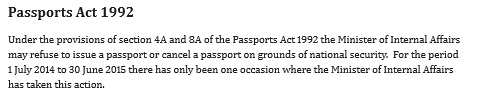
Last year, National rammed through a new anti-terror law, giving the Minister of Internal Affairs new temporary powers to cancel passports without notification and for an extended period. We were told this was urgent - so urgent that a select committee couldn't be permitted time to read the submissions on the bill - but was it really?

If the law was urgent, you would have expected those powers to have been used immediately after its passage. So were they? Of course not. Here's the Department of Internal Affairs' statutory declaration on its annual use of passport cancellation powers from its Annual Report:
passports2014
Note that that's under sections 4A and 8A, not the schedule. The conclusion: these "urgent" powers have not been used. That's good - people's rights have not been abused. And yet it suggests strongly that there was simply no case for urgency, and casts doubt on whether they were ever necessary in the first place. National abused our Parliament and our democracy to pass this law. They told us it was urgent and necessary to prevent imminent terrorist threats. And yet whenever we've checked that claim - on emergency warrantless surveillance, on whether DIA had ever had trouble extending a passport revocation in the courts, and now on urgent passport cancellation, we find that it was not necessary and that new powers have not been used. The obvious conclusion: the whole law was not justified, but was simply a power grab by the SIS to increase their budget and shift the status quo ahead of a statutory review which might have been unwilling to grant new powers (but would be less willing to remove existing ones). And National let themselves be played like a fiddle. The other obvious conclusion: it should be repealed.

Tuesday, October 27, 2015


Challenging the no fly list

Since the beginning of its "war on terror", the US has run a secret "no-fly list" limiting the freedom of movement of Muslims (and also children, environmentalists, human rights activists and politicians). The list was pure executive fiat, and once you were on it there was no way to get off it. But now, a US court has ruled that inclusion on the list can be challenged in the courts:

Tens of thousands of people, including U.S. citizens who have never committed a crime, are forbidden from flying into or out of the U.S. because they are on a list they were never even told they are on: the No Fly List.

Today, a federal court ruled that Americans can challenge their inclusion on this secretive list on legal grounds.

[...]

The U.S. Sixth Circuit Court of Appeals ruled on Monday that district courts have jurisdiction to hear challenges to the No Fly List, establishing a precedent for courts throughout the country. The court also reversed a lower court’s dismissal of Mokdad’s case, allowing him to proceed with his lawsuit against the Attorney General, Director of the FBI, and the Director of the Terrorist Screening Center (TSC).


This is good news, and a sign that the rule of law is gradually reasserting itself in the US. At the same time, this secret list limited the freedom of movement of tens of thousands of people, with no oversight and no real evidence. Those responsible for it need to be held accountable for that crime.

Monday, December 15, 2014


A pure power grab

When the government proposed extending the duration of passport revocations in its recent urgent spy bill, several people raised the obvious question: what was the justification? Why was it necessary? Had the government ever had trouble using the courts to extend a revocation?

Thanks to an FYI requester, we now know the answer: no, because they never tried:

No application to a Judge of the High Court has been made for an order to extend a cancellation of a New Zealand passport on the grounds of national security using the provisions of section 8A(3) of the Passports Act 1992.

So, there was no "problem" to be solved by the bill (though if the courts were rejecting extensions, it wouldn't be a problem with the courts, but that Ministers were revoking passports without justification). Instead, it was a pure power grab. The bill's shoddy Regulatory Impact Statement said that it was just too much hassle for them to prepare documents for the courts after a year. Even if we accept that at face value (difficult given that they also say that they would be preparing repeated documentation and ongoing risk analysis for the Minister in the case of any extended travel ban), the administrative convenience of officials is simply not a good reason for interfering with fundamental human rights.

Naturally, Peter Dunne buried this admission until after the bill had passed. But he voted for this legislation knowing that there was no case for it. People should judge him at the ballot box for that.

Friday, November 28, 2014


Submission on the Countering Terrorist Fighters Legislation Bill

Below is my submission on John Key's Countering Terrorist Fighters Legislation Bill. Hopefully some of you made your own as well.

  1. I oppose the Countering Terrorist Fighters Legislation Bill and ask that it not be passed.

  2. I also oppose the abuse of the Parliamentary process seen in the passage of this bill - and in particular the short select committee stage. It is a matter of some irony that a bill which will permit the SIS to spy without warrant for 48 hours without any submission to the Minister does not give the public even that length of time in which to make submissions. The short period for submissions is an express denial of our democratic rights, which brings Parliament into further disrepute. And when combined with the similar abuse done in the name of the GCSB Act, suggests that on matters of spying, the government and spy agencies do not want our voices to be heard.

    Amendments to Passports Act 1992

  3. I oppose the amendments to Passports Act 1992 contained in the schedule to the bill.

  4. I particularly oppose the power in new sections 1(6) and 2(6) extending the length of passport refusal / revocation from one to three years. At present, the Minister can cancel passports for a year, and can extend this for a further year on application to the High Court. The government has made no case that this period is inadequate and has presented no evidence that the current process of judicial extension is not working. The effect of these clauses (and the similar clauses applying to certificates of identity, refugee travel documents etc) is to remove judicial oversight of such decisions. This is something that should not be accepted in a free and democratic society.

  5. I oppose the avoidance of doubt clause in new section 1(3), 2(3) etc that the government can refuse or cancel a passport to someone outside New Zealand. This seems to interfere with the fundamental right of citizens to re-enter New Zealand, and to turn passport refusal/revocation into a Ministerial-imposed sentence of exile without trial. While emergency one-use travel documents are in theory available under s23(30 Passports Act 1992, "in theory" is not sufficient. In practice, any refusal or cancellation of a passport or travel document of someone who is offshore should result in the immediate issue of documents to enable the victim to return to New Zealand, to ensure that they are not effectively exiled.

  6. I oppose the new clause in s1(5)(b), 2(5)(b) etc that "notice [of a passport cancellation/revocation etc] is to be treated as given if the Minister has taken all practicable steps to provide it." Sections 1(7)(a), 2(7)(a) etc limit direct appeals to the Minister to within 30 days of notice. The combination of these two clauses is to effectively rob those whom the Minister decides it is impractical to notify of any right of appeal. This is inconsistent with the Right to Justice affirmed in section 27 of the Bill of Rights Act.

  7. I oppose the power in new section 7 to temporarily suspend a travel document for 10 days. The power requires no evidence or even suspicion of wrongdoing. Instead it merely requires that a report be being prepared. It is hard to see how such an arbitrary suspension of an individual's freedom of movement accords with the right to justice affirmed in section 27 of the Bill of Rights Act, or how it could be considered to be the least intrusive measure.

  8. I oppose the extension of sections 29AA to 29AC (permitting the government to use secret evidence which is not disclosed to the other party in cases involving "national security") to cases involving passport refusal / revocation etc. The use of secret evidence in court cases is absolutely inconsistent with the right to justice affirmed in s27 of the Bill of Rights Act, and its use has been found to impair similar rights overseas.1 As Lord Kerr noted in Al Rawi and Others v. The Security Service and Others [2011] UKSC 34, "Evidence which has been insulated from challenge may positively mislead. It is precisely because of this that the right to know the case that one’s opponent makes and to have the opportunity to challenge it occupies such a central place in the concept of a fair trial". Absent such an opportunity, both the justice and the public credibility of a judgement is irreversibly compromised.

  9. I oppose the limitation of crown liability in new section 9. It serves no purpose except to insulate the government from the legal consequences of poor decision-making. As I value good decision-making where human rights are concerned, I would prefer that the government had every incentive to get it right, rather than enjoying impunity.

    Amendments to Customs and Excise Act 1996

  10. I oppose new section 280M, which provides for police and SIS to have direct access to Customs' data for counter-terrorism purposes.

  11. As the bill's RIS and BORA-vet makes clear, this section is required because significant doubts have arisen about the legality of Customs' current information exchanges with police and SIS. Current practice is that police are able to directly enter targets into the Customs' database, specifying who they want stopped and what they want to search for.2 Customs then provides them with the results of any warrantless search at the border conducted under s151 Customs and Excise Act. Presumably there are similar arrangements with SIS. These powers are specifically used to conduct warrantless searches of digital devices such as laptops and cellphones.3. But as the Minister of Justice notes in her BORA-vet, "comprehensive examination of data, either from cell phones, laptops or other storage media, for general law enforcement purposes would require at least reasonable suspicion".

  12. The result of section 280M therefore is to effectively bypass the protections of the Search and Surveillance Act 2012 and New Zealand Security Intelligence Service Act 1969 to enable both agencies to conduct warrantless searches of anyone entering the country, potentially gaining access (via their cellphones, stored emails, browser histories and files) to every detail of their lives. These protections exist for good reason: the oversight of the courts (or, in the case of the SIS, of Ministers and the Commissioner of Security Warrants) prevents abuses of power. This clause would throw away any oversight, and grant these agencies arbitrary search powers. This is inconsistent with the right to be free from unreasonable search and seizure affirmed in s21 of the BORA.

  13. As a further note, because it is not a "search power" in terms of the Search and Surveillance Act 2012, border searches conducted by Customs under s151 have no protections for journalistic privilege, or for attorney-client privilege. They therefore raise the prospect of Police and SIS colluding with customs to violate the rights of journalists, and the fair-trial rights of people whose lawyers travel to and from New Zealand.

    Amendments to New Zealand Security Intelligence Service Act 1969

  14. I oppose new sections 4IA to 4IC governing the use of visual surveillance warrants. The power to film a person in their own home, with their family, is extremely intrusive. It needs to be subjected to the strictest safeguards. Sadly, those covering SIS surveillance are insufficient. Such warrants should only be authorised by judges, not by Ministers. And they should be subjected to full judicial oversight, not hidden behind a wall of secrecy.

  15. The justification for such warrants is "security". In the past, the SIS has shown extremely poor judgement of what constitutes a threat to "security", and the existing oversight procedures have provided no protection. They have spied on politicians and even children. The abuses which could result from allowing them to do so with video cameras ought to be obvious.

  16. I oppose the emergency surveillance powers of new sections 4ID to 4IF. These allow the SIS to exercise its surveillance powers (including the new visual surveillance powers, but also existing powers to e.g. break into people's homes) for up to 48 hours without a warrant where obtaining one would be "impractical" and a delay "is likely to result in a loss of intelligence".

  17. In terms or practicality, it is difficult to see why in this age of cellphones it would be impractical to gain Ministerial authorization. If the concern is that the Minister may be out of the country, then an arrangement similar to s19A Government Communications Security Bureau Act 2003 (which allows other Ministers to authorise interceptions when the Minister is unavailable) would be a more appropriate solution. If the concern is that oversight by the Commissioner of Security Warrants is a delay, then this is effectively an attack on the entire oversight system which needs to be resisted.

  18. In terms of "loss of intelligence", to spies any delay may result in such a loss. The clause effectively serves to circumvent the entire warrant oversight system.

  19. The "safeguards" around this are non-existent. Quite apart from any doubts about whether the Minister would refuse to confirm such a warrant, if a warrant is not granted, the information collected must be destroyed - except for any "relevant to the detection of activities prejudicial to security [or to] the gathering of foreign intelligence information that is essential to security". Effectively this is saying that the SIS can keep the poison fruit of breaking the law. The fine for failing to destroy information is derisory (and as any offence will be secret, there is no prospect of prosecution). These are not proper checks and balances.

  20. A comparison with existing police powers for emergency warrantless search and surveillance shows that the bar to such powers in a free and democratic society is high. Under the Search and Surveillance Act 2012 the police may conduct emergency searches without warrant to prevent the destruction of evidence of serious crime (sections 8 and 15), or where there is a risk to the life or safety of any individual (s14). They may also conduct emergency surveillance using a surveillance device for up to 48 hours in similar circumstances. Note the threshold: serious crime (punishable by 14 years or more imprisonment, or specified offences involving firearms) or a real threat to life and safety. A vague and unsubstantiated "risk to security" simply does not meet this threshold (and in the cases where it does, the SIS should be turning the case immediately over to police, so that they can exercise their powers and prosecute the offender).

  21. While both the visual surveillance and emergency surveillance powers have been compared to existing police powers, it is important to remember that the SIS are not the police. The SIS's goal is to gather intelligence, while the police's is to gather evidence. The former is secret, while the latter must ultimately be revealed in court and withstand judicial scrutiny. This public and judicial oversight provides a further check and balance on the police and gives them a strong incentive to act within the law. As their intelligence is kept secret and used privately, there is no similar incentive on the SIS, and the results can be seen in the dismal history of the service.

    Sunset clause

  22. The provisions of this bill have a "sunset" clause and expire on 1 April 2018. While I welcome the sunset clause, the duration seems far too long. The SIS is supposed to be reviewed next year, and I would expect Parliament to treat the outcome of that review as a matter of some urgency (though not the unconstitutional level of urgency displayed in the passaged of this bill). A 2016 expiry seems more suitable.

  23. I do not wish to make an oral submission to the Select Committee.
1. See for example Secretary of State for the Home Department v. MB (FC) (Appellant) [2007] UKHL 46, which found that the use of a similar "closed material proceeding" with "special advocates" violated the fair-trial rights of suspected terrorists.
2. See OIA response to TechLiberty and the police-customs MOU annex on data access.
3. As an example, police asked Customs to stop the wife of a suspected drug-dealer at the border so they could download the contents of her cellphone.

Thursday, November 27, 2014


The Law Society on the spy bill

At the moment the Foreign Affairs, Defence and Trade committee is hearing submissions on John Key's Countering Terrorist Fighters Legislation Bill. One of the first submitters was the Law Society. So what did they think of it? It is a disproportionate response to the problem:

some provisions in the Bill substantially interfere with and reduce human rights and individual liberty. Thus, the powers taken should be limited strictly to what is required by the threats that have arisen.

They're recommending that the term for passport denial not be extended, and that it be subject to stronger judicial review. They think that there's a very weak case for visual surveillance powers. Visual surveillance seems less appropriate for intelligence work, and the threshold in the bill is significantly lower than that required by police for such surveillance. As for warrantless emergency surveillance, they again note that the threshold is far too low, the period too long, and the safeguards nonexistent. They also criticise the use of urgency and the extended "sunset clause".

These are all strong criticisms. If you'd like to add your voice to them, please submit. There's a submission guide here. Just do it quickly, because submissions close today.

Wednesday, November 26, 2014


Submission guide: Countering Terrorist Fighters Legislation Bill

I've just completed my submission on John Key's Countering Terrorist Fighters Legislation Bill. In the past I've posted my submissions, but that has tended to lead to a bunch of people copy-pasting them, which has in turn reduced their impact (MP's hate spam-submissions). So I'll post it tomorrow, and instead do a quick guide on how to write your own. Remember, submissions are due tomorrow, so write fast!

Some points you may want to make:

  • The government has not made a case for the inadequacy of the current passport regime. In particular, it hasn't explained why a one-year cancellation / refusal is insufficient, or why going to court to get an extra year doesn't work. Indeed, there's no evidence at all that they've ever gone to court to extend a cancellation.
  • The ability to cancel the passports of people overseas creates a risk of rendering people stateless and constitutes a de facto sentence of exile imposed by Ministerial fiat.
  • The ability to suspend a passport for 10 days without evidence is (by definition) an arbitrary infringement of people's freedom of movement, and makes all our international travel subject to Ministerial whim.
  • The ability to use secret evidence in appeals against these actions violates the right to justice and undermines the credibility of the courts. They should have learned this from Ahmed Zaoui.
  • Giving the police and SIS access to Customs data effectively circumvents the safeguards on their search powers, at least where the target of an investigation may be travelling overseas.
  • Visual surveillance is highly intrusive, and given their past poor judgement and collection of irrelevant material, the SIS cannot be trusted with such powers.
  • 48-hour emergency surveillance powers seem designed to circumvent existing safeguards, while permitting the SIS to retain anything "interesting" they find. There are other solutions, including designating alternative Ministers who can approve warrants (as is done for the GCSB). In cases of real emergancy, such as a threat to life, the police already have the necessary powers, and cases should be turned over to them.
  • The short period permitted for submissions is ab abuse of the democratic process.
Once you've written it, you can submit through the online form here. Remember, you've now got less than 24 hours to do so, so be quick about it.