Showing posts with label Urgency. Show all posts

Monday, September 21, 2026


Ignoring the elephant in the House

The Standing Orders Committee has finally reported back on the Review of Standing Orders 2026, proposing amendments to parliament's rules for the next term. In a term dominated by the constant abuse of urgency and related anti-democratic efforts to restrict public participation, people really only had one question about this review: what would it do to curb these abuses? The committee's response? Nothing. And fuck us for asking.

I'm serious. What people wanted was checks and balances to limit the use of urgency - a supermajority, a requirement that there be an actual state of national emergency to justify interference with the normal democratic process, or something similar. Some rules so that the government of the day couldn't just say "fuck you, urgency!" and ram through hugely controversial legislation overnight without scrutiny, or steamroll it over exhausted MPs at the end of a week of midnight sittings. The committee refused to consider any of that. The furtherest they will go is a default rule that a bill go to select committee after first reading, unless the member responsible moves that it go immediately to second reading, in which case there's a requirement that they "inform the House with some particularity of the reason why the omission of select committee consideration is warranted." And there's a similar requirement where select committee consideration periods are shortened.

Such a requirement already applies to urgency itself, and the record abuse of urgency this term is absolute proof of its ineffectiveness. But that's the sort of shit you get from a legislature which began as a rubberstamp for a hereditary tyranny. Unfortunately for them, some of us would like them to grow out of that and be something more.

Parliamentary apologists will no doubt point at the rest of the chapter on legislative procedures, the proposed new Legislative Scrutiny Committee and rules to allow various sorts of technical bills and revisions of the statute book to go much faster. But this is just missing the point. Because urgency overwhelmingly isn't used for those sorts of bills (if it was, it would be far less controversial). Instead, urgency is used to introduce hugely controversial legislation in secret; to ram it through quickly to prevent opposition; to shove it through its final stages again to limit the window when it is in the news. It is not used because there is any sort of "crisis" or (non-self-inflicted) time-limit - it is being used as a political management strategy by an anti-democratic regime.

Parliament claims to be the centre of our democracy. It cannot credibly make that claim so long as it retains this tyranny at its heart. Its refusal to deal with this problem further erodes its legitimacy and social licence and strengthens the perception that it is an undemocratic, out-of-touch institution, now actively ignoring the people it claims to represent.

But urgency isn't the committee's only area of failure. They've also dismissed calls to limit the use of discriminatory and unparliamentary language, saying that that's up to the Speaker. The constant racism from the regime benches, the questioning of MPs' citizenship or right to be there by racist Ministers, that's all OK apparently. Certainly nothing the House should take a stand on. As opposed to overdeclarations of pecuniary interests by MPs wanting to set a good example by being transparent, which must be stomped on lest anyone be forced to follow suit or be publicly shamed if they do not. Similarly, they view the record number of submissions this term (due to troll legislation and an increasingly active and engaged public) as a problem, rather than a positive development (the engagement, not the trolling), and so propose ways of dismissing or ignoring submissions which - in the eyes of the political class - are not focused on producing "high-quality legislation". Which also means that when the regime says "people will get to have their say at select committee" - something it does whenever it has refused to consult before legislating - it will be a lie. The regime might not care about that - they're anti-democratic scum - but you'd think that an institution which purports to be representative and to provide the people with a voice might. But it seems parliament doesn't care about that either. Instead, they're interested in insulating the political class as much as possible from what people think.

Parliament has failed here. And by failing so publicly and arrogantly, they have reduced their legitimacy, their social licence, their mana. The public deserved much more than a "fuck you" in response to our concerns about the erosion of democracy. And Parliament will have only itself to blame if we start saying "fuck you" right back at them.

Tuesday, December 19, 2023


Burying the evidence

Back in 2020, IRD began a hugely controversial (among rich people) study of how much tax the rich are actually paying. earlier this year, it reported what we all knew: the rich aren't paying their fair share. The government refused to act on that, but they did pass a law, the Taxation Principles Reporting Act 2023, requiring IRD to report annually on the effectiveness, efficiency, and equity of the tax system, against a specified set of measurements and principles. Effectively, this would provide ongoing evidence of the need to tax the rich more, as well as of any other problems in the tax system.

The first of these reports is due by the end of the year. But National must not have liked what it says, because they're going to repeal the law under all-stages urgency to prevent its publication. Effectively, trying to bury the evidence. Of course, the report, and its drafts and associated correspondence are all official information. They are - unless National has a giant illegal shredder party - held. Which means that they can simply be requested under the OIA. And I expect every political journalist in the country is doing that right now.

Friday, May 01, 2020


Oops

Yesterday, I blogged about Parliament's extreme use of urgency to pass a pandemic-related tax bill with only one debate and no select committee or committee stage. As I noted, this increased the chances of an error slipping through, which might then need to be fixed later. And it turns out that's exactly what happened: just now, the Finance Minister explained at one o'clock Ashley that the wrong version of the bill had been tabled by the Parliamentary Counsel's Office, meaning that they had passed a small-business loan scheme before they were planning to. Oops.

Its something the government was planning to do anyway, so as mistakes go, its not that serious, and it doesn't need fixing. But it highlights the dangers of this sort of abuse of the Parliamentary process. It also highlights that MP's don't bother to actually read the legislation they're voting on, and as a result can end up passing something unintentionally. And that's rather disturbing. Again, it would be nice if politicians actually did their jobs properly. But apparently that's just too much to expect.

Thursday, April 30, 2020


A new extreme for urgency

We're in a state of emergency at the moment, demanding a quick policy response from the government. So, you'd expect some use of parliamentary urgency as a result, and it might even be justified. But even expecting that, I was shocked today to see the government introduce an urgent bill, with no debate on the first or second readings, and no committee state. Its the most extreme urgency I have ever seen in our Parliament. It means there will be a debate, and a vote, but no real scrutiny, and no chance to correct the inevitable drafting errors. And of course, the opposition didn't even get to see the bill until earlier today (its now online, so the rest of us can see it as well).

Its as if the regular procedural abuses had become so normalised that they had to invent a new one just to stress that they were taking the pandemic seriously. Except that its not a way to get good legislation. Even the democratic fraud of an abbreviated select committee stage would have been preferable to this (and since it has retrospective application, its not as if that would make much of an implementation difference anyway).

In a crisis I expect some urgency, where required. I don't expect Parliament to essentially just give up on doing its job as a legislature and stop scrutinising legislation entirely. While this is a technical bill, it changes a very complicated area of law, which makes scrutiny essential just to avoid mistakes. This terrible process all but guarantees a fuckup, which will then no-doubt require equally urgent legislation to fix. Wouldn't it be better if the politicians did their jobs properly in the first place?

Tuesday, December 03, 2019


This is bullshit, and our democracy deserves better

The government has said it will ban foreign donations to political parties and candidates, and will be introducing legislation to be passed under all-stages urgency this afternoon. While I agree with the goal, I don't see a particular case for urgency, unless the government is concerned about a flood of foreign money being snuck in before the ban comes into place (in which case, simply include a retrospective reporting requirement, and let the parties face the voters). And given the complexities (we allow anonymous donations of up to $1,500, while targeting foreign-controlled NZ companies and trusts is going to be fiddly), this seems like a move which needs serious select committee scrutiny. Otherwise, we're either going to end up with a cosmetic PR move, or a fuck-up. And the public deserves better than that.

Update: The bill is now online. It limits foreign donations to $50, and imposes a duty on party secretaries to "take all reasonable steps in the circumstances" to ensure that anonymous donations aren't from "overseas persons". Meanwhile, it leaves the definition of "overseas person" unchanged, meaning NZ front companies can still be used to run a herd of Mongolian horses through the law. This is bullshit, and our democracy deserves better.

Tuesday, September 25, 2018


Abolishing urgency?

Speaker of the House Trevor Mallard has suggested an effective abolition of parliamentary urgency:

Speaker Trevor Mallard has suggested sweeping changes to the use of Parliamentary urgency, effectively abolishing the practice in all but the most extreme circumstances.

Currently, the Government can put the House into urgency with a simple Parliamentary majority. Mallard’s proposed changes would require a 75 percent majority before the House goes into urgency.

On top of that qualification, the bill under urgency would have to pass each stage of the legislative process with a 75 percent majority.

This would effectively abolish urgency in all but the most extreme cases, where there was some bipartisan consensus.


Such cases are rare, and happen maybe once or twice a year. The rest of the time urgency is used either to bypass public scrutiny and shut down the opposition, or to make up for past laziness. The former is obviously illegitimate, and is why the public hates urgency. As for the latter, Mallard is proposing greater use of extended sittings - effectively making MPs work harder - to pass all the non-controversial bills which are currently rammed through under urgency because MPs have been too busy flinging shit at one another and playing silly buggers on the public dime.

(All of this could of course be bypassed by a government moving to suspend standing orders, and then making up the rules as it goes along. But that has a political cost. Effectively this would increase the cost of using urgency for anything not truly urgent).

Its a good proposal, and in line with public expectations. There's a suggested exception for the first hundred days in office, where the public expect the government to be able to pass legislation they have run on, and that seems reasonable as well. And it would definitely improve scrutiny of legislation and Parliamentary behaviour during the rest of the year. So of course, National opposes it, because they want to be free to abuse the public trust in any way they see fit when next in power.

Thursday, June 21, 2018


A childish tantrum

That's the only way to describe events in Parliament last night. Faced with the opposition filibustering two time-sensitive bills, the government moved urgency, then attempted to amend the instruction to the committee to prevent any debate on what was being voted on. The urgency isn't problematic - the bills are time-sensitive, and need to be passed this week if they are to come into force on time on July 1. They could have been completed under urgency with the budget, but the government unusually didn't take that opportunity at the time (something which I was happy to see, but it did set them up for this problem later). But the motion to forbid debate was an affront to our democracy. While it was withdrawn this morning - saner heads having prevailed - the fact that it was moved at all is obscene.

Oppositions exist to oppose. This will be inconvenient to the government, and that's the point. The way governments respond under this pressure illustrates their character. And Labour has exposed itself as authoritarian and intolerant of dissent (who'd have thunk it) - not values I want to see in a government. Chris Hipkins' childish tantrum actively undermined our democracy and the stature of our Parliament. And someone who does that is not fit to be Leader of the House.

Tuesday, May 08, 2018


There's a lesson here

When then Prime Minister John Key rammed the Countering Terrorist Fighters Legislation Bill through Parliament, he whipped up fear and presented the new powers it contained as vital to the security of the New Zealand public. Only giving the SIS warrantless and video surveillance powers immediately would prevent a terrorist bloodbath! This spy fearmongering was used to justify suspending normal parliamentary procedure and ramming the bill through under urgency after a select committee process so abbreviated that MP's had no time to even read the submissions of people who engaged with it in good faith.

But it turns out that it wasn't that serious after all. Because when the new powers expired due to a drafting oversight in the replacement Intelligence and Security Act, the government didn't feel a need to legislate immediately to replace them:

A law-making bungle deprived our spies of a key weapon against terrorism in the wake of classified briefings warning of "an increasingly complex and escalating threat environment" in New Zealand.

NZ Security Intelligence Service documents revealed the blunder left our spies unable to use video surveillance tools to watch terrorism suspects in their cars, homes or workplaces for six months last year.

[...]

Kitteridge revealed the hole in the law to former NZSIS minister Chris Finlayson last year. In a memo on June 30, she said "the NZSIS no longer had the power to apply for a visual surveillance warrant" or to use emergency power to act without a warrant in emergencies.

The memo said warrants to allow visual surveillance were to "detect, investigate or prevent a terrorist act".

But she said the NZSIS was unable to do so for six months after the old law expired on April 1 2017 because the new Intelligence and Security Act did not apply until September 28 2017.

In a handwritten note, Finlayson told Kitteridge: "You will not be seeking a legislative solution AT ALL. Don't even bother asking."


If the SIS could live without these powers for six months, it suggests at the least that there was no case for urgency, and possibly no case for the powers at all (DPMC certainly didn't bother to make one in their shoddy and unprofessional Regulatory Impact Analysis). There's a lesson here both for future attempts to expand spy powers, and for abuse of urgency, and it is one we should heed. Our spies are power grabbing liars, who use fear to boost both their powers and their budgets. And this is not behaviour we should tolerate.

Thursday, November 19, 2015


Urgent?

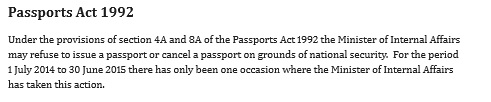
Last year, National rammed through a new anti-terror law, giving the Minister of Internal Affairs new temporary powers to cancel passports without notification and for an extended period. We were told this was urgent - so urgent that a select committee couldn't be permitted time to read the submissions on the bill - but was it really?

If the law was urgent, you would have expected those powers to have been used immediately after its passage. So were they? Of course not. Here's the Department of Internal Affairs' statutory declaration on its annual use of passport cancellation powers from its Annual Report:
passports2014
Note that that's under sections 4A and 8A, not the schedule. The conclusion: these "urgent" powers have not been used. That's good - people's rights have not been abused. And yet it suggests strongly that there was simply no case for urgency, and casts doubt on whether they were ever necessary in the first place. National abused our Parliament and our democracy to pass this law. They told us it was urgent and necessary to prevent imminent terrorist threats. And yet whenever we've checked that claim - on emergency warrantless surveillance, on whether DIA had ever had trouble extending a passport revocation in the courts, and now on urgent passport cancellation, we find that it was not necessary and that new powers have not been used. The obvious conclusion: the whole law was not justified, but was simply a power grab by the SIS to increase their budget and shift the status quo ahead of a statutory review which might have been unwilling to grant new powers (but would be less willing to remove existing ones). And National let themselves be played like a fiddle. The other obvious conclusion: it should be repealed.

Tuesday, November 17, 2015


Urgency for abuse

The House has just gone into urgency for two key (for the government) bills - the first to punish retroactively people who have already been punished, the second to steal from the poor.

The first bill is the government's returning offenders legislation, designed to impose "parole-like conditions" on New Zealanders deported from Australia after serving their sentences. This means not just a host of invasions of privacy such as taking fingerprints and DNA, but also restrictions on where and how they live and the ability to recall them to jail:

Those who breached the conditions would be "dealt with as any other offender" and could be put back in prison, she said.
But, as noted above, these are people who have already completed their sentence. They've done their time, been deported - and now the government is proposing that they be punished again through invasion of privacy, conditions, and possible jail - for a crime they have already been punished for. And this, pretty obviously, violates s26(2) of the Bill of Rights Act:
No one who has been finally acquitted or convicted of, or pardoned for, an offence shall be tried or punished for it again.
[Emphasis added]

And yet, somehow, the bill failed to attract a section 7 report from the Attorney-General. Benefits of urgency, I guess. But once again, we're seeing all-stages urgency being used by National to pass a bill repugnant to our constitution and to basic standards of justice. And once again, its a strong argument that parliament simply is not fit to decide such things, and that they need proper supervision by the courts.

The other major bill they're passing under all-stages urgency is a bill to steal from the poor. For 18 years, WINZ deliberately underpaid beneficiaries, robbing them of a day every time they signed up for a benefit. And then when they were caught, the government's solution is not to pay people what they are owed, but to legislate retrospectively to legalise this theft. It is unfair, and it is unjust, to rob from the poorest New Zealanders. But isn't it so very, very National? And isn't it so very, very National to bring Parliament into disrepute by committing such theft under the cloak of urgency?

Wednesday, September 23, 2015


A desperate farce

Our farcical flag referendum looks set to get even more farcical, with Parliament looking to sit under all-stages urgency to add "Red Peak" to the ballot paper. And its pretty easy to see why: Key's process and crony-stacked "independent" flag consideration panel has produced designs pretty much no-one wants. Faced with almost certain failure, Key is gambling in the hope of being able to force change, and go down in history as "the guy who changed the flag" (a distinctly unambitious goal IMHO).

Its obviously a win for those who like the "Red Peak" design (and it has grown on me a bit, though I am still in thrall to the Hypnoflag), it raises an obvious question: why wasn't it on the ballot to begin with? And given the way it has inspired debate and captured (some) public imagination, in exactly the way that Key's preferred silver fern designs haven't, why was his abortion of a process unable to do the same?

The answer, I think, is that people knew the outcome was fixed, so they refused to engage and legitimise. And the blame for that can be placed firmly on the government. They had a chance to do it right, but instead they deliberately fucked it up. And now they're scrambling to fix that mistake, and making their process look even more farcical by doing so.

Friday, March 13, 2015


Urgent?

Last year, National rammed through a new anti-terror law giving the SIS new warrantless surveillance powers. We were told this was urgent - so urgent that a select committee could only be given a week to look at it, which wasn't enough time to read the submissions. But was it really?

If the law was that urgent, you'd expect those powers to be used immediately. But it turns out they weren't. Yesterday the SIS released their first statutory report on the use of warrantless surveillance, and it speaks for itself:

The ability to issue a section 4ID authorisation came into effect on 12 December 2014.

During the period 12 – 31 December 2014, no authorisations were issued under section 4ID of the NZSIS Act.


So much for the case for urgency.

(See also: Peter Dunne's refusal to say how many times the new passport revocation powers, granted under urgency, have been used. That also speaks for itself. The urgency over the spy bill wasn't because the changes were urgently needed, but because the government wanted to limit debate).

Thursday, March 12, 2015


Legislate in haste, repent before you've even started

When John Key promised to remove MPs' outrageous, undeserved pay rise - without showing us the bill to do so - I predicted that it would be a knee-jerk rush job, which we'll probably need to fix later. It turns out that "later" is sooner than I thought: National is now having to pull the bill and redraft it before it has even been voted on out of fears it could give MPs even more money:

Prime Minister John Key's plans to quickly ram through changes to the way MPs' pay is set have hit a speed bump amid concerns they could deliver higher, not lower, increases in future.

[...]

But plans to debate it this week have been repeatedly revised, and it now seems unlikely to reach the floor of the House until next week.

"On Monday it was going to be Wednesday, on Tuesday it was Wednesday or Thursday, on Wednesday morning it was Wednesday, on Wednesday afternoon it was Thursday and today it's next week," an Opposition source said.


All of which is a potent reminder of why we have select committees and public submissions: to catch problems like this before they become law, and allow the public to suggest alternatives. And it suggests that what National should have done if it wanted to fix the problem this year is a two-stage process: an urgent bill to claw back the undeserved pay rise and substitute a politically set one in its place, followed by a proper bill through the normal Parliamentary process to fix the system in the long term. Instead, their poor political management and desire to be seen to be acting immediately has resulted in such a mess that the window for retrospectivity has basically passed. Thanks to National, MPs will probably get to keep this year's pay rise. And the public should hold them accountable for that.

(I have no problem with retrospectivity to correct a mistake, if it is done in a timely manner. But as more time passes, the case for a retrospective clawback becomes untenable. You could just do it immediately afterwards, before the money had been spent or plans made on that basis. But now that its no longer going to be immediate in any sense of the word, I think we just have to live with the mistake and instead commit to fixing it properly in future).

Monday, March 02, 2015


I want MPs' pay reformed, but not like this

One of New Zealand's core political myths is the tale of how back in 1985 before MP's pay and conditions were set by the Remuneration Authority, they used urgency to give themselves a gold-plated pension scheme in just seven minutes - forever cementing their reputation as self-serving parasites. Next week, we look to see urgency used to do the opposite: to remove the pay-rise the Remuneration Authority just gave them.

While I'm pleased by the outcome, I'm not pleased by the process. The bill apparently hasn't even been written, and "Ministers anticipate more detailed advice from officials on the measure to be used". So, its a knee-jerk rush job, which we'll probably need to fix later. And while a case for urgency could have been made last week to prevent the pay-rise from happening, now that the evil it seeks to avert has happened, the case is much weaker. Since the government is already contemplating clawing back the pay rise, there's no reason it can't legislate by the normal process, allowing a full public debate on the criteria we should use to set MPs' pay, and ensuring a select committee (and the country's lawyers) can spot and plug any loopholes. But the focus groups have spoken, the government is bleeding popularity, so instead we see the democratic process abused once again, for purely PR purposes.

(I have no problem whatsoever with clawing back a politically set pay-rise which should never have been given in the first place. Or with amending the law to link MPs pay to that of other public servants. But this is a shit way to do it which shows yet more contempt for the public and for our democracy).

Monday, April 28, 2014


Back to hypocrisy again

Last year Parliament almost unanimously passed the Psychoactive Substances Act 2013. The bill ended the policy of attempting to regulate new recreational chemicals under the Misuse of Drugs Act and instead established an evidence-based regime which allowed substances to be sold legally if they could show they were low-risk. It was a bold step forwards on drug policy, one which hinted at an end to decades of wasteful prohibition and knee-jerk policy-making. And now, thanks to a moral panic and another election-year knee-jerk, its in ruins.

The ostensible justification is the harm caused by these products and "reports of severe adverse reactions". But Section 40 of the Act already permits an approval to be withdrawn if there is evidence a substance is not "low risk". Over on Public Address, Russell Brown points out that the government's claims that "[i]t has been impossible to attribute these adverse effects to any particular products" are bullshit and that the National Poisons Centre and users know which products are causing the problem. So why didn't the government use it and ban those harmful products? Simple. Firstly, it would be subject to judicial review, meaning the possibility of a court case and an embarrassing backdown if the government's evidence didn't stack up. And secondly, it would have given the Opposition a chance to grandstand instead - and as Peter Dunne made clear over Twitter, he wasn't going to let them do that:

do you really think the government would have given you a victory on this?

And so thanks to petty politics we're back to the insanity of blanket prohibition (with all the ills that that entails), not to mention the constitutional violence of all-stages urgency. Fuck you very much, Peter Dunne.

[And ditto to Labour. We had a good law, one you voted for, and you're feeding moral panic over it and destroying it basicly to make the government look weak. I guess for them its politics first and policy second]

Meanwhile we've been reminded once again of the hypocrisy inherent in drug policy. Old people's drugs - alcohol and nicotine - are legal, despite the immense harm and social costs they cause. Drugs which cause vastly less harm are not (and while its banning more of the latter, the government selects a tobacco lobbyist as a candidate). Such an approach does not reduce social harm. Nor does it encourage respect for the law or our political system as a whole. Instead, it makes it clear to all that our politicians are whores and hypocrites and that their law is an ass. As for the consequences, the widespread flouting of drug laws and declining voter turnout speak for themselves.

Friday, May 17, 2013


Another abuse of urgency

Parliament is currently in urgency to pass budget-related legislation. Usually, this is justified - for example, when raising taxes, or sending major policies to select committee. However, the government has included two bills in the urgency motion (for all-stages passage, no less), which do not seem to be justified.

The first - the Crown Minerals Amendment Act 2013 Amendment Bill - is a patch-up job on the Crown Minerals Amendment Bill they rammed through just a few weeks ago. It seems that National was in such a hurry they left significant flaws in the legislation. However, that in itself does not justify no select-committee scrutiny, especially when the amendments won't come into force for up to two years. There's plenty of time to send this to committee and make sure they're doing it properly this time. But to add insult to injury, the bill expands the Anadarko Amendment to apply to waters above the continental shelf but outside our EEZ - a legislative grab which may not be supported in international law (and which has BORA implications). Given the lack of scrutiny for the original amendments, you'd think this deserved some.

The second - the New Zealand Public Health and Disability Amendment Bill (No 2) - is worse. This is the government's response to the family carers in Atkinson & Others v Ministry of Health, and it is aimed at overturning that court victory so the government can pay family carers less than anyone else. The Attorney-General has given it a negative section 7 report on the grounds that it unlawfully discriminates on the basis of family status (not online yet), but it is being rammed through under all-stages urgency. Worse, the bill's Regulatory Impact Statement [PDF] - the primary mechanism for informing MPs of the consequences of their legislative actions - has been heavily redacted. So MPs are being expected to decide on a bill with serious human rights implications, in the absence of the legal advice which would tell them whether they are making the right choice.

Again, this is unacceptable. Human rights should not be violated under urgency, and to do so makes a mockery of the BORA's reporting process and again calls into question Parliament's right to legislate in this area. They are trusted to do so on the basis that they will only violate the BORA after thinking long and hard about it; every time they refuse to do that, they simply strengthen the case to take that right off them by making the BORA supreme law and giving the Supreme Court the power to overturn MP's lazy excesses. As for the RIS, it makes a mockery of the claim that Parliament's consent to this law is in any way "informed" - and by doing so it undermines the legitimacy not just of the law, but of Parliament as an institution. If Parliament is simply mushroomed by the government, then its votes carry no weight, and the laws it passes aren't. Its that simple. National's continued contempt for Parliamentary process is in danger of undermining our entire democracy. We should not let them get away with it.

Tuesday, October 18, 2011


Urgent, my arse

When the government rammed through the Video Camera Surveillance (Temporary Measures) Bill, it told us that the legislation was urgent. When it refused any amendments designed to ensure that future police surveillance required warrants for the invasion of privacy as well as property, they said there was no time. The government had to be allowed to do what it wanted, immediately, with no questions asked, because the police had been forced to turn off surveillance cameras in ongoing investigations, and needed to turn them on again as quickly as possible.

As usual, they lied.

The bill was passed by Parliament during its last sitting on October 6. It was only given the Royal Assent yesterday, and became law today. Some urgency. I guess the police weren't in as much of a hurry as they said they were.

And so now we're saddled with a bad law which gives the police a blank cheque to film in our bedrooms for the next six months, all because the government lied and MPs were too fucking lazy to do their jobs properly. They really have earned their reputation with this one.

Tuesday, September 27, 2011


Reported back

The Standing Orders Committee has reported back [PDF] on its triennial review of Standing Orders. Its recommendations include some fairly significant changes - and a lot of "more of the same".

There are four big changes. On urgency, the Committee is recommending allowing extended sittings. This would basically extend the hours of the House, without any changes in internal procedure or allowing the government to introduce bills out of the blue. Extended sittings would be set by the Business Committee (requiring "near unaniminity"), rather than a vote in the House. This should remove one of the drivers of urgency, which is good - but the core problem remains.

Secondly, BORA scrutiny is being tightened, with a new requirement for the Attorney-General to report on BORA implications of substantive amendments. Human rights concerns will also be given prominence in explanatory notes, and in select committee reports. Its a good first step, but given some of the abuses we've seen, I don't think its really enough for Parliament to claim in good faith that it is properly discharging its obligations under the Act.

Thirdly, Parliament will be publishing all Member's Bills put in the ballot. Score one for transparency.

Finally, there's a recommendation to tighten up on the affirmation of office, to prevent the common practice now of stating allegiance to the Treaty of Waitangi and/or the people of New Zealand before giving the correct legal form. This is predicated on a claim that

The Speaker or the Clerk in administering the oath or affirmation can permit no form of words other than those set out under the Oaths and Declarations Act 1957
Which is true as far as the affirmation itself goes. But no-one is trying to pretend that those preliminary statements are the affirmation or have any legal effect, and everyone goes on to jump through the legal hoop and give their affirmation "properly". And by being anal about not being able to say anything else other than the affirmation when called up, Lockwood Smith is making a rod for his own back. To point out the obvious, this matters significantly to people. And there are far more disruptive ways that MPs can signify their opposition to our current constitutional arrangements than the current way of making a quick statement before being sworn in. Smith is inviting MPs to use those methods, and in the process, to turn the next state opening of Parliament into a nationally televised farce. And I hope they do exactly that - because by doing so they will be serving both our democracy and the people they represent.

On the "no change" front, the Committee's other response to the systematic abuse of urgency was to require the Minister moving it to "inform the House with some particularity of the circumstances that warrant the claim for urgency". That's not really any different from the current requirement to inform the House why the motion is being moved, which in the hands of Gerry Brownlee is little more than a bad joke.

There's no change on the discriminatory prayer, of course. Parliament will continue to open each day by affirming its allegiance to an imaginary entity, in the process excluding the majority of New Zealanders who no longer believe in such a thing.

Finally, they consider the perennial question of the OIA. But while mouthing some sentiments about transparency and openness, they refuse to allow it. They make some comments about a Standing Orders-based regime for Parliamentary transparency, but make no recommendation. And then they wonder why the public thinks they're scum. Again, MPs earn their reputation - and they've earned a little more of it today.

Wednesday, September 21, 2011


No majority

ACT has announced its position on National's plans to oust the rule of law and retrospectively validate unlawful police surveillance, saying that they want the bill to go to select committee. So that's that then. The government has no majority for this change, and will not be able to ram it through without public scrutiny.

The question now is what will happen after the select committee. The legal profession, the Human Rights Commission, and likely the courts will all voice serious objections to the proposed retrospective validation (while supporting in principle the right of the police to conduct such surveillance in the future with proper judicial oversight). Hopefully this will mean the retrospective portions of the bill will be removed, and we'll get a quick-fix which is basically unobjectionable. But the government may try to press on anyway, and try and tar other parties as "soft on crime" (rather than "soft on human rights") if they refuse. The question then is whether ACT or Labour will buckle, or whether they will stand up for our constitution in the face of an assault which exceeds anything done by Muldoon.

Tuesday, September 20, 2011


Labour on rule of law repeal

Labour has finally spoken up about National's plans to oust the rule of law and retrospectively validate unlawful police surveillance, saying they will not support the bill until they have seen it, and they will not support the bill being passed under urgency:

Labour wants a select committee to scrutinise retrospective legislation to allow secret filming on private property by police.

[...]

''The bottom line is it must go through a select committee process,'' Goff said. ''It needs to have expert opinion, we need to have the Law Commission, we need to have the Law Society, the other players in this game, able to comment.''

He added: ''We haven't seen the law yet, we haven't seen the bill, and I'm not going to support anything I haven't seen.''

This is better than I had expected, but it still leaves the door open to support interfering in ongoing criminal trials to support the prosecution. And that is something no party in our Parliament should support.

Update: And more from Charles Chauvel here.


