Thursday, November 04, 2010


Social Report 2010

The 2010 Social Report was quietly released on Tuesday. Unlike previous years reports, this one is a web-only publication. And where last year's one warranted a press release, this one came out without even a whisper. Its almost as if the government is embarrassed about publishing this data.

And well it should be. The report clearly shows the increase in unemployment and drop in market income per person which has resulted from National's failure to mitigate the recession. The more recent figures, which be in next year's report, wil be even worse. Meanwhile, lagging indicators such as income inequality clearly show that Labour's policies in this area were slowly working - income inequality continued to decline (after increasing last year), and was at its lowest point since 1994 (!). National's tax-cuts, which will show up in two years' time, will probably put paid to that trend.

Air and water quality measures have been removed from the report, most likely to hide the bad news resulting from National's relaxing them. But there is an interesting new addition of a "life satisfaction" metric, from the New Zealand General Social Survey. Its a good addition, and it will allow us to see how changes in other social measures affect happiness.

The full report can be downloaded here [PDF].

Garrett's lies and the SST's hypocrisy

ACT MP David Garrett resigned from Parliament in September, and it looks like we were well rid of him. Documents released today show conclusively that he lied to a court in 2005 by covering up his Tongan assault conviction:

"Since being admitted [to the bar] in 1992, I have committed no criminal offence nor had any disciplinary proceedings brought against me either in New Zealand or Tonga," Mr Garrett, a former lawyer, told the court in 2005, the documents reveal.

"The worst I could be accused of is incurring some parking and speeding fines," he said.

Its not perjury because it wasn't under oath. But it shows what a scumbag Garrett was.

Meanwhile, the Sensible Sentencing Trust's hypocrisy is also exposed. In any other case involving identity theft, the SST would have been howling for the accused's head. But SST spokesperson Garth McVicar personally vouched for Garrett. I guess they see criminal offending differently if the offender is rich, white, and one of them...

Against tobacco prohibition

Yesterday, the Māori Affairs Committee published its Inquiry into the tobacco industry in Aotearoa and the consequences of tobacco use for Maori [PDF], in which they called for New Zealand to be a smoke-free nation by 2025. In other words, ban tobacco.

I oppose this for two reasons. Firstly, on straight-out liberal grounds: if it harms only themselves, then what informed, consenting adults stick into their bodies is really none of my business. And secondly, on practical ones. Prohibition didn't work for alcohol in the United States between 1920 and 1933. It doesn't work for other drugs now. It simply provides criminal networks with a ready-made income stream, while ensuring that the products are unsafe and the resulting public health problems harder to deal with.

But while their headline goal should be a non-starter, several of their other recommendations are quite sensible. Making tobacco companies (which means ultimately smokers) pay for the cost of addiction treatment and public health campaigns. Banning "powerwalls" and requiring plain packaging to prevent tobacco companies from marketing by stealth. Requiring them to publish more product information, and regulating additives to prevent them from masking the taste of their product. And of course hiking excise taxes to ensure that the public health costs are fully met.

The fact that 50% of smokers interviewed by Campbell Live wanted tobacco banned so they could give up [video] suggests addiction issues are serious, and provides a strong mandate to make tobacco companies provide them and make their product less addictive. But it does not provide a mandate for an outright ban. But there's a lot we can do, without going that far, to make it easier for those who want to to give up, and to help ensure that tobacco companies can't push them into addiction.

Unexpected

Another interesting little titbit from that government presentation on the economy. The government identifies the high-tech manufacturing and services sectors as potential growth areas, but identifies lack of capital to help them grow as a significant barrier to that growth. Their proposed solution?

Pursue an aggressive strategy of co-investing with the private sector in this industry, for example through equity investment that grows firms in return for anchoring them in New Zealand.
This is a sensible, pragmatic solution, which solves an identified failure of the market and which if done well could see both the government and the wider economy profit. OTOH, it also has a name: nationalising the means of production. Sure, they're not taking stuff by fiat, but if pursued, it would see large sectors of the economy being government-owned. I don't have a problem with that - but its not the sort of suggestion I would ever have expected to see from National.

And OTOH, they haven't actually done it. I have heard that much of the advice in this paper relating to a more interventionist stance in the economy was ignored by NeoLiberal ideologues within the government. If so, its a shame. This is a sensible solution. Government has shown, contra the NeoLiberals, that it can make good investment decisions - just look at the results of the New Zealand Superannuation Fund. It can make them at arm's length, without politicising them. The government's ideological refusal to consider such options and take an active role in growing the economy in a smart direction is a recipe which dooms us to failure.

Wednesday, November 03, 2010


UK prisoners to be allowed to vote

Currently, National MP Paul Quinn, with the full support of his party, is trying to ban all prisoners from voting via his Electoral (Disqualification of Sentenced Prisoners) Amendment Bill. Meanwhile, the UK government will be doing the reverse:

Prisoners are to get the right to vote as the government is poised to throw in the towel in a long-running legal tussle with the European court of human rights, it emerged today.

It is understood that the coalition is to confirm that it is ready to change the law to remove the voting ban on more than 70,000 inmates of British jails.

The move comes after government lawyers advised that failure to comply with a 2004 ECHR ruling could cost the taxpayer hundreds of millions of pounds in litigation costs and compensation.

[Link added]

As I pointed out last month when this first sprang up, this is a perfect example of why we need an enforceable Bill of Rights Act. The UK is being forced to change to conform with international law because it signed up to the ECHR, and the European Court of Human Rights' rulings are binding upon it. Meanwhile, our lack of an enforceable human rights instrument means that our Parliament is allowed to pass legislation which violates our rights, and there is nothing we can do about it. But that is not how liberal democracies operate in the 21st century. They have checks and balances to prevent exactly that sort of behaviour. Its time we got some too.

Never any milestones or targets

Further to my post yesterday on Gerry Brownlee's bullshit on milestones and targets for closing the gap with Australia, I've been contacted by a source within the government, who says:

I can confirm that during the period you are referring to - roughly speaking, the winter and fall of 2009 - there was no discussion of or advice given on targets for closing the income gap with Australia. The 15 Sept Cabinet paper, which details the growth paths of GDP and exports needed to achieve the Government's goals, is the closest thing that exists.

In short, Minister Brownlee did not ask for advice on specific targets or milestones.

Of course, this doesn't rule out him having asked for advice on targets sometime between then and his claims in Parliament - but then he would have been obligated to provide that advice in response to my OIA request. Which means that he's either ignoring the OIA for no apparent reason, or he lied to Parliament by claiming to have targets and milestones when he did not. So, which is it?

The public wins on transparency

On Friday, Speaker of the House Lockwood Smith slammed the door on transparency, limiting disclosure of MP's international travel expenses. The decision was condemned by party leaders, and the public, and as a result he has been forced to back down and release all the information. He's petulantly blaming "confusion created by the decision of some party leaders to release individual party figures", but the blunt fact is that he was wrong, and we (and our representatives) called him on it.

Hopefully Smith has learned his lesson from this, and will embrace the cause of transparency. Otherwise he will continue to drag Parliament into disrepute and contribute to the poor reputation of our politicians.

Against scrapping gift duty

On Monday, the government announced its intention to scrap gift duty. Their rationale is that it brings in only $1.5 million a year, so there's no point retaining it. Sure, but the point of gift duty isn't really to tax gifts - its to prevent people evading taxes by "giving" stuff to their relatives. And once you see it like that, the fact that the rich spend $70 million a year complying with gift duty tells us that its removal would result in open slather.

So, I agree with Phil Goff: this is just another tax cut for the wealthy, just another example of National looting the state for the benefit of its wealthy donors and cronies. Its what National does, of course - but we shouldn't be happy about it.

Delaying disconnection

The Commerce Committee has reported back [PDF] on the Copyright (Infringing File Sharing) Amendment Bill. The good news is that they won't be immediately introducing disconnection from the internet as a penalty for file sharing. The bad news is that they will retain the option to introduce it at any time by Order-in-Council.

This is unacceptable. As I have already pointed out, disconnection is a disproportionate penalty. The internet is no longer a form of entertainment - it is as essential to everyday life as the telephone. Without it, we can't read the news, pay our bills, talk to our friends and family, or participate in society. Disconnection is thus an active denial of citizenship, akin to cutting out our tongues. We don't do it for scammers and spammers. We don't do the equivalent for telephone fraudsters. So why do it for file-sharers?

(The answer, of course, is that the victims of spammers and scammers and telephone fraudsters aren't a multi-billion dollar global industry which can splash around millions on lobbying. They're just ordinary people. But the law doesn't work for us - it works for the rich corporations instead).

This draconian and disproportionate punishment violates the Bill of Rights Act, not to mention all standards of justice and decency. Even if not immediately implemented, it has no place in our law.

Big business fails New Zealand

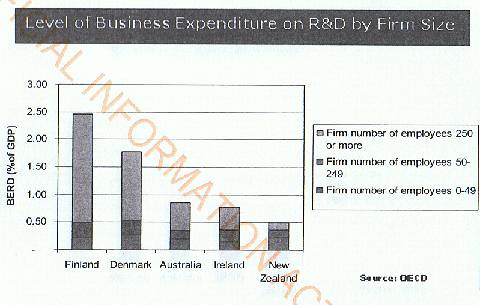
One of the big problems with the New Zealand economy is the lack of R&D spending, which restricts innovation and hamstrings our future. But when you look at the statistics, its not the government's fault - our government spend about the same as Japan's (as a proportion of GDP) on R&D. The failure is on the part of our business community, who spend less than any other developed nation.

But not all businesses. This chart, from the a government presentation on Achieving New Zealand's Economic Potential: Exploiting International Opportunities by Harnessing our Strengths, points out who the real culprit is:

nzrnd

Our small businesses spend about the same proportionately as those in Ireland or Australia. Our big businesses OTOH, spend only a third as much. Our innovation problem basically boils down to the short-term thinking of our business "leaders", who prefer to asset-strip rather than invest.

Tuesday, November 02, 2010


Corruption in Samoa

Last night, Campbell Live carried an investigation (full video here) into the fate of aid money given in response to the September 2009 tsunami. According to the Samoan government's accounts, they received over 160 million Tala (NZ$86 million ) in aid. But according to its Prime Minister, Tuilaepa Aiono Sailele Malielegaoi, they received only 35 million Tala. The difference - over 120 million Tala - appears to have vanished. Meanwhile, people in the disaster zone are still suffering, their villages in ruins.

In New Zealand, this would result in the government being roasted in the media. Its Ministers would be forced to front up and explain the discrepancy. In Samoa, not so much. Their Prime Minister feels no obligation to answer questions on the issue, pulling out of an interview with Campbell Live at the last minute. Ministers remain silent. The culture of deference towards traditional leaders - and every MP in Samoa is a matai, because only matai are allowed to stand - is exploited to silence criticism and protect those in power from scrutiny. Attempts to demand accountability are met with bluster and insults.

This is what happens when government is not accountable to its people: they get away with corruption on a vast scale, while leaving those in need to suffer. But the most appalling thing is that the Samoans Campbell interviews don't seem to expect any better. They don't expect the government to be honest with its money. They don't expect the government to help when there is a disaster. Rather than being outraged, they're just... resigned.

Samoa is holding elections next March. But as a one-party state, nothing will change; the opposition will be punished, sidelined, co-opted or bribed with a Ministerial position (and every government MP is also an associate Minister, for the perks). And so the people of Samoa will continue to have a government which isn't accountable to them. Its long past time they did something about that.

More on milestones and targets

Back in July, Labour pressed National hard on its goal of "closing the gap" with Australia, demanding to know if there were any targets or milestones by which progress towards this goal could be assessed. In response, Minister of Economic Development Gerry Brownlee replied that there were, but he refused to say what they were. Subsequently he claimed that those targets were:

In the answer I gave to the question that the member refers to, I shared my first target. That target was to remove the millstones from around the neck of the New Zealand economy placed on it by the previous Labour Government. Today I would like to share two other targets. My second target is to assist the Government’s programme to undertake comprehensive economic reform of the New Zealand economy. A third target is to rebalance the economy towards export-led growth. If we are successful in achieving these targets, we will achieve the Government’s milestone of achieving income parity with Australia by 2025.
That claim was repeated in his response to an OIA request I made on the topic, which revealed how empty the government's rhetoric on this issue was. It seems the government's "targets", rather than being approved by Cabinet or recommended by the Ministry of Economic Development, had been made up by some spindoctor in Brownlee's office, and aimed more at slamming the opposition than measuring the government's performance. In an effort to prove this, I asked for the primary advice document by which those targets were set. Today - 40 working days after I filed my request, and 10 working days after Brownlee's extended deadline whizzed by, I received the response: a random Cabinet Paper from September 2009 titled Medium-Term Economic Growth Agenda: Sectors and Industries with the Greatest Prospect for Economic Growth (CAB (09) 555). It makes no mention of Brownlee's "targets", or indeed of any interim targets or milestones at all. Instead, its full of the usual bureacratese, recommending that Ministers take "a targeted and structured approach" to economic growth and inviting them to consider actions in their portfolios which could be the subject of further papers. A lot of wheel-spinning, but no formal targets or milestones.

Attached to that Cabinet Paper was a powerpoint presentation to the Cabinet Strategy Committee, Achieving New Zealand's Economic Potential: Exploiting International Opportunities by Harnessing our Strengths (15 September 2009). It likewise does not contain any targets or milestones. But it does contain lots of information on the sorts of things which should be targets. For example, it notes that NZ's GDP per-capita growth rate must be 1.5% higher than Australia's on average over the next 15 years if we are to close the gap. The Government has already admitted that it does not expect to meet that target for the next five years. Real exports/capita needs to grow 2.2% faster than their historic average of 3.1%. There's no sign of that happening. Exports need to grow to $150 billion. But even the government's "stretch" targets show them coming to only $116 billion or $137 billion if we discover oil (which seems to be their plan, BTW: "discover oil"). And that is why the government will not publish proper benchmarks: because by any assessment, their grand project would be judged a failure, an impossible dream.

(There's some other interesting stuff in that annex, particularly around the dairy industry, but that will be the subject of another post).

As for Brownlee's publicly-stated targets, I'm still pursuing them. Because at present, it seems he just pulled them out of his arse. When you do that in the House in response to a question on notice, its called "lying to Parliament". I don't think that's acceptable, and neither should you.

Earning that reputation VII

So, what's the latest way MPs are conspiring to earn their bad reputation? Removing any factual test on where they live, allowing them to claim "out of town" accommodation expenses, even if they actually live in Wellington:

Members of Parliament are secretly planning to change the rules around their $24,000-a-year accommodation allowance to make it easier for those who make Wellington their home to still be counted as out-of-towners.

Under the new rules, MPs will be able to nominate a "home base" where they normally live when not doing parliamentary business in Wellington.

If that is outside Wellington, they will qualify for the accommodation allowance.

n recognition of the requirement for them to be in Wellington for longer periods than backbenchers, ministers, the leader of the opposition, the Speaker and the Deputy Speaker would be exempt from even the loose test for a "home base".

MPs have resolved that for senior members "their non-Wellington home would remain their `home base' regardless of the amount of time they are able to spend there (thereby also preventing the perception that the member is no longer based in their constituency)".

An ordinary MP's home base would be deemed to be in Wellington only if their electorate was within its commuting area or they lived "permanently" in the area.

So, their response to Bill English's appalling ethical failure in charging the taxpayer $700 a week for living in his own home is to legalise it. And then they wonder why we think they're dogshit.

But it gets better! That change to transparency around international travel perks, that almost all party leaders have now denounced? It turns out that their representatives on the Parliamentary Services Commission all agreed to it:

Meanwhile, Prime Minister John Key confirmed he would be asking his MPs next week to consider voluntarily disclosing their travel expenses, effectively flouting the Speaker's ruling. But this appears to cut across the position National took behind closed doors. Its representative on the PSC, Napier MP Chris Tremain, is understood to have raised no objections when Dr Smith outlined his plan.

ACT leader Rodney Hide also called for transparency but his party's representative, John Boscawen, is also believed to have raised no objections.

The sole exception to this was the Greens. As for the rest, they have only themselves to blame when we regard them as lying, self-interested hypocrites.

Something to go to in Wellington

VUW's Institute of Policy Studies is holding a policy forum on "Does Inequality Matter?" in a fortnight. The main topic will be The Spirit Level, and the keynote speaker (via videoconference) Professor Richard Wilkinson, its author. In addition, a number of New Zealand academics will be discussing whether the thesis of the book is robust, whether there is a political constituency for equality, and the New Zealand data. A full programme can be found here [PDF; the IPS version crashes my browser].

When: Tuesday, 16 November
Where: Rutherford House Lecture Theatre 3, VUW Pipitea Campus, Wellington
How much: Free, but you need to register by emailing ips@vuw.ac.nz

[Hat-tip: Liberation]

Goff finally condemns secrecy

Finally, three days after Lockwood Smith slammed the door on Parliamentary transparency by covering up MP's use of their international travel perk, Phil Goff has joined other party leaders in condemning it:

The leaders of both major parties say they want their caucuses to release details of members' use of the MPs' international travel perk after the decision by Speaker Lockwood Smith to withhold the information.

[...]

Mr Goff said he would talk to his caucus about releasing the details.

"My personal view is that there needs to be transparency around the use of the travel privileges or there is a risk they are abused."

He's also joined the Greens in their call for a full and independent review of Parliamentary perks, and said that he does not believe the taxpayer should be paying for MPs' holidays. All of which is good. But wouldn't it have been better if he'd said it on Friday, rather than being late to the party?

This leaves the Maori Party as the only significant party not to condemn Lockwood's move - and Peter Dunne (who gets the 90% subsidy) as its only defender. I guess he - and Lockwood - must be planning some expensive foreign holidays on the taxpayer then.

Monday, November 01, 2010


Krugman on austerity II

Last week I blogged about Noble-prize winning economist Paul Krugman's recent posts on the austerity madness gripping developed nations. His latest New York Times column is more on the same theme. Yes, there were unsustainable (private) debt levels before 2008. Yes, the bursting of that debt bubble is forcing debtors to cut spending. But the continued moralisation of that debt is driving us all into depression:

The key thing to bear in mind is that for the world as a whole, spending equals income. If one group of people — those with excessive debts — is forced to cut spending to pay down its debts, one of two things must happen: either someone else must spend more, or world income will fall.

Yet those parts of the private sector not burdened by high levels of debt see little reason to increase spending. Corporations are flush with cash — but why expand when so much of the capacity they already have is sitting idle? Consumers who didn’t overborrow can get loans at low rates — but that incentive to spend is more than outweighed by worries about a weak job market. Nobody in the private sector is willing to fill the hole created by the debt overhang.

So what should we be doing? First, governments should be spending while the private sector won’t, so that debtors can pay down their debts without perpetuating a global slump. Second, governments should be promoting widespread debt relief: reducing obligations to levels the debtors can handle is the fastest way to eliminate that debt overhang.

But the moralizers will have none of it. They denounce deficit spending, declaring that you can’t solve debt problems with more debt. They denounce debt relief, calling it a reward for the undeserving.

And this in turn means a stagnant economy with low demand and high unemployment. You can see it in the US and in the UK. And you can see it right here in New Zealand. National's insistence on cuts, cuts, cuts is causing economic stagnation. Their refusal to stimulate the economy is keeping people out of work. Having been left in a perfect position by Michael Cullen to ride out the recession, they have squandered that opportunity, and are instead driving us deeper into a hole - exactly as they did last time they were in power (Ruth Richardson's vicious cuts prolonged the early 90's recession, for the same reason). Far from being competent economic managers, they are the last people you should want to be in charge of New Zealand when the economy is weak.

Outright discrimination

Stuff this morning reports on the case of a car salesman who refused to employ someone because she was a woman. Naturally, he got nailed for it, being forced to pay $6500 in a settlement after mediation failed and the Human Rights Commission turned his case over to the Office of Human Rights Proceedings to be sent to the Human Rights Review Tribunal. And so he should have been - gender is a prohibited ground of discrimination under the Human Rights Act, and it is ilegal to refuse to employ someone or offer them worse conditions on that basis. This isn't a new law - gender discrimination has been illegal in this country since 1977. But some people it seems are still living in the earlier parts of last century - and this car dealer is one of them.

[Hat-tip: The Hand Mirror]

Brazil elects its first female President

Brazil went to the polls over the weekend in the second round of Presidential elections - and elected its first woman leader: Dilma Rousseff, a former Marxist rebel, political prisoner, and torture victim. She's made it clear that she intends to continue the successful policies of her predecessor, Lula, which have raised millions out of poverty - and with a solid majority in both houses of the National Congress, she'll be able to do it.

Goff still silent on transparency

Rodney Hide, who last year was busted for abusing his Parliamentary travel perks, has come out in support of transparency, saying that it is public money and that the public have "an expectation around transparency and accountability these days". The Greens' Metiria Turei is also backing transparency, as well as calling for a full independent review of Parliamentary perks to remove the taint of MPs setting their own entitlements.

Meanwhile, Phil Goff remains silent. New Zealand's leading progressive party isn't leading on this. That doesn't just put them in the wrong - as Hide says, this is public money, and so we are entitled to see how it is spent - it also puts them on the wrong side of the public.

New Fisk

Lebanon and Iran make uneasy bedfellows