US Secretary of State Hillary Clinton has condemned the king of Bahrain's murder of his own people, and demanded they "show restraint". That's good, but the US can and should do more. The photo in that Guardian article is clear: those are American tanks occupying Pearl Square. The soldiers who murdered those civilians were armed with American guns, firing American ammunition. If the US doesn't want its allies to murder civilians, maybe it should stop selling them the weapons to do it?
Thursday, March 17, 2011
Spinning on dirty dairying
MAF has released the latest snapshot of progress on its Clean Streams Accord (download here). The government is proudly announcing that farmers are "getting the message" on dirty dairying. But the report tells a different story. According to the table on p6, compliance levels have remained static for the past three years (and have fallen when you look at older reports), while levels of significant non-compliance have risen. The culprit is the Waikato, home to a third of the country's dairy farms, where levels of significant non-compliance have almost trebled in three years, from 10 to 27%. Rather than "getting the message", farmers in this region are polluting worse and faster than ever before.
Its time the government stopped pussyfooting around on this issue. We have environmental standards, and they should be enforced. Farmers who fail to comply should be fined and prosecuted until they do. Repeated non-compliance should be punished with the review and cancellation of resource consents (a power now available thanks to the government's RMA reforms). Anything less is tolerating serious criminal behaviour.
The judiciary on justice reform
The government's Criminal Procedure (Reform and Modernisation) Bill is currently before select committee. The bill would eliminate jury trials in most cases, while also eroding the right to silence by forcing defendants to effectively admit to elements of the case against them. While undoubtedly efficient, this is fundamentally unjust. But don't just take it from me - here's what the Chief Justice (on behalf of the Supreme Court, High Court, and Court of Appeal) had to say [PDF]:
The second matter concerns the requirement for notification of issues in dispute in advance of trial and also at the commencement of trial, together with related provisions providing for sanctions in the event of non−compliance both at sentence and by way of costs orders against defendants and their counsel. I have previously recorded my grave concern that these provisions are contrary to longstanding principle, being inconsistent with a defendant's right to have the prosecution prove its case beyond reasonable doubt, not being obliged to assist the prosecution by volunteering information. I appreciate that some defendants and counsel are guilty of abusing the system but, on balance, the judiciary is not persuaded that this provides good reason for the departure from basic principle which is involved in any requirement for advance disclosure of an intended defence.And its not just them. The District Court [PDF] calls the idea of inferring guilt based on procedural failure to notify "conceptually incoherent, and therefore arbitrary". And they've basically put the government on notice that due to the likelihood that such procedural defect is the fault of the lawyer rather than the defendant, they are highly unlikely to infer guilt in such a fashion. The net result: the idea isn't just unjust, but it will also be ineffective.
[Graeme Edgeler has more on this at Public Address]
Against government promotion of religion
I've blogged before about the problem of promoting religion being a "charitable purpose" - something which seems to violate the right to be free from discrimination (and arguably the right to freedom of religion) affirmed in the BORA. Today, we have a concrete example of that, in the form of the government's Christchurch Earthquake Appeal Trust. The trust has been established by the government as a charitable vehicle for assisting victims of the Christchurch earthquake. Its trust deed (offline, as far as I can tell) lists its purposes as:
The specific objects of the Trust are:(Emphasis added)(a) the relief of poverty; and
(b) the advancement of education; and
(c) the advancement of religion; and
(d) the advancement of any other purposes beneficial to the community; and
(e) the advancement of any other purposes that are charitable under the law of New Zealand.
On the one hand, this is simply a statement of the definition in the Charities Act 2005. But OTOH, this is a government body, and it is fundamentally inappropriate for any such body to be advancing religion. Our state is supposed to be religiously neutral. It should not be taking sides in religious debates, seeking to influence people's religious decisions, or assisting one religion over another (or any religion over none at all).
And no, this isn't just a case of them incorporating the definition to ensure the widest possible purpose. PR material around the establishment of the trust makes it clear that when they say "the advancement of religion", they mean "the advancement of religion":
The seven categories of the Christchurch Quake Appeal:(Their emphasis)[...]
Spiritual and faith For the advancement of religion, including: places of worship, books, clothing, artefacts, musical instruments.
So, if you donate to the trust, your money will be used to rebuild churches (regardless of their classification as heritage buildings) and provide religious texts. That's perfectly appropriate for a private body (though it should not be granted charitable status). But it is absolutely inappropriate for government.
Wednesday, March 16, 2011
An ignorant redneck
That's the only way to describe ACT MP Hilary Calvert. Quite apart from her simply strange claim that Maori couldn't have any rights in the foreshore and seabed because no-one could hold their breath for 170 years (yes, really), there's her view of tikanga:
"Tikanga is an 'Alice in Wonderland' word. It means whatever the Queen - I think it was the Red or White Queen - said it would mean, no more and no less."In fact, tikanga over land ownership and customary rights is well understood, and has been recognised in New Zealand law in one way or another for almost 150 years (first through the Native Land Court in translating titles, then more recently through the Treaty settlement process). But Calvert and the rest of her party subscribe to the Prendergastian view that Maori were "savages" and "barbarians" with no body of customary law and therefore no system of property rights. Its as ignorant as it is racist - but its absolutely par for the course for ACT.Under the bill tikanga covered inherited rights and interests, she said.
"So we are to believe that this Alice in Wonderland word, a word that can be defined by the person claiming some property in our coastal land, creates legal rights based entirely on the say-so of the claimant. We might just as well ask iwi for a list of what they want and put through a legal transfer."
Tyranny in Bahrain
Yesterday, Bahrain's monarch invited a foreign army into his country to suppress pro-democracy protests. Today, he declared martial law and sent them into action. The cost? Two dead and 200 injured:
At least two people have been killed and as many as 200 injured in clashes between anti-government demonstrators and security forces in Bahrain.As in Libya, we are seeing a government murdering its own people to stay in power. Such governments deserve to fall.A doctor told the BBC he was treating many people with head and gunshot wounds, and that soldiers and police were using ambulances to attack people.
Irony II
Yesterday, Rodney Hide introduced his Regulatory Standards Bill to the house. The aim of the bill is to improve the quality of legislation by requiring Ministers to certify that new laws comply with a set of highly ideological "principles of responsible regulation". One of the less-contentious of these principles is that a law
be the most effective, efficient, and proportionate response to the issue concerned that is available.According to Treasury's just-released Regulatory Impact Statement [PDF], the bill clearly fails to meet that criteria. In fact, like Kate Wilkinson, Hide appears to have chosen the worst possible option. The short version is in the table below:
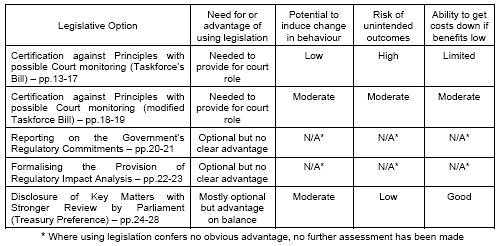
Rodney's bill is the top option. As can be seen, it ranks worse on every criteria than the other possible options. As for why:
- Rodney's preferred principles are highly ideological and therefore will have little buy-in, either from the public or from Ministers. This will reduce certification to a compliance exercise. Meanwhile, the requirement for dual certification by both Ministers and officials creates strong pressure on the latter to agree with the former, reducing the integrity of the process. Ministers aren't qualified to certify, and officials may lack the proper resources to do so.
- The interpretation clause and ability to declare legislation incompatible creates significant legal uncertainty, particularly given the vague nature of some of the principles.
- The resource requirements for certification are extremely high, and will continue to be high even if there is no benefit.
The two major options proposed addressed these flaws. The first of these modified the bill to remove the more ideological principles and the interpretation and incompatibility clauses. But given that this imposition of Libertarianism by stealth was the bill's real purpose, you can see why Hide rejected that option. Meanwhile, Treasury's second option - basically requiring Ministers to highlight potential problems in their bills, and beefing up Parliament's ability to address them either through enhanced select committee support or a dedicated Officer of Parliament would actually significantly improve things, while not costing a lot or tying us to Rodney's peculiar ideology. This option - the most effective, efficient, and proportionate one - was also rejected.
The upshot: if Rodney's bill was law, it would not itself be able to be certified as meeting its own principles. But that's hardly surprising. As noted above, the whole purpose of the bill is to impose those highly contentious and ideological principles, with a right to challenge primary legislation for non-compliance, so as to deter and undermine environmental, health and other regulation and protect the profits of existing vested interests. "Quality legislation" is just right-wing code for further kneecapping government and preventing it from working in the public interest.
The end of lese majeste in Europe
Arnaldo Otegi is a Basque separatist leader. In 2003, after Spanish police raided and closed down a Basque leader and tortured its staff, he accused Spain's king, as head of the armed forces and police, of being ultimately responsible for torture and the oppression of his people. He was subsequently convicted of insulting the monarch - lese majeste - and sentenced to a year in jail.
Today, the European Court of Human Rights overturned that conviction on freedom of speech grounds, and ordered that Otegi be compensated. But its not just a victory for freedom of speech in Spain - other European nations, including Germany, Poland, Italy and Turkey also have lese majeste laws (laws protecting the "dignity" of monarchs or those in power from "insult" by being criticised). And those laws have now been effectively overturned. Given their abuse to stifle dissent, protect dictators, and punish protest, that can only be a good thing.
Tuesday, March 15, 2011
Irony
One of the "principles of responsible regulation" that Rodney Hide is pushing through his Regulatory Standards Bill is that laws should not be made unless there has been a careful evaluation of the issue, the effectiveness of the proposed measure, the alternative options, and the costs and benefits of each. The government does this at present, through a "Regulatory Impact Statement" attached to each bill (the guidelines for which are here).
Guess what's missing from Hide's bill...?
Elevating property over human rights
Today the government introduced its Regulatory Standards Bill into the House. The bill is a rewrite of ACT's Regulatory Responsibility Bill (currently hanging around on the Order Paper), and aims to force all laws to comply with a set of "principles of responsible regulation". Many of these principles around clarity, the role of the courts, consultation and policy evaluation are good ideas, and capture existing practice. However, there are also principles based explicitly on libertarian ideology, prohibiting government from taking or "impairing" property without full compensation. And the aim of these principles is to deter any policy not profitable to existing vested interests, and allow open-ended challenges to any attempt to strengthen environmental, health or employment protections. There is a BORA-style "justified in a free and democratic society" clause, which is going to be doing a lot of work, but the courts are going to be spending a lot of time and money telling farmers and polluters that actually, the RMA and ETS and smokefree legislation are demonstrably justified. I guess that's why Simon Power wants to free up time by eliminating jury trials...
But there is one very odd feature of the law: the protections for those property rights are greater than those of the BORA for fundamental human rights such as the right not to be killed or tortured. For example:
- The BORA requires the Attorney-General to warn of inconsistencies, but Parliament can pass inconsistent laws. The RSB requires Ministers to certify that bills comply with the principles, with the implication (and effect, as the certification will be written into Parliament's Standing Orders just as the BORA process has been) that laws cannot be progressed without certification.
- The RSB allows the courts to make declarations of inconsistency (though they have no legal effect). The BORA does not contain such a provision.
So, property rights for polluters will have greater institutional protection than fundamental human rights. Its completely topsy-turvy - but it speaks volumes about ACT's, and National's, priorities.
Eroding the right to bail
Not content with moving to eliminate jury trials for most crimes, Justice Minister Simon Power is already mounting another attack on the rights of the accused - this time on the right to bail:
People accused of serious drug charges would face tougher tests to be granted bail under proposals set out by the Government.The problem with this lies in one word: "accused". People accused of a crime have not yet been found to be guilty. They may in fact be innocent. But Power is proposing throwing them in jail for two years or longer, simply on the basis of a police accusation. And that's just wrong.Justice Minister Simon Power has just launched a discussion document on reforming the bail system that would include a reverse burden of proof for people charged with serious Class A drug offences, such as those involving P.
A reverse burden would require the defendant to prove to the court that they should be granted bail rather than the prosecution having to show the court why they should be remanded in custody.
Power said the Government was also exploring issues such as whether people accused of murder should lose the right to bail.
Currently our bail laws generally recognise this. Despite National's "tough on crime" changes, bail is still a human right in this country. And this is recognised in section 24 of the New Zealand Bill of Rights Act, which provides that everyone charged with an offence
Shall be released on reasonable terms and conditions unless there is just cause for continued detentionA real risk of non-appearance, reoffending, or interference with the trial process is "just cause". Public outrage at the crime, or a desire to take a tough line against a particular type of offence isn't. Power's proposal would see innocent people imprisoned for prolonged periods of time, losing their jobs, families, and sometimes even lives, with no apology or compensation from the government. It is unjust, it is unfair, and it is just plain wrong.
"Boosting science and innovation"
For the past year, the government has been talking a lot about "boosting science and innovation" as the "keys to economic growth". Today, we saw the reality behind that talk, with news that NIWA is planning to sack 5% of its total workforce:
The crown research company NIWA is proposing to cut 17 science and 17 support staff positions. Most of the science job to be cut are at the company’s Wellington regional office but nationwide include marine taxonomists, molecular biologists, fisheries stock assessment scientists, an environmental economist, a renewable energy scientist/engineer, a catchment water quality modeler, an atmospheric physicist, a marine ecologist, and a remote sensing scientist.SO much for boosting innovation. But hey, who really needs to know how many fish we've got, or what sort of fish they are, or how they work anyway? And who needs to know what our climate is doing, whether our lakes are polluted, and how to build wave turbines? Its not as if these things let us understand our world, manage our resources, and identify and deal with environmental problems, right? We can just rely on Gerry Brownlee to tell us these things, the same way he tells us whether heritage buildings can be preserved...
Note that scientists aren't accountants; when you sack one, their NZ career is over. They are too highly specialised, and there are too few NZ employers, for them to find work elsewhere in their field (sometimes, they are their field). The lucky ones go overseas. Most get out of science altogether. Either way, we effectively lose their knowledge, permanently. But its not just them - this also sends a message to everyone considering a scientific career that they shouldn't bother, or that they should go overseas - because they won't find a stable research environment here
Its stupid. Its short-sighted. It will result in a permanent loss of scientific knowledge and expertise to the country. Far from "boosting science and innovation", this government is doing the exact opposite.
Undue influence in Samoa
In New Zealand, as in other modern democracies, we take certain things for granted. Notably, that if you vote for someone at an election, you won't be punished for it afterwards. Not so in Samoa. There, they have established a culture of exacting political revenge on people who vote the "wrong" way, using the powers of the Village Fono Act to fine or even banish those who back a different candidate from village authorities. And its not just the ruling Human Rights Protection party which does this - the new opposition Tautua Samoa Party has now got into the act:
A family of a high chief in Samoa in Asau village on Savaii island has been banished for not voting for the village’s defeated candidate.Back the wrong candidate, get kicked out of your home. Its exactly the sort of abuse the secret ballot was brought in to prevent - but the village chiefs don't violate ballot secrecy AFAIK; they just rely on gossip and hearsay as "evidence". It also seems to be a classic example of undue influence, which is a corrupt practice in Samoa as well as New Zealand. But no village council ever gets prosecuted for it, despite the flagrant violation of the law and abuse of basic democratic rights. That has to change. People must be free to cast their votes without fear of revenge, and the state has to protect them - otherwise democracy is just a facade for thuggery.In the election earlier this month, the high chief, Masoe Selota, and his family reportedly voted for the opposition Tautua Samoa party leader, Vaai Papu Vaai, from the neighboring village of Vaisala.
However, the newspaper Le Week-ender says the family is yet to leave.
The village chiefs’ special committee is still to investigate who had not voted for the candidate of the ruling HRPP party, Tufuga Gafoaleata Faitua, who is also a high ranking orator.
Monday, March 14, 2011
Tyrants stand together
For the past month, the people of Bahrain have been protesting in the streets, demanding democracy, equality, and an end to torture and corruption. The government has responded by beating and shooting them. But now, it looks set to up the ante, inviting the Saudi military in to put down the protests by force:
Saudi forces are preparing to intervene in neighbouring Bahrain, after a day of clashes between police and protesters who mounted the most serious challenge to the island's royal family since demonstrations began a month ago.As for the Saudis, the last thing they want is their own people getting Ideas, so they're quite happy to lend a hand with the repression. Its like a mutual support network for tyrants, all working together against their common enemy: the people.The Crown Prince of Bahrain is expected to formally invite security forces from Saudi Arabia into his country today, as part of a request for support from other members of the six-member Gulf Co-operation Council.
These tyrants are all of course US allies, and they'll be murdering those protestors with US tanks and US guns. But I'm not holding my breath for the US to denounce this move. When push comes to shove, the US puts stability above democracy and human rights. And then they wonder why people hate them...
Oram on National
Rod Oram had a blistering column in yesterday's Sunday Star-Times (offline), in which he ripped National a new one over its handling of the economy. According to Oram, the government has basically done nothing to keep its economic promises since coming to power, and its reluctance to intervene and preference for leaving the market to sort itself out has seen the recession drag on and on. And as a result, people are losing faith in their economic management.
But it gets worse - because the government's zero-sum, cut everything approach to rebuilding Christchurch means it is likely to screw that up too:
To build a new Christchurch, we need a strong economy; and to build a new economy we need a strong Christchurch. The two tasks are inextricably linked. For example, rebuilding the city using the best urban design and sustainable technology would fast-forward those sectors elsewhere in the economy.Oram calls bullshit on this, pointing out that its just the latest excuse for what they wanted to do anyway, the latest dishonest use of circumstances to justify their pre-existing agenda. And he points out that this abuse of Christchurch's misery will have consequences:Absolutely, the government must devote the full effort and investment Christchurch needs to recover. But if the government starves the rest of the country of the resources it needs to grow, then Christchurch and New Zealand would be much worse off.
Can we do both? No, says the government. To give Christchurch what it needs, we must cut elsewhere.
If [the government] says it must cut Working for Families, welfare benefits, student loans and infrastructure investment to help pay for the earthquakes, it will quickly weaken support for Christchurch, demotivate large chunks of the population and hobble the economy.And that's not something we can really afford either.
As for what should be done, Oram favours active government intervention - the government investing and doing something rather than sitting on its hands. The idea is unlikely to find favour with National, whose current ideology is predicated on the idea that government can't do anything right, and that the economy will sort itself out in the long run. Of course, that approach means abandoning people to suffer. Bu apparently that's just the price you have to pay for tax cuts for the rich...
More shock doctrine
First we had Fran O'Sullivan cynically using Christchurch's earthquake to push for cuts and privatisation. Now the Business Round Table have joined the chorus:
The Business Roundtable is urging Christchurch City Council to sell its shareholdings in commercial businesses after the earthquake that devastated the central city.Firstly, I'd think that the port, airport, and electricity are local infrastructure. Secondly, the council's ownership of those assets reduces rates bills by 15%. That's a heck of a lot of long-term revenue to forgo. But the BRT isn't actually interested in the well-being of the people of Christchurch. Instead, they're after an excuse - any excuse - to push the council to sell assets to them at fire sale prices. And an earthquake fits the bill nicely."Reducing its shareholding in its port, airport and electricity companies would free up cash for repairs to local infrastructure without imposing new burdens on ratepayers," the roundtable said.
Like exorbitant rent rises, this is looting by another name, an effort to steal from the people for private profit. And hopefully the Christchurch City Council will make it clear exactly what it thinks of such greedy opportunism.
ACT: The racist party
ACT held its party conference over the weekend, in which delegates and MPs reacted to their increasing irrelevance by retreating even further into shrill radicalism (because obviously, if people hate something, you should give them more of it!). But after a series of increasingly racist speeches and a demand for open-cast mining the party reached a new low when a delegate suggested reviving Australia’s "shoot the natives" policy. Contrary to that report, the suggestion was not met with groans - but laughter [audio; starts at 2:25].
This little blurt is very revealing about where ACT is now: deeply racist, willing to voice the previously unthinkable: that people should be murdered based on the colour of their skin to prevent them from irritating rich white people with their demands for justice. There are some ugly, ugly views hiding behind that "one law for all" rhetoric - the sorts of views you'd expect to see in the National Front. And it speaks volumes that the party leadership has not condemned them.
This is who ACT is now: no longer "the liberal party", but the racist party. And hopefully they'll pay for that in November.
Sacked for opposing torture
On Friday, PJ Crowley, a senior US State Department official, was asked what he thought of the revolting treatment of alleged Wikileaker Bradley Manning. He responded with the only answer a decent person could give: that it was "ridiculous and counterproductive and stupid". Today, he was forced to resign for it.
That's the sort of country the US is now: where the government tortures its domestic political opponents, and those who speak out against it are silenced.
Sunday, March 13, 2011
Friday, March 11, 2011
No plan
Last week, the Guardian reported on UK climate and energy secretary Chris Huhne's plans to shift the UK away from oil. The immediate driver is fear of another price shock, which could devastate the UK economy. But in the long-term, there's the need to move to a greener, low-emissions economy to avoid dangerous levels of climate change. Oil prices are again at a level where that transition significantly pays off, even without considering the benefits of avoiding climate change - and the UK government seems to be seizing the opportunity while it has it.
Meanwhile, back here in New Zealand, Finance Minister Bill English was asked about how our government planned to deal with high oil prices. His response? Leave it all to the market, of course:
People are pretty sensible. When they see prices going up, they start thinking about whether they want to continue with their energy-intensive business or lifestyle.In English, that means "people will stop driving cars". Which is pretty obvious, but also has some serious consequences around people getting to work, to the supermarket etc, as well as for food prices and the wider economy generally. You'd expect the government to be thinking about those consequences, and working out how to mitigate them and manage a transition that keeps things running - but you'd be wrong. They're not looking at greater funding for public transport as insulation against such an eventuality. They're not looking at supporting biofuels to ensure we have a fallback domestic energy supply to moderate costs. They're not looking at ways, in the long term, to shift us away from cars and towards better urban form. Their "plan" for oil price hikes is the same as their "plan" for unemployment: do nothing, and leave the market to sort itself out.
What we have is a "do nothing" government. And in the face of the worst recession in a lifetime and a likely upcoming fossil fuel demand crunch, that's just not good enough.
[Hat-tip: Frog Blog]





