Tuesday, October 18, 2016


A moral and fiscal failure

Back in 2011, Finance Minister Bill English called prisons a "moral and fiscal failure". So naturally, the government he is a part of is building more of them:

The Government has announced plans for a growing prisoner population including double-bunking for an extra 80 beds at Ngawha in Northland, a new building at Mt Eden to take 245 extra prisoners, and possibly a new 1500-bed prison on the current Waikeria Prison site in Waikato.

Corrections Minister Judith Collins said prison population growth required a further 1800 places.

Work was already underway to add 341 prison places through double-bunking and converting facilities to accommodate more beds.

But another 1800 places were needed which would cost $1 billion.


...which is pretty much National's planned tax cuts, up in smoke.

This is what happens when you make "tough on crime" your policy centrepiece. This is what happens when you continually promise to throw more people in jail for longer and longer: you need to build more prisons to house them - prisons where their lives are destroyed, their skills eroded, and they learn to be better criminals. Its a huge, pointless expense and a complete waste of money which would be better spent on health and education.

GCHQ spied illegally for 17 years

The UK's Investigatory Powers Tribunal has rule don GCHQ's collection of bulk communicatiosn metadata, finding that they had spied illegally on the UK public for seventeen years:

British security agencies have secretly and unlawfully collected massive volumes of confidential personal data, including financial information, on citizens for more than a decade, senior judges have ruled.

The investigatory powers tribunal, which is the only court that hears complaints against MI5, MI6 and GCHQ, said the security services operated an illegal regime to collect vast amounts of communications data, tracking individual phone and web use and other confidential personal information, without adequate safeguards or supervision for 17 years.

[...]

The tribunal said the regime governing the collection of bulk communications data (BCD) – the who, where, when and what of personal phone and web communications – failed to comply with article 8 protecting the right to privacy of the European convention of human rights (ECHR) between 1998, when it started, and 4 November 2015, when it was made public.

It added that the retention of of bulk personal datasets (BPD) – which might include medical and tax records, individual biographical details, commercial and financial activities, communications and travel data – also failed to comply with article 8 for the decade it was in operation until it was publicly acknowledged in March 2015.


Seventeen years of illegal spying in violation of the ECHR - you'd think there would be some accountability for that, maybe some people in jail? But no. Instead, GCHQ's abuse is going to be legalised, and they will be handed even more power to engage in mass surveillance on the UK public. Because if the government had to obey its own laws, the "terrorists" might win or something.

I guess being a spy means never having to say you're sorry...

New Fisk

When Mosul falls, Isis will flee to the safety of Syria. But what then?

Australia should be prosecuted for its torture camps

Yesterday Amnesty International released a damning report on Australia's Pacific refugee concentration camps. A key finding of the report was that the treatment in the camps amounted to torture:

Amnesty International found that the system to which refugees and asylum seekers on Nauru are subjected amount to torture.

The combination of refugees’ severe mental anguish, the intentionally harmful nature of the system, and the fact that the goal of offshore processing is intended to intimidate or coerce others to achieve a specific outcome, means that Australia’s offshore “processing” regime fits the definition of torture under international law.


Now, lawyers are apparently investigating laying charge with the International Criminal Court over this state policy of torture:
Lawyers are investigating taking Australia to the International Criminal Court over its offshore detention centres, Amnesty International says.

[...]

"The system is illegal and we show in our report in great detail how Australia is violating its multiple international obligations, including an obligation not to torture," she said.

"There are lawyers who are communicating with the International Criminal Court - it's not Amnesty International yet, but we are in touch with them as well, who believe there is enough evidence for the ... court to investigate Australia's offshore processing."


Good. Torture is illegal under international (and Australian) law, and those responsible for it - the architects of the policy and those who implemented it, from government Ministers down to the lowest camp guard - need to be held to account for it.

New Zealand should be a part of this. As I've frequently pointed out, we have universal jurisdiction for torture. And we should use it whenever someone involved in torture sets foot in our country. When our nearest neighbour is running torture camps in our backyard, we need to stand up for what is right. And if that means arresting the Australian Prime Minister on their next state visit, so be it.

Monday, October 17, 2016


A rich man's bubble

Why is John Key so completely out of touch on child poverty? Maybe its because he only visits rich schools...

Prime Minister John Key has been accused of neglecting children in the poorest neighbourhoods, after he visited more than three times as many high decile schools this year, than low.

Of the 27 schools Key visited in the year to September 12, 13 of those were in the decile 8, 9 and 10 bracket, data obtained under the Official Information Act (OIA) shows.

Just four were either 1, 2 or 3 bracket. Ten fell in between.


This is a symptom of a wider problem: our Prime Minister isn't one of us, but lives in a rich man's bubble. At home, he lives in a multi-million dollar mansion in Parnell. At work, he's in a huge state-funded house. He travels everywhere in Ministerial limos, accompanied by armed security goons so he can feel important. And this seals him off utterly from the experiences of normal kiwis, the people he claims to represent. He's said himself that the only time he gets to talk to people is in the Koru Lounge - which isn't really a representative sample...

And the result of all this self-isolation is that the Prime Minister is absolutely blind to the real problems affecting our society. He never sees the beggars on our streets or the hungry kids in our schools. He never has to go on a waiting list to access housing or medical care. He never even sees the way his farmer friends are destroying our rivers, because he holidays overseas. Isn't it time we had a Prime Minister who is actually one of us?

New Fisk

A beautiful mosque and the dark period of the Armenian genocide

Australia's concentration camps are torture

What are the effects of being detained indefinitely in an Australian refugee concentration camp? According to Dr Nina Zimmerman, a forensic psychiatrist contracted by the UN to study the issue, they make 81% of their inmates mentally ill:

Recruited by the UN refugee agency due to her expertise with populations in detention, Dr Zimmerman's mission to Nauru required her to interview refugees and asylum seekers within the detention camp and those living in the island's settlements.

She found 81 percent of those she surveyed were suffering disorders due to their indefinite detention, the second highest rate ever recorded in a group of refugees.

"There's been a study done on Syrians who are fleeing and find themselves in central Europe," explained Dr Zimmerman, putting her findings into context.

"These rates are two to three times higher than what you find in those refugees... three times higher than what you see in the imprisoned populations in Australia."


With an 81% mental illness rate, I'd say that the camps reach the threshold of inflicting severe mental pain and suffering. Which makes them torture under international law. These camps are torture camps. They need to be closed, and the people who order, guard and run them need to be prosecuted.

Friday, October 14, 2016


Climate change: The wrong track

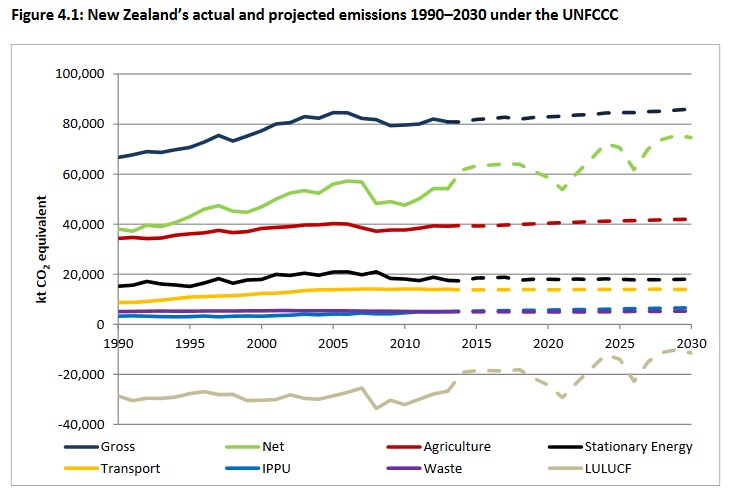
Writing in the Herald this morning, Climate Change Minister Paula Bennett thinks our climate change policy is on the right track, citing the list of policies her government has. But are we really? Below is the government's latest official projection of our emissions pathway, from New Zealand’s second biennial report under the United Nations Framework Convention on Climate Change:

NZEmissionsto2030

As can be seen, the government expects both gross and net emissions to rise to 2030 (and rise beyond that), despite "commitments" to cut them.

The truth is that we are not on the right track. National's policies are ineffective, and deliberately so, to shield their polluting donors and cronies from having to pay the full costs of their activities. Their "goal" of 90% renewable electricity is on-track for failure, while they're letting polluters build more gas-fired power plants. They've deliberately crippled the ETS, while their policies around agricultural emissions research and electric vehicles are token measures, aimed at generating positive PR and the appearance of action rather than real reductions in emissions.

This is the biggest challenge facing the planet, and it is going to be disastrous for our agricultural industry. This is not a problem we can spin our way out of. We deserve a Minister who understands that, and government which will take it seriously. We won't get either under National.

New Fisk

A quarter century after I was arrested by Turkish police, things have only got worse for Kurdistan

What surplus?

Stephanie Rodgers at Boots Theory responds to yesterday's government "surplus":

The truth is, there is no surplus.

When Housing New Zealand says it simply cannot build the houses we need for families who are living on the street and in their cars, how can we have a surplus?

When District Health Boards insist that they cannot afford to deliver safer rosters for junior doctors, or new equipment, or decent pay rises for support staff, how can we have a surplus?

When public schools, built on the promise of free education for every Kiwi kid, have to demand “voluntary donations” from parents in order to keep operating, how can we have a surplus?

When sick people have to run public campaigns ask for donations to fund the medicine they need, because Pharmac has to prioritise which life-saving treatments it subsidises, how can we have a surplus?

When the people who clean the ministerial toilets in the Beehive aren’t paid a living wage, how can we have a surplus?

If you aren’t providing the services you are contracted to do – in this case, maintaining the public services and promoting the welfare of New Zealanders – and declaring a profit, you’re not running a successful business. You’re running a Ponzi scheme.


The only reason we have a "surplus" is because the government's failure - or rather, refusal - to provide those services does not appear on their balance sheet. If they did, then the trick would be laid bare: all National has done is pump up the government's books by giving us public squalor. And now they plan to leave us that mess, and the long-term costs it entails, while letting the rich run away with the profits as tax-cuts.

This isn't government. Its pillage.

Thursday, October 13, 2016


Sexist bullying in our Parliament

If you watch Question Time daily, you'll have noticed that there's a lot of sexist bullying that goes on in Parliament, with National's predominantly male backbench trying to shout down and intimidate female MPs. Today, New Zealand First's Tracey Martin used a point of order to complain about this. The National backbench took the opportunity to prove her point for her, interjecting to shut down her point of order. You can watch the whole sorry display below, from 8:27:


It has become blatant enough that even National's Speaker David Carter conceded the point. And hopefully now we'll see an end to it. Otherwise female MPs should start publicly naming and shaming the bullies so they can be driven out of politics. There should be no place for this sort of bullying in our Parliament.

Phone companies don't want to be spies

The government is currently pushing a spy bill which could significantly expand the powers of our spy agencies. One of the minor provisions would enable private bodies - for example, banks and phone companies - to provide information to spies on request. Its specifically intended to allow spies to circumvent warrant processes, while insulating companies from any legal consequences for betraying their customers' privacy. The good news is that Vodafone, one of the larger telecommunications companies, has said "nope":

Telecommunications giant Vodafone says it is uncomfortable about a proposal to allow New Zealand companies to volunteer suspicious information about their customers to spying agencies.

The company told MPs at Parliament today that it would prefer to stick to a warrants-based regime, rather than offer up sensitive information on its own initiative.

[...]

Vodafone lead counsel Tom Thurby said he did not expect any New Zealand business to proactively volunteer information if the law change went ahead.

"Our position would be that we will respond to warrants, we will respond to compulsion. We will not co-operate on a voluntary basis under this clause."


Spark has also apparently raised this issue. Good. There is a process by which the spies can obtain information, which involves both an assessment of its necessity and oversight of the spies' decisions. And they should stick to it. Spies should not be allowed to circumvent the warrant process and the oversight it entails by effectively bullying companies into submission. And naturally, any company receiving such a bullying request should publicise it immediately and tell the spies to fuck off.

"Fiscal prudence"

In their time in office, National has tripled New Zealand's debt from $31.4 to $93.9 billion. So naturally, when they get a whiff of a surplus, they're planning tax cuts for the rich:

Tax cuts could soon be on the way with the Government opening up its books today revealing Crown accounts are tracking along nicely.

"We've always said, if economic and fiscal conditions allow, we will begin to reduce income taxes," Finance Minister Bill English said.

Surplus is currently sitting at around $1.8 billion which is up from $414 million on the previous year.


If National gives away the surplus in tax cuts, the debt Bill English built up will never be reapid. But I guess that's just what National calls "fiscal prudence". Meanwhile, with Housing New Zealand virtually bankrupt due to National's privatisation efforts, it looks like next year's election will be a choice between a functioning state housing system or tax cuts for the rich. Hopefully voters will choose the former.

New Fisk

This is what it feels like to be an ordinary Kurd caught in the tragedy of Turkey’s turmoil

National wrecks state housing

Faced with poor polling, National is talking big on state housing. What they actually appear to have done is bankrupted it:

The Government's state housing agency is set to run out of money by February, ministers have been warned.

Housing New Zealand has also told Finance Minister Bill English that it will have no cash for developments or to maintain houses past 2017/18.

[...]

An email by a Treasury official appeared to say that the corporation would run out of money by early next year.

"HNZC modelling indicates that it is likely to exhaust its cash balance by February 2017 based on its planned development activity."

[...]

HNZ's financial situation was partly the result of the transfer of 2800 state houses to the Tamaki Regeneration Company, a Government-council entity, this year.

The transfer meant $1.6 billion was removed from HNZ's balance sheet and it was now collecting $34m less in rent a year.


Housing New Zealand is a core government agency responsible for a key government service. Running it to the brink of bankruptcy like this shows either utter incompetence, or pure malice. Either way, there's a real danger that National will use this self-imposed crisis to further undermine state housing by privatising more of it or reintroducing market rents. And when we have a real housing crisis on our hands, either would be a disaster.

Wednesday, October 12, 2016


Some "solution"

National told us that their Special Housing Areas would solve the housing crisis. But it turns out they haven't. While over a thousand "affordable" homes have been consented, only 18 have been sold to first-home buyers.

Which is what happens when you leave provision to the market: it doesn't deliver. Because affordable homes are less profitable than million dollar palazzos, developers simply aren't interested in building them, no matter how many they are forced by regulation to consent. If we want these homes built, then the government will need to do it directly. And if we want a government committed to that, we need someone other than National.

Twenty years of MMP

The Spinoff reminds us that it has been twenty years since the first MMP election. Like almost all of their commentators, I think that MMP has been a huge improvement to our democracy. Our votes count. Our Parliament looks like us. Our legislature is a check on executive extremism. None of these things were true under the old system, with its marginal electorates and male, pale and stale "representatives".

Things can still be improved, of course. I've consistently argued against the undemocratic 5% threshhold, which unjustifiably excludes some of us from political representation while limiting political competition. Using open lists or preferential voting for electorates wouldn't hurt either. Unlike others, I don't favour elimination of the "electorate lifeboat" because it improves rather than harms proportionality; if we're concerned about party game-playing and unfairness between electorates, we should lower the threshhold to 0.8% so that it ceases to be an issue.

New Fisk

Why did President Erdogan restart the battle with the Kurdish PKK? The answer lies in the tale of the failed coup

CYFS tortured children

The Herald reports today that CYFS, the agency that is supposed to protect kids, has instead been torturing them in one of its "care" facilities:

Teenagers were unlawfully detained for weeks on end in the seclusion wing of a youth justice facility run by Child Youth and Family, according to its own senior staff.

Documents obtained by the Herald also reveal:
  • staff used "inappropriate force" against young people.
  • secure care was used as punishment.
  • some young people were stripped and put in suicide gowns..
  • a "significant number" of teens should not have been put in seclusion in the first place.
The use of segregation (solitary confinement) and isolation is tightly regulated because prolonged isolation causes mental illness. The UN Special Rapporteur on torture has ruled that its use on young people constitutes cruel, inhumane, or degrading treatment. Prolonged use on anyone constitutes torture. And here CYFS has been using it on kids for weeks at a time, in blatant violation of the law and basic decency. Fortunately, we have a solution. The Crimes of Torture Act imposes a penalty of up to 14 years imprisonment for committing torture, and 10 years for being an accessory. And its time we fucking used it. The CYFS staff who did this need to go to jail. And until they do, other CYFS staff will feel they have impunity to commit similar acts.

Tuesday, October 11, 2016


Just fuck off, Labour

Turnout in the local elections was low. Cue the Labour party pushing its stupid barrow of compulsory and online voting:

Compulsory voting for local elections - with fines for those who don't have their say - is worth considering to tackle record low turnout, Labour says.

Fewer than 40 per cent of eligible voters cast a ballot in last weekend's local elections, leading to calls for action in order to reverse the downward trend.

Labour local government spokeswoman Meka Whaitiri said the Government needed to lead the way on a national strategy, looking at innovative ways to improve voter turnout.

The U-turn on trialling online voting at this year's elections due to security concerns was a disappointment, Whaitiri said.

[...]

She was interested in exploring Australia's compulsory voting model, where people are fined $20 if they don't vote.

"I know Australia fines people that don't vote, and that idea has been floated, I'm keen to look at that to see how well that gets people to the polls at the end of the day."


Just fuck off, Labour. Online voting is fundamentally insecure, and a stupid idea because of that. As for compulsion, this is Labour's perennial "solution" to the "problem" that its core constituency doesn't turn out for them. But refusing to vote is a choice, and a valid one. People vote when they have something to vote for. It speaks volumes that Labour would rather try and force them to the ballotbox on pain of a fine than give them hope that a Labour government or Labour local body politicians could make a meaningful difference to their lives.


