Showing posts with label Hollow Men. Show all posts

Tuesday, June 07, 2016


Another amazing coincidence!

Hager Book: Brash assisted to power by business lobby, New Zealand Herald, 24 November 2006:

Hager also details attendees at National Party corporate fundraisers and lists "high value" donors.

These include Alan Gibbs, Craig Heatley, David Richwhite, Diane Foreman, Doug Myers, Michael Friedlander, Peter Shirtcliffe and Rod Deane.


Queen's Birthday Honours: Michael Friedlander receives knighthood, Stuff, 7 June 2016:
Long-time philanthropist and property investor Sir Michael Friedlander says he has "come to terms with" receiving a knighthood this Queen's Birthday.

Friedlander, who is also one of the country's wealthiest people, was made a Knight Companion of the New Zealand Order of Merit for services to philanthropy.


In fact, its just amazing how many of the people on that list have been given honours by National. Heatley and Foreman got CNZMs, Myers and Deane were given knighthoods (Shirtcliffe had already been given one by Roger Douglas). But I'm sure its just a terrible, awful-looking coincidence.

Thursday, May 21, 2009


Don Brash versus the laws of evidence

Poor Don Brash - still whining after all these years about his "stolen" (leaked) emails. And still utterly failing to understand that, unless the leaker comes forward, there is nothing the police can do about it. Why not? Because - contra 24, the police can't just beat answers out of people. Nor can they just kick in doors and search for stolen documents. In order to that, they need a search warrant, and that in turn requires showing a judge they have reasonable grounds to believe that said documents will be in a particular place. Absent something like a witness saying they saw them printing Brash's emails, or emails released to police showing that they had been corresponding with Nicky Hager about dropping off the latest "package", that's just not enough.

What about Hager himself? Brash contrasts the police's handling of Hager with its pursuit of a search warrant against TV3's John Campbell over his interview with the Waiouru medal thief. But while journalists can be ordered to reveal their sources, the threshold is very high, requiring a High Court Judge to balance the public interest in forcible disclosure against the public interest in both the communication of facts by the media and the ability of the media to access sources. That balance isn't clear in the case of Campbell, but it is clear in the case of Hager: I cannot imagine a judge forcing disclosure in a highly political leak case in which there was a high public interest in exposure and the alleged crime is so minor. And neither, I expect, can the police.

This isn't a "conspiracy", it isn't "political bias" - it's the simple laws of evidence. But Brash it seems would rather retreat into paranoia and conspiracy theories than accept that he was betrayed by someone in his own party and that they are (quite sensibly) keeping silent about it.

Tuesday, July 01, 2008


Caught!

The Standard have the evidence: John Key hired an Aussie dirty tricks brigade, then lied about it to the public. When asked last year whether he was still employing anyone from the Hollow Men era, "any other advisors from the 2005 election", he first dodged the question, then when pressed, said

I haven't read the book for such a long time I'm really not sure who he names. But from the top of my head, no, but I'd probably have to go back a check, it, and look at them one by one.
It is inconceivable that the leader of a political party would not remember who was advising him. Instead, he chose to lie about it. I guess he knew even then how bad employing Crosby / Textor, the people who advised Brash to whip up racial hatred in 2005, would look.

All of which raises the natural question: if Key is so comfortable lying to the New Zealand public, what else is he lying about? Can we really trust his protests that restarting the Revolution is off the agenda "for National's first term"? I think not.

Monday, June 23, 2008


Soon to be a major motion picture

Via The Standard, I see that The Hollow Men has been adapted into a documentary by Alister Barry, the filmmaker responsible for the excellent In a Land of Plenty and Someone Else’s Country. Better, it will be screening at this year's International Film Festival. Guess I'd better think about getting some tickets then...

Wednesday, April 16, 2008


An inside job

The police have finished their investigation into the "theft" of Don Brash's emails (which provided the basis for The Hollow Men), and concluded that contrary to all the screaming from National about hacking and secret Labour Party Attack Ninjas, it was an inside job. In other words, Brash was knifed by someone from his own party. The interesting question is whether they're still around, and as upset by the current leadership (which is funded and directed by the same people who funded and directed Brash) as they were by Brash. OTOH, given that the current leadership are in fact the two most likely suspects, I think not.

Wednesday, October 10, 2007


Election funding: the Hollow Men again

The Standard has a real scoop - a transcript of Nicky Hager's evidence before the Justice & Electoral Committee last month, in which he talks about the collusion between the National Party and the Exclusive Brethren documented in his book The Hollow Men and how it affected the 2005 election.

So the idea, which was as proposed by the National Party campaign manager, was that the Exclusive Brethren would say: “Change the Government.”, and the National Party itself would have all possible opportunity to say: “And the way to change the Government is to vote National.” The effect of that, of course, was to add about $1.5 million extra money to the National Party election campaign.
He then goes on:
this is why the bill is needed, otherwise it’s simply too easy for parties with wealthy backers to outspend the others and keep their linkages secret. This also, I believe, is why the National Party is attacking the bill— not because of the mistakes with the drafting which need to be fixed, but because they would rather not have controls on third-party campaigning.
Hagar also points out that this sort of dirty anonymous campaigning is a growing phenomena worldwide, and one we would be wise to take precautions against if we want to ensure that our elections are free, fair, and democratic, rather than being bought and sold by the rich.

There's more there, and it's interesting reading. The full transcript is here [PDF].

Monday, October 01, 2007


Time for National to come clean

Colin Espiner discusses National's recent policy blurts in The Press this morning, and points out a disturbing fact:

Last week we learned more about what National plans to do if it becomes the Government next year than in all the rest of the months of this year put together.
Think about that for a minute: this is our major opposition party, which is trying to present itself as a government-in-waiting, and yet for the past two years they have steadfastly refused to tell us anything at all about what they think or what they would actually do if they gain power. This has been part of a deliberate strategy of emptiness, and in light of the reaction to their recent policy outbursts, the reason for it is obvious: because if we knew what they planned, they would never get elected. So National lies and obfuscates and relies on empty slogans about "political correctness" and "bureaucracy gone mad" and "waste", and hopes that no-one will look past the bluster to see the hollowness within.

As I've said before, this isn't how democracy is supposed to work. Implicit in the idea of the public choosing between competing political alternatives is that we must know what the alternatives actually are. By trying to sell us a political pup, National and its hollow men are undermining our democracy.

Espiner is too wedded to the "sports commentary" mode of political reporting to recognise this, and so instead bases his call for National to come clean on pragmatism: deceiving the electorate will result in it being swiftly turned out of office. Fortunately his fellow correspondent Tracy Watkins understands, pointing out that in 1999, Labour was not only open about its policy of higher taxes for the rich - it campaigned on it as well. If National respected us, it would do the same, put its policies to the voters, have the argument and try and convince us. Their refusal to do so so far, and their fear and desperate obfuscation in response to their unintended honesty speak volumes about their true intentions.

Tuesday, July 17, 2007


John Key in a nutshell

Key promises local body change, but won't say what

The Herald's subeditors have inadvertantly perfectly captured Key's strategic emptiness, that effort to be all things to all people by speaking only in generalities and never adopting a firm position or serious policy. But you can't govern like that, and eventually National is going to have to tell us what it really stands for and what it plans to do.

Hopefully, we'll be able to force them to do it before the next election.

Monday, April 30, 2007


Strategic emptiness

Last week, National's foreign affairs spokesperson Murray McCully called for New Zealand to focus its aid spending more strongly on the Pacific. However, he caveated his call in a significant way:

Mr McCully said he was not announcing National Party policy, because it was "much too early" for that

This is one example; a second was mentioned yesterday morning on Agenda: National is apparently still telling business leaders "you elect us, then we'll tell you what we're going to do". And this is not a new phenomena, but part of a long-term trend. Since losing power in 1999, they seem to have adopted a deliberate strategy of emptiness - of refusing to put up policy and say what they stand for, and of being deliberately vague when forced to (see for example their 2005 election policies, which are charitably described as "thin"). Instead, National prefers to fight on empty slogans - "tough on crime", "one law for all", "political correctness gone mad" - rather than talking about what it is going to do if it regains power.

In The Hollow Men, Nicky Hager suggests two reasons for this. The first is the obvious one: a deliberate attempt to hide what they want to do if they gain power, because they know that the public will not like it. This was evident in the 2005 election campaign, when for example National agreed with its donors to keep its highly unpopular, and highly profitable (for the donors) policy of ACC privatisation secret from the public. Or when it kept its policy of borrowing for tax cuts secret until the last minute (and then had the gall to complain when people took the vague promises they initially made at their word). Or when they desperately tried to avoid talking about Iraq, nuclear ships, and their relationship with the US.

The second reason is more interesting: vagueness on policy avoids the need for National to confront the differences between its radical and conservative wings. Having policy means having an argument within caucus (or at least the dominant clique), creating winners and losers and bad feelings of the sort which led to tension and departures in the 90's. Not having policy - or having only the vaguest generalities - means all of that can be avoided, and the party can instead focus on winning elections. The problem is that the differences have to be confronted at one stage or another - you can get away with emptiness in opposition, but not in government - and this simply delays the inevitable while worsening the consequences.

But regardless of the reason, this is not how democracy is supposed to work. Our democratic system is based on the idea of the public choosing between competing political parties (or coalitions of parties) to determine which will hold power. Implicit in this is that the public at least has the opportunity to know what the choices actually are. But rather than fronting up, National is deliberately trying to keep the public in the dark as much as possible - even on something as simple and uncontroversial as aid spending. This simply isn't good enough, and the public deserves better.

Thursday, November 30, 2006


Gone after lunchtime

Radio New Zealand just reported that Don Brash is resigning from Parliament. I guess he realised he was pure political poison in the wake of the publication of Nicky Hager's book, and that the best thing he could do would be go back to the orchard and tend his kiwifruit.

Saying that I am "pleased" would be an understatement. Brash was a corrosive and cancerous influence on New Zealand politics who knowingly and willingly practicised the politics of division, scapegoating New Zealand's most vulnerable in an effort to gain political power. And he was not averse to pandering to the bigot vote (in spite of his supposed liberal principles), or simply making shit up to advance his ambition. His departure will hopefully end some of the viciousness around Parliament, and in the National Party.

As a list MP, Brash will be replaced by Katrina Shanks.

Wednesday, November 29, 2006


"A tissue of lies"

That's how former National Party leader Don Brash (oh, how I enjoy saying that) describes Nicky Hager's book The Hollow Men. But it seems it better describes Brash's excuses - and specifically his claim that he did not read that email from the Brethren. Quite apart from the obvious unbelievability of this claim - Brash is famous for reading and responding to his emails - there's the inconvenient facts that a) it was forwarded to him by Bryan Sinclair; and b) he responded to Sinclair discussing its contents. But I guess he didn't know what he was talking about, right?

So much for "Honest Don". National, and the country, is well rid of him.

Monday, November 27, 2006


National - proudly sponsored by the tobacco industry

In Chapter 14 of The Hollow Men, Nicky Hager notes that the 1986 Royal Commission on the Electoral System argued strongly for full transparency of political donations, arguing (among other things) that this would "give valuable information to voters about the character of the parties". Indeed it would - and reading further, you can see why National is so keen to launder donations and keep the identity of their backers secret: because they accept money from some people that most voters would not want any political party to be talking to: the tobacco industry.

At the same June 2005 fundraising dinner attended by Pfizer and Diane Foreman (both of whom stood to gain substantially from National's policies), two tables were sponsored by Carrick Graham, son of former cabinet minister Doug Graham. Hagar notes:

This may have reflected Graham’s personal generosity, but another explanation could be that the event organisers decided for reasons of good taste not to write down the name of the company – British American Tobacco – for which Graham worked as corporate affairs director. He had arranged Brash’s visit to the BAT head office in Auckland a year earlier, when Brash and MP David Carter met all the top executives.

If this is correct, National had invited BAT to be part of the fundraiser and accepted tobacco industry money for the campaign...

You can judge a person by the company they keep, and you can judge a political party by who they accept money from. And on that basis, National keeps some very bad company indeed, with an industry whose business is selling cancer and death. No wonder they want to keep it all secret!

Right-wingers will say (and have been saying) "it's their money, and they can do what they like with it". Indeed they can - but it's our Parliament, and we have a right to know who is backing our parties so we can judge them accordingly. This is precisely the sort of donation the public has an interest in knowing about - and precisely why we must reform our election law to ensure total transparency and make it an offence to obscure the true source of political funding.

Sunday, November 26, 2006


Why we need transparency

News from The Hollow Men continues to trickle out, with the Dominion-Post have a good series on some of the key allegations yesterday, and the Herald publishing a short summary today (Public Address also has a guest column, from Danyl Mclauchlan, who occasionally comments here, assessing the book). Meanwhile, I'd like to focus on one of the more interesting aspects: the role of money in politics.

Chapters 14 and 15 take a long hard look at the way National's 2005 election campaign was funded, uncovering the donors behind National's money laundering trusts, and demonstrating that both Don Brash and party president Judy Kirk lied to the public repeatedly with their claims that they "have no idea where the money comes from". Some parts of this, notably National's skirting of election funding laws and the offer of the Talley brothers to provide $1 million through an anonymous front company to support Brash's election - arrangements that "stink", according to electoral law expert Andrew Geddis - have already received solid coverage. But one aspect has been all but ignored by the media: the practice of people and companies "investing" in a political party so as to profit directly from its policies.

For example, Hager notes that pharmaceutical company Pfizer sponsored a table at a fundraising dinner held by National in June 2005 - in the process giving about $5000 to the party. While this is below the $10,000 declaration limit, and so did not need to be declared to the public, Pfizer was very visible and made damn sure that the senior National Party people at the dinner - including Don Brash, John Key, and Judy Kirk - knew exactly who they were and where the money was coming from. Coincidentally, National had promised a bottom-up review of Pharmac - from which Pfizer stood to profit significantly if it weakened or ended Pharmac's single-buyer power (used to squeeze better deals out of the pharmaceutical industry for the benefit of sick New Zealanders). Equally coincidentally, it has also subsequently opposed measures to limit direct-to-consumer pharmaceutical advertising. Another table was sponsored by Diane Foreman, on behalf of the Private Hospitals Association, an organisation with the goal of "grow[ing] the private [health] sector to relieve the public sector" - in other words, shuffling patients into private hospitals rather than public ones. Coincidentally again, this is National Party policy, and equally coincidentally, Foreman and her associates would make hundreds of millions of dollars from such a shift.

The most egregious example however is that of the Insurance Council, who reportedly promised National a million dollars because it would privatise ACC - resulting again in hundreds of millions of dollars in revenue to its members. They then colluded with the party to ensure that the "details" (such as the core idea) of the policy were kept from the public - a textbook example of Brash's "moral obligation to lie" in action. When the policy was leaked, they then worked hand-in-glove with National on the media response.

All of this was of course kept secret from the New Zealand public - and you can see why. It looks pretty suspicious, doesn't it? In fact, if it happened in a poor third-world country, we wouldn't hesitate to call it by its true name: corruption. One hand is clearly washing the other.

As Hager notes,

When National MPs oppose measures to control smoking or gambling, or to allow greater subsidies for or advertising of pharmaceuticals, the public has every right to know whether those interests have been giving the party money.

Unfortunately, thanks to National's laundering of its donations, the public doesn't know, and so cannot judge whether such arrangements are acceptable. Which is precisely the point - National knows that what it is doing is dodgy, and so they hide it.

This is why we need electoral transparency and an end to money laundering and anonymous donations: so the voters can decide for themselves, and hold parties to account at the ballot box. And that fear of accountability is precisely why National opposes such moves.
Friday, November 24, 2006


A corrupt practice

Every time we talk about ending the practice of large anonymous donations to political parties, some right-wing shill pops up and says that its all OK because the politicians don't know who the donors are, and therefore they can't be influenced by them.

It's a lie.

According to The Press, The Hollow Men alleges that National failed to maintain a proper separation between donors and politicians, and allowed big donors to remain anonymous despite knowing their identities:

Hager names top New Zealand businessmen and women as the principal donors to National's 2005 election campaign, including Alan Gibbs, Barry Coleman, Craig Heatley, David Richwhite, Diane Foreman, Doug Myers, Michael Friedlander, Peter Shirtcliffe, Rod Deane, Colin Giltrap, and Michael Horton.

According to the book, donations were made anonymously through the Waitemata Trust, one of a series of secret trusts that gave substantial sums to National at the last election.

Hager's book alleges that Brash and his key advisors were in regular contact with the donors and regularly sought their advice on policy and strategy as well as soliciting funding from them.

There's a name for this: it's called a corrupt electoral practice. Section 214G of the Electoral Act 1993 requires party secretaries to file an annual return of donations, including the name and address of each person donating over $10,000 a year, or just the amount if the donation is anonymous. In order to be considered "anonymous" for the purposes of the Act, both candidates and party administrators must be unaware of the donor's identity (s3(1)). Knowingly making a false return is a corrupt electoral practice and carries a penalty of one year's imprisonment and a $20,000 fine. And from the above, it seems that people in National have been knowingly making false statements, falsely claiming their donors are anonymous while knowing full well who they are and what they want, and using the trusts essentially to launder donations to hide this fact from the public.

Unfortunately, it is now too late to prosecute. Declarations of donations were due by April 30th, and there is a six month time limit for prosecution. So, as in the case of their colluding to violate their spending cap, National gets to piss on the Electoral Act (and the voters) and escape legal punishment.

It's time we put a stop to this sort of political corruption - and the first step should be to outlaw large anonymous donations. Sunlight is the best disinfectant - and if the Gibbs', Shirtcliffes, Richwhites and Deanes of this world are unwilling to donate publicly, it strongly suggests that undue influence is what they were seeking all along.

Correction: As pointed out in the comments, National's donations are all attributed to specifc sources, so this is not a corrupt practice in terms of the Electoral Act. It does however make an absolute mockery of the right's constant claims that anonymous donations are OK because no-one knows who the donors are. National knows who its donors are, it just prefers not to name them. And the reason it does this is to prevent the public from seeing the obvious connections between donors and policy positions - i.e. as a mask for political corruption.

This needs to be fixed. In the UK, it is a crime to knowingly obfuscate the true source of a political donation. This effectively outlaws National-style money laundering, and it is something we should do here.

The shitstorm begins

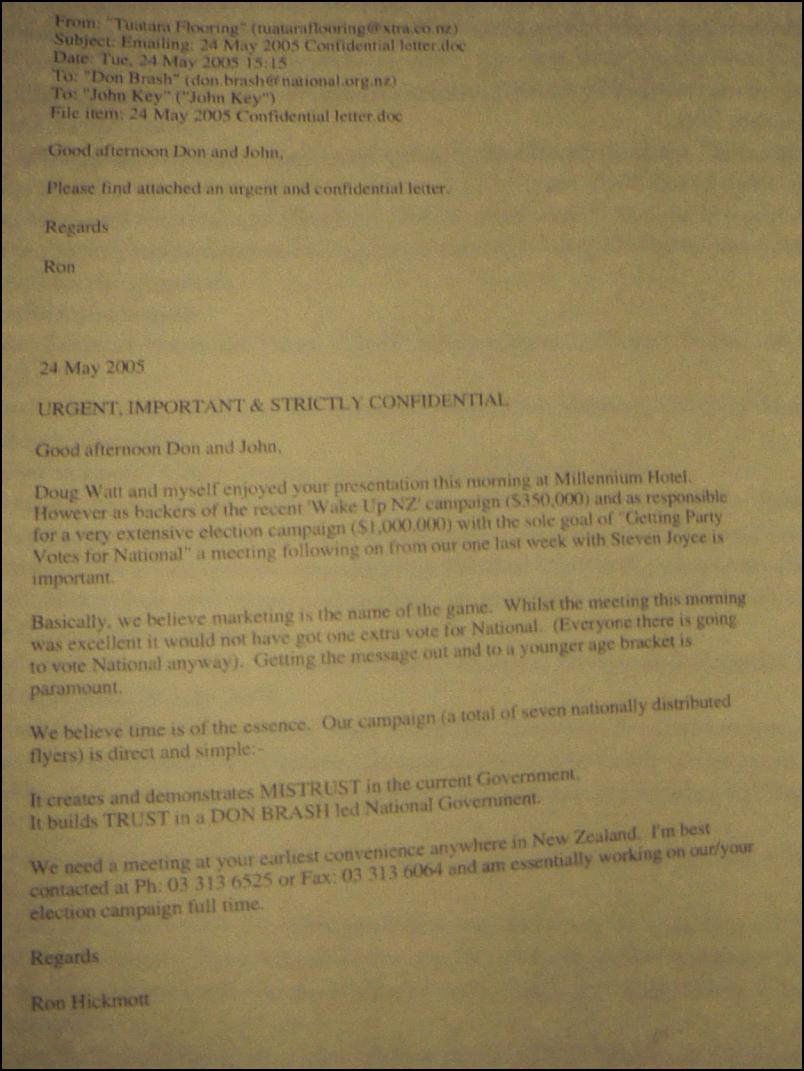
Now that the injunction has been lifted, journalists are frantically speed-reading their hastily acquired copies of The Hollow Men to uncover the juicy bits. Scoop's "Sludge Report" has already noticed the smoking gun email, sent by the Brethren's campaign manager to both Brash and Key in May 2005 (several months before Brash said he had discussions with the Brethren) and requesting a further meeting to discuss their pamphlet campaign:

Good afternoon Don and John,

Doug Watt and myself enjoyed your presentation this morning at the Millennium Hotel. However as backers of the recent "Wake Up NZ" campaign ($350,000) and as responsible for a very extensive election campaign ($1,000,000) with the sole goal of "Getting Party Votes for National" a meeting following on from our one last week with Steven Joyce is important.

It goes on to talk about the aims of the campaign and concludes with a statement that the author is "essentially working on our/your election campaign full time" (scan [JPEG]).

The Herald expands on the subject here. It seems that national discussed the use of outside groups on defence and education at a campaign strategy meeting as early as February 2005 - and that the pamphlets were discussed with and shown to MPs in June. So much for pleading ignorance.

There's an obvious issue here that this is a far higher degree of collusion than admitted to, and one which means that the Brethren's expenditure should have been both authorised by and attributed to the National Party. Instead, National used a third-party essentially to circumvent its Electoral Act spending limit - something for which they should have been prosecuted for had this information come to light earlier. As with Labour's overspending, it is now too late to prosecute, but we can take steps to stop this from happening again. Allowing parties to circumvent spending limits in this way essentially allows the rich to buy elections - something we should not allow to happen in this country.

Injunction lifted

Don Brash has bowed to the inevitable and lifted his injunction - allowing The Hollow Men to be published. It should be available in the next few days, and I'm looking forward to reading it to learn exactly how deceitful he's been (and to see who else among National's top echelon is implicated).

Thursday, November 23, 2006


Hager gets the scalp

Scoop is reporting that Don Brash has called a press conference to announce that he is stepping down as leader of the National Party. I guess Nicky Hager really did have the goods.

So, who will take his place? Will it be John Key, or will there be enough in The Hollow Men to sink him too?

Wednesday, November 22, 2006


More National hypocrisy

As I keep pointing out, there's a massive inconsistency between Don Brash's labelling his leaked emails as "stolen", and the Opposition's everyday reliance on leaked material to do its basic job of holding the government to account. This inconsistency was perfectly displayed yesterday at the end of Question Time:

Nicky Wagner: I seek leave to table the leaked internal Ministry for the Environment report—[Interruption]

That "interruption" was the rest of the House guffawing with laughter at the hypocrisy on display.

So, what's the difference here? Is Dr Brash really saying that the difference between a "leak" and "theft" is whether he is on the receiving end? And if so, how does this fit with his slogan of "one law for all"?

Tuesday, November 21, 2006


"Unable to function"

A key part of Don Brash's argument to get his rather fishy injunction was the claim that he would be unable to function as an MP or as National's leader if they were published. The implication was that this would be due to personal stress caused by the intrusion into his private life. But the revelation that Nicky Hagar has written a book dishing the the dirt on Don's dodgy dealings shows it in rather a different light. Rather than protecting his privacy, it seems that Brash was protecting his job against the natural consequences of his systematic dishonesty and deceit being revealed to the public. He is, as Hagar notes [JPEG], using claims of personal privacy to dodge political accountability.

Is this really something the courts should be supporting? And is false pretences a good reason to overturn such an injunction?

Brash's cover-up

In the Herald this morning, John Armstrong examines Don Brash's unique injunction against dissemination of his leaked emails and asks "why now"? The answer is on Stuff: Nicky Hagar was going to launch his book based on the emails today. And it sounds like it would be quite revealing:

The book - The Hollow Men: A Study in the Politics of Deception - was to have been launched today but has been caught by a court injunction obtained by Brash last week forbidding publication of the emails.

Hager called a press conference in Wellington this morning and distributed copies of his preface to the book and a foreword by former National MP Marilyn Waring.

The book is "an extraordinary case study of unprincipled and anti-democratic politics," Hager says in his preface.

Waring, now professor of public policy at Massey University, described the book as "an excellent systems analysis" and "so important".

"This is a story about democracy, and the public of New Zealand deserve to know what they have when they speak of such an ideal," she writes. "I would expect to see much of the evidence set out in the book reported to the Electoral Commission, Parliamentary Services, the police and the Auditor-General."

Unfortunately, thanks to Don's injunction, publication has been halted. So, we won't get to learn exactly how much he lied to the public during the election campaign, or how dirty his dealings were.

There's a rich vein of hypocrisy in this on Brash's part. The opposition - and our political system - relies on leaks every day to hold the government to account. They are a vital part of our democratic system. But what's good for the goose apparently isn't good for the gander, and leaks which would allow the opposition to face similar scrutiny - leaks which, despite their supporters efforts to smear the government, unquestionably came from within the National Party from people dissatisfied with Brash's political direction - are suddenly unethical and illegal, and to be suppressed. And no doubt they'd continue to claim this, while at the same time denouncing any effort by a government ministry to suppress leaked information by similar means. Consistency, it seems, is for other people.

Fortunately the media sees the threat posed by this injunction and is fighting it - and hopefully that means we'll finally be able to find out just how dirty Dr Brash was playing it last year.