Showing posts with label 2005 Election. Show all posts

Monday, August 02, 2010


Hypocrites

Back in 2007, in the wake of an Auditor-General's report which totally overturned the status quo on the use of Parliamentary funding, the then-Labour government passed the Appropriation (Continuation of Interim Meaning of Funding for Parliamentary Purposes) Act 2007 in order to restore that status quo and provide clarity until Parliament decided on new rules. Naturally, National screamed bloody murder. So I'm a little surprised to see that they've just introduced a Parliamentary Service Amendment Bill which effectively makes that definition permanent.

DPF will no doubt be quick to point out that its not exactly the same. The definition of "funding entitlements for parliamentary purposes" now includes services to certain electoral candidates (to cover allowances to sitting MPs during the election period), while the list of exclusions now includes soliciting votes in a referendum as well as in an election. There is now also an explicit ban on election advertisements (in terms of the Electoral Act), though this is redundant given the ban on funding for communications that support candidates or parties. The changes are immaterial; the substance is the same (and rightly so - its a sensible definition).

The upshot: National, which opposed this vigorously in 2007, is now promoting it in 2010 (of course, they did it in 2009 too). On the one hand, this could just be seen as the ordinary hypocrisy of politics. On the other, it exposes how groundless and vile National's 2007 opposition was. Unfortunately, its taken a spell in government for them to see sanity.

(Meanwhile, will the sewer be preaching revolution over this, as they did in 2007? Somehow, I doubt it...)

Friday, July 18, 2008


Whoops!

It turns out that Owen Glenn did give Winston Peters $100,000 - and that Winston "didn't know about it". The money was used to fund his electoral petition against Bob Clarkson, which really means it was to Peters in his role as a candidate. Unfortunately, it falls into a gap in electoral law - Peters wasn't technically a candidate at the time, the donation was made after the deadline for candidate returns, and in any case there was a six month limit on prosecutions. So, under the Electoral Act 1993, you could give a politician a hundred grand in a brown paper bag, and provided it wasn't between the time you were nominated and the time you were declared elected, no-one had to know about it. I'm glad we closed that loophole (or did we? There's a lot of wiggle room in the word "candidate" after all...)

But while Peters has escaped prosecution under the Electoral Act, he has exposed himself elsewhere. Since 2006, Members of Parliament have been required to submit annual returns of their pecuniary interests. These must include

a description of each gift (including hospitality and donations in cash or kind but excluding any donation made to cover expenses in an electoral campaign) received by the member that has an estimated market value in New Zealand of more than $500 and the name of the donor of each of those gifts (if known or reasonably ascertainable by the member)
Owen Glenn gave Peters, through his lawyer, $100,000 to cover legal expenses. Peters should have declared it. He didn't. Not in 2006, 2007, or 2008 [all PDF]. This is quite clearly a breach of Parliamentary Privilege under Standing Order 400 (h):
as a member, knowingly providing false or misleading information in a return of pecuniary interests
Peters knew his legal fees were being covered by donations. He says himself in the Herald article that he had been doing this since 1991:
He said that since 1991 he had been involved in 14 legal actions which had been partly funded through donations, and Mr Henry had "a firm policy" of not disclosing the source of donations.

"I have never been told the source of these donations but have personally met the shortfall which has amounted to many hundred thousands of dollars," Mr Peters said in a statement.

He knew there were donations, he didn't declare them. That's a clear breach of privilege. If a Member would like to lodge the complaint...

Not that I expect anything to really come of it. I have nothing but contempt for the Privileges Committee, a cosy kangaroo court where MPs vote on party lines and collude to overlook one another's indiscretions -even in a case such as this. But the rest of us ought to be concerned that a Member of Parliament has been receiving large amounts of anonymous cash for so long, without any sort of disclosure. Peters says everything is above board here, but the potential for corruption is blindingly obvious. And given that the Privileges Committee can't be trusted to do anything about it, its time we took the job off them, and gave it to the police. Who is giving money to our MPs and whether they tell us about it is not a private matter for Parliament, it is a public matter for the law. But the chances of our MPs voting to recognise that are about zero.

Wednesday, November 07, 2007


Hypocrites

Last week, the government introduced a bill into Parliament - the Appropriation (Continuation of Interim Meaning of Funding for Parliamentary Purposes) Bill - aimed at bringing clarity to parties' Parliamentary spending by extending the current definition of funding entitlements until 2009. This ought to have been uncontentious - the definition (with its ban on spending funds for "electioneering", meaning the explicit solicitation of votes, funds, or members) is what everybody other than the Auditor-General has always understood to be the case, and the extension is necessary given the failure of the Parliamentary Services Commission to reach agreement on a better one. But of course the opportunists in the National Party, who leapt eagerly on the Auditor-General's flawed interpretation last year, have decided to oppose it, beating the "state funding by stealth" drum and raising the spectre of another pledge card (something which was in fact legal under the guidelines as understood by everyone other than the Auditor-General, but which of course should have been declared as electoral spending under the Electoral Act).

This is simply the height of hypocrisy. Why? Firstly, because despite all their screaming about Labour's pledge card, in May this year they were perfectly happy to put out one of their own, implicitly (but not explicitly) seeking support for the National Party, and bearing the Parliamentary crest - precisely the behaviour they supposedly object to (yet another case of one law for all - for everyone but National). And secondly, they informed the government that they privately supported the legislation, but that they would publicly oppose it for political reasons - a fact admitted to by Gerry Brownlee in Question Time yesterday:

Gerry Brownlee: I have in my possession a document that sets out the fact that National was happy for a rollover, provided it would lead to a much shorter election period. I seek leave to table that document...

If there's a more glaring example of hypocrisy, I'd love to see it.

There are problems with the potential misuse of Parliamentary funding, but the problem lies in the Electoral Finance Bill, not the Parliamentary spending rules. Sections 58 and 81 (2) (g) of the bill specifically exclude from the definition of "electoral expense" material published by candidates in their capacity as Members of Parliament. So while these materials may fall within the definition of "election advertisement" in s5, they would not count towards candidates' or parties' spending limits. On the one hand, its easy to see why such a clause is necessary - MP's publish a great deal of material in the course of representing and communicating with their constituencies, and this ordinary business of representation and advocacy should not have to stop simply because it is election year. And OTOH, this exemption also allows incumbent parties to pull tricks like the pledge card, effectively violating their spending limit and setting up a very uneven playing field. But the proper solution is to refine the exemptions in the EFB, not to try and cripple Parliament from doing its work and leading our national conversation. Unfortunately, National is acting in bad faith on that issue as well, and I don't expect them to contribute usefully to a solution anytime soon.

Monday, March 19, 2007


Databases and electioneering

Saturday's Dominion Post reported that the National Party had spent $90,000 of its Parliamentary budget on a database system allowing them to track voters. The National Party is defending the spending on the basis that the database allows them to

do electoral surveys, get mail, do mail-outs, all those kind of things ... basically it's a database that enables them to communicate with their constituents.

and that this sort of communication is a core part of an MP's job. I agree entirely. Keeping track of constituent's concerns is something MPs ought to be encouraged to do, and this sort of database seems like just the tool they should be funding out of Parliamentary expenditure to do it. However, the Auditor-General may not agree.

As people may remember, last year in a review of Parliamentary Services advertising expenditure, the Auditor-General controversially ruled that if Parliamentary spending had any "electioneering" purpose whatsoever - if it was used to persuade a voter to vote in a particular way - then it was unlawful. Note that that's not "entirely", or even "substantially" - the ruling was that

any significant reference to electioneering is likely to "taint" the remainder of a publication or other communication (i.e. infect it with an electioneering purpose).

The Auditor-General only looked at advertising - but the same principle surely applies to other Parliamentary expenditure. The key question for the database then is whether it was used at election time. If it was, then the spending is clearly unlawful, and by its own standards, the National Party is morally obliged to pay the money back.

What this goes to show of course is just how mistaken the Auditor-General's ruling was. Explicit electioneering is one thing, but if MPs can't do core Parliamentary business such as running newsletters, holding public meetings, or communicating with their constituents for fear that someone somewhere might be persuaded to vote for them, then they pretty much can't do anything.

Monday, February 26, 2007


"No church involvement"

The Exclusive Brethren Church has denied it had any involvement in the 2005 election [audio], saying that "there was certainly no church sponsored involement in anything political" and that the publication of anonymous smears, running of push polls, funding and support for the National Party and hiring of private investigators to stalk the Prime Minister and her partner were all the actions of a few individual members.

Of course they were. The facts that the "secret seven" were all high up in the New Zealand Church heirarchy, that hundreds of rank-and-file members contributed to National's campaign as volunteers, that children in Brethren-run schools were given push-polling as "homework assignments", that their political activities followed the same pattern set by the Brethren in the Australian, Swedish, Victorian, Tasmanian, and US elections, and that this is a cult where people don't wipe their arse without a note from the "elect vessel" obviously mean nothing. And if you believe that, I have a god to sell you...

Monday, February 05, 2007


"Reneging"?

According to the Herald, Labour will reconsider repaying the $800,000 for its election pledge cards if New Zealand First succeeds in a legal challenge. This has drawn the expected outrage on the right, with DPF claiming that Labour plans to "renege" on its debt. But think about that for a moment: if a challenge is successful, Labour will presumably owe less than they do at present. How then can the repayment of that lesser amount be said to be "reneging"? Labour will still be paying exactly what it owes, no more, no less.

DPF (and the National Party's) position boils down to the absurd demand that in the event of a successful challenge, other parties "repay" money that they do not owe. Which simply reinforces my assessment that this spat was all about the money. National can't win at the ballot box, so they're trying to win at the bank instead.

(As for DPF's comments about how the government should have waited for the result of the Darnton v Clark lawsuit, I don't think there's an exception in the Public Finance Act for that. Once the Auditor-General had found the spending to be unlawful, the government had to validate it. This is standard procedure, and done every year for something. More importantly, they also had to restore certainty so that Parliamentary Services - and hence Parliament itself - could continue to function. Unlike the Libertarians and DPF, I do not think that effectively shutting down Parliament would have been worth it simply to allow them to continue to grandstand on what was by then an entirely moot point).

Wednesday, December 06, 2006


Standard procedure

Two months ago, the rabid right were crying "corruption!" over the government's retrospective validation of Parliamentary Services funding, and claiming that any such validation was unconstitutional. Today, the government introduced the annual Appropriation (2005/06 Financial Review) Bill. And what does the explanatory note say?

This Appropriation Bill confirms transfers between outputs made by Order in Council and confirms expenses incurred for the 2005/06 financial year in excess of appropriation by Parliament but with the approval of the Minister of Finance. It also validates unappropriated expenses and capital expenditure.

(Emphasis added).

As I pointed out at the time, this sort of retrospective validation is entirely normal - and it has to be done as all government expenditure must (one way or another) be authorised by Parliament. This bill (along with others of its type - which are listed on the Parliamentary website) tends to confirm this picture. What I'm wondering is whether we'll see the same outpouring of constitutional outrage - or whether the rabids will stay silent because it really is just standard procedure.

Monday, November 27, 2006


National - proudly sponsored by the tobacco industry

In Chapter 14 of The Hollow Men, Nicky Hager notes that the 1986 Royal Commission on the Electoral System argued strongly for full transparency of political donations, arguing (among other things) that this would "give valuable information to voters about the character of the parties". Indeed it would - and reading further, you can see why National is so keen to launder donations and keep the identity of their backers secret: because they accept money from some people that most voters would not want any political party to be talking to: the tobacco industry.

At the same June 2005 fundraising dinner attended by Pfizer and Diane Foreman (both of whom stood to gain substantially from National's policies), two tables were sponsored by Carrick Graham, son of former cabinet minister Doug Graham. Hagar notes:

This may have reflected Graham’s personal generosity, but another explanation could be that the event organisers decided for reasons of good taste not to write down the name of the company – British American Tobacco – for which Graham worked as corporate affairs director. He had arranged Brash’s visit to the BAT head office in Auckland a year earlier, when Brash and MP David Carter met all the top executives.

If this is correct, National had invited BAT to be part of the fundraiser and accepted tobacco industry money for the campaign...

You can judge a person by the company they keep, and you can judge a political party by who they accept money from. And on that basis, National keeps some very bad company indeed, with an industry whose business is selling cancer and death. No wonder they want to keep it all secret!

Right-wingers will say (and have been saying) "it's their money, and they can do what they like with it". Indeed they can - but it's our Parliament, and we have a right to know who is backing our parties so we can judge them accordingly. This is precisely the sort of donation the public has an interest in knowing about - and precisely why we must reform our election law to ensure total transparency and make it an offence to obscure the true source of political funding.

Sunday, November 26, 2006


Why we need transparency

News from The Hollow Men continues to trickle out, with the Dominion-Post have a good series on some of the key allegations yesterday, and the Herald publishing a short summary today (Public Address also has a guest column, from Danyl Mclauchlan, who occasionally comments here, assessing the book). Meanwhile, I'd like to focus on one of the more interesting aspects: the role of money in politics.

Chapters 14 and 15 take a long hard look at the way National's 2005 election campaign was funded, uncovering the donors behind National's money laundering trusts, and demonstrating that both Don Brash and party president Judy Kirk lied to the public repeatedly with their claims that they "have no idea where the money comes from". Some parts of this, notably National's skirting of election funding laws and the offer of the Talley brothers to provide $1 million through an anonymous front company to support Brash's election - arrangements that "stink", according to electoral law expert Andrew Geddis - have already received solid coverage. But one aspect has been all but ignored by the media: the practice of people and companies "investing" in a political party so as to profit directly from its policies.

For example, Hager notes that pharmaceutical company Pfizer sponsored a table at a fundraising dinner held by National in June 2005 - in the process giving about $5000 to the party. While this is below the $10,000 declaration limit, and so did not need to be declared to the public, Pfizer was very visible and made damn sure that the senior National Party people at the dinner - including Don Brash, John Key, and Judy Kirk - knew exactly who they were and where the money was coming from. Coincidentally, National had promised a bottom-up review of Pharmac - from which Pfizer stood to profit significantly if it weakened or ended Pharmac's single-buyer power (used to squeeze better deals out of the pharmaceutical industry for the benefit of sick New Zealanders). Equally coincidentally, it has also subsequently opposed measures to limit direct-to-consumer pharmaceutical advertising. Another table was sponsored by Diane Foreman, on behalf of the Private Hospitals Association, an organisation with the goal of "grow[ing] the private [health] sector to relieve the public sector" - in other words, shuffling patients into private hospitals rather than public ones. Coincidentally again, this is National Party policy, and equally coincidentally, Foreman and her associates would make hundreds of millions of dollars from such a shift.

The most egregious example however is that of the Insurance Council, who reportedly promised National a million dollars because it would privatise ACC - resulting again in hundreds of millions of dollars in revenue to its members. They then colluded with the party to ensure that the "details" (such as the core idea) of the policy were kept from the public - a textbook example of Brash's "moral obligation to lie" in action. When the policy was leaked, they then worked hand-in-glove with National on the media response.

All of this was of course kept secret from the New Zealand public - and you can see why. It looks pretty suspicious, doesn't it? In fact, if it happened in a poor third-world country, we wouldn't hesitate to call it by its true name: corruption. One hand is clearly washing the other.

As Hager notes,

When National MPs oppose measures to control smoking or gambling, or to allow greater subsidies for or advertising of pharmaceuticals, the public has every right to know whether those interests have been giving the party money.

Unfortunately, thanks to National's laundering of its donations, the public doesn't know, and so cannot judge whether such arrangements are acceptable. Which is precisely the point - National knows that what it is doing is dodgy, and so they hide it.

This is why we need electoral transparency and an end to money laundering and anonymous donations: so the voters can decide for themselves, and hold parties to account at the ballot box. And that fear of accountability is precisely why National opposes such moves.

Friday, November 24, 2006


A corrupt practice

Every time we talk about ending the practice of large anonymous donations to political parties, some right-wing shill pops up and says that its all OK because the politicians don't know who the donors are, and therefore they can't be influenced by them.

It's a lie.

According to The Press, The Hollow Men alleges that National failed to maintain a proper separation between donors and politicians, and allowed big donors to remain anonymous despite knowing their identities:

Hager names top New Zealand businessmen and women as the principal donors to National's 2005 election campaign, including Alan Gibbs, Barry Coleman, Craig Heatley, David Richwhite, Diane Foreman, Doug Myers, Michael Friedlander, Peter Shirtcliffe, Rod Deane, Colin Giltrap, and Michael Horton.

According to the book, donations were made anonymously through the Waitemata Trust, one of a series of secret trusts that gave substantial sums to National at the last election.

Hager's book alleges that Brash and his key advisors were in regular contact with the donors and regularly sought their advice on policy and strategy as well as soliciting funding from them.

There's a name for this: it's called a corrupt electoral practice. Section 214G of the Electoral Act 1993 requires party secretaries to file an annual return of donations, including the name and address of each person donating over $10,000 a year, or just the amount if the donation is anonymous. In order to be considered "anonymous" for the purposes of the Act, both candidates and party administrators must be unaware of the donor's identity (s3(1)). Knowingly making a false return is a corrupt electoral practice and carries a penalty of one year's imprisonment and a $20,000 fine. And from the above, it seems that people in National have been knowingly making false statements, falsely claiming their donors are anonymous while knowing full well who they are and what they want, and using the trusts essentially to launder donations to hide this fact from the public.

Unfortunately, it is now too late to prosecute. Declarations of donations were due by April 30th, and there is a six month time limit for prosecution. So, as in the case of their colluding to violate their spending cap, National gets to piss on the Electoral Act (and the voters) and escape legal punishment.

It's time we put a stop to this sort of political corruption - and the first step should be to outlaw large anonymous donations. Sunlight is the best disinfectant - and if the Gibbs', Shirtcliffes, Richwhites and Deanes of this world are unwilling to donate publicly, it strongly suggests that undue influence is what they were seeking all along.

Correction: As pointed out in the comments, National's donations are all attributed to specifc sources, so this is not a corrupt practice in terms of the Electoral Act. It does however make an absolute mockery of the right's constant claims that anonymous donations are OK because no-one knows who the donors are. National knows who its donors are, it just prefers not to name them. And the reason it does this is to prevent the public from seeing the obvious connections between donors and policy positions - i.e. as a mask for political corruption.

This needs to be fixed. In the UK, it is a crime to knowingly obfuscate the true source of a political donation. This effectively outlaws National-style money laundering, and it is something we should do here.

The shitstorm begins

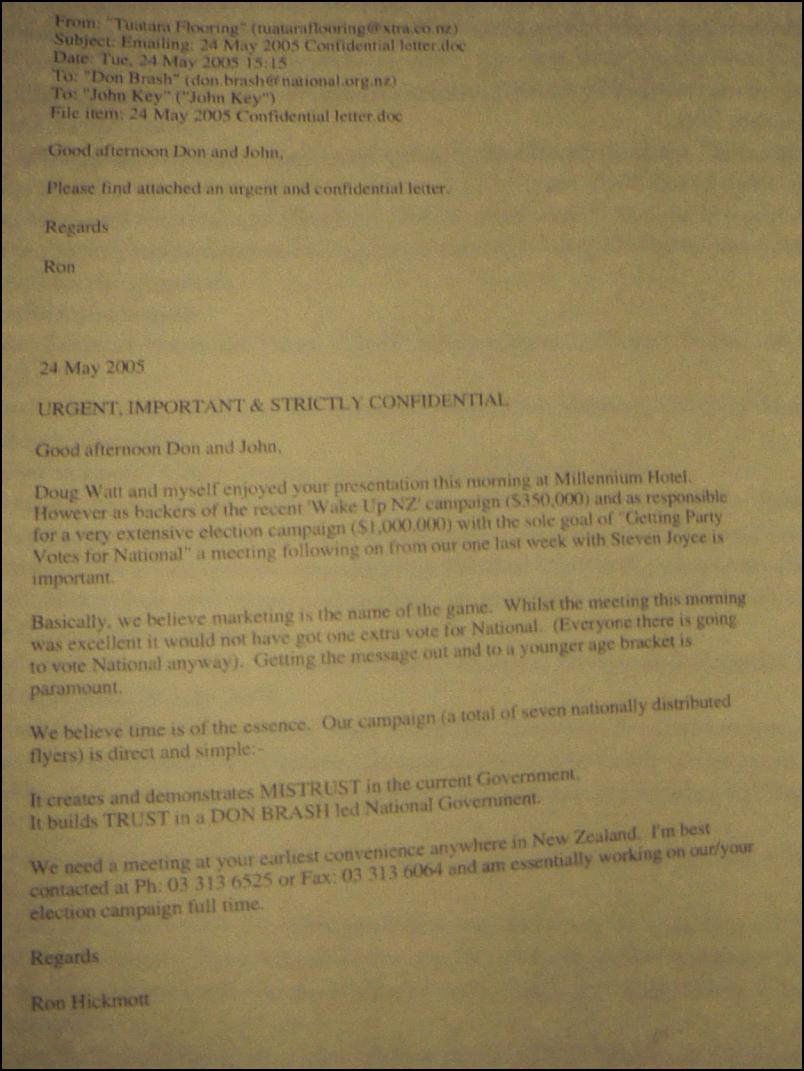
Now that the injunction has been lifted, journalists are frantically speed-reading their hastily acquired copies of The Hollow Men to uncover the juicy bits. Scoop's "Sludge Report" has already noticed the smoking gun email, sent by the Brethren's campaign manager to both Brash and Key in May 2005 (several months before Brash said he had discussions with the Brethren) and requesting a further meeting to discuss their pamphlet campaign:

Good afternoon Don and John,

Doug Watt and myself enjoyed your presentation this morning at the Millennium Hotel. However as backers of the recent "Wake Up NZ" campaign ($350,000) and as responsible for a very extensive election campaign ($1,000,000) with the sole goal of "Getting Party Votes for National" a meeting following on from our one last week with Steven Joyce is important.

It goes on to talk about the aims of the campaign and concludes with a statement that the author is "essentially working on our/your election campaign full time" (scan [JPEG]).

The Herald expands on the subject here. It seems that national discussed the use of outside groups on defence and education at a campaign strategy meeting as early as February 2005 - and that the pamphlets were discussed with and shown to MPs in June. So much for pleading ignorance.

There's an obvious issue here that this is a far higher degree of collusion than admitted to, and one which means that the Brethren's expenditure should have been both authorised by and attributed to the National Party. Instead, National used a third-party essentially to circumvent its Electoral Act spending limit - something for which they should have been prosecuted for had this information come to light earlier. As with Labour's overspending, it is now too late to prosecute, but we can take steps to stop this from happening again. Allowing parties to circumvent spending limits in this way essentially allows the rich to buy elections - something we should not allow to happen in this country.

Wednesday, November 22, 2006


Evading the law

The National Party claims to have found a way around its impasse over their conveniently "forgotten" GST: purchasing advertising on behalf of charities. This apparently allows them to evade the legal repurcussions, while ensuring that broadcasters get (some of) their money (but only in exchange for giving away another slice of airtime).

So, will they be doing it again next election then?

Update: DPF calls this a "win-win", but there are two clear losers: firstly, TVNZ, the broadcasters, whose money has effectively been given to charity, and the New Zealand public, who get to see a party "mistakenly" violate its broadcasting advertising limits, then evade any punishment. Those limits exist for good reasons - to ensure a level playing field between (the two major) parties, and to ensure that the rich cannot buy their way to political power. But clearly, that is exactly what National thinks it should be able to do.

I'm also not clear on why they think this is avoiding the law. A payment is being made, it is clearly being made for their outstanding broadcasting expenses, and National says that is why it is being made. Surely that should invite prosecution? Are are they hoping to have intimidated the police into submission by claims that enforcing the law would somehow be "biased"?

Wednesday, October 25, 2006


Electioneering?

Today, a copy of Gordon Copeland's newsletter, "Copeland's Chronicle", landed in my mailbox. It's a special edition, sent out in response to the recent Auditor-General's report that United Future (among others) had unlawfully spent parliamentary Services funds on "electioneering". The bulk of the newsletter is Copeland's third-reading speech on the Appropriation (Parliamentary Expenditure Validation) Bill (which you can read here), but it finishes with a not-so-coded appeal for funds:

Concurrently we are seeking support from United Future members and others.

The newsletter is produced by Parliamentay staff and sent from Parliamentary servers. So, does it count as "electioneering"?

Tuesday, October 24, 2006


The Assent has been granted

Question Time today opened with Don Brash asking Michael Cullen (as Acting Prime Minister)

When will the Appropriation (Parliamentary Expenditure Validation) Bill passed by the House last week come into force?

Cullen's answer was "tomorrow". Given that the commencement clause of the bill states that it will come into force "on the day after the date on which it receives the Royal assent", this suggests that it has already been signed into law, or will be so very shortly. As anyone with any knowledge of New Zealand's constitution (as opposed to the 40,000-odd supporters of monarchical fiction) knew it would be.

Blair Mulholland, the petititon's organiser, is now turning to an indicitive referendum under the Citizen's Initiated Referenda Act 1993. Unfortunately, his proposed question illustrates all the problems with that act and the style of referenda we have pursued so far in this country. Rather than asking the electorate whether they approve of motherhood and apple pie (or rather, hate politicians, which amounts to the same thing), he'd be better off drafting some legislation and presenting a question along the lines of "that the [attached bill] be enacted by Parliament". That would at least strip them of one excuse - vagueness - for not doing so.

A referendum petititon needs the valid signatures of 10% of registered electors - about 250,000 people - in order to force a poll. That's a big ask, and certainly far more difficult than getting 40,000 people to click a link on the internet.

Meanwhile the irony of seeing ACT people who supported the Douglas blitzkrieg suddenly turning to referenda as a vital check on government power is inescapable.

Update (25/10/06): I've since been reliably informed that the Assent has now been granted. The bill had apparently already been conveyed to Government House when Culen spoke. So, it's law. That for your monarchical veto!

Saturday, October 21, 2006


Brash's stunning hypocrisy

For the past year, Don Brash has been accusing the government of "corruption" for paying for its election pledge cards from its Parliamentary Services budget. This was judged by the Auditor-General to be "electioneering", and thus an unlawful use of taxpayer's money. Yet on Radio Live yesterday, Brash admitted that he had used National's Parliamentary Services budget to pay the salary of his chief election strategist, Bryan Sinclair. For most of 2005, Sinclair was tasked with helping National win the General Election - something which cannot be described as anything other than "electioneering". The hypocrisy here is simply stunning, but it also raises an obvious question: having pranced around on his moral high horse over Labour's unlawful expenditure and demanded that they repay the money spent, will he now pay the money back? Or is this yet another case of "one law for all, for everyone but National"?

Friday, October 13, 2006


A whip around

So, how are the parties hit with large bills by the Auditor-General's retrospective and arbitrary reinterpretation of the rules going to meet their obligations? Labour has announced a big whip around and is seeking donations from the public. You can either donate online here, call 0900-LABOUR, or send a cheque to

Labour Party
PO Box 784
Wellington

The Greens are also soliciting public donations. You can donate online here, by online banking to Kiwibank, Branch: Wellington, Account Number: 38 9005 0440479 00, or by cheque to

The Green Party
PO Box 11 652
Wellington

Repayment will be a massive task for both parties, similar in scale to pre-election fundraising. And as Peter Dunne pointed out last month, it is likely to have a serious effect on our democracy, hobbling their ability to contest the vote at the next election. Which seems to have been National's aim all along - being unable to win at the ballot box, they have sought to win at the bank instead. Which makes it all the more important that we institute public funding. Fortunately, the Auditor-General has just ensured that there will be a clear majority for it in Parliament.

Thursday, October 12, 2006


They're up

The Auditor-General's report on Parliamentary Services advertising expenditure and the Speaker's reply to it are now available from Parliament's website.

Update: Having read some of it: the Auditor-General concludes that almost half of all Parliamentary Services advertising expenditure in 2004 - 05, and over 60% of that in 05 - 06, was unlawful. Some parties - notably New Zealand First in 05-04, and the Greens and Labour in 05-06, had almost their entire spending considered unlawful, while many had over 50%. National seems to have been very well-behaved, though that's probably due to being wealthy enough to wage a permanant campaign with laundered funds, rather than relying on Parliamentary communications to advise the public of their policies. As a general comment, Parliamentary Services disagreed violently with the A-G's interpretation of the rules, arguing that they only outlawed explicit solicitation rather than anything which might persuade anyone to vote for a party. This difference of opinion is the key reason why so many parties have been caught out.

Update 2: having got to the end: the A-G has recommended a review of the Parliamentary Service's financial procedures to ensure they spend money properly, and restated his prior recommendation that the system of funding political parties be reviewed. The Speaker agrees with these recommendations (while disagreeing quite strongly with his interpretation of the rules, which she clearly regards as both retrospective and outlawing a great deal of Parliamentary activity - e.g. holding public meetings), and furthermore proposes retrospective validating legislation on the basis that this is standard practice and mere repayment is not sufficient to erase the unlawfulness of the spending. She will also be asking the parties to respond to the report and consider repaying the money, if only in the interests of restoring public confidence in Parliament.

I suspect we will see validating legislation - which National will oppose - and a lot of parties are suddenly going to become very keen on public funding or changing the rules so they can continue to actually talk with their constituents without having someone leaning over their shoulder to ensure that they don't persuade them of anything.

Monday, October 09, 2006


Pure hypocrisy

National is accusing Labour of leaking the Auditor-General's report into the misuse of Parliamentary Services spending [audio] in order to "soften up the public" to its conclusions. Even assuming its true (the Sunday Star-Times piece in question seemed to be mostly speculation - hell, they even asked DPF for his opinion), for the past few months, National has been accusing the government of corruption based on... a leaked draft of the same report. So it's apparantly OK for them to leak to influence public opinion, but not for other people to do it. This is pure hypocrisy, and yet another example of National's "one law for all, for everyone but National" position.

Wednesday, October 04, 2006


Cause for complaint

Don Brash has written to the Commissioner of Police complaining about their failure to prosecute Labour for their egregious overspending during last year's election. And he certainly has cause for complaint. Faced with a case of vital importance to our democracy, the police simply did not take it seriously, with one officer even complaining that the investigation was distracting him from "real crime" - like burglaries. This is a basic failure of the police to enforce the law, and it calls the competence of our police into question.

That said, there is little we can do about it now. Section 226 of the Electoral Act sets a six month time-limit on prosecutions, which has long-since expired. And given the clear constitutional provision against retrospective criminality, Labour cannot now be held to account for it (not under criminal law, anyway). All we can do at this stage is tighten the law to ensure that this does not happen again, by extending the time limit and putting prosecution and investigation of electoral crime in the hands of the Electoral Commission rather than the police. National has had more than ample opportunity to introduce a Member's Bill to fix these problems; the question is, why haven't they?

Thursday, September 28, 2006


This is corruption

A wealthy foreign Labour Party backer reportedly offered the Maori party $250,000 if they would support Labour. And there's no question that it's corrupt: Section 103 (2) of the Crimes Act 1961 states:

Every one is liable to imprisonment for a term not exceeding 7 years who corruptly gives or offers or agrees to give any bribe to any person with intent to influence any member of Parliament in respect of any act or omission by him in his capacity as a member of Parliament.

Money was offered in exchange for "support", which ultimately means support on a confidence vote - clearly an act as an MP. The Maori Party should name names, and the police should prosecute this offence to the full extent of the law. Bribery and corruption have absolutely no place in our democratic system. Meanwhile, Labour should be cutting all ties with the people involved, and thinking very hard about who it accepts money from in future...