Monday, October 26, 2009


Guest column: Labour Day

By Stephen Day

I've always thought that there is something counterintuitive about unionists organising activity around Labour Day. Labour Day has come to mean, for most New Zealanders, a day off because, well, we deserve to have a day off. It's nice to have a place in our year dedicated to not needing to do anything, just taking a break.

Sure, during our early Labour Days we had big festivals, parades and sporting occasions. But these days Labour Day can quite happily be about little more than sleeping in, hopefully sitting about in the sun and maybe spending more time than you might usually with friends or family.

This year hasn't been the best one for workers and union members. Most employers, including the biggest employer of them all, the one we elect, have responded to the global recession by zipping up their wallet and bunkering down. It's tough times for employers as well as workers. On the whole workers, through their unions, have tried to work cooperatively with their employers within these new financial constraints. However some employers, who haven't faced tough times, who are in fact continuing to make large profits, are exploiting the situation to batter their workers and generate more profits. Many workers are still after all theses years still not getting paid enough to look after a family and live a decent life. Many face working conditions that are unnecessarily harsh, lacking in respect or dignity, or even downright dangerous.

But despite all that there are still things to celebrate. We now have paid parental leave. We have legislated meal breaks, breastfeeding breaks, four weeks annual leave and regular increases to the minimum wage. We achieved all these things in the recent past. We achieved all theses things by working together and campaigning for them.

Not everyone will get a holiday on Monday but most will, and another recent victory by working people and our unions means that those who don't still get a day in lieu.

My advice is don't spend Monday thinking about unions and working conditions. It's a holiday so enjoy it doing stuff you want to do. But the next day, Tuesday, go to say hello to the union delegate at your worksite and ask if there is anything simple you can do to help to win the next small improvement for workers and our families.

Sunday, October 25, 2009


New Fisk

End of an era for Lebanon's free press
Beirut's history can't be reduced to a mere 'heritage trail'

Thursday, October 22, 2009


AFK

Busy today and tomorrow, so nothing more from me today. Sorry.

"Financial discipline"

Since getting elected and giving away over a billion dollars a year to their rich mates, National has spun hard on financial discipline, lying about "cutting waste" (there wasn't any), being left "unfunded commitments" (wrong again), and being left a "financial mess" (no net debt and the strongest books in two generations) by the previous government in an effort to tar Labour's legacy of good economic management and paint themselves as the financially respectable party (Yeah, right). So you'd expect that having made all that noise, when they propose major changes to ACC with significant financial flow-on effects to other departments (e.g. Health and Social Development) and private individuals, they'd bother to cost those changes, right?

Wrong:

The Treasury’s adequacy statement in the [ACC] Bill says it does not contain required cost information and the Government’s analysis is incomplete. The cuts to ACC entitlements will shift costs to other government departments or onto workers and there is no quantification of these costs.

Treasury stated: “The proposal to introduce experience rating and risk sharing in the ACC Work Account will increase administrative and compliance costs for business and for the ACC scheme, yet these costs have not been investigated.”

Why haven't they been? Because of the hurry. Having talked up a crisis in ACC, National wants to be seen to be "acting decisively" to "solve" it. And of course, if they wait too long, the moment of low interest rates (and therefore of imbalance in ACC's books) could pass - and the "need" for "reform" with it. So we get policy made in a mad rush, with no thought, no costings - and certainly no checks and balances.

(This of course assumes that National is serious in its proposals. A more cynical person might say that they haven't costed it because the costs are irrelevant; the goal is privatisation to give their insurance industry mates a $200 million windfall, and they don't care who pays for it...)

This is no way to run a country. But sadly, we're stuck with it for at least the next two years.

Some stats on urgency

How bad is National's abuse of urgency? I've just obtained some hard data from Parliament, and it speaks for itself:

  • The 48th Parliament sat for a total of 1503.75 hours between 2005 and 2008. Of that time, 148.75 hours - 9.9% - were under urgency.
  • The 49th Parliament has sat for 545 hours since its election in 2008. Of that time, 183 hours - 33.6% - have been under urgency.

So there you have it. Not only is National using urgency more than three times as often as Labour - they've already sat for more hours under urgency than the previous three years of Labour-led government. Quite an achievement.

Labour's low use of urgency wasn't due to any virtue on their part; rather, they simply didn't have a majority for it except for the rare cases where it was actually necessary, or the pre-holiday crush. By contrast, National's rubberstamp support partners give it an easy majority, which they are abusing in full autocratic style. The result is a return to the "elected dictatorship" of old, when the government does whatever it wants and Parliament is reduced to a rubberstamp "fastest legislature in the west".

This autocratic approach to government is one of the reasons people voted for MMP: to hamstring government, slow it down, and thereby bring it back under control. Clearly, we didn't do a good enough job last time round...

Not so urgent after all

So, having called urgency yesterday, the House rose early tonight when it ran out of business. Which suggests that said business wasn't so urgent after all - and certainly not urgent enough to justify eating Wednesday.

Trevor Mallard suggests its a sign of poor House management, and I agree. Really, can't Brownlee count? Or did they not have the numbers for the un-named bills they were planning to introduce?

Wednesday, October 21, 2009


Another ACT rort?

A trio of ACT MPs were in Dunedin last month, holding a forum on "The hard questions - and some answers". Attendees were charged $10, or $5 if they were under 25, with the money going to the ACT party.

What's the bet they travelled there on the public tab, courtesy of Parliamentary Services? Unfortunately, thanks to self-serving politicians excluding their expenses from the coverage of the OIA, we'll never know.

Climate change: Designed to fail

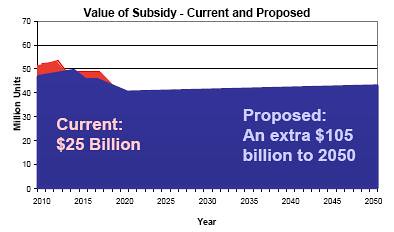
How much will the government's massive subsidies for pollution cost us? The submission of Dr Christina Hood [PDF], a former analyst for MfE and current climate change advisor to the Kapiti Coast Distrct Council, has the answer: $105 billion by 2050:

ETS-costs-hood

Its a staggering sum, over 50% of present GDP. And it will go straight from our pockets into the pockets of polluters.

Note that after an initial dip, the number of units allocated - and hence emissions allowed - does not decrease, and in fact increases to 2050. This is a consequence of intensity-based allocation and projected growth in the farming sector. Its also worth noting that the government's proposed allocation scheme makes it impossible to meet their oft-proclaimed "50% by 2050" (i.e. about 30 million ton) target. Instead, they are committing our emissions to being at least 70% of 1990 levels in free credits alone.

This isn't even "do nothing". Instead, it's "announce target - set policy to ensure it cannot be met - hope that no-one notices". It is a policy designed to fail. And it makes crystal clear that all the government's talk of a 2050 target is simply spin.

Is it a crime?

Is Rodney Hide's corrupt abuse of office to line the pockets of his party a crime? Section 102 of the Crimes Act 1961 outlaws "Corruption and bribery of Minister of the Crown". The relevant subsection reads:

Every Minister of the Crown or member of the Executive Council is liable to imprisonment for a term not exceeding 14 years who corruptly accepts or obtains, or agrees or offers to accept or attempts to obtain, any bribe for himself or any other person in respect of any act done or omitted, or to be done or omitted, by him in his capacity as a Minister or member of the Executive Council.
(Emphasis added).

Is Rodney a Minister of the Crown? Check.

Has he asked for money for himself or any other person? Check.

Is the act he has asked for money to perform - the promotion of policy - one done in his capacity as a Minister? Check.

Is the money a "bribe"? Arguable. Hide calls it a "donation". Whether political donations are bribes or not tends to depend on whether you are a politician or a member of the public.

The latter almost certainly rules our prosecution. But its an awfully thin thread to hang a defence on, particularly when we are talking about public faith in the political system. Regardless of whether you think political donations are bribes or not, this doesn't pass the smell test. Ministers must be seen to uphold the highest ethical standards in the exercise of their office, and they must properly distinguish between their Ministerial and party-political capacities. Hide has failed to make that distinction, and in a way which undermines public faith in our political system. He is simply not fit for Ministerial office.

A perk of office

One of the expectations in our modern, non-corrupt democracy is that government is a free service. If you want your MP to do something for you, you won't be charged a fee, and if you want to know what the government is planning to do, you won't have to give a backhander to a Minister for the privilege. Access to government is not for sale in this country.

Not according to Rodney Hide. He's running a roadshow on his plans for local government - explicitly government business, the sort of thing we expect Ministers to do as a matter of course - as an ACT party fundraiser. If local body members in Christchurch want to know what the Minister has planned for them, they have to pay a fee to his party for the privilege.

This is a gross abuse of office. Promoting policy is explicitly listed in the Cabinet Manual as being something done in a Ministerial capacity. And the rules on how Ministers conduct themselves in that capacity are very clear:

accepting additional payment for doing anything that could be regarded as a ministerial function is not permissible;
The payment is to Hide's party, but I don't think that lets him off the hook, any more than paying a partner or relative or business associate would. He profits indirectly through increased election chances, and the perception is that the party is being paid for his services as a Minister. This absolutely fails to meet the requirement that
In all these roles and at all times, Ministers are expected to act lawfully and to behave in a way that upholds, and is seen to uphold, the highest ethical standards.
Rodney Hide has failed to meet that standard. He has behaved in a way which is frankly corrupt. But I guess he just regards it as a perk of office.

The 2008 election inquiry

The Justice and Electoral Committee has reported back [PDF] on its inquiry into the 2008 election. The inquiry is a standard part of the electoral cycle, a regular review to see how things went and whether any changes should be made. This year a lot of stuff - reform of the electoral agencies, the Electoral Finance Act - was off the table due to reviews already in process, and so they focused heavily on the electoral process. The most significant change they recommended was to remove the requirement for voters to establish grounds to vote in advance, a change which would allow much wider use of advance voting. The driver here is a massive increase in advance voting - 35% in the last electoral cycle - which they attribute to lifestyle changes and shifts in working patterns which mean it is no longer convenient for everyone to vote on a Saturday. The Chief Electoral office described it as people voting with their feet, and they want to support it. IMHO its a good suggestion, which will make voting more accessible to more people - a Good Thing in a democracy.

The Greens raised an interesting question about "authorised witnesses" - party hacks who are authorised by the returning officer to go round e.g. old-age homes on election day and witness and collect special votes. We have no information on these people, how they operate, or the number of votes they collect. None whatsoever. The Chief Electoral Office simply doesn't collect it. Given the obvious potential abuses here, its something there should be a lot more scrutiny of; our electoral system is too important to simply take it on trust.

One other interesting point is that the Electoral Enrolment Centre is working on plans to allow full online enrolment. This would make it much easier for young voters to enrol, and getting them to enrol is the key to getting them to participate. Its a good move, and hopefully it'll be ready for the next election.

No Member's Day

Today is Tuesday.

Yes, of course its not - but it is in Parliament. Yesterday the government put the House into urgency just because they could, meaning that it is nominally Tuesday until they decide it isn't (which will likely happen sometime on what we in the real world would call Thursday evening, or maybe Friday morning). Tuesday lasting all week means that Wednesday doesn't happen, which means that there is no Member's Day. Yes, once again the government has just walked all over the (already extremely limited) rights of Parliament and eaten the valuable and limited time of Members so they can get a few extra hours for such staggeringly important legislation as the Subordinate Legislation (Confirmation and Validation) Bill and Social Assistance (Payment of New Zealand Superannuation and Veteran’s Pension Overseas) Amendment Bill. Interestingly, by doing so they've avoided a messy debate on John Boscawen's child-beating bill. But I'm sure there's no connection at all. Really.

The government's legislative style is increasingly looking like a re-run of the 80's, with legislation introduced under urgency to avoid public debate, and rammed through in minimal time with little scrutiny. They can do this because they have an easy majority, thanks to compliant support parties willing to rubberstamp urgency in exchange for a seat in the back of a Ministerial Limo. Its a perfect warning of the danger of such arrangements - and of the need to hamstring government in future.

Tuesday, October 20, 2009


Irony is dead

Family First's Bob McCoskrie on the upcoming MMP referendum:

“The question ‘do voters want to retain MMP’ is confusing because a voter wanting change in the Electoral system will have to vote NO,” says Bob McCoskrie. “It's a pretty weird referendum when yes means no and no means yes.”
Yes, it is - but I didn't notice him complaining last time.

But snark about McCoskrie's obvious hypocrisy aside, the questions haven't actually been decided yet. As for what they should be, in 1992 voters were presented with two options: "I vote to retain the present FPP system" or "I vote for a change to the voting system". Repeating that, with the obvious change, seems to be the best and fairest solution.

Maori Party supports gutting ACC

The Maori Party will vote for the government's bill to gut ACC, even though they explicitly acknowledge that the bill will further restrict entitlements and be bad for Maori.

When the Maori Party first entered Parliament, they had a simple clear criterion for judging policy: "is it good for Maori"? Today, they have betrayed that principle.

Insanity

Not content with wanting to give massive subsidies to the nuclear industry, the UK government also wants to insulate them from the true costs of their activities by weakening standards around the disposal and storage of nuclear waste. The highlight? Letting them dump nuclear waste in local landfills.

This is simply insanity. At a time when western countries are shitting themselves over the risk of a "dirty bomb" (to the extent that in 2004 they robbed Iraq of all its medical radiation sources, leaving Iraqis to die of cancer), the UK is now proposing that the materials required to create one be left lying around with the trash. But its not just about terrorism - we've already seen the consequences of this sort of dumping in the third world and the former Soviet Union. Dumping this stuff in landfills means it will be found, scavenged, played with, and people will be contaminated and die as a result. But I guess the UK government doesn't care about that as much as it cares about the profits of the nuclear industry.

MMP referendum

So, its 2011, and with a two-stage process that mirrors the original referendum. Which is a lot better than what MMP refuseniks Graeme Hunt and Peter Shirtcliffe wanted, but there's still plenty of scope for the government to strap the chicken. Notably, the list of possible alternatives and the precise wording of the question has not yet been determined, meaning they could try to stack the vote by offering a unequal choice between MMP and an alternative with fewer MPs.

Either way, if we want to protect MMP, its not enough simply to vote for no change in 2011 - we also have to chuck out National, just to be on the safe side. Unfortunately, Labour's plans for MMP aren't much better (being led by a man who opposed its introduction doesn't help), so we need to make it clear to both parties: our democracy is non-negotiable.

National on ACC

Just in case anyone has any doubts that National will give ACT what it wants and use them as an excuse for ACC privatisation, here's their ACC policy [PDF] and policy backgrounder [PDF] from the 2008 election. The latter is quite explicit:

The experience of competition in the late 1990’s was healthy for ACC. Levy rates are now substantially lower as a result of that experience, and the ongoing prospect of competition. The current Government has retained the facility by which larger employers are able, as accredited employers, to opt out of the state monopoly, self-insure, and use a private administrator as the case manager.

It would not be possible now to replicate the large levy reductions that characterised the 1998 reforms. However, the National Party believes there is further scope to improve delivery of the scheme through the introduction of competition and choice.

[...]

The National Party is committed to the principles of competition and choice as the appropriate means of ensuring efficiency of ACC provision, and increasing incentives for improved workplace safety and better rehabilitation of accident victims.

Note that National admits that this will not be any cheaper for the public of New Zealand - there will be no "large levy reductions". The move is purely ideological, the benefits accruing solely to the insurance industry. Fairytales about employers "choosing" to pay more to provide greater cover to their workers (yeah, right) don't change that one iota.

Interestingly according to the policy backgrounder National opposed part-charges. Now they're considering a universal $50 or $100 excess to discourage claims. So much for consistency.

National will give ACT what it wants

The news today (insomuch as there is any) is that National is negotiating with ACT over privatising ACC to get its preferred changes through. The grumbling about a party which won 3% of the vote getting to dictate policy has already started, but its worth remembering that during the election National campaigned on exactly ACT's policy: privatising the work account for the profit of the insurance industry - something John Key was thoughtful enough to remind the press gallery of yesterday. So, while everyone is distracted by the dance, the outcome isn't really in question. National will give ACT what it wants, because they want it too.

Meanwhile, there's a telling omission from Key's criteria for privatisation:

Mr Key said if the ACC work account was opened up to competition, National would "need to be convinced that there were benefits both to the Government and the private sector".
Who's missing? Only the most important stakeholder: the people of New Zealand, who depend on the scheme for cover. But the reason we're missing is because we're the group that won't benefit. An independent review in 2008 found that there were no gains to be made from privatisation. That means that any benefits to the government and the private sector - and Key's former employers Merrill Lynch are on record as estimating they'd make $200 million from privatisation - have to come out of our pockets, in the form of higher premiums and lower entitlements. Key and ACT are plotting to screw us over, while their rich Aussie mates laugh all the way to the bank.

This is not something we should tolerate. Like Auckland's assets, ACC is not theirs to sell - or to privatise, "open to competition", or however else they want to spin it. It is there to provide a service to the people of New Zealand, and it is the governments job to ensure that it keeps providing that service. There is no question that we can afford it - the current "crisis" is entirely manufactured, born of temporary changes to interest rates rather than any real problem (the scheme notably is still taking in far more per year than the long-term cost of claims; at worst the current problems threaten the date at which it is considered to be fully funded, not whether it will be, and certainly not its ability to provide cover). National's moves to undermine and privatise ACC are a fundamental betrayal of trust and a theft from the people of New Zealand. And we should hold them accountable for it.

Monday, October 19, 2009


New Labour's new nadir

UK postal workers are going on strike this week over privatisation and plans to "modernise" the postal service - which means them working harder and longer for less money. In response, the postal service - with the full support of the "Labour" government - has announced plans to hire 30,000 scabs to crush the strike.

And UK Labour wonders why its core voters have given up on it...

Drinking Liberally this week

Drinking Liberally is on in Auckland and Wellington this week:

When: 19:00, Wednesday 21 October
Where: The London Bar, upstairs cnr Queen and Wellesley Streets, Auckland CBD
Who: Greenpeace Executive Director Bunny McDiarmid on climate change and the Sign On campaign.

When: 17:30, Thursday 22 October
Where: The Southern Cross, Wellington
Who: Wellington City Councillor and mayoral candidate Celia Wade-Brown on the threat of a Wellington supercity

[Hat-tip: The Standard on the latter]


