Tuesday, July 28, 2015


"Merit"

In 2004 the then-Labour government wanted to reduce sexism in the public sector, so it set itself a target that 50% of new board and committee appointments would be women. In 2010, National decided that that was too hard, and lowered the target to 45%. So how well has it been doing? The Herald crunched the numbers, and the answer is "appallingly". Only seven Ministers were actually meeting their target. Meanwhile, most lagged in the 30-percent range (when the target was set women were 41% of board members), and six of them were appointing women to fewer than a third of places:

Mr McCully and Mr Bridges appointed less than a quarter board position to women. Mr McCully appointed 23.63 per cent women to boards in 2014 and Mr Bridges appointed 24.56 per cent.

Mr Brownlee appointed 26 per cent of positions to women and Mr Smith appointed 27.84 per cent of positions to women.

Prime Minister John Key appointed 29.17 per cent of board positions to women.


But of course, when asked about this, they claim to appoint on "merit". I guess they use a special dictionary in which that word is a synonym for "penis". Meanwhile, to the rest of us, its pretty clear what is going on: bad, old-fashioned sexism. The message is clear; National hates women, and thinks their place is in the home (or in low-paid professions such as cleaning) rather than in the boardroom. Isn't it time we had a government which tried to fix this problem, rather than exacerbating it?

Monday, July 27, 2015


A declaration of inconsistency

Back in 2010, Parliament passed the Electoral (Disqualification of Sentenced Prisoners) Amendment Act. The Act was passed despite a clear warning from the Attorney-General that it was inconsistent with the Bill of Rights Act, after a "debate" which was so shallow that it brought the entire parliamentary process into disrepute and undermined its legitimacy as our lawmaking body. In short, our government ignored its duty under the Bill of Rights Act and passed legislation which pissed on the right to vote, simply in order to grub for votes from vicious, vindictive sadists by kicking prisoners. It was a tawdry display which invited the courts to correct Parliament by formally declaring the law to be inconsistent with the BORA. And now the High Court has done exactly that:

An Auckland prisoner says he is rapt with a court ruling that a law banning all prisoners from voting breaches their human rights.

In the High Court, Justice Heath issued a formal declaration that the law, passed in 2010, is inconsistent with the Bill of Rights and is unjustified.

The ruling is a victory for career criminal Arthur Taylor, who has been fighting the ban in court for about a year.


The full judgement is here. Its very clear, and the short version is "if we couldn't issue a declaration of inconsistency for this, its hard to see what we could issue one for". Because it has hard to spot a more blatant and unjustifiable violation of the BORA than this.

In practical terms, it means very little, as section 4 of the BORA explicitly says that laws remain valid despite formal findings of inconsistency. Politically and morally, its explosive. The court has just told Parliament for the first time that they think that they did not do their job properly and that the law should not have been passed. And Parliament will have to respond. The sensible thing to do would be to accept the finding, repeal the law and restore it to what it was pre-2010. The question is whether National will accept that, or whether they'll throw a temper-tantrum and try and legislate to gag the courts from commenting on the legislation they pass. What they do will probably establish a constitutional norm, so I hope they choose carefully.

Meanwhile, this suggests that we now need a formal method of responding when the courts make such a declaration. The Human Rights Act requires the responsible Minister to report to parliament on the declaration and the government's proposed response. While a weak response, that would be a good start.

GCHQ spies on the UK's devolved assemblies

UK MPs are currently challenging GCHQ mass-surveillance in the Investigatory Powers Tribunal, on the basis that it violates the Wilson doctrine which outlaws spying on MPs. While the case is still being argued, we've already learned something important: GCHQ has recently decided for itself that it is allowed to spy on Members of the Scottish Parliament and other devolved assemblies:

David Cameron is under pressure to justify a secret decision by spy chiefs at GCHQ that authorises eavesdropping on politicians from the devolved legislatures in Scotland, Wales and Northern Ireland.

Nicola Sturgeon, the Scottish first minister, and other Scottish, Welsh and Northern Irish politicians on Friday urged the prime minister to protect the privacy of parliamentarians from the three nations, after it emerged that GCHQ had introduced new internal guidelines to allow the monitoring of communications by members of the legislatures, even though those rules bar the agency from monitoring MPs at Westminster.

In a letter to Cameron, Sturgeon said she accepted spying on MSPs could take place but only in “truly exceptional circumstances involving national security”. In the vast majority of cases “the confidentiality of communications between parliamentarians and their constituents is of the utmost importance”, she told the prime minister.

[...]

Sturgeon said there was no justification for treating MSPs any differently from MPs. She also asked the prime minister to confirm or deny that MSPs had ever been spied on by British agencies. She asked him: “Will you give an assurance that, with respect to the Wilson doctrine, MSPs will in future be treated equally to MPs by all of the intelligence agencies?”


Spying on MPs is an attack on democracy which inhibits their ability to represent their constituents and raises real questions about democratic control and oversight of spy agencies. The potential for such spying to be abused is obvious, and its simply not acceptable for an intelligence agency to do it without serious justification. Its certainly not acceptable for them to decide to do it themselves. That sort of decision is one for elected Ministers, not unelected bureaucrats. But if the English government has decided that its fine to spy on the representatives of the Scottish and Welsh people - effectively that Scotland and Wales are hostile foreign powers - then I suspect the Scottish people at least will want to have a vote on that to make it official.

New Fisk

The West likes to think that 'civilisation' will defeat Isis, but history suggests otherwise
Iran – the land where some 700 souls were executed last year

Privatisation and political incentives

The theory behind privatising government services is that private providers will perform better than government ones because they have better incentives to do so. On the positive side, more efficient service delivery will result in higher profits. And on the negative side, there's the threat of losing the contract and going out of business if a private provider fails to meet expectations. Which sounds great in theory to ivory-tower economists, but in practice, it turns out a little differently:

Education Minister Hekia Parata says she has given Te Pumanawa o te Wairua in Northland a chance to continue operating because of her concerns about finding other educational opportunities for its students.

Her decision follows a special audit of the Whangaruru school which raised issues about its financial performance, administration and governance.

Ms Parata says the audit findings provided grounds to terminate the partnership agreement with the school, but she has opted not to do so because of her concerns about the school’s students.


And its a similar story with Serco, who will have the management of Mt Eden temporarily taken off them and penalised under their contract - but won't have their contract stripped, despite clear evidence of breach and fraud. And the reason in both cases is because the incentives on the other party to the contract - the Ministers - are not to admit failure. Which means they will bend over backwards not to cancel contracts or punish providers, no matter how poorly the latter perform. Which in turn removes any incentive for better performance, and instead turns this sort of privatisation into a giant scam for rent-seeking and guaranteed profits from the public purse.

As for why Ministers do this, clearly it is because their boss, the Prime Minister, fails to punish them if they do. Which is a similar tale of poor incentives: sacking a Minister, even for obvious failure, would involve the PM tacitly admitting failures in selection and oversight, so it doesn't happen either. The only way it does happen is if there is a credible threat from the public to punish incompetence, and a credible opposition waiting in the wings threatening to be an alternative government. Absent that, we get poor governance and muppetry all the way down.

Friday, July 24, 2015


D-day for privatisation

It looks like D-day for National's privatisation plans, with two providers facing termination. First, there's Whangaruru school:

A decision on whether a troubled Northland charter school will close is being announced by the Education Minister on Friday.

Whangaruru school, which recently changed its name to Te Pumanawa o te Wairua, has been plagued with problems since it opened last year, including poor attendance, bullying, drug use and management infighting.

With only about 40 students left on the school roll there was plenty of uncertainty as to how the school could continue to function given the severity of the issues it faced.

This came on the back of its former curriculum director Natasha Sadler being made redundant despite being a driver of the school's establishment.


The government has thrown more than $3 million at this school in "establishment costs", and there's no guarantee they'll be able to reclaim any of it. Its highly likely that the net effect of this charter "school" has been to buy the operators a farm. Which suggests that the level of contract oversight and of security for the government's interest in the contract are low to non-existent. Heckuva job there, Hekia.

And then there's Serco:
Corrections chief executive Ray Smith says he will announce action against Serco this afternoon, amid mounting allegations of assaults at Mt Eden Prison.

Mr Smith issued a statement last night saying was considering legal advice and looking at a "full range of options" after allegations of a third serious incident came to light this week.

[...]

He wouldn't answer questions on whether that could include cancelling the company's contract, although there are a number of other options available to him, including a "step-in" - where the Government takes temporary control of the prison.


...while no doubt paying Serco for the privilege, because private prison contracts are probably written with as much protection for the public interest as those for charter schools. But that's not enough. Serco appears to be dumping prisoners on other institutions in order to avoid fines for injuries, and has helped cover up a murder. That's fraud and perversion of the course of justice. They shouldn't just be having their contract cancelled - they should be looking at the inside of a jail cell themselves!

But the problem with both of these cases is that despite clear evidence of failure, the government has invested too much politically in their success to be able to admit it. So we'll get bullshit half-measures to paper over failure and sweep it under the carpet, simply to protect the egos of Ministers. So rather than solving the Principal-Agent problem of effective service delivery (where goals are subverted by the self-interested actions of bureaucrats), National's privatisation has simply replaced it with another (in which goals are subverted by the self-interested actions of Ministers). But at least with public delivery we had clear lines of accountability and responsibility. National's model seems to involve neither. And we, the public, are the losers.

Thursday, July 23, 2015


Climate change: Ignoring the problem

Climate change is the biggest challenge facing humanity at the moment. It is the biggest long-term challenge facing New Zealand at the moment. While the headlines are full of noise about falling dairy prices, climate change may mean that we do not have a dairy industry in future. It is that serious. So you'd expect policy-makers to be paying attention to it, and assessing government policy for its effects on both emissions and adaptation, right?

Wrong:

Official documents reveal the Government ignored advice to take the impact of climate change into account whenever it developed new policy.

A Treasury paper shows the Government was also encouraged to establish an independent agency to advise it on greenhouse gas reduction target levels.

The Treasury advice was given to the Government last year as part of the lead up to the United Nations climate change discussions in Paris in December.


This is short-sighted muppetry from the government, which ensures continued failure. It ensures short-term targets which bear no relation to long-term ones, and policies which make things worse rather than better. And their reason?
"It's just getting a bit carried away with bureaucratic process and won't make any difference - having bureaucrats guess what impact a policy might have."

Except that bureaucrats "guess" about policy impacts all the time. That's their job. We have an entire process to "guess" the impacts of policy before introduction, so Ministers can know what the hell they're doing. And we have statutory and convention-based reporting requirements for impacts on human rights, women, people with disabilities, and Maori. Bill English knows all this, and in fact is even responsible for a bill to strengthen this scrutiny. So why doesn't he want climate change impacts analysed and reported? Its to escape the conclusion that its because he doesn't think its a real problem. And we are all going to pay for that short-sightedness and denial.

An admission of guilt

The UK government is aware of plans (or possibly itself planning) to assassinate Wikileaks' Julian Assange. That's the only conclusion which can be drawn from their response to a Freedom of Information Act request about the subject:

The FCO can neither confirm nor deny whether it holds any information that would meet the terms of your request, in reliance on the exemption contained in section 27(4). Section 27 relates to international relations. Section 27(4) is a qualified exemption under which we have no obligation to confirm or deny whether information is held where to do so would or would be likely to

(a) prejudice relations between the United Kingdom and any other State or
(b) prejudice the interests of the United Kingdom abroad.


[Emphasis added]

But given the explosive nature of the request (for any and all records held by FCO "which concern current or previous plots to assassinate Julian Assange, including those generated by UK and US security agencies such as MI5, MI6 and the CIA"), I'd expect them to deny it if they possibly could. The fact that they haven't suggests strongly that they are aware of at least one such plot. Whether they're withholding it to protect the reputations of their murderous "friends" (who would be upset if the UK spilled the beans on their past or present murder plans), or to protect their own reputation is unclear, but either way: they're actively covering up for would-be murderers.

Drawn

A ballot for four member's bills was held today, and the following bills were drawn:

So its a clean sweep for Labour, but also a political victory. Paid parental leave extension was defeated just five months ago on a tied vote, but now there's a majority for its passage. It'll take a while, but the bill will pass, unless the government tries to use its unconstitutional spending veto (and if it does, the result may then be to see that veto consigned to the dustbin of history where it belongs).

I'm also pleased to see Adrian Rurawhe's bill to bring Parliamentary Under-Secretaries under the OIA drawn. This ought to be absolutely non-controversial; they're performing Ministerial functions, so any information held in the performance of those functions should be official information. Sadly, I expect National to vote against it.

Covering up a murder

So, it seems that Corrections and Serco have been covering up a murder:

Corrections bosses and their minister were told weeks ago a prison inmate may have been murdered but nothing was passed on to police.

[...]

Questioned over that failure, Lotu-Iiga said that was Corrections' call. But he indicated that they were awaiting the outcome of a coroner's inquiry as the cause of death was still unknown.

He would be asking his officials, however, why none of them made a note at the select committee to follow up the accusation.


So, a person dies in suspicious circumstances after being transferred from a Serco-run prison, and Corrections doesn't notify the police? They must really want their Minister's pet privatisation project to succeed. But its simply wrong, and not the standard we expect from New Zealand public servants. Heads need to roll for it - starting with the Minister's. He knew, but he did nothing. He can't simply blame his underlings for his failure to act.

Meanwhile, its apparently not the only thing they're covering up - they also allegedly helped cover up a riot, again because it would have led to Serco being financially penalised and the privatisation project labelled a failure. But this shows the lie behind National's claims that private prisons will be more efficient because of the financial incentive on operators. After all, if the Minister can't enforce those financial incentives without admitting failure themselves, then there's no control or incentive at all.

Wednesday, July 22, 2015


Climate change: Carbon pricing worked in Australia

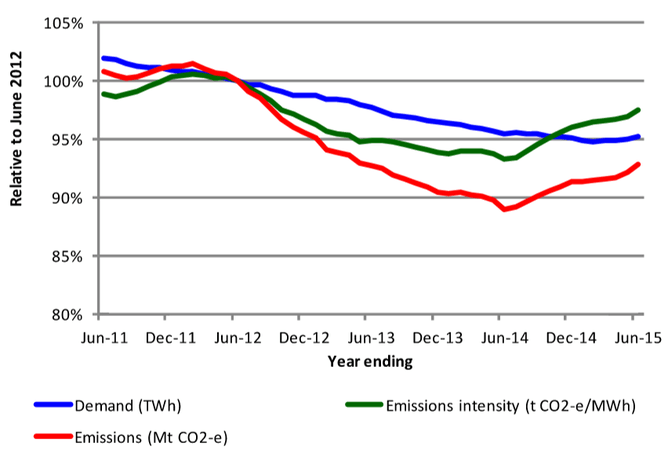
In 2012, the Australian government introduced a carbon tax on major industrial polluters on A$23 / ton. In July 2014 the Abbott government repealed it. The problem? It was actually working. Greenhouse gas emissions from the electricity sector dropped more than 10%, and emissions intensity - how much carbon you need per gigajoule - dropped by more than 5%. Both of these changes were immediately reversed on repeal:
OzCarbonPriceEffects

Making polluters pay for carbon shifted generation away from lignite and towards hydro. Some of the hydro effect was short-term, driven by expectations of repeal (they mined their supplies to profit while they could); you need stable policy to affect investment decisions (alternatively, the right sort of uncertainty, creating a risk of paying rather than an expectation of not paying). Unfortunately we've made the same mistake in New Zealand, gutting the ETS and increasing pollution subsidies, leading polluters to expect they won't have to pay.

But its also worth noting that the effect of carbon pricing was rather modest (10% is good, but not enough).

Fourth, and following from the three preceding conclusions, achieving larger and faster emissions reductions will require a wide range of policies, all working in the same direction. A price on emissions, whether through an emissions trading scheme or a tax, will be a key component of such a suite, but only one component.
This is the approach being taken by all of the many countries and sub-national jurisdictions that have introduced emissions pricing.

Campaigners for the return of Australian carbon pricing shouldn’t lose sight of the fact that other policies will be needed too.


This is something we're ignoring in New Zealand too. Even if the ETS wasn't broken, we'd need more than just a market price signal to achieve the sorts of emissions reductions we need. Unfortunately, with policy still in the grip of market fundamentalists, serious policy seems unlikely.

A people's review of the spies

GetSmart
Don't like the government's rubberstamp "review" of the spy agencies and their powers? The NZ Council for Civil Liberties is organising a people's review, with public meetings in Auckland and Wellington:

To help compensate for the lack of public consultation, the NZ Council for Civil Liberties is hosting public meetings in Wellington (July 29th) and Auckland (August 6th). They are inviting people to go along to have their say about what should happen to the GCSB, the SIS, and New Zealand’s participation in the Five Eyes spy network.

Wellington: Wednesday, 29 July, 6pm, St John's Hall (Dixon/Willis St)
Auckland: Thursday, 6 August, 6:30pm, Grey Lynn Library Hall (474 Gt North Rd)


Go along, speak up, and let the government know that you want the spies shut down.

Relationship recognition is a human right

How far has the battle for marriage equality come? The European Court of Human Rights has just ruled that Italy's failure to provide any legal recognition for same sex relationships violates the right to privacy and family life:

Italy violates human rights by not offering adequate legal protection and recognition to same-sex couples, a European court has ruled.

[...]

The European court ruling on Tuesday said gay couples were essentially forced to live double lives in Italy: they could live openly in their relationships, but they did not receive any official recognition of their status as a family.

Specifically the court ruled that Italy was in violation of article eight of the European convention on human rights, which provides for the right to respect for privacy and family life.

The case was brought by three gay couples – all men – who do not have the right to marry or enter into a civil union and described the challenges the lack of recognition posed in their daily lives. The legal move was led by Enrico Oliari, president of a gay rights group called GayLib.

“We are delighted,” Oliari said in a statement. “We arrived at this conclusion at the end of a battle that began 18 years ago with our association and an eight-year fight in the courtroom.”


The court awarded damages and costs to the complainants, and urged Italy to legislate to recognise same sex relationships. Italy's NeoLiberal Prime Minister has promised to do that, but has never bothered to actually act on it. Hopefully this ruling - and the threat of future damages claims - will force him to do so. Meanwhile, its also a clear challenge to Eastern European bigot states like Poland and Slovakia, which have passed Texas-style constitutional amendments against marriage equality and refuse any recognition at all to same sex couples. The ECHR has basicly just said that that position is illegal and will have to change. Hopefully they'll get the message and act soon.

The full judgement is here.

Member's Day

Today is a member's day, and the floodgates have finally opened with a pile of first readings. First up is Meka Whaitiri's Environmental Protection Authority (Protection of Environment) Amendment Bill, which would amend the EPA's purpose to match its name. Then we have Tracey Martin's New Zealand International Convention Centre Act 2013 Repeal Bill, which would repeal National's SkyCity crony legislation; it will be interesting to see if ACT, which purports to oppose subsidies and cronyism, will support that one. This is followed by Phil Goff's Overseas Investment (Owning our Own Rural Land) Amendment Bill which would tighten restrictions on foreigners buying farms. Finally there's Fletcher Tabuteau's Fighting Foreign Corporate Control Bill, which would outlaw investor-state dispute clauses in future "free trade" agreements. This will effectively be a dry run for TPP ratification, so it will be interesting to see which way Labour votes on it. If the House moves quickly it might get to David Parker's Minimum Wage (Contractor Remuneration) Amendment Bill, which is perhaps the first of these bills with any real chance of passing. Which means a ballot for three or four new bills tomorrow morning. Hopefully David Seymour will get his act together and get his death with dignity bill in sometime.

Tuesday, July 21, 2015


Freedom of Information under threat in the UK

On Friday the UK government announced that it would be reviewing that country's Freedom of Information Act:

Ministers have launched a cross-party review of the Freedom of Information Act that is likely to be viewed as an attempt to curb public access to government documents. The move comes just hours after papers released on Friday under FOI disclosed that British pilots have been involved in bombing in Syria.

Matthew Hancock, the Cabinet Office minister, laid a statement before parliament outlining details about the five-person commission that will be asked to decide whether the act is too expensive and overly intrusive. Members will include Jack Straw, the former foreign secretary, who is already on the record calling for the act to be rewritten. Straw is still the subject of FOI requests over the rendition of a terror suspect during his time in office.

Lord Carlile of Berriew will also sit on the commission. He accused the Guardian of “a criminal act” when it published stories using National Security Agency material leaked by Edward Snowden. The committee’s other members will be Michael Howard and Dame Patricia Hodgson, and it will be chaired by Lord Burns.

Hancock wrote that the review was intended to make sure that the act is working effectively, 15 years after it was introduced by Labour. “[The commission will] consider whether there is an appropriate public interest balance between transparency, accountability and the need for sensitive information to have robust protection,” he wrote. “And whether the operation of the act adequately recognises the need for a ‘safe space’ for policy development and implementation and frank advice.”


So, a commission stacked with enemies of transparency, some of whom want to cover up their crimes, with an explict mandate to limit access to (embarrassing) policy advice. Yes, I'm sure this will be a neutral and unbiased review of the law rather than the usual establishment hatchet-job.

Meanwhile, its worth remembering what we've learned through the UK FOIA: MP's expenses. Charles Windsor's "black spider memos". Endless failures of government policy. And this transparency has allowed government failure and wrongdoing to be exposed, allowing politicians to be held accountable. Which is precisely why they want to nobble it.

New Fisk

David Cameron extremism speech: The PM's Churchillian posturing over Syria is misguided

Policy creep

National's state house sales policy was originally about shrinking the size of the portfolio and reducing the capacity of the government to assist people with housing - effectively one of a slow exit from a core government responsibility. But according to Treasury advice, its now gone beyond that, into selling all of the state houses in some cities to create regional private monopolies:

Treasury has revealed that all of the houses in each city - 370 in Invercargill and 1250 in Tauranga - could be sold to a single buyer. At a minimum, Treasury would look at selling at least 100 houses to each buyer because of the cost of transactions.

"Our current thinking is that we will transact at scale, the upper end being the entire portfolios in each region and the lower end potentially being one or two hundred," Treasury told potential buyers.

The Government would be prepared to have a single charity operating all of the social housing, as the scale may be a greater advantage than the lack of competition.

"It may not be feasible to have a traditional market with competition in each regional market due to the size of these markets," Treasury said, saying that in Invercargill "it is possible that a transfer of the whole portfolio may bring benefits that outweigh the need for competition".


So, monopoly state provision is bad, but monopoly private provision is good. No, I don't understand that either. But it seems that the policy isn't being driven by the needs of state house tenants, or people who need housing assistance, but by the desire of the private sector - which now means banks and foreign investors - to insert itself leech-like into a guaranteed government funding stream. And if they make their profits by underproviding the service they're being paid to provide, well, its not as if any of their victims, the tenants, will be in a position to complain about it, or seek a better service elsewhere. And meanwhile, politicians will be able to dodge responsibility for any problems by blaming the provider (while of course continuing to shovel money at them in income-related rent subsidies). The politicians and their cronies win - but its the public who will lose.

Monday, July 20, 2015


Impunity

What does impunity look like? This:

Not a single staff member accused of abusing a child asylum seeker at Nauru has been charged for an offence and the centre's operator cannot guarantee the safety of the detainees, a Senate inquiry has heard.

It also emerged on Monday that on-the-job staff drug testing is not conducted at Nauru, despite allegations of guards trading marijuana for sexual favours from female detainees.

Transfield Services, which runs the detention centre at Nauru, says there have been 67 child abuse allegations at the facility - 30 against staff and 37 against asylum seekers.

[...]

Transfield Services Commercial & Strategy Manager Erin O'Sullivan said of the 67 allegations, 12 were referred to police. Six staff members were dismissed, two were removed from the site and one was suspended. Ms O'Sullivan said she was not aware of a staff member being charged over any allegation.

A Transfield director, Angela Williams, could also not guarantee that the staff members had been permanently dismissed from the centre, saying they may have been reassigned to a different section or stood down pending investigation.


They also conveniently don't say how many of the referrals to police were staff and how many were refugees. But either way, this is dismal. Guards who abuse refugee kids in Australia's gulags won't be prosecuted, and the odds are good that they won't even be sacked. Instead, its people who blow the whistle on this abuse who will go to jail.

And that's modern Australia in a nutshell: where they imprison kids and abuse them for being born in the wrong country, and jail anyone who complains about it. Its absolutely sickening.

"Hijacked"

In the wake of their election loss, UK Labour is having the usual post-election leadership competition, with the usual parade of Blairites competing to be king (or queen) of a dying party. But one of the contenders isn't a Blairite. Jeremy Corbyn is instead pushing for Uk Labour to return to its roots as a left party rather than being Thatcher-wannabes. He even uses the "s"-word! Socialism! In a Labour party! Worse, this is capturing the imaginations of the party's membership, who get a vote now. But the Blairites have a solution: a post-election leadership coup:

Labour MPs are plotting to mount a coup against Jeremy Corbyn before Christmas, if he wins the leadership in September.

The left-wing MP for Islington North has staged a stunning raid on support among constituency labour party (CLP) organisations in the past week, prompting panic among supporters of the three mainstream candidates, Andy Burnham, Yvette Cooper and Liz Kendall. Two internal polls also suggested a surge in support for Mr Corbyn, with one even suggesting he could win on 12 September.

Although this result is still seen as a long shot, MPs said in the event of a Corbyn victory they would immediately start gathering the 47 names needed to trigger a coup. One said: “We cannot just allow our party, a credible party of government, to be hijacked in this summer of madness. There would be no problem in getting names. We could do this before Christmas.”

"Hijacked". I can't think of a worse word to describe a democratic decision of a party's membership. But it is deeply illuminating about the mindset of Blairites, and the modern political class as a whole (and sadly, we have more than a few such people here in New Zealand). These people don't see politics as involving voters, and the only role they have for party members is as a disposable source of free labour come election time. Which makes you wonder who the fuck they think they're representing - because it sure as hell isn't their members.

New Fisk

What a choice for Egypt – a megalomaniac president or the madness of Isis
Yemen crisis: With the Iran nuclear deal done, John Kerry must now sort out the Saudis