Monday, November 07, 2016


A good idea

Human Rights Commisisoner Dr Jackie Blue thinks its time to force companies to disclose their gender pay-gaps:

Women's pay and their presence in the workplace hierarchy aren't progressing quickly enough, says Equal Employment Opportunities Commissioner Jackie Blue.

So she's now calling for a law forcing major New Zealand companies to declare their gender pay gap.

Dr Blue says she would like to see New Zealand adopt a new UK law which applies to every company with more than 250 employees.

"They tried the voluntary approach, didn't work, so they're bringing in legislation. There's going to be a penalty if they don't comply of about £5000. It's still too low," she told the Nation.

"But just across in Australia, they've been doing that since 2012 for companies over 100, so this is not like a weird idea."


I agree. Public information - and the public pressure that results from it - is one of the best ways to force employers to obey the law. At present, they get away with discriminatory pay rates because its done in secret: they don't tell us (or the government) that they're doing it, while gag clauses in employment contracts prevent their employees from discussing pay rates and finding out. But whether a company is breaking the law is not private information. Instead, sunlight is the best disinfectant. Employers should be forced to provide this data, and justify any pay gaps that exist.

National will never do it: their dead white male caucus is deeply in the pocket of the dead white male business class which benefits from this discrimination. If we want a more equal society, we need to change the government.

New Fisk

A view of the Syrian war from the Golan Heights

Why we need inheritance taxes

The Herald yesterday pointed out the long-term consequences of Auckland's unrestrained housing bubble: increased disparities of wealth and the rise of an English-style class system:

Beckett faces becoming a victim of a new phenomena that is poised to create a tale of two Aucklands.

Economists say there are those who will inherit houses and those who will never afford one.

This "bequest bulge" driven by a combination of crazy house prices and baby boomer housing wealth may spark a return to the Victorian-style class system.

And that places Auckland at the precipice of an unprecedented shift back in time.


An Auckland house is expected to cost more than $3 million in 20 years time. And at that price, even people with university degrees and good jobs will be locked out of the housing market. The only people able to afford to own their own home will be those who inherited one from their parents.

This is not the sort of New Zealand anyone wants to live in. Inherited wealth disparities on this scale are exactly why many of our ancestors fled Britain - and why we strangled our incipient would-be aristocracy at birth in the 1890's with land taxes. As for how to stop it again, the answer is simple: tax it. We used to have inheritance taxes, which limited the ability of the ultra-wealthy to pass on social disparity. We should bring them back.

Friday, November 04, 2016


Another spy agency caught illegally hoarding metadata

The Canadians aren't just spying on journalists. The Canadian Security Intelligence Service has been caught illegally hoarding metadata:

A Federal Court judge says Canada's spy agency illegally kept potentially revealing electronic data about people over a 10-year period.

In a hard-hitting ruling made public Thursday, Justice Simon Noel said the Canadian Security Intelligence Service breached its duty to inform the court of its data-collection program, since the information was gathered using judicial warrants.

CSIS should not have retained the information since it was not directly related to threats to the security of Canada, the ruling said.

"Ultimately, the rule of law must prevail," Noel wrote, adding, "without it, the actions of people and institutions cannot be trusted to accurately reflect the purpose they were entrusted to fulfil."


There's shades of GCHQ here, which was recently found to have spied illegally on the public for 17 years. And it really makes you wonder whether the New Zealand SIS or GCSB are doing the same thing here. Five Eyes agencies share techniques and strategies, and if one has been doing something for a long time, its a good bet that the others are too. Clearly there's a consensus among the Five Eyes that mass domestic metadata surveillance is a useful counter-terrorism tool. But our Parliament has never approved such a thing, and it seems to go well beyond the particularised suspicion the warrant mechanism has been sold to us on. I think we need some assurances that our intelligence agencies are not doing this. And if they won't give such assurances, we can only conclude that they are guilty and need to be shut down.

Canada spies on journalists

Another week, another example of police spying on journalists - this time in Canada:

Rights campaigners are among those sounding the alarm over the erosion of press freedom in Canada after it emerged that police in Montreal had spent several months monitoring the phone of a journalist in order to identify his sources.

La Presse, one of Canada’s oldest and largest newspapers, said on Monday that at least 24 surveillance warrants were obtained by Montreal police to track the phone of columnist Patrick Lagacé. The warrants enabled the force’s special investigation unit to track Lagacé’s whereabouts using the GPS in his phone, as well as monitor incoming and outgoing text messages and calls.

The revelations left Lagacé shaken. “I was appalled,” he said. “I was living in the fiction that police officers wouldn’t dare do that, and in the fiction that judges were protecting journalists – and hence the public – against this type of police intrusion.”


Lagacé isn't alone. It turns out that Quebec police have spied on at least six other journalists (and another one today), all in an effort to uncover their sources, often for the dubious purpose of shutting down leaks. All of these cases of spying would have been judicially authorised, though as with the Hager case here there are natural questions about whether they disclosed all that they should have done in seeking the warrants. The Quebec government has set up an inquiry to try and get the issue out of the media, but the fundamental problem is that Canadian (and New Zealand) law allows this sort of spying in the first place, with no special protection for the public interest work journalists do. The solution is to write those protections into the law, rather than just relying on caselaw, to create a strong presumption against police and spy agencies interfering in the work of the media.

New Fisk

The poppy has become a symbol of racism – I have never worn one, and now I never will

About as popular as a dead cat

Recently when looking over the list of NZ political parties I was lamenting the shrinking number of small parties in our political system. I should have been careful what I wished for: infamous cat-hater Gareth Morgan has decided to play Bob Jones and found his own political party:

Mr Morgan, a philanthropist and economist who set up The Morgan Foundation - a charitable trust "primarily for the purpose of reducing the wealth disparities between people" - said he has resigned from his position as a foundation trustee to launch his political career.

In a statement, Mr Morgan said The Opportunities Party would aim to improve fairness, environmental sustainability and national pride while reducing poverty and housing prices.

He said fear of losing votes made established parties "champions of inertia and only ever reluctant proponents of incremental change".


On the plus side, it sounds like he's interested in action on climate change. On the minus side, he's interested in superannuation (that is, getting rid of it). The former isn't a hugely popular issue, but the latter means that he'll be about as popular as a dead cat. Or ACT.

Still, even cat-haters deserve Parliamentary representation. Its just a shame that our undemocratic 5% threshhold is likely to prevent it.

That for your royal prerogative, you blaggard!

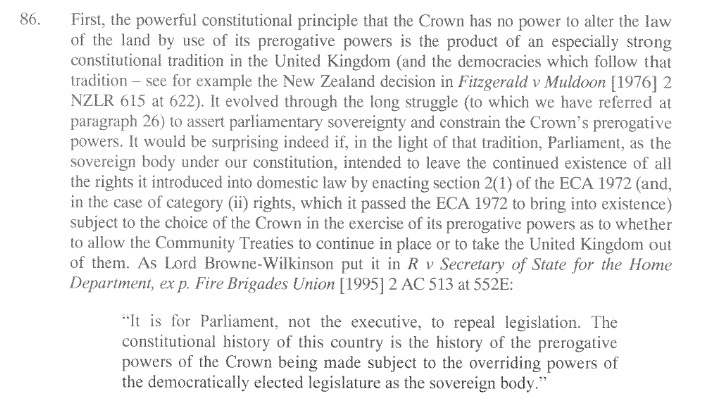
The UK High Court has ruled that it is for Parliament, not the executive, to trigger Article 50 and exit the European Union. And the reason for the judgement? Good old Fitzgerald v. Muldoon:
Brexit86

Basicly, Brexit means the effective repeal of legislation - and legislation of such constitutional significance that it is the UK's only higher law protected from implied repeal, at that. And that can only be done by Parliament, not the exercise of monarchical prerogative power.

The judgement is of course being appealed, and will go straight to the Supreme Court. It may be upheld, it may be overturned. But in the meantime it's a welcome blow for Parliamentary sovereignty against the executive - and the decaying legacy of the monarchy.

(Title of course thanks to pterry. You can find the source in Monstrous Regiment).

Thursday, November 03, 2016


Still unfit for purpose

The Inspector-General of Intelligence and Security has released their second annual report [PDF]. The headline news? The SIS is still unfit for purpose:

Overall, I conclude that some further work is required before I can assess NZSIS’s compliance procedures and systems as sound

Or, to put it in English: the Inspector-General does not have confidence that the SIS is obeying the law or will notice if it is not.

As the Inspector-General makes clear in their annual report, this is a fundamental requirement for any modern intelligence service. And the SIS has failed to meet it in both years when it has been required to be publicly certified. Which really calls into question the lawfulness of everything they've ever done.

And that's not the only problem. As the Herald points out, the SIS also appears to be resisting IGIS oversight:
In early 2015, Gwyn raised a serious issue about whether certain SIS activity was lawful and, if not, how that could be remedied.

"I raised the issue with the Director in June 2015 and provided the Director with detailed provisional findings on my view of the legality of the activity in August 2015. The NZSIS provided its first substantive response to the questions raised in March-April 2016," Gwyn wrote in the annual report, released today.

While she appreciated the issue was complex and substantial work is underway on the questions raised, Gwyn said the "time taken to engage with and resolve this significant issue is in itself a matter of concern".


With these sorts of problems, the government would be mad to even consider granting an agency like the SIS further powers. But that is exactly what they're doing. The opposition parties should reject these efforts and commit to repealing any extra powers given to this lawless agency.

So much for spam bills

The National Party became a subject of ridicule over the last few months when Nuk Koroko's Airport Authorities (Lost Property) Amendment Bill was drawn from the ballot. The bill did nothing, and apparently existed solely to take up space in the ballot and prevent Parliament from debating a more worthy bill. It was swiftly followed by Matt Doocey's Companies (Annual Report Notice Requirements) Amendment Bill, which isn't quite as pointless, but existed for a similar purpose. Both bills could easily have been incorporated into the Statutes Amendment Bill currently progressing through Parliament, and obvious questions were raised about why they weren't.

The good news is that now they have been, thanks to SOPs from Labour and ACT. And as a result, the House will be free to debate more substantive bills. Unless of course National comes up with a new load of spam to stuff into the biscuit tin...

Why is WINZ making people sign unlawful employment contracts?

NewsHub has exposed the fact that WINZ is forcing beneficiaries to sign blatantly unlawful employment contracts with an Australian labour-hire company to get them off their books:

A Newshub investigation has revealed a major recruitment company is signing up beneficiaries to legally questionable employment contracts.

Global recruitment company Manpower Group is looking for temporary workers and Work and Income is helping to provide staff.

[...]

[O]ne of the clauses in Manpower's contract gives the company power to collect and pass on their workers' sexual preferences and practices, race, religious beliefs and political views.

[...]

However it's not just what was in the contract, but also what wasn't.

There was no detail of the hours, pay rate, work description, location or duration of the job.


This very obviously breaches section 23 of the Human Rights Act (which prohibits the collection of information in a manner which indicates a desire to discriminate) and section 65 of the Employment Relations Act. Its so blatant that you'd expect even the muppets at WINZ to recognise it. And yet they're standing over people, implicitly threatening to cut their benefit if they don't sign.

I think WINZ owes us some answers on why they're leaning on beneficiaries like this and helping a foreign company break the law. As for Manpower, they should be prosecuted.

New Fisk

The tales of bodies and blood that surround a front line in Syria

A good move

The government is explicitly banning schools from using "seclusion rooms":

Seclusion will be outlawed following worrying cases where teachers locked autistic children in rooms alone for hours at a time.

Education Minister Hekia Parata said she planned to make the use of seclusion in schools illegal and release guidance, developed by an advisory group, so schools had a clear understanding of how to deal with challenging behaviour.

The majority of schools had good practices in place for managing challenging behaviour of a small number of students in a safe and inclusive way, Parata said, adding that dealing with this behaviour can be "very difficult".

"But in today's world there is no situation where it is acceptable for seclusion to be used in schools or early childhood education services, so I want to make that clear in the law."


Good, but given that Parata was first advised of this problem last year, you have to wonder why she took so long to act on it - and how many children were tortured by their schools as a result of her inaction.

Wednesday, November 02, 2016


McCully lied to Cabinet

The Auditor-General has released their report into Murray McCully's sordid Saudi sheep bribe. While they find it was not a bribe in the tightly criminal sense of whether Murray McCully is liable for prosecution under the Crimes Act (of course he's not - he was the briber, not the recipient), they're very clear that it was a payoff to Hmood Al Ali Al Khalaf to achieve a diplomatic objective (i.e. a bribe in the ordinary sense of the word). They criticise the contract under which the money was paid for deliberately obfuscating this objective and hiding the fact that it was first and foremost about resolving a diplomatic dispute. But most importantly, they find that Murray McCully basicly lied to Cabinet in his papers promoting the deal:

I found some significant shortcomings in the Cabinet paper, including that it:
  • did not clearly explain that the Al Khalaf Group would own the goods and services costing the New Zealand Government $6 million;
  • did not identify how the $10 million figure was arrived at (a figure that has since risen to $11.5 million);
  • signalled the risk of a claim against the Government based only on the $20-$30 million figure that the Cabinet paper said was suggested by the Al Khalaf Group (there was no assessment by Ministry officials of the substance of that legal risk);
  • did not include any analysis about whether there were any other potential obstacles to the signing or ratification of the free trade agreement, apart from the concerns of the Al Khalaf Group about the export of live sheep or the assertion by the Gulf Cooperation Council that this was the only obstacle to the free trade agreement; and
  • identified that New Zealand exports could double to $3 billion in five years if a free trade agreement was signed with the Gulf Cooperation Council, without including any analysis.
Based on these significant shortcomings, I am concerned at the lack of robust analysis and the quality of information that was provided to Cabinet on this matter.

Cabinet approved the money based on these obfuscations by McCully. The Auditor-General deliberately refuses to comment on the quality of Cabinet's decision, but any flaws in it can only be the fault of the poor information supplied by McCully. More importantly, Cabinet Ministers owe their colleagues a duty of candour in Cabinet discussions. McCully has violated that duty. He should resign as a result.

Finally, the Auditor-General criticises the government for its secrecy on this issue. The public are owed transparency on what the government is doing with our money and what (if anything) has been achieved. They failed on this front as well - primarily due to the efforts of McCully to hide the fact that he had given poor advice and effectively bribed a foreign government. That's not acceptable either, and something he should be held accountable for.

23,000 unemployed under National

The Labour Market Statistics were released today, showing that unemployment has dropped to 4.9% - the first time it has been under 5% in National's entire 8 year term of office. And yet there are still 128,000 unemployed - 23,000 more than when they took office.

Not that 5% unemployment is anything to crow about. Labour managed to get it down to 3.5% and less during their term by manipulating monetary policy. National has simply let it fester to keep wages low. And the result is widespread poverty and a more unequal society. It would be nice to have a government which actually prioritised these issues rather than abandoning people to the market.

New Fisk

'We were living a real tragedy in east Aleppo': One family's journey across the city amid the bloodshed
Aleppo’s agony is far from over as Syrian general seeks further battles

The orcs are back

National wants to let an Australian mining company prospect on conservation land:

An Australian gold mining company is applying for consent to explore a large area of Northwest-Nelson conservation park land, but says it will only use hand-held tools in its exploration work.

Strategic Elements this week has been exploring 5559 hectares that contains the historic Aorangi gold mine bordering the Kahurangi National Park.

The company has been interested in the area for several years and in 2012 it gained a permit to study a 134 square kilometre area around the Golden Blocks goldfield.

It is currently seeking consent from the Department of Conservation to further explore a smaller area that includes the Aorangi Mine.


The Crown Minerals Act permits this sort of minimum-impact prospecting. But its sole purpose is to build a case for industrial gold mining in a highly sensitive part of the conservation estate.

The land in question should be part of Schedule 4. It was recommended for inclusion in Kahurangi National Park when it was formed due to its high conservation values, but excluded due to an unresolved Treaty claim. That claim has now been resolved, and thanks to the generosity of Ngāti Rārua the land has been gifted to the crown for conservation purposes. It should therefore be included in Kahurangi as quickly as possible. If its not, then I think we need to acknowledge that it is Ngāti Rārua's gold and that the government is violating its duty to protect it and its Treaty settlement obligations.

Tuesday, November 01, 2016


Donald Trump: Tax cheat

Now there's a surprise: it turns out that Donald Trump is a tax cheat:

Donald J. Trump proudly acknowledges he did not pay a dime in federal income taxes for years on end. He insists he merely exploited tax loopholes legally available to any billionaire — loopholes he says Hillary Clinton failed to close during her years in the United States Senate. “Why didn’t she ever try to change those laws so I couldn’t use them?” Mr. Trump asked during a campaign rally last month.

But newly obtained documents show that in the early 1990s, as he scrambled to stave off financial ruin, Mr. Trump avoided reporting hundreds of millions of dollars in taxable income by using a tax avoidance maneuver so legally dubious his own lawyers advised him that the Internal Revenue Service would likely declare it improper if he were audited.

Thanks to this one maneuver — which was later outlawed by Congress — Mr. Trump potentially escaped paying tens of millions of dollars in federal personal income taxes. It is impossible to know for sure because Mr. Trump has declined to release his tax returns, or even a summary of his returns, breaking a practice followed by every Republican and Democratic presidential candidate for more than four decades.


No wonder he won't release his tax returns.

And OTOH, do we really think any other member of America's financial-political elite is really any different? Their defining belief is that laws are for little people; I doubt they'd treat tax laws any different.

National's New Zealand

Another reminder that in John Key's "rock star economy", the real growth industry is foodbanks:

An increase in the number of people needing food donations is placing pressure on Palmerston North food banks and support staff in the build up to the busy Christmas season.

Methodist Social Services experienced a spike of new people in August, with 34 needing food donations - the highest monthly amount for the past three years.

A total of 106 new people required assistance in the past four months, more than half of the total amount for the 2014/15 financial year.

In the past four months the charitable organisation has already seen 1147 people, including a number of children.


And the reason for this is obvious: low wages, persistent high unemployment, sub-starvation benefit levels and a WINZ culture of denying people support. But hey, rich Auckland property speculating MPs are making out like bandits, so everything must be good, right?

Open Government: Shamed by Australia

Two weeks ago the government finally released New Zealand's second Open Government Partnership action plan. It was a pallid, unambitious document, continuing the government policy of trying to do as little as possible while not spending any money or changing anything substantive - in other words, exactly what the SSC ordered.

Australia has also just released its new action plan. It has twice as many commitments as ours, and they're substantial, rather than technical tweaks. And they're promising all the stuff that we demanded and didn't get: improved whistle-blower protection, improved transparency on beneficial ownership, greater political transparency, a whole-of-government framework for enhanced public participation, and real FOIA reform. Unlike New Zealand, these are ambitious and meaningful reforms which will make a difference. And it certainly puts us to shame to have this promised by the anti-transparency, anti-open government Australians.

The Australian plan is an example of what we could have done, if the process had been started earlier and if it had been overseen by a Minister and department actually committed to change, rather than viewing the OGP solely as an opportunity for PR and overseas junkets. And its a reminder that we can and should do much better in this area.


