Wednesday, July 20, 2022


A conspiracy against the public

Earlier this year the government held a public consultation on proposed changes to the election donations regime. Naturally, political parties - who have a strong interest in the rules around donations and what they have to disclose - submitted to it. But the Ministry of Justice cooked up a crooked deal to keep those submissions secret:

The Ministry of Justice struck a deal with political parties to keep secret their submissions on donation law reform.

[...]

As part of the reform, political parties – and the public – were asked for their feedback on a range of policy options.

The ministry says it will release submissions from ordinary people. But it will not disclose those from three political parties.

“The political parties which the ministry received submissions from, provided these on a confidential basis,” Kathy Brightwell, general manager of civil and constitutional policy said in response to an Official Information Act request from Stuff.

“These parties may not have provided submissions if they knew they were going to be identified, so it would be within the public interest to withhold their submissions, as release of this would likely prejudice the supply of similar information, and it is in the public interest that the ministry can continue to consult with political parties in the future.”

Weirdly the Ministry can't even keep its story straight on how many parties it granted confidentiality to - they told me it was only one. But either way its bullshit. Firstly, because the idea that political parties would not submit on a consultation about the rules they operate under is simply absurd and does not even pass the laugh test. Secondly because insofar as there is any obligation of confidence, it can apply only to truly confidential information, such as membership and financial numbers - not to the views of the parties and the arguments they are using to try and influence policy. Thirdly, because of the public interest: this is an issue which is the subject of widespread public disquiet. Bluntly, the parties are perceived as writing the rules to suit themselves, in flagrant disregard of public demands for greater transparency (which are themselves driven by real questions about who is buying our politicians). This refusal is simply going to strengthen that disquiet and that perception, to the detriment of our democracy.

Of course, while the Ministry says "parties", the party in question is Labour. We know this because National has already publicly released its submission, while Labour refused to do so. Why not? The obvious reason is that they believe that the public will not like what they are saying, and will judge them for it at the ballot box. But we should judge them on their refusal as well. If a party isn't willing to be open about its views on electoral donations, the public should judge them as corrupt-by-default. There are clean parties out there - vote for one of them instead.

Tuesday, July 19, 2022


Climate Change: A case to watch

Back in 2019 our parliament passed the Zero Carbon Act. The Act was modelled on the UK's Climate Change Act, and has a similar scheme of five-yearly budgets, with detailed government plans to meet them. But after initial success, its no longer working out so well in the UK - their most recent strategy lacked ambition, while key measures weren't funded. And now, the UK's high court has ordered the government to clarify its measures:

The high court has ordered the government to outline exactly how its net zero policies will achieve emissions targets, after a legal challenge from environmental groups.

Friends of the Earth, ClientEarth and the Good Law Project had all taken legal action over the government’s flagship climate change strategy, arguing it had illegally failed to include the policies it needed to deliver the promised emissions cuts.

In a judgment handed down late on Monday, Mr Justice Holgate said the strategy lacked any explanation or quantification of how the government’s plans would achieve the emissions target, and as such had failed to meet its obligations under Climate Change Act (CCA) 2008.

The strategy hasn't been overturned, but the government will need to report to parliament on the details of what its measures will achieve. And if it falls below the statutory targets, then it will be overturned. Which I guess is another reason why the Tories want to get rid of judicial review...

The application to Aotearoa ought to be obvious. We have the same framework, and the government's first emissions reduction plan is craven, status quo policy which won't achieve even the weak targets they've set. It seems ripe for a challenge...

Monday, July 18, 2022


Corrupt cops should be named, shamed, and fired

On Thursday the Independent Police Conduct Authority found that a senior Northland police officer had improperly involved himself in a prosecution to protect a mate's son from an assault charge. As usual for the IPCA, they refused to name the officer, despite a finding that fundamentally called into question their fitness for a leadership role. But the Northern Advocate was on the case, and on Sunday night they named and shamed him:

The identity of the senior Northland police officer who "improperly influenced" a senior prosecutor to withdraw an assault charge can now be revealed.

Whangārei-Kaipara police area commander Inspector Marty Ruth was called "Officer B" in an Independent Police Conduct Authority (IPCA) report which found he had intervened in a prosecution on behalf of an associate.

[...]

The police watchdog found Ruth's action breached a police policy on conflicts of interest because of his business connection.

Ruth - second in command of police in Northland - denied to the IPCA that he had breached the policy. The Advocate has asked Ruth for comment and received no response.

And it turns out that Inspector Ruth has a long history of abuse. Back in 1999 he was found by a judge to have been making fake interview recordings of suspects, while conducting the real interviews - complete with threats and violence - off-camera. Despite this, the police continued to employ him. The police tell us that they've changed, and that they're not that bad old agency anymore. But that's hard to believe when they're full of the same people doing the same things, and when their response to judicial or IPCA findings of abusive, corrupt, or even criminal behaviour is to resolutely look the other way.

The Police Manual chapter on internal Fraud and corruption defines corruption as "The abuse of entrusted power or the lack of integrity or honesty (typically involving bribery) for private gain". It gives examples of

  • Deciding not to take some action, such as to investigate or highlight some corrupt activity by a person, when that inaction improperly benefits them, you, or some other person...
  • Intentionally circumventing Police policy or procedure in order to obtain an advantage for themselves or another person...
  • So‐called ‘Noble Cause Corruption’‐ Includes the intentional avoidance of correct procedure to achieve the best result, such as planting or fabricating evidence, lying on reports or in court, and generally abusing police authority to achieve a conviction...
Its is left as an exercise for the reader to judge whether Inspector Ruth's actions met that definition.

The same policy claims that "New Zealand Police has zero tolerance for fraud and corruption. Police does not and will not accept fraud or corruption at any level, or in any form, occurring in our organisation". I look forward to them applying it. Because allowing an officer who has been found on multiple occasions to have behaved corruptly to remain in a senior leadership position is obviously untenable. It undermines the police's integrity, and the message police leadership is supposedly sending to junior officers about what is and is not acceptable behaviour. It also very obviously undermines public trust and confidence in the police and their role as impartial upholders of the law. And that is unacceptable. This corrupt officer must be fired.

Thursday, July 14, 2022


Straight-up police corruption

Another report from the Independent Police Conduct Authority today, on a senior police officer who improperly involved himself in a prosecution to protect a mate's son from an assault charge. The IPCA finds that this was improper and a conflict of interest (well, duh), but they fail to call it what it is: corruption. Because while it doesn't involve money, abusing your power to benefit your mates is corrupt, and not something we should tolerate in our society.

But it gets worse, because buried in the full report is this little titbit: it seems the officer in question is a serial offender:

Officer D said he could recall only one other occasion when Officer B spoke to him about an investigation file and that was also where Officer B knew both the parties involved.
The police's response? They claim to accept the findings, and apparently there was an "employment process". But they don't say that the officer was fired, which suggests that they are tacitly accepting this sort of serial corruption. Which fails any reasonable standard of public probity. So why should we trust the police as impartial arbiters of the law again?

Meanwhile, the police are refusing to name the serially abusive officer who was the subject of two IPCA reports on the same day last month, and who was prosecuted for assault, pleaded guilty, and was convicted. They're also refusing to release their complaint record (which would be... informative if it shows a pattern of abusive behaviour which was ignored by police). They also took no employment action against the officer whose lies to defend their mate were so egregious that even the poodle IPCA was forced to note that they "lacked credibility". Such information is routinely released overseas, and is an important tool for investigating police misconduct and holding police to account - but apparently not in Aotearoa. Which is I guess another example of our police's everyday corruption: they protect their own, even when they have admitted to crimes and been convicted.

Wednesday, July 13, 2022


More British war crimes

Back in 2017, the ABC revealed that Australia's SAS committed war crimes in Afghanistan, murdering prisoners and civilians, and taking body-parts as trophies. Now, the BBC has exposed the same behaviour in the British SAS:

SAS operatives in Afghanistan repeatedly killed detainees and unarmed men in suspicious circumstances, according to a BBC investigation.

Newly obtained military reports suggest that one unit may have unlawfully killed 54 people in one six-month tour.

The BBC found evidence suggesting the former head of special forces failed to pass on evidence to a murder inquiry.

The ABC story led to a full government inquiry, which found Australian troops had committed at least 39 murders. The most guilty unit was disbanded, and prosecutions are in process. So far, the British government's response has been to accuse the BBC of putting soldiers at risk. But given their past history of obstructing investigations, while pushing for amnesty legislation to outlaw domestic prosecutions of English war criminals, an Australian-style response seems unlikely. But if Westminster won't hold its own to account, then we'll just have to rely on the International Criminal Court to do it for them.

Tuesday, July 12, 2022


Limiting rights needs justification

cropped-20190714_makeit16_logo_v2-8

If the government wants to violate the Bill of Rights Act, does it need to actually justify it, and what happens if it doesn't? That's basicly the issue in question today in the Supreme Court, where activists of the Make it 16 campaign are challenging the voting age. The current law limiting the right to vote to those over 18 is a prima facie violation of the right to be free from discrimination on the basis of age (which means "any age commencing with the age of 16 years"). But the government, in defending that law, simply didn't bother to make a case that the discrimination is demonstrably justified in a free and democratic society. The Court of Appeal thought that didn't matter, and declined to issue a declaration of inconsistency. But given the structure of our Bill of Rights Act, the onus is surely on the government to prove that limiting rights is justifiable. And while the level of justification required can vary depending on the nature of the question, not providing any at all must surely lead to a conclusion that the limit is arbitrary and unreasonable, and therefore unjustified and inconsistent. And if not, it invites people to draw that same conclusion of the court.

Not that a legal victory will result in a direct change to the law - s4 of the BORA is crystal clear on that. But it will provide a powerful moral argument for change, and put the pressure on Parliament to step up, do its job, and amend the law to be consistent with the BORA. And if Parliament drags its feet or fails to do that, we voters should judge them harshly for it.

The sin of cheapness

On Monday, RNZ reported on the results of testing CO2 levels in various places, which showed that Auckland buses had CO2 levels of 5737ppm, making them effectively covid-filled sewers (CO2 is a proxy for exhaled air, which in the current situation is a proxy for covid). As with school classrooms, its a problem that could be mitigated with proper ventilation and filtration. But Auckland Transport had ruled out fixing it due to cost:

Auckland Transport acting group manager of metro services Darek Koper said plans to improve air quality on buses were dropped due to cost.

"Based on the financial assessment of costs for the identified air treatment options and the efficacy and safety of the systems, it was decided to abandon the plans to introduce air purifications systems or introduce more fresh air onto existing buses and trains."

He said the investment required to change the public's perception of safety "without the scientific evidence and subject matter expert support" presented a challenge in justifying such investment.

What this actually means is that they're dumping the cost on the health system, while running an unsafe work environment (which ought to be of interest to WorkSafe). And not just because of covid - high CO2 concentrations have a significant effect on cognitive ability, putting the drivers at greater risk of accidents. But that's just not on Auckland Transport's budget, and there's no regulation requiring it to be - astoundingly, Waka Kotahi regulates almost everything about bus design except air quality. And this institutional blindness has turned the entire public transport system into a public health threat.

But I guess its just the government's covid response writ small: they want covid to go away, but they're not actually willing to commit resources to make that happen. To their minds, gaslighting us while we get sick is just cheaper. And if that results in higher costs due to Long Covid later, well, they're just not thinking about that either.

Friday, July 08, 2022


13,000

There's a lot going on today - the political circus in Westminster, an apparent political assassination in Japan, the ongoing war in Ukraine - but the only story that matters is this one: there were 13,344 new community cases of Covid-19 reported in Aotearoa today, and a further 23 deaths. That, and the government's repeated refusal to do anything at all about it - not even a public mask mandate, let alone work from home support or lockdowns. I've castigated Labour as chickenshits over the years - but now their chickenshittery has a bodycount: 1600 people so far, and between four and eight thousand a year on current numbers. And for what? So they can avoid criticism and bad headlines from certain noisy industries whose profitability depends on us all being exposed to risks.

Well, fuck that. The first duty of the government is to keep us safe. And Labour is failing that duty. And whether it is from cowardice or sociopathy is immaterial: I can never forgive them for it. And neither should you. A government which just lets us die is not worth anyone's support (some would say its not really a "government" at all).

And because some people will need it said explicitly: the other bunch also being sociopathic murderers isn't an excuse. Both major parties are failing the most basic test of governance, and fail to meet even the most minimal ethical standards we should expect from our "leaders". They need to do better, or fuck off.

Update: And the Ministry of Health is now saying there was a computer glitch, and today's number is only 9,318. Which is good, so far as it goes, but it really only delays the anger by a week.

Thursday, July 07, 2022


Some light in Australia

Back in 2013, a former ASIS agent blew the whistle on how the Australian government had illegally bugged the leaders of East Timor in order to listen in on their negotiating position over oil and gas rights in the Timor Sea. When the issue was raised in the International Court of Justice, the Australian government raided the homes of both the whsitleblower and East Timor's Australian lawyer, then charged them with revealing classified information. But today, at least part of that persecution has been ended, with the Australian government dropping against lawyer Bernard Collaery:

Attorney-General Mark Dreyfus has ordered the Commonwealth to drop the prosecution of lawyer Bernard Collaery, four years after he was charged with conspiring to release classified information about an alleged spying operation in East Timor

Mr Collaery was charged in 2018 for allegedly helping his client, an ex-spy known only as Witness K, to reveal details of the classified ASIS mission.

This is good, but its not enough - Collaery was persecuted for five years, essentially for representing a whistleblower. His client, "Witness K", was forced to plead guilty and convicted. They should be pardoned, and both should be compensated. The people who orchestrated that persecution need to be fired. But most importantly, Australia's "national security" laws need to be repealed to protect the public interest in leaking, so this can never happen again.

Wednesday, July 06, 2022


The real cost of cars

At the moment a big chunk of the transport policy that isn't focused on building roads is focused on decarbonising the vehicle fleet, via policies like the clean car standard, feebate system, and scrappage scheme. The underlying justification for this is the need to rapidly reduce greenhouse gas emissions. That's vital, but at the same time it looks like we've been missing the elephant in the room: air pollution:

In findings which have startled scientists, new data shows car pollution is killing thousands of New Zealanders each year and costing the country billions of dollars.

[...]

It found 3300 people were dying yearly because of air pollution, and it was mostly because of cars.

That meant as a whole, 10 percent of the people who died each year in the country were dying because of air pollution.

Exposure was also sending more than 13,000 people to hospital for respiratory and cardiac illnesses and giving the same number of children asthma.

The social cost of these health impacts was estimated to be $15.6 billion.

And that's per year. To give an idea of this, the total cost of all road transport greenhouse gas emissions (13.18 million tons at $150/ton) is just under $2 billion a year. So air pollution is almost eight times larger - and apparently not factored into our calculations at all.

This should have a massive effect on all future benefit-cost analyses of future transport spending. The good news is that the sorts of solutions which eliminate transport carbon emissions - mode shift, public transport, and switching to EVs - also eliminate air pollution: you don't get nitrogen dioxide from inefficient combustion when you don't burn anything. So it pushes in the same direction we want to go in, only much, much faster. How fast? Well, if we assume that every one of the 4.4 million vehicles in Aotearoa is a large car (they're not), costing $40,000 to replace (the average in 2021), then full replacement would cost $176 billion. Factoring in the cost of air pollution means it pays for itself in twelve years. Which is about the sort of timescale we need to change in to avoid climate disaster.

Climate Change: Calling bullshit on He Waka Eke Noa

Last month, farmers released their proposal for emissions pricing, which was a scam from start to finish, packed with artificially low prices subsidised by the rest of us, bullshit "offsets" also subsidised by the rest of us, and predatory delay. Today, the Climate Commission released their assessment of the proposal, in the form of a statutory report on Progress towards agricultural emissions pricing. And while they're polite about it, they basicly call bullshit on the whole scam. The important takeaways:

  • Farmers are already breaking the promises they made to us about monitoring their emissions;
  • Years of predatory delay and farmer recalcitrance means they can't implement what they're proposing;
  • A lot of what they are proposing - in particular, the entire "offset" scheme - is bullshit anyway, since its neither real nor additional - not additional because its claiming credits for stuff that was already happening, and not real because the supposed "reductions" are not scientifically supported and so not recognised in our inventory. They do however suggest that the government could recognise some of it outside the emissions pricing system, e.g. by paying directly for biodiversity protection (which isn't a terrible idea);
  • The magic technology farmers are relying on to lower emissions without them having to change their practices isn't going to arrive any time soon, and will take time to be recognised in inventories anyway;
  • The 95% free allocation promised by the government is likely to result in significant overallocation, and needs to be ditched;
  • While they don't talk about subsidised emissions prices, they've basicly done a whole other report on that, which pans the idea;
  • The He Waka Eke Noa scheme is unfair to other New Zealanders.

So what do they recommend? Essentially, taking the He Waka Eke Noa proposal for farm-level pricing, and ripping out all the subsidies and bullshit - which will also make it much easier to implement. What this is likely to look like in practice initially is a per-animal levy, which in theory provides a direct incentive for more efficient production (and in practice provides an incentive for farmers to whine about being "taxed"). Offsets would be handled via the ETS, with the promise that if more stuff is internationally recognised then it will be incorporated (which is fair enough). As there's no emissions benefit in pricing fertiliser at the farm level, it should be bought into the ETS as quickly as possible at the producer level, with a much lower level of free allocation (the first bit is easy, as it is already provided for; the second bit will require a law change to tweak a definition or move fertiliser production to industrial activities, where it belongs).

So now we have a real test for the government: do they listen to the expert body they appointed to provide credible, neutral advice, or do they listen to whining farmers? While I'm hoping for the former, given Labour's other chickenshittery, it'll probably be the latter. In which case farmers need to be told firmly that whatever deal they think they've got will be renegotiated and unilaterally altered the moment the Greens have the leverage to do so.

Tuesday, July 05, 2022


Labour on the wrong side of history

Last week, Stuff asked Associate Education Minister Kelvin Davis about compulsory te reo Māori in primary schools. And as usual for Labour, he firmly rejected the idea, citing fears of a public backlash. Today, Stats NZ released data from the 2021 General Social Survey, showing us thatfears of that backlash are imaginary. In addition to a welcome uptick of use of te reo, there was also this:

62 percent (up from 57 percent) of people agreed or strongly agreed that te reo Māori should be a core subject in primary schools

57 percent (up from 53 percent) agreed or strongly agreed that the government should encourage and support the use of te reo Māori in everyday situations

56 percent (up from 51 percent) agreed or strongly agreed that signage should be in both te reo Māori and English

Which makes sense. There's been a significant change in public use and acceptance of te reo in the past few years (which comes on top of significant change over the course of my life). There's a public recognition that te reo is a taonga, one of the things that makes Aotearoa Aotearoa. Its everywhere now - on the street, on TV and radio, in government press conferences. And apart from a few dirty old racists (who are gradually dying off), we like this, because its who we are now.

And in the face of this change - which they helped promote years ago - Labour is resolutely on the wrong side of history. As with capital gains taxes. They need to learn to read the fucking room. But maybe the real problem is that the only room they're interested in is the one full of rich old racists?

Friday, July 01, 2022


Labour fucks us on copyright again

Last night the government concluded a free trade agreement with the European Union. I'm pretty meh about FTAs, largely because they seem to be a backdoor for pro-corporate irregulation than actual trade now, so I wasn't enthusiastic to begin with (though on the plus side this one does at least make the Paris climate agreement legally enforceable, meaning that if farmers don't cut their emissions they can be cut out of the market). And then I read the bit in the "key outcomes" summary about copyright:

New Zealand has agreed to extend copyright term by 20 years for authors, performers and producers. New Zealand will also extend the protection it gives to digital locks (technological protection measures) to include preventing a person undertaking an act to circumvent those locks other than in limited circumstances. New Zealand will have four years from entry into force of the Agreement to implement these changes to the Copyright Act 1994.
Labour had already sold us out on term extension in their FTA with the UK, but at least that had a 15 year transition period. Now we'll have four. And with the FTA expected to enter into force around 2024, that means nothing will enter the public domain in New Zealand from 2028 or so. Immediate casualties will include Mary Scott (whose works would otherwise enter the public domain in NZ in 2030), Dennis Glover (2031), Bruce Mason (2033) and Ngaio Marsh (2033). They're literally going to be locking our culture away from us, forbidding the production of adaptations and derivative works for a further twenty years.

And they're doing this when the government admits there is no benefit to New Zealand from term extension, and that it does not further incentivise the creation of new works - the latter meaning that term extension violates the Bill of Rights Act. They're also doing it when MFAT and MBIE had told parliament back in April that they would "provide advice on mitigating factors that may guard against the potential harm of the copyright extension term". Against that backdrop, cutting a deal to do it even faster seems a lot like lying to Parliament to me.

Thursday, June 30, 2022


Drawn

A ballot for one member's bill was held today, and the following bill was drawn:

  • Sale and Supply of Alcohol (Harm Minimisation) Amendment Bill (Chlöe Swarbrick)

Swarbrick's bill implements a number of past recommendations from government agencies and advisory bodies which for some reason (cough big booze money cough) have remained unimplemented. One of these is to remove a special-purpose appeal chain over territorial alcohol policies, which is something I am wary of. OTOH, the way that appeal process works is by preventing the policies from ever coming into effect, which seems to frustrate the law, and general appeal rights such as judicial review remain. So this would mean that territorial authorities actually get to make a policy (which can then be judicially reviewed), rather than stopping them from doing so.

There were only 61 bills in the ballot today.

Wednesday, June 29, 2022


The police lied in an OIA response

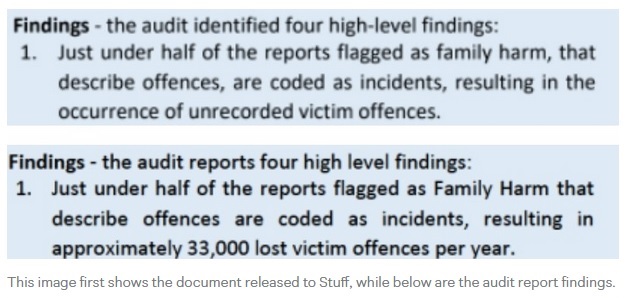
Stuff has a story this morning about the police juking the domestic violence stats, downgrading family violence crimes to "incidents" so they don't have to be investigated (and so Bad Number doesn't Go Up). That's appalling in and of itself, for the human consequences, and for what it says about the police's attitude to victims, their job and to accountability. But there's another appalling thing buried well down in the story: the police lied in an OIA response:

It said it did not release the full report publicly in line with “standard practice”. The 33,000 number was left out of a summary provided to Stuff under the Official Information Act because it could have been “misinterpreted”, it said. It only decided to release the full text after the Ombudsman stepped in.
The difference can be seen in the screenshot below:

Stuff-Police-OIALie

The Ombudsman has apparently decided that releasing an intentionally misleading summary was wrong. But it raises other questions as well - namely whether protecting your institutional reputation is a "benefit", or whether depriving the public of information they are entitled to causes "loss". Because if either is true, the police staff responsible for this fraudulent release may in fact have committed the crime of altering, concealing, destroying, or reproducing documents with intent to deceive.

And if the answer to those questions is "no", we ought to be asking ourselves why lying in an OIA response is not a crime. It is in other countries, and the Ombudsman has recommended that we adopt similar provisions here. With agencies actually being caught lying in their responses, maybe the government should make that a priority? Because if agencies can just lie without consequences, the law means nothing, and public trust is dead.

Bigot schools are acting unlawfully

Earlier in the month we learned about institutionalised transphobia at Bethlehem College. The school is an "integrated school", meaning that it is state-funded while retaining a "special character". Stuff has now taken a look at several other similar schools, and found another three with institutionalised bigotry:

Three more state-funded Christian schools have been identified as having anti-queer policies, prompting advocates to call for a full-scale education inquiry into discrimination against the LGTBQI community.

[...]

The schools – Maranatha Christian School in Lower Hutt, Cornerstone Christian School in Palmerston North, and Matamata Christian School – say they only recognise marriage between a man and a woman, and only acknowledge two genders.

“Homosexual, lesbian or any other relationships or partnerships are seen as the outworking of mankind’s rebellious nature and therefore are not consistent with the school’s Special Christian Character,” Matamata Christian School says in its public statement of beliefs. “The term ‘gender’ is limited to the two separate and distinct sexes, the masculinity of the male and the femininity of the female.”

The bigotry is in the schools' official "statement of beliefs", which forms part of their integration agreement with the Ministry of Education. The problem is that it seems blatantly unlawful: both sex (which includes gender identity) and sexual orientation are prohibited grounds of discrimination in the Human Rights Act. While the Act allows "educational establishment[s] maintained wholly or principally for students of one sex, race, or religious belief, or for students with a particular disability, or for students in a particular age group" to discriminate on those grounds, there is no exemption for sexual orientation, or for sex or gender identity discrimination in co-ed schools. So, the schools are breaching the Human Rights Act.

Is the discrimination authorised by some other statute? It does not seem so. While the old Education Act 1989 authorised the Minister of Education to negotiate and approve integration agreements, which may "prescrib[e] the religious or philosophical instruction and observances that are to form part of the school programme after integration", no part of it authorises departure from the Human Rights Act (nothing in the new Education and Training Act 2020 seems to authorise it either). And insofar as an integration agreement actually contains clauses inconsistent with the Human Rights Act, they are void, and sections 3 and 19 of the BORA mean that they were beyond the power of the government to make anyway. Contracts must be consistent with the law, and the government cannot simply contract out of its legal obligations or ignore them when exercising its powers.

So what should happen? Pretty obviously, the schools should obey the law, cease discriminating against queer and trans students, and remove the offensive sections from their statements of belief. If they refuse, the Minister should exercise their powers under the Act, cancel the integration agreement, and refer them to the Human Rights Commission. The government should not be funding bigotry.

Member's day

Today is a Member's Day, and it looks like its back to local legislation for a while. First up is the committee stage of the highly controversial Canterbury Regional Council (Ngāi Tahu Representation) Bill, which would allow unelected appointees (and a disproportionate number of them, at that) on ECan. This was something Ngai Tāhu got used to under National's dictatorship, but there's a world of difference between appointing iwi representatives to an unelected body, and appointing them to an elected one. It might be a good way of recognising the Treaty relationship, but I'd want to see a much bigger constitutional conversation about it before proceeding.

Following that, there's the rather boring Palmerston North Reserves Empowering Amendment Bill, which is about letting my local council sell a former reserve (which they have deliberately neglected) to property developers so it can become another motel on Fitzherbert Ave. I oppose this, but the best way of dealing with it is to vote some arseholes out in October, so the council never uses the powers the bill grants.

After that, we have some first readings. First is some National-style law-and-order bullshit from Greg O'Connor, in the form of the Child Protection (Child Sex Offender Government Agency Registration) (Overseas Travel Reporting) Amendment Bill. Like a lot of law-and-order bullshit, it contravenes the Bill of Rights Act. Labour will vote it through anyway, because O'Connor is one of theirs. Which is about the level of "protection" Parliament gives to our human rights, and shows why we need a much stronger constitutional protection framework. Then its the first reading of Damien Smith's Overseas Investment (Exempt Investment from OECD Countries) Amendment Bill, which is about gutting overseas investment protections for people from rich, overwhelmingly white countries (which sounds very ACT, doesn't it?). If the House moves quickly I expect it to make a start on Chris Baillie's Repeal of Good Friday and Easter Sunday as Restricted Trading Days (Shop Trading and Sale of Alcohol) Amendment Bill. There should be a ballot for at least two bills tomorrow.

Tuesday, June 28, 2022


The police still suck at the OIA

Last year, sparked by the contrast between the official OIA statistics police reported to PSC, and their actual performance experienced and seen over FYI, I asked some questions about their numbers - and discovered that their official statistics were a lie. Once you remove the routine traffic crash reports and speed camera requests, which the police do not treat or track as OIAs (except for the purposes of reporting a big number to TKM-PSC) then their performance was dismal: 42.5% on time rather than the reported 95.3%.

I thought I'd do a followup on this, so I asked for calendar-year 2021 statistics to extend the existing dataset. The response shows that while their performance has improved, it is still unacceptably low, with only 76.8% of OIA requests processed by PNHQ completed on time (this compares to 42.5% in 2020 and 35.8% in 2019).

I also did a followup on a previous request (which I don't think I'd published) about the proportion of requests marked as "high organizational impact" (HOI). Requests marked in this way require extra scrutiny from legal and media teams, signoff by the police executive, and are notified to the Minister. The earlier results showed that the number of HOI requests was small but growing, making up 1.1% of requests in 2019 and 10.2% in 2020. This year, that number has exploded, with 32% of requests to PNHQ marked this way. And the resulting extra scrutiny has an effect on timeliness, with HOI requests being more likely to be late (63.8% on time vs 83% for non-HOI requests). This appalling performance is actually an improvement on last year (when only 30% of HOI requests were on-time), but HOI requests are still responsible for just over half of all late requests (231 late of 450 total).

In a normal organisation, the Ombudsman would be taking a pretty close look at why so many requests were being tagged in this way, and why it led to so many delays. But the Ombudsman cannot scrutinise police outside the context of a specific OIA complaint, so while they can notice individual problems (like this one, they can't do the usual practice investigation and examine the system as a whole. While it is within the functions of the IPCA, they are neither funded for or interested in general practice investigations. The Ombudsman pointed out that this was a problem in their submission on the OIA consultation back in 2019. The government has done nothing to fix it over the last three years. As a result, our most-request agency remains functionally immune from proper oversight, and continues to laugh at the law. The consequences of those arrangements can be seen in the statistics above.

Still digging

Over the weekend, the US Supreme Court followed through on its threat, and overturned Roe v. Wade, effectively outlawing abortion in much of the United States. People were outraged, in America and around the world. And in Aotearoa, this meant a lot of sudden questions for the National Party, which is led by a fundamentalist anti-abortionist, stuffed with fundamentalist anti-abortionist MPs, and which tends to take its lead from whatever crack the US Republicans are smoking this week. While National's fundy backbenchers celebrated the imposition of forced birth in America, Christopher Luxon desperately tried to backpedal on his past views and reassure the public that National had no intention of changing the law. Except that today, he's doubling down on being anti-abortion:

When asked about his views on Monday, he told Newshub he still has a pro-life stance.

"I acknowledge I have a pro-life stance at a personal level," he said. "Simon has his own views as do others in our Caucus. They should be free to express that but in this case, it was actually being misinterpreted as the National Party position and therefore it wasn't appropriate."

When asked what he thought about people who chose to have an abortion, Luxon reiterated his pro-life stance.

"As I said I have a pro-life stance. It's a very difficult and a very agonising decision," he said.

He is yet to clarify whether he still believes abortion is tantamount to murder despite Newshub asking early Monday morning.

Which rather casts doubt on all those prior "reassurances", doesn't it? But the real problem for Luxon is that, given that US conservatives have literally perjured themselves to gain power to impose theocracy, we just can't trust anything he says. Sure, Luxon says he won't change anything - but so did Gorsuch, Kavanaugh, and Barrett. And we know how that turned out. We should not make the same mistake here.

Monday, June 27, 2022


Two steps forward, one step back

The government is finally moving to improve transparency over party finances, lowering the donation disclosure threshold to $5,000. This is a good move, though it doesn't go as far as it should. And of course, there's a nasty twist:

The rules for larger donations are also changing. Presently parties must report all donations from a single donor that exceed $30,000 within 10 working days of receipt. Now the threshold will reduce to $20,000 – but these donations only have to be declared within 10 days during an election year.
...which means that in two years out of three, we won't be able to quickly see who is attempting to buy our political parties, instead learning about it after the policies have already been sold. This is a significant backwards step, despite the lowering of the trigger point, and its absolutely tone-deaf when the public has been consistently demanding more transparency. Heckuva job, guys. If you wanted to give the impression of a corrupt party with something dirty to hide, you're going the right way about it.

(If you want to see who's been buying our politicians recently, you can just look here).


