Friday, August 16, 2019


Not destined to be

Back in May, Destiny Church leaders Brian and Hannah Tamaki launched another political party. Despite consisting entirely of followers of their religion, they grandly called it "Coalition New Zealand", in a vain effort to suggest it was something broader. But when they applied for registration, submitters opposed the name, as being likely to mislead voters (which was perhaps the point). And as a result, they've been refused registration:

The Electoral Commission has refused to register Hannah Tamaki's political party, Coalition New Zealand.

The Destiny Church-derived party was refused registration because the name and logo was likely to mislead or confuse voters, the commission confirmed on Friday.

The Tamakis launched their political party in May and claimed the country would see "politics with teeth".


The party can simply reapply with another name. Hopefully next time they'll choose something more honest.

Meanwhile, its worth noting: this is the first party anyone can remember being refused registration for having a misleading name. Others have been refused for not having enough members, but not apparently for this reason. The closest parallel is that in 2014 the Conservatives were refused a misleading logo (it said "vote", and would have been right next to their circle on the ballot box, so likely to be viewed as a ballot-paper instruction). Which really does invite the question: what is it with bigots and deception?

A real mayoral race

Last local body elections, the race for Palmerston North mayor was pretty boring - basicly being the incumbent rugby meathead vs the convicted child-beater. As a result, 1500 people (including myself) simply left that part of the ballot paper blank (vs less than 300 for the council elections). The good news is that this time, we have some actual competition. And the race has had a surprising last-minute entry from the Green Party:

The Greens have put action on climate change centre stage for Palmerston North's mayoral election, endorsing activist Teanau Tuiono as their candidate.

The party two months ago chose incumbent councillor Brent Barrett and newcomer Renee Dingwall as council candidates, pitching Tuiono for mayor on Friday, the day nominations close.

[...]

[Tuiono] said he would stand up to tackle climate change, putting in place a local plan to prepare for the changes expected, and do what was possible to reduce effects on the environment.


This is good, both for electoral competition, and because its good to see a candidate focusing on what is really the only policy issue in town. Yes, Palmerston North is 10m above sea-level, so things have to get pretty bad before we're going to be drowned. But climate change is also going to mean floods and severe weather, which local authorities need to prepare for. More importantly, there's the need to reduce emissions to stop all that from happening, and that's something which requires leadership at all levels.

(Its also good to see the Greens running strong local body campaigns, and hopefully it'll pay off both in elected councillors and in a higher general election vote. Though, there's no-one running for Horizons carrying the Green banner, which is odd given that they decide both water quality and air pollution - which will mean CO2 if the government keeps its promises and puts climate change back in the RMA.

But its not all good news: because this time, we have not one, but two convicted child abusers running for mayor (child-beater Ross Barber is back, and he's joined by convicted child sex abuser Maruna "donut man" Engu). I guess Palmerston North is really living up to its reputation for quality mayoral candidates...

New Fisk

If Chinese tanks take Hong Kong, who'll be surprised? Land grabs are happening everywhere – and we're all complicit

Climate Change: Fuck Australia

The Pacific is on the front line of climate change, and if we don't cut emissions quickly, some countries are literally going to be underwater. Because of this, small Pacific states had tried to use this week's Pacific Islands Forum meeting to get Pacific countries to agree to ending coal use. Australia sabotaged it:

Australia has stymied efforts by small island states to get Pacific-wide consensus on their declaration for stronger action on climate change.

Regional leaders, including Australia and New Zealand, held 12-hour talks in the tiny Pacific nation of Tuvalu for this year's Pacific Islands Forum (PIF), eventually reaching an agreement on a statement on climate change and a communique early this morning.

They could not reach agreement on the Tuvalu Declaration made by smaller Pacific countries, instead drafting a separate Kainaki II Declaration, with different terms on coal use and emissions reduction.

The finished communique comes with a qualification that means the leaders do not support all of the declaration from the smaller nations.


So Australia's attitude is that the Pacific can drown before they will stop using coal (oh, and if climate refugees come to Australia, they'll put them in a concentration camp). That's not really being a good neighbour. Its certainly not being decent human beings. But Australia hasn't been either for a long time, has it?

Which is just another reason to not buy Australian - because if you do, you're effectively funding coal burning and the drowning of the Pacific.

Thursday, August 15, 2019


Nazis, prisons and mail

Everyone was outraged yesterday to learn that the Christchurch shooting accused had been able to send mail from prison to his Nazi fans, apparently pushing more hate. "How could this possibly happen", people asked. Simple: because New Zealand is a civilised country, and so we let prisoners send and receive mail.

The right of prisoners to send and receive mail is stated very clearly in the Corrections Act: "A prisoner may send and receive as much mail as the prisoner wishes". In fact the law goes further, because the Corrections Regulations state that the prison must pay for postage for up to three standard letters per week (plus another three to prison inspectors or the Ombudsman). We do this for simple and obvious reasons: firstly, simple freedom of speech, which prisoners retain despite being in prison. Secondly, because communication with the outside world helps prisoners maintain their social relationships, and that's one of the key drivers of reoffending (in that if they don't have any beyond the prison walls, they tend to reoffend). For the same reason, we let prisoners make phone calls (I have no idea if they're allowed to receive email, but they should be allowed to do that too, given the way social relationships have all moved online).

This right isn't a blank cheque. Mail is monitored. It may be opened and read. Incoming or outgoing mail (or items in it) can be withheld for various reasons, including consent, court orders, and preventing the commission of further offences. In particular, it can be withheld if it appears to "promote or encourage the commission of an offence, or involve, or facilitate the commission or possible commission of, an offence". The letter in question may fall into that category. So, the first lesson here is Corrections fucked up. Because the letter was marked as having been screened, and they let it through.

Corrections' immediate response to publicly fucking up is to ban the prisoner from sending or receiving any more mail. Which I guess protects them from fucking up again, but it is simply illegal. The right to send or receive mail is not a privilege that can be withheld, but a minimum entitlement specified in law. It can be withheld only under narrow, legally defined circumstances. The closest one is probably s69(2) - that there is an emergency in the prison, a threat to the prison's security or to someone's health or safety. But I think even the latter is pushing shit uphill, and in any case the ban must be for no more time than is reasonable in the circumstances. And in this case, the amount of time that is reasonable in the circumstances is zero, because the correct response to Corrections failing to screen mail properly is not to ban someone from sending anything, but to do their fucking job properly.

The longer-term response is the real problem. Firstly, because the government is apparently reviewing the law and threatening to change it, and that law exists for good reasons. If they move to amend it, it'll be a perfect example of hard cases making bad law, and long-term interests around rehabilitation being threatened by the short-term ones of politicians around re-election.

(While we're on politicians, journalists are badgering both the Minister and Corrections for details of what mail has been sent. But its a criminal offence to tell them, and indeed, a criminal offence for the prison manager to tell anyone higher up the food chain, and in particular, the Minister. And if they've done the latter, then they need to be prosecuted - because prison officers, like police, must obey the law, and must be held strictly accountable when they do not, to prevent the whole institution from going rotten).

Secondly, the Minister has told Corrections "this can not happen again". Which means that every prisoner's mail is now going to be subject to the "front page of the Dom-Post" test by overenthusiastic Corrections officers, resulting in more stuff being unlawfully withheld for an essentially political purpose of "avoiding embarrassing the Minister". Corrections, being natural arseholes, will have no problem with that whatsoever. But its both illegal and stupid, in that it undermines long-term rehabilitation (and remember: we're not barbarians, so everyone in a New Zealand prison eventually gets out. Everyone. Yes, even the Nazi shooting accused, if he is convicted). Fortunately, this is probably self-correcting, because prisoners can complain to the Ombudsman, and the Ombudsman will force Corrections to obey the law. And if that fails, Arthur Taylor will sue them and win.
A good start

If we are to avoid dangerous anthropogenic climate change, we need to rapidly decarbonise our transport fleet. The good news: its starting to happen:

The number of electric vehicles on New Zealand's roads have nearly tripled in the past two years.

There are currently 15,453 registered electric vehicles (EVs), up from 5,363 in October 2017.


That's an annual increase of 70%. But we have a long, long way to go: EVs only make up 2% of quarterly vehicle registrations, and at current rates it'll be a decade before its even 25%. There are doubts whether that rate will continue, but if the technology matures and cheapens over that time, and an "electric car" just becomes a "car", then it will. But if we want it to remain high, we will need policy. The government's feebate scheme will help, when it kicks in - and it will certainly help reduce the dirtiness of the fossil fuel fleet. The just-announced support for EV trials and charging stations will help too. But in the long run, we need to push people towards EVs, by calling time on fossil fuel vehicles - both new imports and re-registrations. Unfortunately, our government is too chickenshit to do that.

Against facial recognition

Yesterday, we learned that Auckland Transport wanted to turn Auckland into a surveillance state, with an extra 8,000 cameras equipped with facial recognition technology. Today, we learned that the police want to use those cameras:

The new cameras are capable of facial recognition but Auckland Transport (AT) said this function was not used.

However, police are interested in it.

"Police does not currently have the ability to run facial recognition off live CCTV cameras," a police spokesperson said in a statement.

"However, we would always be open to using new and developing technologies in the future, balanced against relevant legislation."


Or, to put it another way: they're open to engaging in mass-surveillance and spying on innocent members of the public going about their daily business, in the hope of catching a few criminals. Except that its a forlorn hope, because facial recognition has false positive rates between 81% and 96%. Meaning that if they try and make an arrest based on a "match", they'll be harassing an innocent person four times out of five, or 24 times out of 25. Which may work fine in a police state like China, but imagine what it does to the police's social licence in New Zealand.

Using facial recognition cameras is mass surveillance. Instead of encouraging Auckland Transport, we should be outlawing this intrusive technology and the tracking it enables and entails.

Wednesday, August 14, 2019


Drowning our taonga

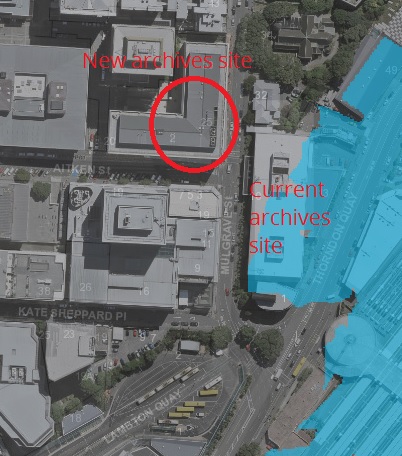
The government has announced plans to move the Treaty of Waitangi and other taonga to a new site. Great news! So where are they going? Right next to the old one:

The new plan will see a new 22,000-square-metre archive built on the former site of Defence House - the former Defence Force headquarters demolished after the 2016 Kaikoura earthquake - to home the documents.

Huh. Isn't that close to the pre-colonial shoreline? I wonder how it looks on the Wellington City Council's interactive climate flooding map, with their expected sea-level rise of 1.5 metres?
ArchivesFlood

So basicly, the government plans to move everything to a site which will be on the beach within 80 years, and subject to erosion and flooding. I don't think that's a good idea. Instead, the government should be seeking to minimise its climate risk. And that means taking this opportunity to move the archives out of Thorndon, to somewhere well above sea-level. Like Karori.

Data Ventures: StatsNZ plays startup

Back in June, StatsNZ went public about a project to track population data on an hourly level by using people's cellphones. It wasn't as bad as it initially looked - they were receiving no individual data, only counts by suburb - but there was still a huge consent problem, so I sent off an OIA to try and find out more. Thanks to commercial sensitivity redactions, the OIA wasn't very informative about that (it basicly boils down to StatsNZ is trusting cellphone providers' clickwrap licences, which does not meet the ethical standard I expect from a government agency). But it was quite informative about Data Ventures, the StatsNZ subsidiary responsible. And what it shows is unsettling.

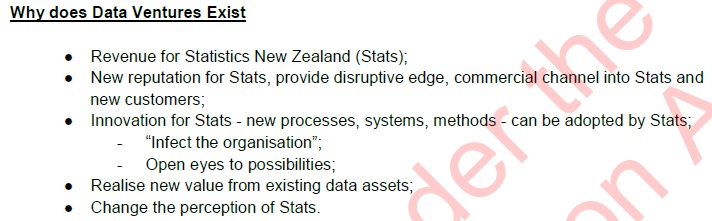
Here's StatsNZ's initial pitch to the Minister of Statistics about Data Ventures, and here's their "strategy session" to define what they want to do:
WhyDoesDVExist

Revenue is top of the list, but it won't come from selling Stats' (or rather, our) data. Instead, they'll be providing commercial data analysis services. But they tell the Minister they'll be using this revenue to fund social good ventures, so its a bit confused there. More confusing is their talk of "providing [a] new reputation for stats" as "disruptive" - they use this word a lot. Basicly, it sounds like a bunch of public servants playing at startups with government money - and its an impression confirmed by their monthly reports, which are all about sales pitches and innovation shows and grovelling for grants (frequently from other government agencies) to get a "longer runway". This is not the culture of the public service, and it makes me wonder what the hell is going on over there. And when they talk about wanting to "infect the organisation" with their values, well, that's a worry. And maybe the sort of thing the State Services Commission needs to be looking at.

But most worrying is this bit, from their pitch to the Minister:

All data acquired and created by Data Ventures is fed to Stats NZ for noncommercial benefits, such as improving existing data and statistical outputs.

In other words, they're going to use these contracts to hoover up private data for government use. There's no evidence they've done this yet - Data Ventures is still in its early days, and has only just delivered its first product - but that's one of the goals. And its a concern, because inevitably that data is going to end up in the Integrated Data Infrastructure, Stats' big brother pile of everything government has ever learned about you, where it will be mined for future "insights" (meaning: ways to cut funds somewhere or interfere in your life).

StatsNZ has a huge social licence problem at the moment, with using data collected for one purpose for something completely different without any sort of consent. Feeding private data into the IDI on the basis of commercial clickwrap licences is just going to add to that. And this is dangerous, because it undermines trust, and StatsNZ is an organisation we need to be able to trust. Maybe they should focus a bit more on that, rather than all the cool things they can do with Really Big Databases full of stolen data.

Tuesday, August 13, 2019


Climate Change: Say no to carbon cheats

The Environment Committee is currently hearing submissions on the Zero Carbon Bill, and Stuff is reporting on the submissions. Today, they're covering yesterday they heard from "NZ" Steel:

NZ Steel has told MPs it may be forced to close with the loss of thousands of jobs if changes aren't made to the Climate Change Response Bill which is being considered by Parliament.

[...]

But NZ Steel said in a submission to Parliament's Environment select committee that by failing to adequately recognise the issue of "competitiveness", the legislation could kill the industry.

"There is a very real prospect ... we may set up policy decisions that could result in the closure of steel-making in New Zealand," it warned.


They want the committee to remove restrictions on foreign carbon credits, allowing them to meet their carbon costs from international markets. Of course they do. Because before the government outlawed the use of such credits, "NZ" Steel (actually foreign owned by Aussie polluters Bluescope) were one of the biggest carbon cheats in the country. The scam was simple: the government gave them hundreds of thousands of tons of valuable NZ units as a pollution subsidy, but instead of using them, they banked or sold them, paying instead in fraudulent Ukranian "credits" which had no environmental benefit whatsoever. And they scammed us for millions by doing so: NZ units traded for $4.20 at the time ($25 now), while Ukranian credits cost a tenth of that. If they banked those credits for use now - effectively paying off all their previous obligations with fraud - then they're sitting on tens of millions of dollars of fraudulent profits.

Naturally, they want to start this scam again. We should refuse. Instead, we should be cutting their pollution subsidy - currently 1.4 million tons a year - and demanding they stand on their own feet. And if they close, good riddance - they emit 2.5 tons of CO2 per ton of steel, against an international benchmark of 2 tons CO2 per ton of steel, so shutting them down is a net environmental gain.

Strike for a future on September 27

Students are striking against climate change on September 27. And this time, they're asking everyone to join them:

Students are taking to the streets, beaches and parks on 27 September, and we're inviting everyone to join us. That's right, this is an intergenerational issue, and you're all invited to put pressure on politicians worldwide to pass bills which will take action to reduce the impacts of climate change.

[...]

On 24 May, we walked out of school alongside hundreds of thousands of students around the globe. We won't sit and watch our futures disintegrate, and we invite you to join us to strengthen our movement. That's you, reading this column; that's the next person you talk to; that's the waiter who gives you your coffee and the woman sitting in front of you in the car/bus/train, it really is everyone.

Climate change isn't just a youth problem, even though it'll hit us the hardest. It's everyone's problem. Everyone has a responsibility to act, in both practical ways and through joining the strike movement on 27 September.


I'll be joining them. I hope you will too. As the article says, pressuring politicians is one of the most powerful things you can do to stop climate change. Sure, you can eat less meat, not fly, use public transport or an electric car, and all of that by everyone adds up. But real change needs policy, and that needs politicians to get the message that if they don't do something about this, they will be de-elected and replaced with someone who will. And that needs people making their anger and demands known.

As the article makes clear, this matters to all of us. If you want a future, strike for the climate on September 27.

We need to clean up local body politics

Peter McKenzie has a piece on Newsroom this morning about how local body politics is awash with property developer cash. 70% of all the donations in the 2016 Wellington mayoral election came from property developers. And its pretty obvious what they want in exchange:

That’s particularly important in local government, according to Rashbrooke. “Local government is pretty weak in New Zealand. The one thing they have huge influence over is urban planning - what to build, and where, and with what restrictions.” It’s the kind of decision-making that can have a huge impact on a property developer, says Chapple. “It benefits the donors because the Wellington City Council is making decisions under the regional plan that greatly affect their bottom line.”

It’s the kind of decision-making which will have a huge impact on Cassells’ bottom line in particular. Cassels and his companies have been the driving force behind the controversial $500 million Shelly Bay development in southern Wellington. The Shelly Bay development has had to secure approval from Wellington City Council (WCC) at multiple points over the past five years, including to secure Special Housing Area status in 2015 and to purchase or lease WCC land in Shelly Bay in 2017. After a lengthy court battle, the Shelly Bay development is still trying to get approval to proceed.

Cassels made no identifiable donations to candidates in the 2013 WCC elections; he only began to do so after the Shelly Bay development started making its way through the council approval process.


There's a name for this: corruption. And its not just a Wellington problem. Back in 2007, newly elected Palmerston North Mayor pushed through a private plan change for the benefit of a trust run by one of his donors. It was later revealed that another trust run by that same donor had bankrolled 95% of his campaign. Naylor pinky-promised he wouldn't vote on issues affecting his donors again, but it didn't matter - the donor had already got what they wanted. The nexus of power and poor oversight around local government and zoning decisions invites corruption - just as it does in Australia.

What to do about it? There are obvious measures. Greater transparency - down to $50 or $100, rolling disclosure so we can see who is being bought and when, a cap on individual donations to limit the power of the rich and encourage fundraising from small donors. There's also just outright public funding (used in Canada) or "Democracy vouchers" (used in Seattle), where everyone can assign money to a candidate of their choice. To that, I'd chuck in outlawing local body members from discussing or voting on issues where donor's interests may be impacted - making such donations effectively self-defeating.

Politicians will complain, but ultimately this is a question of who we want our local body politicians to work for: us, or property developers. Of whether we want our local government to be honest, or corrupt. And the answer to those questions ought to be obvious.

Monday, August 12, 2019


Submit!

The Justice Committee has called for submissions on the Electoral Amendment Bill. The bill makes a number of technical changes to electoral administration, and while these are good, it could do so much more. Obvious things to demand in your submission:

  • Greater transparency around donations, including lower the donation disclosure threshold to $1500 and requiring rolling disclosure so we can see who is buying our politicians as it happens;
  • Removing the 5% threshold, or at least accepting the Electoral Commission recommendation to lower it to 4%;
  • Restoring voting rights for prisoners to remove an ongoing breach of the Treaty of Waitangi and the BORA.
Submissions are due by Friday, 20 September 2019 and can be made at the link above.

Scandalised

When the Justice Committee reported back on the Administration of Justice (Reform of Contempt of Court) Bill, free speech advocates breathed a sigh of relief. As originally introduced, the Bill reitered the ancient offence of "scandalising the court" - basicly, a special sedition law protecting judges from criticism. The select committee, following practice overseas, removed it. But now, thanks to an amendment introduced out of the blue at the committee stage, its back:

The Government is pushing to protect the integrity of the judiciary by limiting free speech and making it illegal to publish fake news about the courts, also known as "scandalising the court".

And it has taken aim at National MP Nick Smith, using his contempt of court conviction from 2004 as a reason for justifying the move.

Justice Minister Andrew Little said a new clause in the Contempt of Court bill, currently awaiting its third reading in Parliament, is a justified limitation on free speech to protect the administration of justice.


Really? The law imposes a penalty of up to 6 months imprisonment for making a "false accusation" about a court or a judge. The basis for it is that judges are important people doing an important job and therefore public confidence in them shouldn't be undermined by false accusations. But politicians and public sector CEOs are also important people doing an important job. Does Little think people making false accusations and undermining public confidence in them should also be thrown in jail?

But don't take it from me. Here's Geoffrey Palmer, basicly the architect of the BORA, on the subject (quoted on Scoop because the NZLJ is behind a corporate paywall):
This new offence amounts to a statutory libel on a judge or a court. The judiciary are part of the system of government, although independent from Parliament and the Executive. False statements made in attacks upon the government are no longer punishable under the criminal law of libel and slander and sedition. Why should it be any different for the judiciary and the system of justice than for the political arms of government? ... These provisions in the Bill seem to be bringing back an approach to speech that has recently been rejected by the Parliament.

And to that I'd add: if the confidence of the public in judicial institutions rests solely on the threat of jail - that is, on terror - then they deserve neither our confidence or our protection. The fairness, impartiality and competence of our courts and judges should speak for itself, and it usually does (usually). The real threat to public confidence is not wild accusations on websites no-one pays attention to - but laws such as this.

This bill should be recalled to committee and this clause removed before it is allowed to pass. Laws which protect the powerful and punish their critics have no place on our statute books.

A reminder

Eighteen months ago, the government promised to strengthen the Bill of Rights Act, by explicitly affirming the power of the courts to issue declarations of inconsistency and requiring Parliament to formally respond to them.

Since then - crickets.

Which raises the obvious question: are they actually going to do this, or is it something - like restoring voting rights to prisoners - which is "not a priority" for them?

Fix the OIA

Back in March, the Ministry of Justice conducted a public consultation exercise on whether to hold a review of the Official Information Act. 285 people submitted on it. Now, Stuff has trawled through those submissions, and the case for reform is strong:

The Justice Ministry asked Kiwis what they thought was wrong with the OIA, to help them decide if the act needs an overhaul. The 290 submissions reveal what appears to be a broken process.

Those who use the act to seek information highlight delays, excessive deletions, overuse of vague withholding grounds, political interference and an ombudsman appeal process made ineffective by sometimes years-long waits.

On the other side, officials who respond to OIA questions say requests are unwieldy and unfocused and they need more reasons to withhold information, not fewer.

The only common ground seems to be support for more information to be proactively released, the idea of an independent agency such as an Information Commission to help with training and prevent political interference and penalties for failing to comply.


So will the government act? So far, they've been dragging their feet. A decision is due "by September", so I guess we'll know whether they're lying to us in the next three weeks.

National's prisoner voting ban breaches the Treaty

National's prisoner voting ban has gone down as one of the worst laws in New Zealand history. Passed after a farcical debate (including this farcial speech from ACT MP Hilary Calvert), it has subsequently been found to be inconsistent with the Bill of Rights Act by the High Court, Court of Appeal, and Supreme Court. And now the Waitangi Tribunal has weighed in, with a formal finding that the law and how it was passed breaches the Treaty of Waitangi:

The Tribunal found that the manner in which Crown officials offered support and advice to the Law and Order Select Committee before the 2010 law change failed to provide sufficient information about the specific effect the legislation would have on Māori, as well as on Crown rights and obligations under the Treaty.

By failing to provide adequate advice, the tribunal said the Crown had failed to actively protect Māori rights.

Additionally, they found that being unable to vote had the potential to affect Māori prisoners beyond their time in prison, impacting their whanau and their community.


The law has a hugely disproportionate impact on Māori, with 11.4 times more Māori than Pakeha disenfranchised in 2018. Effectively its a magnifier for racism in the justice system - and one that is completely without justification. The government could identify no purpose whatsoever for the policy, and none was identified by Parliament when they shamefully passed it.

The Tribunal has asked the government to urgently repeal the law and allow prisoners to vote in 2020, and to their credit, they're actually looking at it (having previously said it was "not a priority". Which tells you what they think of the courts and Bill of Rights Act). But they've also recommended that the government establish a system to provide a proper Treaty impact analysis of all bills before the House. That is something worth doing in and of itself, and it needs to be an independent statutory reporting function, similar to that of the Attorney-General under the BORA, so that the House cannot pretend that it has not been informed. That would be a worthwhile reform in and of itself, to ensure that Parliament upholds its Treaty obligations. Sadly, I think they'll be as eager for it as they are for any other constraint on their power.

Friday, August 09, 2019


Climate Change: Chickening out on a fossil-fuel vehicle cutoff

When the government announced its timid and unambitious vehicle "feebate" policy, my first question was why they hadn't coupled it with announcing a cutoff date for fossil fuel vehicle imports. Such a policy would turn off the tap of transport emissions, while providing lead time for us to electrify the vehicle fleet within the normal upgrade cycle. The feebate advice noted this had been proposed and rejected, and someone used FYI, the public OIA request site, to ask for the advice about it. The advice shows that Associate Transport Minister Julie-Anne Genter proposed a 2035 cutoff last year, but that it did not make it to Cabinet. Sadly, its completely silent on why not, but I think we can all guess.

The released advice (such as it is) also includes a cost-benefit analysis. This straps the chicken every way it can, with lowball carbon prices, arbitrary costs for "welfare impact" of people not buying the car they want (which end up making up the majority of "costs"), and most astoundingly, a "business-as-usual" emissions case which assumes that a 50% by 2050 target will be met (quite how is unclear, and assuming targets will be met when assessing policy designed to meet those targets seems to be getting things arse-backwards). But even then, it shows a BCR of 1.26, and NPV net benefits of $2.25 billion - which is hugely better than most of National's roads. So, this policy would have been beneficial, and it would have been effective at turning off the carbon tap. It is a disgrace that it was not implemented.

Climate Change: The cost of sea-level rise

We've had some grim projections about sea-level rise in the last week, with Wellington Regional Council notifying storm surge risks for a 1m sea-level rise, and Wellington City Council expecting 1.5m by the end of the century. How much is all this going to cost us? A shit-ton:

Every 10cm of sea level rise puts several thousand more New Zealanders in a position they might rather avoid: living in an area that could be flooded by an extreme storm.

Modelling has found that each added 10cm puts at risk another 7,000 New Zealand buildings, worth an estimated $2.48b to replace, 133km of roads and 10km of railway line.

To put this in context, seas have already risen almost 20cm globally since pre-industrial times and 1m of sea level rise is considered a middling projection for 2100.


A metre means $25 billion. Wellington's expected 1.5m means ~$38 billion. The latter is roughly the cost of the Christchurch rebuild, or about 40% of a years government spending, which is a staggering amount. And the way things are going, we'll probably find out that these were conservative estimates.

The even scarier thing is that the amount of carbon we have put into the atmosphere means we are already committed to at least a half-metre by 2100, and more after that (because warming and sea-level rise doesn't just stop after then). So we're going to be paying at least half a shit-ton. The challenge is to ensure we don't have to pay the rest of it.

New Fisk

As India and Pakistan – and America and Iran – go toe-to-toe, now is the time to recall the scorched corpses of Hiroshima and Nagasaki