Wednesday, November 30, 2016


This is what happens if you don't vet your list

Mt Roskill is having a by-election on saturday, and while Labour's Michael Wood is expected to win, he's not a certainty. But the National candidate Parmjeet Parmar is already in Parliament as a list MP, so if they win, the next person on the list gets elected. Who is that? Misa Fia Turner, who seems to be a crazy bigot:

Little has been written about Turner. She was the subject of a minor scandal in 2014 when it was alleged she had not earned the Samoan chief title 'Misa'.

Also in 2014, she told the Catholic website CathNews that gay marriage is "really against our moral values".

[...]

Turner also seems to be a fan of United States president-elect Donald Trump, who she refers to as "anointed [by God] for an assignment".

She has also posted about a young Samoan woman who claimed to suffer from stigmata, writing: "If God can use a donkey, then He can use anyone as He pleases."


Hating gay people and believing in stigmata and politicians being anointed by god is like something out of the middle ages. But I guess that's what you get if you don't vet your list candidates properly: crazy people.
Member's Day

Today is a member's day, unless the government bumps it for urgency. Assuming that doesn't happen, we'll see the third reading of Chris Bishop's Financial Assistance for Live Organ Donors Bill, followed by the first readings of Andrew Little's Our Work Our Future Bill and Metiria Turei's Residential Tenancies (Safe and Secure Rentals) Amendment Bill. If the House moves quickly, it might make a start on David Bennett's Private International Law (Choice of Law in Tort) Bill, but I think that's unlikely. There should be a ballot for two bills tomorrow.

A barrage of hate

Since the US election there have been a distressing series of reports of hate crimes against immigrants, African-Americans, and Muslims from the US. Now, a report from the Southern Poverty Law Center has explicitly linked this to Donald Trump's election:

The Southern Poverty Law Center (SPLC) has counted 867 hate incidents in the 10 days after the US election, a report released Tuesday found, a phenomenon it partly blamed on the rhetoric of Donald Trump.

The advocacy group collected reports of incidents from media outlets and its own #ReportHate page. SPLC said it was not able to confirm all reports but believed the number of actual incidents was far higher, as according to the Bureau of Justice Statistics most hate crimes go unreported.

[...]

According to the report’s findings, anti-black and anti-immigrant incidents were the most commonly reported, with K-12 settings and colleges the most common venues.

Nearly a third of the incidents (289 of them) were motivated by anti-immigrant sentiment, the report said. Assailants often invoked Trump’s promise to build a wall in their attacks and called for the victims to be deported. For instance, in Redding, California, a student brought “deportation letters” to school and recorded himself handing them out to Latino students. In Royal Oak, Michigan, students chanted “build the wall” in a school cafeteria the day after the election.

SPLC released a separate report on Tuesday detailing the impact of the election on schools.

Anti-black incidents were the second-most common, making up 23%, or 180, of the total. References to lynching were frequent, and pictures of nooses were used for intimidation. For instance, a black doll was found hanging from a noose in an elevator at New York’s Canisius College.

In a school in Orlando, students wrote “Yall Black ppl better start picking yall slave numbers. KKK. 4Lyfe.” followed by the line “Go Trump. 2016”.


This is what happens if you run a campaign based on hate (see also: Brexit). The problem, as Jim Bolger recognised, is that you have to govern the country in the morning. No matter how much Trump's racist supporters want it, non-white people aren't going to just suddenly disappear from the US, and if they try and make that happen, its going to lead to civil disorder. But the scary thing is that Trump might be quite happy for that to happen, provided his name is on the desk.

Beneficial ownership registers expose crime

Why do we need a public register of the beneficial ownership of companies and trusts? Just look at what the UK one has exposed so far:

On top of these data validation issues, we found a number of signs of non-compliance with the law. For example, 9,800 companies listed their beneficial owner as a foreign company. Now this is possible if the foreign company was listed on one of the stock exchanges deemed equivalent to the UK system (e.g. the US, EU and Japanese exchanges). However, we found almost 3,000 companies with tax haven addresses listed as beneficial owners. This is not allowed under the rules. We’ll be handing this list of companies over to Companies House to investigate further.

[...]

Initial findings suggest 19 senior politicians (known as politically exposed persons), 76 people from the U.S. sanctions list and 267 disqualified directors were listed as beneficial owners.

However, these matches were based on name and month and year of birth. This means that it’s hard to be certain that the matches are good ones. Any leads coming out of the new register will have to be followed up with more traditional investigative digging.


So that's 3,000 corporate and potentially 350 individual criminals right there. Plus, they can use the data to trace complicated the corporate ownership structures designed to cheat taxes and steal from the public as well.

These seem like excellent reasons to have a public register in New Zealand. So why doesn't our government implement one? Are they on our side, or the side of the criminals and tax cheats?

Oops

Last year, driven by panic around cyber-harassment, the government passed the Harmful Digital Communications Act. Among other things, the Act creates an offence of "causing harm by posting digital communication", punishable by up to two years imprisonment and/or a fine of $50,000. When it was going through Parliament, TechLiberty pointed out that the offence was so poorly defined that it would capture people exposing political corruption by politicians. Now, in the first defended case under the HDCA, a judge has supported that interpretation.

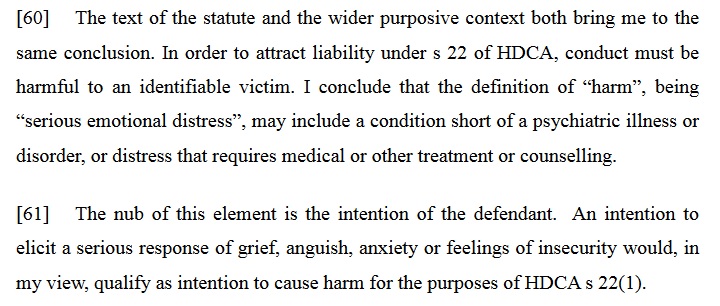
The critical questions are the definitions of "harm" and "serious emotional distress", which are not defined elsewhere. The judge interpreted them like this:
HDCA-Harm

"[A]nguish, anxiety or feelings of insecurity" (the prospect of damage to your political career and even imprisonment) are exactly the intent and expected effect of such a post. There's no public good defence, so the prima facie result is that exposing political malfeasance is a crime in New Zealand. You might hope that a judge would interpret the Act through the lens of the BORA to protect such speech, but that's a risky proposition. As for exposing the identity of a rapist or serial harasser online, you're pretty much fucked.

(In the particular case - a nasty case of someone posting intimate photos of their ex online in an effort to bully and control them - the charge was dismissed as the prosecution failed to provide evidence that such harm was actually inflicted. But the threshold has been set).

I doubt that this was National's intention. But its the law they passed. Now the problem is clear, they need to fix it, and quickly. Otherwise, they invite the conclusion that criminalising the exposure of corrupt politicians is something they're perfectly comfortable with.

Tuesday, November 29, 2016


More torture of autistic kids

Another school has been caught torturing autistic children:

Claims that staff at a Dunedin special needs school hit, sat on and force-fed children as young as five have led to three investigations - by police, an independent investigator and the Ministry of Education.

[...]

RNZ has been told there were 11 sworn affadavits from teachers and teacher aides about children being abused - including being hit, force-fed fruit, and having their wrists bent backward.

Another source said teaching staff had sat on children, pinched their nail cuticles, and tackled them to the ground.

Nearly all the eight or nine pupils of at the Sara Cohen junior class, aged between 5 and 10 and mostly with autism, are non-verbal.

Some were put in a seclusion room regularly, which appears to have been used for longer than two years.


This is just fucking wrong. The use of solitary confinement on adults has been found to be torture; its use on children is prohibited. The idea that a school, which is supposed to protect children, is intstead tortring them for its own convenience is simply monstrous. As for what we should do about it, we have a Crimes of Torture Act, and the police should use it.

More police intimidation

What is it with the police interfering in politics? First there was their attempts to intimidate people protesting against US ship visits, then their outright abuse of power to undermine the push to legalise death with dignity. The anti-democratic mindset is so ingrained that they're now attempting to intimidate people protesting on boring local government issues:

A Horowhenua woman planning to attend a protest in Levin next week has complained to the police watchdog about what she says was an intimidating phone call from an officer.

The protest, dubbed Don't Rumble Our Ross, is being organised against a push to strip the Horowhenua District Council deputy mayor of his title.

[...]

Bernadette Casey indicated on the protest's Facebook page that she was planning to attend in support of Mr Ross, but was shocked to receive a phone call from police asking about it on Monday morning.

"I get a phone call from the police asking me if I was the organiser, asking if I knew the organiser of the protest - I don't know who organised it - and then asking if I was going to it. I said to the constable who rang me I didn't think it was any of his business."


This is intrusive and intimidating. People should not be treated like criminals simply because they want their voice to be heard. The police need to be reminded that we have freedom of speech and assembly in this country, and that their job is to facilitate the exercise of those rights, not to try and shut them down.

As for the response, it was exactly the right one. You don't have to tell the police anything in this country, and you shouldn't.

Monday, November 28, 2016


This'll be fun

It turns out that the Scottish Parliament may have the legal power to block Brexit:

Not many people are familiar with section 2 of the Scotland Act of 2016, but it could give First Minister Nicola Sturgeon and her government in Edinburgh the legal power to block the UK from triggering Article 50. Conservative MP Anna Soubry - in a wonderfully honest interview in The Guardian yesterday - mentioned it in passing:

The government is appealing against the high court ruling, but at the supreme court hearing, the Scottish government will argue that the consent of Holyrood is also required to trigger article 50. Soubry thinks it has a strong case. “Yes. I’m reliably informed that the Scotland Act 2016 section 2 says that you cannot interfere with devolved Scottish matters, they must be determined by the Scottish parliament.”


The application of EU law in Scotland is a devolved matter. Which means the consent of the Scottish Parliament is required if Westminster wants to remove it (just as the consent of the NZ Parliament used to be required if the UK Parliament legislated something which affected us).

Of course, the deal here is obvious: Holyrood will consent to Brexit if Westminster consents to Scoxit. And the two countries can then happily go their separate ways. Sadly, I expect the "English nationalists" (actually English supremacists) who backed Brexit won't be happy with that though...

Climate change: More bad news

Currently we're seeing unprecedented weather in the arctic, with air temperatures 20 degrees above normal delaying the usual winter ice formation. That's bad, but the real problem is that this could push us over some tipping points in the global climate:

Arctic scientists have warned that the increasingly rapid melting of the ice cap risks triggering 19 “tipping points” in the region that could have catastrophic consequences around the globe.

The Arctic Resilience Report found that the effects of Arctic warming could be felt as far away as the Indian Ocean, in a stark warning that changes in the region could cause uncontrollable climate change at a global level.

Temperatures in the Arctic are currently about 20C above what would be expected for the time of year, which scientists describe as “off the charts”. Sea ice is at the lowest extent ever recorded for the time of year.

“The warning signals are getting louder,” said Marcus Carson of the Stockholm Environment Institute and one of the lead authors of the report. “[These developments] also make the potential for triggering [tipping points] and feedback loops much larger.”

[...]

In the Arctic, the tipping points identified in the new report, published on Friday, include: growth in vegetation on tundra, which replaces reflective snow and ice with darker vegetation, thus absorbing more heat; higher releases of methane, a potent greenhouse gas, from the tundra as it warms; shifts in snow distribution that warm the ocean, resulting in altered climate patterns as far away as Asia, where the monsoon could be effected; and the collapse of some key Arctic fisheries, with knock-on effects on ocean ecosystems around the globe.


All of which means either faster climate change or worse consequences for us or both.

This is exactly why we need organisations like NASA's Earth Sciences Division (which President-elect Trump wants to shut down): to tell us what the hell we are doing to our planet and warn us of the consequences of our actions. But I guess that's precisely why Trump and the right want to kill it off: because a few people profit by fucking up the climate for the rest of us, and they don't want us to be able to measure the true cost of their vandalism.

Limiting electronic border searches

Last night the government introduced a new Customs and Excise Bill to Parliament. The bill would replace the Customs and Excise Act 1996 and one of the features is that it finally imposes some limits on Customs' unreasonable and invasive practice of electronic border searches.

The new provisions are in s207 of the bill. The short version is that Customs will only be able to search your electronic devices if they have reasonable cause to suspect "relevant offending" - defined strictly in terms of offences under the Act or the import or export of prohibited goods. And they won't be able to copy anything unless they have reasonable cause to suspect that evidence of that offending will be present. The search threshold is subject to some uncertainty as the new bill shifts prohibited goods largely to an Order In Council system, meaning we don't know exactly what is covered. But the bill includes objectionable publications and "goods that are for a dishonest purpose" (which ends up meaning a crime involving dishonesty in terms of the Crimes Act 1961). The upshot: unless the government passes some very dubious Orders In Council, Customs will not be able to abuse border searches to help police bypass the need for search warrants, they will not be able to abuse them to collect information for the SIS, and they will not be allowed to abuse them to search for pirated TV (which is the primary reason for such searches at present). They'll also be required to report annually on these searches - though not on the numbers of full vs initial searches, and not on what fraction of them actually result in finding anything.

The downside: Customs will be able to demand your password or that you assist them in unlocking any device. So, change your passwords before and after travel (better yet: don't travel with any devices or data other than "if you can read this you are a spying twatcock". Buy a burner at the other end, and get your data encrypted over the cloud).

On paper, this is still a huge advance. The problem is practice. To point out the obvious, Customs is an organisation which operates in near-total secrecy, with an entrenched culture of doing "favours" for police and foreign agencies. Do we really think the organisation which unlawfully harasses cyberactivists and harassed Kim Dotcom and his friends to earn "brownie points" with the FBI is going to change? Yeah, right. Unless this law is coupled with a purge of senior management to change the current institutional culture, I predict we will have a large number of unlawful searches, resulting in abuse of people's privacy and significant liability for the government.

The bigger problem is necessity. The new thresholds largely mirror the requirements for search warrants, sans judicial oversight. So if there's actual reasonable cause (rather than trawling and harassment), Customs could just get one of those. There's perhaps a timeliness argument, but I don't think its beyond Customs' abilities to get a proper warrant within 24 hours if they need to. Like the NZCCL, I think the intrusiveness of these searches requires proper oversight, not the suspicions of some jumped-up security thug at the border. If Customs wants to look at our devices, they should do what the police do and get a warrant for it.

New Fisk

Tougher tactics would have ended Syrian war, claims the country's top intelligence general

"A stupid idea"

That's what John Key thinks of equality around the Cabinet table:

Prime Minister John Key says the idea of promising a gender-balanced Cabinet is "stupid" because appointments are made on talent, not gender.

Speaking on The Nation on Saturday, Key dismissed the call made by Equal Employment Opportunities Commissioner Jackie Blue, who would like Key to follow in the footsteps of Canadian Prime Minister Justin Trudeau, who last year unveiled a Cabinet which was half female.

[...]

But Key told Nation host Lisa Owen "it would be stupid" to promise a gender-balanced Cabinet.


And then he trotted out the usual excuse that Cabinet appointments are made on "merit". Yeah, right. I think Murray McCully, Tim Groser, and Sam Lotu-Iiga are proof of the absurdity of that idea. But even if we accept it, it just pushes the question back another level, from "why doesn't National select women as Cabinet Ministers" to "why doesn't National select women as candidates / MPs?" And I think we all know the answer to that question...

Friday, November 25, 2016


New Fisk

America once turned its back on Anne Frank, just as Donald Trump rejects Muslim refugees today

Utterly predictable

One of the first things National did after being elected was implement targets for A&E waiting times. Seven years later, and it turns out that hospitals have been faking their waiting-time data:

Health Minister Jonathan Coleman has ordered an investigation into alleged "manipulation" of data at district health boards to comply with the six-hour emergency department target.

The first study on this since the six-hour target was introduced in 2009 was presented at a Queenstown conference today by Dr Peter Jones, an emergency medicine specialist and Auckland University researcher.

He said he had found evidence that the data had been manipulated to meet the target.

Opposition politicians have long suspected this, especially after widespread manipulation was uncovered in the UK to comply with its tighter, four-hour target. The UK's policy, unlike in New Zealand, came with incentives and penalties.


This is utterly predictable, and we've seen it everywhere such targets have been tried. When the incentives are strong enough, and its easier to fake data than meet the target, then that's exactly what institutions will do (see also: Serco). We're fortunate here that it doesn't seem to have negatively affected people's care, but that's all it is: good fortune. In reality, what this has done is shifted resources from elsewhere in the health sector to meeting National's targets - and who knows what else is being neglected as a result?

The key problem in the health system isn't slack doctors letting A&E patients suffer because they're on their tea-break - it is under-resourcing. Maybe we should fix that? But I forget: to National, having enough doctors and nurses to deal with actual demand (let alone letting them work sane hours rather than endangering patient safety with endless 14-hour days) is "waste". Better to have mickey mouse targets that everybody lies about instead.

Manifestly unjust

What does National's "three strikes" policy look like in practice? Seven year sentences for bottom-pinching:

A man who grabbed a prison officer on her bum has been sentenced to seven years in prison.

The length of the sentence for the offence involved - and the legislation that enforces it - has earned stern criticism from sentencing judge Kit Toogood.

[...]

"I have no option but to sentence you to the maximum term of imprisonment prescribed for the offence - seven years' imprisonment. I agree that is very harsh given that what you did was not the most serious assault of its type, but Parliament has determined that your history of violent offending requires a very stern response to protect the public from you and to act as a deterrent to you and others.

"It may seem very surprising that this consequence could be required by law for an offence of this kind, but that is the law and I have no option but to enforce it.

"Were it not for the requirement to sentence you to the maximum term of seven years, the need to denounce your conduct, hold you accountable and deter others and you from such offending, it would likely have resulted in a period of no more than 12 months' imprisonment."

Nobody likes a groper, but you don't need to be an apologist for indecent assault to recognise that this sentence is grossly disproportionate and manifestly unjust. Even allowing for parole - something the judge allowed because the legally required denial would have been utterly beyond the pale - this man will still serve over four times as much time as is justified by the offence (two years vs six months in practice, assuming parole in both cases). And the effect of that is not going to be to rehabilitate, or to deter, but to tell everyone that the system is unjust and that if you are caught you will not get a fair go from the courts. Which is a very dangerous message to send. After all, if you're going to get seven years regardless, you might as well earn it properly...

But hey, National got to grub votes from stupid vicious old people who approve of stabbing teenagers for tagging fences, so what do they care? And as always, it'll be other people paying the bill for their stupidity.

What does the monarchy stand for?

Over on the NZ Constitution site, Morgan Godfrey nails what the real "symbolism" of the monarchy is: inherited wealth and power:

I sometimes wonder why we can’t do the same with our head of state arrangements. Isn’t it odd that “the Queen in right of New Zealand” lives 18,000 kilometres away in a palace built from Jurassic limestone? Nothing says “modern New Zealand” like the monarch of a rain-soaked island off the north-western coast of the European mainland.

I suppose it’s obvious I’m a partisan for a local and elected head of state. Not just for practical reasons, or even symbolic ones, but simply out of honesty. New Zealand is not feudal Britain. I struggle to summon any affection for a person who makes £304.1 million per year for no other reason than her exalted bloodlines.

The politics of envy! I can hear the accusations crashing against my door. Maybe I’m a bitter hack, but given the argument for constitutional monarchy so often seems to amount to nothing more than “symbolism” and “special relationship” it seems appropriate to state just what the monarchy represents – inherited wealth and power.


The clash with New Zealand's democratic and egalitarian values is obvious. Most of us don't want to live in a country where wealth and power are inherited. For many Pakeha, that's exactly what our ancestors fled here to escape!

An inherited billionaire descended from mass-murdering tyrants is not an appropriate symbol for modern, democratic New Zealand. Its time we cut that constitutional link and declared a republic.

Thursday, November 24, 2016


Climate change: Sticking his fingers in his ears

US President-elect Donald Trump has made it clear that he doesn't believe in climate change, claiming that it was "created by and for the Chinese in order to make U.S. manufacturing non-competitive" (I guess Arrhenius must have emigrated or something). And now he's planning to shut down NASA's climate change research as one of his first acts as President:

Donald Trump is poised to eliminate all climate change research conducted by Nasa as part of a crackdown on “politicized science”, his senior adviser on issues relating to the space agency has said.

Nasa’s Earth science division is set to be stripped of funding in favor of exploration of deep space, with the president-elect having set a goal during the campaign to explore the entire solar system by the end of the century.

This would mean the elimination of Nasa’s world-renowned research into temperature, ice, clouds and other climate phenomena. Nasa’s network of satellites provide a wealth of information on climate change, with the Earth science division’s budget set to grow to $2bn next year. By comparison, space exploration has been scaled back somewhat, with a proposed budget of $2.8bn in 2017.

Bob Walker, a senior Trump campaign adviser, said there was no need for Nasa to do what he has previously described as “politically correct environmental monitoring”.


Of course, that environmental monitoring is one of NASA's most successful programmes, and it tells us a great deal about what we are doing to our planet. Shutting it down is like sticking your fingers in your ears so you can't hear the fire alarms. But whether you can hear them or not, the house is still burning, and its still going to kill you (or, in this case, your kids and grandkids).

This is shortsighted and stupid. Sadly, that's climate change denial in a nutshell.

A victory for women

Last year, the government tried to get equal pay off the political agenda by establishing a Joint Working Group on Pay Equity. Unfortunately, it didn't work out that way - in June it reported back, recommending changes to the Employment Relations and Equal Pay Acts which would make it far easier to lodge discrimination claims, while requiring employers to use comparator professions which were not themselves undervalued due to systematic discrimination. After sittign on them for six months, the government has finally released its response, (mostly) accepting the recommendations:

In a major boost in the fight for pay equity women will be able to file claims with employers and not have to go through the courts.

The move has been hailed by the Public Service Association as enabling New Zealand to "once again claim to be a leader in gender equality".

The changes will mean employees who believe they are underpaid because they do work in fields dominated by women will be able to approach their employer to raise a pay equity claim.


The big difference is in the choice of comparators, the profession which a profession is to be compared to when determining whether women are receiving the legally required equal pay for work of equal value. The Joint Working Group recommended that any appropriate, non-undervalued comparator could be used. The government wants to force women to use comparators in their own business, then industry, then sector, which increases the chance that the comparator itself will be undervalued. There's the fallback of the courts, but we've already seen how difficult that is in practice. OTOH, by bringing the process within the Employment Relations Act, women can strike over it, picket over it, and trash their employer's reputation over it. And I think the latter especially is going to be a powerful bargaining chip in the underpaid service sector. In the modern era, no sane business wants to be publicly labelled as discriminating against women, and one campaign can permanently poison a brand with both customers and potential employees.

While its not everything that was hoped for, this still looks like a major step forward. The sooner it is implemented, the better.

Wednesday, November 23, 2016


For working less

The Independent today has an interesting piece about Sweden and its culture of working less. Opening by pointing out that the Swedes regard working long hours as a vice rather than a virtue, it goes on:

Swedish culture has taken a step further lately, by making moves towards a six-hour working day. In many of the organisations and companies that have made the change, they’ve noticed that their staff are happier, more productive and more creative, which proves the point that if the employees feel better, they’ll actually do better work. It’s a win-win situation.

Burned-out people cost companies and society time and money. They need healthcare, time off work, replacements have to be recruited and trained. Rested, enthusiastic staff members feel positive about their workplaces and can be passionate about their jobs.


In Sweden, they've figured out that you work to live, not the other way round. And by normalising a healthy attitude to work-life balance, rather than fetishising GDP and work for work's sake, they end up healthier and happier. Which surely is the point. The economy is supposed to work for us, not the other way round.

Justice for Vilikesa Soko

In August 2014, Fijian police arrested Vilikesa Soko in connection with a robbery. They then beat and raped him to death. Yesterday, eight police officers and a solider were sentenced to between seven and nine years jail for that crime:

Eight police officers and a military officer convicted of rape, sexual assault and perverting the course of justice in Fiji have been given custodial sentences by the Lautoka High Court.

The nine men attacked two prisoners, one of whom, Vilikesa Soko, died of his injuries while in custody in Lautoka Hospital in August 2014.


But note what they weren't sentenced for: murder. Despite beating and raping him so badly that he died, charges of manslaughter were inexplicibly dropped. And it will be interesting to see whether these criminals will serve their sentences, or be pardoned by the regime (the solider is a former bodyguard to Frank Bainimarama).

Vilikesa Soko's death wasn't political. Fiji's police routinely beat and torture suspects, with the result that serious charges are frequently dropped due to the "confessions" being inadmissible. Hopefully these convictions will help change that pattern.