Wednesday, February 28, 2018


No place for secret trials in New Zealand

Secret trials with evidence hidden from the defendant are rightly viewed as a mark of tyranny, the sort of thing that happens in Iran or China. But one is happening right now in New Zealand:

A secret hearing was being held under tight security at the High Court in Wellington on Wednesday.

The case was so secret that it was not listed in any form on the court's list of fixtures for the day.

Access to the basement level courtroom was barred by court and other black-clad security staff. The usual access between a public cafe on that level, and the court building, was also stopped.

The court manager, Jane Penney, said Justice Robert Dobson had directed that it was a closed court, and media could not attend.


Stuff has suggested that the hearing is connected to A v Minister of Internal Affairs, and is a closed material proceeding where the government is presenting secret "evidence" to the judge which is withheld from the defence. If that is the case, it is abhorrent. Such procedures have been found repeatedly to violate the right to a fair trial, and the UK Supreme Court is on record as ruling that secret evidence "may positively mislead". Keeping secret, potentially misleading evidence from the defence prevents them from effectively challenging it or presenting reasonable explanations, effectively turning the hearing into a kangaroo court. That was certainly the view of the New Zealand public when the government tried to use such procedures against Ahmed Zaoui.

We should not tolerate this sort of process in New Zealand. Whichever law this is being held under must be repealed.

Will Sage stop tenure review?

Last year, in a decision on irrigation in the Mackenzie Country, the Environment Court said there were strong ecological reasons to end the process of high country tenure review. The message was reiterated in a report last week on the future of the Mackenzie basin. And the good news is that, unlike her predecessor, Conservation Minister Eugenie Sage might actually act on it:

Conservation Minister Eugenie Sage is not ruling out a moratorium on the tenure review process, as pressure on the process mounts on land use in the central South Island's Mackenzie Basin.

Sage's remarks follow the release last week of a $70,000 report on the future of the basin's governance that suggests all agencies work closer together to improve environmental outcomes.

Sage, who is also Land Information Minister, told Stuff she would be reviewing all aspects of the issue over the next six months. A moratorium on tenure review, as previously suggested by Environment Court Judge Jon Jackson, was one option.

She declined to mention other options, but also said she would be talking to pastoral lease-holders in the region.


Hopefully she'll follow up on this, because tenure review has led to the privatisation and environmental destruction of the Mackenzie Country. It has also been a phenomenally corrupt process, with the government selling land to farmers for a pittance, which is then subdivided and onsold for a thousand times more money. And that in itself should be reason enough to stop it.

Updating our democracy

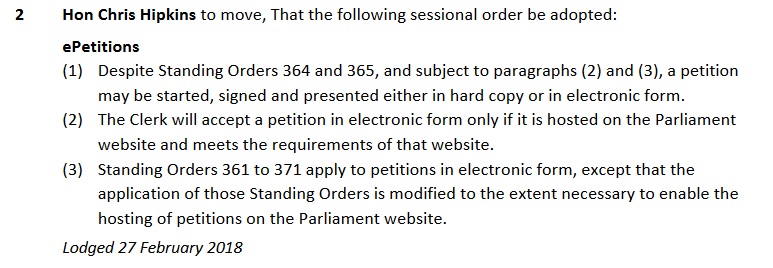
At the moment, if you want to petition Parliament, you have to collect physical signatures on paper forms. Nowdays, petitions are largely done online, and so this is circumvented by having a petition of one person, asking that the House take note that so many thousand other people have signed an online one. But it looks like change is finally brewing, with Leader of the House Chris Hipkins introducing a motion for a sessional order to allow Parliament to receive electronic petitions:
nze-petitions

A lot will depend on the specific requirements imposed by the Clerk, but it is likely that this will make the petition system significantly more accessible than at present. Hopefully it will be introduced soon.

(And then we'll need the next step: a formal system like that used int he UK or US to force Parliament to debate issues raised if enough people petition it).

A failure of due diligence

Last week the government announced the first recipients of its billion dollar a year regional development fund. But it turns out that in addition to funding railway lines and sawmills, they're also funding alleged fraudsters:

A flagship Government programme is funding a project tied to a businessman who has been referred to the Serious Fraud Office.

Among the projects by the Government's new regional development programme is a $350,000 feasibility grant to investigate whether a waste-to-energy plant can be built on the West Coast, Radio New Zealand reports.

The scheme will involve burning rubbish from around the country to generate electricity.

The company behind the scheme is Renew Energy and one of its major shareholders is Gerard Gallagher.

An investigation last year, prompted by a Stuff investigation, found Gallagher and another former official from the Canterbury Earthquake Recovery Authority (Cera) tried to use their positions for their own financial gain.

The State Services Commission found the pair committed "serious misconduct" when they set up a private company in an attempt to leverage off business deals connected to their Cera jobs. They were referred to the SFO.


This is an appalling failure of due diligence by MBIE. While there's nothing suggesting that the project isn't real, handing over wads of cash to people to people who resigned from public positions over corrupt behaviour found to be "serious misconduct" and are currently under investigation is Not A Good Look. I expect the grant will be withdrawn, but the fact it was offered has got the programme off to a very bad start.

Tuesday, February 27, 2018


Feeding big brother

I got my census form yesterday. The PR around the census is all about how it will provide data to enable the government to make better policy decisions. Quietly unmentioned: that the data you put on your census form will be combined with pretty much everything the government has in one giant pile called the Integrated Data Infrastructure for future data mining.

I've blogged about this before, back in 2016. I started by comparing the IDI to a certain dystopian science fiction TV show:

You are being watched. The government has a secret system which contains records of everything you have ever done. Where you went to school. Where you worked. How much you earned. Who you lived with. Your sexual orientation. Whether you have ever been a victim - or a suspect - of crime. Whether you have ever had a mental illness or addiction problem. Where you went on holiday. Whether you have been on a benefit. What drugs you have been prescribed, and for what conditions. Your census records. Whether you have had a sexually transmitted disease. Everything you have ever told a government agency, or anything they have learned or inferred or suspected about you, all in one big database for them to look through.

If you think that's overblown, take a look at the official list of data in the IDI. It includes benefit records, CYFS records of "concerns", MSD data about whether people are "at risk" of becoming NEET (not in education, employment, or training - in other words, whether MSD thinks you will end up on a benefit), NCEA grades, border crossings, comprehensive health records including immunisations, prescriptions, and outpatient and inpatient records, tax records, driver's licence, any answers you gave to the General Social Survey - basicly, everything. Officially, it can't be searched for individuals, but that can always change, and its always available to police, immigration, or other agencies with a production order. It is one hell of a capability to leave lying around in government hands, and the potential for abuse is almost endless.

This data was not gathered for the purpose of combining it with other datasets in this manner. We were never asked for our consent. Legally, they don't need it, because the data is "anonymised" (meaning "we know whose it is but we pinky-promise never to look"). Morally? Its all been gathered under false pretences and the government has systematically lied to us about what it is doing with our data.

(The fact that they could do that BTW also shows how worthless their promises never to identify specific individuals are. They've lied to us already about how they would use our data. Why would we place the slightest trust in their current assurances?)

Census data is a key component of the IDI. In particular, it allows Stats to create links across multiple data series, to identify (via an anonymous hash, of course) specific individuals and combine their records into a complete picture. By completing your census form, you are feeding this massive, privacy-invading beast. And you have to do it: failing to complete a census form or providing false information are crimes, and Stats are gearing up to prosecute people for them. Chillingly, their prosecution guidelines specifically target those who have "a strong negative attitude" towards invasion of privacy for prosecution.

But while we have to fill out our forms and feed big brother, we don't have to like it. And if you don't like it, I recommend you contact James Shaw, the Minister of Statistics (j.shaw@ministers.govt.nz) and politely let him know why. Politicians funded this beast, and politicians can (in theory) be convinced to de-fund it. But they won't do that unless we tell them. So, speak up. Its time to demand our privacy back.
OIA handling is getting worse

The Ombudsman and State Services Commission released the third lot of OIA and complaint statistics today. The data is scattered across several websites and spreadsheets, and for some reason they don't do a temporal comparison, which would be the most useful thing in telling us whether performance is getting better or worse. So I've done one - and the news isn't good.

First, the raw data: the overall volume of requests increased slightly, from 40,273 to 41,935 - an increase of 4%. Timeliness generally improved - an example of how a watched agency is an agency that actually does its job - and most core agencies are above the 90% mark where we want them to be. TPK is still the worst public service department, completing only 69.7% of requests on time, with MfE the second worst on 75.4% (a decrease from 77.9%, so they've actually got worse). For non-core agencies, its a similar story. Hawke's Bay DHB is still the shittest, with only 63.6% of requests completed on time - and the scary thing is that that's a massive improvement (last year it was less than 40%). Hopefully repeated publication of these stats and scrutiny on failing agencies will result in their doing better.

The complaint data tells a far more unsettling story. Its sliced differently - every six months rather than every year - and resolution data doesn't necessarily map to complaints received in the same period. But the headline is that complaint numbers are up, from 538 in the second half of 2016 to 673 in the same period in 2017. Insofar as you think complaints are any sort of proxy for the quality of decision-making, that's not good news. And when you look at the resolution data, and at the proportion of resolved complaints which resulted in a remedy, that's up too, from 56% to 65% in just 6 months. Since a remedy implies poor decision-making, that suggests strongly that OIA decisions actually got worse over the course of last year (I can't compare with late 2016, because it looks like the Ombudsman's Office changed what they were recording between the first and second set of statistics).

SSC has now started tracking complaints itself, with the number f complaints notified and final views against, and this should help us spot some trends in future years. But what we really need is UK-style statistics on outcomes, measuring whether a request resulted in release, release in part, or a refusal. Because that will help us identify problem agencies which aren't as open as they could or should be, who need their institutional cultures (and probably leadership) changed. Hopefully we'll start getting that next year.

Update: I've based my comments on timeliness and which departments are doing badly on the 2016/17 full year statistics. SSC has also released half-year stats for Jul - Dec 2017, aligning them with the Ombudsman's complaint data, which show a significant increase in timeliness. In particular, TPK and Hawke's bay DHB have significantly improved their performance, which is good to see.

National's teacher shortage

When National was in power they increased teacher workload with national standards, while freezing pay. They also made tertiary education and teacher training harder to access. The result? A collapse in those training to be teachers:

The number of people training to be teachers dropped 40 per cent in six years, leaving a huge teacher shortage, the Government says.

A boomer-aged teachers prepare to retire, New Zealand is facing a "ticking time bomb" Education Minister Chris Hipkins said.

Figures released today showed the number of people training to be teachers dropped from 14,585 to 8895 - nearly 5700 students.

"The numbers are staggering," Hipkins said.

Early childhood education teacher trainees were down from 6760 to 3615, primary teacher trainees down from 5740 to 4065 and secondary teacher trainees were down from 1865 to 1120.

"In each case, the numbers were going in the opposite direction between 2008 and 2010."


And the result of that combined with retirements and inaccessible housing is that Auckland is expected to be short 3,000 teachers by 2027. There will no doubt be similar shortages in the rest of the country. Which is what happens when you under-invest, then leave others to carry the can.

Fixing this is going to be expensive. The PPTA will apparently be demanding a 14.5% pay rise this year, plus a housing allowance in expensive regions - and there's going to be increased costs to improve accessibility of tertiary education as well. And no doubt National will spend the next three years screaming that that's all "waste", and studiously ignoring the fact that its basicly been forced on the current government by their past penny-pinching. Just like they do with everything else.

Monday, February 26, 2018


Giving the BORA (tiny) teeth

Last year, the Court of Appeal made a landmark constitutional decision, by declaring National's anti-prisoner voting law to be inconsistent with the Bill of Rights Act. This didn't mean that the law was overturned - s4 of the BORA explicitly forbids this - but it was a serious warning to Parliament about the quality of its lawmaking. And now the new government has responded, announcing plans to amend the BORA to require Parliament to formally respond to future declarations of inconsistency and review any law declared to be inconsistent.

Its a small step forward, but a significant one. Most importantly, it recognises that Parliament doesn't always get it right, and that the courts have an important role in checking abuses of our fundamental human rights. The teeth it gives the BORA are tiny, but they may be enough in our system to force significant amendment or repeal of odious laws. And that, after all, is the point of constitutional safeguards.

Why the road toll is rising

After years of going down, in the past couple of years road deaths per capita have been going up - contrary to the trend in the rest of the world. Why? Because the police have cut basic enforcement:

New figures supplied to RNZ News show 1.75 million alcohol breath tests were recorded by Police last year, the lowest in at least 10 years.

It is down 43 percent on 2013 - when more than three million breath tests were carried out.

During that same time frame, 2013 to last year, the road toll rose 50 percent.

The Police Commissioner Mike Bush argues the Police are focussed on quality not quantity.

They might be - but as a matter of law, his budget appropriation requires him to do 2 - 2.4 million breath tests in 2017 [p. 24]. He hasn't. But more importantly, if you look back through past budget appropriations, it appears National cut the expected number of breath tests, from 2.7 - 2.9 million in 2014/15 [p. 58] to 2 - 2.4 million last year. And it wasn't the only decrease. Sam Warburton has documented how National has systematically cut performance expectations for road safety, resulting in fewer dedicated staff. Police officers themselves, via their union, have explicitly linked this to increased deaths.

Which is pretty obvious: the biggest thing deterring speeding and drink-driving is the risk of getting caught, and that risk obviously goes down if there are fewer police officers running checkpoints and ticketing speeders. Looking at the Ministry of Transport's historic road toll data, there are at least 150 excess deaths attributable to these cuts, and that doesn't include last year (which will probably add another 50). That's two hundred deaths from one funding decision. And those deaths were entirely foreseeable, which makes it no different from murder. Shouldn't we hold National's policing and transport Ministers accountable for that?

New Fisk

Negotiations continue between rebels and the Syrian Army, but the bombardment of Ghouta won't stop any time soon
There's a reason why anti-Muslim ideology hasn't found a home in Portugal

Justice denied

How do we enforce human rights and privacy law in New Zealand? Generally, if you have a problem, you complain to the Human Rights Commission or Privacy Commissioner. If mediation fails and/or the problem is serious, it then goes to the Human Rights Review Tribunal (HRRT), a judicial body able to make binding rulings. And there your case will be lost in limbo, because the previous government systematically under-staffed the HRRT to prevent it from hearing cases:

People fighting for their human rights face "beyond unacceptable" waits of more than two years for justice, after politicians and officials ignored repeated pleas for a law change to help clear the backlog, documents reveal.

"Access to justice is being denied to almost all," Human Rights Review Tribunal chairman Rodger Haines said in his latest letter, to new Justice Minister Andrew Little. "For a tribunal charged with protecting human rights the situation is ironic, to say the least."

Claimant Lyn Copland – a grieving mother publicly shamed by the chief executive of the health board in whose care her son died – said the delays were disgusting, insulting and cruel and made a mockery of human rights protections.

Privacy Commissioner John Edwards also labelled the delays unacceptable and said planned Privacy Act changes would further stress the struggling tribunal: "Any justice delayed is justice denied."


The core problem is that all cases must be heard by the chair, which imposes a bottleneck. Despite repeated requests for multiple co-chairs to be appointed to allow the HRRT to deal with its caseload, National appointed only one, and refused a law change to remove the bottleneck entirely. As for why, it's pretty obvious: it would have cost money, both directly in the form of salaries, and indirectly, because the HRRT is a key institution in holding the state to account for its failures, and those failures are often expensive. The family carers case, which has seen the government ordered to pay parents who care for their adult disabled children, began in the HRRT. Stopping the tribunal from doing its job effectively is cheaper for the state.

Its also obviously unjust. Which is why this needs to be fixed as quickly as possible. The new government needs to make this a priority, so we have a functioning justice system and an effective remedy for human rights breaches by the state and by others.

Friday, February 23, 2018


Finally, some action on EQC

Yesterday was the seventh anniversary of the 2011 Christchurch earthquake - and a reminder of what a terrible mess National made of the rebuild. On a macro scale, huge parts of Christchurch are still wasteland seven years on, while the infrastructure is still a mess. On a micro scale, EQC massively failed earthquake victims, with bureaucracy, shoddy repairs, and claims dragging on and on. Apparently 2600 EQC claims are still unresolved after seven years - something which should be utterly unacceptable.

National tolerated this incompetence, because it didn't affect their voters and they expect government to be broken anyway. Labour, OTOH, has sent a clear message that they expect this to be sorted out swiftly, effectively sacking the chair of EQC and appointing an independent advisor to help manage it:

The chair of the EQC board has resigned, as the government vows to speed up all remaining Canterbury earthquake claims.

Megan Woods - the Minister Responsible for the Earthquake Commission - announced today that an independent Ministerial advisor will be sent in to EQC to help speed up the remaining claims.

"I've made it clear I am not satisfied with where EQC is at in respect of the Canterbury Earthquake work seven years on from the February 22nd event. For the around 2600 people with unresolved claims, being stuck in limbo is unacceptable. We've got to see faster progress for these people so that they can get their lives back on track.

"Today I have accepted the resignation of Sir Maarten Wevers, chair of the EQC board, and I thank him for his service. Next week I will be appointing an interim chair to oversee the changes I believe need to be made to speed up this process.


Good. And hopefully those claims will be settled ASAP - because seven years is far too long for people to wait for help after a natural disaster.

No "breakthrough" in the Mackenzie country

ECan has released a report on the environmental governance of the Mackenzie basin, which they're hailing as some sort of "breakthrough":

After more than 10 years of wrangling between environmental and farming interests, a "breakthrough" report on the Mackenzie Basin proposes everyone comes together if the area is to be properly protected.

While emphasising a need for better collaboration, the 54-page "Mackenzie Basin: Opportunities for Alignment", released publicly this week, stops short of suggesting a formal amalgamation of local council and government departments.

Commissioned by Environment Canterbury (ECan), Land Information New Zealand (Linz), the Department of Conservation (DOC) and the Waitaki and Mackenzie district councils, the report recommends joint consent hearings, clearer plan guidelines, new tenure review guidelines and staff sharing among affected organisations. It also suggests all of the major agencies look into ways of managing the pressures of tourism in the Mackenzie.

Mackenzie District Mayor Graham Smith said the report was a "breakthrough".


Hardly. Because if you read the report, and in particular the issues summary table, its clear that there is a huge divergance in views between farmers (who want to profit by despoiling the area and drowning it in pivot irrigators) and everyone else. While there's obvious potential for government agencies to work more closely together to ensure that e.g. ECan's water consents don't undermine district council efforts to control land use, there's no kum-bah-yah group hug "everyone wins" moment to be found here. As the report itself notes, "a common understanding of the appropriate extent of pastoral intensification compared to landscape / ecological protection has not yet been achieved". And given that that is the central problem, this isn't any form of "breakthrough".

The central idea of the report is a drylands park to protect the natural landscape, now downgraded to a non-contiguous drylands natural heritage area because so much of it has been privatised and destroyed while they've been talking. If we're to have any hope of achieving this, then the first step has to be stopping the corrupt process of tenure review, at least in the northern part of the basin, so the government can work out what land we would need to make it happen. The good news is that the relevant portfolios are both in the hands of Eugenie Sage, so we we now have a Minister and a government which might actually be interested in doing this.

Thursday, February 22, 2018


But why would we want to do that?

The Queenstown Lakes District Council wants luxury houses exempted from the Overseas Investment Act's foreign-buyer ban:

The Queenstown Lakes District Council wants luxury homes to be exempt from the government's foreign buyers ban.

Some expensive homes owned by the exeptionally wealthy may not sell if they are only available to New Zealanders, it said in its submission on the bill.

[...]

The council said the district had benefited "significantly" from people who have purchased in the luxury home market.

"Not only have we seen traditional investment in local business, but we have seen the launch of ground breaking social enterprises and incredible impact investment," the submission said.

That part of the housing market attracted high net worth people to the country who help the economy by bringing expertise, connections, investment and philanthropy, it said.


Yeah - people like anti-democratic vampire capitalist Peter Thiel and his silicon-valley doomsday prepper friends. Or the various foreign millionaires who have restricted access to public land. Or foreign criminals stashing and laundering money. Why would we want people like that?

The proposed law doesn't apply to anyone who actually lives here, so what QLDC is saying is that non-resident foreigners should be allowed to own parts of New Zealand for use as emergency boltholes for when they've fucked up the world, or as a commodity, effectively a house-shaped gold bar. And I just don't see why we should accept that, especially when said house-shaped gold bars are fucking things up for the rest of us. While QLDC is correct that the luxury property market is effectively a foreign market, utterly out of reach of almost all kiwis, those empty luxury houses are still taking up land which could be used for real homes for real people - something Queenstown is desperately short of. If they are devalued by the law, then maybe that land will be used for other purposes. The only losers in that will be the foreign speculators and the parasitic developers and real-estate agents who service them. But I guess the latter are exactly the sorts of people who get elected to local authorities and use them as a platform to promote their own economic interests.

Disappointed

Last year, the Palmerston North City Council voted to ensure Māori representation with Māori wards. Now, thanks to a visting band of out-of-town racists whipping up hate, we're going to be forced to have a referendum on it:

Petitioners opposing a decision to guarantee Māori seats on the Palmerston North City Council have succeeded in forcing a city-wide poll on the matter.

Organiser Don Esslemont, whose campaign has been supported by Hobson's Pledge, presented nearly 4000 signatures to the city council on Wednesday afternoon.

Only 2727 signatures needed to be verified as those of registered voters to require a referendum.

Council officials confirmed about 7.20pm on Wednesday the threshold has been reached and the poll would be held on Saturday, May 19, by postal vote and using the first-past-the-post system. The result will be binding.


So, we're going to have vote where the majority will vote on the democratic rights of a minority. Hopefully it'll go the right way, but no matter what the outcome, the situation is not acceptable. The decision of how they want to be represented is really one for Māori, and its not really the place of Pakeha to try and veto that. Such polls should be restricted to those on the Māori roll, and I'd love to see a Member's Bill to require that.

National vandalised our health system

Surprise, surprise! The health system in Auckland is collapsing due to underfunding:

Auckland health bosses have revealed a picture of a health system at breaking point from underfunding and population growth.

Reporting to MPs at Parliament yesterday, they spoke of a wave of unprecedented demand for acute services and staff who were extremely stressed at having to cope with more and sicker people.

"Our staff were working unexpectedly long hours and became increasingly stressed about not just how hard they were having to work but about the numbers of extremely unwell people they were having to look after," the head of Manukau Counties District Health Board, Gloria Johnson, told the health select committee.

"The problem we have at the moment, particularly over the last 18 months, [is] we've become overwhelmed by demand."


Its so bad that the former chair of the three Auckland DHBs believes they no longer have the resources to deal with a pandemic.

This isn't surprising: National deliberately underfunded health for its term of office in an effort to pay for its tax cuts for the rich. While they played up large nominal increases, these were always less than that required to counter inflation, let alone population growth and demographic change. Instead, like the rest of the public service, the health system was expected to "do more with less". The results of that policy can be seen above. What's changed is that with a new government, DHB chairs feel they can openly say it, rather than risking dismissal and revenge funding cuts under National.

It is going to take the best part of a decade to undo this damage. And no doubt, National will spend that time complaining about "overspending" and "inefficiency" and promising more vandalism if re-elected. Just like they did during the Clark government after Jenny Shipley and Bill English vandalised the health system in the 90's.

New Fisk

Western howls of outrage over the Ghouta siege ring hollow – we aren't likely to do anything to save civilians

Drawn

A ballot for four Member's Bills was held today, and the following bills were drawn:

  • Election Access Fund Bill (Chlöe Swarbrick)
  • Oranga Tamariki (Parent’s and Guardian’s Responsibility) Amendment Bill (Barbara Kuriger)
  • Employment (Pay Equity and Equal Pay) Bill (Denise Lee)
  • Health and Safety at Work (Volunteer Associations) Amendment Bill (Harete Hipango)
Despite the hopeful title, Denise Lee's bill is National's pre-election bill designed to overturn caselaw and make pay equity and equal pay claims more difficult. It was widely criticised, and allowed to lapse by National when Parliament was dissolved for the election, which tells you a) how little support there was for a pro-employer framework; and b) how little National really cared about it anyway. I'm sure we can expect a lot of tub-thumping from them about how the government is opposing pay equity by voting it down, and it should put the pressure on them to introduce their own legislation ASAP.

There were 68 bills in the ballot today, so its back to running near capacity again.

Wednesday, February 21, 2018


Local government fails the transparency test

That's the view of Chief Ombudsman Peter Boshier:

The chief ombudsman says local democracy is being undermined as councils fail to meet obligations to release public information.

Peter Boshier said councils are not meeting their responsibilities under the Local Government Official Information and Meeting Act and that some councils seem to resent having to be held accountable.

"The performance of many councils is disappointing. Local government is absolutely fundamental to democracy, and in that respect the need for accountability and supply of information is just as strong as it is with central government, and yet many local councils don't see it that way.

"We will commence a better process of publicising our data on complaints, giving better guidance and encouraging an earlier dispute resolution process so ratepayers who often have legitimate complaints can get to the end of the journey earlier than before."


This matches my experience. Local government agencies tend to be less familiar with the requirements of the LGOIMA, and generally less forthcoming with information. And if you look at the sorts of responses they give on FYI, its the same picture. As for what to do about it, for central government agencies, we address this sort of problem with training and performance statistics. Extending that regime to local government would seem to be a good first step.

No freedom of speech in Spain

Oh look - Spain still has an archaic lese majeste law:

Spain's Supreme Court confirmed Tuesday rapper Jose Miguel Arenas, known as Valtonyc, will serve three and half years in prison for insulting, slandering Spain's monarchs and "exalting terrorism." Arenas was found guilty by a national tribunal on Feb. 7.

Valtonyc had argued he was exercising his right to free speech and artistic creation, but the court dismissed his defense saying the songs he wrote and published via internet include support of terrorist groups and attacks against the king and his family.


Spain is supposed to be a democratic country which respects freedom of expression, as required by the European Convention on Human Rights. But as we've seen from the state use of violence to suppress Catalonia's democratic desire for independence, it has abandoned those values. Civilised states don't have special criminal libel laws protecting the monarch, and civilised states allow people to criticize corrupt aristocrats and comment on politics without going to jail. But I guess Spain isn't really civilised any more.