Wednesday, September 16, 2009


Climate change: Compensation

Last night, the Maori Party revealed that it was pushing for an increase to social welfare benefits as the price of its support for gutting the ETS. The government, which prefers to give money to the rich rather than the poor, has slapped this down pretty quick - but it is the right approach. Any price on carbon, whether from an ETS or a carbon tax, will lead to rises in electricity and fuel prices, which will fall disproportionately on the poor (what policy analysts disarmingly call an "equity effect"). If we want to reduce this impact - and a moral society would - then we need to financially compensate for it. Raising benefits is a good targeted way of doing this: people in need get help, while the price signal of the ETS (and hence its effectiveness) is unchanged.

The government's solution - a 50% subsidy for pollution - is not a good way of doing this, for two reasons. Firstly, it doesn't target those in need, but rather hands out money to the people we want to discourage: polluters. Secondly, by ensuring polluters do not face the full marginal cost of their activities, it reduces the financial incentive for emissions reduction, and hence the effectiveness of the scheme. But it is clear that the government doesn't actually care about emissions reduction. Instead, its all about using the ETS as another excuse for corporate welfare to its donors and cronies - another incidence of its meta-policy of looting the state.

Meanwhile, with the government brutally slapping down any attempt to get a policy quid pro quo, I'm wondering why the Maori Party is supporting this wretched policy at all. It's completely counter to their own stated policy and they are getting nothing for it - except maybe a reputation as a doormat.

The left wins in Norway

Norwegians went to the polls yesterday in parliamentary elections - and appear to have re-elected their centre-left government by the narrowest of margins. The Labour / Socialist Left / Centre coalition won 86 seats in the 169 member Storting, a majority of a single seat. Which sounds bad - but it is the first time Norwegians have re-elected a government in 16 years.

A simple question about a complex subject

Last weekend we learned about Larry Baldock's latest joke: a referendum on referenda. The Clerk's office has now received the formal proposal to promote an indicative referendum petition on the question of

Should Citizens Initiated Referenda seeking to repeal or amend a law be binding?
It's a deceptively simple question covering a rather complex subject. But as usual with CIR promoters, Baldock makes no effort to engage with that complexity or pin down his inchoate desire for politicians to Do As They're Told into a concrete proposal (let alone one with proper checks and balances). Which simply gives the politicians an excuse to ignore it. And if they do listen, its a safe bet that Baldock will be unhappy with their implementation. But by failing to specify those details in the question (e.g. in the form "should the attached bill to make CIR's binding be passed into law?"), he will have no-one to blame but himself.

The Clerk is currently asking for submissions on the wording of the question. If you have an opinion on the subject, then send three hardcopies by Friday, 16 October 2009, to

The Clerk of the House of Representatives
Parliament Buildings
Wellington

"Boy racers": Reported back

The Transport and Industrial Relations Committee has reported back [both PDF] on the Land Transport (Enforcement Powers) Amendment Bill and the Vehicle Confiscation and Seizure Bill. The bills establish a draconian regime targeting "boy racers", criminalising "cruising" and allowing their cars (or those of "substitutes for the offender") to be impounded, confiscated, and crushed for a variety of mostly minor offences. Despite serious human rights concerns and no evidence that these measures will work, the select committee has reported the bills back without substantive amendment, and the major parties are already positioning themselves for yet another unseemly competition to see who can be the most vicious and inhumane (yes, Labour objects to one of the bills because it doesn't go far enough). Meanwhile, the report on the Land Transport Bill neatly sums up the lack of actual need for new legislation:

We understand that there are effective interventions being undertaken by the New Zealand Police, such as Operation Sniper in Counties Manukau, and that measures have been taken by the New Zealand Police to ensure that operational responses to illegal street racing are national and consistent. This includes the Police fully utilising all existing legislation and clearly monitoring illegal street racing in each district.
In other words, to the extent that there is a real problem - as opposed to pure pedophobia - it can be handled under existing legislation. But I guess there's no votes for any politician in admitting that.

Tuesday, September 15, 2009


Electorates and MMP

Over the weekend Labour went public with its idea to "improve" MMP by making it less proportional. One of the underlying assumptions here is that our electorates are "too large". But are they? Below is a table of FPP jurisdictions showing population, number of electorates in their lower house, and the effective quota:

CountryPopulationElectoratesPeople / electorate
Australian Federal government21,885,000150145,900
Ontario13,150,000107122,897
Canadian Federal33,778,000308109,669
UK61,100,00064694,582
New South Wales7,017,0009375,452
Quebec7,782,00012562,256
New Zealand4,315,0007061,643
Victoria5,205,0008859,148
British Colombia4,420,0008552,000
Queensland4,182,0008946,989
Alberta3,632,0008343,759
Western Australia2,163,0005936,661
South Australia1,598,0004734,000
Manitoba1,213,0005721,281
Saskatchewan1,023,0005817,638

As can be seen, New Zealand appears in the middle of the table; we're certainly not wildly out of step with the rest of the Westminster tradition here, and our seats are smaller than any of the comparable national legislatures (the comparison is even better when you remember that those list MPs don't just sit around in Wellington with paper bags over their heads, but adopt electorates and do constituency work; counting them puts us well into the bottom half of the table, with a mere 35,369 per representative).

The problem isn't one of population. Rather it is one of geographic size, caused by our low population density. The classic example here is the West Coast - Tasman electorate [PDF], which covers about a quarter of the South Island because nobody bloody lives there. Such geographically large electorates reduce access to MPs - something which NZ is good at (most of the Maori seats have similar problems; Te Tai Tonga [PDF] covers the whole South Island as well as Wellington and the Hutt Valley). All other things being equal, smaller electorates would be better.

The problem is that all other things aren't equal. Simply reapportioning the balance of electorate and list seats within the 120 seat cap undermines proportionality, leading to regular overhangs in favour of the largest party. If we want geographically smaller electorates, we really only have two options:

  • Increase the size of Parliament. The optimum size - the cube root of population - is about 161 members now anyway. This will be unpopular, but if you didn't want more politicians, you shouldn't have been having kids.
  • Allow some electorates (either a limited number, or defined geographically) to exceed the existing 5% tolerance (so e.g. allowing a small number in the South Island to be 10% or even 15% out). This undermines the principle that everyone's vote should count equally, but only on the electorate vote. And in an MMP system, where the overall shape of Parliament is proportional to the list vote, that doesn't actually pose too much of a problem and is extremely unlikely to affect the outcome (I should note here that the Royal Commission on the Electoral System recommended a 10% tolerance for exactly this reason).
Either solution would require a referendum or a supermajority, as both the number of electorates (or rather, the number in the South Island, from which all else is derived) and the 5% tolerance are entrenched provisions.

And either way, the longer term solution is to allow Parliament to grow with the electorates, by removing the hardcoded size of 120 members and instead replacing it with the number of electorates plus a hardcoded number of list seats. That should insulate us from further problems for another 50 years or so.

Urgency again

As predicted, the government has just put the House into urgency for the Auckland supercity bill and a swathe of other legislation. As a result, there will be no member's day tomorrow.

This is not "urgent" legislation by any means, and the government isn't really bothering to pretend it is. Instead, it is repeating the excuse from last week that it "just wants a few more hours in the sitting week". The real reason is to avoid a prolonged pubic debate on a potentially divisive issue; instead, they get it all out of the way by tomorrow, rather than having it drag on until the end of next week.

IMHO, that is a piss-poor reason to subvert the Parliamentary process.

Climate change: "A bottom line"

Rahui Katene, Maori Party climate change spokesperson, Checkpoint interview [Audio], August 31 2009:

Mary Wilson: What about your views on agriculture? Bringing that in earlier?

Rahui Katene: We would want it to... definitely it needs to be part of an emissions trading scheme, and that is something that agriculture is opposed to but we think it needs to come in.

MW: By what date?

RK: Coming in earlier would certainly help.

MW: And what's earlier?

RK: Well we see it a lot earlier than 2013 anyway, which is what other parties are saying.

MW: Much earlier than that?

RK: I think that that should happen, or we think that that should happen, at least within the next two years rather than within the next four or even five.

MW: And that's something that you're going to put up for negotiations with National?

RK: I think that's something that we can put as a bottom line.

MW: A bottom line?

RK: Well its one of those things when you look at how many emissions we have, where those emissions are coming from, agriculture is around 50% of our emissions, and we really need to be pushing the line that everybody needs to be taking this seriously.

MW: And a bottom line for the Maori Party is that agriculture should be brought in by 2011.

RK: it needs to be there, it really does need to be included.

The new scheme they will be voting for delays the entry of agriculture into the ETS by two years, until 2015. Some "bottom line".

Climate change: Compare and contrast

Māori Party minority report on the Review of the Emissions Trading Scheme and related matters [PDF], 31 August 2009:

During the debate on the Climate Change (Emissions Trading and Renewable Preference) Bill, the Māori Party raised concerns over the introduction of an ETS. Opposition to the bill was both generalised and specific. At a fundamental level, there was opposition to an ETS which allows sectors to pollute and trade up to the Kyoto target, but which does not include incremental emission reduction targets in its design.
The new scheme they will be voting for has no incremental emission reduction targets in its design.
More specifically, we opposed the bill because of its relative ineffectiveness and inequalities, including the subsidisation of the nation’s largest polluters at the cost of households and small-medium businesses.
The new scheme they will be voting for has higher subsidies, for longer, at a cost of $400 million a year.
The Māori Party continues to oppose the introduction of an ETS on these grounds, and would do so more strongly if a replacement scheme were to be less effective and more inequitable.
The new scheme they will be voting for will be less effective and more inequitable.
Market forces will continue to be unpredictable and mitigating measures such as price caps and price protections may be demanded and agreed to for longer than merely transition periods.
The new scheme they will be voting for includes price caps and price protections far beyond what is necessary for a transition period.
The urgency of the climate-change crisis demands the development and implementation of an effective scheme that is not reliant on whether or when the price of carbon increases to a sufficient level to incentivise change.
The new scheme they will be voting for ensures that prices will not increase to a sufficient level to incentivise change.
We also remain deeply concerned about protections in the form of intensity-based allocations and subsidies, which again distort the market model by allowing protected businesses to increase their emissions without penalty, and to be rewarded for it.
The new scheme they will be voting for includes intensity-based allocations and subsidies for industrial and agricultural polluters, allowing then to increase their emissions without penalty and be rewarded for it.
The Māori Party strongly believes that more needs to be done.
The new scheme they will be voting for does less than the one currently in place.
We take seriously the kaupapa of the Māori Party—rangatiratanga, kaitiakitanga, kotahitanga
The new scheme they will be voting for does not.

Climate change: Shafted

Do you feel shafted by the government's proposed ETS changes? You should. At a time when the government has no money, when it is cutting back on "nonessentials" like health and education and sacking public servants to reduce wage costs, it will be giving $430 million a year in direct subsidies to polluters. That's real money - its the cost of the entire court system [PDF] - which could be used for other things (like, oh, ensuring the health system can keep up with demand, or paying doctors and teachers properly, or building Auckland a proper commuter rail network, or fixing our decrepit schools). And it comes straight out of our pockets, and goes straight into the pockets of those polluters' (mostly foreign) shareholders. In other words, wealth transfer from the poor to the rich - the entire reason d'etre of the National Party.

But it gets worse. The changes will make the ETS far less effective at reducing emissions, as polluters will not face the full marginal cost of their activities, while also significantly reducing the incentives for tree planting, our biggest and cheapest way to balance our carbon budget. The price cap will limit returns, while the 50% subsidy will halve the size of the market, lowering prices even further. The upshot is poor incentives for planting and retaining trees. And yet according to its Q&A [PDF], the government is assuming 50,000 Hectares of new planting a year. With this policy framework, I'm not sure where that is going to come from - but maybe Nick Smith knows some magic pixies who will solve the problem for us.

(Interestingly, the forestry changes mean the Maori Party has just shafted its own constituents, who have large forestry assets they now will not be able to get a return from. But I'm sure the government will give them a flag or something. Or maybe some shiny beads and a ministerial limo...)

Finally, agriculture. Not only does the free ride continue for another two years - they get ongoing production-based subsidies after that, amounting to half a billion to a billion dollars a year, every year, depending on the exact level of subsidy (and you can expect national to be more generous rather than less; these are after all its own constituents). Again, that money comes straight out of our pockets, and goes straight into those of some of New Zealand's richest citizens. And the more they pollute - the more their cows burp and piss and shit and foul our atmosphere and waterways - the more they get from us. If you don't feel ripped off by now, you bloody well should.

Monday, September 14, 2009


Climate change: "Consistent"

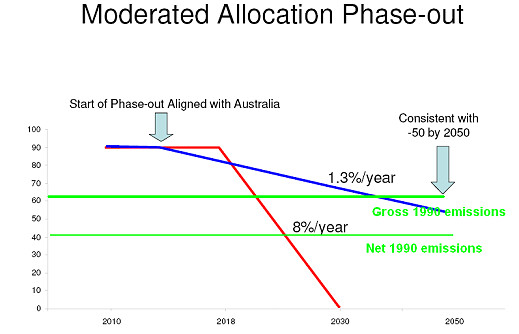
Correction: I had assumed that the y-axis on the graph - helpfully unlabelled - was millions of tons of CO2. But as pointed out on Hot Topic, it is more likely to be percentage of 2005 emissions. So, it doesn't show what I think it does; mea culpa, mea culpa, mea maxima culpa.

Back in 2007, National set a 50% by 2050 emissions reduction target:

National Party Leader John Key says his party will set a target of a 50% reduction in carbon equivalent net emissions, as compared to 1990 levels, by 2050. In shorthand: A 50% cut by 2050. 50 by 50.
But their announcement on the ETS today suggests they have backed away from that target. Check out the graph on page 4 of the summary of ETS changes, which proudly states their phase out is "consistent with -50 by 2050". To help, I've added lines for gross and net 1990 emissions:

CCbaselineshift

Some "consistency". National now seems to be aiming for a 2050 target which is higher than our net 1990 emissions - a target manifestly inadequate compared to the 80% - 95% reduction by developed nations recommended by the IPCC.

Climate change: Subsidised pollution

The government has announced its preferred amendments to the ETS. The most important ones:

  • Revised entry dates of 1 July 2010 for transport, energy and industrial sectors and 1 January 2015 for agriculture
  • A transitional phase until 1 January 2013 with a 50% obligation and $25 fixed price option for the transport, energy and industrial sectors
  • A production-based industry average approach to allocations for trade exposed, emissions intensive businesses
Together these amount to massive subsidies from the taxpayer for pollution. The cap is bad enough - it is only marginally above present Treasury estimates, and will likely kick in if there is any increase in price or unfavourable shift in exchange rates. But the 50% obligation is worse. Those sectors were responsible for 38.3 million tons of emissions in 2006, and you and I will be picking up the tab for 19.15 million tons of that. At current carbon prices, that amounts to a subsidy of $428.2 million every year, straight into the pockets of polluters' (mostly foreign) shareholders. It will also mean that emitters do not face the full marginal cost of emissions - meaning a much lower incentive to reduce pollution, while the production-based allocation for industrial polluters means allowing emissions to increase without limit.

From the press release, it seems the Maori party will be supporting this. Given that just a week ago they were saying that agriculture entering the ETS in 2011 was "a bottom line", and they've now agreed to it being delayed until 2015, they seem to have shifted rather a lot. I guess their environmental rhetoric and tough stance in their minority report was simply hot air.

After Charles Chauvel's speech, I cannot imagine Labour supporting these proposals. Which means the door is open to toughening the scheme in the result of any change of government. Polluters expecting to profit from National's subsidies may want to take that into account in their investment decisions.

Drinking Liberally Auckland

Drinking Liberally is on again in Auckland this Wednesday, with guest speaker Lewis Holden of the Republican Movement of Aotearoa New Zealand speaking about their new book, The New Zealand Republic Handbook.

When: 19:00, Wednesday, 16 September
Where: Galatos, 17 Galatos St, Newton, Auckland

[Hat-tip: New Zealand Republic]

Tonga: Acquitted

The Tongan Court of Appeal has acquitted five People's Representatives of sedition on the grounds of insufficient evidence. Akilisi Pohiva, Isileli Pulu, ‘Uliti Uata, Lepolo Taunisila and Clive Edwards all faced multiple charges of seditious conspiracy and speaking seditious words over speeches given in the leadup to the 2006 riots. In the three years since, charges have been added and dropped, while a trial has been repeatedly delayed. But the Court of Appeal found that the government had failed to make even a prima facie case that violence was planned or intended, and struck out all charges against four of the accused. Charges of seditious conspiracy against Edwards were also dismissed, leaving him facing only a single charge of "speaking seditious words". That charge will now finally be able to go to a jury - though the odds there are good. Every sedition case over the riots which has come to trial has so far resulted in acquittal - it seems the people of Tonga know political persecution when they see it.

The full judgement is here [PDF].

Greed

As we all know, we are in the midst of the worst recession since the 1930's. Times are tough. Unemployment is growing, pay is being frozen, corporate profits are down. So naturally, the UK's bank executives, the people whose greed helped cause all this, have helped themselves to an average 10% pay rise.

I guess the recession only applies to little people.

Bad politics

In addition to being ill-thought out and seemingly purpose-designed to break the electoral system, Labour's proposals to "improve" MMP by making it less proportional are just bad politics. The referendum was a gift to them: a chance to engage in principled and popular opposition to an attempt by the government to undermine our democracy. And they've squandered that gift, in the process alienating both core activists and potential swing voters. Not to mention giving National more space to push for their less democratic alternative. Way to go, guys.

But I forget: Labour is a large party, which never really liked MMP in the first place. And clearly they haven't changed.

Labour plots to break the electoral system

So, the really big news to come out of this weekend's Labour conference is that they want to break the electoral system. Yesterday we had Chris Hipkins floating the idea of "improving" MMP by making it less proportional. Then this morning on Q&A we had Phil Goff saying

we’ve had at this conference quite an interesting discussion about that and the members I’ve talked to have said look we’d like to see fewer list MP’s and more Electorate MP’s. We’d like to see electorates a little bit smaller so that electorate members can give a bit more personal attention to their constituents. Our people tell me that we can do that, we could have as many as 80 electorate MP’s with the balance of 40 being list MPs.
This is grandly described by Lianne Dalziel as "Smaller Electorates, fewer List MPs, while retaining proportionality". But these things are simply incompatible. As I pointed out yesterday (and Andrew Geddis points out again here) fewer list seats means less proportionality, as it significantly increases the chance of a major party overhang. How likely is this? Well, under Labour's 80-40 proposal, assuming a proportionate increase in electorate seats won, we would have been very close to an overhang in 1999 and 2002, with Labour being ineligible for any list seats. And given that the number of electorates (but not the total number of seats) rises with the population, it would not take long before it actually happened.

Overhangs are undesirable, whether they happen for large parties or small parties. They are the price we pay for electorates - but we should try and keep them to a minimum. Labour seems to disagree with that - or simply hasn't thought about it very hard.

But there's a bigger problem with Labour's proposal, and its this: what happens if minor parties - who generally don't win electorate seats - win more than 33% of the vote? What happens if they're entitled to more than 40 seats? It's not beyond the bounds of possibility - see 1996 (where they won 39 seats on 30.4% of the vote, with 7.5% "wasted") and 2002 (where they won 41 seats on 32.9% of the vote with 4.9% "wasted") - and it could quite easily happen again. Under Labour's proposal, its just tough shit - "sorry, our democracy doesn't cater for the actual will of the people" we get regular and increasingly large overhangs leading to an ever-more disproportionate Parliament, a completely unacceptable result. And with built-in growth in the number of electorates, the critical percentage at which our electoral system simply breaks down will get lower with every census.

Basically, MMP needs a reasonable balance between electorates and list seats to function properly. Upset that balance, and it quickly turns back into FPP in disguise. Labour's proposals seem purpose-designed to produce that outcome. They are unprincipled, unproportional, undemocratic, and ultimately unacceptable.

Correction: D'oh! It's not tough shit - we get regular big overhangs instead. Still not good news, but not quite as bad as I feared.

Sunday, September 13, 2009


Ils sont fous ces Americans

In Washington yesterday, 15,000 people marched against government healthcare, bearing placards screaming about communism and depicting Obama as Hitler (plus a little bonus racism on the side). Because if the government runs the health system, it might be as expensive and inefficient as the NHS (or indeed the New Zealand public healthcare system), with bureaucrats making treatment decisions, rather than offering people the cheapness, efficiency and choice of their current system of insurance and HMOs (that was irony, for people who know nothing about the horror of the US system).

These Americans really are crazy.

New Fisk

Not even a civil war could stop the old bookbinder of Beirut

Saturday, September 12, 2009


Some "improvement"

Chris Hipkins posts on a discussion at the Labour conference on "improving MMP". Among the suggested "improvements" were:

  • increasing the number of electorates and decreasing the number of list MPs
  • making the party vote threshold apply without exception, which would mean that a party that wins an electorate seat but does not cross the threshold would not get extra list MPs

Neither of these is any sort of improvement.

The first - as noted here in my submission on the 100 MP bill - would undermine proportionality, producing regular large overhangs in favour of the major parties. That was in the context of a smaller house, but any shift in the proportions which results in "too many" electorate seats has the same effect. Because the number of electorates grows with the population (or rather, the difference in population growth between the North and South Islands), MMP actually commits us to regular readjustments to rebalance the system - either by shrinking the number of electorates back down to 60 (constitutionally difficult to do, as it requires a referendum - not to mention creating serious problems with the sizes of South Island electorates) , or by increasing the overall size of Parliament by increasing the number of list seats (something we had no problem with in the FPP days, but which is likely to be unpopular due to the perceived lower legitimacy of list seats). Reducing the number of list seats also encourages the public to see them as less legitimate - which has been one of the problems with our MMP debate from the start.

As for the second option, I will simply say that the solution to unfairness is not greater unfairness. If party A gets representation while party B - which won more votes - does not, then the solution is to give party B representation, not to deny it to both.

If Labour wants to defend democracy, it should do exactly that. If it wants to improve MMP, it should push in the principled direction of lowering the threshold. That both connects well with their core values, and gives them a principled platform on which to oppose National's attempts to gerrymander the electoral system to their advantage. Their current response robs them of that opportunity, and simply makes them look unprincipled, self-interested, and hypocritical. And that's not a party I could vote for in 2011.

Friday, September 11, 2009


Making cheese is not an "essential service"

The Standard highlights the upcoming stoush in the dairy industry, where Open Country Cheese (owned by a toxic combination of National MPs and the anti-union Talley brothers) are trying to casualise their labour force and eliminate the Dairy Workers Union by issuing a six-week lockout notice. This will of course be lifted for any employee who quits the union, making it a prima facie case of using undue influence to violate workers' freedom of association. In the process, they highlight an unusual fact: the dairy industry - or specifically "the production of butter or cheese or of any other product of milk or cream and the processing, distribution, or sale of milk, cream, butter, or cheese or of any other product of milk or cream" - is classed as an essential service under employment law, meaning that strikes and lockouts are restricted. That's right - protecting farmers' profits is considered to be as important as hospitals, ambulances, and fire brigades.

This strikes me as something Labour should do something about (in fact, going through the list, there are a few others as well: port services, interisland ferries and airlines seem to be at odds with the "health and safety" focus of the rest of the list, as does the protection for the meat industry in part B of the schedule). So, I've drafted a little bill to fix it. Any takers?


