Showing posts with label Amy Adams. Show all posts

Friday, June 22, 2018


The IGIS advisory panel mess

Back in April, Stuff published the news that our spies had been without proper oversight for over a year, due to the failure of the previous government to appoint members to the Inspector General of Intelligence and security's statutory advisory panel. At the time, I blamed the previous government, saying that they simply couldn't be fucked appointing anyone to it. I also blamed DPMC for dropping the ball, assuming that they didn't follow up the appointments process they began in February 2017. Documents I've received via the OIA today have shown both my conclusions to be unfair and wrong. There's plenty of blame to go around, but the failure to appoint anyone wasn't for lack of effort by either former Prime Minister Bill English or DPMC.

The full documents are here. They show:

  • DPMC ran a straight appointments process in 2017, came up with a shortlist and two nominees (one of whom English "had reservations" about). These were duly discussed by the Intelligence and security Committee in May, and only one of them was approved.
  • In June, senior DPMC staff consulted the Inspector-General about alternative candidates and shoulder-tapped two alternatives. English offered both of them to the Intelligence and Security Committee and invited them to pick one. Both were rejected (though it is unclear if this was a formal or informal rejection). National MP Amy Adams is specifically identified as vetoing one candidate.
  • Despite this, DPMC tried to get the (previously approved) panel chair appointed in the last cabinet meeting before the election, noting both the urgency of the appointment and that the candidate had been approved by both opposition members of the ISC. Cabinet rejected them, with the result that the panel remained vacant.
  • The rejection of multiple candidates by National Ministers presents problems for future appointments, as noted by DPMC in November 2017:
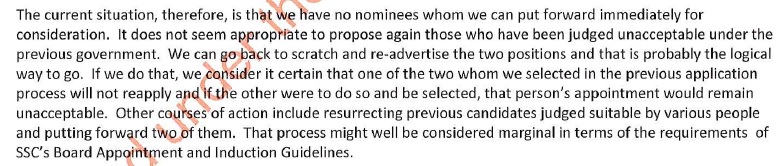
    IGIS Panel Email Nov2017
So, it wasn't Bill English's fault. But Amy Adams certainly bears some of the blame here. Meanwhile, its now been 20 months, and this panel is still vacant. I wonder if it will ever be filled? Update: A replacement panel was finally appointed a month ago. Somehow in my googling I'd managed to miss that.

Tuesday, November 14, 2017


Opening the floodgates

One of Labour's first decisions in government was to respect the ruling of the High Court and inflation adjust Teina Pora's compensation payment for the more than twenty years of wrongful imprisonment he suffered. Now, National's "justice" spokesperson Amy Adams is warning that this move will "open the floodgates":

National's justice spokeswoman Amy Adams is warning the Government may have opened up a can of worms in awarding Teina Pora almost an extra $1 million for his two decades of wrongful imprisonment.

[...]

How the new calculation for Pora's settlement will affect "everyone else who has had compensation that wasn't inflation adjusted" remains to be seen, Adams said.

"The way the decision is written, it now throws in to question every sort of payment of any sort the Government might make that isn't specifically provided to be inflation-adjusted."

"There will be others now looking at whether they should be inflation-adjusted."


And so they should. Because the High Court has effectively ruled that National's penny-pinching policy of screwing over people shown to be innocent was wrong. And that means the current government may have to clean up National's mess. But the proper response to that is to clean the fucking mess up, not stick your fingers in your ears and deny that you ever did anything wrong.

So, let the "floodgates" open. The worst that will happen is that we'll have to treat people fairly, like we should have done in the first place. And only an arsehole from a party of arseholes which grubs for votes from other arseholes would see any problem with that.

Wednesday, May 27, 2015


Environmental Reporting Bill: Our fears are realised

Back in March, Statistics New Zealand announced their Ministerially-approved national environmental reporting topics for their 2015 Synthesis Report - basicly, a prototype for reporting under the yet-to-be-passed Environmental Reporting Bill. They were dismal, a political hatchet-job which ignored key drivers and impacts while obfuscating the causes of our environmental problems. And it wasn't just climate change: the other domains, air, land, freshwater and the marine environment all received similar treatment.

Statistics New Zealand made a lot of noise about the robust and independent method they used to develop the topics. So how did this happen? Because Ministers micromanaged the whole process and systematicly watered down the robust topic list developed by the Technical Advisory Groups. The dismal tale is told in a series of release from the Minister for the Environment, Ministry for the Environment (part 1, part 2), Statistics New Zealand, and (most illuminatingly) the Minister of Statistics. Some highlights:

  • From the beginning, Ministers pushed for highly detailed and prescriptive topics - "global greenhouse gas emissions" rather than "climate change", "economic production by primary industries" rather than "economic impacts of climate change". This caused consternation in Statistics New Zealand, with an email from MfE noting that "Stats are very keen to avoid any ultimatums being put to Ministers but clearly feel their independence is being compromised by the specificity of the topics areas". Eventually the Government Statistician issued a (heavily redacted) briefing note which appears to have basically read Ministers the Riot Act. Amy Adams did not agree, and there are a large number of highly specific topics in the final list. By saying "you will report on this in this way", they have prevented Statistics New Zealand from using more illuminating statistics.

  • Ministers also repeatedly watered down reporting on impacts on Maori, successively rejecting topics on wahi tapu and customary use in favour of a vague "cultural significance of the [X] environment to Maori" - which was then left out of the final report. This is pitched as due to Amy Adams seeing it as "a ‘nice-to-have’ and not ‘must include’", but earlier comments make her real reason clear: she wanted to avoid "unintentionally committing the Government to report on Treaty of Waitangi issues as part of the Environmental Reporting Bill". Unstated: because doing so might give rise to Treaty claims.

  • As an example of the suspicion Ministers regard the reporting with, they wanted to micromanage final peer review: "Ministers would like to be consulted on who peer reviews the synthesis report to ensure 'extreme ideas' don't find there way into the report."

  • The final topic list was signed off on September 1, 2014 - after which there was an election, a cabinet reshuffle, and a new Minister for the Environment. Who immediately wanted to interfere:
    Minister Smith expressed concern with some topics for the 2015 Environmental Synthesis Report, and requested time to consider them. He is concerned that officials may go wide of the mark and infer value judgements because of the measures selected. He is happy with draft ERB legislation with respect to Ministers setting topics, but wants to consider it further.

    Overall, Minister Smith was more comfortable with state topics than pressure or impact topics. He expressed doubt that officials could measure some of the latter topics rigorously; for example, Maori measures. He did note he wants to use international best practice, however.

    Unfortunately, information on exactly what effect Nick Smith had on the synthesis report was not part of the release. But given how it appears to have been watered down even further in exactly the way he suggested, he may have had some influence.
Supposedly, if the Environmental Reporting Bill is eventually passed, there will be a round of public consultation before the final topics are set by regulation. But looking at the process so far, I don't think we can have any confidence in that process. The big risk with the bill as it stands is that the Minister can choose the topics to suit themselves, steering reporting away from areas of key environmental concern. And judging by the behaviour of the Ministers involved, that concern is fully justified. As long as Ministers can set the topics, their environmental report is a joke with no credibility.

Thursday, February 19, 2015


Here we go again

So, after a review, a secret one-sided "peer review" of the review, a judicial review and a secret settlement deal, we're now back to square one on David Bain's bid for compensation, with another review:

Cabinet will go back to square one on the David Bain compensation case and has commissioned a fresh inquiry.

A 2012 report by former Canadian Supreme Court judge Justice Ian Binnie, which found Bain was innocent on the balance of probabilities, was rejected by ex-Justice Minister Judith Collins, sparking court action by Bain's legal team.

Collins' successor Amy Adams said Cabinet does not have the information to "reasonably" make a decision.

She has asked for the new report and says it is important "the final decision on Mr Bain's claim is durable and withstands the close scrutiny the case attracts."


Hopefully it will be better managed than the last clusterfuck. But with Collins out of the picture, that's probably guaranteed. I doubt Adams will be dumb enough to leak inquiry material to a sewerblogger while she's meant to be considering it, for example...

But the fundamental problem still remains: while Bain was imprisoned for a prolonged period before being eventually acquitted, whether he receives compensation will ultimately be decided by a bunch of politicians, who, like Collins, will be driven by vote-grubbing rather than justice. And that is not a recipe for a just outcome. We would be far better replacing our current ad-hoc scheme with a statutory one, to provide compensation for all victims of miscarriages of justice, rather than just those who the government thinks are white enough and sympathetic enough to get them votes.

Tuesday, March 18, 2014


A clear conflict of interest

Last week, I joined with other bloggers in highlighting Environment Minister Amy Adams' apparent conflict of interest over decisions she made about ECan. Adams has come out swinging, calling the excavation of her actions a "smear campaign" and even threatening defamation proceedings against a Taranaki Daily News columnist who had brought the story into the public media. Meanwhile, Rob Salmond has just highlighted the smoking gun: a 2012 Cabinet Paper on the renwal of ECan's dictatorship:

"Over several years a number of problems with ECan’s performance emerged… Key priorities of regional and national importance, such as the effective management of Canterbury’s valuable freshwater resources, were not progressed. (para 12)

"Irrigation is predicted to significantly contribute to the growth of the New Zealand economy, with Canterbury being a key contributor. The value of production in Canterbury is predicted to increase from $1,000 [per] ha to $7,000 [per] ha with the irrigation acceleration initiatives underway." (para 13)

"...there is a significant risk that the progress that has been made since the Commissioners’ appointment will stall, or at worst, be reversed at the expiry of their term with the local authority election in 2013." (para 15)

[...]

"The Act currently removes appeal rights to the Environment Court in relation to decisions made by ECan, but provides a right of appeal to the High Court on points of law. We propose to continue this limitation to decisions that are made on RMA plans and policy statements that relate to freshwater management (including those instruments containing related land use or discharge provisions). This is to ensure that the CWMS [Canterbury Water Management Strategy] is given appropriate priority and to enable broader freshwater related plans and policies to be progressed in a timely manner. This is consistent with the significance of freshwater management as reflected in other government policies including the Irrigation Acceleration Fund and Business Growth Agenda." (para 41)

Amy Adams was one of the two people who brought that paper to Cabinet (the other was then-Local Government Minister David Carter). So we have a person who owns a stake in an irrigation company (and a farm whose value will be significantly improved by irrigation) directly promoting governance arrangements designed to help the business she has shares in. As Rob points out, Adams "could reasonably be perceived as standing to gain or lose financially from decisions or acts for which [she] is responsible", meeting the Cabinet Manual test for a pecuniary conflict of interest (though he sloppily over-eggs it by failing to follow the paper trail on what Cabinet actually decided). Adams should have declared that conflict and recused herself from all decision-making on the subject. She didn't. Whether this was ethical behaviour is left as an exercise for the reader.

Wednesday, March 12, 2014


Some answers from Amy Adams

Amy Adams' press secretary has popped up on The Standard to give some answers. Adams has indeed declared a conflict of interest with regards to Central Plains Water, and transferred decisions relating to it to Gerry Brownlee:

Accordingly, to avoid any actual or perceived conflicts of interest, Minister Adams has transferred her responsibilities as Environment Minister to Minister Brownlee. This was done after she became Environment Minister in April 2012... Environment officials report directly to Minister Brownlee on matters concerning the Central Plains Water scheme.

I understand there has only been one Cabinet decision made regarding the Central Plains Water Scheme. On this occasion, Minister Brownlee took the paper to the relevant Cabinet committee. When this issue was discussed, Minister Adams excused herself from the Cabinet committee where it was discussed, and took no part in the discussions.


The decision in question was the one to amend the Rakaia River Water Conservation Order, allowing the river to be pillaged for irrigation.

So, while she has behaved ethically in the specific case, it doesn't answer the wider questions about the ECan dictatorship and its relaxed water management regime.

Amy Adams owes us some answers

Over at Rebuilding Christchurch, James Dann has done some digging into Environment Minister Amy Adams and the ECan dictatorship. Adams owns several farms, worth millions of dollars. Those farms are in the irrigation area of Central Plains Water (a company Adams' farm owns shares in), meaning they are likely to increase substantially in value. As a backbench MP, Adams voted to overturn Canterbury's elected regional council and replace it with unelected dictators - a move subsequently revealed to have been all about giving water rights to companies like CPW, and for the 2011 Budget which assigned $400 million to an Irrigation Acceleration Fund intended to fund such companies. And as a Minister, she fronted Cabinet's decision to extend the ECan dictatorship - a decision which will make it easier for CPW to gain the water and funding it needs. Which seems to be a fairly significant conflict of interest. As Dann says,

The Central Plains Water scheme would not have been viable if the National government had not passed the ECan bill in 2010. The value of land with access to water for irrigation is greater than land which does not. Adams owns a large amount of land which is within the CPW water scheme, and also owns shares in the scheme itself. It is difficult not to conclude that the actions of this government, including Adams and Carter, have benefitted their farming portfolios.
The Cabinet Manual agrees that this would be a conflict of interest:
Pecuniary interests are financial interests such as assets, debts, and gifts. A pecuniary conflict of interest may arise if a Minister could reasonably be perceived as standing to gain or lose financially from decisions or acts for which he or she is responsible, or from information to which he or she has access. A pecuniary conflict of interest could, for example, relate to the value of land or shares that a Minister owns, or the turnover of a business in which a Minister has an ownership interest.
[Emphasis added]

I think its clear that Adams could reasonably be perceived as standing to gain from broad decisions around ECan and irrigation in Canterbry. So did she declare those conflicts? Not as an MP - she spoke on the Canterbury dictatorship bill, but made no declaration (though her farm - but not its shareholding in CPW - was listed in the Register of Pecuniary Interests). As for the Ministerial decisions, she became a Minister in December 2011, and declared a number of conflicts [p. 7], including a pecuniary interest in "potential decisions in respect of a particular company" (responsibility for which was transferred to Bill English, then Gerry Brownlee), and a personal interest in "potential decisions as Minister for the Environment in respect of a particular company" (responsibility for which was transferred to David Carter). Unfortunately the Cabinet Office won't say what those companies are (or even whether its one company or two), but we can guess that one was her farm, and one may have been CPW. The question is how broadly those declarations were interpreted, both by the Cabinet Office and by Adams. Did Adams behave ethically, and recuse herself from discussion about extending the Canterbury dictatorship, a governance regime which protects and increases the value of her investments? I think she owes us some answers on that.

Update: See also this post on Adams' answers so far.